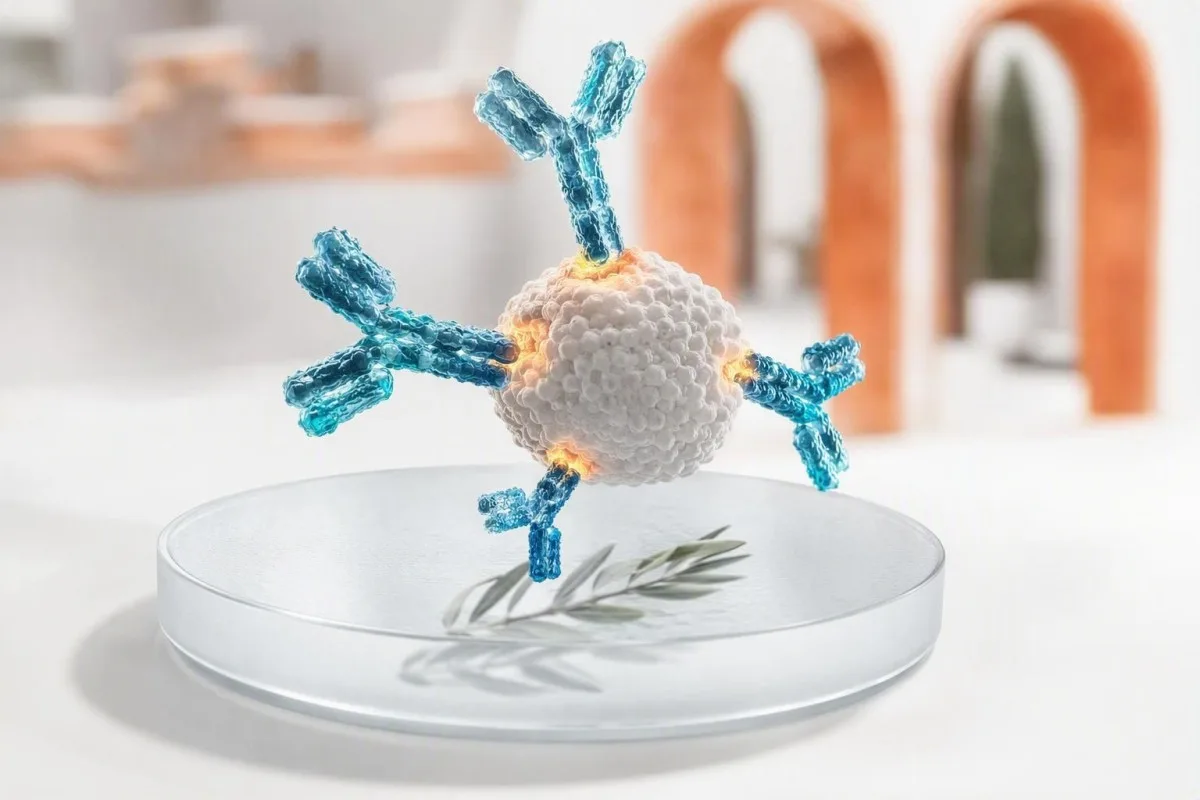
'n Positiewe antiliggaamresultaat beteken jou immuunstelsel het 'n spesifieke teiken herken; dit bewys op sigself nie 'n aktiewe infeksie of 'n siekte nie. Die antiliggaamklas, toetsmetode, tydsberekening, simptome en gepaardgaande toetse bepaal of jy gerusstelling, 'n herhaalde toets, bevestiging of vinnige kliniese sorg benodig.


- Positiewe antiliggaamresultaat toon gewoonlik immuunerkenning, nie noodwendig huidige siekte of aansteeklikheid nie.
- IgM teenoor IgG is 'n tydsberekeningskluis, nie 'n horlosie nie: IgM kan maande lank voortduur en IgG kan vroeg verskyn.
- Entstof-antiliggame kan immuniteitstoetse positief maak sonder om natuurlike infeksie aan te dui.
- Allergeen-spesifieke IgE bo 0.35 kUA/L dui sensitisasie aan, maar simptome na blootstelling vestig kliniese allergie.
- ANA positiwiteit kom voor in tot 20% van gesonde volwassenes teen lae titers, veral met ouderdom; simptome en spesifieke teenliggaampies is belangriker.
- HIV-sifting reaktiwiteit vereis altyd die laboratoriumbevestigingsalgoritme voordat enige diagnose gemaak word.
- Anti-tTG IgA is slegs betroubaar vir 'n koliakiese beoordeling wanneer die persoon gluten eet en voldoende totale IgA het.
- Dringende simptome soos asemhalingsprobleme, verwarring, geelsug, borspyn of 'n wydverspreide blaasuitslag weeg swaarder as 'n roetine-teenliggaamuitslag.
Wat 'n positiewe antiliggaamresultaat eintlik vir jou sê
A positiewe teenliggaamtoets beteken die toets het immuunproteïene opgespoor wat 'n spesifieke teiken bind; dit doen nie beteken nie outomaties dat jy 'n aktiewe infeksie, 'n outo-immuun siekte, of 'n allergie het wat behandeling benodig nie. Die volgende stap hang af van die tipe teenliggaam, die sterkte van die resultaat, simptome, blootstellingstydsberekening en enige gepaardgaande antigeen-, PCR- of orgaanfunksietoetse.
Teenliggaampies is B-selproteïene wat gemaak word na entstof, infeksie, allergie blootstelling, outo-immuniteit, of soms om geen klinies skadelike rede nie. “n Positiewe resultaat beantwoord een eng analitiese vraag—”is binding bo hierdie laboratoriumafsnit opgespoor?”—in plaas van die breër kliniese vraag van wat vandag in jou liggaam aangaan.
In my 15 jaar van kliniese praktyk, was die mees algemene fout om “positief” as 'n diagnose te lees. Dr Thomas Klein se praktiese reël is om eers die teiken—'n virus, entstofantigeen, voedselproteïen, tiroïedensiem, kernantigeen of geneesmiddel—dan vra of die toets vorige blootstelling, huidige organisme, sensitisering, of immuun wanrigting opspoor.
Kantesti AI is ’n KI-bloedtoetsontleder wat teenliggaamvlae langs datums, immunoglobulinklas en verwante resultate lees eerder as om 'n enkele positiewe lyn as 'n uitspraak te behandel. Daardie konteks is veral nuttig wanneer pasiënte verslae van verskillende laboratoriums vergelyk; kwalitatiewe en kwantitatiewe resultate is nie uitruilbaar selfs wanneer albei positief sê nie.
IgG teenoor IgM positief: waarom tydsberekening minder eenvoudig is as wat dit klink
IgM positief kan 'n onlangse immuunrespons voorstel, terwyl IgG positief dikwels vroeëre blootstelling of entstofrespons voorstel; geen patroon dateer 'n siekte op sy eie betroubaar nie. Sommige infeksies produseer IgG binne 7–14 dae, en IgM kan vir 3–12 maande of langer opspoorbaar bly.
IgM is 'n groot vyf-eenheid teenliggaam wat dikwels vroeg opspoorbaar is, maar sy grootte en breë binding maak dit meer geneig tot kruisreaksies. Epstein–Barr virus, parvovirus B19, rumatoïede faktor en sommige outo-immuun teenliggaampies kan misleidende IgM-reaksies veroorsaak; 'n geïsoleerde lae vlak IgM-resultaat verdien meer skeptisisme as paniek.
IgG bly gewoonlik voortleef nadat immuun geheue ontwikkel het, soms vir dekades. 'n Positiewe IgG-resultaat kan kinderjare-infeksie, 'n onlangse entstof, passiewe teenliggaam van binneaarse immunoglobulien, of moederlike oordrag na 'n baba weerspieël; dit kan nie beskerming bewys nie tensy daardie spesifieke toets 'n gevalideerde beskermende drempel het.
Gepareerde spesimens kan meer nuttig wees as 'n enkele trek: 'n viervoudige styging in teenliggaam titer tussen monsters wat ongeveer 2–4 weke uitmekaar geneem is, ondersteun onlangse infeksie in geselekteerde siektes. Indien die verslag totale IgG, IgA en IgM lys, beoordeel die patroon eerder as een nommer met ons immunoglobulien interpretasiegids.
Wanneer infeksie-antiliggame aktiewe siekte wel en nie beteken nie
Teenliggame teen infeksie toon gewoonlik blootstelling, terwyl PCR, antigeentoetsing, kultuur, of 'n stygende titer beter hulpmiddels is om baie aktiewe infeksies op te spoor. 'n Positiewe antiliggaamresultaat sonder simptome is dikwels histories, maar die uitsondering hang af van die organisme en jou immuunstelselstatus.
Vir hepatitis C beteken 'n reaktiewe antiliggaam blootstelling op 'n sekere punt, maar slegs detekteerbare HCV RNA vestig huidige viremie. Vir hepatitis B maak die kombinasie saak: oppervlaksantigeen, oppervlaksantiliggaam en kernantiliggaam onderskei aktiewe infeksie, opgeloste infeksie en entstofimmunititeit baie beter as een positiewe merker.
MIV is nog 'n situasie waar bewoording enorm saak maak. 'n Reaktiewe vierde-generasie-sifting is nie 'n diagnose nie; die laboratorium volg op met 'n MIV-1/MIV-2 differensiasie-immunoanaliseerder en, indien nodig, nukleïensuurtoetsing. 'n Persoon wat post-blootstelling profilakse neem, benodig tyd-spesifieke toetsing, soos verduidelik in ons MIV-toetsgids na PEP.
Ek het 'n welgestelde pasiënt gesien wat bang was vir 'n positiewe treponemale sifilis antiliggaam na behandeling 18 jaar vroeër. Treponemale toetse bly algemeen positief vir die lewe, terwyl 'n RPR of VDRL-titer help om huidige aktiwiteit en reaksie te bepaal; sifilistestpatrone maak hierdie onderskeid duideliker.
Hoe entstof-antiliggame verskil van antiliggame na infeksie
Entstofverwante antiliggame toon dat die immuunstelsel op 'n entstofantigeen gereageer het; hulle beteken nie dat die entstof 'n aktiewe infeksie veroorsaak het nie. 'n Positiewe resultaat kan steeds onder 'n bekende beskermende korrelaat val, omdat bindende antiliggame en funksionele neutraliserende antiliggame nie identies is nie.
Hepatitis B-oppervlaksantiliggaamkonsentrasies van 10 mIU/mL of hoër gemeet 1–2 maande na 'n gedokumenteerde entstofreeks word oor die algemeen as beskermend by immuunkompetente mense beskou. Anti-HBc, die hepatitis B-kernantiliggaam, word nie deur standaard hepatitis B-inenting geproduseer nie; die teenwoordigheid daarvan dui op natuurlike blootstelling en moet lei tot volledige paneelinterpretasie.
Rubella IgG word algemeen voor swangerskap nagegaan omdat dit voorheen gevestigde immuniteit aandui, nie 'n aktiewe rubella-siekte nie. Laboratoriums stel assay-spesifieke drempels vas, en grense word gewoonlik as nie-immuniteit vir prekonsepsiebeplanning hanteer eerder as onlangse infeksie geïnterpreteer; tydsberekening word breedvoerig beskryf in ons rubellatoetsgids.
Kantesti AI is ’n AI bloedtoets interpretasie platform wat entstofpatroon-antiliggame van infeksiepatroon-antiliggame skei wanneer die verslag die relevante metgeselmerkers insluit. Die praktiese vraag is dikwels nie “is ek positief nie?” maar “watter antigeen is gemeet, wanneer is ek ingeënt, en verander hierdie resultaat vandag se beskermingsplan?”
Waarom 'n positiewe allergie-antiliggaamtoets dalk nie allergie beteken nie
'n Positiewe allergeenspesifieke IgE toets dui sensitisasie aan, wat beteken dat IgE 'n allergeen herken; dit diagnoseer nie kliniese allergie sonder 'n versoenbare reaksiegeskiedenis nie. 'n Waarde bo 0.35 kUA/L is 'n algemene analitiese positiviteitsdrempel, nie 'n universele drempel vir die vermyding van 'n voedsel of medikasie nie.
Die vooraf-toetsverhaal maak meer saak as wat baie mense besef. As 'n persoon weekliks grondboontjies eet sonder korwe, hyg, braking of ineenstorting, moet 'n lae positiewe grondboontjie-IgE alleen nie tot vermyding lei nie; onnodige voedselbeperking kan voedingkundige en sosiale skade veroorsaak.
Die NIAID-geborgde riglyne vir voedselallergie bepaal dat vel-prik en spesifieke IgE-toetse moontlike snellervoedsel identifiseer, maar nie onafhanklik voedselallergie kan diagnoseer nie (Sampson et al., 2010). In geselekteerde gevalle gebruik 'n allergis komponent-opgeloste toetsing of 'n medies-begeleide orale voedseluitdaging, wat die verwysingstandaard bly vir die oplossing van onsekerheid.
Totale IgE word gemeet in IU/mL en kan hoog wees by ekseem, parasitiese blootstelling, rook en verskeie immuunstoornisse; dit kan nie 'n skuldige allergeen identifiseer nie. Komponenttoetsing kan 'n stabiele stoorproteïen onderskei van 'n kruisreaktiewe stuifmeel-verwante proteïen, 'n verskil wat in ons molekulêre allergie toetsartikel.
Waarom outo-immuun-antiliggame simptome en orgaanleidrade vereis
Outo-immuun teenliggame kan siekte voorafgaan, siekte vergesel, of by gesonde mense voorkom; 'n positiewe resultaat alleen vestig selde 'n outo-immuun diagnose. Klinici tree op wanneer die teenliggaam patroon ooreenstem met simptome, ondersoekbevindinge, inflammasie merkers of objektiewe orgaansveranderinge.
'n Antinukleêre teenliggaam, of ANA, is positief teen lae titters in ongeveer 13% van mense by 1:80 en rondom 20% by 1:40 in bevolking studies, met hoër koerse by vroue en ouer volwassenes. 'n Homogene of gespikkelde patroon diagnoseer nie lupus nie; ANA word die beste gebruik as 'n poorttoets wanneer die kliniese prentjie bindweefselsiekte waarskynlik maak.
Die 2019 EULAR/ACR lupus klassifikasie raamwerk gebruik ANA teen 'n titter van ten minste 1:80 as 'n ingangskriterium, dan vereis addisionele geweegde kliniese en immunologiese kenmerke (Aringer et al., 2019). Nuwe proteïen in urine, lae C3/C4, sitopenias, inflammatoriese gewrig swelling of 'n oortuigende fotosensitiewe uitslag verander die dringendheid baie meer as 'n swak ANA alleen.
Anti-dsDNA word meer betekenisvol wanneer dit saam met lae komplement en nier bevindinge gepaar word, hoewel toetsmetodes aansienlik verskil. Ons anti-dsDNA opvolggids en komplement toets oorsig verduidelik waarom 'n spesialis toetsing op 'n ander platform mag herhaal.
Orgaan-spesifieke antiliggame: tiroïed, coeliakie en maag voorbeelde
Orgaan-spesifieke teenliggame identifiseer immuun teiken van 'n weefsel, maar hulle wys nie altyd of die orgaan tans beskadig is of behandeling benodig nie. Skildklierperoksidase teenliggame, weefsel transglutaminase teenliggame en intrinsieke-faktor teenliggame vereis elkeen verskillende metgesel toetse.
TPO teenliggame is algemeen in Hashimoto tiroïeditis en kan vir jare teenwoordig wees terwyl TSH en vry T4 normaal bly. By 'n nie-swanger volwassene met normale skildklierfunksie, ondersteun die resultaat gewoonlik periodieke TSH monitering eerder as skildklier hormoon behandeling; swangerskap, vrugbaarheid planne en simptome kan daardie benadering verander.
’n Positiewe tTG-IgA stel coeliakie siekte voor slegs indien die persoon nog gluten inneem en totale IgA toereikend is. Selektiewe IgA tekort kan tTG-IgA vals negatief maak, dus gebruik klinici IgG-gebaseerde gedeamideerde gliadin peptied of tTG toetse wanneer totale IgA laag is; sien ons verduideliking van lae IgA slaggate.
Intrinsieke-faktor teenliggaam is relatief spesifiek maar nie hoogs sensitief vir pernisieuse anemie nie. Wanneer dit positief is tesame met lae B12, verhoogde metielmalonzuur en makrositose, is die patroon oortuigend; sonder daardie patroon, vermy ek die behandeling van 'n laboratorium etiket eerder as die pasiënt. Pernisieuse anemie toetsing toon die gewone bevestiging reeks.
Wat veroorsaak 'n vals-positiewe antiliggaamresultaat
Vals-positiewe teenliggaam resultate ontstaan wanneer die toets onbedoelde binding opspoor, nie wanneer die laboratorium eenvoudig “dit verkeerd kry.” Kruis-reaktiewe teenliggame, rumatoïede faktor, onlangse immuun stimulasie, passiewe immunoglobulien en lae voor-toets waarskynlikheid is algemene redes.
Spesifisiteit is nie perfeksie nie. 'n Toets met 99% spesifisiteit produseer ongeveer 10 vals-positiewe resultate vir elke 1,000 werklik negatiewe mense wat getoets word; wanneer die toestand skaars is, kan daardie resultate ware positiewes oortref. Dit is hoekom breë siftings in iemand sonder simptome dikwels twyfel skep eerder as gerusstelling.
Biotien is beroemd daarvoor dat dit met sommige hormoon en kardiale toetse inmeng, terwyl heterofiele teenliggame en rumatoïede faktor met sekere immunoassays kan inmeng. Die laboratorium kan soms die monster verdun, blokkerende reagens gebruik, die resultaat op 'n ander toets argitektuur herhaal, of 'n meer spesifieke bevestigende metode uitvoer.
'n Positiewe resultaat wat bots met 'n absoluut onopmerklike kliniese prentjie is nie iets om te ignoreer nie; dit is 'n rede om te verifieer. Kantesti AI vergelyk inkongruente merkers en toetsdatums, en ons laboratorium-uitslagakkuraatheidskontrolelys kan jou help om aanvullings, onlangse infusies en siektes aan te teken voordat jy met die bestellende klinikus praat.
Antiliggaamtoets positief maar geen simptome: 'n praktiese triageplan
Wanneer 'n teenliggaam toets positief is, maar jy voel goed, benodig die meeste mense verduideliking eerder as noodsorg. Die veiligste eerste stappe is om die presiese toets te verifieer, blootstelling- en inentingsdatums na te gaan, en te soek na die gepaarde toets wat huidige siekte of orgaan betrokkenheid bevestig.
Begin met die verslag self: teken die analietnaam, teenliggaamklas, numeriese indeks of titer, verwysingsinterval, laboratoriummetode en versamelingsdatum aan. “Reaktief” kan 'n sein-tot-afsnit-verhouding effens bo 1.0 beteken of 'n baie sterker resultaat; laboratoriums gebruik nie identiese drempels nie, en die grootte volg soms slegs kliniese waarskynlikheid.
Volgende, vra of 'n aktiewe-siektetoets bestaan. Voorbeelde sluit in PCR vir hepatitis C, reeks RPR vir sifilis, stoelgang- of asemtoetsing vir aktiewe Helicobacter pylori, TSH/vrye T4 vir skildklierteenliggaampies, en urinale ondersoek plus kreatinien vir lupus-verwante niersorg.
Vanaf 8 September 2026, sou ek nie selfbehandeling met antibiotika, antivirale middels, gluten-vrye diëte, skildklier medikasie of voedselvermyding uitsluitlik uit 'n geïsoleerde teenliggaamresultaat aanbeveel nie. Stoor die oorspronklike PDF, teken u basislyn aan met longitudinale laboratoriumopsporing, en reël roetine-oorsig tensy rooi-vlag simptome teenwoordig is.
Bevestigingstoetse wat die volgende stap verander
Die beste bevestigingstoets hang af van wat die teenliggaam teiken: molekulêre opsporing bevestig baie infeksies, funksionele toetse verduidelik allergieë, en orgaanfunksie toetsing beoordeel outo-immuun impak. Om dieselfde teenliggaamtoets te herhaal is slegs nuttig wanneer die verwagte verandering oor tyd kliniese betekenis het.
Vir 'n reaktiewe HIV-skermtoets, is die refleks-verklaringpad 'n differensiasietoets gevolg deur HIV-nukleïensuurtoetsing indien resultate onbepaald is. Vir 'n hepatitis C-teenliggaam, is HCV RNA die deurslaggewende opvolg; vir 'n positiewe hepatitis B-kernteenliggaam, oppervlakantigeen, oppervlakteenliggaam en soms HBV DNA verhelder die patroon.
Vir vermoedelike coeliakie, moet biopsiebesluite geneem word terwyl glutenblootstelling voldoende is vir toetsing. Vir moontlike voedselallergie, oorweeg 'n allergis die blootstellingsgeskiedenis, spesifieke IgE-vlak, komponentprofiel en uitdagingrisiko—nie 'n paneel van onverwante lae positiewes wat sonder 'n kliniese vraag bestel is nie.
Kantesti AI is ’n KI-aangedrewe bloedtoets-analisehulpmiddel wat hierdie gekoppelde merkers kan organiseer in 'n dokter-gereed vraelys, maar dit vervang nie bevestigingstoetsing of diagnose nie. As jy onseker is hoeveel om 'n afwykende resultaat te vertrou, ons mediese valideringstandaarde beskryf waarom verifikasie en kliniese toesig belangrik is.
Simptome wat 'n positiewe antiliggaamresultaat meer dringend maak
'n Positiewe teenliggaamresultaat regverdig dringende assessering wanneer dit gepaard gaan met asemhalingsprobleme, gesigs- of keel swelling, flouheid, verwarring, borspyn, geelsug, vinnig verspreidende uitslag, ernstige dehidrasie of nuwe neurologiese swakheid. Simptome—nie die teenliggaamnommer alleen nie— bepaal die dringendheid.
Moontlike anafilakse is 'n noodgeval: skielike wydverspreide korwe met hyg, keelstyfheid, aanhoudende braking, flouheid of lae bloeddruk na blootstelling benodig nooddienste en voorgeskrewe adrenalien indien beskikbaar. 'n Positiewe voedsel- of gif IgE van maande gelede voorspel nog nog sluit nog hierdie onmiddellike risiko uit.
Nuwe geelsug met donker urine, merkbare buikpyn, koors of verwarring moet dieselfde dag evaluasie aanvra, hetsy vir virale hepatitis teenliggaampies positief of nie. L Everensieme, bilirubien, INR en direkte patogeen toetsing help om immuun geskiedenis van aktiewe hepatobilêre siekte te onderskei; lewerpaneel-komponente is nuttige konteks.
Outo-immuun kommer word tyd-sensitief met bloedhoes, kortasem, vinnig stygende kreatinien, bloedige diarree, sigverandering, aanval of 'n nuwe eensydige swakheid. Ek het geleer om nie iemand te gerusstel op grond van 'n grenslyn teenliggaam titer wanneer hul simptoom-trajek duidelik versleg nie.
Beteken 'n hoër antiliggaamgetal meer ernstige siekte?
'n Hoër teenliggaam indeks of titer verhoog soms die waarskynlikheid dat 'n resultaat eg is, maar dit meet gewoonlik nie siekte erns nie. Toetswaardes is metode-spesifiek, en 'n resultaat van 80 AU/mL kan nie direk vergelyk word met 80 U/mL van 'n ander laboratorium nie.
In outo-immuun siekte kan anti-dsDNA tendense soms lupus aktiwiteit volg, veral wanneer dit konsekwent deur dieselfde metode gemeet word en met komplement en urine proteïen geïnterpreteer word. ANA titer, egter, is 'n swak maatstaf van lupus erns en moet nie herhaaldelik by 'n stabiele persoon nagestreef word nie.
Vir infeksies, 'n sterk teenliggaam sein kan vorige blootstelling ondersteun maar aandui selde aansteeklikheid. Neutraliserende teenliggaam toetse is gespesialiseerd en hul beskermende afsnitte kan verskil per patogeen, ouderdom, entstof produk en immuunonderdrukking; 'n eenvoudige kommersiële IgG-toets is nie 'n persoonlike immuniteit paspoort nie.
By die vergelyking van verslae, hou die laboratorium, toets en eenhede sigbaar. 'n Werklike biologiese verandering behoort gewone analitiese en daaglikse variasie te oorskry, daarom ons bloedtoets-vergelykingsgids fokus op datums en metodes eerder as kleur-gekodeerde vlae alleen.
Swangerskap, kinders en immuunonderdrukking verander interpretasie
Swangerskap, babas en immuunonderdrukkende behandeling kan beide teenliggaamproduksie en die veiligheid van wag vir bevestiging verander. In hierdie groepe kan 'n positiewe resultaat maternale teenliggaampies, verminderde entstofrespons, reaktiveringrisiko of 'n behoefte aan vroeër spesialisties advies weerspieël.
Maternaal IgG kruis die plasenta en kan vir etlike maande in 'n baba opspoorbaar bly, terwyl maternaal IgM oor die algemeen nie kruis nie. Daarom weerspieël 'n baba se geïsoleerde IgG-posititeit dikwels maternale immuniteit, terwyl organisme-spesifieke IgM of direkte opsporing meer gefokusde evaluasie kan verdien afhangende van die infeksie en ouderdom.
Gedurende swangerskap word rubella- of parvovirus-teenliggaamresultate geïnterpreteer met blootstellingsdatums, aviditeitstoetse en herhaalmonsters eerder as 'n eenmalige IgM alleen. Vals-positiewe IgM is 'n erkende probleem, en vermybare alarm kan lei tot onnodige indringende ondersoeke; verloskundige of aansteeklike siekte-inset is sinvol wanneer blootstelling geloofwaardig is.
Mense wat rituximab, hoë-dosis kortikosteroïede, chemoterapie of oorplantingsmedikasie ontvang, kan swak of afwesige teenliggaamreaksies hê ten spyte van infeksie of inenting. Vir gesinsbesluite, beperkings van kinders se KI-interpretasie en die Kantesti mediese adviesraad versterk die behoefte aan deur 'n klinikus geleide oorsig.
Hoe om voor te berei vir 'n nuttige klinikus oorsig van 'n positiewe resultaat
Bring die volledige laboratoriumverslag, die rede waarom die toets versoek is, datums van simptome of blootstelling, entstofgeskiedenis, medisyne en vorige resultate. Hierdie inligting kan 'n oënskynlik vae positiewe teenliggaamresultaat omskep in 'n duidelike volgende aksie binne een afspraak.
Skryf vyf feite neer voor die besoek: die eerste dag van simptome, die laaste moontlike blootstelling, entstofdatums, immuunonderdrukkende medisyne of immunoglobulieninfusies, en of simptome verbeter of versleg. 'n Koors wat 3 dae voor monsterneming begin het, word baie anders geïnterpreteer as moegheid wat 6 maande gelede begin het.
Vra drie gefokusde vrae: “Wat bespeur hierdie toets?”, “Watter toets bepaal aktiewe siekte of orgaan-effek?”, en “Watter resultaat sal behandeling verander?” Dr. Thomas Klein vind dat hierdie vrae onnodige herhaalpanele verminder en pasiënte help om te vertrek met 'n gedefinieerde tydsraamwerk—vandag, 1-2 weke, of roetine-monitering.
Kantesti KI ondersteun veilige verslaghersiening oor meer as 75 tale en kan ontbrekende metgesel-toetse van 'n gefotografeerde of opgelaaide PDF binne ongeveer 60 sekondes opspoor. Ons KI-tegnologiegids verduidelik die konteks-passing benadering, terwyl ons kliniese span die mediese toesig agter pasiënt-gerigte interpretasie verskaf.
Gereelde vrae
Wat beteken 'n positiewe antiliggaam-uitslag as ek geen simptome het nie?
'n Positiewe antiliggaamresultaat sonder simptome dui meestal op vorige blootstelling, inenting, sensitisering of 'n resultaat wat bevestiging benodig eerder as aktiewe siekte. Die volgende stap hang af van die teiken: hepatitis C antiliggaam benodig HCV RNA, 'n reaktiewe HIV-skerm benodig die laboratoriumbevestigingsalgoritme, en skildklierantiliggame benodig TSH en vry T4. 'n Geïsoleerde laag-positiewe resultaat is minder oortuigend wanneer daar geen versoenbare blootstelling of simptoomgeskiedenis is nie. Soek dadelik sorg as nuwe geelsug, asemhalingsprobleme, verwarring, borspyn of 'n vinnig verslegtende uitslag ontwikkel.
Beteken IgM positief en IgG negatief altyd 'n nuwe infeksie?
IgM positief met IgG negatief kan vroeg in 'n infeksie voorkom, maar dit bewys nie altyd 'n nuwe infeksie nie. IgM kan kruisreageer met onverwante immuunproteïene, en sommige toetse lewer meer vals-positiewe IgM-resultate as IgG-resultate op. Klinici kan serologie na 1–2 weke herhaal, PCR of antigeentoetsing aanvra, of 'n meer spesifieke bevestigingstoets gebruik. Die korrekte interpretasie hang ook af van die siektestydlyn en die spesifieke organisme wat getoets word.
Kan 'n entstof 'n antistoftoets positief maak?
Ja, entstowwe maak algemeen dat antistoftoetse positief is vir die antigeen wat in die entstof bevat word. Vir hepatitis B, 'n anti-HBs konsentrasie van minstens 10 mIU/mL gemeet 1–2 maande na 'n voltooide reeks dui oor die algemeen op 'n beskermende entstofrespons by immuunkompetente mense. Standaard hepatitis B-inenting produseer nie anti-HBc nie, dus dui kern-teenliggaam-positifiteit op natuurlike blootstelling eerder as inenting alleen. Entstof-verwante positifiteit beteken nie dat jy 'n aktiewe infeksie het nie.
Kan jy 'n positiewe outo-immuun teenliggaam toets hê en gesond wees?
Ja, gesonde mense kan positiewe outo-immuun teenliggame hê, veral lae-titer ANA-resultate. ANA is opspoorbaar in ongeveer 13% van mense teen 'n titer van 1:80 en ongeveer 20% teen 1:40, so dit is nie 'n op sigself staande lupus-toets nie. Simptome soos inflammatoriese gewrigswelling, mondsere, fotosensitiewe uitslag, lae komplement, proteïen in urine of abnormale bloedtelling bepaal of spesialisbeoordeling benodig word. 'n Positiewe resultaat moet geïnterpreteer word in die konteks van die rede waarom die toets versoek is.
Beteken 'n positiewe IgE-bloedtoets dat ek daardie kos moet vermy?
Nee, 'n positiewe kos-spesifieke IgE-resultaat beteken sensitisasie en bewys nie dat die eet van die kos 'n allergiese reaksie veroorsaak nie. Baie laboratoriums noem resultate bo 0.35 kUA/L positief, maar daardie afsnypunt is ontwerp vir opsporing eerder as 'n universele vermydingsbesluit. 'n Persoon wat gereeld die kos eet sonder korwe, hyg, herhalende braking of flouheid, moet dit nie outomaties uit die dieet verwyder nie. 'n Allergis kan die reaksiegeskiedenis, komponenttoetsing en soms 'n beheerde orale voedseluitdaging gebruik om risiko te verduidelik.
Hoe lank bly teenliggame positief na 'n infeksie?
Teenliggaamduur wissel wyd per infeksie en teenliggaamklas. IgM kan binne weke verdwyn, maar kan vir 3–12 maande of langer voortduur, terwyl IgG vir jare of lewenslank meetbaar kan bly. Treponemale sifilis teenliggame bly dikwels lewenslank positief na suksesvolle behandeling, terwyl RPR of VDRL titters gebruik word om aktiwiteit te volg. 'n Positiewe teenliggaamresultaat kan dus nie betroubaar sê wanneer 'n infeksie plaasgevind het sonder ander kliniese en laboratoriuminligting nie.
Kry vandag KI-aangedrewe bloedtoets-analise
Sluit aan by meer as 2 miljoen gebruikers wêreldwyd wat Kantesti vertrou vir onmiddellike, akkurate laboratoriumtoetsanalise. Laai jou bloedtoetsresultate op en ontvang omvattende interpretasie van 15,000+-biomerkers binne sekondes.
📚 Verwysde navorsingspublikasies
Klein, T., Mitchell, S., & Weber, H. (2026). Veeltalige KI-gesteunde Kliniese Beslissingsondersteuning vir Vroeë Hantavirus-triasie: Ontwerp, Ingenieursvalidering en Werklike Ontplooiing oor 50 000 Geïnterpreteerde Bloedtoetsverslae. Figshare. https://www.researchgate.net/. Kantesti KI Mediese Navorsing.
Klein, T., Mitchell, S., & Weber, H. (2026). 'n Vooraf-geregistreerde, Rubriek-Gebaseerde Geoutomatiseerde Tegniese Benchmark van die Kantesti Bloedtoets-Interpretasie-enjin op 100 000 Sintetiese Toetssake. Figshare. https://www.academia.edu/. Kantesti KI Mediese Navorsing.
📖 Eksterne mediese verwysings
⚕️ Mediese Vrywaring
Hierdie artikel is slegs vir opvoedkundige doeleindes en vorm nie mediese advies nie. Raadpleeg altyd ’n gekwalifiseerde gesondheidsorgverskaffer vir besluite oor diagnose en behandeling.
E-E-A-T Vertrouenseine
Ervaring
Kliniese oorsig gelei deur ’n geneesheer van laboratorium-interpretasie-werksvloei.
Kundigheid
Laboratoriumgeneeskunde fokus op hoe biomerkers in ’n kliniese konteks optree.
Gesagsvermoë
Geskryf deur dr. Thomas Klein met hersiening deur dr. Sarah Mitchell en prof. dr. Hans Weber.
Betroubaarheid
Bewysgebaseerde interpretasie met duidelike opvolgpaaie om alarm te verminder.