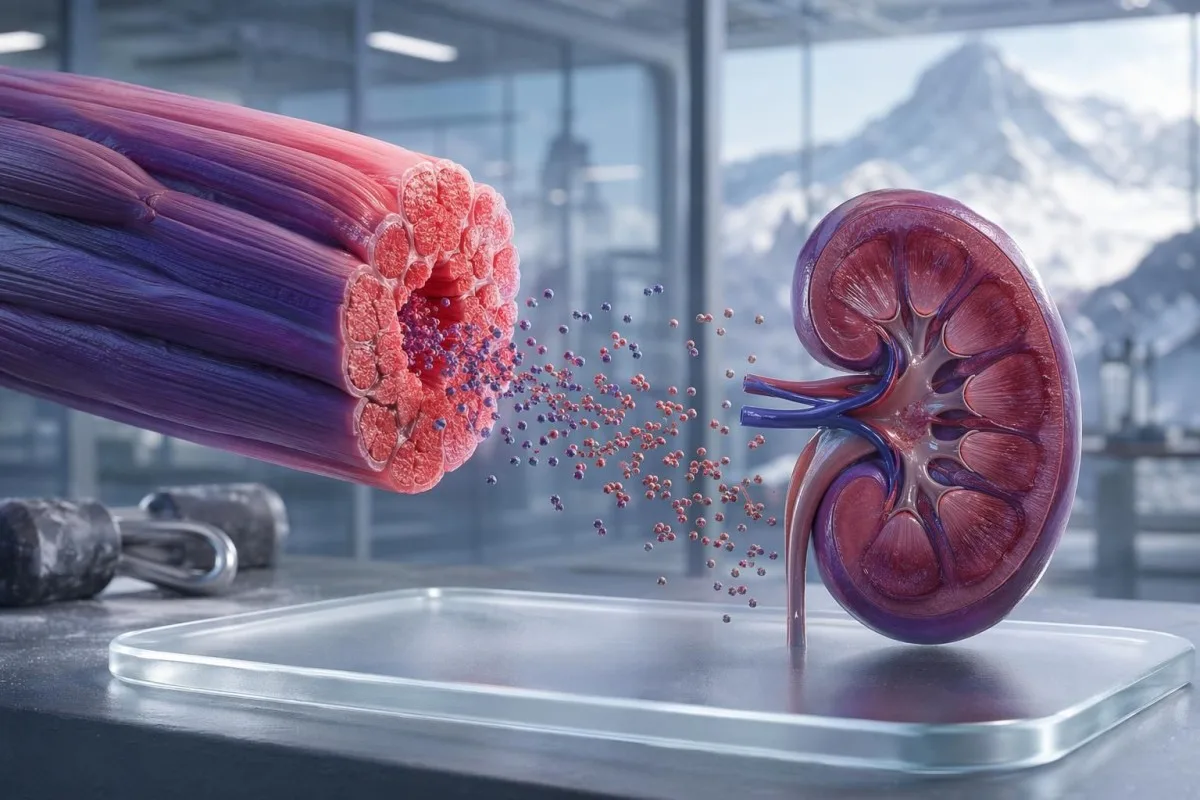
Post-WOD soreness becomes a rhabdomyolysis concern when pain is severe, weakness is out of proportion, urine turns cola-colored, or labs show CK rising with kidney or electrolyte stress.


- CK after CrossFit can rise above 1,000 U/L after hard eccentric training, but CK plus dark urine, weakness, or creatinine rise is a red flag.
- Urgent CK pattern usually means CK above 5,000 U/L, rapidly rising CK, or CK with abnormal potassium, phosphate, calcium, bicarbonate, creatinine, or urine output.
- Rhabdomyolysis blood test should include CK, creatinine, eGFR, potassium, phosphate, calcium, bicarbonate, AST, ALT, urinalysis, and often urine or serum myoglobin.
- Myoglobin urine test is most useful early; a urine dip positive for heme with few or no red cells suggests myoglobin from muscle breakdown.
- Potassium ≥5.5 mmol/L after suspected rhabdo needs same-day medical assessment because high potassium can affect heart rhythm.
- Creatinine rise from your baseline matters more than one isolated number; even a 0.3 mg/dL increase can signal acute kidney stress.
- AST above ALT after high-rep lifting often comes from muscle, especially when bilirubin and GGT are normal.
- Return to training is usually delayed until symptoms resolve, urine is normal, kidney markers are stable, and CK is clearly falling, often below 1,000 U/L.
When post-WOD soreness becomes a rhabdo warning
Post-WOD soreness needs urgent evaluation when pain is severe, weakness is not just fatigue, swelling feels tight, urine is tea- or cola-colored, or urination drops. A blood test for crossfitters should check CK, kidney function, electrolytes, and urine myoglobin when those symptoms appear.
Normal delayed-onset muscle soreness usually peaks at 24-72 hours and still lets you walk, climb stairs, and move the trained muscle. Rhabdomyolysis pain is different: patients often describe a deep, swollen, wooden feeling after high-rep pull-ups, GHD sit-ups, heavy negatives, or a heat-stressed competition WOD.
I’m Thomas Klein, MD, and in clinic I worry less about soreness alone than about the cluster. A 28-year-old athlete with quad pain and CK 1,400 U/L but normal urine, creatinine 0.9 mg/dL, and potassium 4.2 mmol/L is a very different patient from someone with CK 1,400 U/L, dark urine, and creatinine rising from 0.8 to 1.3 mg/dL.
A useful rule: if the workout was unusually eccentric, performed after a training break, or done in heat, treat symptoms more seriously for the first 72 hours. Our separate guide to normal labs after exercise explains why CK, AST, WBC, and creatinine can shift after hard training without automatically meaning disaster.
Which rhabdomyolysis blood test panel is worth ordering?
A useful rhabdomyolysis blood test includes CK, creatinine, eGFR, potassium, bicarbonate, calcium, phosphate, AST, ALT, urinalysis, and often myoglobin. Kantesti is an AI blood test interpretation platform that reads these markers together rather than treating CK as a lonely panic number.
Creatine kinase confirms muscle membrane injury, but kidney and electrolyte markers decide urgency. CK above 5 times the lab upper limit, often around 1,000 U/L, supports rhabdomyolysis when symptoms fit; CK above 5,000 U/L raises the probability of kidney complications, especially if creatinine, potassium, or phosphate are abnormal.
The panel should not stop at a CMP if phosphate is missing. I like to see phosphate because damaged muscle releases intracellular phosphate, and phosphate above 4.5 mg/dL alongside low calcium below 8.5 mg/dL can be an early rhabdo pattern before creatinine peaks.
A complete interpretation also asks whether the lab was drawn 6, 24, or 72 hours after the WOD. For marker definitions, sample types, and unit differences, our biomarkers guide is a practical reference when one lab reports CK in U/L and another uses IU/L.
How high can CK after CrossFit be before it is dangerous?
CK after CrossFit can exceed 1,000 U/L after high-volume eccentric work, but danger rises when CK is above 5,000 U/L, still climbing after 48-72 hours, or paired with kidney or electrolyte abnormalities. CK alone is a smoke alarm, not the whole fire report.
Some European labs set the upper CK reference limit near 170 U/L for women and 190-300 U/L for men, while athletic reference intervals can sit higher. A muscular athlete with a baseline CK of 350 U/L may look abnormal on paper all year, which is why baseline testing beats guesswork.
Zimmerman and Shen’s Chest review in 2013 described CK above 5,000 U/L as a common threshold associated with higher renal risk, but they also emphasized clinical context. I have seen CK 8,000 U/L in a hydrated athlete with normal creatinine and careful follow-up; I have also sent someone in with CK 2,200 U/L because potassium was 5.8 mmol/L and urine output was falling.
The missed detail is slope. CK usually peaks 24-72 hours after injury and then falls by roughly 40% per day once muscle injury stops; a CK that doubles between day 2 and day 3 tells me the workout damage is still evolving. Athletes tracking performance labs may also want our athlete recovery labs guide for non-emergency monitoring.
What does a myoglobin urine test show after a hard WOD?
A myoglobin urine test looks for muscle protein spilling into urine after muscle cell injury. A urine dipstick positive for heme with few or no red cells on microscopy strongly suggests myoglobinuria, especially when CK is rising and urine looks brown.
Myoglobin rises earlier than CK and clears faster, often within hours if kidney filtration is intact. That is why a negative urine myoglobin test 24-48 hours later does not rule out rhabdomyolysis, while CK may still be climbing.
Dipstick chemistry is a useful bedside clue but not perfect. The heme pad reacts to myoglobin and hemoglobin, so microscopy matters: 0-2 red cells per high-power field with a strong heme signal points toward myoglobin rather than urinary bleeding.
Urine specific gravity above 1.025 tells me dehydration is part of the story, and acidic concentrated urine may worsen pigment stress in kidney tubules. Our urinalysis guide explains how specific gravity, heme pads, casts, and microscopy fit together without over-reading one strip.
Which kidney and electrolyte patterns need urgent care?
Suspected rhabdo needs urgent care when creatinine rises, eGFR falls, potassium is ≥5.5 mmol/L, bicarbonate is <22 mmol/L, phosphate is high, calcium is low early, or urine output drops. These patterns suggest muscle breakdown is affecting kidney filtration or electrical stability.
A creatinine increase of 0.3 mg/dL from baseline can meet acute kidney injury criteria even if the final number still sits inside the lab range. In exertional rhabdo, baseline matters because creatine use, high muscle mass, and dehydration can make creatinine interpretation messy.
Potassium is the urgent electrolyte. Potassium ≥5.5 mmol/L after suspected rhabdo deserves same-day assessment, and potassium ≥6.0 mmol/L is commonly treated as an emergency because arrhythmia risk can rise quickly.
Chavez et al. reported in Critical Care in 2016 that acute kidney injury occurs in about 13-50% of rhabdomyolysis cases depending on cause and definition. If potassium is high, our high potassium warning guide gives the symptom context, but symptoms can be absent even when the ECG is unsafe.
Why AST and ALT rise after CrossFit without liver disease
AST and ALT can rise after CrossFit because skeletal muscle contains both enzymes, especially AST. A pattern of high CK, AST higher than ALT, normal bilirubin, and normal GGT often points to muscle injury rather than primary liver disease.
A common mistake is diagnosing fatty liver from an AST of 140 U/L drawn 36 hours after high-rep deadlifts. If CK is 6,000 U/L and GGT is 22 U/L, muscle is a far more likely source than bile duct or alcohol-related liver injury.
ALT is more liver-enriched than AST, but it is not liver-only. I pay attention when ALT continues rising after CK falls, bilirubin rises above 1.2 mg/dL, INR prolongs, or alkaline phosphatase and GGT climb together.
This is one of those areas where context matters more than the red flag icon on the portal. Our guide to high AST with normal ALT covers muscle-heavy patterns that patients often misread as liver failure.
How to separate expected training shifts from dangerous breakdown
Expected training shifts are mild, temporary, and internally consistent: CK rises, AST rises, WBC may bump, and creatinine may look slightly higher from dehydration. Dangerous breakdown adds worsening pain, dark urine, falling urine output, rising creatinine, high potassium, or CK that keeps climbing.
A white blood cell count of 12.5 x 10^9/L after a competition WOD can be stress demargination, not infection, if fever and localizing symptoms are absent. The neutrophil shift usually settles within 24-48 hours; persistent WBC elevation with CRP above 50 mg/L points me elsewhere.
Creatinine deserves special caution in muscular athletes. A creatinine of 1.25 mg/dL may be normal for a 95 kg lifter, while 1.05 mg/dL may be abnormal for a smaller athlete whose baseline is 0.65 mg/dL.
The practical comparison is not today versus the lab range; it is today versus you. If you use trend graphs, our blood test variability article explains why a 15% swing in one marker may be noise while a 0.3 mg/dL creatinine jump is not.
Why the same WOD causes rhabdo in one athlete but not another
The same WOD becomes riskier with heat, dehydration, recent illness, alcohol, stimulant use, statins, sickle cell trait, a long training break, or unaccustomed eccentric volume. New athletes and returning athletes are overrepresented because their muscle membrane tolerance has not caught up.
The workout pattern I hear repeatedly is not a one-rep max; it is 100-plus eccentric reps after time away. High-volume pull-ups, negatives, lunges, and GHD sit-ups create more membrane disruption than many athletes expect because eccentric loading damages fibers during lengthening.
Heat changes the physiology. A box temperature above 28°C with poor airflow, heavy sweating, and inadequate sodium intake can push heart rate, core temperature, and kidney perfusion in the wrong direction during a long metcon.
Illness matters even when the athlete feels nearly recovered. If someone trained hard 48 hours after influenza-like symptoms, vomiting, or a long-haul flight, I lower the threshold for labs; our heat intolerance lab guide overlaps with this because sodium, creatinine, and CK often move together under heat stress.
When should CrossFitters test and repeat CK labs?
Test immediately if symptoms suggest rhabdo, even if the WOD was only a few hours ago, and repeat CK and kidney markers in 12-24 hours if early results are abnormal. CK may peak at 24-72 hours, so one early normal value can miss the later rise.
A CK drawn 4 hours after a high-risk WOD can be falsely reassuring because myoglobin rises first and CK lags. If urine is dark or weakness is real, waiting for CK to peak before seeking care is the wrong strategy.
Kantesti is an AI-powered blood test analysis tool used by 2M+ people across 127 countries, and our unit normalization is useful when athletes upload repeat reports from different labs. A CK of 80 µkat/L is roughly 4,800 U/L, and that conversion changes the whole conversation.
For outpatient monitoring, I usually want CK, creatinine, potassium, bicarbonate, calcium, phosphate, and urinalysis repeated until the trend is clearly safer. Our article on repeating abnormal labs gives timing logic for markers that change over hours rather than months.
What should you do while waiting for rhabdo lab results?
Stop training, cool down, avoid alcohol and NSAIDs, and seek urgent care if urine is dark, urination falls, weakness progresses, or vomiting prevents fluids. Oral fluids are reasonable for mild symptoms, but suspected rhabdo with red flags is not a home hydration experiment.
Plain water alone can be a problem after heavy sweating if sodium is already low. I prefer athletes use balanced oral fluids rather than forcing several liters quickly, especially if nausea, headache, confusion, or swelling appears.
Avoid ibuprofen, naproxen, and similar NSAIDs until kidney function is known. These drugs can reduce kidney blood flow in dehydration, which is exactly the wrong direction when myoglobin pigment may already be stressing tubules.
Electrolytes are not a supplement guessing game here. If your sodium is below 135 mmol/L or potassium is above 5.5 mmol/L, the plan changes; our electrolyte panel guide explains why sodium, potassium, chloride, and bicarbonate must be read as a group.
How clinicians decide ER care versus outpatient monitoring
ER care is usually appropriate for CK above 5,000 U/L with symptoms, any kidney injury, high potassium, low bicarbonate, dark urine, reduced urination, severe swelling, or concern for compartment syndrome. Outpatient monitoring may be reasonable only when symptoms are mild and kidney-electrolyte markers are normal.
McMahon et al. developed a rhabdomyolysis risk score in JAMA Internal Medicine in 2013 using age, sex, cause, creatinine, calcium, phosphate, bicarbonate, and CK. In that study, scores below 5 carried about 2.3% risk of kidney replacement therapy or in-hospital death, while scores above 10 carried about 61.2% risk.
That score explains why clinicians do not worship CK alone. A CK of 12,000 U/L with creatinine 0.8 mg/dL, potassium 4.1 mmol/L, bicarbonate 25 mmol/L, and good urine output is not the same as CK 4,000 U/L with creatinine 1.7 mg/dL and potassium 5.9 mmol/L.
Kantesti AI uses clinically reviewed rule layers to flag combinations that require human escalation, not just isolated highs. Our medical validation standards and our guide to critical lab values describe why urgent patterns are weighted more heavily than cosmetic red marks.
How Kantesti reads CrossFit lab reports without overcalling rhabdo
Kantesti is an AI biomarker interpretation platform that compares CK, creatinine, eGFR, electrolytes, urinalysis, AST, ALT, timing, and symptoms in one clinical context. The goal is to separate expected training biology from patterns that need same-day care.
A raw PDF may show eight red flags after a brutal WOD, but several can share one cause. CK, AST, LDH, and mild WBC elevation can all reflect muscle injury and stress, while creatinine, potassium, bicarbonate, and urinalysis tell us whether the situation is becoming unsafe.
Our neural network reads uploaded blood test PDFs or photos in about 60 seconds, but it also preserves uncertainty. If the report lacks phosphate or urinalysis, the interpretation should say so; missing data is not reassurance.
For readers who want the mechanics, our AI technology guide explains document parsing, unit conversion, and risk logic. If your report is a phone photo rather than a PDF, our PDF upload guide covers how to avoid cropped reference ranges and unreadable units.
When is it safe to train again after suspected rhabdo?
Return to training should wait until pain and swelling resolve, urine is normal, creatinine and electrolytes are stable, and CK is clearly falling, often below 1,000 U/L or below 5 times the lab upper limit. There is no perfect universal cutoff.
Most sports medicine clinicians use a staged return: rest until symptoms settle, light movement for several days, then gradual loading over 1-2 weeks. I am cautious with repeat eccentric volume because the second exposure can be safer physiologically but riskier behaviorally if the athlete tries to prove they are fine.
If rhabdo recurs, happens after modest exercise, or appears with cramps since childhood, clinicians may check thyroid function, metabolic myopathy tests, sickle cell trait, medication triggers, and family history. Recurrent exertional rhabdo is a different problem from one reckless comeback WOD.
Creatine is often blamed too quickly. Standard creatine monohydrate dosing of 3-5 g/day can raise measured creatinine slightly without causing rhabdo; our creatine lab guide explains why supplement history still belongs on the lab form.
Research notes and clinical standards behind this interpretation
As of June 7, 2026, our rhabdo interpretation approach follows physician-reviewed emergency thresholds, peer-reviewed rhabdomyolysis risk literature, and structured lab-pattern validation. The Kantesti medical team reviews this topic because missed rhabdo and overcalled exercise labs both harm athletes.
Our clinical review process includes physicians listed on the Medical Advisory Board and engineering governance described by Kantesti LTD on our About Us page. In my experience, the safest AI output is not the most confident one; it is the one that says when a CK result needs a clinician now.
Kantesti Research Group. (2026). Iron Studies Guide: TIBC, Iron Saturation & Binding Capacity. Zenodo. https://doi.org/10.5281/zenodo.18248745. ResearchGate: https://www.researchgate.net/search/publication?q=Iron%20Studies%20Guide%20TIBC%20Iron%20Saturation%20Binding%20Capacity. Academia.edu: https://www.academia.edu/search?q=Iron%20Studies%20Guide%20TIBC%20Iron%20Saturation%20Binding%20Capacity. The related iron studies guide is not a rhabdo protocol, but it shows the same principle: one biomarker is rarely enough.
Kantesti Research Group. (2026). aPTT Normal Range: D-Dimer, Protein C Blood Clotting Guide. Zenodo. https://doi.org/10.5281/zenodo.18262555. ResearchGate: https://www.researchgate.net/search/publication?q=aPTT%20Normal%20Range%20D-Dimer%20Protein%20C%20Blood%20Clotting%20Guide. Academia.edu: https://www.academia.edu/search?q=aPTT%20Normal%20Range%20D-Dimer%20Protein%20C%20Blood%20Clotting%20Guide. Our coagulation research guide is included because severe systemic illness can distort clotting labs, though typical exertional rhabdo is a muscle-kidney problem first.
Frequently Asked Questions
What CK level after CrossFit means rhabdomyolysis?
CK above about 1,000 U/L, or roughly 5 times the upper limit of normal, supports rhabdomyolysis when symptoms fit. CK above 5,000 U/L is a higher-risk range, especially with dark urine, reduced urination, creatinine rise, potassium ≥5.5 mmol/L, or bicarbonate <22 mmol/L. A well athlete can have a high CK after hard eccentric work, so the trend and kidney-electrolyte pattern matter more than the number alone.
Can you have rhabdo with clear urine?
Yes, rhabdomyolysis can occur with clear urine, especially if testing happens after myoglobin has already cleared or if the muscle injury is moderate. Myoglobin often rises and falls earlier than CK, while CK may peak 24-72 hours after injury. Clear urine is reassuring only when urine output, creatinine, potassium, bicarbonate, and symptoms are also reassuring.
Is a myoglobin urine test better than CK?
A myoglobin urine test is better for early pigment detection, but CK is better for tracking muscle injury over the next 1-3 days. Urine dipstick heme positivity with few or no red cells suggests myoglobinuria, but false positives can occur from hemoglobin. Clinicians usually interpret myoglobin, CK, creatinine, electrolytes, and urinalysis together rather than choosing one winner.
When should I go to urgent care after a CrossFit workout?
Go to urgent care or emergency care after a CrossFit workout if you have severe muscle pain, marked weakness, tight swelling, cola-colored urine, reduced urination, vomiting, confusion, or symptoms with CK above 5,000 U/L. Same-day care is also warranted if potassium is ≥5.5 mmol/L, creatinine has risen from baseline, or bicarbonate is below 22 mmol/L. Do not wait for soreness to become unbearable if urine output is dropping.
Can AST and ALT be high from muscle instead of liver?
Yes, AST and ALT can rise from skeletal muscle injury after hard training, with AST often higher than ALT. A pattern of high CK, high AST, modest ALT, normal bilirubin, and normal GGT usually points more toward muscle than liver. Persistent ALT rise after CK falls, bilirubin above about 1.2 mg/dL, or abnormal INR needs separate liver-focused review.
How long should CK stay high after exertional rhabdo?
CK usually peaks 24-72 hours after muscle injury and then falls by about 40% per day once injury stops, though recovery varies. CK can remain elevated for several days after exertional rhabdo and longer after severe injury. A CK that keeps rising after 72 hours, or rises with worsening creatinine or potassium, needs clinician reassessment.
Do repeated episodes of rhabdo mean I need more testing?
Repeated episodes, or an episode after exercise you normally tolerate, can justify assessment for an underlying muscle or metabolic condition. Ask your clinician whether a neuromuscular referral is appropriate, especially if you have a family history of similar problems.
Will I need an ECG if my potassium is high after a workout?
Often, yes: an ECG is commonly performed when potassium is meaningfully elevated or symptoms raise concern, because potassium can alter heart rhythm. A normal ECG is reassuring but does not replace repeat potassium testing and medical treatment when needed.
Can dehydration or creatine supplements make rhabdo labs look worse after CrossFit?
Dehydration can concentrate urine and strain kidneys, so it can make a borderline situation look more concerning and should be corrected. Creatine supplements usually do not cause rhabdo by themselves, but tell your clinician because they may affect how your kidney markers are interpreted.
Get AI-Powered Blood Test Analysis Today
Join over 2 million users worldwide who trust Kantesti for instant, accurate lab test analysis. Upload your blood test results and receive comprehensive interpretation of 15,000+ biomarkers in seconds.
📚 Referenced Research Publications
Klein, T., Mitchell, S., & Weber, H. (2026). Iron Studies Guide: TIBC, Iron Saturation & Binding Capacity. Kantesti AI Medical Research.
Klein, T., Mitchell, S., & Weber, H. (2026). aPTT Normal Range: D-Dimer, Protein C Blood Clotting Guide. Kantesti AI Medical Research.
📖 External Medical References
⚕️ Medical Disclaimer
This article is for educational purposes only and does not constitute medical advice. Always consult a qualified healthcare provider for diagnosis and treatment decisions.
E-E-A-T Trust Signals
Experience
Physician-led clinical review of lab interpretation workflows.
Expertise
Laboratory medicine focus on how biomarkers behave in clinical context.
Authoritativeness
Written by Dr. Thomas Klein with review by Dr. Sarah Mitchell and Prof. Dr. Hans Weber.
Trustworthiness
Evidence-based interpretation with clear follow-up pathways to reduce alarm.