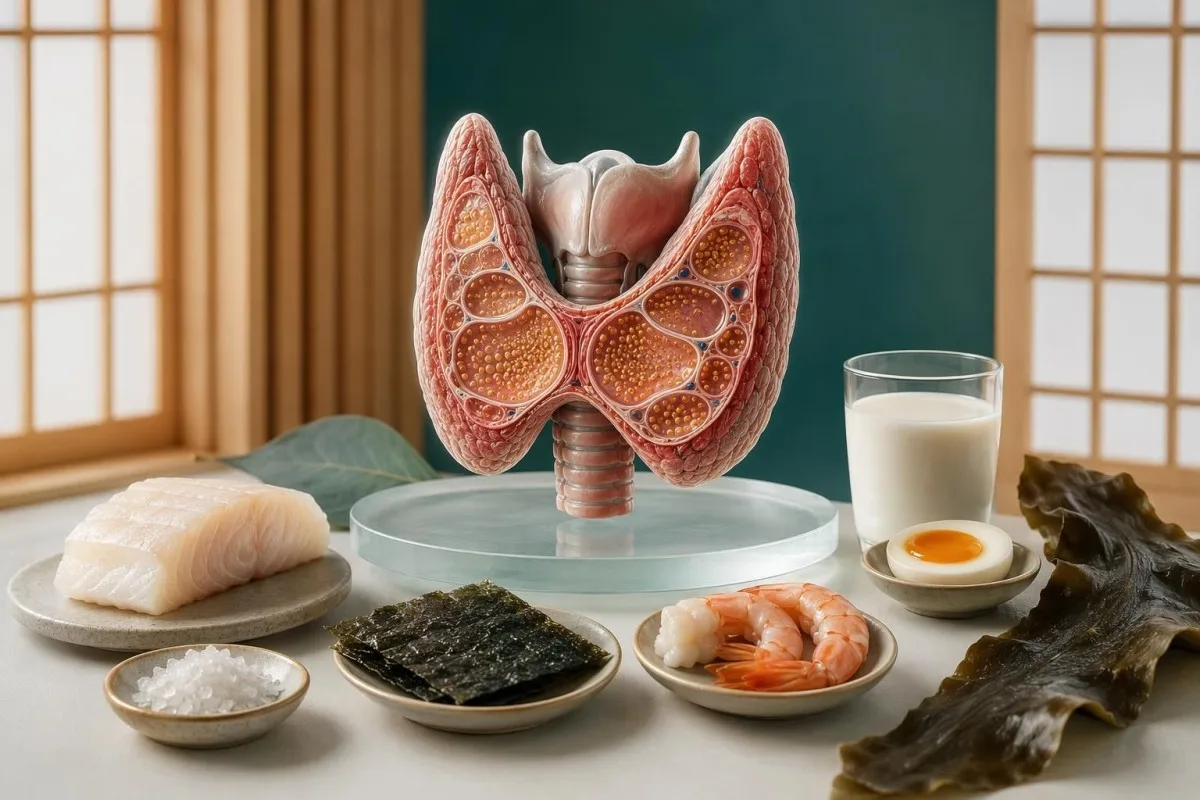
Iodine is easy to get too little—or far too much—when seaweed, salt, supplements, and thyroid disease enter the picture. Here is the food-first approach I use in practice.


- Adult iodine target is 150 micrograms (mcg) daily; pregnancy needs 220 mcg and breastfeeding needs 290 mcg.
- Reliable food sources include dairy, eggs, white fish, shellfish, and clearly labelled iodized salt—not most specialty salts.
- Iodized salt iodine commonly provides about 45 mcg per gram in the United States, but actual use and national fortification policies vary.
- Seaweed iodine content is highly variable: a kombu serving can exceed the 1,100 mcg US adult upper limit several times over.
- Pregnancy supplements should generally contain 150 mcg iodine as potassium iodide, unless a maternity clinician advises otherwise.
- Hashimoto disease, Graves disease, thyroid nodules, and amiodarone use are reasons to ask before adding iodine tablets or seaweed.
- Urinary iodine testing assesses recent population intake best; one spot result is often too variable to diagnose an individual.
- TSH and free T4 show thyroid function, while iodine exposure is only one possible explanation for an abnormal result.
How much iodine do adults, children, and pregnant people need?
Most adults need 150 mcg of iodine daily, usually achievable with ordinary foods rich in iodine rather than a high-dose supplement. The target rises to 220 mcg in pregnancy and 290 mcg while breastfeeding because the developing infant depends on maternal iodine; the practical safety issue is avoiding both sustained low intake and sudden seaweed-driven excess.
The US Recommended Dietary Allowance is 90 mcg for children aged 1–8 years, 120 mcg for ages 9–13 years, and 150 mcg from age 14 onward. The adult tolerable upper intake level is 1,100 mcg per day in the US, while the European Food Safety Authority uses a more conservative adult upper limit of 600 mcg per day; neither figure is a daily goal.
I see a recurring misconception: people assume fatigue proves iodine deficiency. It does not. Iodine deficiency can contribute to goitre and hypothyroidism, but iron deficiency, poor sleep, depression, medication effects, and autoimmune thyroid disease are much more common explanations in iodine-sufficient settings.
Dr. Thomas Klein's practical rule is simple: build a predictable baseline from food, then investigate symptoms with appropriate tests rather than guessing. Thyroid blood test patterns matter more than a single dietary recall, and medical validation standards matter when interpreting any automated health insight.
Why the target changes during pregnancy
Pregnancy increases iodine needs because maternal thyroid hormone production rises by roughly 50% and iodine is transferred to the fetus. Severe deficiency is clearly harmful to fetal neurodevelopment, yet taking several milligrams of iodine daily is not safer; the fetal thyroid is especially sensitive to excess iodine after mid-pregnancy.
Which iodine rich foods are dependable enough to plan around?
Dairy, eggs, marine fish, shellfish, and labelled iodized salt are the most dependable everyday iodine sources. Their iodine content is still not identical across countries or brands, but it is far less erratic than seaweed iodine content.
A 3-ounce, or 85-gram, serving of baked cod provides roughly 99 mcg, while a cup of cow's milk often provides 55–90 mcg and one large egg about 25 mcg. Values differ with farming practices, season, animal feed, and processing, so these are planning estimates—not promises printed by nature.
Plain yogurt can contribute approximately 75 mcg per cup, and many white fish are particularly useful because their iodine concentration is meaningful without the extreme spikes seen in kelp. People avoiding dairy and seafood can meet needs, but a fully plant-based diet deserves more deliberate label reading; our review of plant-based diet nutrient gaps explains why several nutrients may shift together.
The World Health Organization's 2014 salt-fortification guideline supports iodization as a population measure because it reaches households regardless of income or food preference (WHO, 2014). That public-health success should not be confused with a reason to eat extra sodium: one teaspoon of table salt contains about 2,300 mg sodium, near the usual US daily limit.
A realistic day from food
For an omnivore, milk at breakfast, an egg at lunch, and a modest white-fish dinner can land near 150–250 mcg without any supplement. For a vegan, a verified iodine-containing multivitamin or consistently used iodized salt may be more predictable than trying to calculate iodine from vegetables.
A practical iodine food guide: portions that add up
Use food portions, not vague “thyroid-supporting” claims, to estimate iodine intake. A few ordinary choices can cover an adult's 150 mcg target, whereas a single concentrated seaweed product may supply several days' worth.
Approximate amounts per common serving are: cod 99 mcg per 85 g, canned light tuna 17 mcg per 85 g, shrimp 35 mcg per 85 g, milk 55–90 mcg per 240 mL, yogurt 75 mcg per cup, and one egg 25 mcg. These figures are useful for menus, but nutrition databases cannot account for every local product.
Fish has benefits beyond iodine, including protein, selenium, and omega-3 fats, but species selection still matters. Large predatory fish can carry more mercury, so people who eat seafood frequently should understand mercury testing after seafood rather than relying on iodine alone as a marker of dietary quality.
Cow's milk is sometimes overlooked because it is not naturally iodine-rich in the same way as ocean fish; iodine in milk partly reflects iodine-containing feed and dairy sanitation practices. Plant drinks are usually low unless fortified, and a carton that lists calcium and vitamin D may still contain 0 mcg iodine.
Why food labels beat assumptions
Fortified plant milks, meat alternatives, and multivitamins are not interchangeable. Check the nutrition panel or manufacturer information for iodine specifically, because many products use calcium carbonate and vitamin D but omit iodide entirely.
Does iodized salt provide enough iodine without raising sodium?
Iodized salt can reliably contribute iodine, but it should not be used as a treatment for low iodine intake by increasing salt intake. In the United States, iodized salt typically contains 45–76 mcg iodine per gram, so one-quarter teaspoon may provide roughly 70–100 mcg.
Sea salt, Himalayan pink salt, kosher salt, and most restaurant salt are not automatically iodized. Colour, coarse texture, or “natural” packaging says nothing about iodine content; the word “iodized” must appear on the pack if you plan to count it.
Salt use is also inconsistent. A person cooking at home may use iodized salt, while someone eating mostly packaged foods or restaurant meals may consume substantial sodium from non-iodized sources. This is why nutrition history must ask which salt is used, not merely how much sodium appears in an app.
If hypertension, heart failure, chronic kidney disease, or a sodium-restricted diet is part of the picture, do not make salt your primary iodine strategy. The DASH diet and blood-pressure markers offer a sensible frame: keep sodium low and obtain iodine from a clinician-approved food or supplement plan.
The “salt is iodized everywhere” myth
Iodization policy differs sharply by country, and voluntary programs leave gaps. In the United Kingdom, for example, iodized household salt is not routinely used to the same extent as in the United States, while dairy remains a substantial contributor for many people.
Why seaweed iodine content can become excessive so quickly
Seaweed is the least predictable iodine source, and kombu or kelp can deliver more than 1,100 mcg in one small serving. Nori is generally lower, wakame sits in the middle, and dried kelp is the product I most often ask patients to stop when thyroid tests become unexpectedly unstable.
Published analyses show seaweed iodine can vary by more than 100-fold according to species, harvest area, drying, and portion size. A nori sheet may provide only tens of micrograms, whereas 1 gram of kombu can contain 1,000–3,000 mcg or more, which is enough to exceed the US adult upper limit before dinner.
Excess iodine can temporarily suppress thyroid hormone synthesis through the Wolff–Chaikoff effect; most healthy thyroids escape this effect within days, but susceptible people may develop hypothyroidism or hyperthyroidism. Leung and Braverman's review describes why autoimmune thyroid disease, nodular thyroid tissue, and prior iodine deficiency alter that risk (Leung & Braverman, 2012).
I have seen patients add kelp powder to smoothies because it sounds “clean,” then present with a newly high TSH or palpitations several weeks later. The evidence is not strong enough to blame every abnormal result on seaweed, but stopping concentrated seaweed for 6–8 weeks before repeat thyroid testing is often a reasonable clinician-led experiment.
Safer ways to use seaweed
Occasional nori in a meal is usually very different from daily kelp capsules, kelp broth, or sea moss gel with an undisclosed dose. Treat an unquantified seaweed supplement as a high-dose iodine product, not as a harmless seasoning.
Iodine in pregnancy: why timing and formulation matter
Pregnant people need 220 mcg of iodine daily and breastfeeding people need 290 mcg, but the usual prenatal supplement contribution is 150 mcg. The remaining amount comes from food, and the safest formulation is generally potassium iodide rather than variable kelp.
The American Thyroid Association recommends that women planning pregnancy, pregnant women, and breastfeeding women take a daily supplement containing 150 mcg iodine as potassium iodide, ideally beginning before conception (Alexander et al., 2017). Not every prenatal vitamin contains iodine, and some that do use kelp, which makes dose consistency less certain.
Fetal thyroid hormone production begins around 12 weeks of gestation, but fetal brain development depends on maternal thyroid hormone earlier than that. This is why waiting until the first antenatal appointment may not be ideal for someone who is trying to conceive, follows a vegan diet, or avoids dairy and fish.
Vomiting, restrictive eating, bariatric surgery, and lactose intolerance can all change the food calculation. A tailored review of supplements for pregnancy is more useful than doubling a prenatal vitamin, because excess preformed vitamin A, iron, or folic acid may create separate problems.
When to call the maternity team
Contact a maternity clinician before adding iodine if you have Graves disease, Hashimoto disease, a thyroid nodule, prior radioiodine treatment, or are taking levothyroxine. New persistent tremor, racing heart, severe heat intolerance, or marked neck swelling during pregnancy deserves prompt assessment rather than a supplement adjustment at home.
Who should limit iodine or seek thyroid clinician advice first?
People with known thyroid disease should not self-prescribe high-dose iodine, kelp, or “thyroid support” blends. Hashimoto thyroiditis, Graves disease, multinodular goitre, previous thyroid surgery, and recent iodine contrast exposure all make the thyroid more vulnerable to a large iodine shift.
In autoimmune thyroiditis, excess iodine may increase thyroid antigenicity and can worsen hypothyroidism in some individuals; in autonomous nodules, it may trigger iodine-induced hyperthyroidism, called the Jod–Basedow phenomenon. Risk is not determined by a single TPO antibody result, but a positive antibody test deserves context; see our guide to positive TPO antibodies with normal TSH.
Amiodarone contains an exceptionally large iodine load, and iodinated contrast for CT or angiography can affect thyroid tests for weeks to months. Do not add kelp because a thyroid test changes after either exposure; the appropriate follow-up is usually repeat TSH and free T4, with free T3 or antibodies when clinically indicated.
A low-iodine diet is a specialised short-term preparation for some radioactive iodine scans or thyroid cancer treatments, not a healthy permanent diet. It commonly restricts intake to roughly 50 mcg daily for 1–2 weeks under the nuclear medicine team's instructions.
Supplements that deserve a label check
Many “metabolism,” hair, and thyroid blends combine kelp with selenium, ashwagandha, and biotin. Biotin can interfere with some thyroid immunoassays, while the iodine content may be omitted or expressed as an unclear seaweed quantity; neither is a good basis for dose decisions.
How can vegans and dairy-free eaters get iodine safely?
Vegan and dairy-free diets can meet iodine needs, but they need a deliberate source because plants grown on land are usually low in iodine. The most predictable options are iodized salt used within sodium goals or a modest, clearly dosed iodine supplement approved by a clinician.
Most fruits, vegetables, grains, legumes, and nuts contain little iodine because soil iodine concentration varies greatly. A diet rich in whole foods can therefore be excellent overall yet provide under 50 mcg iodine daily if it excludes seafood, dairy, eggs, iodized salt, and fortified products.
Soy, cassava, millet, and cruciferous vegetables contain compounds that can affect thyroid hormone production under certain conditions, but normal servings are not a reason to avoid nutritious foods. The concern is greater when very low iodine intake and high intakes of these foods coexist, particularly in someone with underlying thyroid disease.
Kantesti is an AI blood test analyzer that helps users place TSH, free T4, ferritin, B12, and vitamin D in the same nutritional context rather than treating one tiredness symptom as proof of iodine deficiency. A blood test for mineral deficiency can help guide a wider discussion, although it does not replace a dietary iodine assessment.
A conservative vegan plan
For many adults, an iodine-containing multivitamin supplying about 150 mcg daily is simpler than daily seaweed. Avoid stacking it with kelp snacks, iodine drops, and a prenatal vitamin unless the total daily dose has been reviewed.
Can blood tests or urine tests confirm iodine status?
Urinary iodine is the preferred marker of recent iodine exposure, but a single spot urine sample is unreliable for diagnosing one individual. Serum iodine is rarely useful for routine nutrition decisions, while TSH and free T4 identify whether thyroid function has actually changed.
About 90% of ingested iodine is excreted in urine, which makes urinary iodine concentration useful for population surveillance. World Health Organization criteria define a median urinary iodine concentration of 100–199 mcg/L as adequate for non-pregnant adults and 150–249 mcg/L as adequate in pregnancy; those are group medians, not personal diagnostic cutoffs.
A 24-hour urine collection can estimate individual iodine excretion more accurately, but collection errors are common and day-to-day intake still swings. Our detailed urinary iodine test guide explains why a result after sushi, seaweed soup, or contrast imaging can be misleading.
Kantesti AI interprets thyroid-related lab results by checking TSH, free T4, free T3 when available, thyroid antibodies, medications, and result trends rather than implying that a normal serum iodine value rules out a thyroid problem. In primary hypothyroidism, a high TSH with low free T4 needs clinical assessment regardless of whether iodine was eaten yesterday.
Tests that should not be overread
Hair iodine tests, iodine skin-patch disappearance tests, and urine iodine results from unvalidated wellness kits are not standard diagnostic tools. A spot result may reflect the previous meal more than long-term intake, which is one of those areas where context matters more than the number.
What thyroid lab patterns can iodine excess or deficiency cause?
Iodine deficiency usually pushes the thyroid toward goitre and hypothyroidism, while excess iodine can cause either high or low thyroid function in susceptible people. A TSH outside the laboratory range does not establish the cause, but the pattern of TSH, free T4, symptoms, medicines, and timing narrows the possibilities.
Overt primary hypothyroidism typically shows high TSH with low free T4, whereas overt hyperthyroidism usually shows suppressed TSH with high free T4, high free T3, or both. A TSH of 10 mIU/L or higher on repeat testing warrants clinician review even when symptoms are subtle, especially in pregnancy or when antibodies are positive.
Subclinical patterns are more ambiguous. A mildly raised TSH between roughly 4.5 and 10 mIU/L with normal free T4 can reflect early autoimmune disease, recovery from illness, laboratory variation, medication effects, or a recent iodine load; our article on borderline TSH results explains sensible retesting intervals.
Do not stop prescribed levothyroxine because you have found a food list. Levothyroxine replaces hormone; iodine supplies raw material to a functioning gland, and increasing iodine cannot make up for an absent thyroid, thyroidectomy, or significant autoimmune hormone-production failure.
The timing question clinicians ask
When I review an unexpected TSH, I ask about kelp, iodine drops, contrast imaging, amiodarone, pregnancy, and biotin before declaring a new diagnosis. Repeating a stable outpatient thyroid panel after 6–8 weeks is often more informative than testing every few days, because TSH changes slowly.
How to build a food-first iodine plan without overdoing it
A food-first iodine plan uses one or two consistent sources across the week, not a daily rotation of high-dose seaweed products. For most adults, regular dairy or eggs plus fish once or twice weekly—or verified iodized salt in modest cooking amounts—creates a safer baseline.
An example omnivorous pattern is milk or yogurt on several days, 2 portions of low-mercury seafood weekly, and eggs as desired. It does not require eating cod every day; in fact, dietary variety reduces the chance that any one nutrient or contaminant source becomes excessive.
For a dairy-free household, use the same approach but confirm whether plant drinks are iodine-fortified and decide on a measured supplement if they are not. I would not use sea moss gel as the foundation of a nutrition plan because product labels often fail to state iodine in micrograms.
People taking warfarin often worry that any nutrition change will disrupt treatment, but iodine itself is not vitamin K. The relevant issue is keeping dietary patterns consistent and understanding vitamin K food safety with warfarin rather than avoiding all nutrient-rich foods.
A useful shopping rule
Buy foods, not “thyroid detox” products. If you do buy a supplement, select one with a stated dose in mcg, a full ingredient list, and no hidden kelp blend; a bottle that only says “proprietary marine complex” cannot be safely calculated.
Seven iodine mistakes that can distort thyroid decisions
The biggest iodine mistakes are assuming all salt is iodized, treating seaweed as a daily vitamin, and changing supplements just before thyroid testing. Each can create a false sense of control while making the next laboratory result harder to interpret.
Mistake one is counting restaurant salt as iodized; mistake two is using kelp capsules with 500–2,000 mcg or an unstated dose; mistake three is taking multiple products that each contain 150 mcg. Four small sources can quietly exceed the adult upper limit without any single product looking alarming.
Mistake four is treating “normal-range” TSH as proof that a large iodine dose is harmless. Thyroid adaptation can lag behind exposure, and a normal result today does not guarantee that a susceptible gland will remain stable after months of excess.
Mistakes five through seven are ignoring prenatal labels, using seaweed to self-treat hair loss, and attributing every thyroid symptom to iodine. Hair shedding can follow iron deficiency, thyroid disease, postpartum change, weight loss, or illness; a blood test before and after supplements is far more useful when paired with a dated supplement list.
Record the dose, not just the brand
Bring photos of labels to appointments and include serving size, frequency, and start date. This helps distinguish a 150 mcg daily prenatal dose from an intermittent multi-milligram kelp exposure, which are clinically very different histories.
When should iodine intake prompt a medical review?
Seek clinician advice before changing iodine intake if you have thyroid disease, are pregnant, have had contrast imaging, or use amiodarone. Urgent medical assessment is appropriate for chest pain, fainting, severe shortness of breath, confusion, or a sustained very rapid heartbeat—symptoms that should never be managed with dietary changes.
Non-urgent but timely review is sensible for persistent neck enlargement, new tremor, unexplained weight change, constipation with cold intolerance, or palpitations after beginning a seaweed product. A clinician may order TSH and free T4, then add free T3, TPO antibodies, or imaging depending on the pattern.
Kantesti is an AI lab test interpretation service that can organise an uploaded thyroid panel into a clear timeline, flag mismatched values, and help users prepare questions for their clinician; it does not diagnose the cause of a thyroid disorder or replace physical examination. Our blood test biomarkers guide explains what each common thyroid marker can and cannot establish.
In my experience, the most productive question is not “Should I take iodine?” but “What problem are we trying to solve, and what evidence supports it?” Dr. Thomas Klein recommends noting supplement changes, pregnancy status, recent scans, and family thyroid history before the appointment.
If your test result is already flagged
A flagged result is a prompt for context, not an emergency diagnosis. Read the laboratory's reference interval, compare prior values, and review what out-of-range blood results mean before making a sudden dietary change.
Why iodine and thyroid results should be tracked over time
Thyroid values are more informative as a trend than as one isolated result, especially after a dietary or supplement change. TSH may take 6–8 weeks to reach a new steady state after a meaningful change in thyroid hormone status or treatment.
A meaningful record includes the test date, TSH and free T4 values, laboratory ranges, levothyroxine dose, iodine supplement dose, seaweed intake, pregnancy status, and recent contrast exposure. Without those details, two values several months apart may look contradictory when they are actually explainable.
Kantesti's AI-powered blood test analysis tool can compare lab reports across visits and surface changes that merit a clinician's review, including a TSH drift that was not obvious on separate PDFs. The process is designed to support—not substitute for—clinical reasoning, and our AI lab-report accuracy checklist shows what to verify before acting.
Avoid “chasing” a TSH result with alternating iodine doses every week. A stable food pattern for 6 weeks, unless your clinician advises otherwise, gives a repeat test a fairer chance of showing whether the change was relevant.
What a good follow-up note contains
Write down the exact brand and dose rather than “seaweed supplement.” If the result is abnormal, a clinician can then judge whether stopping exposure, repeating tests, checking antibodies, or changing medication is the appropriate next move.
A clinician-approved bottom line on iodine food choices
Choose predictable foods rich in iodine, keep seaweed occasional and modest, and use a measured supplement only when your diet or life stage calls for one. Most healthy adults do well around 150 mcg daily; pregnancy, breastfeeding, thyroid disease, and medication use are the situations where a generic rule becomes inadequate.
The safest routine for most people is not glamorous: regular dairy, eggs, seafood, or modest iodized salt, with no daily kelp. If you avoid these foods, choose a product with a declared 150 mcg dose instead of an unmeasured marine extract.
Kantesti, an AI biomarker interpretation platform, helps patients turn thyroid laboratory results into focused questions about trends, medicines, and nutrition; it cannot determine personal iodine requirements from a food photograph or a single TSH value. Our clinical approach is reviewed with the Medical Advisory Board and keeps urgent symptoms and pregnancy care in the hands of appropriate clinicians.
As of July 22, 2026, I would rather see a patient make one calm, measurable change than start three supplements at once. That modest approach is less exciting, frankly, but it gives both the thyroid and the next laboratory test a chance to tell the truth.
A one-week action plan
Check whether your household salt is iodized, list every supplement containing kelp or iodine, and select one repeatable food source. If you are pregnant, breastfeeding, have thyroid disease, or your combined intake may exceed 600–1,100 mcg daily, discuss the plan with your clinician before continuing.
Frequently Asked Questions
What foods are highest in iodine?
Seaweed, especially kombu and kelp, contains the highest iodine concentrations, but its content is too variable to use casually as a daily source. More predictable foods rich in iodine include cod at about 99 mcg per 85 g, cow's milk at roughly 55–90 mcg per cup, yogurt at about 75 mcg per cup, and eggs at about 25 mcg each. An adult needs 150 mcg daily, so ordinary food combinations can usually meet the target without kelp. People with thyroid disease should ask a clinician before using seaweed supplements or iodine drops.
How much iodine is in iodized salt?
In the United States, iodized salt commonly provides about 45–76 mcg iodine per gram, which means one-quarter teaspoon may supply roughly 70–100 mcg. The exact amount differs by manufacturer and country, so the label matters. Sea salt, kosher salt, Himalayan salt, and restaurant salt are not reliably iodized unless the package specifically says so. Do not increase salt intake solely for iodine because one teaspoon of salt contains about 2,300 mg sodium.
Can eating seaweed cause thyroid problems?
Yes, concentrated seaweed can trigger thyroid problems in susceptible people because kelp or kombu may contain 1,000–3,000 mcg iodine per gram. This can exceed the US adult upper intake level of 1,100 mcg in a single serving. Excess iodine may cause hypothyroidism through temporary thyroid suppression or hyperthyroidism in people with nodules or autoimmune thyroid disease. Occasional nori is generally much lower in iodine than daily kelp products, but the species and portion still matter.
Should I take iodine during pregnancy?
Pregnancy requires 220 mcg iodine daily, and the American Thyroid Association recommends a supplement containing 150 mcg iodine as potassium iodide for people planning pregnancy, pregnant people, and those breastfeeding. Breastfeeding needs rise to 290 mcg daily because iodine is supplied through breast milk. Check the prenatal label because some products contain no iodine and others use variable kelp rather than potassium iodide. Anyone with Graves disease, Hashimoto disease, thyroid surgery, or thyroid medication should confirm their plan with a maternity or thyroid clinician.
Can a blood test show iodine deficiency?
A routine blood test does not reliably diagnose dietary iodine deficiency in an individual. Urinary iodine reflects recent intake because about 90% of consumed iodine is excreted in urine, but a single spot urine result varies too much for a personal diagnosis. TSH and free T4 show whether thyroid function is abnormal, although they do not identify iodine intake as the cause. A 24-hour urine iodine collection and dietary review may be considered when a clinician has a specific concern.
Who should avoid iodine supplements?
People with Hashimoto thyroiditis, Graves disease, thyroid nodules, previous thyroid surgery, recent iodinated contrast exposure, or amiodarone use should not start iodine supplements without clinician advice. These situations can make the thyroid more sensitive to a sudden iodine increase. The US adult upper intake level is 1,100 mcg daily, while the European Food Safety Authority uses 600 mcg daily, so stacking seaweed, multivitamins, and iodized salt can become excessive quickly. A prescribed 150 mcg prenatal supplement is different from a multi-milligram kelp product and should be assessed in clinical context.
Can iodine-containing skin antiseptics affect thyroid health?
Occasional use of povidone-iodine on a small area is unlikely to affect most adults. Tell your clinician about repeated use, large-area wound treatment, or iodine antiseptic exposure in infants, as absorption can be greater in these situations.
Get AI-Powered Blood Test Analysis Today
Join over 2 million users worldwide who trust Kantesti for instant, accurate lab test analysis. Upload your blood test results and receive comprehensive interpretation of 15,000+ biomarkers in seconds.
📚 Referenced Research Publications
Klein, T., Mitchell, S., & Weber, H. (2026). A Pre-Registered, Rubric-Based Automated Technical Benchmark of the Kantesti Blood-Test Interpretation Engine on 100,000 Synthetic Test Cases. Kantesti AI Medical Research.
Klein, T., Mitchell, S., & Weber, H. (2026). Clinical Validation Framework v2.0 (Medical Validation Page). Kantesti AI Medical Research.
📖 External Medical References
World Health Organization (2014). Guideline: Fortification of food-grade salt with iodine for the prevention and control of iodine deficiency disorders. World Health Organization.
⚕️ Medical Disclaimer
This article is for educational purposes only and does not constitute medical advice. Always consult a qualified healthcare provider for diagnosis and treatment decisions.
E-E-A-T Trust Signals
Experience
Physician-led clinical review of lab interpretation workflows.
Expertise
Laboratory medicine focus on how biomarkers behave in clinical context.
Authoritativeness
Written by Dr. Thomas Klein with review by Dr. Sarah Mitchell and Prof. Dr. Hans Weber.
Trustworthiness
Evidence-based interpretation with clear follow-up pathways to reduce alarm.