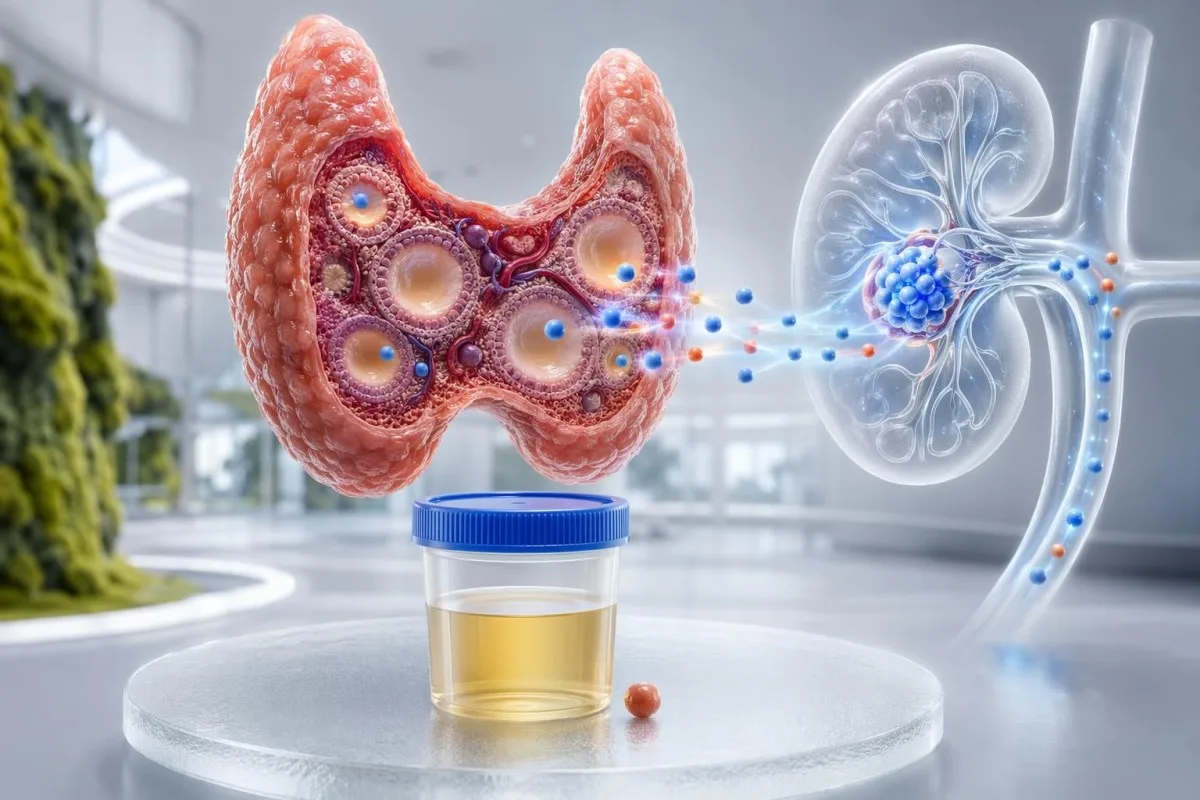
Urine iodine can be useful, but a single spot result is easy to overread. The safest interpretation combines thyroid labs, symptoms, diet history, supplements, and pregnancy status.


- Urinary iodine test results are best for estimating iodine intake in groups; one spot urine value can swing widely after meals, hydration changes, or supplements.
- Low iodine urine result usually means recent low iodine intake, but a single spot value below 100 µg/L does not diagnose iodine deficiency in one person.
- Population cutoffs define median urinary iodine below 100 µg/L as insufficient in school-age children and nonpregnant adults.
- Pregnancy needs are higher; the WHO considers a median urinary iodine concentration of 150-249 µg/L adequate in pregnant populations.
- High urine iodine above 300 µg/L in nonpregnant populations may reflect excess intake from seaweed, kelp tablets, iodinated contrast, or amiodarone exposure.
- Iodine blood test results are less commonly used than urine iodine for intake assessment because serum iodine often reflects very recent exposure rather than long-term stores.
- Thyroid context matters; doctors interpret iodine with TSH, free T4, free T3, TPO antibodies, symptoms, and medication history.
- Adult intake is typically 150 µg/day, while pregnancy needs are about 220-250 µg/day and lactation needs are about 250-290 µg/day depending on the guideline.
- Safety ceiling in the United States is 1,100 µg/day for adults; repeated high iodine intake can trigger hypothyroidism or hyperthyroidism in susceptible people.
What a urinary iodine test can and cannot tell you
A urinary iodine test estimates recent iodine intake by measuring iodine excreted in urine, but it does not directly measure thyroid hormone production. A low or high result is most useful when your clinician also reviews TSH, free T4, symptoms, diet, supplements, pregnancy status, and recent iodine exposure.
Most swallowed iodine leaves through urine within 24-48 hours, so urine is a practical window into recent intake. On Kantesti AI, we treat urine iodine as an intake marker, not as a stand-alone diagnosis of thyroid disease.
In our analysis of 2M+ lab uploads, the common pattern is simple: patients see one flagged iodine value and assume their thyroid is either starved or overloaded. The safer next step is to compare it with a thyroid panel and ask what changed in the last 3-7 days.
A median urinary iodine concentration below 100 µg/L suggests insufficient iodine intake at the population level in nonpregnant groups. For one individual, a single spot result below 100 µg/L is a clue, not a verdict.
Thomas Klein, MD, often explains this test as a nutrition exposure snapshot. It answers the question, did iodine recently pass through the body, better than the question, does this person have permanent iodine deficiency.
Why spot urine iodine results swing so much
Spot urine iodine fluctuates because hydration, time of day, salt intake, seafood, dairy, seaweed, and supplements can shift the concentration within hours. A result from one random cup of urine can differ substantially from another cup collected the same week.
A diluted urine sample can make iodine concentration look lower, while a concentrated morning sample can make the same intake look higher. This is the same type of biological and pre-analytic noise we discuss in blood test variability.
Creatinine correction, reported as µg iodine per g creatinine, can reduce some hydration noise. It still has limits because creatinine output varies with muscle mass, age, pregnancy, kidney function, and diet.
Here is a real-world pattern we see: someone eats sushi with seaweed on Saturday, takes a kelp capsule on Sunday, then tests Monday. A urine iodine of 420 µg/L in that setting may reflect a short iodine burst rather than a chronic toxic exposure.
Clinicians disagree on how many repeat samples are enough for one person. In practice, two or three spot samples collected on ordinary diet days give a more believable story than one dramatic result.
When urine iodine testing is actually useful
Urine iodine is most useful for population nutrition surveys, pregnancy intake assessment, follow-up after iodine restriction, and suspected excess iodine exposure. It is less useful as a broad screening test for every person with fatigue or weight change.
The WHO/UNICEF/ICCIDD manual uses median urinary iodine to judge iodine nutrition in populations, not to label one patient from one sample (WHO/UNICEF/ICCIDD, 2007). This is why public-health cutoffs are powerful for cities, schools, and pregnancy cohorts but weaker for a single clinic visit.
Pregnancy is different because iodine supports maternal thyroid hormone production and fetal neurodevelopment. If you are planning pregnancy or already pregnant, urine iodine may sit beside routine prenatal blood tests rather than replace them.
Urine iodine can also help after a low-iodine diet before radioactive iodine therapy, although specialist protocols vary. A value that looks low during a supervised restriction phase may be expected, while the same value during pregnancy deserves a different conversation.
The test can be useful after suspected iodine excess too. Recent iodinated contrast, antiseptic iodine exposure, amiodarone, or high-dose kelp products can push urinary iodine high for days to weeks.
What a low iodine urine result usually means
A low iodine urine result usually means recent iodine intake was low, especially if spot urinary iodine is below 100 µg/L in a nonpregnant adult. It does not prove hypothyroidism unless thyroid blood tests and symptoms point the same way.
A spot value below 50 µg/L is more concerning than a borderline result of 80-99 µg/L, but both need context. The person who avoids iodized salt, dairy, seafood, and iodine-containing prenatal vitamins has a very different risk profile from someone who simply drank 2 liters of water before testing.
Iodine deficiency becomes clinically meaningful when intake is low enough to impair thyroid hormone synthesis. Patients may notice cold intolerance, constipation, dry skin, slowed pulse, heavy periods, or low energy, but those symptoms overlap with iron, B12, vitamin D, and sleep problems covered in our guide to nutrient deficiency signs.
A low urine iodine with high TSH and low free T4 raises concern for true hypothyroidism or inadequate hormone production. A low urine iodine with normal TSH, normal free T4, and no symptoms often calls for dietary review and repeat testing rather than immediate treatment.
Zimmermann’s Endocrine Reviews paper describes iodine deficiency as the leading preventable cause of impaired neurodevelopment worldwide, but that population fact should not be converted into panic over one spot urine cup (Zimmermann, 2009).
What high urine iodine can signal
High urine iodine usually reflects recent excess iodine intake or exposure, commonly from kelp, seaweed, iodine drops, contrast imaging, amiodarone, or high-dose multinutrient products. In nonpregnant populations, median urinary iodine above 300 µg/L is considered excessive by WHO criteria.
The thyroid can usually adapt to sudden iodine loads, but adaptation is not perfect. People with Hashimoto’s thyroiditis, Graves’ disease, nodular thyroid disease, older age, or prior iodine deficiency are more likely to develop iodine-induced thyroid dysfunction.
A standard 200 mg amiodarone tablet contains about 75 mg of iodine, far above the 150 µg/day adult requirement. Not everyone on amiodarone becomes hyperthyroid or hypothyroid, but the exposure explains why urine iodine can look extreme.
Kelp tablets are a common trap. Some products contain hundreds to thousands of micrograms per serving, and patients often stack them with multivitamins unless they use a careful supplement timing guide.
A high urine iodine with low TSH, palpitations, tremor, or unexplained weight loss should move faster than a high urine iodine with normal thyroid blood tests and a clear recent seaweed meal. The number matters; the pattern matters more.
Urinary iodine test versus iodine blood test
A urinary iodine test is generally better for estimating iodine intake than an iodine blood test because most iodine is excreted in urine. Blood iodine is usually reserved for selected exposure questions and may reflect very recent intake rather than stable body iodine status.
Some specialty labs offer serum iodine, plasma iodine, or whole-blood iodine, but reference intervals differ and clinical validation is narrower than for urine iodine in nutrition surveys. Kantesti AI flags this distinction in our biomarker guide because patients often assume blood automatically means more accurate.
Serum iodine can rise after iodinated contrast, iodine-containing supplements, or topical iodine exposure. That makes it useful for some exposure investigations, but awkward for diagnosing chronic deficiency.
Thyroid blood tests answer a different question. TSH, free T4, free T3, and thyroid antibodies show whether the thyroid axis is compensating, underproducing, overproducing, or inflamed.
When a report includes both iodine blood test and urine iodine data, our AI blood test platform reads them as complementary signals. A normal TSH with mildly low urine iodine is usually handled differently from low urine iodine plus rising TSH over 6-12 weeks.
How thyroid symptoms change the meaning
Thyroid symptoms change iodine interpretation because iodine is only one input into thyroid hormone production. Doctors usually combine urine iodine with TSH, free T4, free T3, TPO antibodies, Tg antibodies, heart rate, weight trend, bowel pattern, and medication history.
A TSH above the lab range with low free T4 suggests overt hypothyroidism, whether iodine is low or not. If iodine is low too, diet may be part of the story, but Hashimoto’s disease, thyroid surgery, medications, and pituitary context still need review.
A suppressed TSH below about 0.1 mIU/L with high free T4 or free T3 suggests hyperthyroidism and should not be treated by simply reducing iodine foods. Graves’ disease, thyroid nodules, thyroiditis, and iodine-induced hyperthyroidism can all appear in thyroid disease clues.
Alexander et al. note in the 2017 American Thyroid Association pregnancy guideline that iodine intake and thyroid function must be interpreted differently in pregnancy because maternal thyroid demand rises early (Alexander et al., 2017). That same principle applies more broadly: physiology changes the meaning of the number.
I see this pattern often: a person with fatigue and a urine iodine of 72 µg/L wants iodine drops immediately. If their TSH is 1.8 mIU/L, free T4 is mid-range, ferritin is 9 ng/mL, and sleep is poor, iodine may not be the main driver.
Diet patterns that can shift iodine within days
Diet can shift urinary iodine within days because iodine intake depends heavily on iodized salt, dairy, seafood, seaweed, eggs, fortified foods, and supplements. People eating similar calories can have iodine intakes that differ by more than 10-fold.
Iodized salt is one of the most reliable iodine sources, but many specialty salts are not iodized. Sea salt, Himalayan-style salt, kosher salt, and gourmet finishing salts may contain little iodine unless fortified.
Dairy can contribute iodine because of animal feed and dairy processing practices, but content varies by country and season. Vegans and people avoiding dairy and seafood may need a more deliberate plan, similar to the approach in our vegan lab checklist.
Seaweed is the opposite problem. Nori may provide modest iodine, while kelp and kombu can contain very high amounts, sometimes thousands of micrograms per serving.
A practical diet history asks about the last 7 days, not just the usual diet. One kombu broth, a new prenatal vitamin, or a kelp capsule can explain a high urine iodine result that looks mysterious on paper.
Pregnancy and breastfeeding needs are higher
Pregnancy and breastfeeding increase iodine needs because maternal thyroid hormone production rises and iodine must support the developing baby or breast milk supply. The WHO considers a pregnant population median urinary iodine of 150-249 µg/L adequate.
The US recommended dietary allowance is 220 µg/day during pregnancy and 290 µg/day during lactation, while WHO guidance often uses 250 µg/day for pregnant and lactating people. Those numbers are close, but not identical, which is why clinicians read local guidance.
Too little iodine in pregnancy can raise concern for maternal hypothyroxinemia and fetal neurodevelopment risk. Too much iodine can also be harmful, especially when supplements, seaweed, and iodine-containing antiseptics stack together.
TSH targets also change during pregnancy, and iodine testing should not distract from trimester-specific thyroid interpretation. For that reason, we often pair urine iodine context with TSH in pregnancy and free T4 patterns.
If a prenatal vitamin contains 150 µg iodine and the diet already includes iodized salt and dairy, intake may be adequate without extra kelp. If the prenatal has no iodine, the same diet story can point in the opposite direction.
Spot, creatinine-corrected, and 24-hour testing
Spot urine iodine is convenient but noisy, creatinine-corrected iodine reduces hydration effects, and 24-hour urinary iodine better estimates daily excretion when collection is complete. The best method depends on the clinical question and how carefully the sample can be collected.
A random spot urine is the easiest test to collect and the most common method in population studies. Its weakness is that one sample can be distorted by fluid intake, timing, and a single iodine-rich meal.
Creatinine-corrected iodine can be reported as µg/g creatinine or µmol/mol creatinine. This helps when urine is very dilute or concentrated, but it can mislead in people with low muscle mass, pregnancy-related changes, or kidney disease.
A 24-hour collection can estimate iodine excretion across a full day, but only if every urine portion is captured. Missed samples are common, just as collection errors appear in other urine testing discussed in our urinalysis guide.
Most clinicians choose repeat spot testing for practical follow-up and 24-hour testing for unusual cases. The least useful strategy is making a major supplement decision from one uncorrected, random result.
How to prepare before repeating iodine testing
Before repeating iodine testing, keep your usual diet stable for 1-2 weeks unless your clinician gives a different plan. Do not start, stop, or double iodine supplements just to make the result look better.
Write down iodine-containing products for at least 7 days: multivitamins, prenatal vitamins, kelp, thyroid support formulas, iodine drops, seaweed snacks, and antiseptic iodine exposure. Also record recent CT contrast or heart medicines such as amiodarone.
If the first result was borderline, repeating a spot urine on an ordinary day is usually more informative than testing after a deliberate iodine binge. For many abnormal lab results, the same principle appears in our guide to repeat abnormal labs.
Do not stop prescribed levothyroxine, antithyroid medicine, or amiodarone because of a urine iodine flag. Medication changes need a clinician because thyroid levels can move over weeks, not hours.
A reasonable retest window is often 2-8 weeks after changing diet or supplements, depending on pregnancy status, symptoms, and thyroid blood tests. If TSH or free T4 is significantly abnormal, doctors may act sooner.
When abnormal iodine needs faster medical review
Abnormal iodine results need faster medical review when they occur with severe thyroid symptoms, pregnancy, very abnormal TSH or free T4, new arrhythmia symptoms, neck swelling, or recent high-dose iodine exposure. Urine iodine alone rarely creates an emergency, but the combined pattern can.
Seek prompt clinical advice if high urine iodine occurs with resting heart rate above 120 beats per minute, chest pain, fainting, severe tremor, confusion, or fever. Those symptoms may reflect thyrotoxicosis or another urgent condition rather than a nutrition problem.
Pregnancy lowers the threshold for follow-up because both low and high iodine exposure can matter more. A pregnant person with abnormal iodine plus abnormal TSH should not wait months for repeat testing.
Low iodine plus a clearly high TSH and low free T4 deserves thyroid evaluation, especially when symptoms are progressing. High iodine plus low TSH, palpitations, and weight loss belongs in the faster lane, much like the evaluation of irregular heartbeat labs.
One nuance gets missed: iodine excess can cause either hyperthyroidism or hypothyroidism. The direction depends on thyroid background, autoimmunity, nodules, age, and how much iodine arrived.
How Kantesti AI reads iodine alongside your labs
Kantesti AI interprets iodine results by checking the iodine value against thyroid markers, symptom context, pregnancy status, diet clues, medication exposure, and historical trends. Our AI is designed to reduce overreaction to one noisy urine result while still flagging patterns that need clinician review.
Upload a PDF or photo of your results, and Kantesti AI can compare urine iodine with TSH, free T4, free T3, antibodies, ferritin, B12, vitamin D, kidney markers, and medication notes in about 60 seconds. You can try free AI blood test analysis before deciding whether deeper tracking is useful.
Our clinical standards are built around pattern recognition rather than single-flag alarm. The method is described on our medical validation page, and our physician oversight is listed through the Medical Advisory Board.
A practical example: urine iodine 65 µg/L, TSH 4.9 mIU/L, free T4 low-normal, positive TPO antibodies, and no iodized salt suggests a mixed diet-autoimmune picture. Urine iodine 65 µg/L with TSH 1.6 mIU/L, normal free T4, and heavy water intake is a softer signal.
Kantesti AI also helps catch report-reading errors, such as confusing µg/L with µg/g creatinine or comparing a pregnancy cutoff with a nonpregnant cutoff. If your lab report is hard to read, our blood test PDF upload workflow preserves the original units for safer interpretation.
Kantesti research publications and validation notes
Kantesti research publications document how our clinical AI is validated, benchmarked, and monitored across large anonymised lab datasets. These papers do not replace medical guidelines for iodine, but they explain how Kantesti AI approaches pattern-based interpretation across biomarkers.
Thomas Klein, MD, reviews iodine content with the same clinical rule we use across lab medicine: a result must be interpreted with the patient, the unit, the method, and the trend. Readers who want the broader methodology can review the Kantesti benchmark and our company background on About Us.
Kantesti Ltd. (2026). Clinical Validation Framework v2.0 (Medical Validation Page). Zenodo. https://doi.org/10.5281/zenodo.17993721. Related author profiles and project records are available through ResearchGate and Academia.edu.
Kantesti Ltd. (2026). AI Blood Test Analyzer: 2.5M Tests Analyzed | Global Health Report 2026. Zenodo. https://doi.org/10.5281/zenodo.18175532. The report summarizes anonymised global testing patterns across countries, languages, and lab formats.
For iodine specifically, the strongest external clinical references remain WHO population criteria, endocrine reviews, and pregnancy thyroid guidelines. Kantesti AI adds value by placing those criteria beside the user’s actual thyroid labs, diet notes, pregnancy status, supplements, and trend history.
Frequently Asked Questions
Is a urinary iodine test accurate for one person?
A urinary iodine test can estimate recent iodine intake in one person, but a single spot result is not highly reliable for diagnosing deficiency or excess. Hydration, time of day, recent seafood or seaweed, and supplements can shift the value within 24-48 hours. Doctors usually repeat testing or use creatinine correction when the result will change clinical decisions.
What does a low iodine urine result mean?
A low iodine urine result usually means recent iodine intake was low, especially when spot urine iodine is below 100 µg/L in a nonpregnant adult. It does not prove hypothyroidism by itself because thyroid status depends on TSH, free T4, symptoms, antibodies, and medication history. If low iodine appears with high TSH and low free T4, doctors investigate true thyroid hormone underproduction more seriously.
What level of urine iodine is too high?
For nonpregnant populations, the WHO classifies median urinary iodine of 300 µg/L or higher as excessive. For pregnant populations, 500 µg/L or higher is considered excessive. In an individual, a high spot result should be checked against recent kelp, seaweed, iodine drops, iodinated contrast, amiodarone, and thyroid blood tests before making treatment decisions.
Is an iodine blood test better than a urine iodine test?
An iodine blood test is not usually better for routine iodine intake assessment because urine reflects the main excretion route for iodine. Blood iodine can be useful in selected exposure questions, but it often reflects very recent iodine intake or contrast exposure. Most clinicians rely more on urine iodine for intake context and on TSH and free T4 for thyroid function.
Should I take iodine if my urine iodine is low?
Do not start high-dose iodine solely because one spot urine test is low. Adult iodine needs are about 150 µg/day, pregnancy needs are about 220-250 µg/day, and the adult upper limit in the United States is 1,100 µg/day. A clinician should review your diet, thyroid labs, pregnancy status, and supplement list before recommending iodine.
Why is iodine testing different in pregnancy?
Iodine testing is different in pregnancy because maternal thyroid hormone production rises and iodine supports fetal neurodevelopment. The WHO considers a pregnant population median urinary iodine of 150-249 µg/L adequate, while values below 150 µg/L suggest insufficiency at the population level. Pregnant patients also need TSH and free T4 interpreted using pregnancy-specific ranges.
How long should I wait before repeating a urinary iodine test?
Many clinicians repeat urinary iodine testing after 2-8 weeks if diet or supplements have changed, although timing depends on symptoms and thyroid labs. If the first test followed a seaweed meal, kelp supplement, or iodinated contrast, waiting until that exposure has cleared gives a cleaner result. Severe thyroid symptoms or pregnancy may require faster medical review instead of waiting.
Can kidney disease change how my urinary iodine result is interpreted?
Yes. Because iodine is cleared largely through the kidneys, moderate to severe kidney impairment can make a urine iodine result less representative of usual intake. Share your creatinine and eGFR results with your clinician, who may weigh diet history and thyroid tests more heavily.
Do I need to separate an iodine supplement from my levothyroxine dose?
Usually, no timing separation makes an unnecessary iodine or kelp supplement safe. Levothyroxine replaces thyroid hormone, while excess iodine can still disrupt thyroid function; ask your prescriber before adding iodine, especially with Hashimoto's disease or thyroid nodules.
Can iodine skin antiseptics affect a urinary iodine test?
Yes, repeated use of povidone-iodine on large wounds, burns, surgical areas, or mucous membranes can increase iodine absorption and raise urine iodine. Tell your clinician if you used these products in the last few weeks.
Get AI-Powered Blood Test Analysis Today
Join over 2 million users worldwide who trust Kantesti for instant, accurate lab test analysis. Upload your blood test results and receive comprehensive interpretation of 15,000+ biomarkers in seconds.
📚 Referenced Research Publications
Klein, T., Mitchell, S., & Weber, H. (2026). Clinical Validation Framework v2.0 (Medical Validation Page). Kantesti AI Medical Research.
Klein, T., Mitchell, S., & Weber, H. (2026). AI Blood Test Analyzer: 2.5M Tests Analyzed | Global Health Report 2026. Kantesti AI Medical Research.
📖 External Medical References
World Health Organization, UNICEF, and ICCIDD (2007). Assessment of iodine deficiency disorders and monitoring their elimination: a guide for programme managers. World Health Organization.
⚕️ Medical Disclaimer
This article is for educational purposes only and does not constitute medical advice. Always consult a qualified healthcare provider for diagnosis and treatment decisions.
E-E-A-T Trust Signals
Experience
Physician-led clinical review of lab interpretation workflows.
Expertise
Laboratory medicine focus on how biomarkers behave in clinical context.
Authoritativeness
Written by Dr. Thomas Klein with review by Dr. Sarah Mitchell and Prof. Dr. Hans Weber.
Trustworthiness
Evidence-based interpretation with clear follow-up pathways to reduce alarm.