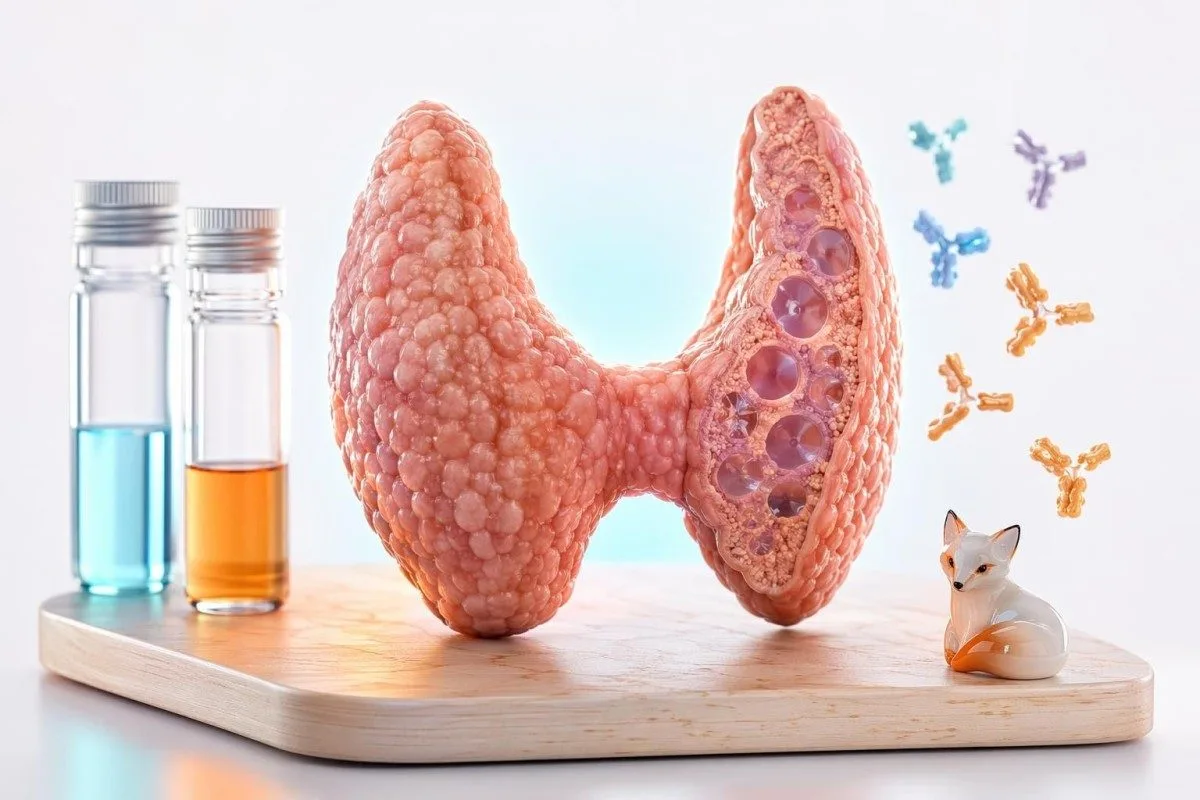
A practical endocrinology-style guide to reading thyroid patterns after one abnormal result, with the follow-up tests that usually settle the question.


- Low TSH + high free T4 or free T3 usually means thyrotoxicosis; positive TRAb or TSI strongly supports Graves disease.
- High TSH + low free T4 is overt primary hypothyroidism, most often autoimmune Hashimoto’s when TPOAb or TgAb are positive.
- TSH reference ranges are commonly about 0.4–4.0 mIU/L in adults, but pregnancy, age, illness and lab methods shift the interpretation.
- Free T4 normal range is often 0.8–1.8 ng/dL, or roughly 10–23 pmol/L; abnormal TSH only makes sense when paired with free T4.
- Free T3 is especially useful when TSH is suppressed and free T4 is normal, because early Graves can be T3-predominant.
- TPOAb positivity supports autoimmune thyroid disease but does not prove current hypothyroidism; many antibody-positive patients have normal TSH for years.
- TRAb test or TSI positivity is the most specific blood clue for Graves disease and is also used in pregnancy and relapse-risk decisions.
- Low radioactive iodine uptake after high thyroid hormone points toward thyroiditis, excess thyroid medication, recent iodine exposure or amiodarone rather than Graves.
- Biotin 5–10 mg/day can make TSH look falsely low and free T4/free T3 falsely high; many clinicians repeat testing after 48–72 hours off biotin.
What an abnormal thyroid result usually means first
An abnormal thyroid disease blood test is sorted by pattern: low TSH with high free T4 or free T3 points to hyperthyroidism; positive TRAb or TSI makes Graves likely; high TSH with low free T4 points to primary hypothyroidism, often Hashimoto’s when TPOAb or TgAb are positive; low TSH with high hormones but negative TRAb and low uptake suggests thyroiditis or medication effect. Kantesti AI helps users map these patterns in about 60 seconds after upload.
The first mistake I see is treating TSH as a diagnosis rather than a signal. A TSH of 0.02 mIU/L means very different things when free T4 is 2.4 ng/dL, when free T4 is 1.1 ng/dL after liothyronine, or when a patient took 10 mg of biotin that morning; our deeper thyroid panel guide explains why the panel matters more than any single flag.
In our analysis of 2M+ uploaded blood tests, the commonest confusing split is this: people with palpitations and a low TSH are told they have Graves, but their antibody and uptake pattern later says thyroiditis. The reason we worry about that distinction is treatment; Graves may need antithyroid medication, while thyroiditis often burns out over 6–18 weeks and is treated mainly with symptom control.
As of May 6, 2026, the practical first-line pattern is still simple. Low TSH + high free T4/free T3 equals thyrotoxicosis until proven otherwise, high TSH + low free T4 equals overt hypothyroidism, and normal TSH with symptoms often needs a wider look at iron, B12, cortisol, medications and sleep rather than endless thyroid retesting.
How TSH separates hypo from hyperthyroid patterns
TSH is the pituitary’s thyroid signal, and adult reference intervals are often about 0.4–4.0 mIU/L. Values below 0.1 mIU/L usually suggest thyroid hormone excess or TSH suppression, while values above 10 mIU/L strongly raise the probability of true primary hypothyroidism even if free T4 is still near the lower end.
A TSH above 10 mIU/L is one of the few thyroid numbers where clinicians become much less tolerant of watchful waiting. In the American Thyroid Association hypothyroidism guideline, Jonklaas et al. describe levothyroxine as standard treatment for overt hypothyroidism, especially when TSH is high and free T4 is low (Jonklaas et al., 2014).
A TSH between 4.0 and 10 mIU/L with normal free T4 is subclinical hypothyroidism, not automatic lifelong medication. I usually ask three questions before calling it disease: was the patient recently ill, are TPO antibodies positive, and has the TSH stayed high on repeat testing 6–8 weeks later; our normal TSH range article goes deeper on age and timing.
A TSH below 0.1 mIU/L is more concerning than a TSH of 0.25 mIU/L because atrial fibrillation and bone loss risk rise when suppression is persistent. A 72-year-old with TSH 0.03 mIU/L, free T4 1.9 ng/dL and tremor is a different patient from a 28-year-old with TSH 0.28 mIU/L after a night shift and normal thyroid hormones.
Why free T4 confirms the direction of thyroid disease
Free T4 tells whether abnormal TSH reflects too little or too much circulating thyroid hormone. A typical adult free T4 range is about 0.8–1.8 ng/dL, or 10–23 pmol/L, and low free T4 with high TSH confirms overt primary hypothyroidism.
When I review a panel showing TSH 18 mIU/L and free T4 0.5 ng/dL, I do not need many extra tests to know the patient is biochemically hypothyroid. The antibody result then answers the cause question, not the function question.
A high free T4 with a suppressed TSH means thyrotoxicosis, but the source is still open. Graves, painless thyroiditis, toxic nodules, excess levothyroxine and iodine-triggered thyrotoxicosis can all produce free T4 around 2.0–4.0 ng/dL; the next clue is TRAb/TSI and often uptake imaging.
A normal free T4 does not always close the file. Subclinical disease, early Graves, T3-predominant thyrotoxicosis and central hypothyroidism can hide behind a normal free T4, which is why I like pairing this with our focused free T4 levels guide when patients ask why their lab was flagged.
When free T3 gives the Graves clue TSH misses
Free T3 is most useful when TSH is suppressed but free T4 is normal or only mildly high. A typical free T3 reference interval is about 2.3–4.2 pg/mL, and isolated free T3 elevation can be an early Graves disease blood test clue.
Graves disease often overproduces T3 out of proportion to T4 because the stimulated gland becomes metabolically loud. I have seen patients with TSH below 0.01 mIU/L, free T4 1.6 ng/dL and free T3 6.1 pg/mL who looked clinically hyperthyroid despite a not-so-impressive free T4.
Free T3 can also mislead. Liothyronine tablets peak roughly 2–4 hours after dosing, so a patient taking 5–25 micrograms daily may show a high free T3 and low TSH that reflects timing rather than new Graves disease.
The best use of free T3 is pattern recognition, not screening everyone with fatigue. If low TSH, weight loss, tremor and high free T3 travel together, I move quickly to TRAb/TSI and sometimes uptake; for broader hormone pattern examples, see our guide to T3 and T4 levels.
What TPO antibodies say about Hashimoto’s risk
TPOAb positivity supports autoimmune thyroid disease and raises the risk of future hypothyroidism, but it does not prove current thyroid failure by itself. Many laboratories call TPOAb negative below about 35 IU/mL, although assay cutoffs vary substantially.
The common patient fear is that positive TPOAb means the thyroid is already destroyed. Not always. I have followed patients with TPOAb above 600 IU/mL and TSH 2.1 mIU/L for years; the lab tells us they are at risk, not that they need levothyroxine today.
TPOAb becomes more clinically meaningful when TSH is drifting upward. A patient with TSH 7.8 mIU/L, free T4 0.9 ng/dL and positive TPOAb has a higher probability of progression than someone with the same TSH after a viral illness and negative antibodies.
Hashimoto’s is usually a blood-test diagnosis plus clinical context, not a biopsy or dramatic scan. If you want the autoimmune-specific interpretation, our Hashimoto’s thyroid blood test article covers TSH, TPOAb and TgAb patterns in more detail.
Why TgAb can be the missing antibody result
TgAb, or thyroglobulin antibody, can support Hashimoto’s when TPOAb is negative or borderline. TgAb cutoffs vary widely by assay, with some laboratories using values below 4 IU/mL and others using cutoffs near 115 IU/mL, so the lab’s own reference range matters.
TgAb is the antibody I check when the story sounds autoimmune but TPOAb does not cooperate. Hair thinning, family autoimmune history, a small firm thyroid on examination, TSH 5.6 mIU/L and negative TPOAb can still turn into a coherent Hashimoto’s picture if TgAb is clearly positive.
TgAb also interferes with thyroglobulin measurement, which matters mainly after thyroid cancer treatment rather than routine hypothyroid evaluation. In everyday thyroid disease blood test interpretation, TgAb is most useful as a second autoimmune marker when TSH and free T4 are borderline.
Some European labs report TgAb in IU/mL with much higher numeric cutoffs than private laboratories in North America, so comparing raw numbers across labs can be messy. Our broader autoimmune panel blood test guide explains why antibody tests need assay-specific interpretation.
How TRAb and TSI point toward Graves disease
TRAb and TSI are the most specific blood clues for Graves disease after low TSH and high thyroid hormones. Many TRAb assays use a negative cutoff around 1.75 IU/L, and a clearly positive result with thyrotoxicosis usually makes Graves much more likely than thyroiditis.
The 2016 American Thyroid Association hyperthyroidism guideline lists TRAb testing as a recommended way to establish Graves disease when the diagnosis is not obvious (Ross et al., 2016). In clinic, this is often faster and cleaner than waiting for imaging if the patient is pregnant, recently exposed to iodine, or has classic eye findings.
TRAb is a receptor antibody family; TSI is the stimulating subset many clinicians associate with Graves activity. A positive TRAb test in a patient with TSH below 0.01 mIU/L, free T4 2.8 ng/dL and diffuse thyroid enlargement is a very different clue from a low-positive antibody in a normal-hormone patient.
Negative TRAb does not fully exclude Graves, especially early or mild disease, but it lowers the probability. If the story still looks hyperthyroid, I compare symptoms, free T3, thyroid blood flow on ultrasound, and uptake when safe; our low TSH guide gives the differential in practical order.
How thyroiditis mimics Graves on blood tests
Thyroiditis can produce low TSH and high free T4/free T3 just like Graves, but the gland is leaking stored hormone rather than manufacturing too much. TRAb is usually negative and radioactive iodine uptake is often low, commonly below 5% at 24 hours.
The blood test trap is that both Graves and thyroiditis can start with TSH below 0.01 mIU/L. A 38-year-old after a respiratory virus may show free T4 2.2 ng/dL for a few weeks, then drift into a temporary hypothyroid phase before normalizing.
Pain is helpful but not required. Subacute thyroiditis often causes neck tenderness and an ESR above 50 mm/hr, while painless or postpartum thyroiditis may cause no thyroid pain at all; that is why uptake and antibodies matter more than symptom stereotypes.
Treating thyroiditis as Graves can expose patients to unnecessary antithyroid drugs. If the pattern is low uptake, negative TRAb and falling hormones over 2–6 weeks, beta-blockers and monitoring often make more sense than methimazole; if high TSH follows, our high TSH pattern guide can help frame the recovery phase.
When uptake scans and ultrasound settle the cause
Radioactive iodine uptake helps separate hormone overproduction from hormone leakage. A typical 24-hour uptake range is about 10–30%, with Graves usually showing diffusely high uptake and thyroiditis, excess thyroid medication or recent iodine exposure showing low uptake.
Uptake is not the same as a CT scan and it is not needed for every abnormal thyroid disease blood test. I use it when TRAb is negative or equivocal, the symptoms are real, and treatment depends on knowing whether the gland is overproducing hormone.
Recent iodine can flatten uptake and confuse the scan. Contrast CT, kelp tablets, amiodarone and some antiseptic exposures may reduce uptake for weeks, so the timing history can matter as much as the percentage result.
Ultrasound adds another clue when imaging is chosen. Graves often has increased vascular flow, nodules point toward toxic nodular disease, and a heterogeneous small thyroid supports chronic autoimmune change; if you are deciding when to repeat labs before imaging, our repeat abnormal labs guide is useful.
Medication effects that can fake Graves or hypothyroidism
Medication and supplement effects can make thyroid results look like Graves, hypothyroidism or thyroiditis. Biotin, levothyroxine timing, liothyronine, amiodarone, glucocorticoids, dopamine, lithium, heparin and recent iodine exposure are the medication clues I check before diagnosing a new thyroid disease.
Biotin is the classic trap because 5–10 mg/day hair-and-nail doses can cause falsely low TSH and falsely high free T4/free T3 on susceptible immunoassays. Many clinicians repeat thyroid tests after 48–72 hours off biotin, and longer after very high neurologic doses; our biotin thyroid test guide explains the assay problem.
Levothyroxine timing creates subtler noise. Taking a 100 microgram tablet just before the lab can transiently raise free T4, while missed doses followed by catch-up dosing can produce high TSH with a normal or high-normal free T4 that looks contradictory.
Amiodarone is its own category because a 200 mg tablet contains a large iodine load and can cause both hypothyroidism and thyrotoxicosis. In my experience, the safest first move is not guessing; document dose, start date, iodine exposure and cardiac history, then interpret TSH, free T4, free T3 and antibodies together.
Why pregnancy, age and childhood change the cutoff
Pregnancy, age and childhood change thyroid interpretation enough that adult cutoffs can mislead. The 2017 ATA pregnancy guideline recommends trimester- and population-specific TSH ranges when available, and if not available, an upper TSH reference limit around 4.0 mIU/L may be used in early pregnancy (Alexander et al., 2017).
Pregnancy is where I see the most outdated advice repeated. The old reflex that every first-trimester TSH above 2.5 mIU/L is abnormal has been softened by newer population-based data, but TPOAb positivity, fertility treatment and prior thyroid disease still lower my threshold for closer follow-up.
TRAb also matters in pregnancy if there is current or past Graves disease, even after thyroid removal or radioiodine. A TRAb level more than 3 times the assay upper limit around 18–22 weeks can trigger fetal surveillance because maternal antibodies can cross the placenta.
Children are not small adults for TSH interpretation. Neonates and younger children can have higher TSH ranges than adults, while adolescents move closer to adult intervals; we keep separate logic in Kantesti because a normal result for a 9-year-old may be flagged in an adult table. For patient-facing details, see our pregnancy TSH cutoffs and children’s TSH ranges.
Symptoms that make the same lab result more urgent
Symptoms change urgency because the same TSH can be low-risk or same-day risky depending on heart rhythm, age and severity. Low TSH with chest pain, fainting, confusion, fever, heart failure or a resting heart rate above about 120 beats per minute deserves urgent medical assessment.
A 29-year-old with TSH 0.08 mIU/L, free T4 1.9 ng/dL and mild tremor may need prompt outpatient follow-up. A 76-year-old with the same labs and new atrial fibrillation is a different risk category because thyroid hormone excess can destabilize rhythm and heart failure.
Hypothyroid urgency is less common but real. Severe weakness, low temperature, confusion, slow heart rate, low sodium or swelling around the eyes with very high TSH and low free T4 can point toward severe decompensation, especially in older adults or after infection.
Most patients sit between those extremes, and that is where clinical judgement matters. If palpitations are part of the story, it is sensible to check electrolytes and rhythm clues too; our irregular heartbeat blood test article covers potassium, magnesium and related labs doctors often order.
How soon to repeat thyroid labs after an abnormal result
Repeat testing depends on the pattern, but 6–8 weeks is the standard interval after starting or changing levothyroxine because TSH equilibrates slowly. In suspected thyroiditis or significant thyrotoxicosis, clinicians may recheck free T4 and free T3 sooner, often in 2–4 weeks.
TSH has a long feedback tail. After a levothyroxine dose change from 75 to 100 micrograms, a TSH checked in 10 days can be emotionally satisfying but clinically noisy; our levothyroxine timeline explains why 6–8 weeks is the usual recheck window.
Hyperthyroid follow-up is more hormone-driven at first. Free T4 and free T3 often move before TSH recovers, so a patient improving on antithyroid therapy may still have TSH below 0.01 mIU/L for weeks even when free T4 is back near 1.2 ng/dL.
Use the same lab when possible. A shift from TSH 4.8 to 5.3 mIU/L across different assays may be less meaningful than a shift from 2.1 to 8.9 mIU/L in the same system; our blood test variability guide helps patients avoid overreacting to small analytical changes.
How Kantesti reads thyroid panels without overcalling them
Kantesti AI interprets thyroid results by combining TSH, free T4, free T3, antibody status, units, reference ranges, medication clues, age, pregnancy status when provided and trend history. Our platform does not diagnose Graves or Hashimoto’s; it prioritizes the safest next questions to discuss with a clinician.
Kantesti’s neural network flags incompatible patterns, such as high TSH with high free T4 after recent levothyroxine dosing, or low TSH with high free T3 after liothyronine. That matters because a simple red or high flag can push patients toward the wrong disease label.
Our medical workflow is reviewed against clinical standards, and patients can read more about our medical validation and the Kantesti benchmark if they want the technical background. I am Thomas Klein, MD, and in my CMO review work I am much more interested in whether an answer is safe, humble and clinically sequenced than whether it sounds clever.
Kantesti AI also links thyroid findings with other biomarkers when they change the differential. Low ferritin, B12 deficiency, high CRP, abnormal liver enzymes, kidney disease and pregnancy labs can all affect fatigue, hair loss and palpitations; our biomarker guide shows how broad interpretation prevents thyroid tunnel vision.
What to do next with your thyroid blood test
The next step after an abnormal thyroid result is to match the pattern to the right follow-up: repeat TSH/free T4 when borderline, add TPOAb/TgAb for suspected Hashimoto’s, add TRAb/TSI for suspected Graves, and consider uptake or ultrasound when the cause remains unclear. Uploading a report to free blood test analysis can help you prepare better questions for your appointment.
Bring the actual report, not just a screenshot of the abnormal flag. Units matter: free T4 in ng/dL is not the same display as pmol/L, TRAb cutoffs differ by assay, and TgAb numbers are especially hard to compare across laboratories.
If you use Kantesti, keep the story attached to the numbers: medication list, biotin dose, pregnancy status, recent iodine contrast, postpartum timing, viral illness and prior thyroid treatment. Our About Us page explains how Kantesti LTD operates, and our Medical Advisory Board page lists the clinicians involved in review and governance.
Kantesti research publications are listed here for readers who track our wider medical education work: Kantesti AI Research Group. (2026). B Negative Blood Type, LDH Blood Test & Reticulocyte Count Guide. Figshare. https://doi.org/10.6084/m9.figshare.31333819. Also indexed for academic discovery through ResearchGate and Academia.edu.
Kantesti AI Research Group. (2026). Diarrhea After Fasting, Black Specks in Stool & GI Guide 2026. Figshare. https://doi.org/10.6084/m9.figshare.31438111. Our broader validation work, including population-scale benchmark design, is available in the Kantesti clinical validation publication; as Thomas Klein, MD, I still tell patients that no AI output replaces a clinician who can examine your thyroid and check your pulse.
Frequently Asked Questions
What blood test confirms Graves disease?
The most specific blood test for Graves disease is TRAb or TSI, especially when TSH is suppressed below 0.1 mIU/L and free T4 or free T3 is high. Many TRAb assays use a negative cutoff around 1.75 IU/L, but the exact cutoff depends on the laboratory. A positive TRAb or TSI result strongly supports Graves, while a negative result makes thyroiditis, medication effect or nodular thyroid disease more likely.
Can Hashimoto’s have normal TSH?
Yes, Hashimoto’s can have normal TSH for months or years if the thyroid is still producing enough hormone. TPOAb or TgAb positivity shows autoimmune thyroid tendency, but current hypothyroidism requires the hormone pattern, usually high TSH and low free T4 in overt disease. A person with TPOAb above 100 IU/mL and TSH 2.0 mIU/L usually needs monitoring rather than automatic levothyroxine.
What thyroid blood test pattern suggests thyroiditis instead of Graves?
Thyroiditis often shows low TSH with high free T4 or free T3, negative TRAb or TSI, and low radioactive iodine uptake, commonly below 5–10% at 24 hours. Graves more often shows positive TRAb or TSI and diffusely high uptake above about 30%. The distinction matters because thyroiditis is usually hormone leakage and often does not need antithyroid medication.
How long should I stop biotin before thyroid testing?
Many clinicians advise stopping ordinary high-dose biotin supplements for 48–72 hours before thyroid testing, especially doses of 5–10 mg/day used for hair and nails. Very high medical doses may require a longer washout, sometimes up to a week, depending on the assay and clinician advice. Biotin can falsely lower TSH and falsely raise free T4 or free T3 on susceptible immunoassays.
Can free T3 be high when free T4 is normal?
Yes, free T3 can be high while free T4 remains normal, and this can happen in early or T3-predominant Graves disease. A typical free T3 range is about 2.3–4.2 pg/mL, so values above the lab range with TSH below 0.1 mIU/L deserve follow-up. Liothyronine medication can create the same pattern if the blood test is taken 2–4 hours after a dose.
When should thyroid labs be repeated after a high TSH?
A borderline high TSH with normal free T4 is often repeated in about 6–8 weeks, especially if the patient was recently ill or changed medication. After starting or changing levothyroxine, 6–8 weeks is also the usual interval because TSH takes time to equilibrate. A high TSH above 10 mIU/L, low free T4, pregnancy, severe symptoms or positive antibodies may justify faster clinician follow-up.
Is a thyroid uptake scan always needed after low TSH?
No, an uptake scan is not always needed after low TSH because TRAb or TSI, free T4, free T3, medication history and clinical findings often answer the question. Uptake is most useful when Graves and thyroiditis remain hard to separate, or when nodular thyroid disease is suspected. A 24-hour uptake above about 30% supports hormone overproduction, while low uptake below 5–10% suggests leakage, medication excess or iodine effect.
Should I take my levothyroxine before a thyroid blood test?
Unless your clinician has told you differently, have blood drawn before taking your morning levothyroxine dose, then take it afterward. This reduces the short-term rise in free T4 and makes comparisons with prior results more reliable.
Can a pituitary problem cause low thyroid hormone with a normal or low TSH?
Yes. In central hypothyroidism, the pituitary does not send enough TSH, so free T4 may be low while TSH is normal or low instead of high. This uncommon pattern needs clinician review, not just routine thyroid dose adjustment.
Get AI-Powered Blood Test Analysis Today
Join over 2 million users worldwide who trust Kantesti for instant, accurate lab test analysis. Upload your blood test results and receive comprehensive interpretation of 15,000+ biomarkers in seconds.
📚 Referenced Research Publications
Klein, T., Mitchell, S., & Weber, H. (2026). B Negative Blood Type, LDH Blood Test & Reticulocyte Count Guide. Kantesti AI Medical Research.
Klein, T., Mitchell, S., & Weber, H. (2026). Diarrhea After Fasting, Black Specks in Stool & GI Guide 2026. Kantesti AI Medical Research.
📖 External Medical References
⚕️ Medical Disclaimer
This article is for educational purposes only and does not constitute medical advice. Always consult a qualified healthcare provider for diagnosis and treatment decisions.
E-E-A-T Trust Signals
Experience
Physician-led clinical review of lab interpretation workflows.
Expertise
Laboratory medicine focus on how biomarkers behave in clinical context.
Authoritativeness
Written by Dr. Thomas Klein with review by Dr. Sarah Mitchell and Prof. Dr. Hans Weber.
Trustworthiness
Evidence-based interpretation with clear follow-up pathways to reduce alarm.