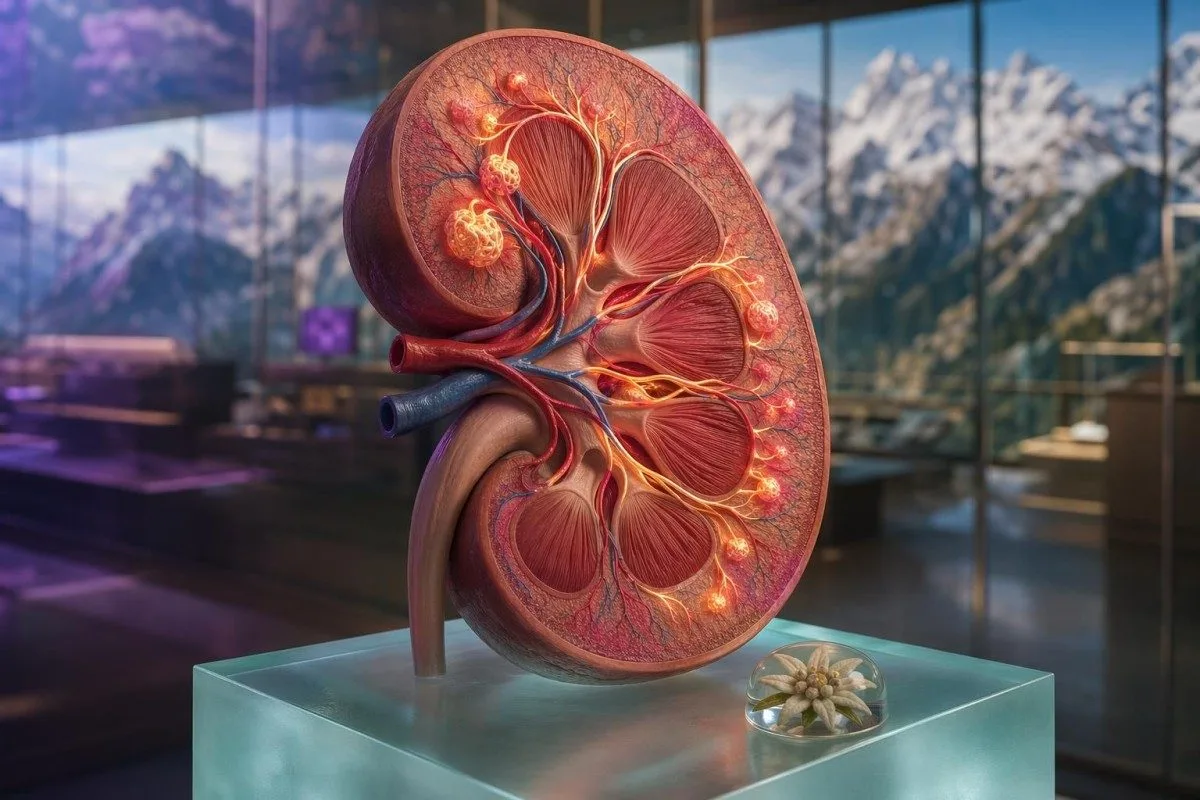
An eGFR flag can look frightening when you feel perfectly well. The number is an estimate, not a verdict, and context changes almost everything.


- eGFR estimates how much fluid your kidney filters each minute, adjusted to 1.73 m² body surface area.
- Normal eGFR is usually 90 mL/min/1.73 m² or higher, but 60-89 can be acceptable in older adults if urine tests are normal.
- Low eGFR meaning depends on persistence: eGFR below 60 for at least 3 months can meet criteria for chronic kidney disease.
- One low result may reflect dehydration, recent heavy exercise, creatine use, high meat intake, or medicines such as trimethoprim and NSAIDs.
- Creatinine-based eGFR can underestimate kidney function in muscular people and overestimate it in people with low muscle mass.
- Urine ACR is the missing partner test; albumin above 30 mg/g or 3 mg/mmol suggests kidney leakage even if eGFR is normal.
- Cystatin C eGFR helps when creatinine is misleading, especially in frailty, bodybuilding, amputation, pregnancy-adjacent physiology, or unusual diets.
- Urgent review is needed for eGFR below 15, potassium around 6.0 mmol/L or higher, very low urine output, swelling, confusion, or a rapid fall.
What eGFR means on a kidney blood test
eGFR means estimated glomerular filtration rate: an estimate of how well your kidneys filter waste from the blood. A result of 90 or above is usually normal, 60-89 may be age-related if urine tests are clear, and below 60 deserves repeat testing and context. One number does not diagnose kidney disease.
When I review a panel showing eGFR 58 in a well 67-year-old, I do not start with panic; I start with the trend, the creatinine, the urine albumin result, and the medication list. On Kantesti AI, our AI blood test interpretation reads eGFR beside creatinine, BUN, electrolytes, age, sex, and prior results rather than treating the flag as a diagnosis.
Estimated glomerular filtration rate is reported in mL/min/1.73 m², which means millilitres filtered per minute adjusted to a standard body surface area. The adjustment is useful for comparing people, but it can feel odd if you are very small, very tall, highly muscular, or clinically frail.
I am Thomas Klein, MD, and in my clinical work the most common eGFR misunderstanding is this: people think it measures kidney function directly. It does not. It is calculated from blood chemistry, mainly creatinine, which is why our how to read blood test results guide spends so much time on patterns rather than isolated red flags.
How laboratories calculate eGFR from creatinine
Most labs calculate eGFR from serum creatinine, age, and sex using an equation rather than measuring filtration directly. Since 2021, many laboratories have moved to race-free CKD-EPI equations, because Inker et al. published a validated equation in the New England Journal of Medicine that does not use race.
Creatinine is a waste product from muscle metabolism, and adult reference ranges are often around 0.6-1.2 mg/dL, or about 53-106 µmol/L, depending on the laboratory. A creatinine of 1.1 mg/dL can generate a different eGFR in a 28-year-old woman than in a 78-year-old man.
The 2021 CKD-EPI creatinine equation removed race from the calculation, and the paired creatinine-cystatin C equation is usually more accurate when both markers are available (Inker et al., 2021). If your older reports used a different equation, a small jump in eGFR may reflect math, not a sudden kidney recovery.
Some European labs still display eGFR as “greater than 90” rather than a precise value above that level, while many US portals show exact numbers. If a unit change or lab-system change has confused you, our guide to lab values in different units explains why the same biology can look different on paper.
A measured GFR test uses markers such as iohexol, iothalamate, or radioisotope clearance and is usually reserved for kidney donation workups, complex drug dosing, or unusual body composition. For a deeper comparison, see our GFR test versus eGFR explainer.
What range is normal, borderline, or low
An eGFR of 90 mL/min/1.73 m² or higher is usually considered normal kidney filtration in adults. An eGFR of 60-89 is mildly reduced but does not confirm chronic kidney disease unless urine albumin, imaging, or other kidney markers are abnormal.
The clinical categories are G1 above 90, G2 60-89, G3a 45-59, G3b 30-44, G4 15-29, and G5 below 15 mL/min/1.73 m². These categories come from kidney-risk staging, not from a promise that every person with G2 has kidney disease.
Age matters. In our analysis of millions of uploaded lab reports, we often see healthy adults in their late 70s sitting around eGFR 60-75 with normal urine ACR and stable creatinine; that pattern is different from a 35-year-old falling from 105 to 62 in 18 months.
For a focused age chart, our eGFR normal range by age article is useful because it separates expected ageing from true risk signals. The practical question is not “is my number perfect?” but “is it stable, explained, and paired with a normal urine result?”
What low eGFR means and when it is CKD
Low eGFR meaning depends on duration and associated abnormalities. KDIGO defines chronic kidney disease as kidney structure or function abnormalities present for more than 3 months, so a single eGFR of 55 does not automatically mean permanent kidney disease.
According to the KDIGO 2024 CKD guideline, eGFR below 60 mL/min/1.73 m² for at least 3 months can define chronic kidney disease even without symptoms. The same guideline also treats albuminuria, abnormal urine sediment, imaging changes, and biopsy-proven abnormalities as kidney markers, even when eGFR is higher.
A one-off eGFR of 52 after gastroenteritis, a long flight, or several days of ibuprofen is a different clinical story from eGFR 52 on four panels over a year. The first may be an acute, reversible dip; the second needs a CKD risk conversation.
People often arrive at our low GFR with normal creatinine guide because their portal says “low” while the creatinine still sits inside the lab range. That happens because eGFR is age-adjusted and can flag early before creatinine crosses the printed reference limit.
Why eGFR can look low even if you feel fine
eGFR can look low while you feel well because early kidney impairment is usually silent and creatinine is affected by muscle, hydration, food, supplements, and medicines. Many patients have no symptoms until kidney filtration is well below 30 mL/min/1.73 m².
The kidneys have a large reserve. In clinic, I have seen patients working full-time, exercising, and sleeping normally with eGFR in the 35-45 range, especially when the decline has been slow.
Creatinine rises after intense resistance training, muscle injury, cooked meat meals, and creatine supplementation, and each of those can make eGFR look temporarily lower. Our creatine supplement and creatinine article walks through the awkward but common situation of a fit person being labelled as having kidney trouble.
Dehydration can raise creatinine and BUN together, making eGFR look worse for 24-72 hours. If your result followed vomiting, sauna use, heavy sweating, or a long fasting window, our dehydration and blood results guide is worth reading before assuming the worst.
Low muscle mass creates the opposite problem: eGFR may look reassuring because creatinine is low, even when true filtration is reduced. This is why an 82-year-old with frailty and creatinine 0.8 mg/dL may still need cystatin C or urine ACR.
How eGFR differs from creatinine, BUN, and renal panel results
eGFR estimates filtration, creatinine provides the raw calculation input, and BUN reflects urea handling, hydration, protein intake, and kidney clearance. A renal function panel adds electrolytes and minerals that often reveal risk before symptoms appear.
BUN, or blood urea nitrogen, is commonly around 7-20 mg/dL in many adult labs, though ranges vary. A high BUN with only mildly changed creatinine often points toward dehydration, high protein intake, gastrointestinal bleeding, or catabolic stress rather than kidney scarring alone.
The BUN-to-creatinine ratio is often around 10:1 to 20:1 when both are reported in mg/dL. A ratio above 20:1 can occur with low circulating volume, while a low ratio can appear with low protein intake, liver issues, or dilution; our BUN creatinine ratio guide shows the pattern logic.
A renal panel usually includes sodium, potassium, chloride, bicarbonate or CO2, calcium, phosphorus, albumin, BUN, creatinine, and eGFR. If you want the full map, our renal function panel article explains which results change early and which change late.
Potassium matters because kidney filtration affects potassium removal. A potassium result near 6.0 mmol/L, especially with weakness, palpitations, kidney disease, or certain medicines, is not a casual repeat-next-month finding.
Why repeat testing and trends matter more than one result
A stable eGFR trend is usually more useful than one flagged value. NICE and KDIGO-aligned practice commonly repeats a new eGFR below 60 within about 2 weeks to rule out acute kidney injury, then confirms chronicity over 3 months.
Biological and analytical variation can move creatinine enough to shift eGFR by several mL/min/1.73 m². A change from 74 to 69 may be noise; a change from 92 to 58 with the same lab and no explanation is not noise.
I see this pattern often: a patient has eGFR 57, drinks more water, repeats it 10 days later, and returns to 69. That does not prove hydration “fixed the kidneys”; it tells us the first result needed context, which is why our repeat abnormal labs guide is deliberately practical.
A sustained fall of more than 5 mL/min/1.73 m² per year is usually faster than expected ageing and deserves investigation. Some referral guidelines use a drop of 15 mL/min/1.73 m² per year, or a 25% fall with a category change, as a clear escalation signal.
Kantesti AI trend analysis flags direction, velocity, and paired abnormalities across dates. Our blood test comparison article explains why side-by-side comparison is safer than scrolling through isolated portal pages.
Why urine ACR can matter as much as eGFR
Urine albumin-to-creatinine ratio, or ACR, detects kidney leakage that eGFR can miss. Albumin above 30 mg/g, or 3 mg/mmol in UK-style units, suggests abnormal kidney albumin loss even when eGFR is still above 90.
The 2010 CKD Prognosis Consortium meta-analysis by Matsushita et al. found that both lower eGFR and higher albuminuria independently predicted all-cause and cardiovascular mortality. In plain English: a “normal” eGFR with high urine albumin is not automatically reassuring.
ACR categories are usually A1 below 30 mg/g, A2 from 30-300 mg/g, and A3 above 300 mg/g. In mmol-based reporting, that roughly corresponds to below 3 mg/mmol, 3-30 mg/mmol, and above 30 mg/mmol.
A first-morning urine sample is cleaner for ACR interpretation because exercise, fever, menstruation, urinary tract irritation, and recent heavy activity can raise albumin temporarily. Our kidney blood test guide covers why urine results often shift before creatinine does.
If eGFR is 72 and ACR is 8 mg/mmol, I pay attention. If eGFR is 72 and ACR is 0.8 mg/mmol on repeated first-morning samples, the risk conversation is usually calmer.
When cystatin C gives a fairer kidney estimate
Cystatin C can give a fairer eGFR estimate when creatinine is distorted by muscle mass, diet, supplements, limb loss, frailty, or very high training load. The combined creatinine-cystatin C equation is often more accurate than either marker alone.
Cystatin C is produced by most nucleated cells and is less dependent on muscle mass than creatinine. It is not perfect: thyroid disease, corticosteroids, smoking, inflammation, and obesity can shift cystatin C in ways clinicians still debate.
Inker et al. reported that equations using both creatinine and cystatin C improved GFR estimation accuracy compared with creatinine alone in many patients (Inker et al., 2021). That matters when drug dosing, kidney donation, or a new CKD label depends on a borderline number.
I often suggest asking about cystatin C when a muscular 42-year-old has eGFR 58 but normal ACR, normal blood pressure, and stable labs. Our GFR test with cystatin C article gives the specific scenarios where a recheck changes management.
Cystatin C is not available in every local lab, and some insurers or public systems restrict it. If it is unavailable, repeat creatinine under controlled conditions—well hydrated, no intense exercise for 24-48 hours, no large cooked meat meal beforehand—can still reduce noise.
Medicines, supplements, and diet changes that shift eGFR
Several common medicines and supplements can lower eGFR on paper or in reality. NSAIDs, trimethoprim, cimetidine, creatine, diuretics, ACE inhibitors, ARBs, and SGLT2 inhibitors can all change creatinine, kidney blood flow, or both.
Trimethoprim and cimetidine can raise creatinine by reducing tubular secretion, even when true filtration has not fallen much. I have seen creatinine rise by 0.2-0.4 mg/dL within days of trimethoprim, then settle after the course ends.
ACE inhibitors, ARBs, and SGLT2 inhibitors may cause an early eGFR dip that is sometimes expected and protective long term. A creatinine rise up to about 30% after starting an ACE inhibitor or ARB is often monitored rather than automatically stopped, but the clinical context matters.
NSAIDs such as ibuprofen and naproxen can reduce kidney blood flow, especially when combined with dehydration, diuretics, ACE inhibitors, ARBs, or older age. If your kidney number changed after a medication switch, our medication monitoring timeline can help you map timing before your review.
High protein intake can raise BUN and sometimes creatinine without proving kidney damage. Our high protein diet labs guide is useful for lifters and weight-loss patients whose BUN rises before anyone checks the diet history.
How eGFR connects with diabetes, blood pressure, and heart risk
eGFR is not just a kidney number; it also changes cardiovascular and diabetes risk planning. Lower eGFR and higher urine albumin predict heart attack, stroke, heart failure, and death more strongly together than either marker alone.
Matsushita et al. showed that eGFR below 60 and albuminuria above normal each increased mortality risk across general population cohorts, with risk rising steeply when both were abnormal. That is why a kidney result often changes cholesterol, blood pressure, and diabetes conversations.
Diabetes can damage kidney filtering units years before eGFR falls, and urine ACR is often the earlier clue. If your A1c is 6.5% or higher, or your fasting glucose repeatedly crosses 126 mg/dL, our diabetes blood test guide explains how kidney monitoring fits the diagnosis.
Blood pressure targets vary by country, age, albuminuria, frailty, and medication tolerance. In many kidney-risk patients, clinicians aim lower than 140/90 mmHg, but dizziness, falls, potassium, and creatinine can limit how aggressively we push.
SGLT2 inhibitors have changed kidney medicine because they reduce progression risk in many patients with diabetes, albuminuria, heart failure, or CKD. The evidence here is strong, but eligibility still depends on eGFR, albuminuria, diagnosis, and national prescribing rules.
When a low eGFR result needs urgent help
A low eGFR needs urgent care when it is severe, rapidly falling, or paired with dangerous chemistry changes. eGFR below 15, potassium around 6.0 mmol/L or higher, very low urine output, confusion, breathlessness, chest pain, or severe swelling should not wait for routine follow-up.
Acute kidney injury can develop over hours to days, and the eGFR equation is less reliable while creatinine is changing rapidly. A creatinine that doubles from 0.9 to 1.8 mg/dL is clinically serious even if the portal language sounds mild.
Potassium is the companion result I scan first. A potassium level of 6.0 mmol/L or higher can affect heart rhythm, while bicarbonate below about 18-20 mmol/L can suggest significant metabolic acidosis depending on the lab and clinical setting.
Our critical blood test values article explains why some lab calls trigger same-day action rather than a portal message. If you feel unwell, the symptom pattern beats any reassurance from a single calculated eGFR.
Emergency clues include new inability to pass urine, severe dehydration, persistent vomiting, black stools, new confusion, marked drowsiness, or sudden swelling of the legs and face. I would rather a patient be checked and sent home than sit on a dangerous potassium result overnight.
What to ask your doctor after a low eGFR flag
After a low eGFR flag, ask whether the result is new, stable, or rapidly changing; whether urine ACR was checked; and whether medicines, hydration, or recent exercise could explain it. Those three questions prevent a surprising amount of confusion.
Bring your last 2-5 creatinine and eGFR results if you have them. A clinician can make a better decision from five years of stable eGFR 62-68 than from one isolated eGFR 59 printed in red.
Ask whether you need urine ACR, urinalysis, repeat creatinine, cystatin C, kidney ultrasound, blood pressure review, diabetes testing, or medication adjustment. Our BMP blood test guide explains why emergency doctors often start with sodium, potassium, CO2, BUN, creatinine, and glucose.
If you have known CKD, ask about sick-day rules for dehydration illnesses, especially if you take diuretics, ACE inhibitors, ARBs, metformin, SGLT2 inhibitors, or NSAIDs. Different health systems phrase these rules differently, so get local instructions rather than copying a generic checklist.
Diet questions should be specific: sodium target, protein range, potassium restrictions only if needed, and whether phosphate additives matter for your stage. Our kidney-protective diet article avoids the common mistake of giving every kidney patient the same food list.
How to prepare for a repeat eGFR test
For a fair repeat eGFR test, keep hydration normal, avoid unusually hard exercise for 24-48 hours, avoid a very large cooked meat meal beforehand, and tell the clinician about creatine or new medicines. Do not stop prescribed drugs without advice.
Fasting is usually not required for creatinine or eGFR, but some panels include glucose or lipids that do have timing rules. If your order includes many markers, our fasting versus non-fasting guide helps you avoid repeating the wrong test.
Water is fine unless your clinician gave fluid restrictions for heart failure, advanced CKD, or hyponatraemia. Overdrinking litres before a test can dilute some values and will not prove that filtration has improved.
Avoid intense lower-body training, marathon-level exertion, or heavy lifting right before testing if the purpose is kidney clarification. Muscle stress can raise creatinine and sometimes AST or CK, creating a messy picture that looks worse than your baseline.
Use the same lab when possible. Different creatinine assays are standardised better than they used to be, but small differences can still move eGFR by 3-5 mL/min/1.73 m² near a threshold.
Special situations where eGFR can mislead
eGFR can be misleading in pregnancy, very high or low muscle mass, amputation, severe obesity, malnutrition, rapidly changing kidney function, and acute illness. In these cases, clinicians may use cystatin C, measured clearance, urine testing, or specialist review.
Pregnancy physiology increases filtration, so a creatinine that looks “normal” for a non-pregnant adult may be concerning during pregnancy. Many clinicians focus more on absolute creatinine, urine protein, blood pressure, and symptoms rather than relying on standard eGFR alone.
Older adults with sarcopenia may have deceptively low creatinine because they make less of it. That is one reason routine panels for seniors should not be read like panels from a 35-year-old athlete; our routine labs for seniors guide explains this baseline shift.
Athletes and bodybuilders can sit at higher creatinine because of muscle mass, creatine use, and training load. The safest interpretation uses ACR, blood pressure, cystatin C when appropriate, and a calm look at year-over-year data.
Acute illness is the hardest setting. If creatinine is rising today, the eGFR printed today is already behind the biology, which is why hospital teams often follow creatinine, urine output, potassium, bicarbonate, and fluid balance together.
How Kantesti AI interprets eGFR safely
Kantesti AI interprets eGFR by analysing the result with creatinine, BUN, electrolytes, age, sex, urine markers when available, medications, and prior trends. Our platform does not diagnose CKD from one number; it highlights patterns and explains what to discuss with a clinician.
Kantesti was built for the exact moment when a patient sees a red kidney flag at 10 p.m. and has no idea whether it is urgent. Our AI-powered blood test interpretation can read a PDF or photo and return a structured explanation in about 60 seconds, but it still tells you when human medical review is needed.
Our neural network maps eGFR against more than 15,000 biomarkers, including potassium, bicarbonate, calcium, phosphate, albumin, HbA1c, CRP, lipids, and urine results. The clinical safeguards behind this workflow are described in our medical validation standards, including how we handle borderline and critical patterns.
Kantesti AI also tracks family results and longitudinal patterns, which is particularly useful for inherited kidney risk, diabetes, hypertension, or repeated medication monitoring. If you want the broader marker library, our biomarkers guide shows how kidney results fit into full-panel interpretation.
As Thomas Klein, MD, I like AI most when it slows people down in the right way: not “ignore this,” not “panic,” but “repeat this, check urine ACR, review medicines, and contact care urgently if potassium or symptoms are present.” That is a more honest message than a red arrow alone.
Research notes, medical review, and your next step
As of May 6, 2026, the safest interpretation of eGFR still comes from combining guidelines, repeat testing, urine albumin, medication context, and patient history. A flagged eGFR is a prompt for structured review, not a standalone diagnosis.
This article was prepared under physician editorial oversight at Kantesti LTD, UK Company No. 17090423, with review standards supported by our Medical Advisory Board. We also publish technical validation work, including the pre-registered Kantesti AI Engine benchmark, so readers can see how our clinical reasoning is tested.
Kantesti AI research publication: Klein, T., & Kantesti AI Medical Team. (2026). C3 C4 Complement Blood Test & ANA Titer Guide. Zenodo. https://doi.org/10.5281/zenodo.18353989. ResearchGate: https://www.researchgate.net/search/publication?q=C3%20C4%20Complement%20Blood%20Test%20ANA%20Titer%20Guide. Academia.edu: https://www.academia.edu/search?q=C3%20C4%20Complement%20Blood%20Test%20ANA%20Titer%20Guide.
Kantesti AI research publication: Klein, T., & Kantesti AI Medical Team. (2026). Nipah Virus Blood Test: Early Detection & Diagnosis Guide 2026. Zenodo. https://doi.org/10.5281/zenodo.18487418. ResearchGate: https://www.researchgate.net/search/publication?q=Nipah%20Virus%20Blood%20Test%20Early%20Detection%20Diagnosis%20Guide%202026. Academia.edu: https://www.academia.edu/search?q=Nipah%20Virus%20Blood%20Test%20Early%20Detection%20Diagnosis%20Guide%202026.
If your lab report has eGFR, creatinine, BUN, potassium, or urine ACR and you want a plain-English read, upload it to Try Free AI Blood Test Analysis. Bottom line: repeat unexpected lows, ask for urine ACR, check the medication story, and treat symptoms or dangerous potassium as same-day issues.
Frequently Asked Questions
What does eGFR mean in a blood test?
eGFR means estimated glomerular filtration rate, which estimates how much fluid your kidneys filter each minute adjusted to 1.73 m² body surface area. Most adult labs consider eGFR 90 mL/min/1.73 m² or higher normal if urine tests are also normal. The result is calculated mainly from creatinine, age, and sex, so muscle mass, diet, medicines, and hydration can affect it.
Is an eGFR of 60 bad?
An eGFR of 60 mL/min/1.73 m² is borderline and needs context rather than automatic alarm. In an older adult with normal urine ACR and stable results, it may be a low-risk age-related finding. In a younger adult, or if it has fallen quickly from 90 or 100, it deserves repeat testing and investigation.
What is considered a low eGFR?
An eGFR below 60 mL/min/1.73 m² is generally considered low and may meet chronic kidney disease criteria if it persists for more than 3 months. eGFR 45-59 is category G3a, 30-44 is G3b, 15-29 is G4, and below 15 is kidney failure range. One low value can still be temporary, especially after dehydration, acute illness, intense exercise, or certain medicines.
Can eGFR go back up?
Yes, eGFR can go back up if the low result was caused by dehydration, medication effects, recent heavy exercise, high meat intake, creatine use, or acute illness. A repeat test may improve by 5-15 mL/min/1.73 m² when conditions are controlled, though the exact change varies. Long-term CKD-related declines are less likely to fully reverse, but treatment can often slow progression.
Why is my eGFR low but creatinine normal?
eGFR can be low while creatinine is still within the printed reference range because eGFR adjusts creatinine for age and sex. For example, a creatinine of 1.1 mg/dL may be normal on the lab sheet but can produce a lower eGFR in an older adult or smaller person. This is one reason clinicians look at trends, urine ACR, cystatin C, and body composition before labelling kidney disease.
What eGFR level requires urgent medical attention?
Urgent medical attention is needed when eGFR is very low, rapidly falling, or paired with dangerous findings such as potassium around 6.0 mmol/L or higher. eGFR below 15 mL/min/1.73 m² is kidney failure range and requires prompt specialist-level management. Seek same-day care for low urine output, severe swelling, confusion, breathlessness, chest pain, persistent vomiting, or severe dehydration.
Should I drink more water before repeating eGFR?
Normal hydration is sensible before repeating eGFR, but overdrinking water will not truly improve kidney filtration. Dehydration can temporarily raise creatinine and lower eGFR, so repeating the test when you are well hydrated can reduce noise. If you have heart failure, advanced kidney disease, low sodium, or a fluid restriction, follow your clinician’s fluid advice instead of increasing intake.
How often should my eGFR be rechecked if it is mildly low?
If eGFR is mildly reduced but stable, with normal urine ACR and no concerning symptoms, testing is often repeated at least yearly. Your clinician may check every 3–6 months when eGFR is falling, albumin is present in urine, or diabetes or blood pressure is uncontrolled.
Can I have a CT scan with contrast if my eGFR is low?
Often, yes, but the decision depends on how low the eGFR is and whether kidney function is stable. If eGFR is below 30 or there is possible acute kidney injury, your doctor may choose non-contrast imaging, arrange hydration, or recheck creatinine afterward.
Get AI-Powered Blood Test Analysis Today
Join over 2 million users worldwide who trust Kantesti for instant, accurate lab test analysis. Upload your blood test results and receive comprehensive interpretation of 15,000+ biomarkers in seconds.
📚 Referenced Research Publications
Klein, T., Mitchell, S., & Weber, H. (2026). C3 C4 Complement Blood Test & ANA Titer Guide. Kantesti AI Medical Research.
Klein, T., Mitchell, S., & Weber, H. (2026). Nipah Virus Blood Test: Early Detection & Diagnosis Guide 2026. Kantesti AI Medical Research.
📖 External Medical References
KDIGO Work Group (2024). KDIGO 2024 Clinical Practice Guideline for the Evaluation and Management of Chronic Kidney Disease. Kidney International.
⚕️ Medical Disclaimer
This article is for educational purposes only and does not constitute medical advice. Always consult a qualified healthcare provider for diagnosis and treatment decisions.
E-E-A-T Trust Signals
Experience
Physician-led clinical review of lab interpretation workflows.
Expertise
Laboratory medicine focus on how biomarkers behave in clinical context.
Authoritativeness
Written by Dr. Thomas Klein with review by Dr. Sarah Mitchell and Prof. Dr. Hans Weber.
Trustworthiness
Evidence-based interpretation with clear follow-up pathways to reduce alarm.