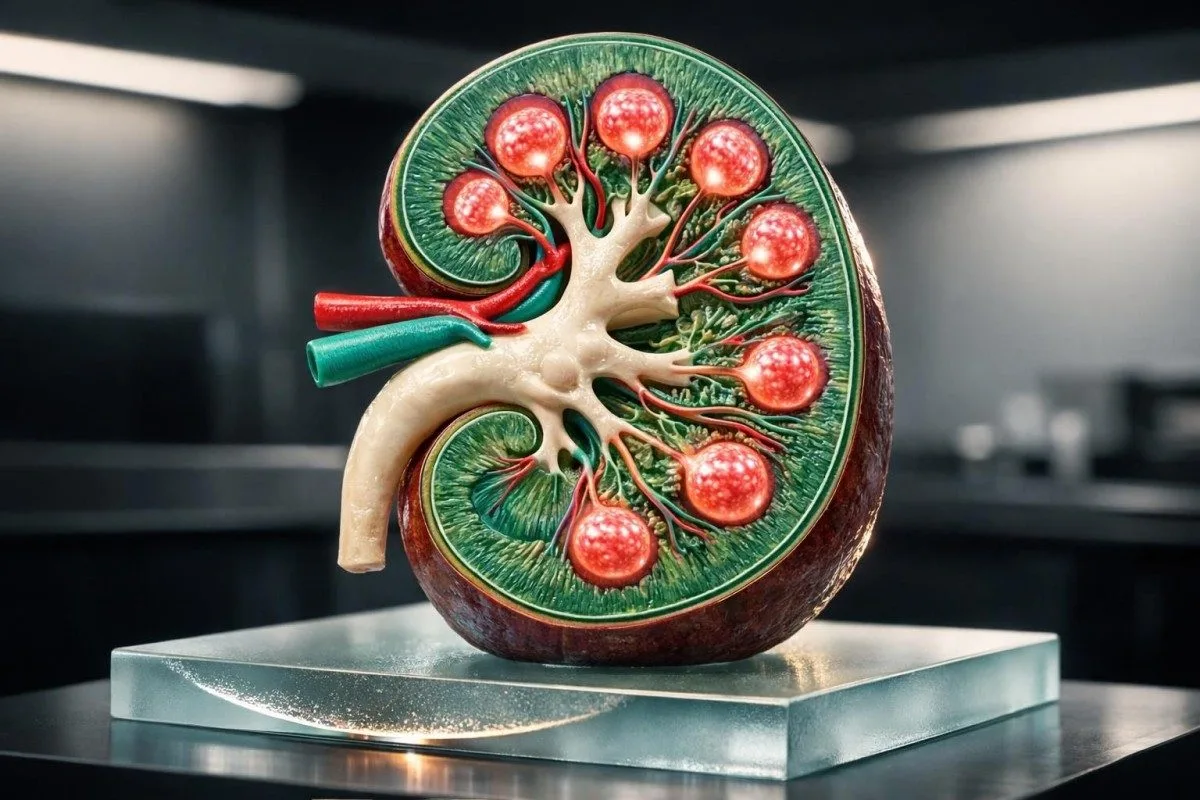
A low GFR with normal creatinine usually reflects calculated eGFR math, especially age and body composition, but it can also be early CKD. The result matters most when it stays below 60 for 3 months or comes with albumin in the urine.


- CKD threshold Persistent eGFR below 60 mL/min/1.73 m² for at least 3 months, or urine ACR above 30 mg/g, meets CKD criteria.
- Normal creatinine Creatinine around 0.6-1.1 mg/dL in women and 0.7-1.3 mg/dL in men can still pair with a low GFR because age is built into the equation.
- Age effect The same creatinine of 0.9 mg/dL can yield eGFR above 90 at age 30 and near 60 at age 75.
- Hydration noise A 0.1-0.2 mg/dL creatinine shift from dehydration, hard exercise, or a meat-heavy meal can move eGFR by 5-15 points near the cutoff.
- Urine ACR Albumin-creatinine ratio below 30 mg/g is reassuring; 30-300 mg/g needs follow-up; above 300 mg/g signals higher kidney risk.
- Cystatin C Borderline creatinine-based eGFR between 45 and 74 is often clarified by a cystatin C test.
- Urgent flags Potassium above 5.5 mmol/L, eGFR below 30, swelling, or falling urine output need prompt medical review.
- Repeat timing Borderline isolated results are often repeated in 1-4 weeks and confirmed again at 3 months if still low.
Why a low GFR can show up even when creatinine looks normal
Low GFR with normal creatinine usually means the lab reported an estimated GFR rather than a directly measured filtration rate. Because the equation includes age and sex, a creatinine of 0.9 mg/dL can produce very different GFR values in a 28-year-old and a 78-year-old.
One isolated GFR test below 60 mL/min/1.73 m² is not automatically kidney disease. The 2024 KDIGO guideline defines CKD as kidney abnormalities present for at least 3 months, including eGFR under 60 or urine albumin-creatinine ratio above 30 mg/g (KDIGO, 2024).
On Kantesti AI, we see this pattern most often in older adults, lean patients, and people checking routine labs after an illness. If you want the reference points first, our eGFR range guide gives the staging framework in plain language.
Normal creatinine can be a false reassurance. Our creatinine interpretation article shows why a value inside the lab range does not guarantee normal filtration when age, body size, and trend are taken seriously.
I tell patients this all the time—Thomas Klein, MD, in clinic and in our review meetings: treat the first low number as a flag to investigate, not a verdict. An eGFR stable at 58 for 4 years with urine ACR 8 mg/g is a very different story from a fall from 92 to 58 over 6 months.
What a measured GFR really is
A true measured GFR uses exogenous tracers such as iohexol or iothalamate, not routine serum creatinine alone. Most patients never need that level of testing, but it becomes useful when body composition is extreme or drug dosing demands precision.
How labs calculate eGFR from a kidney blood test
Most reported low GFR values come from a calculation based on serum creatinine, not from measuring filtration in real time. The current default in many labs is the 2021 CKD-EPI creatinine equation.
Inker et al. published the race-free CKD-EPI equation in 2021, and many laboratories switched over during the last few years (Inker et al., 2021). Around the cutoff of 60, a formula change alone can move an eGFR by roughly 3 to 10 mL/min/1.73 m².
That is why two reports from different centers can disagree even when the creatinine line is identical. Our GFR versus eGFR explainer walks through the difference without drowning you in math.
The creatinine assay matters too. Enzymatic assays are usually less vulnerable to interference than older Jaffe methods, which can be nudged by ketones, bilirubin, or some cephalosporin antibiotics.
A detail patients almost never hear: some labs still report based on older CKD-EPI logic first described by Levey et al. in 2009, while others round differently or cap reporting above a threshold (Levey et al., 2009). If you want the broader marker context, the biomarker guide shows where creatinine sits inside a full kidney panel.
Why one country reports 80 µmol/L and another 0.9 mg/dL
Creatinine is commonly reported as 0.6 to 1.3 mg/dL in the US and roughly 53 to 115 µmol/L in many other regions. The conversion is straightforward, but rounding plus lab calibration can make two perfectly valid reports look more different than they really are.
Why age can lower GFR even when creatinine stays normal
Age can lower estimated GFR even when creatinine stays normal because creatinine production usually falls as muscle mass falls. That is built into the math, not necessarily a sign of sudden kidney failure.
In healthy adults, measured GFR commonly declines about 0.75 to 1.0 mL/min/1.73 m² per year after age 40. So a 76-year-old with creatinine 0.9 mg/dL and eGFR 61 may have much less immediate risk than a 30-year-old with the same eGFR.
This is one of those areas where context matters more than the raw number. A stable eGFR of 58 with urine ACR 6 mg/g and normal potassium often behaves very differently from an eGFR of 58 that used to be 88 two years earlier.
Still, age does not magically protect the kidneys. KDIGO keeps the under-60-for-3-months threshold because cardiovascular and kidney outcomes worsen below it, even though clinicians genuinely disagree about how hard to label isolated G3a CKD in older adults with no albuminuria.
When I review a renal function panel compared with a CMP, I look for corroboration—potassium, bicarbonate, phosphate, albumin, and urine protein. A mildly low eGFR with everything else quiet often deserves confirmation rather than alarm.
Hydration, exercise, meat, and supplements that can skew the number
Hydration, heavy exercise, creatine supplements, and a large cooked-meat meal can all transiently lower eGFR by pushing creatinine upward a little. Near the 60 cutoff, even a small creatinine shift can look dramatic on paper.
Near the decision line, a 0.1 to 0.2 mg/dL creatinine change can move eGFR by roughly 5 to 15 points. That is why I never love making sweeping conclusions from a single sample drawn after a race, a sauna session, or a day of vomiting.
I see this after endurance events more than textbooks admit. A 42-year-old cyclist can show creatinine 1.12 mg/dL and eGFR 59 on Monday, then 0.93 mg/dL and eGFR 74 by Friday once the training block and dehydration have settled.
Acute vomiting, diarrhea, fever, or simply not drinking enough before the draw can do the same. Our guide to dehydration-related false highs gives practical clues if the whole panel looked concentrated.
Athletes are their own category. If high CK, AST, or dark urine are part of the picture, our performance blood test article is a better companion than repeating creatinine blindly the next morning.
When low GFR with normal creatinine may signal early kidney disease
Low eGFR with normal creatinine can mean early kidney disease when it persists for more than 3 months or appears alongside albuminuria, hypertension, diabetes, or abnormal urine sediment. Urine often tells the story sooner than creatinine does.
Urine ACR below 30 mg/g is normal to mildly increased, 30 to 300 mg/g is moderately increased, and above 300 mg/g is severely increased. The pairing that changes my tone fastest is eGFR 55 to 75 plus silent urine protein.
Patients usually feel fine at this stage, which is exactly why early diabetic and hypertensive kidney damage gets missed. A kidney blood test by itself can look almost ordinary while the urine is already waving a flag.
If fasting glucose, HbA1c, or insulin resistance markers are drifting, review our high glucose without diabetes guide. If blood pressure lives above goal—especially repeated readings over 130/80 mmHg—our blood pressure range article explains why the kidneys quietly absorb the hit.
And sometimes neither diabetes nor hypertension is the culprit. Autoimmune disease, reflux nephropathy, recurrent stones, obstructive uropathy, and inherited disorders can all reduce filtration before creatinine ever looks dramatic.
Which follow-up tests actually clarify a confusing renal function panel
The best next tests are usually urine ACR, cystatin C, a repeat renal function panel, and a good medication review. A combined creatinine-cystatin C eGFR is especially helpful when the creatinine-based result lands between 45 and 74 and does not fit the person in front of you.
Cystatin C is less dependent on muscle mass than creatinine, which helps in athletes, frail older adults, and people with amputations. It can still be affected by smoking, thyroid disease, glucocorticoids, and systemic inflammation, so I never treat it as magic.
The rest of the panel carries weight. Potassium above 5.5 mmol/L, bicarbonate below 22 mmol/L, or a rising BUN shifts the conversation from watchful follow-up to faster evaluation; our electrolyte panel guide and BUN normal range article explain those pattern clues.
If the picture stays muddy, measured GFR with iohexol or iothalamate clearance is the gold-standard style test, although we reserve it for special cases such as transplant workup, chemotherapy dosing, or extreme body composition. On Kantesti, we show when borderline results deserve that next layer rather than pretending every report is equally precise.
One practical point most patients appreciate: if a nephrology workup is coming, bring the original lab method and unit if you have it. A change from an older assay to an IDMS-traceable method can make the trend look worse or better than it really is.
When ultrasound earns its place
I order renal ultrasound sooner when the eGFR stays low, urine shows blood, or there is a history of stones, obstruction, or a family history of polycystic kidney disease. Size asymmetry, cortical thinning, or hydronephrosis changes the differential more than another isolated creatinine does.
When to repeat testing, and how long to wait
Repeat testing matters because CKD is defined by persistence. If the only issue is eGFR 45 to 59 with normal potassium, stable blood pressure, and no proteinuria, a repeat in 1 to 4 weeks is often reasonable, then again at 3 months if it stays low.
The timing gets shorter when the result is new or symptoms are present. A creatinine rise of 0.3 mg/dL within 48 hours can meet acute kidney injury criteria even when the absolute value still sits inside the lab reference range.
Trend beats snapshot. Our guide to comparing blood tests over time shows why three results across 6 months tell me more than one isolated panel from a walk-in lab.
Bring prior reports if you have them—even old PDF exports from another country help. Our PDF upload workflow was built because the clinically relevant question is often not Is 58 bad but Was it 82 last year or 57 for the last decade.
Most patients find the repeat result emotionally easier when they understand the goal. We are not asking the kidneys to prove innocence; we are checking whether the first number reflected biology, timing, or plain lab noise.
Repeat sooner if the number fell fast
A drop in eGFR of more than about 20% from a recent baseline is more than I expect from ordinary day-to-day noise. That kind of change pushes me to review medications, volume status, and urinalysis sooner.
Who commonly gets a falsely low or otherwise misleading eGFR
eGFR can mislead in people with unusual muscle mass, pregnancy, acute illness, limb amputation, cirrhosis, or rapid weight loss. The equation assumes average creatinine generation, and real humans are rarely average.
A bodybuilder taking 5 g of creatine daily may look worse on paper than they are. A frail 82-year-old with sarcopenia can look safer on paper than they are.
Pregnancy deserves a separate warning: standard eGFR equations are not well validated there, and true GFR often rises early in gestation. Rapidly changing kidney function is another trap, because eGFR formulas assume a steady state that acute illness simply does not provide.
This is why a basic lab printout can miss the story. Our standard blood test guide explains what routine panels include, and just as importantly, what they leave out.
In my experience, the most misread reports are from very fit adults and very frail older adults. Same creatinine. Completely different physiology.
Red flags that make a low GFR result more urgent
A low GFR result is more urgent when it comes with swelling, shortness of breath, markedly reduced urine output, hematuria, uncontrolled blood pressure, or potassium above 5.5 mmol/L. An eGFR below 30 mL/min/1.73 m² deserves prompt follow-up even in someone who feels fairly well.
One sentence I use often, as Thomas Klein, MD: symptoms and direction matter more than whether creatinine still looks normal. A patient with creatinine 1.1 mg/dL, eGFR 52, new ankle edema, and BUN rising from 18 to 36 mg/dL over 2 weeks is not a casual repeat-test case.
Medication history can rescue or clarify the situation. NSAIDs, contrast dye, diuretics, trimethoprim, ACE inhibitors, and ARBs can all reshape the pattern, which is why our BUN/creatinine ratio guide is useful only when you read it beside the full clinical story.
When Kantesti flags a kidney result as higher priority, that logic comes from physician review rather than a single threshold. You can see the experts behind that process on our medical advisory board.
A surprisingly common red flag is the patient who feels weak, slightly confused, and more short of breath but assumes the lab is fine because creatinine is still in range. That is exactly the person I do not want reassured by the word normal.
What to do before the repeat kidney blood test
Before a repeat GFR test, hydrate normally, avoid unusually hard exercise for 24 to 48 hours, and skip creatine or bodybuilding pre-workouts if your own clinician says that is safe. Do not force liters of water right before the draw; overdoing it creates a different kind of noise.
Keep the meal before testing boring. A very high-protein dinner, a night of heavy alcohol intake, or testing immediately after a long sauna session can all make a borderline result harder to interpret.
Use the same laboratory if you can. Our article on choosing a reliable local lab explains why same-lab comparison reduces false trend alarms.
If you are arranging follow-up yourself, be realistic about what self-ordering can and cannot solve. Our piece on ordering labs without a doctor helps patients decide when convenience is reasonable and when a clinician needs to own the workup.
And bring the full report, not just the eGFR line. I want creatinine, BUN, potassium, bicarbonate, glucose, albumin, collection date, and ideally a urine result from the same period.
If the low GFR persists, what actually helps
If a low GFR persists, the interventions with the best evidence are blood pressure control, diabetes management, albuminuria treatment, and avoiding nephrotoxins like regular NSAID use. Supplements sold as kidney cleanses rarely improve a true eGFR trend.
SGLT2 inhibitors and ACE inhibitor or ARB therapy have changed kidney care, but only when the underlying diagnosis fits. I mention this because many patients assume every low eGFR needs supplements; in my experience, the boring basics outperform internet fixes.
Protein advice is subtler than social media makes it sound. Most adults with CKD do not need zero protein; they usually need reasonable intake, less sodium, and medication review, especially if urine ACR is above 30 mg/g.
On our AI blood test platform, patients can watch eGFR beside glucose, potassium, and BUN rather than fixating on one line. In our dataset of more than 2 million uploaded reports, pattern review cuts false alarms far better than single-number interpretation.
People also need reassurance when the pattern is stable. Our patient success stories show how often the right next step was repeat testing, urine ACR, or cystatin C—not panic.
How Kantesti validates kidney interpretation and what to do next
Kantesti interprets low GFR by combining equation context, trend analysis, and physician-reviewed rules rather than treating every value under 60 as the same problem. As of April 15, 2026, we still label borderline eGFR findings as provisional until the urine story and repeat timing are clear.
That caution is deliberate. You can review who we are before trusting our clinical voice.
For methodology, our clinical standards page details how we validate biomarker interpretation, including kidney markers. Thomas Klein, MD, and our reviewers keep revising edge-case logic because lab equations and assay reporting do change.
If you want to test the workflow on your own report, try the free blood test demo. We usually return a structured explanation in about 60 seconds, and the Kantesti blog is where we publish updates when renal interpretation rules evolve.
That last point matters. A modern kidney blood test is not one number; it is a pattern, and the pattern is exactly what our platform was built to read.
Frequently Asked Questions
Can dehydration cause low GFR if creatinine is still normal?
Yes, mild dehydration can lower reported eGFR even when creatinine remains inside the lab reference range. Near the cutoff of 60 mL/min/1.73 m², a creatinine change of only 0.1 to 0.2 mg/dL can shift eGFR by about 5 to 15 points. This is common after vomiting, diarrhea, endurance exercise, or poor fluid intake before the draw. If the low GFR persists after normal hydration and repeat testing, it deserves a more formal kidney workup.
Is eGFR 59 serious if creatinine is 0.9 mg/dL?
An eGFR of 59 mL/min/1.73 m² with creatinine 0.9 mg/dL is not automatically serious, but it is not something I ignore. In a 75-year-old with stable results and urine ACR under 30 mg/g, it may reflect age-related decline or equation math. In a 30-year-old, the same number is more concerning, especially if prior results were above 90 or urine protein is present. The practical next step is repeat testing and a urine albumin-creatinine ratio.
Can age alone lower GFR when creatinine is normal?
Age can lower estimated GFR because the equation assumes creatinine generation declines as muscle mass declines. The same creatinine of 0.9 mg/dL can yield an eGFR above 90 in a younger adult and close to 60 in an older adult. Average measured GFR often falls by about 0.75 to 1.0 mL/min/1.73 m² per year after age 40. Age can explain part of the pattern, but persistent eGFR below 60 still deserves context from urine testing and trend review.
What test should come next after a low GFR result with normal creatinine?
The most useful next tests are usually urine albumin-creatinine ratio, cystatin C, a repeat renal function panel, and blood pressure review. Urine ACR below 30 mg/g is generally reassuring, while 30 to 300 mg/g suggests moderately increased albumin loss. Cystatin C helps when creatinine may be misleading because of high or low muscle mass. If potassium is above 5.5 mmol/L, bicarbonate is below 22 mmol/L, or symptoms are present, the follow-up should happen faster.
Can exercise or creatine supplements lower eGFR temporarily?
Yes, heavy exercise and creatine supplements can temporarily lower reported eGFR by raising serum creatinine without causing structural kidney damage. I see this especially in runners, cyclists, and strength athletes who test within 24 hours of hard training. A large cooked-meat meal can do something similar for 6 to 12 hours. Repeating the test after 24 to 48 hours of rest and normal hydration often gives a truer baseline.
When should I seek urgent care for a low GFR result?
A low GFR result needs urgent review if it comes with swelling, shortness of breath, very low urine output, confusion, chest symptoms, or potassium above 5.5 mmol/L. An eGFR below 30 mL/min/1.73 m² also deserves prompt medical attention, even without dramatic symptoms. A creatinine rise of 0.3 mg/dL within 48 hours can signal acute kidney injury, even if the value is still technically normal. The red flag is not only the number—it is the number plus symptoms, speed of change, and the rest of the panel.
Can a urinary tract infection change my eGFR result?
A simple bladder infection usually does not meaningfully lower eGFR, but fever, dehydration, a kidney infection, or urinary blockage can affect kidney function. Contact a clinician promptly for flank pain, fever, vomiting, or difficulty passing urine, and repeat testing after recovery when advised.
Should I avoid CT scan contrast dye if my eGFR is low?
Not necessarily. Modern iodinated CT contrast can often be used safely, but the imaging team should know your eGFR and any recent illness; they may check a current creatinine, recommend hydration when appropriate, or choose another test if kidney risk is high.
Can blood pressure medicines make my eGFR look lower even if my kidneys are protected?
Yes. ACE inhibitors or ARBs can cause a small expected creatinine rise after starting or dose increase, often checked within 1–2 weeks. Doctors usually focus on the trend, potassium level, and urine albumin before deciding whether any change is needed.
Get AI-Powered Blood Test Analysis Today
Join over 2 million users worldwide who trust Kantesti for instant, accurate lab test analysis. Upload your blood test results and receive comprehensive interpretation of 15,000+ biomarkers in seconds.
📚 Referenced Research Publications
Kantesti LTD (2026). Clinical Validation Framework v2.0 (Medical Validation Page). Kantesti AI Medical Research.
Kantesti LTD (2026). AI Blood Test Analyzer: 2.5M Tests Analyzed | Global Health Report 2026. Kantesti AI Medical Research.
📖 External Medical References
KDIGO 2024 CKD Guideline Work Group (2024). KDIGO 2024 Clinical Practice Guideline for the Evaluation and Management of Chronic Kidney Disease. Kidney International.
⚕️ Medical Disclaimer
This article is for educational purposes only and does not constitute medical advice. Always consult a qualified healthcare provider for diagnosis and treatment decisions.
E-E-A-T Trust Signals
Experience
Physician-led clinical review of lab interpretation workflows.
Expertise
Laboratory medicine focus on how biomarkers behave in clinical context.
Authoritativeness
Written by Dr. Thomas Klein with review by Dr. Sarah Mitchell and Prof. Dr. Hans Weber.
Trustworthiness
Evidence-based interpretation with clear follow-up pathways to reduce alarm.