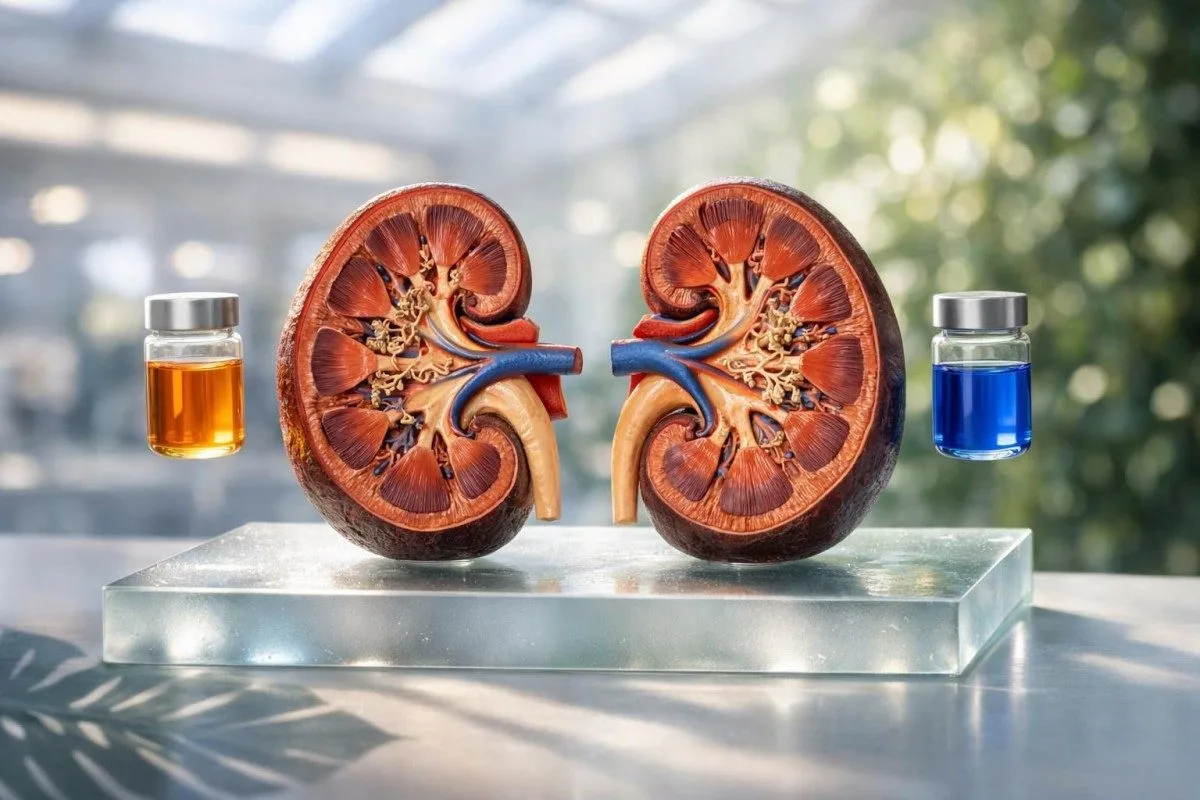
A BUN creatinine ratio around 10:1 to 20:1 is common in adults. Above 20:1 often fits dehydration, low kidney blood flow, or sometimes upper GI bleeding, while below 10:1 can reflect low protein intake, liver dysfunction, pregnancy, or dilution—unless creatinine itself is rising, which changes the story.


- Typical ratio is about 10:1 to 20:1 when BUN is roughly 7-20 mg/dL and creatinine is about 0.6-1.3 mg/dL in adults.
- High ratio above 20:1 more often suggests dehydration, vomiting, diarrhea, diuretics, heart failure, or reduced kidney perfusion than intrinsic kidney damage.
- Very high ratio above 30:1 with black stool, dizziness, or falling hemoglobin can point toward upper GI bleeding.
- Low ratio below 10:1 can occur with low protein intake, liver dysfunction, overhydration, pregnancy, or SIADH.
- AKI clue is a creatinine rise of 0.3 mg/dL within 48 hours or 1.5 times baseline within 7 days—more meaningful than the ratio alone.
- eGFR context matters: an eGFR below 60 mL/min/1.73 m² for more than 3 months supports CKD, but eGFR can mislead during acute changes.
- Electrolyte warning includes potassium 5.5 mmol/L or higher and bicarbonate below 20 mmol/L with rising creatinine; potassium 6.0 mmol/L is urgent.
- Kantesti AI interprets the ratio by comparing creatinine, BUN, eGFR, hemoglobin, electrolytes, medications, and prior trends in about 60 seconds.
How to read the BUN creatinine ratio as a pattern, not a verdict
The BUN creatinine ratio is best read as a pattern: about 10:1 to 20:1 is common, above 20:1 often fits dehydration or reduced kidney blood flow, and below 10:1 can reflect low protein intake, liver dysfunction, or dilution. On Kantesti AI, we teach people to interpret it beside creatinine, eGFR, hemoglobin, and symptoms. Our lab-reading guide uses the same approach.
BUN and creatinine come from different biology. BUN reflects urea made in the liver from protein metabolism, while creatinine reflects muscle waste cleared by the kidneys; because those analytes behave differently, the ratio can look high from dehydration, steroids, or digested blood even when the kidneys are not the primary problem.
Creatinine also lags. In early volume depletion, a BUN test may rise within hours while creatinine can stay near baseline for 24-48 hours, which is one reason our medical validation standards prioritize pattern recognition over one-number reactions.
I’m Thomas Klein, MD, and the mistake I see most is this: a patient notices a ratio of 24 and assumes kidney failure. In our review of more than 2M uploaded lab panels across 127+ countries, the safer question is whether high creatinine is present, whether the change is new, and whether related markers moved in the same direction.
One more nuance: a mathematically normal ratio can hide two abnormal numbers. A BUN of 40 mg/dL with creatinine 2.0 mg/dL gives a tidy 20:1 ratio, but that panel is still clearly abnormal and needs context.
Normal BUN, creatinine, and ratio ranges—what labs actually report
Most adult labs report BUN around 7-20 mg/dL and creatinine levels around 0.6-1.3 mg/dL, but the ratio matters only when both are in compatible units. For a deeper look at isolated BUN changes, see our BUN reference guide.
A typical adult BUN test reference interval is 7-20 mg/dL, and many labs use 0.6-1.3 mg/dL for creatinine. The commonly taught BUN creatinine ratio of 10:1 to 20:1 is a rule of thumb, not a universal law; some laboratories effectively accept something closer to 8:1 to 23:1.
Unit traps are common, especially outside the US. Many labs report urea in mmol/L rather than BUN in mg/dL, and some portals do not calculate the ratio at all; for isolated high creatinine questions, our creatinine reference guide is usually the better starting point.
Reference intervals also shift with age, muscle mass, sex assigned at birth, and pregnancy. A creatinine of 1.0 mg/dL may be ordinary in a muscular adult but unexpectedly high in a smaller older woman or in pregnancy, where creatinine often falls to roughly 0.4-0.8 mg/dL.
The practical takeaway is simple: ask whether the lab is reporting BUN or urea, whether creatinine fits the person in front of you, and whether the result changed from baseline. Those three questions prevent a lot of unnecessary panic.
When a high ratio usually means dehydration or low kidney perfusion
A high BUN creatinine ratio above 20:1 most often reflects dehydration or reduced kidney perfusion when creatinine is normal or only slightly high. Our guide to dehydration-related false highs explains why several labs can shift together.
The classic pattern is BUN 25-40 mg/dL with creatinine still near baseline, often around 0.8-1.2 mg/dL. Slow tubular flow and higher antidiuretic hormone levels let the kidney reclaim more urea than creatinine, so the ratio widens even before creatinine changes much.
I see this after vomiting, diarrhea, long flights, aggressive sauna use, fasting with poor water intake, and loop diuretics. It also happens in heart failure or severe infection, where kidney blood flow drops even if a patient is not especially thirsty; paired markers like albumin can help, and our albumin hydration guide explains that part well.
A small but useful bedside clue is timing. If the chemistry panel was drawn after a marathon, a stomach bug, or a week of high-dose diuretics, a high ratio often improves quickly once perfusion improves; intrinsic kidney disease usually does not normalize that fast.
Here is the subtle point many patients are never told: sarcopenia can exaggerate the ratio. A frail 78-year-old with creatinine 0.7 mg/dL and BUN 28 mg/dL may have more real kidney stress than a muscular 30-year-old with creatinine 1.2 mg/dL and the same BUN, which is why Kantesti AI compares age, body habitus, and prior labs instead of just printing 'high.'
Why GI bleeding can push the ratio up before creatinine changes
A ratio above 30:1 can be a clue to upper GI bleeding, especially if BUN rises while creatinine stays near baseline. When that happens, I immediately review hemoglobin and stool symptoms instead of assuming simple dehydration.
Upper GI bleeding can drive BUN upward because digested hemoglobin becomes a nitrogen load that the liver converts to urea; creatinine usually does not rise to the same extent. A ratio above 30:1 with a falling hemoglobin or new melena is a pattern I take seriously, and ulcer bleeding guidance from Laine and Jensen (2012) reflects that urgency.
Lower GI bleeding is less likely to do this because there is less time for protein digestion and absorption. Patients also confuse sticky tarry stool with harmless dark stool from iron or bismuth, so I often send them to our digestive symptoms guide and then ask about dizziness, tachycardia, and orthostatic symptoms.
One practical nuance: BUN may climb before hemoglobin fully declares the bleed, especially if the first sample was taken early or the patient is hemoconcentrated from vomiting. If the story fits, repeating a CBC and chemistry panel within 6-24 hours is often more useful than debating whether the ratio is 28 or 32.
In clinic, the combination that changes my behavior is not just a big ratio. It is a big ratio plus black stool, lightheadedness, or a hemoglobin drop of even 1-2 g/dL from prior records.
Upper vs lower GI bleeding patterns
A disproportionately high ratio favors an upper source more than a lower one because protein from digested blood is absorbed before it reaches the colon. That is not a perfect rule, but it is a helpful clue when labs and symptoms arrive before endoscopy does.
High creatinine with a normal or low ratio points more toward kidney causes
If creatinine levels are clearly high but the ratio is normal or low, intrinsic kidney problems, obstruction, or muscle-related creatinine rise move higher on the list than dehydration. A creatinine increase of 0.3 mg/dL within 48 hours meets KDIGO acute kidney injury criteria even when the ratio looks ordinary.
When creatinine levels are genuinely elevated, I shift attention from the ratio to kidney function itself. As of April 15, 2026, clinicians still use the KDIGO acute kidney injury threshold of a 0.3 mg/dL creatinine rise within 48 hours or 1.5 times baseline within 7 days, and our eGFR guide helps place that in context.
A patient with creatinine 1.8 mg/dL and BUN 18 mg/dL has a ratio of 10:1, which does not reassure me if the prior creatinine was 0.9 mg/dL. Intrinsic kidney causes, medication injury, obstruction, or pigment injury move higher on the list; the reason we compare estimated and measured context is that GFR and eGFR are not the same story.
This is where cystatin C can help. Inker et al. (2021) showed that combined creatinine-cystatin C equations estimate GFR more accurately than creatinine alone, which matters in smaller older adults, amputees, very muscular people, and anyone whose muscle mass makes high creatinine hard to interpret.
In my experience, urine findings often settle the argument. New protein, blood, or casts push me toward intrinsic kidney pathology, while flank pain, retention, or a suddenly enlarged bladder makes me think obstruction.
Low BUN creatinine ratio: low protein intake, liver disease, and dilution
A low BUN creatinine ratio below about 10:1 usually means BUN is suppressed rather than creatinine being reassuringly normal. The common reasons are low protein intake, impaired urea production in liver disease, overhydration, pregnancy, or occasionally SIADH.
Low protein intake is the cleanest benign explanation. A strict low-protein diet, under-eating during illness, or long-term frailty can push BUN to 5-8 mg/dL while creatinine sits at 0.8-1.0 mg/dL; for readers eating plant-based diets, our vegan lab checklist is worth saving.
The liver angle matters because urea is made in the liver. When liver synthetic function falls, BUN test results can run unexpectedly low even in a sick patient, so I cross-check albumin, bilirubin, INR, and the broader protein pattern; our serum proteins guide helps with that part of the panel.
Overhydration, pregnancy, and SIADH can also dilute BUN. A ratio of 7:1 is usually less urgent than a ratio of 30:1, but it is not meaningless—if sodium is 128 mmol/L, appetite is poor, or there is known liver disease, the low ratio is telling you something real.
One overlooked scenario is the older adult who eats very little protein after illness. The ratio may look low, creatinine may not look dramatic, and yet the person is clearly losing muscle and nutritional reserve; that is not a kidney emergency, but it absolutely matters.
Medications, muscle mass, and diet can mislead the ratio
Medications, muscle mass, and recent diet can distort the BUN creatinine ratio by shifting one marker more than the other. Corticosteroids, tetracyclines, and high-protein intake raise BUN; creatine supplements, trimethoprim, cimetidine, and heavy training can raise creatinine without structural kidney disease.
Muscle changes are the usual culprit on the creatinine side. A runner who lifts heavily, uses creatine, or shows up right after a hard interval session can have creatinine 1.3-1.5 mg/dL with normal kidney function, which is why our athlete testing guide tells people not to over-interpret one post-workout sample.
Drug effects are sneakier. Trimethoprim and cimetidine can raise creatinine by reducing tubular secretion, often by about 10-20%, while corticosteroids, tetracyclines, fever, burns, and high-protein tube feeds can raise BUN; a so-called routine panel can miss that clinical context, as we discuss in what standard blood tests miss.
Recent diet matters too. A large cooked meat meal within 12 hours can nudge creatinine up, and a day of under-drinking after hard exercise can widen the ratio at the same time; when the story is muddy, I usually prefer a repeat morning sample after 24-48 hours of ordinary hydration and no strenuous exercise.
This is one of those areas where context matters more than a cutoff. I would rather know what happened in the previous 48 hours than stare at a ratio in isolation.
What to check next with the ratio: eGFR, electrolytes, bicarbonate, and urine
The ratio becomes clinically useful only when you pair it with eGFR, potassium, bicarbonate/CO2, sodium, and a urinalysis. Potassium above 5.5 mmol/L, bicarbonate below 20 mmol/L, or new urine protein shifts the conversation from 'maybe dehydrated' to 'needs prompt medical review.'
Electrolytes change the urgency. Potassium above 5.5 mmol/L, sodium below 130 mmol/L, or bicarbonate/total CO2 below 20 mmol/L with rising creatinine points to a more meaningful kidney problem than a mildly abnormal ratio, and our electrolyte panel guide walks through those cutoffs.
Urine usually tells me whether the kidney tissue itself is involved. New protein, blood, glucose, or cellular casts on urinalysis suggest intrinsic kidney disease more than simple dehydration, and in hospital patients on diuretics, a fractional excretion of urea under about 35% still supports a pre-renal state.
Panel choice matters more than most websites admit. A renal panel versus CMP may add phosphorus and albumin, which help when you are deciding whether a ratio abnormality is nutritional, temporary, or part of broader kidney dysfunction; KDIGO risk staging prioritizes GFR plus albuminuria, not the ratio by itself.
Kantesti AI weights these markers together because a ratio without urine and electrolytes is often half a story. That is especially true when creatinine is only mildly elevated but potassium, bicarbonate, or urine protein are moving in the wrong direction.
When an abnormal ratio becomes urgent
An abnormal ratio is urgent when it comes with a fast creatinine rise, low urine output, black stools, fainting, chest symptoms, or dangerous electrolytes. In practice, I worry less about a lone ratio of 24 and far more about creatinine 2.1 mg/dL, potassium 6.0 mmol/L, or no urine for 12 hours.
Go to urgent care or the emergency department if creatinine is rising quickly, urine output drops sharply, you cannot keep fluids down, or there are signs of GI bleeding. Black tarry stool, fainting, severe weakness, shortness of breath, swelling, chest discomfort, or confusion with abnormal kidney labs deserve real-time evaluation, not message-board reassurance.
Numbers help. Potassium 6.0 mmol/L or higher, bicarbonate below 18 mmol/L, BUN above 80 mg/dL with nausea or confusion, or virtually no urine for 12 hours are red flags; as Thomas Klein, MD, I teach patients to worry more about those combinations than about a ratio sitting a few points outside range.
Our Medical Advisory Board sets the physician review framework behind these thresholds. And our symptom decoder can help you match lab abnormalities with symptoms while you decide how quickly to act.
Most patients find this reassuring once they hear it plainly: urgency comes from the pattern plus symptoms. A high ratio alone is common; a high ratio with melena, rising creatinine, or dangerous potassium is different.
A smart next step after abnormal kidney labs
After an abnormal kidney panel, the best next step is usually not guessing—it's comparing the result with prior labs, medications, hydration, and symptoms, then repeating the panel if your clinician advises it. On our AI blood test platform, we analyze trend direction, related biomarkers, and risk context in about 60 seconds rather than treating one ratio as destiny.
The first practical step is comparison. Pull the last 1-3 chemistry panels, list recent medications, note whether you were fasting, ill, or dehydrated, and review the direction of change with our blood test comparison guide rather than staring at one abnormal line.
If your report is sitting in an email or patient portal, our guide to secure PDF lab uploads explains how the process works. Our About Us page outlines the medical and technical team behind Kantesti's interpretation workflow.
Most patients want a fast second look before deciding whether to call their doctor in the morning or go now. You can try our free lab demo for a quick pattern check, but if you have black stool, chest symptoms, confusion, or rapidly worsening high creatinine, skip the upload and seek urgent care.
That last point matters. A smart tool helps with interpretation, but symptoms still outrank software every time.
Frequently Asked Questions
What is a normal BUN creatinine ratio?
A normal BUN creatinine ratio in adults is commonly about 10:1 to 20:1 when BUN is roughly 7-20 mg/dL and creatinine is about 0.6-1.3 mg/dL. Some laboratories use slightly different cutoffs, so a ratio of 8:1 to 23:1 may still be treated as acceptable in practice. The ratio is only a starting point, because a 'normal' ratio can still occur when both BUN and creatinine are abnormally high.
Can dehydration cause a high BUN creatinine ratio?
Yes, dehydration is one of the most common reasons for a high BUN creatinine ratio, especially when the ratio rises above 20:1 and creatinine is still near baseline. The kidney reabsorbs more urea than creatinine when blood flow is reduced, so BUN often climbs first. Vomiting, diarrhea, heavy sweating, diuretics, fasting with low fluid intake, and heart failure can all create this pattern.
Does a high ratio mean kidney failure?
No, a high ratio does not automatically mean kidney failure. In day-to-day practice, ratios above 20:1 more often reflect dehydration, low kidney perfusion, steroid effect, or sometimes upper GI bleeding than intrinsic kidney damage. Kidney injury becomes more concerning when creatinine rises by 0.3 mg/dL within 48 hours, rises to 1.5 times baseline within 7 days, urine output falls, or potassium and bicarbonate become abnormal.
What causes a low BUN creatinine ratio?
A low BUN creatinine ratio below about 10:1 usually happens because BUN is unusually low relative to creatinine. Common causes include low protein intake, liver dysfunction with reduced urea production, overhydration, pregnancy, and SIADH. When BUN falls below 7 mg/dL, I usually review diet, liver markers, sodium, and the overall clinical picture before assuming the result is harmless.
Can GI bleeding raise BUN but not creatinine?
Yes, upper GI bleeding can raise BUN while creatinine stays near baseline because digested hemoglobin acts like a protein load and is converted into urea. That is why a ratio above 30:1 with black tarry stool, dizziness, or a falling hemoglobin level deserves urgent attention. Lower GI bleeding is less likely to produce the same disproportionate BUN rise.
When should I go to the ER for abnormal kidney labs?
You should seek urgent care or emergency evaluation if abnormal kidney labs come with no urine for about 12 hours, repeated vomiting, fainting, confusion, severe weakness, black tarry stool, chest symptoms, or shortness of breath. Laboratory red flags include potassium 6.0 mmol/L or higher, bicarbonate below 18 mmol/L, or a fast creatinine rise from baseline. Those combinations matter far more than the ratio alone.
Can creatine supplements or hard exercise raise creatinine?
Yes, creatine supplements, large muscle mass, and hard exercise can all raise creatinine without permanent kidney injury. In some athletes, creatinine can rise into the 1.3-1.5 mg/dL range after training, especially if they are mildly dehydrated at the same time. If the result does not fit the person, repeating the test after 24-48 hours of usual hydration and no strenuous exercise often clarifies the picture.
How should I prepare for a repeat BUN and creatinine test?
Follow the laboratory’s instructions and keep your usual food and fluid intake unless your clinician advises otherwise. Avoid unusually strenuous exercise, and report supplements, recent illness, vomiting, diarrhea, or changes in urination before the test.
Can pregnancy change the way my BUN and creatinine results are interpreted?
Yes. Pregnancy normally increases kidney filtration, so BUN and creatinine often run lower than before pregnancy; a result that seems ordinary on a nonpregnant lab range may deserve review by your obstetric clinician, especially if blood pressure is high, swelling is new, or urine protein is present.
Should I stop my diuretic or blood pressure medicine before repeating BUN and creatinine?
Do not stop diuretics, ACE inhibitors, ARBs, or other blood pressure medicines on your own. Ask your clinician first, because the safest plan depends on your blood pressure, fluid status, potassium level, and why the medicine was prescribed.
Get AI-Powered Blood Test Analysis Today
Join over 2 million users worldwide who trust Kantesti for instant, accurate lab test analysis. Upload your blood test results and receive comprehensive interpretation of 15,000+ biomarkers in seconds.
📚 Referenced Research Publications
Klein, T., Mitchell, S., & Weber, H. (2026). Diarrhea After Fasting, Black Specks in Stool & GI Guide 2026. Kantesti AI Medical Research.
Klein, T., Mitchell, S., & Weber, H. (2026). Women's Health Guide: Ovulation, Menopause & Hormonal Symptoms. Kantesti AI Medical Research.
📖 External Medical References
KDIGO Acute Kidney Injury Work Group (2012). KDIGO Clinical Practice Guideline for Acute Kidney Injury. Kidney International Supplements.
⚕️ Medical Disclaimer
This article is for educational purposes only and does not constitute medical advice. Always consult a qualified healthcare provider for diagnosis and treatment decisions.
E-E-A-T Trust Signals
Experience
Physician-led clinical review of lab interpretation workflows.
Expertise
Laboratory medicine focus on how biomarkers behave in clinical context.
Authoritativeness
Written by Dr. Thomas Klein with review by Dr. Sarah Mitchell and Prof. Dr. Hans Weber.
Trustworthiness
Evidence-based interpretation with clear follow-up pathways to reduce alarm.