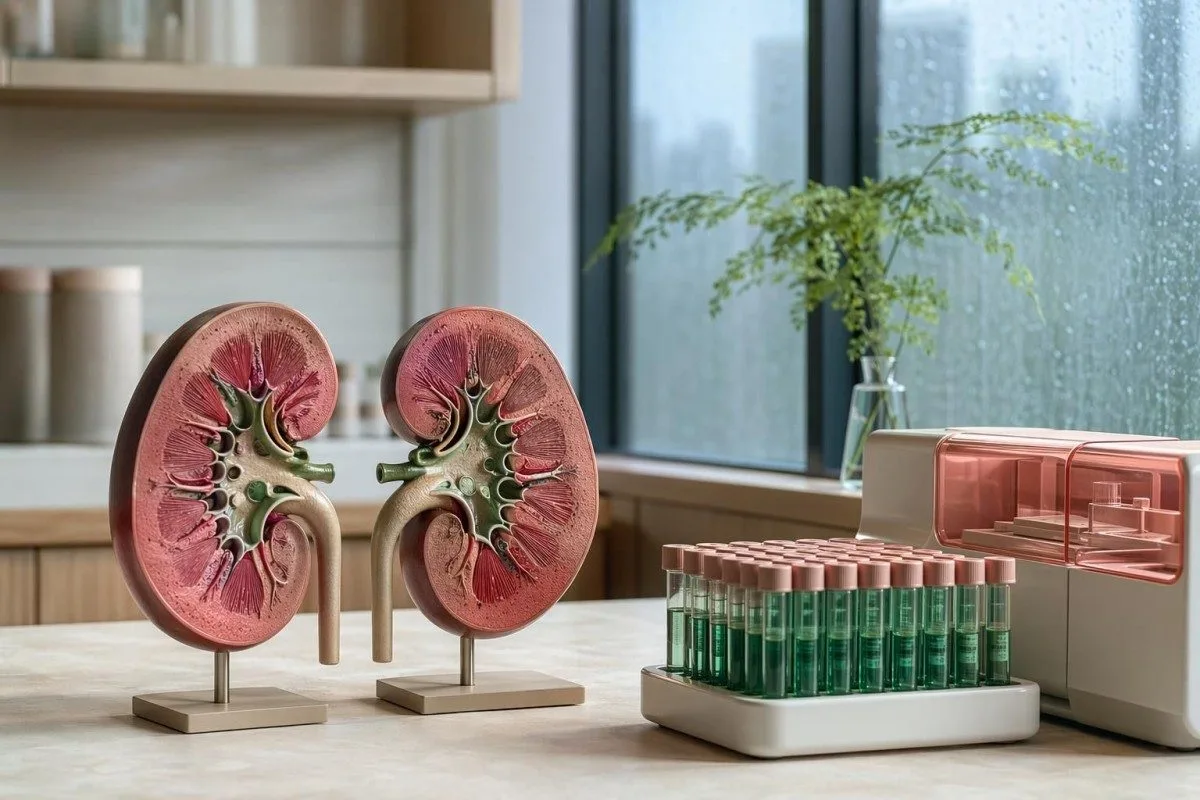
A renal panel is usually readable even if you had breakfast. The trick is knowing which values are food-sensitive and which abnormal results need action today.


- Renal panel fasting is usually not required; most adults can have this kidney blood test non-fasting unless glucose or another fasting test is ordered at the same time.
- Creatinine may rise transiently by roughly 10-30% after a large cooked meat meal, which can make eGFR look falsely lower for several hours.
- BUN or urea can increase after a high-protein meal, dehydration, steroids, gastrointestinal bleeding, or kidney under-perfusion; a typical adult BUN range is about 7-20 mg/dL.
- Glucose is the renal panel marker most predictably affected by food; fasting glucose is normally 70-99 mg/dL, while post-meal values require different interpretation.
- Potassium is usually stable after ordinary meals, but values above 6.0 mmol/L or any value with weakness, chest symptoms, or palpitations should be treated as urgent, not blamed on breakfast.
- Phosphate can rise after dairy, cola, processed foods, or phosphate additives; adult phosphate is often about 2.5-4.5 mg/dL, depending on the lab.
- Albumin and calcium can look higher with dehydration because the sample is more concentrated; total calcium should be interpreted with albumin or ionized calcium.
- Repeat testing is sensible when a non-fasting result is borderline, isolated, and inconsistent with your prior trend; it is unsafe when potassium, sodium, CO2, or creatinine is severely abnormal.
- Water is usually allowed before a renal panel and often improves sample quality; avoid deliberate overhydration because it can slightly dilute sodium, BUN, and albumin.
Do you need to fast for a renal panel?
A renal panel usually does not require fasting. If you ate first, most kidney and electrolyte results are still interpretable; the numbers most likely to move are glucose, phosphorus, BUN or urea, bicarbonate or CO2, potassium, albumin/calcium, and creatinine after a meat-heavy meal or creatine use. I repeat a non-fasting renal panel when the result is borderline and the meal could realistically change a decision.
A standard renal panel commonly includes sodium, potassium, chloride, bicarbonate or CO2, BUN/urea, creatinine, eGFR, glucose, calcium, phosphate, and albumin. For a marker-by-marker explanation, our renal function panel guide is the closest companion to this article.
I’m Thomas Klein, MD, and in day-to-day review I see more harm from overinterpreting one non-fasting result than from accepting a properly collected non-fasting renal panel. A 46-year-old patient with creatinine 1.18 mg/dL after steak and a hard gym session is a different story from creatinine 1.18 mg/dL plus falling eGFR, albuminuria, and high potassium.
Kantesti AI is an AI blood test interpretation platform that reads a renal panel in the context of fasting status, hydration clues, medications, prior trends, and paired markers rather than treating one flagged number as a diagnosis. If you want to know who we are as a medical technology organization, our About Us page gives the formal company background.
Which renal panel values change after eating?
The renal panel values most affected by eating are glucose, phosphate, BUN/urea, and sometimes creatinine. Sodium, chloride, and eGFR are usually less meal-sensitive, but eGFR can look worse if creatinine rises after cooked meat.
Fasting glucose is normally 70-99 mg/dL, while a random glucose above 200 mg/dL with classic symptoms can meet diabetes criteria in the right clinical setting. A renal panel glucose of 138 mg/dL after a bagel is not interpreted like a fasting glucose of 138 mg/dL; the timing matters more than the flag.
Adult phosphate is often reported around 2.5-4.5 mg/dL, and I see mild post-meal bumps after dairy, nuts, cola drinks, and processed foods with phosphate additives. The European preanalytical guidance paper by Simundic et al. (2014) helped standardize fasting collection for meal-sensitive tests, but a renal panel is not usually ordered fasting for phosphate alone.
BUN is typically about 7-20 mg/dL in many US-style reports, or urea roughly 2.5-7.1 mmol/L in SI units. A high-protein dinner can nudge BUN upward, but a BUN of 58 mg/dL with dizziness, low blood pressure, or rising creatinine deserves clinical attention, not a shrug.
Water, coffee, and fluids before kidney blood tests
Plain water is normally allowed before a kidney blood test, and mild dehydration can distort a renal panel more than drinking water does. Coffee is less predictable because caffeine can affect urination, stress hormones, and glucose in some people.
Dehydration can raise albumin, total calcium, BUN, and sometimes creatinine by concentrating the blood volume. This is why I ask about vomiting, diarrhea, sauna use, long flights, and diuretic timing before reacting to a BUN/creatinine ratio of 28:1.
Do not deliberately chug two litres before a renal panel. Overhydration can mildly lower sodium, albumin, and BUN; in susceptible patients, especially those using thiazide diuretics or with heart failure, extra water can push sodium toward unsafe ranges below 130 mmol/L.
For practical fasting rules, our guide on drinking water before labs goes deeper into coffee, gum, and medication timing. My usual advice is simple: drink a normal amount of water, avoid a new caffeine experiment, and tell the clinician if the sample followed unusual fluid intake.
Creatinine and eGFR after meat, creatine, or exercise
Creatinine can rise for several hours after a large cooked meat meal, creatine supplementation, or strenuous exercise. Because eGFR is calculated from creatinine, a temporary creatinine rise can make eGFR look temporarily lower.
Many labs report adult creatinine roughly around 0.6-1.3 mg/dL, though the useful range depends heavily on age, sex, muscle mass, and assay method. A muscular 32-year-old taking 5 g/day creatine may sit above the lab’s reference interval without having low filtration.
Cooked meat contains creatinine formed from creatine during heating. In clinic I have seen creatinine move from 0.98 to 1.23 mg/dL after a steak dinner, enough to shift eGFR from the high 80s to the low 60s in some calculators.
If creatinine is unexpectedly high after meat, supplements, or intense training, repeat after 12-24 hours without heavy meat and 24-48 hours without extreme exercise, unless the result is severe or symptoms are present. Our creatinine range guide explains why the same creatinine number can mean different things in a frail adult and a powerlifter.
BUN or urea after high-protein meals
BUN and urea often rise after a high-protein meal because the liver converts dietary nitrogen into urea for kidney excretion. A mild isolated BUN rise after protein is not the same as kidney failure.
A BUN of 23-28 mg/dL after a protein-heavy meal, dehydration, or a long fast may normalize on repeat testing. A BUN above 40 mg/dL, especially with rising creatinine, low blood pressure, confusion, or reduced urine output, needs a medical explanation.
The BUN/creatinine ratio is often quoted as 10:1 to 20:1, but that ratio is not a kidney diagnosis by itself. A ratio above 20 can reflect dehydration, gastrointestinal bleeding, steroid use, catabolic illness, or high protein intake; I treat it as a clue, not a verdict.
Patients using bodybuilding diets, ketogenic diets, or large whey servings can have consistently higher urea production. For diet-specific nuance, our article on BUN and hydration is useful before assuming the kidney is the only organ in the story.
Potassium, sodium and chloride after food
Potassium, sodium, and chloride usually do not swing dramatically after an ordinary meal. When these electrolytes are severely abnormal, sample handling, medications, kidney function, adrenal physiology, and acute illness matter more than whether you ate toast.
Potassium is commonly reported around 3.5-5.0 mmol/L, sodium around 135-145 mmol/L, and chloride around 98-107 mmol/L. A potassium of 5.3 mmol/L in a hemolyzed sample is a different problem from a potassium of 6.4 mmol/L with kidney impairment.
Food can modestly affect potassium, especially large servings of potassium-rich foods, salt substitutes containing potassium chloride, or supplements. Still, insulin after a carbohydrate meal usually pushes potassium into cells, so a high potassium result is not automatically explained by eating.
If potassium is above 6.0 mmol/L, or below 3.0 mmol/L, I want fast confirmation and often an ECG depending on symptoms and context. Our potassium range guide explains why palpitations, weakness, paralysis, or chest symptoms change the urgency completely.
Bicarbonate, CO2 and acid-base clues after meals
Bicarbonate or total CO2 can shift slightly after meals, but large abnormalities usually reflect acid-base physiology, medication effects, lung disease, kidney tubular problems, or acute illness. A CO2 below 18 mmol/L deserves context even if the renal panel was non-fasting.
Most laboratories report serum CO2 around 22-29 mmol/L. A value of 20 mmol/L after mild diarrhea may fit bicarbonate loss, while a value of 12 mmol/L with rapid breathing, high glucose, or kidney failure can be an emergency pattern.
Meals can produce small alkaline or acid loads, and delayed sample processing can lower measured CO2 because carbon dioxide escapes. This is one reason I hesitate to overcall a single CO2 of 21 mmol/L when every other marker is stable and the tube sat around for hours.
The anion gap is usually calculated from sodium, chloride, and bicarbonate, often with a rough reference interval near 8-12 mmol/L depending on the lab. Our CO2 guide explains why low CO2 plus high anion gap is more concerning than low-normal CO2 alone.
Calcium, phosphate and albumin after eating
Phosphate is the most food-sensitive marker in this cluster, while total calcium and albumin are more affected by hydration and protein binding. A non-fasting phosphate of 4.8 mg/dL after processed foods is not interpreted like persistent phosphate elevation in chronic kidney disease.
Total calcium is often reported around 8.6-10.2 mg/dL, albumin around 3.5-5.0 g/dL, and phosphate around 2.5-4.5 mg/dL in adults. Because about 40% of calcium is albumin-bound, dehydration can make both albumin and total calcium look higher.
The corrected calcium formula is imperfect, especially in critical illness or abnormal albumin states. When calcium is repeatedly abnormal, ionized calcium is more physiologically direct than trying to rescue a messy result with arithmetic.
Phosphate deserves extra attention in patients with eGFR below 45 mL/min/1.73 m², parathyroid disease, vitamin D therapy, or phosphate binders. If albumin looks high at the same time, our albumin hydration guide helps separate concentration effects from true protein problems.
Renal panel versus metabolic panel fasting rules
A renal panel and a metabolic panel overlap, but fasting rules differ because the metabolic panel is often bundled with glucose, lipids, or liver markers. The renal portion usually does not need fasting, while the combined order sometimes does.
A basic metabolic panel usually includes electrolytes, BUN, creatinine, glucose, calcium, and CO2. A comprehensive metabolic panel adds liver-related markers such as ALT, AST, ALP, bilirubin, total protein, and albumin; fasting is often requested because glucose interpretation is cleaner.
Kantesti AI is an AI-powered blood test analysis tool used by people in 127+ countries, and our renal panel logic treats “fasting requested” differently from “fasting clinically necessary.” The distinction matters: a non-fasting glucose flag may be expected, while a potassium flag may be urgent.
If your lab order says CMP plus lipids, the fasting request may be aimed at triglycerides or glucose rather than kidney markers. Our CMP fasting guide explains why a single appointment can contain both fasting-sensitive and fasting-insensitive tests.
When a non-fasting eGFR result should be repeated
A non-fasting eGFR should be repeated when it is newly low, borderline, inconsistent with your history, and paired with a plausible creatinine trigger such as cooked meat, creatine, dehydration, or heavy exercise. Chronic kidney disease is not diagnosed from one meal-affected eGFR.
KDIGO 2024 defines chronic kidney disease by abnormalities of kidney structure or function present for more than 3 months, not by one low eGFR after lunch (KDIGO, 2024). An eGFR below 60 mL/min/1.73 m² is meaningful when persistent or accompanied by albuminuria, abnormal urine sediment, imaging findings, or electrolyte complications.
The 2021 race-free creatinine and cystatin C equations by Inker et al. improved eGFR estimation, but eGFR remains an estimate rather than a measured filtration test. In borderline cases, cystatin C or a combined creatinine-cystatin C eGFR can clarify whether muscle mass or diet is distorting creatinine.
Repeat timing depends on urgency. If the patient is well and the only issue is eGFR 58 after steak, I often repeat within 1-2 weeks under calmer conditions; if creatinine is rapidly rising or potassium is high, I do not wait. Our plain-English guide to eGFR meaning covers why age changes the interpretation.
How to prepare before repeating a renal panel
Before repeating a renal panel, keep conditions boring and reproducible for 24-48 hours. That means normal water intake, no unusually large protein meal, no new creatine dose, no extreme workout, and no medication changes unless your clinician tells you to change them.
For most repeat renal panels, an 8-12 hour fast is optional unless glucose, lipids, or another fasting test is being repeated at the same time. If you do fast, water is still usually encouraged because dehydration can raise BUN and concentrate albumin.
Medication timing matters more than breakfast for many patients. ACE inhibitors, ARBs, spironolactone, NSAIDs, trimethoprim, diuretics, lithium, and SGLT2 inhibitors can all change kidney or electrolyte patterns; never stop them just to make a lab number look tidy.
Add urine testing when blood results are repeatedly borderline. A urine albumin-creatinine ratio above 30 mg/g or 3 mg/mmol can detect kidney injury that creatinine misses, and our urine ACR guide explains why early kidney damage can hide behind a normal renal panel.
When you should not blame a renal panel abnormality on food
Do not blame food for severe electrolyte abnormalities, rapidly rising creatinine, symptoms, or a pattern that repeats. Breakfast may explain a glucose or phosphate flag; it rarely explains dangerous potassium, sodium, or acid-base results by itself.
A sodium below 125 mmol/L or above 155 mmol/L can cause neurological symptoms and needs prompt assessment. A chloride abnormality is less dramatic by itself, but chloride plus CO2 helps reveal vomiting, diarrhea, diuretic effects, and acid-base patterns.
Creatinine that rises by 0.3 mg/dL within 48 hours can meet acute kidney injury criteria in the right clinical setting. A non-fasting state does not protect someone from AKI after dehydration, infection, contrast exposure, NSAID use, or urinary obstruction.
If the abnormal result is severe, repeat testing should confirm and triage, not postpone care. Our guide on repeating abnormal labs explains when a second draw is sensible and when immediate clinical review is safer.
How Kantesti AI reads renal panel context
Kantesti AI interprets a renal panel by comparing the result with meal status, hydration clues, medications, previous values, age, sex, and paired markers such as urine ACR. This pattern-based approach reduces false alarm from one non-fasting number while still flagging unsafe combinations.
Kantesti AI is an AI biomarker interpretation platform built to read renal markers as clusters, not as isolated red arrows. A creatinine of 1.25 mg/dL, BUN 18 mg/dL, potassium 4.2 mmol/L, and stable eGFR trend means something different from creatinine 1.25 mg/dL with BUN 46 mg/dL and potassium 5.9 mmol/L.
In our medical review workflow, Dr. Thomas Klein and the clinical team look for repeatable patterns: rising creatinine slope, falling CO2, worsening potassium, and albuminuria together. Our medical validation standards describe how we test interpretation logic against clinical edge cases rather than only straightforward normal reports.
Trend variability is also part of the interpretation. A creatinine change of 0.05 mg/dL may be analytical noise, while a change of 0.30 mg/dL over 48 hours can be clinically meaningful; our lab variability guide covers why small changes are not always real disease.
Research, references and medical review notes
This article was medically reviewed for renal panel interpretation, fasting effects, and repeat-testing thresholds as of May 29, 2026. The clinical priority is not to label every non-fasting result as wrong; it is to identify which results are still valid and which need confirmation.
Kantesti AI’s kidney-lab interpretation is overseen with physician review, and our Medical Advisory Board helps set the safety boundaries for high-risk electrolyte and kidney patterns. For broader marker definitions, the biomarkers guide maps thousands of lab markers to units, ranges, and clinical context.
The broader validation work behind our interpretation engine is described in the clinical validation benchmark, although individual renal panel decisions still require clinical judgement. I remain deliberately cautious with potassium, sodium, and acute kidney injury patterns because a safe repeat-test plan is not the same as reassurance.
Kantesti LTD. (2026). Iron Studies Guide: TIBC, Iron Saturation & Binding Capacity. Zenodo. https://doi.org/10.5281/zenodo.18248745. ResearchGate: publication search. Academia.edu: archive search. This methods paper is listed for Kantesti research transparency and is not a renal panel guideline.
Kantesti LTD. (2026). aPTT Normal Range: D-Dimer, Protein C Blood Clotting Guide. Zenodo. https://doi.org/10.5281/zenodo.18262555. ResearchGate: publication search. Academia.edu: archive search. It supports our general lab-interpretation research archive, not fasting advice for kidney markers.
Frequently Asked Questions
Do I need to fast for a renal panel?
Most people do not need to fast for a renal panel because creatinine, eGFR, sodium, potassium, chloride, calcium, albumin, and CO2 are usually interpretable after ordinary food. The main exceptions are when glucose must be interpreted as fasting, when the renal panel is bundled with a fasting metabolic panel or lipid test, or when your clinician specifically asks for fasting conditions. If you ate a large meat-heavy meal, used creatine, or were dehydrated, a borderline creatinine or BUN result may need repeating under steadier conditions.
Can I drink water before a renal panel?
Yes, plain water is usually allowed before a renal panel and often improves sample quality. Mild dehydration can raise BUN, albumin, total calcium, and sometimes creatinine by concentrating the blood sample. Avoid deliberate overhydration, because excessive water intake can slightly dilute sodium, BUN, and albumin and may be unsafe for people prone to low sodium.
Which renal panel result changes the most after eating?
Glucose is usually the renal panel result most predictably affected by eating, because fasting glucose is interpreted against a 70-99 mg/dL reference target while post-meal glucose follows different rules. Phosphate can rise after dairy, cola, nuts, or processed foods, and BUN can rise after high-protein intake. Creatinine may rise transiently after a large cooked meat meal or creatine supplementation, which can make eGFR look lower for several hours.
Should I repeat a high creatinine if I was not fasting?
A high creatinine should be repeated if it is newly abnormal, borderline, and there is a plausible temporary trigger such as cooked meat, creatine, dehydration, or heavy exercise. A practical repeat plan is often 12-24 hours without a large meat meal and 24-48 hours without extreme exercise, unless symptoms or severe abnormalities are present. Do not delay care if creatinine is rising quickly, potassium is high, urine output is low, or you feel acutely unwell.
Can breakfast cause high potassium on a renal panel?
An ordinary breakfast rarely causes a dangerous potassium result by itself. Potassium is commonly about 3.5-5.0 mmol/L, and results above 6.0 mmol/L should be reviewed promptly because they can affect heart rhythm. A mildly high potassium result may reflect sample hemolysis, kidney impairment, ACE inhibitors, ARBs, spironolactone, NSAIDs, or potassium-containing salt substitutes, so the context matters.
How long should I fast if my doctor wants a fasting renal panel?
If your clinician requests a fasting renal panel, an 8-12 hour fast is usually enough unless the order includes another test with different instructions. Water is generally permitted during the fast, and normal medication timing should be confirmed rather than changed on your own. The goal of fasting is usually cleaner glucose or combined metabolic panel interpretation, not because every kidney marker requires an empty stomach.
Could a cystatin C test help clarify an unexpectedly low eGFR?
Yes. Cystatin C is less affected by recent meat intake and muscle mass than creatinine, so it can help confirm kidney filtration when a creatinine-based eGFR is uncertain. Your clinician may consider it alongside your medical history and repeat blood tests.
Can a urine albumin-to-creatinine ratio be checked if I have not fasted?
Yes. Fasting is not usually needed for a urine albumin-to-creatinine ratio, which checks for protein leakage. A first-morning urine sample is often preferred for confirmation; postpone testing during a urinary infection, fever, menstruation, or vigorous exercise if possible.
Can my medications affect a renal panel more than food does?
Yes. Diuretics, ACE inhibitors or ARBs, NSAIDs, some antibiotics, and potassium supplements can change creatinine or potassium more than breakfast. Do not stop prescribed medicine on your own; ask your clinician whether any dose should be held before repeat testing.
Get AI-Powered Blood Test Analysis Today
Join over 2 million users worldwide who trust Kantesti for instant, accurate lab test analysis. Upload your blood test results and receive comprehensive interpretation of 15,000+ biomarkers in seconds.
📚 Referenced Research Publications
Klein, T., Mitchell, S., & Weber, H. (2026). Iron Studies Guide: TIBC, Iron Saturation & Binding Capacity. Kantesti AI Medical Research.
Klein, T., Mitchell, S., & Weber, H. (2026). aPTT Normal Range: D-Dimer, Protein C Blood Clotting Guide. Kantesti AI Medical Research.
📖 External Medical References
KDIGO CKD Work Group (2024). KDIGO 2024 Clinical Practice Guideline for the Evaluation and Management of Chronic Kidney Disease. Kidney International.
Simundic AM et al. (2014). Standardization of collection requirements for fasting samples: for the Working Group on Preanalytical Phase. Clinical Chemistry and Laboratory Medicine.
⚕️ Medical Disclaimer
This article is for educational purposes only and does not constitute medical advice. Always consult a qualified healthcare provider for diagnosis and treatment decisions.
E-E-A-T Trust Signals
Experience
Physician-led clinical review of lab interpretation workflows.
Expertise
Laboratory medicine focus on how biomarkers behave in clinical context.
Authoritativeness
Written by Dr. Thomas Klein with review by Dr. Sarah Mitchell and Prof. Dr. Hans Weber.
Trustworthiness
Evidence-based interpretation with clear follow-up pathways to reduce alarm.