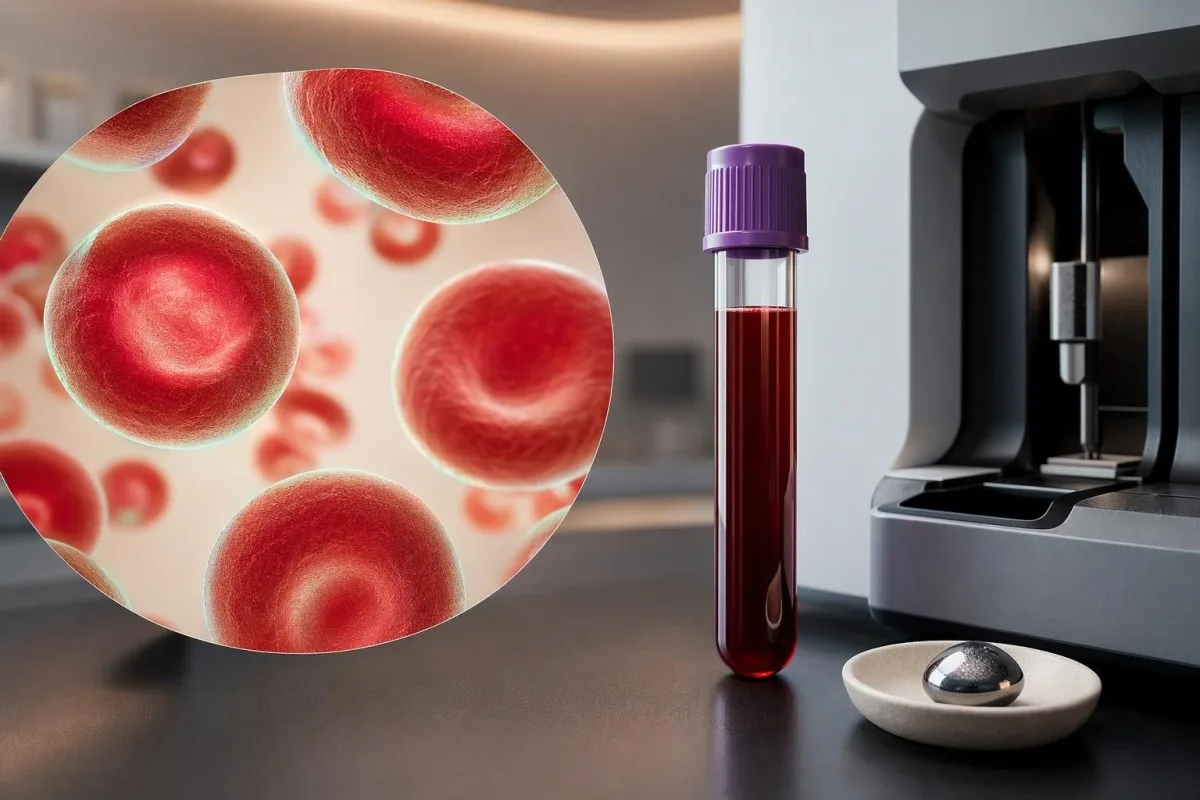
HGB stands for hemoglobin, the oxygen-carrying protein measured on a complete blood count. The useful part is not just whether HGB is low or high, but how it lines up with RBC and HCT.


- HGB means hemoglobin, the iron-containing protein in red cells that carries oxygen; most adult lab ranges sit around 12.0-15.5 g/dL for women and 13.5-17.5 g/dL for men.
- Low HGB usually means anemia or dilution from extra fluid, but the next clue is whether MCV is below 80 fL, normal, or above 100 fL.
- High HGB can reflect dehydration, smoking, altitude, sleep apnea, testosterone therapy, or rarer marrow disorders; HCT above 49% in men or 48% in women raises the stakes.
- RBC and HCT help check whether HGB makes sense; HCT is often roughly 3 times HGB, so HGB 14 g/dL often pairs with HCT near 42%.
- CBC context matters because an isolated HGB of 11.8 g/dL means something different in pregnancy, after a heavy period, after endurance training, or during chronic inflammation.
- Urgent thresholds vary, but many stable hospital patients are evaluated for transfusion near HGB 7 g/dL, while chest pain, fainting, or breathlessness can make higher values urgent.
- Lab variation of about 0.3-0.7 g/dL can happen between draws, especially after hydration changes, IV fluids, hard exercise, or a difficult sample collection.
- Kantesti AI reads HGB alongside RBC, HCT, MCV, RDW, platelets, WBC, kidney markers, inflammation markers, and prior trends instead of treating one flagged number as a diagnosis.
What HGB Means on a CBC Result
HGB means hemoglobin, the oxygen-carrying protein inside red cells, and it is reported on a complete blood count in g/dL or sometimes g/L. If you asked me, Thomas Klein, MD, to translate one line of medical lab terminology quickly, I would say: HGB tells us how much oxygen-carrying capacity your circulating red cells provide right now.
A CBC usually reports HGB, RBC, HCT, MCV, MCH, MCHC, platelets, and white cell measurements; our CBC components guide explains the neighboring lines patients often mix up. The HGB line is not the same as HbA1c, even though both contain the word hemoglobin.
Kantesti is an AI blood test analyzer that reads HGB as part of a CBC pattern, not as a lonely abbreviation on a page. Kantesti LTD, UK Company No. 17090423, describes our clinical and privacy approach on About Us, because patients deserve to know who is interpreting their numbers.
Most labs measure HGB by converting hemoglobin into a colored compound and reading light absorbance, while automated analyzers simultaneously count cellular elements. A lavender-top EDTA tube is the usual specimen for a CBC, and fasting is not required for a reliable HGB result.
Why Doctors Check HGB in Routine Blood Work
Doctors check HGB to screen for anemia, oxygen-carrying capacity, dehydration patterns, and unexpectedly thick blood. In routine care, HGB is often the first number that explains fatigue, pale skin, shortness of breath on stairs, or a racing heart after mild exertion.
In our analysis of 2M+ blood tests, HGB flags often appear before patients have a clear diagnosis; a value of 10.2 g/dL may be the first objective clue behind months of low energy. That is why CBC results belong among core blood markers for preventive and symptomatic testing.
HGB also acts as a safety marker before surgery, chemotherapy, pregnancy care, kidney disease treatment, and long-term medications. A surgeon may delay an elective operation when HGB is 8.5 g/dL, while an oncologist may accept temporary drops if the trend is expected and symptoms are controlled.
The WHO 2024 haemoglobin guideline uses anemia cutoffs near <13.0 g/dL for adult men, <12.0 g/dL for non-pregnant adult women, and <11.0 g/dL for pregnancy, with adjustments for altitude and smoking (WHO, 2024). Those cutoffs are screening thresholds, not automatic diagnoses.
The practical trick is to ask why the test was ordered. A HGB of 11.6 g/dL found during a wellness screen is different from the same number after black stools, a 6-week heavy period, or new kidney failure.
Normal HGB Ranges by Sex, Age, and Pregnancy
Normal HGB ranges depend on age, sex assigned at birth, pregnancy status, altitude, smoking, and the laboratory method. As of July 12, 2026, many adult reference intervals still cluster around 12.0-15.5 g/dL for women and 13.5-17.5 g/dL for men, but your lab's printed range wins for that analyzer.
Male and female ranges differ partly because testosterone increases red cell production, so a healthy man may sit at 16.8 g/dL while the same value in a non-pregnant woman may be flagged high. We cover this broader issue in sex-specific lab ranges.
Pregnancy lowers measured HGB through plasma volume expansion; a value near 10.8-11.2 g/dL may be watched rather than treated urgently, depending on trimester and symptoms. In children, normal ranges change quickly, with infants often having different cutoffs from teenagers by several g/dL.
Some European labs report haemoglobin in g/L, where 140 g/L equals 14.0 g/dL. I still see patients panic over a '140' result after moving countries, when it is simply the same value written in another unit.
Altitude adjustments are not cosmetic. Living above roughly 1,500 meters can push HGB higher because oxygen pressure is lower, and applying a sea-level reference range may overcall disease in a healthy person.
How HGB, RBC, and HCT Fit Together
HGB, RBC, and HCT describe related but different parts of red cell status: HGB measures oxygen-carrying protein, RBC counts red cells, and HCT estimates the percentage of blood volume occupied by red cells. A rough rule is HCT ≈ HGB × 3, so HGB 14 g/dL often pairs with HCT near 42%.
The rule breaks when cells are unusually small, unusually large, dehydrated, or affected by analyzer interference. A high RBC count with low-normal HGB, for example, can point toward many small cells rather than many efficient oxygen carriers.
When I review a CBC with RBC 5.8 million/µL, HGB 12.0 g/dL, and MCV 68 fL, I do not read it the same way as RBC 3.6 million/µL, HGB 12.0 g/dL, and MCV 94 fL. Our article on RBC-HGB mismatches walks through that pattern in more detail.
HCT is more sensitive to plasma volume than many patients realize. Drink 2 liters after dehydration and the next HCT can fall 2-4 percentage points without any true loss of red cells.
This is why I rarely reassure or worry based on HGB alone. The trio of HGB, RBC, and HCT catches arithmetic mismatches, physiologic dilution, and the occasional specimen issue that a single line cannot.
What Low HGB Usually Means
Low HGB usually means anemia, dilution from extra fluid, recent blood loss, reduced red cell production, or increased red cell breakdown. It does not tell the cause by itself; the CBC indices and the clinical story decide the next sensible step.
A HGB of 11.4 g/dL in a menstruating 32-year-old after months of heavy periods often suggests iron loss, while the same result in a 76-year-old man needs a more cautious gastrointestinal and chronic disease lens. For deeper pattern reading, see our guide to anemia patterns.
WHO 2024 cutoffs define anemia for population screening, but individual management depends on symptoms, MCV, ferritin, kidney function, CRP, medications, and bleeding history (WHO, 2024). In clinic, a slow fall from 14.0 to 11.8 g/dL over 18 months often matters more than a one-time value 0.1 below range.
Low HGB with low MCV below 80 fL commonly pushes clinicians toward iron deficiency or thalassemia trait patterns. Low HGB with MCV above 100 fL raises different questions, including B12, folate, alcohol effects, liver disease, thyroid disease, or marrow stress.
Do not start high-dose iron just because HGB is low. If ferritin is 250 ng/mL and CRP is 40 mg/L, the story may be inflammation rather than simple iron depletion, and unnecessary iron can cause constipation, nausea, and confusing follow-up labs.
What High HGB Usually Means
High HGB means the measured hemoglobin concentration is above the lab range, often because of dehydration, smoking, altitude, sleep apnea, testosterone therapy, or increased marrow production. A repeated HGB above about 16.5 g/dL in men or 16.0 g/dL in women deserves context with HCT and symptoms.
The 2016 WHO classification uses HGB >16.5 g/dL in men, >16.0 g/dL in women, or HCT >49% in men and >48% in women as major threshold clues for polycythemia vera evaluation (Arber et al., 2016). That does not mean everyone above those values has cancer; it means repeat testing and pattern review are reasonable.
A 52-year-old marathon runner living at altitude may show HGB 17.2 g/dL and HCT 50% after a hard training week, especially if the sample was drawn after mild dehydration. Our polycythemia clues article separates common causes from the rarer hematology pathway.
Sleep apnea is a surprisingly common high-HGB clue. I have seen men with morning headaches, loud snoring, HGB 18.1 g/dL, and normal white cells improve after apnea treatment rather than phlebotomy alone.
The worry rises when high HGB travels with high HCT, headaches, visual symptoms, aquagenic itching, unusual clots, low EPO, or persistent values across 2-3 draws. One dehydrated sample is noise; a stable pattern is a message.
When an HGB Change Is Real Versus Noise
A small HGB change of 0.3-0.7 g/dL can occur from hydration, posture, timing, analyzer variation, or sample handling. A change of 1.5-2.0 g/dL is harder to dismiss, especially if RBC and HCT move in the same direction.
Labs use delta checks to catch sudden changes that may reflect a true clinical event or a specimen problem. We explain this quality-control logic in delta checks, because patients often see only the final flag.
After IV fluids, HGB can drop from 13.2 to 11.9 g/dL within hours through dilution alone. After dehydration from vomiting or a long flight, HGB can rise by 0.5-1.5 g/dL without any extra red cell production.
Exercise adds another wrinkle. Endurance training can expand plasma volume, giving athletes a lower HGB concentration even when total red cell mass is normal or increased; some sports clinicians call this sports anemia, though the phrase can be misleading.
My usual recheck logic is simple: repeat a surprising but non-urgent HGB in 2-8 weeks, sooner if symptoms are new. Use the same lab when possible, because changing analyzers can move a borderline result across a printed reference line.
How MCV, MCH, and RDW Refine HGB
MCV, MCH, and RDW help explain whether low HGB comes from small cells, large cells, uneven cell sizes, or reduced hemoglobin per cell. They do not diagnose the cause, but they tell doctors which direction to look first.
MCV below 80 fL means microcytosis, MCV 80-100 fL is usually normocytic, and MCV above 100 fL means macrocytosis. Our MCV and MCH explainer is useful when the letters on a CBC start to look like alphabet soup.
MCH often falls when each red cell carries less hemoglobin, such as in iron-limited states. MCHC, usually around 32-36 g/dL, tends to be more stable and becomes clinically interesting when it is truly low or unexpectedly high.
RDW describes variation in red cell size; a high RDW with low MCV often suggests a developing or mixed process rather than a perfectly uniform inherited pattern. If RDW rises before HGB falls, I treat that as an early warning rather than a diagnosis.
Kantesti is an AI blood test interpretation platform that reads HGB together with MCV, MCH, RDW, ferritin, CRP, kidney markers, and prior CBCs when available. That multi-marker pattern reduces the chance of overreacting to one mildly flagged line.
Symptoms That Make an HGB Result More Urgent
HGB becomes more urgent when low values come with chest pain, fainting, severe breathlessness, black stools, rapid heartbeat at rest, pregnancy bleeding, or new confusion. The number matters, but symptoms decide how fast someone should be assessed.
AABB's 2023 international transfusion guideline recommends a restrictive transfusion strategy for many stable hospitalized adults, commonly considering transfusion near HGB <7 g/dL, with higher thresholds such as 8 g/dL in selected cardiovascular or orthopedic contexts (Carson et al., 2023). Outpatients should not use that number as a home decision rule.
When I, Thomas Klein, MD, see HGB 9.8 g/dL with dizziness, pulse 118, and black stool, I treat it very differently from HGB 9.8 g/dL found during a slow iron-deficiency workup. Our dizziness and anemia clues guide explains why symptoms change risk.
High HGB can also be urgent if it comes with neurologic symptoms, severe headache, visual disturbance, chest pain, or a clot history. HGB 19.0 g/dL with HCT 57% is not a lifestyle curiosity; it needs prompt medical review.
If your report is mildly abnormal and you feel well, a planned appointment is often reasonable. If you are breathless at rest, fainting, or passing black or red stool, do not wait for an app interpretation or a routine callback.
Special Situations: Pregnancy, Athletes, Altitude, and Smoking
Pregnancy, endurance training, altitude, smoking, and testosterone therapy can shift HGB without meaning the same disease process. These situations are where a technically abnormal result can be physiologically expected, partly expected, or still concerning.
Pregnancy expands plasma volume by roughly 40-50%, so HGB often drops even while total red cell mass rises. A HGB of 10.9 g/dL may be monitored in mid-pregnancy, while the same number after delivery with heavy bleeding deserves faster attention.
Endurance athletes may have HGB in the low-normal range because plasma volume expands with training. If performance falls and ferritin is also low, the picture changes; if ferritin and reticulocytes are healthy, the number may reflect adaptation rather than disease.
Altitude-related HGB changes can persist for weeks after travel or relocation. We discuss timing and rechecks in altitude-related HGB changes, especially for people who test soon after returning to sea level.
Smoking and carbon monoxide exposure can raise HGB because hemoglobin is partly occupied by carbon monoxide, reducing oxygen delivery. A smoker with HGB 17.8 g/dL may not have 'extra oxygen'; they may be compensating for less usable oxygen.
Units, Lab Test Acronyms, and Report Formats
HGB may appear as Hgb, Hb, haemoglobin, hemoglobin, or HGB depending on country and laboratory software. In the United States it is usually g/dL, while many UK, European, Canadian, Australian, and international reports may use g/L.
The conversion is simple: multiply g/dL by 10 to get g/L, so 13.8 g/dL equals 138 g/L. Our unit conversion guide helps when results look changed after switching countries or labs.
Medical lab terminology is full of lab test acronyms that are close enough to confuse real people. HbA1c reflects glycated hemoglobin over about 2-3 months, while HGB on a CBC reflects today's hemoglobin concentration.
Kantesti's biomarkers guide includes thousands of blood test abbreviations list entries, including CBC markers, iron studies, inflammatory markers, kidney markers, and hormone abbreviations. I prefer spelling out the first mention in reports because a frightened patient should not need a glossary to understand oxygen-carrying capacity.
Some labs flag only values outside their own reference interval, not values that are clinically risky for a specific person. That is why a normal-looking HGB can still matter if your personal baseline was 15.0 g/dL and now it is 12.6 g/dL.
How Kantesti AI Reads HGB in Context
Kantesti AI interprets HGB by checking whether RBC, HCT, MCV, RDW, WBC, platelets, iron markers, kidney markers, inflammation markers, and previous results tell the same story. The goal is pattern recognition, not replacing a clinician who knows your symptoms and exam.
Our Technology Guide describes how OCR, unit normalization, reference interval parsing, and clinical rule layers work together. For HGB, the first safety step is confirming the unit, because 140 g/L and 14.0 g/dL are the same value.
Kantesti AI also checks whether a PDF or photo has obvious recognition errors before interpreting a CBC. A smudged decimal point can turn HGB 13.6 into 136, so our PDF upload checks are not cosmetic; they protect interpretation quality.
In a typical 60-second analysis, our AI may flag 'low HGB with low MCV and high RDW' as a pattern needing iron-context review, while 'high HGB with high albumin and high sodium' may point first toward dehydration. Those are different clinical pathways.
I am cautious about certainty here. HGB patterns can suggest the next question, but they cannot see your stool color, menstrual history, oxygen saturation, snoring, family history, or whether you just finished an ultramarathon.
What to Ask Before Your Next Appointment
The best HGB follow-up questions ask about trend, severity, symptoms, and which nearby CBC markers explain the result. A patient who brings 5 focused questions often gets a better visit than someone who arrives with a single highlighted abnormal flag.
Ask: 'How far is my HGB from my prior baseline?' A fall from 14.5 to 12.2 g/dL may matter even if 12.2 is barely in range for one lab, and a stable HGB of 11.8 g/dL for 10 years may be less dramatic.
Ask whether RBC, HCT, MCV, RDW, platelets, WBC, ferritin, creatinine, and CRP support one explanation. Our doctor visit checklist can help you summarize results without dumping a 9-page portal printout on the desk.
Kantesti is an AI-powered blood test analysis tool used by 2M+ people across 127+ countries, and most patients find the trend view useful before a clinician visit. The strongest use is preparation: spotting the 3-4 numbers worth discussing, not self-diagnosing a cause.
Bring dates, symptoms, supplements, bleeding history, altitude travel, smoking status, testosterone or EPO use, and recent illness. Those details can change the interpretation of HGB by more than any online reference range.
Kantesti Research, Validation, and Medical Oversight
Kantesti's HGB explanations are built with physician oversight, technical benchmarking, and conservative safety language because CBC interpretation is medical content, not trivia. Our doctors review the clinical framing through the Medical Advisory Board, and our broader standards are described in clinical validation.
One Kantesti publication reports multilingual AI-assisted clinical decision support across 50,000 interpreted blood test reports for early hantavirus triage: Kantesti LTD. (2026). Multilingual AI Assisted Clinical Decision Support for Early Hantavirus Triage: Design, Engineering Validation, and Real-World Deployment Across 50,000 Interpreted Blood Test Reports. Figshare. https://doi.org/10.6084/m9.figshare.32230290.
A second pre-registered benchmark tested the Kantesti blood-test interpretation engine on 100,000 synthetic cases: Kantesti LTD. (2026). A Pre-Registered, Rubric-Based Automated Technical Benchmark of the Kantesti Blood-Test Interpretation Engine on 100,000 Synthetic Test Cases. Figshare. https://doi.org/10.6084/m9.figshare.32095435.
Those papers do not mean AI can diagnose anemia, polycythemia, internal bleeding, or marrow disease from a CBC alone. They do support a narrower claim: structured interpretation can reduce abbreviation confusion, unit mistakes, and missed pattern links when paired with medical review.
Bottom line: HGB means hemoglobin, and it is one of the most useful single lines on a CBC only when read with RBC, HCT, indices, symptoms, and trend. If your value is very low, very high, rapidly changing, or paired with worrying symptoms, human medical care comes first.
Frequently Asked Questions
What does HGB mean on a blood test?
HGB means hemoglobin, the iron-containing protein in red cells that carries oxygen from the lungs to the body. On a CBC, HGB is usually reported in g/dL in the United States or g/L in many other countries, where 14.0 g/dL equals 140 g/L. Typical adult ranges are about 12.0-15.5 g/dL for women and 13.5-17.5 g/dL for men, but the lab's printed range should be used for that result.
Is HGB the same as hemoglobin A1c?
HGB and hemoglobin A1c are not the same test. HGB is the current hemoglobin concentration on a CBC and helps assess anemia, oxygen-carrying capacity, dehydration patterns, or high red cell states. HbA1c measures the percentage of glycated hemoglobin and estimates average blood sugar over about 2-3 months.
What HGB level is considered low?
Many guidelines screen for anemia at HGB below 13.0 g/dL in adult men, below 12.0 g/dL in non-pregnant adult women, and below 11.0 g/dL in pregnancy. Mild low HGB is often handled with outpatient follow-up, but values near 7.0-8.0 g/dL may be urgent depending on symptoms and medical history. Chest pain, fainting, black stools, severe breathlessness, or pregnancy bleeding should prompt same-day medical advice regardless of the exact number.
What does high HGB mean?
High HGB means hemoglobin is above the lab's reference range, often from dehydration, smoking, high altitude, sleep apnea, testosterone therapy, or increased marrow production. Repeated HGB above about 16.5 g/dL in men or 16.0 g/dL in women becomes more concerning when HCT is also high. HGB around 19.0 g/dL with headache, visual symptoms, chest pain, or clot history needs prompt medical review.
Why are my RBC and HGB results not both high or both low?
RBC counts the number of red cells, while HGB measures the oxygen-carrying protein inside them, so they can disagree. A person can have a high RBC count with low-normal HGB when cells are very small, such as an MCV below 80 fL. A low RBC count with relatively preserved HGB can occur when cells are larger, after volume shifts, or during mixed CBC patterns.
Can dehydration change HGB?
Yes, dehydration can make HGB look higher because the blood is more concentrated, and rehydration or IV fluids can make HGB look lower by dilution. A shift of 0.5-1.5 g/dL can occur around illness, vomiting, heavy sweating, or fluid treatment. If a surprising HGB result does not fit symptoms, many clinicians repeat the CBC in 2-8 weeks or sooner if symptoms are concerning.
Should I take iron if my HGB is low?
Do not start iron solely because HGB is low unless a clinician has confirmed that iron deficiency is likely or proven. Low HGB can come from iron deficiency, B12 or folate problems, kidney disease, inflammation, bleeding, hemolysis, pregnancy dilution, or marrow conditions. Ferritin, transferrin saturation, MCV, RDW, CRP, kidney markers, and symptoms usually guide the decision better than HGB alone.
Can I have iron deficiency even if my HGB is normal?
Yes. Iron stores can become low before hemoglobin falls enough to show anemia. If symptoms such as fatigue, restless legs, hair shedding, or heavy periods are present, ask whether ferritin and iron studies would help clarify the cause.
Get AI-Powered Blood Test Analysis Today
Join over 2 million users worldwide who trust Kantesti for instant, accurate lab test analysis. Upload your blood test results and receive comprehensive interpretation of 15,000+ biomarkers in seconds.
📚 Referenced Research Publications
Klein, T., Mitchell, S., & Weber, H. (2026). Multilingual AI Assisted Clinical Decision Support for Early Hantavirus Triage: Design, Engineering Validation, and Real-World Deployment Across 50,000 Interpreted Blood Test Reports. Kantesti AI Medical Research.
Klein, T., Mitchell, S., & Weber, H. (2026). A Pre-Registered, Rubric-Based Automated Technical Benchmark of the Kantesti Blood-Test Interpretation Engine on 100,000 Synthetic Test Cases. Kantesti AI Medical Research.
📖 External Medical References
World Health Organization (2024). Guideline on haemoglobin cutoffs to define anaemia in individuals and populations. World Health Organization.
⚕️ Medical Disclaimer
This article is for educational purposes only and does not constitute medical advice. Always consult a qualified healthcare provider for diagnosis and treatment decisions.
E-E-A-T Trust Signals
Experience
Physician-led clinical review of lab interpretation workflows.
Expertise
Laboratory medicine focus on how biomarkers behave in clinical context.
Authoritativeness
Written by Dr. Thomas Klein with review by Dr. Sarah Mitchell and Prof. Dr. Hans Weber.
Trustworthiness
Evidence-based interpretation with clear follow-up pathways to reduce alarm.