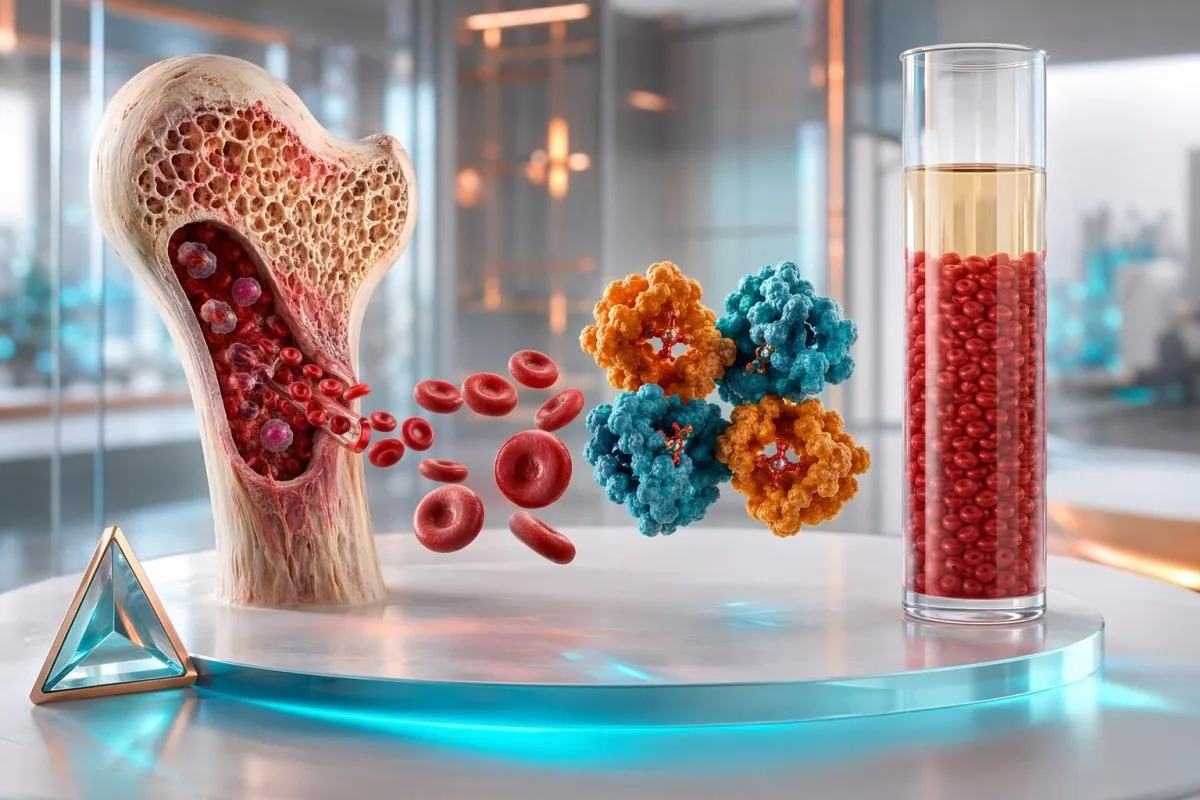
A CBC mismatch usually means the cells are different in size, concentration, or timing — not that the report is automatically wrong. The pattern matters more than one flagged number.


- Red blood cell count is the number of red cells, usually reported as million/µL or 10^12/L; it can be high even when hemoglobin is normal if cells are small.
- Hemoglobin levels measure oxygen-carrying protein; WHO anemia thresholds are below 13.0 g/dL in men, 12.0 g/dL in nonpregnant women, and 11.0 g/dL in pregnancy.
- Hematocrit is the percentage of blood volume occupied by red cells; it roughly equals RBC × MCV ÷ 10.
- RBC normal range is often about 4.5–5.9 million/µL for adult men and 4.0–5.2 million/µL for adult women, but lab ranges differ.
- Hemoglobin normal range is commonly 13.5–17.5 g/dL in adult men and 12.0–15.5 g/dL in adult women.
- Dehydration can raise hemoglobin and hematocrit by concentrating plasma, often with high albumin or BUN/creatinine ratio.
- Iron deficiency often lowers ferritin first; MCV, MCH, and RDW may shift before hemoglobin falls.
- High RBC with low MCV often points toward thalassemia trait or long-standing iron-restricted red cell production.
- Recent bleeding can leave hemoglobin deceptively normal for several hours, then drop after fluid shifts or IV fluids.
- Lab variation of 1–3% is common for CBC red-cell measures; a tiny change near the cutoff is often noise, not disease.
Why red blood cell count, hemoglobin and hematocrit disagree
Red blood cell count, hemoglobin levels, and hematocrit can disagree because they measure different things: cell number, oxygen-carrying protein, and packed red-cell volume. A high RBC with normal hemoglobin often means small cells. A high hemoglobin with a normal RBC often means concentrated plasma, altitude adaptation, smoking, or larger cells. Our Kantesti AI blood test analyzer reads these as patterns, not isolated flags.
When I review a CBC, I first ask whether the mismatch is mathematical or biological. Hematocrit is usually estimated from the equation RBC × MCV ÷ 10, so a red blood cell count of 5.6 million/µL with an MCV of 68 fL gives a hematocrit near 38%, which may look normal despite a high RBC.
The most common patient panic I see is a single red flag beside RBC while hemoglobin normal range appears reassuring. That pattern is not rare; it often tracks with microcytosis, and our broader guide to blood test number patterns explains why one abnormal value rarely tells the whole story.
As of May 14, 2026, I still see automated portals label these results in a way that scares people unnecessarily. A CBC is like a three-camera view of the same process: number of cells, size of cells, and oxygen protein per cell.
What each CBC red-cell marker actually measures
RBC count measures how many red cells are present, hemoglobin measures oxygen-carrying protein, and hematocrit estimates the percentage of blood volume made of red cells. These three usually move together, but cell size and plasma volume can pull them apart.
A normal red-cell trio is internally consistent: RBC count, hemoglobin, hematocrit, MCV, MCH, and MCHC all tell a compatible story. If hematocrit is 45% and MCV is 90 fL, the RBC count should sit close to 5.0 million/µL because 5.0 × 90 ÷ 10 = 45.
Hemoglobin is less about cell number and more about payload. A person can have 5.8 million/µL red cells but only 12.4 g/dL hemoglobin if each cell is small and pale; our MCV blood test guide goes deeper into that size clue.
Hematocrit is sensitive to hydration and analyzer calculations. If you want the plain-English version of this marker, I usually send patients to our hematocrit levels guide before we talk about rare diagnoses.
RBC normal range and hemoglobin normal range by context
RBC normal range is commonly about 4.5–5.9 million/µL in adult men and 4.0–5.2 million/µL in adult women. Hemoglobin normal range is usually about 13.5–17.5 g/dL in adult men and 12.0–15.5 g/dL in adult women, though each lab sets its own interval.
WHO uses hemoglobin cutoffs below 13.0 g/dL in men, 12.0 g/dL in nonpregnant women, and 11.0 g/dL in pregnancy to define anemia in population guidance (World Health Organization, 2011). Those cutoffs are screening thresholds, not a complete diagnosis.
Pregnancy is the classic trap. Plasma volume expands by roughly 40–50%, while red-cell mass rises less, so hemoglobin can fall into the 10.5–11.5 g/dL range without iron deficiency; our hemoglobin range guide covers the trimester nuance.
Children are different enough that adult ranges should not be pasted onto them. For example, toddlers often run lower hemoglobin than teenagers, and our pediatric blood range guide is safer than guessing from an adult portal.
Dehydration can raise hemoglobin and hematocrit without extra cells
Dehydration can make hemoglobin and hematocrit look high because the plasma volume is lower, not because the body suddenly made many new red cells. The clue is usually a parallel rise in albumin, total protein, sodium, or BUN/creatinine ratio.
A 52-year-old marathon runner once showed me hemoglobin of 17.2 g/dL after a hot race, with albumin 5.2 g/dL and BUN/creatinine ratio of 28. Two days later, after normal hydration, hemoglobin was 15.6 g/dL and the panic disappeared.
Dehydration usually raises hemoglobin and hematocrit more than it raises RBC count. If sodium is 146 mmol/L, albumin is high-normal, and urine is concentrated, our dehydration false-high guide is often the first place I point patients.
The BUN/creatinine ratio is a useful supporting clue, not a verdict. A ratio above 20:1 can fit dehydration, high protein intake, gastrointestinal fluid loss, or upper GI bleeding, so our BUN hydration guide helps separate those stories.
Iron deficiency can start before hemoglobin becomes low
Iron deficiency often begins with low ferritin and subtle red-cell index changes before hemoglobin drops below the normal range. Ferritin below 30 ng/mL is a common practical cutoff for depleted iron stores, even when the lab still labels hemoglobin as normal.
Camaschella’s New England Journal of Medicine review describes iron-deficiency anemia as a staged process: iron stores fall first, then iron-restricted red-cell production appears, and hemoglobin falls later (Camaschella, 2015). In clinic, that sequence is exactly why a normal hemoglobin does not rule out early iron loss.
The common early pattern is ferritin under 30 ng/mL, transferrin saturation below 20%, rising TIBC, falling MCH below 27 pg, and RDW creeping above 14.5%. Our low ferritin normal hemoglobin article is built around that exact mismatch.
I worry more when symptoms match the chemistry: restless legs, hair shedding, cold intolerance, heavy periods, or endurance fatigue. If hemoglobin is still 12.8 g/dL but ferritin is 9 ng/mL, our iron deficiency anemia guide explains why waiting for anemia can be the wrong strategy.
High RBC count with low MCV often means small cells, not thick blood
High red blood cell count with low MCV often means the body has many small red cells. The two classic causes are thalassemia trait and long-standing iron-restricted production, and the distinction usually depends on ferritin, iron saturation, RDW, family history, and sometimes hemoglobin electrophoresis.
This is one of the most misunderstood CBC patterns. A patient might have RBC 6.2 million/µL, MCV 65 fL, hemoglobin 13.1 g/dL, and hematocrit 40%; that is not the same as polycythemia.
In thalassemia trait, RDW can be normal or only mildly high, while RBC count is disproportionately high for the hemoglobin. Our article on high RBC with low MCV walks through the Mentzer index, where MCV ÷ RBC below about 13 leans toward trait rather than iron deficiency.
Iron studies still matter because thalassemia trait and iron deficiency can coexist. I usually want ferritin, serum iron, TIBC, and transferrin saturation together; our iron studies guide explains why serum iron alone is too jumpy to settle the question.
Recent bleeding may not lower hemoglobin immediately
Recent bleeding can leave hemoglobin and hematocrit deceptively normal for the first several hours because whole blood volume is lost together. Hemoglobin often falls after fluid shifts, IV fluids, or rehydration, while reticulocytes usually rise after 3–5 days if the marrow responds.
I have seen patients with nosebleeds or heavy menstrual loss show a normal hemoglobin on day one, then drop by 1–2 g/dL the next day. That is not the lab changing its mind; it is the circulation equilibrating.
The reticulocyte count is the recovery marker. A normal adult reticulocyte percentage is roughly 0.5–2.5%, and a rising absolute reticulocyte count after several days suggests the marrow is replacing lost cells; our reticulocyte count guide gives the timing.
For recurrent nosebleeds, I do not just check hemoglobin. A CBC, ferritin, PT/INR, aPTT, and platelet count can find the hidden pattern, which is why our nosebleed lab guide includes both clotting and iron tests.
Altitude, smoking and sleep apnea can push hemoglobin higher
Altitude, smoking, and sleep apnea can raise hemoglobin or hematocrit by increasing erythropoietin signaling from lower oxygen availability. The pattern may show high-normal or high hemoglobin, high hematocrit, and sometimes a high red blood cell count.
Living at 2,000 meters can raise hemoglobin by roughly 0.5–1.0 g/dL in many people, although ancestry, fitness, and acclimatization matter. WHO altitude adjustments subtract increasing hemoglobin amounts as elevation rises, which prevents overcalling polycythemia in mountain communities.
Smoking adds another twist: carbon monoxide binds hemoglobin, so the body may compensate by making more oxygen-carrying capacity. A smoker with hemoglobin 17.0 g/dL and normal oxygen saturation in clinic may still have elevated carboxyhemoglobin, and our high RBC normal hemoglobin article covers that odd-looking contrast.
Sleep apnea is the underchecked cause in my experience, especially in people with morning headaches, snoring, resistant hypertension, or hematocrit above 49%. Our sleep apnea lab guide explains why CBC changes are only a clue, not a sleep study.
Pregnancy and IV fluids can dilute hemoglobin without reducing red-cell mass
Dilutional anemia happens when plasma volume expands faster than red-cell mass. Pregnancy, IV fluids, and some kidney or inflammatory states can lower hemoglobin and hematocrit while the red blood cell count changes less dramatically.
Pregnancy is physiologically designed to dilute the blood a bit. By mid-pregnancy, hemoglobin around 10.5–11.0 g/dL can be dilutional, but ferritin below 30 ng/mL or transferrin saturation below 20% pushes me toward iron deficiency as well.
IV fluids can create the same effect within hours. After surgery or an emergency visit, a hemoglobin drop from 14.0 to 12.2 g/dL may reflect dilution if the patient received 2–3 liters of crystalloid and has no signs of ongoing loss.
Context is everything for pregnant and postpartum patients. Our prenatal blood test guide separates dilution from iron loss during pregnancy, while our new mother lab guide covers the postpartum ferritin and CBC timing I use in practice.
Lab variation can create small CBC mismatches near the cutoff
CBC variation of about 1–3% is common for red-cell indices, even on well-calibrated analyzers. A hemoglobin shift from 13.4 to 13.1 g/dL or RBC shift from 5.20 to 5.32 million/µL can be ordinary analytic and biologic noise.
Posture matters more than patients expect. Moving from lying down to standing can reduce plasma volume enough to raise hemoglobin and hematocrit by roughly 5–10% in susceptible people, especially if the draw is early morning and fasting.
Tube handling matters too. EDTA samples that sit too long can show subtle cell-size artifacts, while cold agglutinins can make RBC count look falsely low and MCV falsely high; our lab variability guide shows which shifts deserve a repeat.
Units cause another kind of mismatch. Some labs report RBC as 10^12/L, others as million/µL, and the number is essentially the same; our lab unit guide helps patients avoid mistaking a unit conversion for a biological change.
When high hemoglobin or hematocrit needs medical workup
Persistently high hemoglobin or hematocrit deserves evaluation when hemoglobin is above about 16.5 g/dL in men, 16.0 g/dL in women, or hematocrit is above 49% in men or 48% in women. Those thresholds appear in major polycythemia vera diagnostic frameworks and should not be ignored.
The British Society for Haematology guideline on polycythaemia vera emphasizes confirming true erythrocytosis and assessing JAK2 mutation status, erythropoietin level, oxygen drivers, and thrombosis risk (McMullin et al., 2019). In real clinics, I repeat the CBC first unless symptoms or hematocrit are clearly concerning.
A practical workup often includes repeat CBC, oxygen saturation, ferritin, erythropoietin, JAK2 V617F testing, kidney and liver assessment, and sleep apnea screening. Our doctors review these patterns against clinical standards described in Kantesti medical validation, not by one red flag alone.
Urgent care is different. New chest pain, one-sided weakness, severe headache, vision changes, shortness of breath, or hematocrit above roughly 55–60% needs same-day clinician input, and our Medical Advisory Board is very direct about that safety boundary.
Low hemoglobin with normal RBC count points to payload or size problems
Low hemoglobin with a normal red blood cell count usually means each cell carries less hemoglobin, cells are unusually large, or plasma volume is expanded. MCV, MCH, MCHC, RDW, ferritin, B12, folate, kidney function, and inflammation markers usually clarify the cause.
A hemoglobin of 11.2 g/dL with RBC 4.4 million/µL and MCV 72 fL points in a different direction than hemoglobin 11.2 g/dL with MCV 108 fL. The first smells like iron restriction; the second makes me ask about B12, folate, liver disease, alcohol exposure, thyroid disease, and medications.
Kidney disease can lower hemoglobin by reducing erythropoietin even when RBC count does not look dramatically low. Inflammatory disease can also trap iron in storage, producing low serum iron with normal or high ferritin.
Our low hemoglobin causes article lays out the first follow-up labs I usually want: ferritin, transferrin saturation, reticulocyte count, B12, folate, creatinine/eGFR, CRP or ESR, and sometimes stool testing if iron loss is unexplained.
Trend reading beats one flagged CBC result
CBC trends are more reliable than a single red-cell result because hydration, illness, exercise, menstrual timing, and laboratory method can shift values modestly. A change of 0.2–0.3 g/dL hemoglobin is often less meaningful than a consistent 1.0 g/dL fall over several months.
In my own reviews, I mark three dates before I mark a diagnosis. A patient whose hemoglobin drifts from 14.1 to 13.2 to 12.4 g/dL over 9 months has a story; a patient who moves from 14.1 to 13.9 g/dL after a long fast usually does not.
Retest timing depends on the suspected cause. After starting oral iron, reticulocytes may rise within 7–10 days, hemoglobin often rises by about 1 g/dL every 2–3 weeks, and ferritin recovery can take 2–4 months or longer.
Our blood test comparison guide teaches patients to compare like with like: same lab if possible, similar hydration, similar time of day, and no hard workout in the previous 24–48 hours if muscle or inflammation markers are also being tracked.
How Kantesti AI interprets RBC and hemoglobin mismatches
Kantesti AI interprets CBC mismatches by combining RBC count, hemoglobin, hematocrit, MCV, MCH, RDW, reticulocytes, iron studies, symptoms, age, sex, pregnancy status, altitude, smoking, and trend history. A single red flag is never treated as the whole answer.
Kantesti's neural network has analyzed more than 2M blood test journeys across 127+ countries and 75+ languages, so it has seen the boring-but-important mismatches many portals mishandle. A high RBC with MCV 66 fL is routed very differently from a high hemoglobin with albumin 5.4 g/dL.
Our AI-powered blood test interpretation platform can read a PDF or photo and return a structured explanation in about 60 seconds, including what pattern fits, what does not fit, and what follow-up questions a clinician may ask. For scanned reports, our PDF upload guide explains the safety checks.
If you want to test your own CBC pattern, use the free blood test analysis tool and upload the full report, not just the abnormal line. The full CBC plus ferritin and iron saturation is far more useful than a screenshot of one flagged RBC value.
Questions that make a CBC follow-up visit more useful
The best CBC follow-up questions ask whether the mismatch is due to cell size, plasma volume, recent blood loss, oxygen signaling, iron status, or lab variation. Bringing prior CBCs, medication changes, altitude history, smoking status, and symptoms saves time.
Ask whether the hematocrit fits the RBC and MCV mathematically. If the numbers do not fit, I ask about analyzer flags, sample clotting, cold agglutinins, or whether the value was calculated differently by that laboratory.
Ask whether iron studies are complete enough. Ferritin alone can be misleading during inflammation because it rises as an acute-phase protein; ferritin 80 ng/mL with CRP 45 mg/L can still coexist with iron-restricted red-cell production.
Ask whether symptoms match the result. Breathlessness, black stools, fainting, chest pain, severe fatigue, neurologic symptoms, or heavy bleeding change the urgency, and our critical blood result guide helps patients decide when not to wait for a routine appointment.
Kantesti research publications and clinical governance
Kantesti research supports safer blood-test interpretation by testing our AI on real-world reports, multilingual workflows, and clinically validated reasoning rubrics. CBC mismatch interpretation is a good example: the model must resist overcalling disease while still flagging true anemia, erythrocytosis, and urgent patterns.
Our internal medical review process is led by physicians and audited against defined standards, with governance details available through Kantesti as an organization. I am Thomas Klein, MD, and my practical rule is simple: an AI answer should make a clinician’s next step clearer, not louder.
For technical readers, the Kantesti benchmark work describes rubric-based validation across specialties, including deliberately difficult trap cases where a model might overdiagnose. The public Kantesti AI benchmark gives the higher-level clinical validation context.
Two formal Kantesti publications are listed below with DOI links: the Figshare hantavirus triage deployment paper at 10.6084/m9.figshare.32230290 and the Zenodo serum proteins guide at 10.5281/zenodo.18316300. They are not substitutes for your clinician, but they show how our team documents method, deployment, and review.
Frequently Asked Questions
Why is my red blood cell count high but hemoglobin normal?
A high red blood cell count with normal hemoglobin most often means the red cells are smaller than average, so the body has more cells but not more total hemoglobin. This pattern is common with thalassemia trait and can also occur in iron deficiency, especially when MCV is below 80 fL. A typical clue is RBC above 5.5 million/µL with MCV below 75 fL and hemoglobin around 12–14 g/dL. Ferritin, transferrin saturation, RDW, family history, and sometimes hemoglobin electrophoresis help separate the causes.
Can dehydration make hemoglobin and hematocrit high?
Yes, dehydration can raise hemoglobin and hematocrit by concentrating the blood plasma rather than increasing red-cell production. The pattern often includes high-normal albumin, total protein, sodium, or a BUN/creatinine ratio above about 20:1. A repeat CBC after normal hydration can fall by 0.5–1.5 g/dL in hemoglobin in some patients. Persistent high hemoglobin still needs evaluation, especially if hematocrit stays above 49% in men or 48% in women.
Which is more important, RBC count or hemoglobin?
Hemoglobin is usually more important for diagnosing anemia because it measures oxygen-carrying capacity directly. RBC count is still valuable because it explains the pattern, especially when MCV is low or high. For example, hemoglobin 11.5 g/dL with RBC 3.6 million/µL suggests a different process than hemoglobin 11.5 g/dL with RBC 5.8 million/µL. Clinicians interpret RBC, hemoglobin, hematocrit, MCV, MCH, RDW, and reticulocytes together.
What is the normal range for red blood cell count?
The common adult RBC normal range is about 4.5–5.9 million/µL for men and 4.0–5.2 million/µL for women, though exact ranges differ by laboratory. Children, pregnancy, altitude, and sex assigned at birth can change expected values. A mild result just outside the range can be lab variation if hemoglobin, hematocrit, MCV, and symptoms are normal. A persistent high or low value should be interpreted with the full CBC.
What is the normal range for hemoglobin?
The common hemoglobin normal range is about 13.5–17.5 g/dL for adult men and 12.0–15.5 g/dL for adult women. WHO anemia thresholds are below 13.0 g/dL in men, below 12.0 g/dL in nonpregnant women, and below 11.0 g/dL in pregnancy. Some labs use slightly different limits because of analyzer method and population reference data. Symptoms, pregnancy, kidney function, iron status, and altitude matter when interpreting a borderline result.
Can recent bleeding show normal hemoglobin at first?
Yes, recent bleeding can show normal hemoglobin initially because red cells and plasma are lost together. Hemoglobin often falls after 6–24 hours as fluid shifts into the circulation or after IV fluids dilute the sample. Reticulocytes usually rise after about 3–5 days if the bone marrow is responding well. That is why repeat CBC and ferritin testing may be needed after heavy bleeding, nosebleeds, surgery, or gastrointestinal blood loss.
When should I worry about high hemoglobin or hematocrit?
Persistent hemoglobin above about 16.5 g/dL in men or 16.0 g/dL in women, or hematocrit above 49% in men or 48% in women, deserves medical review. Common causes include dehydration, smoking, altitude, sleep apnea, testosterone therapy, kidney signaling, and polycythemia vera. Same-day advice is safer if high hematocrit comes with chest pain, shortness of breath, severe headache, vision changes, one-sided weakness, or clot symptoms. A clinician may repeat the CBC and check oxygen status, erythropoietin, ferritin, and JAK2 testing.
Can strenuous exercise affect my red blood cell count or hemoglobin result?
Strenuous exercise, especially with sweating, can temporarily raise hemoglobin and hematocrit by reducing plasma volume. Schedule a repeat CBC when well hydrated and avoid unusually hard exercise for about 24 hours beforehand unless your clinician advises otherwise.
Can vitamin B12 or folate deficiency change my CBC before anemia develops?
Yes. Vitamin B12 or folate deficiency can make red cells larger, raising the MCV and sometimes changing the RBC count before hemoglobin falls. Your clinician may order B12, folate, and related tests based on your symptoms and CBC pattern.
Should I take iron if my hemoglobin is normal but my MCV is low?
Do not start iron just because MCV is low; small red cells can come from iron deficiency or thalassemia trait. Ask your clinician about ferritin and transferrin saturation first, because unnecessary iron can cause side effects and will not fix inherited small-cell patterns.
Get AI-Powered Blood Test Analysis Today
Join over 2 million users worldwide who trust Kantesti for instant, accurate lab test analysis. Upload your blood test results and receive comprehensive interpretation of 15,000+ biomarkers in seconds.
📚 Referenced Research Publications
Klein, T., Mitchell, S., & Weber, H. (2026). Multilingual AI Assisted Clinical Decision Support for Early Hantavirus Triage: Design, Engineering Validation, and Real-World Deployment Across 50,000 Interpreted Blood Test Reports. Kantesti AI Medical Research.
Klein, T., Mitchell, S., & Weber, H. (2026). Serum Proteins Guide: Globulins, Albumin & A/G Ratio Blood Test. Kantesti AI Medical Research.
📖 External Medical References
World Health Organization (2011). Haemoglobin concentrations for the diagnosis of anaemia and assessment of severity. World Health Organization.
⚕️ Medical Disclaimer
This article is for educational purposes only and does not constitute medical advice. Always consult a qualified healthcare provider for diagnosis and treatment decisions.
E-E-A-T Trust Signals
Experience
Physician-led clinical review of lab interpretation workflows.
Expertise
Laboratory medicine focus on how biomarkers behave in clinical context.
Authoritativeness
Written by Dr. Thomas Klein with review by Dr. Sarah Mitchell and Prof. Dr. Hans Weber.
Trustworthiness
Evidence-based interpretation with clear follow-up pathways to reduce alarm.