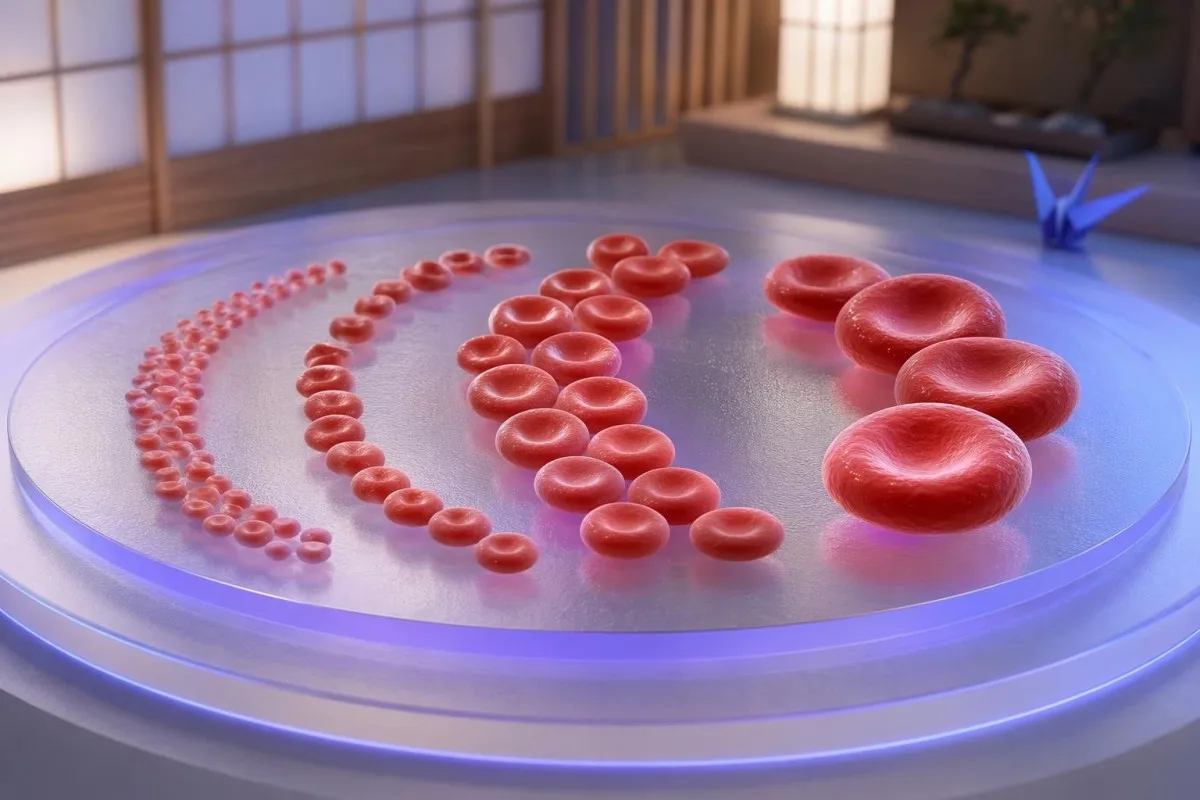
Two red-cell indices often rise and fall together, but the exceptions are where the clinical clues live. Here is how I read them before anyone panics over a flagged CBC.


- MCV measures average red-cell size; most adult reference ranges are about 80-100 fL.
- MCH measures average hemoglobin per red cell; most adult reference ranges are about 27-33 pg.
- MCV MCH difference is size versus hemoglobin amount, not two names for the same result.
- Low MCV low MCH most often suggests iron deficiency or thalassemia trait, especially when hemoglobin is also low.
- High MCV high MCH usually means larger red cells carrying more hemoglobin per cell, often from B12, folate, alcohol, liver, thyroid, medication, or reticulocyte patterns.
- High MCV normal MCH can suggest mixed deficiencies, early macrocytosis, analyzer variation, or a pattern that needs RDW and smear review.
- MCHC is different again; it estimates hemoglobin concentration inside red cells and often stays normal when MCV and MCH move together.
- Recheck timing matters because mild MCV or MCH shifts of 1-3 units can come from hydration, recent illness, exercise, or lab-to-lab variation.
- Urgency depends more on hemoglobin, symptoms, reticulocytes, platelets, WBC, and trends than on MCV or MCH alone.
What MCV vs MCH means when both are flagged
MCV vs MCH compares red-cell size with red-cell hemoglobin content: MCV is measured in femtoliters, usually about 80-100 fL, while MCH is measured in picograms, usually about 27-33 pg. When both are low, think smaller, paler cells; when both are high, think larger cells that carry more hemoglobin per cell. A single flag rarely diagnoses anything.
When I review a CBC, I do not treat MCV or MCH as a verdict; I treat them as coordinates on a map. The stronger clinical signal usually comes from their relationship to hemoglobin, RBC count, RDW, and symptoms, which is why our anemia pattern guide starts with clusters rather than isolated flags.
Kantesti is an AI blood test interpretation platform that reads MCV and MCH alongside more than 15,000 biomarkers, not as lonely red arrows on a PDF. In our analysis of 2M+ blood tests, the most common patient mistake is assuming a mildly low MCH of 26.5 pg means severe anemia even when hemoglobin is 13.8 g/dL and ferritin has never been checked.
As of June 9, 2026, I still tell patients the same thing I told them 15 years ago in clinic: a CBC index is a clue, not a diagnosis. If hemoglobin is under 8 g/dL, symptoms such as chest pain or fainting change the urgency; if hemoglobin is normal and the MCV is 79 fL, the next step is usually organized follow-up, not panic.
The MCV MCH difference in units and formulas
The MCV MCH difference is simple: MCV estimates average red-cell volume in fL, while MCH estimates average hemoglobin mass per red cell in pg. MCV is derived from hematocrit and RBC count; MCH is derived from hemoglobin and RBC count.
MCV is calculated roughly as hematocrit divided by RBC count, multiplied by 10. MCH is calculated roughly as hemoglobin divided by RBC count, multiplied by 10; that shared RBC denominator is one reason the two indices often drift in the same direction.
Most adult labs call MCV low below about 80 fL and high above about 100 fL, but some European laboratories use upper cutoffs closer to 98 fL. For a deeper standalone explanation of cell size, see our MCV blood test guide.
MCH is usually flagged low below 27 pg and high above 33 pg, though analyzer-specific ranges vary by 1-2 pg. If you want the companion view of hemoglobin per cell, our MCH blood test article breaks down early anemia patterns in more detail.
Kantesti links these units to the original lab reference range rather than forcing one universal cutoff, because a 101 fL MCV means something different in a lab whose upper limit is 98 fL versus 102 fL. That small detail prevents a surprising number of false alarms.
Why MCV and MCH often move in the same direction
MCV and MCH often move together because larger red cells usually contain more hemoglobin per cell, and smaller red cells usually contain less. This is physiology, not coincidence; cell size and hemoglobin packaging are linked during red-cell production.
A high MCV of 106 fL with an MCH of 35 pg often reflects macrocytes that are simply bigger containers. The MCHC may remain normal at 32-36 g/dL because the concentration of hemoglobin inside each cell has not changed much.
A low MCV of 72 fL with an MCH of 22 pg often reflects microcytic, hypochromic cells, a pattern clinicians learn to associate with iron-restricted hemoglobin production. This is the classic pattern behind many full blood panel anemia clusters.
The trick is not to overread a 1-unit movement. I have seen a patient’s MCV move from 89 fL to 92 fL after a viral illness with no clinical consequence, while another patient’s slow fall from 84 fL to 77 fL over 18 months revealed chronic gastrointestinal iron loss.
Cell indices are averages, and averages hide mixtures. If half the circulating cells are tiny and half are large, MCV can look deceptively normal near 88 fL while RDW quietly rises above 15%.
Low MCV low MCH: the pattern most patients notice
Low MCV low MCH usually means red cells are smaller than usual and carry less hemoglobin per cell. The two most common explanations are iron deficiency and thalassemia trait, but anemia of inflammation, lead exposure, and sideroblastic patterns also belong on the list.
In iron deficiency, ferritin often falls before hemoglobin drops; many adults have ferritin below 30 ng/mL while hemoglobin remains normal. The British Society of Gastroenterology guideline recommends investigating confirmed iron deficiency anemia in adult men and postmenopausal women because gastrointestinal blood loss is common enough to matter (Snook et al., 2021).
A 41-year-old patient I saw had MCV 74 fL, MCH 23 pg, hemoglobin 10.9 g/dL, and ferritin 6 ng/mL after months of heavy periods. That pattern is very different from a lifelong MCV of 70 fL, MCH 22 pg, hemoglobin 13.2 g/dL, and a high RBC count, which often points toward thalassemia trait.
DeLoughery’s New England Journal of Medicine review of microcytic anemia emphasizes the same clinical split: iron deficiency and thalassemia are common, but the RBC count, ferritin, transferrin saturation, and smear decide the next step (DeLoughery, 2014). Our iron deficiency guide explains why ferritin, TIBC, and iron saturation usually matter more than serum iron alone.
Kantesti flags low MCV low MCH differently when CRP is high, because ferritin can rise as an inflammatory marker even when iron supply to marrow is poor. A ferritin of 80 ng/mL with CRP 35 mg/L is not the same story as ferritin 80 ng/mL with CRP 1 mg/L.
Low MCV with a high or normal RBC count
Low MCV with a normal or high RBC count often suggests thalassemia trait more than simple iron deficiency. A typical clue is MCV below 75 fL with RBC count above about 5.0 million/µL and only mild or no anemia.
Iron deficiency usually makes the marrow underproduce cells, so the RBC count often trends low or low-normal. Thalassemia trait can produce many small cells, so the RBC count may look oddly high for the degree of hemoglobin change.
The Mentzer index, calculated as MCV divided by RBC count, is a screening clue rather than a diagnosis; values under 13 lean toward thalassemia trait, while values above 13 lean toward iron deficiency. I use it only as a nudge, not a final answer, because mixed iron deficiency and thalassemia can blur the line.
If your CBC shows high RBC count with low MCV, do not start iron indefinitely without iron studies. Our guide to high RBC with low MCV covers when hemoglobin electrophoresis or genetic testing becomes reasonable.
One practical detail: thalassemia trait is often stable over years. If an MCV has been 71-74 fL since age 19 and ferritin is 85 ng/mL, that history is more persuasive than a single flagged result in 2026.
High MCV and high MCH without overcalling disease
High MCV and high MCH usually mean macrocytosis: larger red cells with more hemoglobin per cell. Common causes include vitamin B12 deficiency, folate deficiency, alcohol exposure, liver disease, hypothyroidism, reticulocytosis, and medications.
Vitamin B12 deficiency can cause MCV above 100 fL, but early B12 problems may occur with a normal MCV. Green and colleagues reviewed B12 deficiency in Nature Reviews Disease Primers and stressed that neurologic symptoms can appear before classic anemia in some patients (Green et al., 2017).
A 67-year-old taking a proton pump inhibitor for 9 years came to clinic with MCV 103 fL, MCH 34 pg, hemoglobin 12.1 g/dL, and numb toes. His serum B12 was borderline at 260 pg/mL, but methylmalonic acid was elevated, which changed the interpretation completely.
Medication history matters. Hydroxyurea, methotrexate, trimethoprim, zidovudine, valproate, and some chemotherapy regimens can push MCV above 100 fL even when nutrition is adequate; our B12 without anemia article explains why symptoms and confirmatory markers still matter.
Alcohol-related macrocytosis can appear before liver enzymes rise. In my experience, an MCV of 101-106 fL with normal hemoglobin and normal folate is one of those awkward patterns where the history often explains more than another exotic lab.
High MCV normal MCH: why discordance happens
High MCV normal MCH means red cells are larger on average, but hemoglobin per cell has not risen proportionally. This discordant pattern can occur with mixed deficiencies, early macrocytosis, reticulocytosis, analyzer effects, or a broad cell-size distribution.
The most common hidden explanation I see is a mixture: early B12 or folate deficiency pushing cells larger, plus iron deficiency pulling hemoglobin content down. The average MCV may climb to 101 fL while MCH stays near 31 pg, which looks less dramatic than the biology underneath.
Reticulocytes are also larger than mature red cells. After bleeding, hemolysis, or iron treatment, a reticulocyte count above 2.5% can lift MCV for a few weeks without making MCH look especially high.
Kantesti is an AI-powered blood test analysis tool that checks discordant MCV and MCH against RDW, reticulocytes, bilirubin, haptoglobin, ferritin, B12, folate, and trend history when those data are available. The point is not to diagnose from one pair of numbers; it is to decide what needs confirmation.
If RDW is high with normal or high MCV, the average may be hiding two cell populations. Our high RDW normal MCV guide walks through this mixed-deficiency problem in plain language.
MCHC, RDW, and reticulocytes reframe MCV and MCH
MCHC, RDW, and reticulocytes often explain why MCV and MCH appear confusing. MCHC estimates hemoglobin concentration in red cells, RDW estimates size variation, and reticulocytes show whether marrow is responding.
MCHC is usually around 32-36 g/dL and often stays normal when MCV and MCH rise together. A high MCH does not automatically mean the cells are over-concentrated with hemoglobin; it may just mean the cells are bigger.
RDW is often reported around 11.5-14.5%, though ranges vary. High RDW with low MCV supports evolving iron deficiency, while low MCV with normal RDW and a high RBC count makes thalassemia trait more plausible.
Reticulocyte counts are underused by patients reading their own CBC. A reticulocyte percentage of 4% after treatment for anemia can make MCV rise because young cells are larger, and our reticulocyte count guide explains how that recovery signal looks.
For a deeper technical companion on red-cell distribution and indices, our research article on RDW, MCV, and MCHC covers why average values can hide clinically meaningful variation.
When an MCV or MCH flag is not urgent
An isolated mild MCV or MCH flag is often not urgent when hemoglobin, WBC, platelets, and symptoms are normal. A borderline MCV of 99-101 fL or MCH of 26-27 pg commonly needs context and repeat testing, not emergency care.
I pay more attention when the flag is new, progressive, or paired with symptoms. An MCV moving from 88 fL to 76 fL over 12 months matters more than an MCV of 79 fL that has been stable for 8 years.
Lab variation is real. Different analyzers, transport delays, and specimen conditions can shift indices by small amounts; our blood test normal range guide explains why one red arrow near a cutoff can mislead.
Urgent review is more appropriate when hemoglobin is severely low, platelets are very low, WBC is abnormal, or symptoms include chest pain, shortness of breath at rest, fainting, black stools, or rapid heartbeat. In many clinics, hemoglobin under 7-8 g/dL triggers same-day assessment depending on the patient.
A calm rule I use: if the number is borderline and you feel well, compare it with the last 2 CBCs before acting. If it is new and accompanied by symptoms, treat the pattern as clinical, not cosmetic.
Lab artifacts and unit traps that distort interpretation
MCV and MCH can look discordant because of lab artifacts, unit changes, or pre-analytical conditions. Cold agglutinins, delayed processing, very high glucose, and analyzer differences can all distort red-cell indices.
Cold agglutinins can make red cells clump in the tube, which may falsely lower RBC count and falsely raise MCV. In those cases, the analyzer pattern can look bizarre enough that the lab may warm and rerun the sample.
Delayed processing can change cell volume, especially if the sample sits for many hours outside recommended conditions. Most CBCs are stable for routine use, but a sample drawn at 8 AM and processed the next day deserves more skepticism than a same-morning run.
Kantesti's neural network checks unit labels, reference ranges, and impossible combinations because international reports use different formatting. Our lab unit guide shows why a result copied without units can become clinically meaningless.
I have also seen patients compare capillary point-of-care results with venous laboratory CBCs and assume disease progression from a 2 fL shift. That is usually too small to interpret without repeat testing under similar conditions.
What to check next after abnormal MCV and MCH
The next tests after abnormal MCV and MCH depend on the direction of change. Low MCV low MCH usually calls for ferritin, transferrin saturation, TIBC, CRP, and sometimes hemoglobin electrophoresis; high MCV patterns call for B12, folate, TSH, liver tests, reticulocytes, and medication review.
For low MCV low MCH, I usually want ferritin and transferrin saturation before iron treatment. Ferritin below 15 ng/mL is strongly suggestive of depleted iron stores, while many clinicians treat ferritin below 30 ng/mL as compatible with iron deficiency in symptomatic adults.
For high MCV, I check B12 and folate, but I do not stop there. TSH, ALT, AST, bilirubin, GGT, reticulocyte count, and medication history often explain macrocytosis better than a single vitamin result.
If you are trying to make sense of a report with no clinician note, our lab result guide gives a safe order of operations: confirm units, check severity, compare trends, then decide what to ask. A second opinion is reasonable when hemoglobin is falling or the pattern conflicts with symptoms.
One small but useful question: was this checked before or after treatment? MCV can remain low for 2-3 months after iron replacement begins because older microcytic cells remain in circulation for roughly 120 days.
Why trend analysis beats one CBC screenshot
Trend analysis is safer than reacting to one CBC because MCV and MCH change slowly across the red-cell lifespan. A single CBC captures a mixture of cells produced over roughly 120 days, so recent events may not show immediately.
Iron therapy often improves reticulocytes within 7-10 days and hemoglobin within 2-4 weeks, but MCV may lag for months. That lag explains why patients feel better before the index looks normal.
B12 treatment can also create a transient mixed picture. New healthier cells appear while older macrocytes remain, so RDW can rise before MCV settles toward the 80-100 fL range.
Kantesti lets families and individuals compare repeat CBCs side by side, which is clinically useful when a result has drifted by 3-5 fL per year. Our trend analysis guide explains why slope often beats the red flag.
I would rather see 4 CBCs over 2 years than one perfect screenshot. The human marrow tells its story slowly, and the trend is where the plot is.
How our AI reads CBC indices without overreacting
Our AI reads CBC indices by combining MCV, MCH, hemoglobin, RBC count, RDW, platelets, WBC, and available chemistry markers. The goal is risk sorting: identify patterns that need follow-up while avoiding fear from harmless borderline flags.
Kantesti is an AI biomarker interpretation platform used by 2M+ people across 127+ countries, so our models see CBC patterns across many languages, units, and lab formats. That scale helps identify common traps, such as normal hemoglobin with low MCH after blood donation or high MCV after chemotherapy.
The system does not replace a physician, and I would not want it to. It can, however, surface the right questions in about 60 seconds: Is ferritin missing? Is the RBC count unexpectedly high? Did MCV rise after starting metformin, a PPI, or an anti-seizure medication?
Our clinical review process is described in the technology guide, including how parsed values are checked against context rather than read as isolated highs and lows. We also publish methodology details through our clinical validation page.
In my own reviews as Thomas Klein, MD, the best outputs are the boring ones: repeat in 8-12 weeks, check ferritin and B12, compare with last year, or call urgently because hemoglobin is 6.9 g/dL. Sensible triage beats dramatic interpretation every time.
Research publications and further reading
The research section below gives formal sources for readers who want a deeper technical background on CBC indices and related lab-pattern interpretation. These references are separate from urgent medical advice; if hemoglobin is very low or symptoms are significant, clinical care comes first.
Thomas Klein, MD, and the Kantesti medical team use peer-reviewed hematology literature plus internal validation workflows when reviewing CBC interpretation logic. Our Medical Advisory Board provides oversight for patient-facing explanations that involve anemia, iron studies, and red-cell indices.
Klein, T. (2026). RDW Blood Test: Complete Guide to RDW-CV, MCV & MCHC. Zenodo. DOI: https://doi.org/10.5281/zenodo.18202598. ResearchGate: publication search. Academia.edu: publication search.
Klein, T. (2026). BUN/Creatinine Ratio Explained: Kidney Function Test Guide. Zenodo. DOI: https://doi.org/10.5281/zenodo.18207872. ResearchGate: publication search. Academia.edu: publication search.
For iron-specific follow-up, our technical iron studies guide explains TIBC, transferrin saturation, and ferritin together. That combination is usually more useful than arguing over whether an MCH of 26.8 pg is barely low or just analyzer noise.
Frequently Asked Questions
What is the main difference between MCV and MCH?
MCV measures average red-cell size in femtoliters, with a typical adult range around 80-100 fL. MCH measures average hemoglobin mass per red cell in picograms, with a typical adult range around 27-33 pg. MCV tells you about cell volume, while MCH tells you how much hemoglobin each cell carries. They often move together, but they are not the same test.
What does low MCV low MCH mean?
Low MCV low MCH means red cells are smaller than usual and carry less hemoglobin per cell. The most common causes are iron deficiency and thalassemia trait, but anemia of inflammation, lead exposure, and sideroblastic patterns can also do this. Ferritin below 15 ng/mL strongly supports depleted iron stores, while a high RBC count with MCV below 75 fL can suggest thalassemia trait. Hemoglobin level, RDW, ferritin, and transferrin saturation decide the next step.
Can MCV be high while MCH is normal?
Yes, high MCV normal MCH can happen when red cells are larger on average but hemoglobin per cell has not increased proportionally. This pattern may occur with mixed iron and B12 or folate deficiency, early macrocytosis, reticulocytosis, or analyzer variation. RDW above about 14.5% can hint that mixed cell sizes are hiding behind the average. A repeat CBC plus B12, folate, ferritin, TSH, liver tests, and reticulocytes may be appropriate depending on symptoms.
Is high MCH dangerous?
High MCH is not dangerous by itself; it usually reflects larger red cells that contain more hemoglobin per cell. MCH above about 33 pg often appears with MCV above 100 fL in macrocytosis. The concern depends on the cause, such as B12 deficiency, folate deficiency, alcohol exposure, liver disease, hypothyroidism, medication effects, or marrow disorders. Symptoms and hemoglobin level matter more than the MCH number alone.
Which is better for anemia, MCV or MCH?
Neither MCV nor MCH is better alone; the pair is useful because it describes cell size and hemoglobin content together. MCV helps classify anemia as microcytic, normocytic, or macrocytic, while MCH helps show whether cells carry less hemoglobin than expected. A low MCV of 72 fL with MCH of 22 pg points toward a different workup than an MCV of 104 fL with MCH of 35 pg. Hemoglobin, RDW, RBC count, ferritin, B12, folate, and reticulocytes complete the interpretation.
When should I worry about abnormal MCV or MCH?
You should worry more when abnormal MCV or MCH is paired with low hemoglobin, worsening trends, abnormal WBC or platelets, or symptoms such as fainting, chest pain, black stools, shortness of breath at rest, or rapid heartbeat. Mild isolated changes, such as MCV 79-81 fL or MCH 26-27 pg, often need repeat testing and iron or vitamin studies rather than emergency care. Hemoglobin below 7-8 g/dL often needs urgent clinical assessment, depending on age and medical history. A stable lifelong microcytosis can be much less concerning than a new rapid drop.
Can dehydration change MCV or MCH?
Dehydration can concentrate hemoglobin and hematocrit, but it usually does not dramatically change MCV or MCH. Small shifts of 1-3 units can occur from lab variation, sample handling, recent illness, or analyzer differences. If only MCV or MCH is slightly abnormal and the rest of the CBC is normal, repeating the CBC under similar conditions is often more useful than assuming disease. Large or progressive changes should be reviewed with iron, B12, folate, thyroid, liver, and reticulocyte context.
Can I take iron supplements if my MCV and MCH are low?
Not until iron deficiency has been confirmed or a clinician advises it. Low MCV and MCH can also occur with thalassemia trait, where iron will not correct the pattern and may cause side effects or excess iron accumulation.
How long can MCV stay high after I stop drinking alcohol?
MCV can often remain elevated for 2–4 months because red blood cells circulate for about 120 days. If it stays high after that, ask your clinician to review B12, folate, liver, thyroid, and medication factors.
Get AI-Powered Blood Test Analysis Today
Join over 2 million users worldwide who trust Kantesti for instant, accurate lab test analysis. Upload your blood test results and receive comprehensive interpretation of 15,000+ biomarkers in seconds.
📚 Referenced Research Publications
Klein, T., Mitchell, S., & Weber, H. (2026). RDW Blood Test: Complete Guide to RDW-CV, MCV & MCHC. Kantesti AI Medical Research.
Klein, T., Mitchell, S., & Weber, H. (2026). BUN/Creatinine Ratio Explained: Kidney Function Test Guide. Kantesti AI Medical Research.
📖 External Medical References
⚕️ Medical Disclaimer
This article is for educational purposes only and does not constitute medical advice. Always consult a qualified healthcare provider for diagnosis and treatment decisions.
E-E-A-T Trust Signals
Experience
Physician-led clinical review of lab interpretation workflows.
Expertise
Laboratory medicine focus on how biomarkers behave in clinical context.
Authoritativeness
Written by Dr. Thomas Klein with review by Dr. Sarah Mitchell and Prof. Dr. Hans Weber.
Trustworthiness
Evidence-based interpretation with clear follow-up pathways to reduce alarm.