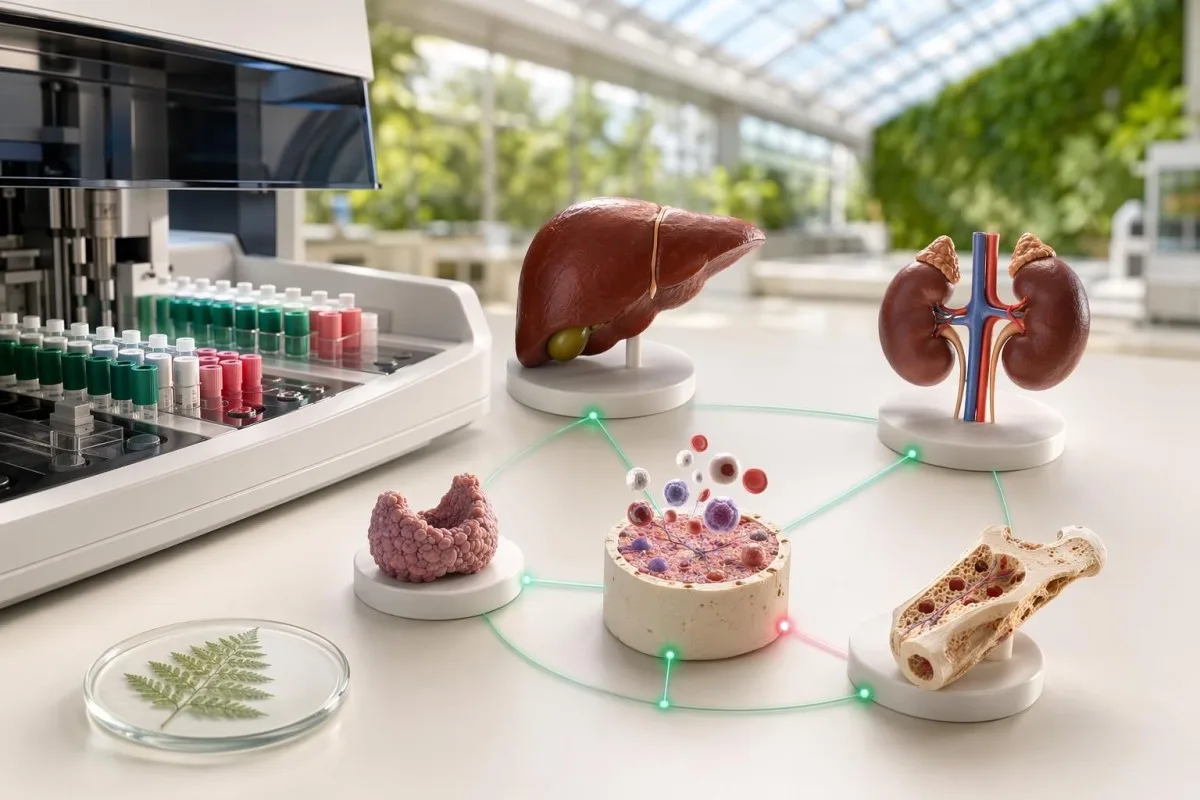
Several mild flags can be more meaningful than one dramatic number. The clinical skill is spotting when markers move together.


- Full blood panel clusters often matter more than one flagged result because linked markers point to a shared physiology.
- Dehydration pattern commonly shows high albumin above 5.0 g/dL, high hematocrit, high BUN, and sometimes high sodium.
- Inflammation cluster may combine CRP above 10 mg/L, high neutrophils, high platelets, raised ferritin, and low albumin.
- Liver-bile pattern is suggested when ALP and GGT rise together, especially with bilirubin above 1.2 mg/dL or 20 µmol/L.
- Kidney-electrolyte cluster becomes more concerning when eGFR is below 60 mL/min/1.73 m² with potassium, CO2, or urine albumin changes.
- Anemia-metabolic overlap may show low hemoglobin, high RDW above 14.5%, low ferritin, high TSH, or A1c that does not fit glucose readings.
- Trend analysis catches slow drift, such as eGFR falling more than 5 mL/min/1.73 m² per year or ALT doubling within range.
- Repeat timing depends on the cluster: hydration-related changes may be repeated in 1-2 weeks, while potassium above 6.0 mmol/L needs same-day advice.
What abnormal clusters mean on a full blood panel
Several small abnormalities on a full blood panel matter when they point in the same physiological direction. High albumin, high hematocrit and high BUN often say dehydration; high CRP, platelets and neutrophils suggest tissue response; high ALP, GGT and bilirubin points toward bile flow; low hemoglobin with high RDW, low ferritin or raised TSH suggests overlapping anemia and metabolic strain. I’m Thomas Klein, MD, and at Kantesti AI we read blood panel results as clusters first, flags second. That is where missed risk usually hides.
A single abnormal value is a clue, not a verdict. In our analysis of 2M+ blood tests, the result that worries me is rarely a lonely ALT of 42 IU/L; it is ALT 42 IU/L plus triglycerides 230 mg/dL, fasting glucose 112 mg/dL, and high-normal uric acid, because that pattern behaves very differently.
The practical trick is asking whether the abnormalities share a mechanism. If three unrelated markers are each 2% outside range after a hard gym session, our advice may be repeat testing; if three related markers move in one direction, our borderline blood results guide becomes much more relevant.
Blood panel results are also probabilistic. A cluster increases or lowers suspicion; it does not diagnose cancer, kidney failure, autoimmune disease, or diabetes by itself, and a clinician still needs symptoms, medicines, timing, and sometimes a repeat specimen.
Why one flagged value can mislead patients
One flagged value can mislead because reference ranges are statistical, not personal. Most lab ranges include the middle 95% of a comparison population, meaning about 1 in 20 healthy people may have a flagged result even when nothing is wrong.
Reference intervals vary by age, sex, pregnancy, altitude, ethnicity, assay method, and laboratory calibration. Some European labs use lower ALT upper limits near 35 IU/L for men and 25 IU/L for women, while other reports still flag only above 40-55 IU/L.
Kantesti AI interprets borderline markers by comparing the lab’s own range, the unit system, and nearby related markers. That is why our medical validation process weighs combinations such as sodium plus chloride plus CO2, not sodium in isolation.
Biological variation matters. Creatinine can shift 0.1-0.3 mg/dL after heavy meat intake or intense exercise; triglycerides can rise 30-80 mg/dL after a recent meal; white cell counts may jump for 24-48 hours after acute stress.
For a deeper look at why flags can overcall or undercall risk, our blood test normal range article explains the mathematics behind low, high, and borderline labels.
The dehydration cluster: high albumin, BUN, hematocrit
A dehydration cluster on a full blood panel usually means the blood is more concentrated than usual. The common pattern is high or high-normal albumin, total protein, hematocrit, hemoglobin, BUN, and sometimes sodium or calcium.
Albumin above about 5.0 g/dL is more often hemoconcentration than excess albumin production. When albumin, total protein, hematocrit above 49% in men or 48% in women, and BUN above 20 mg/dL rise together, dehydration moves high on my list.
The BUN-to-creatinine ratio is useful but imperfect. A ratio above 20:1 often supports reduced circulating volume, yet a high-protein diet, gastrointestinal bleeding, corticosteroids, or catabolic illness can push BUN up without simple dehydration.
I see this pattern after long flights, sauna use, bowel prep, endurance events, and fasting labs done late in the morning. Our dehydration false highs guide covers the common false alarms, including calcium that appears mildly high only because albumin is concentrated.
Here is the patient-level move: compare with your prior baseline. If albumin is usually 4.4 g/dL and returns from 5.2 g/dL to 4.5 g/dL after normal hydration, the story changes completely.
The inflammation cluster: CRP, WBC, platelets, ferritin
An inflammation cluster is suggested when immune markers and acute-phase proteins rise together. CRP above 10 mg/L, neutrophils above 7.5 x 10⁹/L, platelets above 450 x 10⁹/L, high ferritin, and low albumin often point to an active tissue response.
CRP rises quickly, often within 6-8 hours, and may peak by 48 hours after an acute trigger. ESR moves more slowly and can stay elevated for weeks, which is why a high ESR with normal CRP may reflect age, anemia, pregnancy, kidney disease, or a resolving process rather than a fresh flare.
Ferritin is not only an iron-storage marker. Ferritin above 300 ng/mL in men or 200 ng/mL in women can reflect inflammation, liver injury, metabolic syndrome, or iron overload, and the distinction often depends on transferrin saturation and CRP.
The white cell differential adds texture. Neutrophilia with bands leans bacterial or steroid/stress response, while lymphocyte predominance can follow viral illness; our inflammation blood tests guide compares CRP, ESR, fibrinogen, ferritin, and CBC patterns side by side.
A 34-year-old teacher once sent us a panel with CRP 62 mg/L, platelets 510 x 10⁹/L, ferritin 480 ng/mL, and albumin 3.3 g/dL after a week of fever. None of those markers alone gave the diagnosis, but together they argued against treating the ferritin as simple iron excess.
Liver-bile patterns: ALT, AST, ALP, GGT, bilirubin
Liver-bile patterns split into hepatocellular, cholestatic, and mixed patterns. ALT and AST mainly suggest liver-cell or muscle enzyme release, while ALP, GGT, and bilirubin together raise more concern for bile flow or biliary irritation.
ALT above 40 IU/L is commonly flagged, but the context matters more than the cutoff. ALT 65 IU/L with triglycerides 260 mg/dL and A1c 6.1% often suggests metabolic fatty liver risk, while AST 89 IU/L after a marathon may be muscle-heavy if CK is also high.
GGT helps interpret ALP because ALP also comes from bone and intestine. ALP above 120 IU/L plus GGT above 60 IU/L in an adult usually deserves hepatobiliary review, especially if bilirubin is above 1.2 mg/dL or 20 µmol/L.
The American College of Gastroenterology guideline by Kwo et al. recommends pattern-based evaluation of abnormal liver chemistries rather than treating each enzyme separately (Kwo et al., 2017). Our liver function test article follows the same clinical logic across ALT, AST, ALP, and GGT.
One trap: bilirubin can rise during fasting even when ALT, AST, ALP, and GGT are normal. In a thin 22-year-old with bilirubin 2.1 mg/dL, normal direct bilirubin, and normal enzymes, Gilbert syndrome is a very different conversation from jaundice plus dark urine and pale stools.
Kidney-electrolyte clusters: eGFR, creatinine, potassium
A kidney-electrolyte cluster becomes clinically meaningful when filtration markers and mineral balance change together. eGFR below 60 mL/min/1.73 m² for at least 3 months, creatinine rise, potassium abnormality, low CO2, or urine albumin can signal kidney stress.
Creatinine alone is muscle-dependent. A muscular 28-year-old may run creatinine 1.25 mg/dL with normal cystatin C, while an older adult with low muscle mass can have deceptively normal creatinine despite low eGFR.
KDIGO 2024 defines chronic kidney disease by abnormalities of kidney structure or function lasting at least 3 months, including eGFR below 60 or albuminuria above 30 mg/g (KDIGO CKD Work Group, 2024). That time requirement prevents overdiagnosis from a single dehydrated or medication-affected panel.
Potassium is the electrolyte I treat with the least casualness. Potassium above 6.0 mmol/L, especially with kidney impairment or heart symptoms, needs same-day clinical advice; potassium below 3.0 mmol/L can also provoke rhythm problems or muscle weakness.
When Kantesti AI reads kidney-related blood work results, it checks creatinine, eGFR, BUN, sodium, potassium, chloride, CO2, calcium, albumin, and urine markers when available. Our plain-English guide to what eGFR means explains why age and body composition change interpretation.
Anemia-metabolic overlap: hemoglobin, RDW, ferritin, TSH
An anemia-metabolic overlap appears when red cell markers and endocrine or nutrient markers are abnormal together. Low hemoglobin with high RDW, low ferritin, borderline B12, high TSH, or abnormal A1c needs more than a standard anemia label.
Adult anemia is commonly defined as hemoglobin below 13.0 g/dL in men and below 12.0 g/dL in non-pregnant women, though pregnancy and altitude change those numbers. RDW above 14.5% can rise before MCV falls, so early iron deficiency may look normocytic.
Ferritin below 30 ng/mL is a strong clue for iron deficiency in many outpatient settings, but ferritin can look falsely normal or high during inflammation. Camaschella’s New England Journal of Medicine review emphasizes that iron deficiency and inflammation often coexist, which is exactly where serum iron alone misleads (Camaschella, 2015).
A1c can be distorted by red cell turnover. Iron deficiency may push A1c slightly upward, hemolysis or recent blood loss can push it downward, and chronic kidney disease can make the number less tidy than patients expect.
If hemoglobin is low and MCV is high, check B12, folate, liver markers, alcohol exposure, thyroid function, and reticulocytes before assuming one cause. Our anemia blood patterns guide walks through microcytic, normocytic, and macrocytic patterns.
Glucose-lipid clusters that hint at insulin resistance
A glucose-lipid cluster hints at insulin resistance when fasting glucose, A1c, triglycerides, HDL, ALT, uric acid, and sometimes hs-CRP move in the same direction. This pattern can appear years before diabetes criteria are met.
Fasting glucose from 100-125 mg/dL and A1c from 5.7-6.4% sit in the prediabetes range in many guidelines. Yet I get more concerned when glucose 96 mg/dL comes with fasting insulin 18 µIU/mL, triglycerides 210 mg/dL, HDL 38 mg/dL, and ALT 48 IU/L.
The triglyceride-to-HDL ratio is not a diagnosis, but it is a useful pattern clue. In mg/dL units, a ratio above 3 often travels with insulin resistance, especially when waist size, blood pressure, or fatty liver markers are also abnormal.
Uric acid adds another layer. Uric acid above 7.0 mg/dL in men or 6.0 mg/dL in women may cluster with high triglycerides, fatty liver, kidney stress, sleep apnea, fructose intake, or diuretic use.
Kantesti’s neural network flags metabolic overlap by reading glucose, A1c, insulin when present, lipids, liver enzymes, uric acid, CRP, and kidney markers together. Our HOMA-IR guide explains how fasting insulin can reveal risk while A1c still looks normal.
Protein patterns: albumin, globulin, A/G ratio, kidney loss
Protein patterns on a blood panel separate hydration, liver production, kidney loss, gut loss, and immune activation. Albumin, total protein, globulin, and the A/G ratio become most useful when read with urine albumin, CRP, liver enzymes, and kidney function.
Albumin below 3.5 g/dL can reflect inflammation, liver synthetic difficulty, kidney protein loss, malnutrition, or fluid overload. Albumin above 5.0 g/dL is more commonly concentration from low fluid volume than true overproduction.
Globulin above about 3.5-4.0 g/dL may reflect chronic immune stimulation, liver disease, autoimmune activity, or monoclonal protein production. If total protein is high because globulin is high, that is a different problem from total protein high because albumin is concentrated.
The A/G ratio is crude but helpful. An A/G ratio below 1.0 can occur when albumin is low, globulin is high, or both; I usually look for CRP, ESR, liver enzymes, urine ACR, and sometimes serum protein electrophoresis rather than guessing.
Our serum proteins guide covers globulins, albumin, and A/G ratio in more detail, including why a normal total protein can still hide a low albumin-high globulin swap.
Thyroid clusters hiding in CBC and cholesterol results
Thyroid patterns often show up outside the thyroid line of the report. High TSH with high LDL, low sodium, high CK, fatigue, constipation, or anemia can make a borderline thyroid result more meaningful.
TSH reference ranges commonly run about 0.4-4.0 mIU/L, but clinicians disagree on the ideal upper cutoff in symptomatic adults. A TSH of 4.8 mIU/L with normal free T4 may be watched in one patient and treated more seriously in another with pregnancy plans, positive antibodies, or rising LDL.
Hypothyroidism can raise LDL cholesterol by reducing LDL receptor activity. It can also cause mild hyponatremia, CK elevation, macrocytosis, and low energy, so a CBC or lipid panel may be the first clue.
Hyperthyroid patterns are different: low TSH, high free T4 or T3, low cholesterol, sometimes mild liver enzyme changes, and occasionally low neutrophils. A racing heart with TSH below 0.1 mIU/L is not the same scenario as a slightly low TSH after biotin use.
For the thyroid-specific decision tree, see our thyroid panel guide covering TSH, free T4, T3, TPO antibodies, and thyroglobulin antibodies.
Exercise, fasting, medicines, and supplement cluster mimics
Exercise, fasting, medicines, and supplements can create abnormal clusters that look like disease. The timing of the test can explain CK, AST, creatinine, bilirubin, glucose, triglycerides, thyroid assays, and electrolyte shifts.
Hard resistance training can raise CK above 1000 IU/L and AST for several days, while ALT may rise less. A 52-year-old marathon runner with AST 89 IU/L, ALT 41 IU/L, and CK 1800 IU/L needs a muscle-versus-liver interpretation before panic.
Fasting changes are not always cleaner. Bilirubin can rise after 24-48 hours of reduced calories, glucose may run higher from dawn hormones, and triglycerides may fall enough to hide usual metabolic risk.
Medicines leave fingerprints. Thiazide diuretics can raise uric acid and lower sodium or potassium; ACE inhibitors can raise potassium and creatinine; statins can raise CK; corticosteroids can raise neutrophils and glucose while lowering eosinophils.
Supplements matter too, especially high-dose biotin, creatine, iron, vitamin D, and potassium. Our exercise lab values article explains why a normal panel after rest can look abnormal after a heavy session.
Trend analysis: when small changes become real signals
Trend analysis finds risk when values drift inside the normal range. A creatinine rising from 0.78 to 1.05 mg/dL, ALT rising from 18 to 39 IU/L, or MCV falling from 91 to 82 fL can matter before a flag appears.
One panel is a photograph; trends are the film. In my clinical practice, a stable platelet count of 430 x 10⁹/L is less concerning than a count climbing from 210 to 430 to 610 x 10⁹/L over 9 months.
Kantesti AI stores previous uploads so our AI blood test platform can compare slope, percentage change, and cluster movement. A 15% drop in hemoglobin may deserve attention even if the final value is barely inside range.
Noise still exists. Day-to-day variation can be 5-10% for many chemistry markers, larger for triglycerides, and smaller for sodium; repeating too soon can create anxiety rather than clarity.
For people tracking labs across seasons, diets, medications, or GLP-1 treatment, our lab trend graph guide explains drift, swings, and baseline resets without overcalling every wobble.
When a cluster needs urgent follow-up, not just a repeat
Some abnormal clusters need same-day clinical follow-up, even if you feel well. Potassium above 6.0 mmol/L, sodium below 125 mmol/L, hemoglobin below 7-8 g/dL, platelets below 20 x 10⁹/L, or WBC above 50 x 10⁹/L can be urgent depending on context.
Urgency is not only about distance from normal. A potassium of 6.2 mmol/L with kidney impairment is different from a potassium of 5.6 mmol/L in a hemolyzed specimen, and the lab comment about hemolysis can completely change the next step.
Liver clusters can also be urgent. Jaundice with bilirubin above 3 mg/dL, high ALP and GGT, fever, pain, or confusion needs clinical assessment faster than an isolated ALT of 55 IU/L found on a wellness panel.
CBC clusters that need speed include low hemoglobin with chest pain or breathlessness, severe neutropenia below 0.5 x 10⁹/L with fever, and platelets below 50 x 10⁹/L with bruising or bleeding symptoms. Our critical values guide explains which results should not wait for routine follow-up.
If the abnormality is mild, context-rich, and not linked to symptoms, repeating in 1-4 weeks is often reasonable. If the abnormality is severe, new, symptomatic, or part of a dangerous cluster, do not manage it through an app alone.
How Kantesti AI reads clusters and our research record
Kantesti AI reads a full blood panel by combining marker relationships, reference intervals, unit conversions, age and sex context, trend history, and clinical red-flag rules. Our platform is designed to explain patterns in about 60 seconds, not replace a physician’s diagnosis.
Kantesti Ltd is a UK company, and our clinical governance is reviewed with physician oversight through our Medical Advisory Board. As Thomas Klein, MD, I am most comfortable when AI output says what it knows, what it does not know, and what would change the interpretation.
Our engine is built for multilingual blood work results explained in 75+ languages across 127+ countries, with CE Mark, HIPAA, GDPR, and ISO 27001 controls. You can read more about the organisation behind the work on About Kantesti.
For technical readers, our validation benchmark describes how Kantesti’s neural network is tested across medical specialties and trap cases; the clinical benchmark is where we publish methods rather than marketing claims. Patients can also try free analysis by uploading a PDF or photo of recent results.
Kantesti research publications: Kantesti Medical Research Group. (2026). Urobilinogen in Urine Test: Complete Urinalysis Guide 2026. Zenodo. https://doi.org/10.5281/zenodo.18226379. ResearchGate. Academia.edu. Kantesti Medical Research Group. (2026). Iron Studies Guide: TIBC, Iron Saturation & Binding Capacity. Zenodo. https://doi.org/10.5281/zenodo.18248745. ResearchGate. Academia.edu.
Frequently Asked Questions
What does it mean if several blood test results are slightly abnormal?
Several slightly abnormal blood test results matter most when they point to the same body process. For example, albumin above 5.0 g/dL, hematocrit above 49% in men, and BUN above 20 mg/dL together often suggest hemoconcentration from dehydration. Three related mild flags are usually more meaningful than three unrelated tiny flags. A clinician should still check symptoms, medicines, fasting time, exercise, and prior results before deciding what the cluster means.
Can dehydration make a full blood panel look abnormal?
Yes, dehydration can make a full blood panel look abnormal by concentrating proteins, cells, and waste markers. Common findings include high albumin, high total protein, high hematocrit, high hemoglobin, high BUN, and sometimes high sodium or calcium. A BUN-to-creatinine ratio above 20:1 supports reduced circulating volume, although diet and medications can also raise BUN. If symptoms are mild and no critical values are present, clinicians often repeat testing after normal hydration.
Which blood panel pattern suggests inflammation?
An inflammation pattern often combines CRP above 10 mg/L, raised neutrophils, high platelets above 450 x 10⁹/L, high ferritin, and low albumin. ESR can remain high for weeks after CRP falls, so ESR and CRP do not always match. Ferritin can rise from inflammation even when iron stores are not excessive. The pattern should be interpreted with fever, pain, recent infection, autoimmune symptoms, and medication history.
How do liver and bile duct blood test patterns differ?
A liver-cell pattern usually shows ALT and AST rising more than ALP, while a bile-flow pattern usually shows ALP and GGT rising together. ALT above 40 IU/L is often flagged, but ALP above 120 IU/L with GGT above 60 IU/L is more suggestive of a hepatobiliary source. Bilirubin above 1.2 mg/dL or 20 µmol/L adds weight, especially if direct bilirubin is elevated. Isolated bilirubin with normal ALT, AST, ALP, and GGT can occur with fasting or Gilbert syndrome.
Can anemia change A1c or metabolic blood test interpretation?
Yes, anemia can change A1c interpretation because A1c depends on red cell lifespan. Iron deficiency may raise A1c slightly, while hemolysis, recent blood loss, or some kidney-related anemia can lower A1c despite higher glucose. Adult anemia is commonly defined as hemoglobin below 13.0 g/dL in men and below 12.0 g/dL in non-pregnant women. If A1c does not match fasting glucose or home readings, clinicians may use fructosamine, glucose monitoring, or repeat testing after anemia treatment.
When should abnormal blood panel results be repeated?
Mild isolated abnormalities are often repeated in 1-4 weeks after reviewing hydration, fasting, exercise, alcohol, supplements, and medicines. Hydration-related changes may normalize within days, while iron, thyroid, lipid, and A1c changes often need 6-12 weeks to show a stable response. Severe or symptomatic abnormalities should not wait for a routine repeat. Potassium above 6.0 mmol/L, sodium below 125 mmol/L, hemoglobin below 7-8 g/dL, or platelets below 20 x 10⁹/L usually need same-day clinical advice.
Can Kantesti AI interpret my blood panel PDF or photo?
Kantesti AI can interpret a blood panel PDF or photo by reading marker names, units, reference ranges, and abnormal clusters in about 60 seconds. The system looks across CBC, metabolic panel, liver enzymes, kidney markers, lipids, iron studies, thyroid markers, vitamins, and trends when previous reports are uploaded. It gives patient-friendly explanations and red-flag prompts, but it does not replace emergency care or a physician’s diagnosis. As of May 24, 2026, Kantesti supports 75+ languages and users across 127+ countries.
Can ferritin be low even when hemoglobin is normal?
Yes. Low ferritin can reflect depleted iron stores before anemia develops, so hemoglobin may still be within range. Discuss fatigue, restless legs, heavy periods, diet, or possible bleeding with your clinician, because treatment depends on the cause.
Does the time of day affect full blood panel results?
Yes, timing can affect some markers: serum iron and glucose may vary during the day, while meals can substantially change triglycerides. For repeat testing, use the same laboratory and, when possible, similar morning timing and fasting instructions to make trends easier to interpret.
Can a normal full blood panel still miss a serious problem?
Yes, sometimes. Blood panels are screening tools, so new chest pain, severe abdominal pain, unexplained weight loss, bleeding, fainting, or worsening shortness of breath should be assessed even if recent labs were normal.
Get AI-Powered Blood Test Analysis Today
Join over 2 million users worldwide who trust Kantesti for instant, accurate lab test analysis. Upload your blood test results and receive comprehensive interpretation of 15,000+ biomarkers in seconds.
📚 Referenced Research Publications
Klein, T., Mitchell, S., & Weber, H. (2026). Urobilinogen in Urine Test: Complete Urinalysis Guide 2026. Kantesti AI Medical Research.
Klein, T., Mitchell, S., & Weber, H. (2026). Iron Studies Guide: TIBC, Iron Saturation & Binding Capacity. Kantesti AI Medical Research.
📖 External Medical References
KDIGO CKD Work Group (2024). KDIGO 2024 Clinical Practice Guideline for the Evaluation and Management of Chronic Kidney Disease. Kidney International.
⚕️ Medical Disclaimer
This article is for educational purposes only and does not constitute medical advice. Always consult a qualified healthcare provider for diagnosis and treatment decisions.
E-E-A-T Trust Signals
Experience
Physician-led clinical review of lab interpretation workflows.
Expertise
Laboratory medicine focus on how biomarkers behave in clinical context.
Authoritativeness
Written by Dr. Thomas Klein with review by Dr. Sarah Mitchell and Prof. Dr. Hans Weber.
Trustworthiness
Evidence-based interpretation with clear follow-up pathways to reduce alarm.