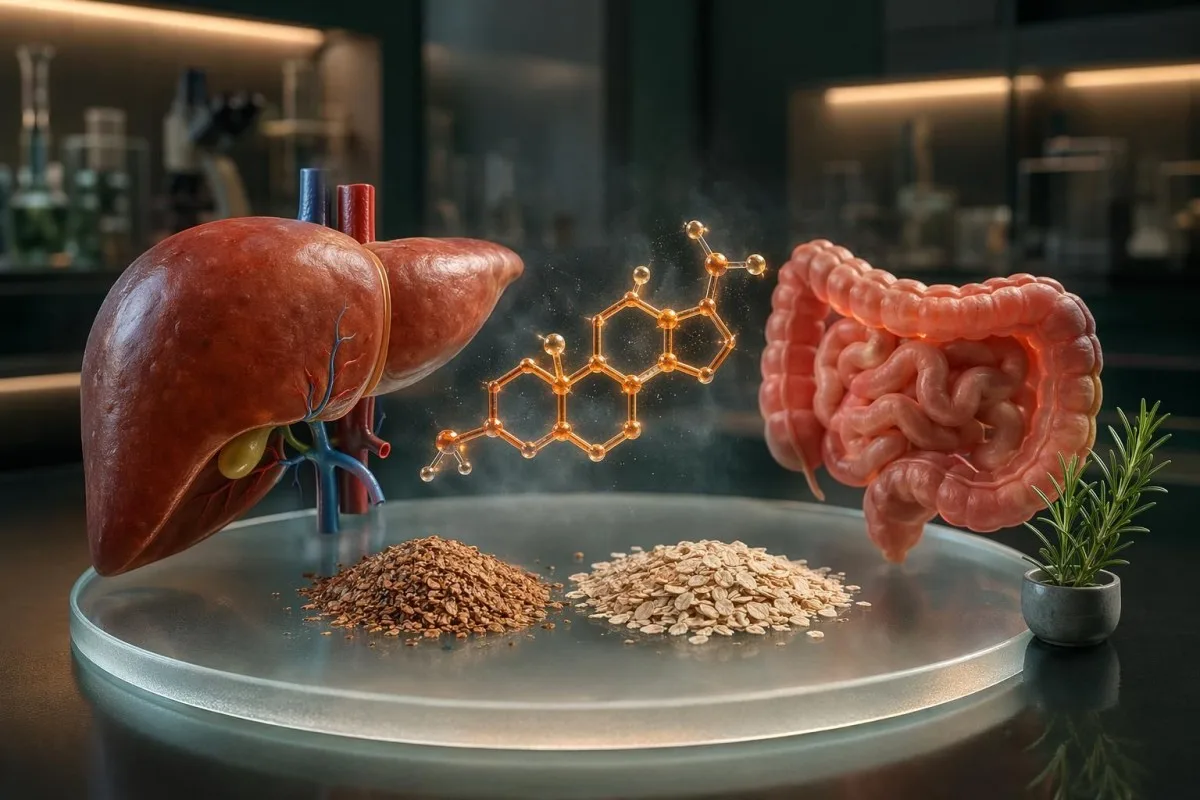
Estrogen metabolism is not a detox trend; it is a gut-liver-lab pattern. The useful question is whether your labs actually suggest excess estrogen, impaired clearance, insulin resistance, or normal physiology.


- Foods that lower estrogen usually work indirectly by improving estrogen clearance, stool transit, insulin sensitivity, and liver metabolism rather than by rapidly suppressing estradiol.
- Fiber intake of about 25-38 g/day is a realistic target; sudden jumps above 40 g/day can worsen bloating, constipation, or iron absorption in some patients.
- Ground flaxseed at 1-2 tablespoons daily, roughly 7-14 g, may modestly shift estrogen metabolism through lignans, but the evidence is mixed and not a substitute for medical care.
- Estradiol ranges vary by sex, cycle day, menopause status, and assay; a premenopausal estradiol of 250 pg/mL can be normal mid-cycle but unexpected after menopause.
- SHBG often rises with improved insulin sensitivity; low SHBG with high fasting insulin can make estrogen and androgen symptoms look worse even when estradiol is not extreme.
- Glycemic index foods matter because high-insulin patterns can lower SHBG, raise triglycerides, and amplify hormone symptoms before estradiol itself changes.
- Foods that reduce inflammation such as oily fish, legumes, berries, and extra-virgin olive oil may help when hs-CRP is above 2 mg/L or ALT/GGT suggest fatty liver strain.
- Lab clues first means checking estradiol timing, progesterone, SHBG, testosterone, TSH, liver enzymes, fasting insulin, A1c, lipids, and sometimes pregnancy status before trying an estrogen-lowering diet.
- Red flags include abnormal uterine bleeding, new breast symptoms, unexplained gynecomastia, jaundice, rapid weight loss, or estradiol far outside the expected range for your life stage.
Which foods that lower estrogen are actually realistic?
Foods that lower estrogen do not drain estrogen overnight; they may support healthier estrogen metabolism through fiber, flax lignans, cruciferous vegetables, low-glycemic meals, and reduced alcohol intake. As of July 8, 2026, the realistic goal is usually better clearance and balance, not medically suppressing estradiol.
Kantesti is an AI blood test analyzer that helps patients read estradiol in the context of SHBG, liver enzymes, insulin markers, thyroid results, and timing. That context matters because a lab result of 180 pg/mL can be perfectly normal on cycle day 12 and puzzling in a postmenopausal result.
I am Thomas Klein, MD, and in my 15 years of clinical practice I have seen many patients chase estrogen down when the real issue was constipation, high insulin, alcohol use, or a poorly timed test. Our clinical team sees this pattern often: symptoms feel hormonal, but the first fix is sometimes bowel regularity and a repeat blood draw.
The most evidence-aligned foods are beans, oats, barley, ground flaxseed, broccoli family vegetables, berries, soy foods in normal portions, oily fish, nuts, and low-GI starches. A useful target is 25 g/day of fiber for many women and 30-38 g/day for many men, adjusted for gut tolerance and medical history.
What lab clues should come before an estrogen-lowering diet?
An estrogen-lowering diet makes sense only after checking whether estradiol is truly high for your sex, age, cycle day, menopause status, medication use, and assay type. A single estradiol value without context is one of the easiest hormone results to overread.
Serum estradiol is commonly reported in pg/mL or pmol/L; 1 pg/mL equals about 3.67 pmol/L. Kantesti AI reads those units and compares them with related markers from our biomarker guide so a unit conversion does not create a false alarm.
In cycling women, estradiol can range from roughly 20-350 pg/mL in the follicular phase, climb higher around ovulation, and then fluctuate in the luteal phase. For more detail on symptom patterns, our guide to high estrogen patterns explains why timing can change the whole interpretation.
In men, many laboratories use an estradiol reference interval around 10-40 pg/mL, but method choice matters; LC-MS/MS tends to be more reliable at low concentrations than some immunoassays. Before diet changes, I also want SHBG, total and free testosterone, fasting insulin or glucose, ALT, GGT, TSH, prolactin when symptoms fit, and sometimes beta-hCG.
How fiber changes estrogen metabolism in the gut
Fiber may lower circulating estrogen modestly by increasing stool estrogen loss, shortening gut transit time, and reducing bacterial beta-glucuronidase activity. The effect is usually gradual, often seen over 6-12 weeks rather than days.
Estrogens are processed by the liver, sent into bile, and can be reabsorbed from the intestine if transit is slow. This gut-liver loop is why I ask about bowel frequency before recommending any supplement; fewer than 3 bowel movements per week can undermine a diet plan.
Rose et al. reported in the American Journal of Clinical Nutrition that a high-fiber diet reduced serum estrogen concentrations in premenopausal women, a finding that still shapes how clinicians think about fiber and hormone clearance (Rose et al., 1991). For food-level tactics, our gut-focused fiber guide is more useful than a generic detox list.
Soluble fiber from oats, barley, beans, lentils, psyllium, apples, and chia is often better tolerated than a sudden raw-bran approach. A practical dose is an extra 5 g/day every 1-2 weeks, with water intake increased by about 250-500 mL/day if kidneys and heart status allow.
Does flaxseed lower estrogen or act like estrogen?
Ground flaxseed may help estrogen balance because its lignans are converted by gut bacteria into weak phytoestrogens that can interact with estrogen receptors and estrogen metabolism. It does not behave like a strong estrogen drug.
Most patients do better with ground flaxseed than whole seeds because intact seeds often pass through the gut poorly digested. I usually start with 1 tablespoon daily, about 7 g, and increase to 2 tablespoons if stool pattern, bloating, and medications allow.
The evidence here is honestly mixed. Tham, Gardner, and Haskell reviewed clinical and mechanistic data on phytoestrogens in the Journal of Clinical Endocrinology & Metabolism and found potential hormonal effects, but not a simple estrogen-lowering guarantee (Tham et al., 1998).
Flax is a food, not a hormone treatment. If a patient has heavy bleeding, postmenopausal bleeding, breast cancer treatment history, or takes anticoagulants, I prefer a clinician-guided plan rather than copying a hormone-balance foods list from the internet.
What cruciferous vegetables can and cannot do
Cruciferous vegetables may support estrogen metabolism through glucosinolates that form indole-3-carbinol and related compounds during chopping and chewing. Broccoli is not a prescription aromatase inhibitor, and that distinction matters.
A typical serving is 75-100 g cooked broccoli, Brussels sprouts, cabbage, bok choy, kale, or cauliflower. Light steaming often preserves more texture and may improve tolerance compared with large raw portions, especially in people with IBS.
The supplement version, usually sold as DIM or indole-3-carbinol, is a different exposure than eating vegetables. A 100-200 mg capsule can affect drug-metabolizing enzymes, while a plate of cabbage usually gives a slower, food-matrix effect.
When hs-CRP is high or ALT is drifting upward, I pair cruciferous vegetables with broader anti-inflammatory habits rather than treating them as hormone hacks. Our CRP diet guide covers the food pattern that usually moves inflammation labs more reliably.
Why glycemic index foods matter for estrogen symptoms
Glycemic index foods matter because high-insulin patterns can reduce SHBG, raise triglycerides, and amplify estrogen-like symptoms even when estradiol is not dramatically high. Improving insulin sensitivity often changes the hormone picture before estradiol moves.
Kantesti is an AI biomarker interpretation platform that flags clusters such as fasting insulin above 15 µIU/mL, triglycerides above 150 mg/dL, HDL below 40 mg/dL in men or 50 mg/dL in women, and low SHBG. Those clusters often explain acne, irregular cycles, low libido, or abdominal weight gain better than estradiol alone.
Reynolds et al. found in The Lancet that higher-fiber, better carbohydrate-quality diets were associated with lower cardiometabolic risk across large systematic reviews and meta-analyses (Reynolds et al., 2019). Our low-GI food guide translates that into practical food swaps.
A simple plate test is useful: after meals, glucose should usually return near baseline within 2-3 hours in people without diabetes. If A1c is 5.7-6.4% or fasting glucose is 100-125 mg/dL, the high fasting insulin pattern deserves attention before blaming estrogen.
How foods that reduce inflammation fit the estrogen story
Foods that reduce inflammation may support estrogen balance when the lab pattern shows metabolic stress, fatty liver signals, or raised CRP. They do not directly switch off estrogen production, but they can improve the terrain that affects hormone clearance.
I pay attention to hs-CRP above 2 mg/L, ALT above about 35 IU/L in many women or 45 IU/L in many men, and GGT above 50-60 IU/L depending on the lab. These numbers are not hormone tests, but they can tell us whether the liver and inflammatory system are under strain.
The best-studied anti-inflammatory pattern is boring in the best way: oily fish 2 times weekly, legumes most days, colorful plants, nuts, seeds, extra-virgin olive oil, and fewer refined starches. If CRP is high after an infection, I wait 2-4 weeks before interpreting it as a diet signal.
In our clinic-style reviews, I get more worried when hs-CRP, triglycerides, ALT, and waist circumference all rise together. That pattern often improves with a Mediterranean-style plan, and our Mediterranean markers guide shows which labs usually shift first.
Alcohol, liver enzymes and estrogen clearance
Alcohol can raise estrogen exposure by changing liver metabolism, increasing aromatase activity in some contexts, and worsening sleep and insulin resistance. For many patients, reducing alcohol moves hormone-related symptoms more than adding another seed or supplement.
A common pattern is mildly high GGT with normal ALT and AST after months of nightly drinking. GGT above 60 IU/L in adult men or persistently above the local reference range in women should prompt a review of alcohol, medications, bile ducts, and fatty liver risk.
The liver packages estrogen metabolites for excretion, but bile flow and stool transit decide whether some metabolites leave or return. If constipation, pale stools, itching, or right upper abdominal discomfort appears, the issue is no longer just diet.
Before recommending aggressive estrogen-lowering foods, I check a standard liver panel and sometimes ultrasound if ALT, AST, ALP, bilirubin, or GGT cluster abnormally. For people with fatty liver signals, the fatty liver diet usually takes priority over hormone tinkering.
Who should be cautious with estrogen-lowering diets?
Pregnant people, breastfeeding mothers, people trying to conceive, postmenopausal patients with bleeding, men with new breast enlargement, and anyone on hormone therapy should not self-prescribe an estrogen-lowering diet. Life stage changes the meaning of every estrogen lab.
In perimenopause, estradiol can swing from low to high within the same month, while FSH may rise and fall unpredictably. A single high reading does not prove estrogen dominance; it may simply catch a late follicular surge.
Men need a different lens. Estradiol around 45-60 pg/mL with low testosterone, high body fat, or liver strain means something different from the same value in a healthy young woman; our men’s estrogen guide walks through those ranges.
People on combined oral contraceptives, HRT, fertility medication, aromatase inhibitors, or testosterone therapy should not use diet to outmaneuver prescribed treatment. If cycles are changing in midlife, our perimenopause lab guide explains which tests are most timing-sensitive.
Which estrogen lab patterns matter most?
The lab pattern matters more than estradiol alone: high estradiol with low progesterone, low SHBG with insulin resistance, or elevated estradiol with abnormal liver enzymes each points to a different next step. Food advice should follow the pattern.
At Kantesti, I prefer pattern-based interpretation because estradiol is noisy. A luteal progesterone below about 3 ng/mL, drawn 7 days before an expected period, suggests ovulation may not have occurred that cycle, even if estradiol looks high.
Low SHBG can make free hormone fractions higher even when total hormone numbers look modest. Insulin resistance, hypothyroidism, fatty liver, and androgen excess can all lower SHBG, so the fix may be metabolic rather than estrogen-specific.
A comprehensive hormone panel review should line up symptoms, cycle day, medications, pregnancy status, and assay method. I have seen patients spend 6 months on DIM when the decisive clue was a TSH of 7.2 mIU/L.
Which estrogen-lowering products can backfire?
Concentrated estrogen-lowering supplements can backfire through drug interactions, gut side effects, false reassurance, or over-suppression of hormones. Foods are usually safer than capsules, but even food strategies need context.
DIM, indole-3-carbinol, calcium D-glucarate, high-dose green tea extract, and aggressive soy-isoflavone capsules are not the same as broccoli, lentils, or tofu. Some products influence CYP enzymes or clotting risk, and label doses vary widely.
Soy is often misunderstood. A normal serving of tofu, edamame, soy milk, or tempeh contains phytoestrogens that bind receptors weakly; it is not equivalent to taking estradiol, and many people tolerate 1-2 servings daily without hormone disruption.
Urine metabolite panels can be helpful in selected cases, but they are not a substitute for standard blood tests and clinical exam. Our article on DUTCH test limits explains why urine estrogen metabolites should not be read like a simple traffic light.
A practical four-week estrogen-supportive food plan
A safe four-week plan should add fiber slowly, use ground flaxseed, choose low-GI starches, include cruciferous vegetables, and reduce alcohol and ultra-processed foods. The aim is measurable metabolic improvement, not punishment.
Week 1 is simple: add 1 tablespoon ground flaxseed daily, 1 extra serving of beans or lentils four times weekly, and 1 cooked cruciferous serving on 3 days. If bloating jumps by more than 2 points on a 0-10 scale, slow down.
Week 2-3 is where glycemic quality comes in: replace white bread, sugary cereal, and sweet drinks with oats, barley, potatoes cooled then reheated, berries, yogurt, tofu, fish, eggs, or legumes depending on preference. For more personalization, our AI diet plan links food choices to actual lab patterns.
Week 4 is the audit. Recheck fasting glucose, lipids, ALT, GGT, hs-CRP, and hormone tests only if the original abnormality and timing justify it; our diet retest timeline explains why A1c needs about 8-12 weeks while triglycerides can shift within 2-4 weeks.
When should you avoid DIY estrogen lowering?
Avoid DIY estrogen lowering when there is abnormal bleeding, new breast changes, unexplained nipple discharge, rapid weight loss, jaundice, severe headaches, vision changes, or a hormone result far outside the expected range. These are medical clues, not diet challenges.
Postmenopausal bleeding needs prompt assessment even if estradiol looks only mildly raised. In younger patients, bleeding through pads hourly, fainting, hemoglobin below 10 g/dL, or pregnancy possibility changes the urgency.
Men with new breast enlargement, testicular symptoms, very low testosterone, or estradiol well above the male reference interval should not rely on flax and broccoli. A clinician may check testosterone, LH, FSH, prolactin, beta-hCG, liver tests, thyroid tests, and medication exposures.
Kantesti content is reviewed with medical oversight, and our medical advisory board helps keep lab interpretation grounded rather than trend-driven. If symptoms suggest a broader endocrine issue, start with hormonal imbalance labs instead of a supplement stack.
How we connect foods, symptoms and lab trends
Kantesti is an AI lab test interpretation service that connects food changes with lab trends by comparing current results, prior baselines, units, sex-specific ranges, and clinical context. This is especially useful for estrogen because one isolated number can mislead.
Kantesti's neural network does not treat estradiol as a standalone verdict; it weighs SHBG, progesterone, testosterone, ALT, GGT, triglycerides, A1c, fasting glucose, CRP, thyroid results, and prior reports when available. Our technology guide explains how pattern matching and unit normalization reduce avoidable confusion.
Thomas Klein, MD, reviews this topic clinically because diet advice can be harmless, helpful, or risky depending on the lab pattern. Our clinical validation work focuses on making the interpretation understandable enough for patients while still preserving the uncertainty clinicians live with every day.
There is also a research-adjacent reason to look beyond hormones: iron status and clotting markers can influence fatigue, heavy bleeding decisions, and medication safety. For that broader lab context, see our formal iron studies guide and coagulation guide, which are cited in the Kantesti research section below.
Frequently Asked Questions
What foods lower estrogen the fastest?
No food reliably lowers estrogen within 24-48 hours in a predictable medical way. The most realistic foods that support estrogen metabolism are high-fiber foods such as beans, oats, barley, lentils, berries, ground flaxseed, and cruciferous vegetables eaten consistently for 6-12 weeks. If estradiol is far outside the expected range for sex, cycle day, or menopause status, repeat testing and clinical review matter more than speed.
Does flaxseed lower estrogen or increase estrogen?
Ground flaxseed contains lignans that gut bacteria convert into weak phytoestrogen compounds, so it can modulate estrogen signaling rather than simply raise or lower estrogen. A common food dose is 1-2 tablespoons daily, roughly 7-14 g, taken with adequate fluid. People with heavy bleeding, hormone-sensitive cancer history, anticoagulant use, or major gut symptoms should discuss flaxseed changes with a clinician.
How much fiber helps with estrogen metabolism?
A practical fiber target is about 25 g/day for many adult women and 30-38 g/day for many adult men, though individual tolerance varies. Increasing fiber by about 5 g/day every 1-2 weeks is usually easier on the gut than jumping from 12 g to 35 g overnight. Fiber may support estrogen clearance by increasing stool excretion and reducing reabsorption through the gut-liver cycle.
What labs should I check before trying to lower estrogen?
Before trying to lower estrogen, check estradiol with correct timing plus progesterone, SHBG, total and free testosterone, LH, FSH when relevant, TSH, prolactin if symptoms fit, ALT, AST, GGT, fasting glucose or insulin, A1c, lipids, and pregnancy status when possible. Estradiol is commonly measured in pg/mL or pmol/L, and 1 pg/mL equals about 3.67 pmol/L. The same estradiol number can be normal mid-cycle and abnormal after menopause.
Do low-glycemic foods reduce estrogen?
Low-glycemic foods do not directly block estrogen, but they can improve insulin patterns that affect SHBG and hormone symptoms. If fasting glucose is 100-125 mg/dL, A1c is 5.7-6.4%, triglycerides are above 150 mg/dL, or SHBG is low, improving carbohydrate quality may be more useful than targeting estrogen alone. Low-GI choices include oats, barley, lentils, beans, berries, yogurt, and minimally processed starchy foods eaten with protein and fat.
Does soy increase estrogen in men or women?
Normal soy foods contain isoflavones that act as weak phytoestrogens, but they are not the same as human estradiol. Most people can include 1-2 servings daily of tofu, edamame, tempeh, or soy milk without expecting a dangerous estrogen rise. Concentrated isoflavone supplements are a different exposure and should be treated more cautiously, especially with hormone-sensitive conditions or medications.
Can diet lower estrogen in men with high estradiol?
Diet may help men with mildly high estradiol when the pattern includes excess body fat, high insulin, fatty liver markers, alcohol intake, or low SHBG. Male estradiol is often expected around 10-40 pg/mL depending on the lab and assay, so persistent results above range deserve a broader review. Weight loss when appropriate, lower alcohol intake, resistance training, better sleep, and high-fiber low-GI meals often matter more than a single estrogen-lowering food.
Can I follow an estrogen-supportive eating plan while using hormone therapy?
Yes, but use it as a balanced eating pattern rather than a way to counteract prescribed treatment. Keep your hormone dose unchanged unless your prescriber advises otherwise, and discuss new supplements or major dietary changes if you use estrogen, anti-estrogen medicines, or have a hormone-sensitive cancer history.
Get AI-Powered Blood Test Analysis Today
Join over 2 million users worldwide who trust Kantesti for instant, accurate lab test analysis. Upload your blood test results and receive comprehensive interpretation of 15,000+ biomarkers in seconds.
📚 Referenced Research Publications
Klein, T., Mitchell, S., & Weber, H. (2026). Iron Studies Guide: TIBC, Iron Saturation & Binding Capacity. Kantesti AI Medical Research.
Klein, T., Mitchell, S., & Weber, H. (2026). aPTT Normal Range: D-Dimer, Protein C Blood Clotting Guide. Kantesti AI Medical Research.
📖 External Medical References
Rose DP et al. (1991). High-fiber diet reduces serum estrogen concentrations in premenopausal women. American Journal of Clinical Nutrition.
Tham DM et al. (1998). Potential health benefits of dietary phytoestrogens: a review of the clinical, epidemiological, and mechanistic evidence. Journal of Clinical Endocrinology & Metabolism.
⚕️ Medical Disclaimer
This article is for educational purposes only and does not constitute medical advice. Always consult a qualified healthcare provider for diagnosis and treatment decisions.
E-E-A-T Trust Signals
Experience
Physician-led clinical review of lab interpretation workflows.
Expertise
Laboratory medicine focus on how biomarkers behave in clinical context.
Authoritativeness
Written by Dr. Thomas Klein with review by Dr. Sarah Mitchell and Prof. Dr. Hans Weber.
Trustworthiness
Evidence-based interpretation with clear follow-up pathways to reduce alarm.