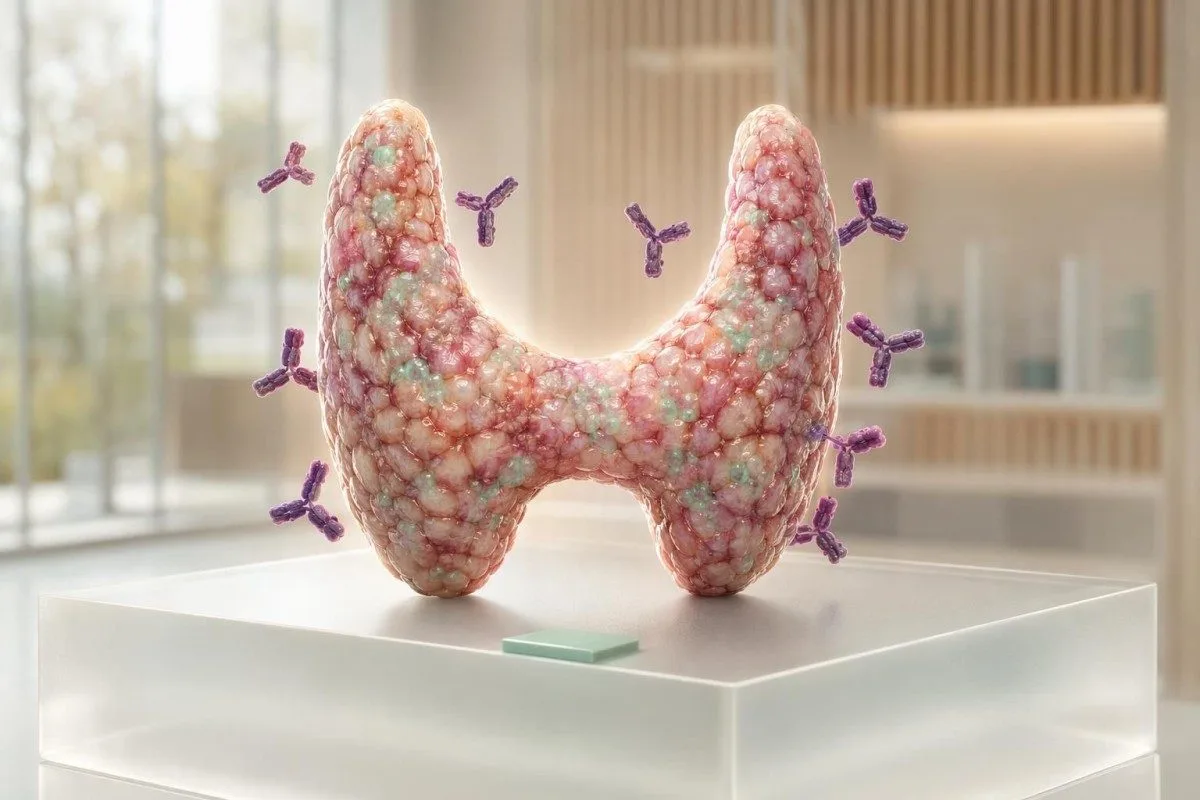
Positive thyroid antibodies can feel alarming when every thyroid hormone result still looks normal. The clinical question is not panic versus ignore — it is risk, timing, and context.


- Positive TPO antibodies usually mean thyroid autoimmunity is present, but they do not diagnose hypothyroidism if TSH and free T4 are normal.
- Normal adult TSH is commonly about 0.4–4.0 mIU/L, although pregnancy, age, lab method, and treatment goals change interpretation.
- Free T4 is commonly reported around 0.8–1.8 ng/dL in adults; a normal free T4 with normal TSH means thyroid hormone output is still adequate.
- Hashimoto’s risk rises when TPO antibodies are positive, especially if TSH drifts upward over time or there is a family history of autoimmune thyroid disease.
- Monitoring interval is usually TSH and free T4 every 6–12 months when TPO is positive but thyroid function is normal, sooner if symptoms, pregnancy, or medication changes occur.
- Treatment threshold is not the antibody number alone; levothyroxine is usually started for overt hypothyroidism, persistent TSH above 10 mIU/L, or specific pregnancy-related indications.
- Pregnancy monitoring is tighter because TPO-positive people can develop rising TSH during gestation; many guidelines advise checking TSH every 4 weeks through midpregnancy.
- Antibody levels can fluctuate and do not map neatly to symptom severity, so repeated antibody testing is less useful than tracking TSH, free T4, and symptoms.
What a positive TPO result with normal TSH usually means
A positive TPO antibodies test with normal TSH and normal free T4 usually means thyroid autoimmunity is present, but thyroid hormone production is still adequate. In plain English: you may be at higher risk for Hashimoto’s thyroiditis later, but you are not automatically hypothyroid today.
As of May 24, 2026, the most practical interpretation is this: TPO antibodies positive + TSH normal + free T4 normal equals euthyroid thyroid autoimmunity. In our analysis of 2M+ blood test patterns at Kantesti AI, this is one of the most common thyroid surprises patients upload after a routine wellness panel.
When I review this pattern as Thomas Klein, MD, I do not treat the antibody result as a standalone disease. I look for the direction of TSH over 6–24 months, the free T4 level, pregnancy plans, thyroid symptoms, family history, and whether thyroglobulin antibodies are also present; our deeper guide to a Hashimoto thyroid panel explains that wider pattern.
The short version is reassuring. Antibodies can precede abnormal thyroid hormones by years, so the result deserves follow-up, not fear.
What the TPO antibodies test actually measures
The TPO antibodies test measures immune proteins directed against thyroid peroxidase, an enzyme the thyroid uses to help make T4 and T3. A positive result means the immune system recognizes thyroid tissue, not that the thyroid has already failed.
Thyroid peroxidase sits inside the hormone-making machinery of thyroid follicular cells. Many laboratories define TPO antibodies as negative below about 9 IU/mL, while others use cutoffs near 34 or 35 IU/mL, so the unit and method matter as much as the flag on the report.
A TPO antibody result of 60 IU/mL is not automatically twice as bad as 30 IU/mL. Once the result is clearly positive, clinicians usually care more about the TSH trend, free T4, symptoms, pregnancy status, and related thyroid antibodies than about tiny antibody changes.
Some European labs use lower cutoffs than many US commercial assays. That is why Kantesti AI reads the laboratory’s own reference interval before interpreting blood test results, rather than forcing every thyroid antibody result into one universal range.
Why normal TSH and free T4 change the interpretation
Normal TSH and normal free T4 mean the pituitary-thyroid system is still maintaining thyroid hormone levels. In this setting, a positive antibody result is a risk marker rather than proof that the body lacks thyroid hormone.
Adult TSH is commonly reported around 0.4–4.0 mIU/L, and free T4 is commonly around 0.8–1.8 ng/dL, although each lab sets its own interval. If your TSH is 1.8 mIU/L and free T4 is mid-range, thyroid hormone replacement is usually not indicated solely because TPO is positive.
The thing is, normal does not always mean static. A TSH of 3.8 mIU/L that was 1.2 mIU/L two years ago deserves a different conversation from a TSH of 1.4 mIU/L that has stayed steady for a decade; our normal TSH guide covers timing, age, and medication clues.
Kantesti interprets this pattern by comparing the antibody result with hormone levels, the report’s units, prior results, and symptom clusters. A single normal TSH result is useful, but a 12-month trend is often more honest.
How much Hashimoto’s risk rises after a positive antibody test
Positive TPO antibodies increase the future risk of Hashimoto’s hypothyroidism, but the risk is not the same for every person. The highest-risk pattern is positive antibodies plus a TSH that is already high-normal or rising.
A person with positive TPO antibodies and a TSH of 1.5 mIU/L may remain stable for many years. A person with positive TPO antibodies and TSH rising from 2.8 to 4.7 mIU/L over 18 months is much closer to subclinical hypothyroidism, and that drift matters clinically.
Clinicians often cite annual progression estimates in the low single digits for antibody-positive euthyroid adults, with higher rates when baseline TSH is elevated. That is why a high TSH pattern changes the conversation much more than an isolated antibody flag.
In our clinical review workflow, we pay special attention to family history. If a mother and sister both take levothyroxine and your TPO is positive at age 35, your monitoring plan should usually be tighter than someone with no family thyroid history.
How often to repeat thyroid labs when antibodies are positive
Most nonpregnant adults with positive TPO antibodies and normal thyroid function should repeat TSH and free T4 in about 6–12 months. Testing sooner makes sense if symptoms change, TSH is high-normal, pregnancy begins, or a thyroid-affecting medication is started.
A practical monitoring plan is TSH plus free T4 every 12 months when TSH is comfortably normal, such as 1.0–2.0 mIU/L. If TSH is 3.5–4.0 mIU/L or has risen by more than about 1.0 mIU/L from your usual baseline, a 3–6 month recheck is often more sensible.
Repeating TPO antibodies every few months usually adds little. Antibody levels can fluctuate with assay variation, immune activity, and time, while the clinically meaningful question is whether thyroid output is changing; a lab trend graph makes that drift easier to see.
When Kantesti AI reviews thyroid lab test results, our platform flags mismatched timing, unit changes, and missing free T4 results. A normal TSH from 8 a.m. and another normal TSH from 5 p.m. are both useful, but they are not perfectly interchangeable.
When levothyroxine is not usually needed yet
Levothyroxine is not usually needed when TPO antibodies are positive but TSH and free T4 are both normal. Treatment decisions should be based on thyroid function, pregnancy context, symptoms, and repeat results — not the antibody number alone.
The 2012 AACE and ATA adult hypothyroidism guideline by Garber et al. supports treating clear hypothyroidism and many cases with persistent TSH above 10 mIU/L, but it does not recommend levothyroxine just to normalize antibodies. A TSH of 1.9 mIU/L with normal free T4 is not a thyroid hormone deficiency pattern.
Overtreatment has real costs. If levothyroxine pushes TSH below 0.1 mIU/L, the risk of palpitations, atrial fibrillation, anxiety-like symptoms, and bone loss becomes more relevant, especially after age 60.
I see this mistake when patients are given thyroid hormone for fatigue with normal thyroid labs. If treatment is eventually started, TSH typically needs reassessment after 6–8 weeks because that is the time frame required for dose steady state; our levothyroxine timeline explains why faster retesting can mislead.
Pregnancy and fertility considerations with positive TPO antibodies
TPO-positive people who are pregnant or trying to conceive need closer TSH monitoring, even when baseline TSH is normal. Pregnancy increases thyroid hormone demand, and antibody-positive thyroid glands may have less reserve.
The 2017 American Thyroid Association pregnancy guideline by Alexander et al. recommends checking TSH when pregnancy is confirmed and monitoring about every 4 weeks through midpregnancy in antibody-positive women. Many clinicians also recheck once around 30 weeks because thyroid demand changes again late in pregnancy.
Treatment is not automatic if TPO is positive and TSH is normal. The TABLET trial by Dhillon-Smith et al. in the New England Journal of Medicine found that levothyroxine did not improve live birth rates in euthyroid women with thyroid peroxidase antibodies who were trying to conceive naturally or with assisted reproduction.
The practical approach is targeted. If you are planning pregnancy, check TSH, free T4, and antibodies before conception, then use pregnancy-specific ranges; our pregnancy TSH guide and preconception lab checklist give the timing details.
Why symptoms can persist when thyroid hormones are normal
Fatigue, hair shedding, cold intolerance, and brain fog can occur with positive TPO antibodies, but normal TSH and free T4 mean those symptoms may have another cause. Iron deficiency, low B12, vitamin D deficiency, sleep disruption, and perimenopause often mimic thyroid complaints.
A 42-year-old patient may have TPO antibodies at 240 IU/mL, TSH at 1.6 mIU/L, free T4 at 1.2 ng/dL, and still feel exhausted. In that situation, ferritin of 12 ng/mL or vitamin B12 of 230 pg/mL may explain more than the thyroid antibody result.
Hair shedding is a classic example. TPO positivity can coexist with low ferritin, postpartum hormone shifts, or androgen changes, so our review often pairs thyroid labs with the fatigue lab panel rather than stopping at TSH.
If symptoms are prominent, ask what else was checked. A focused workup may include CBC, ferritin, B12, vitamin D, A1c, CMP, CRP, and sex-hormone testing when appropriate; our hair loss labs show how often ferritin and thyroid results overlap.
What other thyroid tests add to the picture
Thyroglobulin antibodies, thyroid ultrasound, and a full thyroid panel can refine risk, but they are not all required for every positive TPO result. The next test should answer a specific clinical question.
TgAb, or thyroglobulin antibody, is another autoimmune thyroid marker. If both TPOAb and TgAb are positive, autoimmune thyroiditis becomes more likely, but the treatment decision still depends on TSH and free T4; our TgAb result guide explains the distinction.
A thyroid ultrasound is not mandatory just because TPO is positive. It becomes more useful when there is a goiter, a palpable nodule, asymmetry, neck pressure, abnormal lymph node exam, or a clinician needs to distinguish autoimmune texture from a discrete nodule.
A complete thyroid panel can include TSH, free T4, free T3, TPOAb, TgAb, and sometimes TSH receptor antibodies when Graves’ disease is a concern. For most stable euthyroid patients, though, TSH plus free T4 carries the monitoring weight.
Lab factors that can make thyroid results look inconsistent
Biotin, assay differences, recent illness, and certain medications can make thyroid blood test results look confusing. Before changing treatment, confirm that the result fits the clinical picture and the testing conditions.
Biotin doses of 5–10 mg per day, common in hair and nail supplements, can interfere with some thyroid immunoassays. Depending on the assay design, biotin may falsely lower TSH or falsely raise free T4, so many clinicians advise stopping it for 48–72 hours before testing when safe; our biotin thyroid guide goes deeper.
Medications matter too. Amiodarone contains a large iodine load, lithium can affect thyroid hormone release, immune checkpoint inhibitors can trigger thyroiditis, and high-dose iodine supplements can worsen autoimmune thyroid instability in susceptible people.
Unit changes are easy to miss. If one lab reports TPO in IU/mL and another uses a different assay with a different cutoff, the number may look changed even when the clinical category has not; iodine status is one reason we sometimes pair thyroid review with a urinary iodine test.
Iodine, selenium, diet, and what realistically helps
Diet cannot erase TPO antibodies, but iodine balance and selenium status can influence thyroid autoimmunity in some people. The goal is adequacy, not megadosing.
Adult iodine intake is generally recommended around 150 mcg/day, with about 220 mcg/day during pregnancy and 290 mcg/day during lactation. Chronic intakes above the adult tolerable upper level of 1100 mcg/day can aggravate thyroid dysfunction, especially in people with thyroid antibodies.
Selenium is more nuanced. Some trials show antibody reductions with 200 mcg/day selenium, but the evidence for symptom improvement or prevention of hypothyroidism is mixed, and long-term intake above 400 mcg/day can cause toxicity; our selenium food guide keeps the focus on safer food-first intake.
Gluten-free diets are not automatically needed for TPO positivity. They make sense for confirmed celiac disease, wheat allergy, or clear intolerance, but thyroid antibodies alone do not diagnose a gluten problem.
When a positive antibody result needs specialist review
A positive TPO antibody result needs faster clinician review when TSH is abnormal, free T4 is low, pregnancy is involved, or there is a goiter, nodule, neck pressure, or postpartum thyroid change. Normal labs without red flags can often be monitored in primary care.
Seek review promptly if TSH is above 10 mIU/L, free T4 is below range, or symptoms are severe and progressive. Those patterns are different from a quiet positive antibody result with stable hormones.
Postpartum thyroiditis deserves a special mention. It can cause a temporary low-TSH phase followed by hypothyroidism, often within 12 months after delivery, and TPO-positive people are at higher risk.
A specialist may also help when Graves’ disease is possible, thyroid nodules are present, or results swing between hyperthyroid and hypothyroid patterns. Our thyroid disease blood test guide compares the major lab patterns side by side.
How Kantesti reads TPO antibodies with the full lab pattern
Kantesti AI interprets TPO antibodies by reading the antibody result alongside TSH, free T4, free T3 when available, TgAb, symptoms, medications, pregnancy status, and prior trends. That pattern-based reading is safer than reacting to a single flagged antibody value.
Our AI blood test analyzer accepts PDF or photo uploads and usually returns an interpretation in about 60 seconds. You can try the workflow with free blood test analysis if you want a structured read of your thyroid blood test results before your next appointment.
Kantesti’s neural network checks whether a TPO result is positive by that lab’s cutoff, then compares it with TSH direction, free T4 position within range, and related markers. Our clinical standards are described in medical validation, and our physician review process is supported by the Medical Advisory Board.
For families, the value is trend memory. If a parent, sibling, or postpartum patient has repeated thyroid changes, Kantesti can organize those lab test results across time and flag when a normal value is no longer normal for that person; our AI-powered blood test interpretation platform was built for exactly that kind of longitudinal pattern.
Research notes, publication links, and bottom line
The bottom line is simple: a positive TPO antibodies test with normal TSH and free T4 is a monitoring signal, not an automatic medication signal. The safest plan is periodic thyroid function testing, tighter pregnancy monitoring, and broader symptom evaluation when the numbers do not match how you feel.
The evidence is strongest for treating biochemical hypothyroidism, not for treating antibody positivity alone. Garber et al. 2012 supports treatment for established hypothyroidism and many persistent TSH values at or above 10 mIU/L, while Alexander et al. 2017 gives the pregnancy-specific monitoring framework.
For Kantesti as a health technology organization, the clinical challenge is translating these thresholds into patient-safe, unit-aware explanations. We also publish validation-oriented work, including our population-scale AI engine benchmark on Figshare: Kantesti AI engine validation.
Klein, T., & Kantesti Clinical AI Group. (2025). RDW Blood Test: Complete Guide to RDW-CV, MCV & MCHC. Zenodo. https://doi.org/10.5281/zenodo.18202598. ResearchGate: publication record. Academia.edu: publication record.
Klein, T., & Kantesti Clinical AI Group. (2025). BUN/Creatinine Ratio Explained: Kidney Function Test Guide. Zenodo. https://doi.org/10.5281/zenodo.18207872. ResearchGate: publication record. Academia.edu: publication record.
Frequently Asked Questions
Can TPO antibodies be positive while TSH is normal?
Yes, TPO antibodies can be positive while TSH and free T4 are normal. This pattern usually means thyroid autoimmunity is present but thyroid hormone production is still adequate. Many adults with this pattern are monitored every 6–12 months rather than treated immediately. Treatment depends on thyroid function, pregnancy context, symptoms, and repeat results, not the antibody result alone.
Does a positive TPO antibodies test mean I have Hashimoto’s disease?
A positive TPO antibodies test strongly suggests autoimmune thyroid tendency and is commonly seen in Hashimoto’s thyroiditis, but it does not prove current hypothyroidism if TSH and free T4 are normal. Hashimoto’s is usually diagnosed from the overall pattern: antibodies, TSH trend, free T4, exam findings, symptoms, and sometimes ultrasound. The risk is higher when TSH is high-normal or rising over 6–24 months. A single positive antibody result is best viewed as a risk marker.
How often should I repeat thyroid labs if TPO is positive but TSH is normal?
Most nonpregnant adults repeat TSH and free T4 every 6–12 months when TPO antibodies are positive but thyroid function is normal. A 3–6 month repeat is reasonable if TSH is near the upper reference limit, symptoms are changing, or a thyroid-affecting medication was started. Pregnancy requires closer monitoring, often about every 4 weeks through midpregnancy. Repeating the antibody level itself is usually less useful than tracking TSH and free T4.
Should I take levothyroxine for positive TPO antibodies with normal TSH?
Levothyroxine is usually not recommended solely for positive TPO antibodies when TSH and free T4 are normal. Many guidelines focus treatment on overt hypothyroidism, persistent TSH elevation, or specific pregnancy-related thresholds. Taking thyroid hormone unnecessarily can push TSH too low, sometimes below 0.1 mIU/L, which may increase risks such as palpitations, atrial fibrillation, and bone loss. Discuss treatment only after reviewing the full thyroid pattern with a clinician.
What TPO antibody level is considered high?
TPO antibody cutoffs vary by laboratory, with some assays using about 9 IU/mL and others using about 34–35 IU/mL as the upper reference limit. Results above the lab cutoff are considered positive, and values above 100 IU/mL are often described as clearly positive. Very high values, such as above 500 IU/mL, support autoimmune thyroiditis risk but do not automatically mean medication is needed. TSH and free T4 determine thyroid function.
Can TPO antibodies affect pregnancy if thyroid hormones are normal?
Yes, TPO antibodies can matter in pregnancy even when thyroid hormones are initially normal. The 2017 American Thyroid Association pregnancy guideline recommends closer TSH monitoring in antibody-positive pregnant women, often every 4 weeks through midpregnancy. Treatment is considered when TSH exceeds pregnancy-specific thresholds, especially if antibodies are positive. Large trial data, including the TABLET trial, did not show improved live birth rates from routine levothyroxine in euthyroid TPO-positive women trying to conceive.
Can diet lower TPO antibodies naturally?
Diet may support thyroid health, but it rarely makes TPO antibodies disappear. Adequate iodine intake is important, with adult needs around 150 mcg/day, but chronic excess above 1100 mcg/day can worsen thyroid dysfunction in susceptible people. Selenium at 200 mcg/day has reduced antibody levels in some trials, but clinical benefits are mixed and intake above 400 mcg/day can be toxic. Food-first correction of deficiencies is usually safer than high-dose supplementation.
Should my family members be tested for thyroid antibodies?
Routine TPO antibody testing is not usually recommended for symptom-free relatives. A clinician may check TSH, and sometimes antibodies, when a relative has thyroid symptoms, a goiter, another autoimmune condition, or is planning pregnancy.
Can positive TPO antibodies be linked to other autoimmune conditions?
Yes. TPO positivity can occur alongside other autoimmune conditions, but it does not mean you will develop one. Tell your clinician about persistent digestive symptoms, anemia, skin changes, joint symptoms, or relevant family history, so they can choose targeted tests rather than broad screening.
Do I need a thyroid ultrasound if my TPO antibodies are positive but TSH is normal?
Usually not. Ultrasound is most useful when there is a thyroid lump, visible enlargement, neck pressure, abnormal exam, or unclear diagnosis; a positive TPO result alone does not automatically require imaging.
Get AI-Powered Blood Test Analysis Today
Join over 2 million users worldwide who trust Kantesti for instant, accurate lab test analysis. Upload your blood test results and receive comprehensive interpretation of 15,000+ biomarkers in seconds.
📚 Referenced Research Publications
Klein, T., Mitchell, S., & Weber, H. (2026). Klein, T., & Kantesti Clinical AI Group. (2025). RDW Blood Test: Complete Guide to RDW-CV, MCV & MCHC. Zenodo.. Kantesti AI Medical Research.
Klein, T., Mitchell, S., & Weber, H. (2026). Klein, T., & Kantesti Clinical AI Group. (2025). BUN/Creatinine Ratio Explained: Kidney Function Test Guide. Zenodo.. Kantesti AI Medical Research.
📖 External Medical References
⚕️ Medical Disclaimer
This article is for educational purposes only and does not constitute medical advice. Always consult a qualified healthcare provider for diagnosis and treatment decisions.
E-E-A-T Trust Signals
Experience
Physician-led clinical review of lab interpretation workflows.
Expertise
Laboratory medicine focus on how biomarkers behave in clinical context.
Authoritativeness
Written by Dr. Thomas Klein with review by Dr. Sarah Mitchell and Prof. Dr. Hans Weber.
Trustworthiness
Evidence-based interpretation with clear follow-up pathways to reduce alarm.