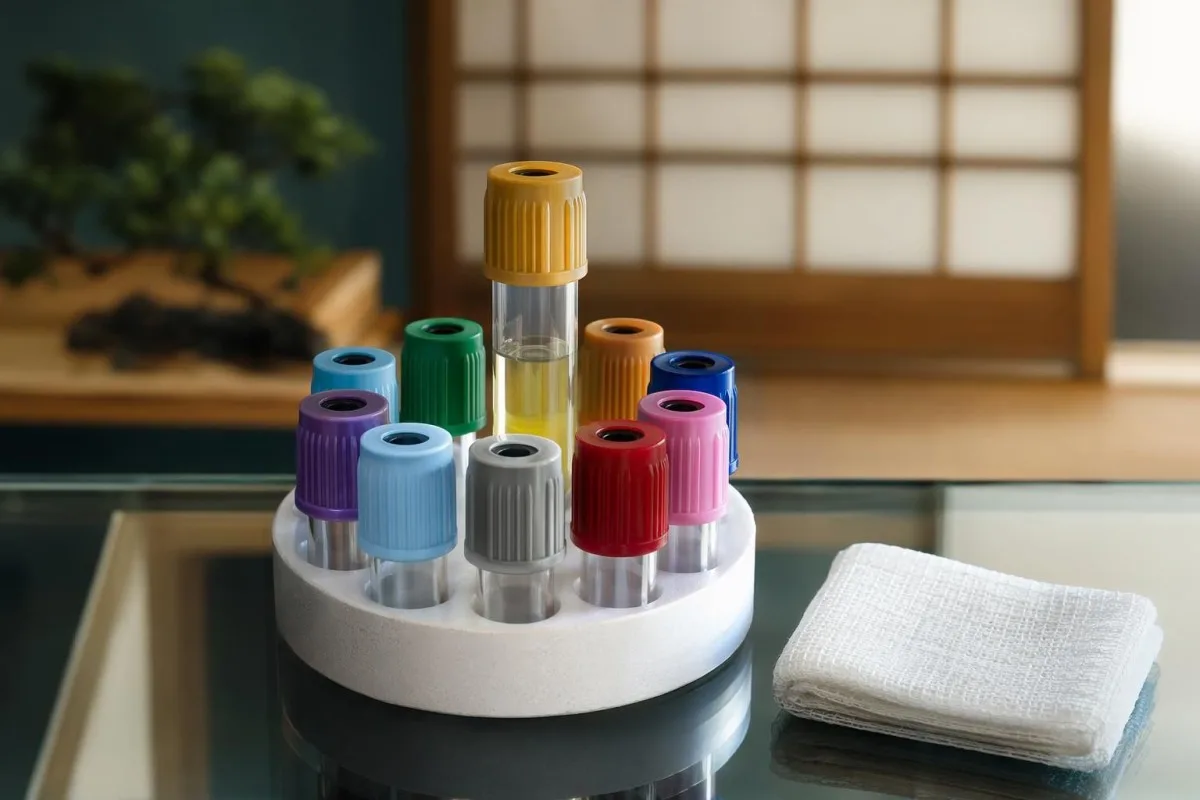
Those colored caps are not decoration. They tell the laboratory which additive is inside the vial, how the sample should clot or not clot, and which results can be trusted.


- Tube color usually identifies the additive: lavender means EDTA, light blue means sodium citrate, green means heparin, and gray means fluoride/oxalate.
- Order of draw generally runs cultures first, then light blue, serum tubes, green, lavender or pink, then gray; local lab policies can vary.
- Light blue citrate tubes must be filled close to the line because coagulation testing needs a 9:1 sample-to-citrate ratio.
- Lavender EDTA tubes are used for CBC testing because EDTA preserves cellular elements but can falsely raise potassium if it contaminates chemistry tubes.
- Gold or tiger-top SST tubes contain clot activator and gel and are common for chemistry, thyroid, lipid, vitamin D, and many hormone tests.
- Gray tubes slow glycolysis; unseparated serum or plasma glucose can fall by about 5% to 7% per hour at room temperature.
- Wrong tube errors can cause recollection, rejected specimens, or misleading results such as high potassium, low calcium, prolonged clotting times, or clotted CBC samples.
- Patient action is simple: check the name and date of birth, keep still during collection, and ask why a recollection is needed if the lab calls you back.
Why blood draw tube colors exist in the first place
Blood test tube colors tell the lab what additive is inside the vial and what test can safely be run from it. The color determines whether your sample clots, stays anticoagulated, separates into serum, protects glucose, preserves cellular elements, or avoids trace-metal contamination.
I am Thomas Klein, MD, and in clinical practice I have seen a single wrong cap turn a clean result into a confusing phone call. As of June 9, 2026, the practical blood test tube colors meaning has not changed much: the cap is a pre-analytical safety code, not a branding choice.
Kantesti is an AI blood test interpretation platform that reads results in clinical context, but the analysis still depends on the laboratory receiving the correct specimen type. We explain our clinical review approach on our About Us page because interpretation starts before the number appears on the PDF.
A common example is potassium. If a lavender EDTA tube contaminates a chemistry tube, potassium may look dangerously high because many EDTA formulations contain potassium salts, while calcium may look falsely low because EDTA binds calcium.
The cap color also tells staff how long to wait before centrifuging. A serum separator tube often needs about 30 minutes to clot, while plasma from a heparin tube can usually be spun sooner for urgent chemistry testing.
Lab tube color chart: common vials, additives, and tests
A lab tube color chart maps each cap color to an additive and a test category. The exact brand may differ, but the common pattern is light blue for citrate, gold or tiger for serum separator, green for heparin plasma, lavender or pink for EDTA, and gray for glucose preservation.
Most patients see only the finished report, but the lab sees a specimen type: serum, plasma, whole blood, or a protected specialty sample. If you are trying to understand cryptic report codes, our guide to blood test abbreviations is useful alongside the vial color.
Red tubes usually produce serum and may contain no additive or a clot activator. Gold or tiger-top tubes are serum separator tubes with gel; many chemistry panels, lipid panels, thyroid tests, vitamin D tests, and serology tests come from these tubes.
Lavender EDTA tubes are whole-blood tubes for CBC and HbA1c. Pink EDTA tubes are commonly reserved for blood bank testing because identity control matters so much when compatibility testing is involved.
Royal blue, tan, yellow, black, and white tubes are not rare for the lab, but patients see them less often. Their additives are chosen for trace elements, lead, microbiology, ESR, or molecular testing rather than routine annual blood work.
Order of draw blood tubes: why sequence matters
The order of draw blood tubes reduces additive carryover from one vial into the next. A typical sequence is blood culture bottles, light blue citrate, serum tubes, green heparin, lavender or pink EDTA, then gray fluoride/oxalate tubes.
CLSI GP41 lists a standardized venous collection sequence to reduce contamination between tubes, and many hospitals adapt that standard to local equipment (CLSI, 2017). For routine outpatient testing, the most patient-relevant detail is that the blue citrate tube should not follow an EDTA tube.
When a butterfly collection set is used for coagulation testing, many labs collect a discard tube before the light blue tube. The reason is practical: air in the tubing can underfill the citrate tube, and even a 10% underfill may distort PT/INR or aPTT results.
A 2017 EFLM opinion paper led by Cornes and colleagues argued that order-of-draw rules still matter most when there is visible additive carryover or improper technique, even though modern closed systems reduce risk (Cornes et al., 2017). That is the kind of nuance patients rarely hear: the rule is not superstition, but the size of the risk depends on the collection system.
If you are fasting for several tests, tube order is separate from fasting rules. Our patient guide to common fasting tests explains which results change after food; the order of tubes mainly protects the sample chemistry.
Red, gold, tiger, and orange tubes for serum testing
Red, gold, tiger-top, and orange tubes are mostly serum tubes, meaning the sample is allowed to clot before the liquid serum is separated. These tubes are common for chemistry, thyroid, lipid, vitamin, hormone, infectious antibody, and medication-level testing.
A gold or tiger-top serum separator tube contains a clot activator and a gel barrier. After centrifugation, the gel sits between the clot and the serum, reducing ongoing cell contact that can change potassium, glucose, and enzyme measurements.
Red-top tubes are still useful when gel might interfere with a specialized assay. I have seen anticonvulsant drug levels and endocrine send-outs rejected because the tube was convenient rather than correct; convenience is not a specimen requirement.
Orange rapid-serum tubes contain thrombin-based clot activator and may clot in about 5 minutes, compared with roughly 30 minutes for many serum separator tubes. Emergency departments like speed, but not every analyzer validates every test on orange tubes.
Comprehensive metabolic panels are often run from serum or lithium-heparin plasma, depending on the lab. If you are comparing CMP results across visits, our CMP fasting guide explains why food, tube type, and timing can all shift borderline glucose and triglyceride patterns.
Lavender and pink EDTA tubes for CBC, HbA1c, and blood bank tests
Lavender EDTA tubes preserve cellular elements for CBC testing, while pink EDTA tubes are commonly used for blood bank work. EDTA prevents clotting by binding calcium, which is helpful for cell counts but harmful for many chemistry and coagulation tests.
A CBC needs whole blood, not serum. EDTA keeps red cells, white cells, and platelets suspended so analyzers can count them; a clotted CBC can falsely lower platelet count because platelets get trapped in the clot.
Most EDTA CBC samples remain analytically acceptable for about 24 hours at room temperature, but blood film morphology can start to degrade within 8 to 12 hours. That is why a pathologist may request a fresh tube if abnormal cells need manual review.
Kantesti's neural network treats a CBC differently from chemistry because the relationships are cellular: hemoglobin, MCV, RDW, platelets, and differential counts move together. Patients trying to decode UK reports may want our FBC guide, since FBC and CBC are essentially the same test family.
Pink tubes look similar in concept but are managed with stricter identity rules. In blood bank testing, a misspelled name, incomplete date of birth, or mismatched wristband can lead to recollection even if the actual sample quality is perfect.
Light blue citrate tubes for INR, aPTT, fibrinogen, and D-dimer
Light blue tubes contain 3.2% sodium citrate and are used for coagulation tests such as PT/INR, aPTT, fibrinogen, and D-dimer. The tube must be filled close to the mark because clotting tests depend on a 9:1 sample-to-citrate ratio.
Citrate works by temporarily binding calcium, then the analyzer adds calcium back during the clotting assay. If the tube is underfilled, there is too much citrate for the sample volume, so clotting times may look falsely prolonged.
Patients with a hematocrit above 55% need special handling because very high red-cell volume leaves less plasma for the citrate to mix with. This is one of those details that looks fussy until you see a false abnormal aPTT trigger unnecessary anxiety.
PT/INR monitoring usually tolerates small pre-analytical variation better than complex factor testing, but lupus anticoagulant, factor assays, and heparin monitoring are less forgiving. Our coagulation test guide walks through PT, INR, aPTT, fibrinogen, and D-dimer patterns after the right tube has been collected.
For a deeper technical view, our research-style aPTT guide explains why anticoagulant ratio, centrifugation, and platelet-poor plasma matter. The patient version is simpler: if the blue tube was not full, repeating it is usually safer than interpreting it.
Green and light green heparin tubes for fast plasma chemistry
Green and light green tubes contain heparin and are often used when the lab needs plasma chemistry quickly. Lithium heparin is common for electrolytes, renal markers, liver enzymes, and urgent chemistry panels, but it is not suitable for every test.
Heparin activates antithrombin and prevents clot formation without the same calcium-binding effect as EDTA. That makes it useful for sodium, potassium, chloride, bicarbonate, creatinine, urea, and many liver enzyme tests.
The trade-off is method dependence. Some immunoassays and drug levels are validated on serum but not heparin plasma, and a lab cannot responsibly substitute one specimen type just because the vial is available.
Light green plasma separator tubes contain heparin plus gel, so they behave a little like SST tubes but produce plasma instead of serum. In emergency settings, shaving 20 to 30 minutes off clot time can matter for potassium or troponin decisions.
Electrolytes are especially vulnerable to pre-analytical confusion. If you are checking sodium, potassium, chloride, or CO2 patterns, our electrolyte panel guide explains which changes point to hydration, kidney handling, or medication effects.
Gray tubes for glucose, lactate, and glycolysis control
Gray tubes are designed to slow glycolysis, the process by which cells keep consuming glucose after collection. They commonly contain sodium fluoride with potassium oxalate or another anticoagulant, and they are used for glucose and sometimes lactate testing.
Unseparated serum or plasma glucose can fall by about 5% to 7% per hour at room temperature because cells continue metabolizing glucose. Sodium fluoride helps, but its glycolysis-blocking effect is not immediate; early separation still matters.
Lactate is even more timing-sensitive. Tourniquet time, fist pumping, delayed processing, and warm storage can all raise lactate enough to change clinical interpretation, particularly when sepsis or poor tissue perfusion is being assessed.
Kantesti is an AI-powered blood test analysis tool used by people across 127+ countries, and our system treats fasting glucose, HbA1c, and random glucose as different signals rather than interchangeable numbers. For diagnostic patterns, see our diabetes blood test guide.
The gray tube is not a magic shield. A glucose sample collected into the right tube but left unprocessed for several hours can still be less reliable than a promptly separated sample in another validated tube.
Royal blue, tan, yellow, black, and white tubes for specialty testing
Specialty tube colors usually exist to reduce contamination or preserve unusual analytes. Royal blue tubes are used for trace metals, tan tubes for lead, yellow tubes for ACD or microbiology additives, black tubes for ESR in some systems, and white PPT tubes for molecular testing.
Royal blue tubes are manufactured and certified to contain very low trace-element contamination. That matters because zinc, copper, selenium, mercury, and arsenic may be reported in µg/L or µmol/L, where tiny contamination can look like biology.
Tan tubes are lead-free EDTA tubes for lead testing. For children, the CDC blood lead reference value is 3.5 µg/dL, so environmental contamination from the wrong tube or collection site can become clinically meaningful.
Yellow tubes are confusing because there are two families: SPS tubes for blood cultures and ACD tubes for genetic, HLA, or cellular studies. The cap color alone is not enough; the printed additive and lab order decide the correct use.
If lead exposure is part of your result set, our lead blood test guide explains why low-level results need careful context. A lead result of 4 µg/dL means something very different in a toddler, a pregnant person, and an adult with occupational exposure.
Temperature, light, and timing can matter as much as tube color
Tube color is only one part of specimen handling; temperature, light exposure, and transport time can also change results. Bilirubin, ammonia, lactate, ACTH, cryoglobulins, and some vitamins have handling rules that may be stricter than the cap color itself.
Bilirubin can degrade with light exposure, so newborn bilirubin samples and some adult bilirubin specimens may be wrapped or protected during transport. This is not cosmetic; photodegradation can make a high bilirubin look lower than it was in the patient.
Ammonia and lactate are timing-sensitive because metabolism continues after collection. Many labs require rapid transport on ice or quick plasma separation, although exact rules differ by analyzer and local validation.
Cryoglobulin testing flips the usual instinct: the specimen must stay warm, often near 37°C, until serum separation. If it cools too early, the cold-precipitating proteins may drop out and create a false-negative result; our cryoglobulin test article covers that odd but important exception.
Some European labs use different collection devices from US labs, and regional tube caps are not perfectly universal. When in doubt, the additive name printed on the tube matters more than the cap color.
What happens when the wrong tube is used?
The wrong tube can cause specimen rejection, recollection, or misleading results that look like disease. The most common clinically important errors include EDTA contamination, citrate underfilling, clotted CBC samples, hemolyzed chemistry samples, and trace-metal contamination.
A real case from my week: a 52-year-old marathon runner had potassium reported at 6.4 mmol/L with calcium at 1.75 mmol/L and no symptoms. The pattern screamed EDTA contamination, not kidney failure, and the repeat potassium was 4.3 mmol/L.
Lippi and colleagues showed in Clinical Chemistry and Laboratory Medicine that hemolysis can significantly affect potassium, LDH, AST, and other routine chemistry results (Lippi et al., 2006). Hemolysis is not just a red color in the tube; it is cellular content leaking into the measured fluid.
Citrate contamination can lower calcium, magnesium, and alkaline phosphatase. EDTA contamination can raise potassium and lower calcium dramatically, sometimes producing a combination that no living physiology would comfortably explain.
This is where pattern recognition helps. Our article on AI lab error checks explains why a suspicious cluster, such as high potassium plus very low calcium plus normal kidney function, deserves a specimen-quality question before a diagnosis.
What patients can do before and during sample collection
Patients cannot choose the tube, but they can reduce avoidable pre-analytical problems. Confirm your identity, follow fasting instructions when given, avoid vigorous fist pumping, keep still during collection, and tell the phlebotomist about IV fluids, anticoagulants, or difficult prior draws.
The World Health Organization's phlebotomy guidance emphasizes patient identification, hand hygiene, correct tube handling, and safe sample collection as basic quality steps (WHO, 2010). Those basics prevent more bad results than most people realize.
Fist pumping can raise potassium locally because muscle activity changes cellular and plasma composition in the limb. A tight tourniquet left on for more than about 1 minute may also concentrate proteins and cells, especially in smaller or dehydrated patients.
If you are told a sample clotted, hemolyzed, leaked, underfilled, or was collected in the wrong tube, recollection is usually a quality safeguard rather than a sign that something is wrong with you. Our guide to repeating abnormal labs explains when a repeat test clarifies the medical picture.
In Thomas Klein, MD's clinical workflow, I would rather repeat one tube than treat a false potassium, false INR, or false platelet count. One extra vial is annoying; one wrong clinical decision is worse.
How tube type affects the report you see online
Your online report may not show tube color, but it often reveals specimen type: serum, plasma, whole blood, citrate plasma, or EDTA whole blood. That label can explain why one result is comparable across visits and another is not.
Serum potassium can be slightly different from plasma potassium because clotting releases small amounts of potassium from platelets and cells. In most healthy adults the difference is modest, but in very high platelet counts it can become clinically misleading.
Plasma glucose, serum glucose, and point-of-care glucose are related but not identical. HbA1c comes from EDTA whole blood and reflects roughly 2 to 3 months of glycation, while fasting glucose reflects the day of collection.
Kantesti is an AI lab test interpretation service that parses specimen labels when they appear on uploaded PDFs or photos. If you photograph a report, our blood test photo scan guide explains how to capture units, reference ranges, and specimen notes clearly.
Kantesti AI also uses trend analysis rather than treating every flagged value as equally meaningful. The technical principles behind that approach are described in our technology guide, including how our model handles units, age, sex, and repeated results.
Bottom line: when tube color should make you ask questions
You usually do not need to memorize every tube color, but you should ask questions when a result is severe, biologically odd, or followed by a lab request for recollection. Tube problems are most suspicious when several results shift in a pattern that fits an additive error rather than a disease.
Ask about specimen quality if potassium is high but kidney function and ECG are normal, if calcium is unexpectedly very low, if platelets are low with a clot comment, or if INR/aPTT is abnormal after an underfilled blue tube. These patterns are common enough that good clinicians check the tube story before escalating care.
As Thomas Klein, MD, I tell patients that recollection is not failure; it is quality control. A rejected citrate tube or clotted CBC is frustrating, but it protects you from a false diagnosis, unnecessary medication, or an avoidable emergency referral.
Kantesti's clinical standards are reviewed against our validation framework and physician oversight process. Readers who want the details can review our medical validation page and the clinicians behind the work on our medical advisory board.
My practical rule is simple: if a result does not fit your symptoms, your prior trend, or the rest of the panel, ask whether the sample type and handling were correct. The tube is not the diagnosis, but sometimes it is the reason the diagnosis looks strange.
Frequently Asked Questions
What do the colors of blood test tubes mean?
Blood test tube colors identify the additive inside the tube and the type of testing the lab can perform. Light blue usually means sodium citrate for coagulation tests, lavender means EDTA for CBC and HbA1c, green means heparin for plasma chemistry, gray means fluoride/oxalate for glucose preservation, and gold or tiger-top means serum separator with clot activator and gel. Local labs may use slightly different brands, so the additive printed on the tube is more reliable than cap color alone.
What is the correct order of draw for blood tubes?
A common order of draw is blood culture bottles first, then light blue citrate, serum tubes such as red or gold, green heparin, lavender or pink EDTA, and gray fluoride/oxalate tubes last. The purpose is to reduce additive carryover, especially EDTA contamination of chemistry tubes and underfilled citrate tubes. If a butterfly set is used for coagulation testing, many labs collect a discard tube before the light blue tube to avoid air-related underfilling.
Why would the lab reject a tube and ask for another sample?
A lab may reject a sample if the tube is wrong, underfilled, clotted, hemolyzed, mislabeled, leaked, expired, or transported under the wrong temperature conditions. Light blue citrate tubes are commonly rejected when the fill level is too low because coagulation testing needs a 9:1 sample-to-citrate ratio. Recollection is usually a quality-control step, not a sign that your medical condition has worsened.
Which tube is used for a full blood count or CBC?
A full blood count or CBC is usually collected in a lavender or purple EDTA tube. EDTA prevents clotting by binding calcium and preserves cellular elements so the analyzer can count red cells, white cells, and platelets. A clotted EDTA tube can falsely lower platelets because platelets may be trapped in the clot.
Which blood tube is used for PT, INR, and aPTT?
PT, INR, and aPTT are usually collected in a light blue tube containing 3.2% sodium citrate. The tube must be filled close to its marked volume because coagulation assays depend on the correct 9:1 sample-to-anticoagulant ratio. If the tube is underfilled by about 10% or more, clotting times may appear falsely prolonged.
Can the wrong tube cause a falsely high potassium result?
Yes, the wrong tube can cause a falsely high potassium result, especially if potassium-containing EDTA contaminates a chemistry specimen. A typical contamination pattern is high potassium with unexpectedly low calcium, sometimes with low magnesium or alkaline phosphatase. Severe hemolysis can also raise potassium because cellular contents leak into the sample fluid.
Are blood draw tube colors the same in every country?
Blood draw tube colors are broadly similar in many countries, but they are not perfectly universal. Manufacturers, hospitals, and national lab systems may use different cap shades or specialty tubes, especially for ESR, molecular testing, trace metals, and blood bank work. The additive name printed on the tube and the laboratory's collection manual are the final authority.
Can blood be taken from the same arm as an IV infusion?
Usually, blood is drawn from the opposite arm when possible. A sample collected near an active IV can be diluted or contaminated by fluids or medicines, so staff may pause the infusion or choose another site under local laboratory protocol.
Why does the phlebotomist sometimes need to draw blood into several different tubes?
Different tests require different additives, so one visit may involve several tubes to provide serum, plasma, or preserved blood cells. This does not necessarily mean more tests than expected; each tube usually contains only a small amount of blood.
Get AI-Powered Blood Test Analysis Today
Join over 2 million users worldwide who trust Kantesti for instant, accurate lab test analysis. Upload your blood test results and receive comprehensive interpretation of 15,000+ biomarkers in seconds.
📚 Referenced Research Publications
Klein, T., Mitchell, S., & Weber, H. (2026). Clinical Validation Framework v2.0 (Medical Validation Page). Kantesti AI Medical Research.
Klein, T., Mitchell, S., & Weber, H. (2026). AI Blood Test Analyzer: 2.5M Tests Analyzed | Global Health Report 2026. Kantesti AI Medical Research.
📖 External Medical References
Clinical and Laboratory Standards Institute (2017). Collection of Diagnostic Venous Blood Specimens, 7th Edition: CLSI Standard GP41. Clinical and Laboratory Standards Institute.
⚕️ Medical Disclaimer
This article is for educational purposes only and does not constitute medical advice. Always consult a qualified healthcare provider for diagnosis and treatment decisions.
E-E-A-T Trust Signals
Experience
Physician-led clinical review of lab interpretation workflows.
Expertise
Laboratory medicine focus on how biomarkers behave in clinical context.
Authoritativeness
Written by Dr. Thomas Klein with review by Dr. Sarah Mitchell and Prof. Dr. Hans Weber.
Trustworthiness
Evidence-based interpretation with clear follow-up pathways to reduce alarm.