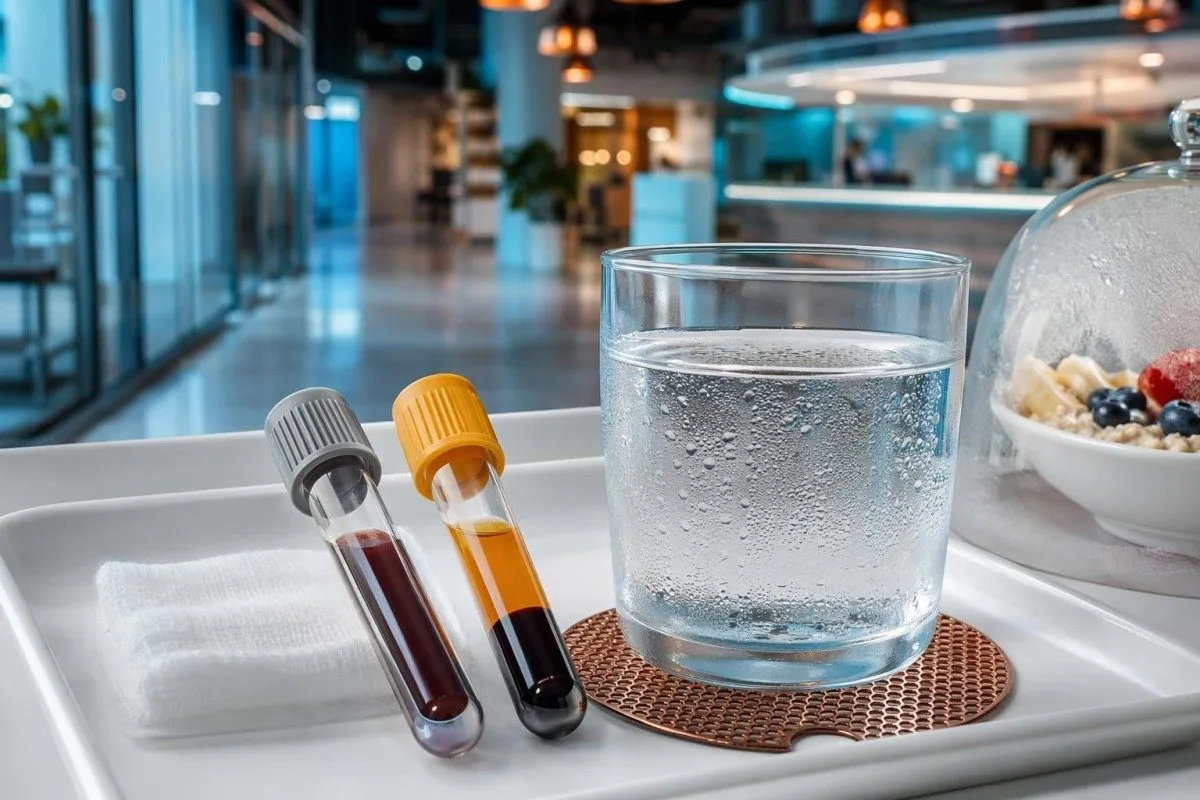
Most common blood tests do not require fasting. The usual exceptions are fasting glucose, OGTT, fasting insulin, and selected triglyceride, iron, testosterone, or cortisol checks where an 8-12 hour fast or morning timing changes the result enough to matter.


- Fasting glucose requires at least 8 hours with no calories; 100-125 mg/dL suggests prediabetes and 126 mg/dL or higher usually needs confirmation.
- OGTT needs a strict 8-12 hour fast and timed samples; food, sweet drinks, or gum beforehand can invalidate the test.
- HbA1c does not require fasting; 5.7%-6.4% suggests prediabetes and 6.5% or higher supports diabetes on the right clinical pathway.
- Lipid panel screening is often fine without fasting, but triglycerides above 400 mg/dL usually justify a fasting repeat.
- CBC, CMP, BMP, liver enzymes, creatinine, CRP, ESR, PT/INR, and D-dimer generally do not need fasting.
- Ferritin usually does not need fasting, but serum iron and transferrin saturation are more consistent with a morning fast.
- Testosterone is best drawn at 7-10 a.m.; timing often matters more than fasting, though many clinicians still prefer both.
- Biotin 5-10 mg/day can distort some thyroid and hormone immunoassays for 24-72 hours, even when fasting was perfect.
- Water is usually allowed for fasting labs; coffee, energy drinks, and creamers can alter glucose, insulin, cortisol, and triglycerides.
- Dehydration can falsely raise hematocrit, albumin, sodium, and BUN, which is one reason a repeat test may differ even without disease.
Which common blood tests actually require fasting?
Most common blood tests do not require fasting. The ones that usually do are fasting plasma glucose, oral glucose tolerance testing, fasting insulin/HOMA-IR, and some lipid or iron measurements when your clinician wants the cleanest triglyceride or transferrin saturation result; most labs define fasting as 8 to 12 hours with only water.
As of April 26, 2026, I still see patients fast for a CBC or TSH because someone told them all labs need an empty stomach. They do not, and on Kantesti AI we routinely flag when blood test fasting advice looks broader than the chemistry really requires.
Why does this confusion persist? Many phlebotomy centers default to early-morning slots, and some requisitions mark every routine blood test as fasting so the lab gets one standardized workflow; that is an administrative habit, not a biological law. Our detailed fasting prep guide separates true fasting-dependent tests from the ones that are simply booked at breakfast time.
The repeat draw I dislike most is the preventable one: a patient skips breakfast for a standard blood test, feels shaky, and later learns the only time-sensitive item was a glucose line buried in a larger panel. In older adults, patients with migraine, and people prone to vasovagal episodes, unnecessary fasting can make sample collection harder without improving the result.
Some labs also use local rules that are stricter than the evidence, especially when they want apples-to-apples trending over years. That is reasonable, but it means you should follow the instructions on your order first and the internet second.
Why one order often gets labeled fasting
A mixed panel is the usual culprit. If a single requisition includes glucose, triglycerides, CBC, and TSH, the whole visit may be scheduled as fasting even though three of the four tests do not biologically require it.
Lipid panels: fasting helps triglycerides more than LDL
A standard lipid panel usually does not need fasting. What changes most after eating is triglycerides, which can rise by 20 to 50 mg/dL for several hours; total cholesterol and HDL-C usually change very little.
Nonfasting total cholesterol and HDL-C often vary by less than 5% after a meal. Triglycerides are different, and in people with insulin resistance or a high-carbohydrate breakfast the increase can be much larger than the lab report implies.
The joint European consensus led by Nordestgaard et al. (2016) states that routine fasting is not required for a lipid profile, which matches what many cardiology clinics now do. I still prefer a 9 to 12 hour fast when prior triglycerides were above 400 mg/dL, when pancreatitis risk is on the table, or when a calculated LDL looks suspiciously low; our piece on nonfasting cholesterol testing goes into the practical scenarios.
A 44-year-old executive in our clinic once arrived straight from an airport breakfast with triglycerides 612 mg/dL and was convinced something catastrophic had happened. His repeat fasting sample two days later was 286 mg/dL—still too high, but a very different risk conversation and no ER trip.
One nuance patients rarely hear: ApoB and Lp(a) do not require fasting, and they are often steadier for cardiovascular risk than triglycerides alone. If your panel is confusing, it helps to understand the whole lipid panel breakdown rather than focusing on a single red number.
A small international difference that matters
Some European labs flag nonfasting triglycerides above 175 mg/dL as abnormal, while many U.S. reports still center the classic fasting cutoff of 150 mg/dL. That is not the lab being wrong; it reflects a different pre-test assumption.
Glucose and diabetes tests: this is where fasting still matters
Fasting glucose requires at least 8 hours with no calories, whereas HbA1c does not require fasting. OGTT requires fasting beforehand and a precise timed schedule, so even sweet coffee or cough syrup can make the sample unusable.
According to the ADA, fasting plasma glucose means no caloric intake for at least 8 hours (American Diabetes Association Professional Practice Committee, 2024). A fasting glucose of 70 to 99 mg/dL is generally normal, 100 to 125 mg/dL suggests prediabetes, and 126 mg/dL or higher on repeat supports diabetes.
HbA1c is different because it reflects roughly 8 to 12 weeks of glycation rather than one morning. An HbA1c of 5.7% to 6.4% suggests prediabetes and 6.5% or higher supports diabetes on the right confirmatory pathway, but iron deficiency, hemolysis, recent transfusion, or hemoglobin variants can bend the story; our diabetes lab guide and HbA1c pitfalls article are useful when the number does not fit the person.
The oral glucose tolerance test is one of the most fragile tests in everyday medicine. Gum, juice, poor sleep, steroid bursts, or walking around between timed samples can distort the curve enough to force a repeat—something I warn every pregnant patient about because one casual coffee can waste half a day.
Then there is fasting insulin. It is not the main diagnostic standard for diabetes, but if you are calculating HOMA-IR, most clinicians want an 8 to 12 hour fast and a calm morning sample because food and stress can shift insulin within minutes; for that angle, our fasting insulin interpretation piece is the better reference.
Coffee with cream is not a harmless exception
Patients often ask whether a splash of milk counts. For fasting glucose, OGTT, and fasting insulin, yes—it counts enough to make the result less trustworthy.
CBC, CMP, BMP, liver and kidney tests: usually no fasting
CBC, BMP, CMP, liver enzymes, creatinine, and most routine blood test panels do not require fasting. Hydration, posture, recent exercise, and IV fluids usually change these results more than breakfast does.
A CBC usually does not care whether you ate toast. Hemoglobin is typically about 12.0 to 15.5 g/dL in adult women and 13.5 to 17.5 g/dL in adult men, and those values shift far more with hydration, altitude, smoking, or acute fluid loss than with breakfast.
For a comprehensive blood panel, the real trap is that one fasting-sensitive analyte may be buried inside a largely nonfasting group—usually glucose. Sodium, potassium, chloride, creatinine, albumin, ALT, and AST can all be interpreted without fasting in most outpatient settings.
I see this pattern in athletes every month: a 52-year-old marathon runner presents with AST 89 U/L and ALT 54 U/L after a hard weekend block. Before you panic about liver disease, ask about muscle load; heavy exercise can raise AST, CK, and sometimes creatinine for 24 to 72 hours.
One caveat is BUN. A high-protein meal can nudge it, and dehydration can push albumin, hematocrit, and the BUN/creatinine ratio upward, which is why a nonfasting afternoon sample can look stranger than a well-hydrated morning one.
Thyroid, vitamin D, B12, and folate: fasting rarely helps, but timing can
Thyroid tests and most vitamin tests do not require fasting. The bigger issue is timing and interference: high-dose biotin can skew TSH, free T4, and some other immunoassays for 24 to 72 hours.
A TSH value around 0.4 to 4.0 mIU/L is a common adult reference range, though pregnancy and some labs use narrower cutoffs. Fasting does not improve TSH much, but time of day, illness, and assay interference absolutely can.
The most common unforced error is biotin. Hair and nail supplements at 5 to 10 mg/day can make TSH look falsely low and free T4 falsely high for 24 to 72 hours on certain immunoassays, which is why I keep directing patients to our note on biotin and thyroid results.
If you take levothyroxine, many endocrinologists prefer the blood draw before the morning pill so serial results are comparable. That does not mean the medicine is unsafe before labs; it just avoids a short-lived bump in free T4 that can muddy a borderline thyroid panel.
Vitamin D, B12, and folate usually do not require fasting either. In practice, I worry more about whether the lab measured the right analyte—25-hydroxy vitamin D for stores, not the active 1,25-dihydroxy form—than whether you skipped breakfast.
Iron studies, testosterone, and cortisol: timing can matter as much as fasting
Ferritin does not usually require fasting, but serum iron, transferrin saturation, testosterone, and cortisol are more reliable when timed correctly. In practice, an 8 to 12 hour fast plus a 7 to 10 a.m. draw gives the cleanest comparison for these tests.
For iron workups, ferritin is the exception and serum iron is the troublemaker. Ferritin below 30 ng/mL often supports iron deficiency in adults even before hemoglobin falls, but serum iron and transferrin saturation swing enough across the day that a morning fast gives cleaner trending; our ferritin range guide covers the storage side of that equation.
Clinicians disagree on whether fasting is mandatory for testosterone. The Endocrine Society guideline by Bhasin et al. (2018) recommends two separate morning total testosterone measurements, and in my experience 7 to 10 a.m. consistency matters more than white-knuckled hunger, although a meal can lower total testosterone modestly; for context, see our piece on morning testosterone timing.
A total testosterone below about 300 ng/dL in an adult man is a common diagnostic anchor, but the number is noisy if the sample was taken at 4 p.m., after poor sleep, or during acute illness. I tell men not to let one late-day borderline result define them.
Cortisol is even more time-dependent. An 8 a.m. cortisol can be several times higher than a late-evening sample, so a low result without a timestamp is one of the least useful endocrine numbers I see in practice.
CRP, ESR, clotting tests, and infection panels do not need fasting
CRP, ESR, procalcitonin, PT/INR, aPTT, fibrinogen, and D-dimer do not require fasting. Acute illness, recent surgery, pregnancy, estrogen therapy, and sampling technique matter more than food.
CRP does not need fasting, and a value below 3 mg/L is often considered low-grade cardiovascular risk territory, while above 10 mg/L usually suggests active inflammation or infection rather than subtle risk scoring. A hamburger does not explain a CRP of 48 mg/L.
The same principle applies to ESR, procalcitonin, and most CBC differential flags. If you want a deeper read on pattern recognition, our infection markers comparison is more helpful than repeating the sample while hungry.
Clotting tests are also nonfasting. A typical D-dimer threshold is 0.50 mg/L FEU or 500 ng/mL FEU, and PT/INR or aPTT results change far more with anticoagulants, liver function, pregnancy, or sample handling than with breakfast; our coagulation tests guide explains the pattern logic.
There is one practical nuance: if you take warfarin, I prefer checking INR at roughly the same interval from the daily dose each time. That is not a fasting rule—it is a consistency rule.
What changes results more than breakfast
The biggest lab spoilers are not toast. Dehydration, hard exercise, alcohol, supplements, posture, and illness can shift results enough to mimic disease.
Dehydration can falsely raise hemoglobin, hematocrit, albumin, total protein, sodium, and BUN by several percentage points. I have seen a morning hematocrit fall from 51% to 47% after a patient simply rehydrated and repeated the test.
Hard exercise is another quiet saboteur. A lifting session or long run within 24 to 48 hours can raise AST, ALT, CK, creatinine, white blood cells, and sometimes CRP, which is why our dehydration false-highs explainer gets so much traffic from athletes.
Supplements matter more than most patients expect. Biotin 5 to 10 mg, creatine, iron tablets taken the same morning, and high-dose vitamin C can each distort selected assays or make results harder to compare with prior draws.
And yes, posture counts. Moving from lying down to sitting or standing can concentrate some analytes by roughly 5% to 10%, so if you are trending borderline albumin or calcium, consistency in how the sample was taken is not fussy medicine—it is simply good pre-analytics.
How to avoid unnecessary repeat blood work
You can prevent a large share of repeat blood draws with a five-point checklist: confirm fasting, ask about medicines, avoid heavy exercise, drink water, and book morning slots for time-sensitive tests. That simple list saves more trouble than memorizing every analyte.
My simple checklist is this: confirm whether calories are restricted, take a written medication and supplement list, drink water unless told otherwise, avoid strenuous exercise for 24 hours, and book a morning slot if hormones or iron are involved. That prevents a surprising amount of repeat work.
When I, Thomas Klein, MD, review a lab set that does not fit the story, I ask four boring questions first: Was it fasting? What time was it drawn? Were you sick? What did you take that morning? Those four questions solve more mystery abnormalities than another expensive panel.
Once you have the report, compare it with prior values instead of staring at one red flag in isolation. Our guide on how to read blood test results is built for exactly that moment, and our AI also checks unit conversions and lab-specific ranges after you upload a PDF or photo.
Across the reports we review, a frequent avoidable repeat is coffee before a glucose test or biotin before a thyroid panel. Our medical validation standards explain how Kantesti distinguishes true concern from pre-analytic noise, which is the difference between a useful repeat and a frustrating one.
How Kantesti helps after the blood draw
After the sample is taken, interpretation is the next error-prone step. Kantesti checks units, reference intervals, time-sensitive markers, and cross-marker patterns in about 60 seconds, which is often enough to tell whether a repeat is truly necessary or just administrative noise.
We built this for real-world uncertainty, not textbook cases. Across 2M+ users in 127+ countries, Kantesti sees the same pattern again and again: people are told to fast for everything, then worry over results that are actually explained by timing, hydration, exercise, supplements, or the wrong reference interval.
As Thomas Klein, MD, I wanted our reports to answer the question I hear in clinic every week: does this number need action today, or does it need context first? The physicians behind that review are listed on our Medical Advisory Board, and the benchmark details are public in our Kantesti AI Engine validation.
If you want to try the workflow with your own labs, use our free blood test demo. And if you want the straightforward corporate background, our About Us page is the cleanest place to start.
Bottom line: fasting matters for fewer tests than most patients think, but timing and preparation still matter a lot. The safest habit is to follow the exact order instructions, note what you ate or took, and use consistent timing when you are trending results over months or years.
Kantesti research publications
Kantesti LTD. (n.d.). Clinical Validation of the Kantesti AI Engine (2.78T) on 15 Anonymised Blood Test Cases: A Pre-Registered Rubric-Based Benchmark Including Hyperdiagnosis Trap Cases Across Seven Medical Specialties. Figshare. DOI: https://doi.org/10.6084/m9.figshare.32095435. ResearchGate: publication search. Academia.edu: paper search.
Kantesti LTD. (n.d.). B Negative Blood Type, LDH Blood Test & Reticulocyte Count Guide. Figshare. DOI: https://doi.org/10.6084/m9.figshare.31333819. ResearchGate: publication search. Academia.edu: paper search.
Frequently Asked Questions
Which common blood tests require fasting?
The common blood tests that usually require fasting are fasting plasma glucose, oral glucose tolerance testing, fasting insulin, and some triglyceride or iron studies. Most labs define fasting as 8 to 12 hours with only water. CBC, HbA1c, TSH, vitamin D, B12, CRP, ESR, kidney, liver, and most routine blood test panels usually do not require fasting. If your order includes many items, the glucose or triglyceride part is often the reason the whole visit gets labeled fasting.
Can I drink water before a fasting blood test?
Yes—plain water is usually allowed and often helpful before a fasting blood test. Good hydration can make sample collection easier and can reduce mild hemoconcentration that may nudge hematocrit, albumin, or BUN upward. What usually breaks the fast is anything with calories, including juice, milk, cream, protein drinks, or sweetened coffee. If your lab gave different instructions, follow those first.
Can I drink coffee before fasting labs?
For truly fasting tests, coffee is usually a bad idea even if it is black. Coffee can affect glucose, insulin, cortisol, and sometimes triglycerides, and cream or sugar clearly breaks an 8-hour fast. A small black coffee will not ruin a CBC or TSH, but it can be enough to make a fasting glucose or fasting insulin result less reliable. When the order says fasting, stick to water.
Do CBC, CMP, TSH, and vitamin D need fasting?
Usually no. CBC, most CMP or BMP components, TSH, and 25-hydroxy vitamin D can generally be measured accurately without fasting. The common exception is when glucose is included in a chemistry panel and your clinician specifically wants a fasting value. For thyroid tests, supplement interference—especially biotin 5 to 10 mg/day—matters more than breakfast.
What if I forgot and ate before my blood test?
If you ate before the test, the result may still be usable depending on what was ordered. A CBC, TSH, CRP, creatinine, or vitamin D may still be fine, while fasting glucose, OGTT, fasting insulin, or a triglyceride-focused lipid test may need to be repeated. Tell the lab exactly what you ate and when; that detail can prevent a false interpretation and may save you a second visit. Do not guess—report it plainly.
Should I take my morning medicines before fasting blood work?
That depends on the test and the medicine. Blood pressure medicines and many routine prescriptions are often taken with water as usual, but levothyroxine, iron tablets, diabetes medicines, and some supplements are commonly delayed until after the sample because they can change results or make fasting unsafe. For thyroid monitoring, many clinicians prefer the draw before the morning thyroid dose for consistency. If the lab order is unclear, call the ordering clinician rather than skipping critical medication on your own.
Is morning timing more important than fasting for testosterone and cortisol?
Often yes. Testosterone and cortisol follow daily rhythms, so a sample drawn at 7-10 a.m. is usually more informative than one drawn late in the day. A borderline total testosterone below 300 ng/dL at 4 p.m. may look normal when repeated early morning, and an 8 a.m. cortisol can be several times higher than an evening sample. Many clinicians still combine morning timing with fasting because it improves consistency, but the clock is usually the bigger issue.
Can fasting too long affect my blood test results?
Fasting longer than instructed does not make results more accurate and may affect glucose levels or leave you feeling faint. Follow your laboratory’s requested fasting window, usually 8–12 hours, and tell staff if you have gone longer so they can advise whether to proceed.
Can I have blood tests soon after donating blood?
Tell the ordering clinician if you have donated blood recently. Donation can temporarily lower hemoglobin and affect iron-related results; do not delay urgent testing, but ask whether nonurgent CBC or iron tests should wait until you have recovered.
Can I brush my teeth before a fasting blood test?
Yes. Brushing your teeth does not break a lab fast as long as you do not swallow toothpaste or use sugary mouthwash; avoid mints, gum, and flavored drinks until after the blood draw.
Can I smoke or vape before fasting blood tests?
Avoid smoking or vaping during the fasting window if you can, especially before glucose, insulin, cortisol, or cardiovascular risk testing. If stopping is difficult, tell the phlebotomist or clinician so the result is interpreted with that context.
Get AI-Powered Blood Test Analysis Today
Join over 2 million users worldwide who trust Kantesti for instant, accurate lab test analysis. Upload your blood test results and receive comprehensive interpretation of 15,000+ biomarkers in seconds.
📚 Referenced Research Publications
Klein, T., Mitchell, S., & Weber, H. (2026). Clinical Validation of the Kantesti AI Engine (2.78T) on 15 Anonymised Blood Test Cases: A Pre-Registered Rubric-Based Benchmark Including Hyperdiagnosis Trap Cases Across Seven Medical Specialties. Kantesti AI Medical Research.
Klein, T., Mitchell, S., & Weber, H. (2026). B Negative Blood Type, LDH Blood Test & Reticulocyte Count Guide. Kantesti AI Medical Research.
📖 External Medical References
American Diabetes Association Professional Practice Committee (2024). 2. Diagnosis and Classification of Diabetes: Standards of Care in Diabetes—2024. Diabetes Care.
⚕️ Medical Disclaimer
This article is for educational purposes only and does not constitute medical advice. Always consult a qualified healthcare provider for diagnosis and treatment decisions.
E-E-A-T Trust Signals
Experience
Physician-led clinical review of lab interpretation workflows.
Expertise
Laboratory medicine focus on how biomarkers behave in clinical context.
Authoritativeness
Written by Dr. Thomas Klein with review by Dr. Sarah Mitchell and Prof. Dr. Hans Weber.
Trustworthiness
Evidence-based interpretation with clear follow-up pathways to reduce alarm.