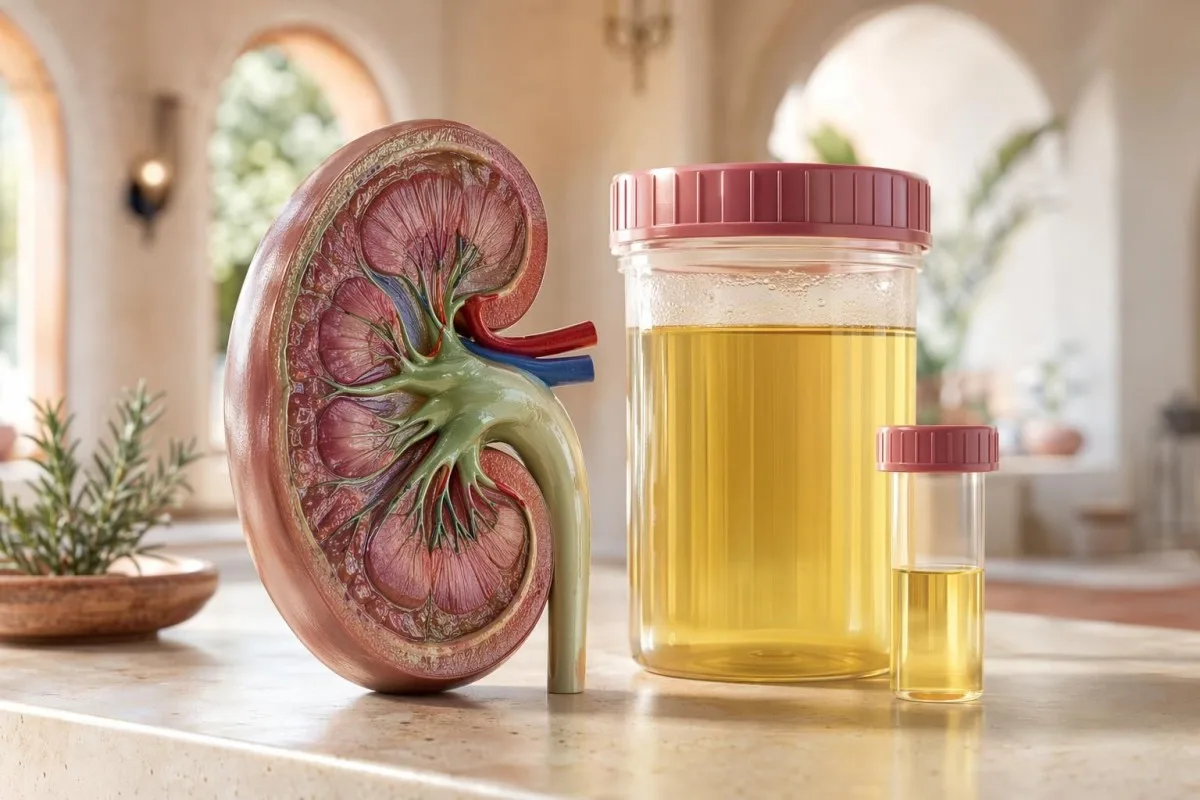
A practical, patient-first guide to doing the collection right the first time and reading the patterns your doctor is looking for.


- 24 hour urine test collection starts by discarding the first urine, then saving every urine for the next 24 hours, including the final void.
- Urine creatinine is the main completeness check; typical adult excretion is about 15-25 mg/kg/day in men and 10-20 mg/kg/day in women.
- Protein in urine above 150 mg/day is abnormal, while nephrotic-range protein is usually above 3.5 g/day.
- Urine sodium of 100 mmol/day roughly equals 2.3 g of sodium, or about 5.8 g of salt intake before sweat and stool losses.
- Urine cortisol test results are often repeated because stress, depression, alcohol, and incomplete collection can distort a single 24-hour value.
- Stone-risk urine panels usually aim for urine volume above 2.5 L/day and check calcium, oxalate, citrate, uric acid, sodium, and pH together.
- Missed urine should usually be reported honestly; one missed void can make protein, sodium, cortisol, or stone-risk results falsely low.
- Creatinine clearance needs a paired blood creatinine and a full 24-hour urine volume; many errors come from wrong start or stop times.
What a 24 hour urine test actually measures
A 24 hour urine test measures how much of a substance your body excretes in one full day, not just its concentration in a single cup. The collection is useful for kidney protein loss, creatinine clearance, sodium intake, cortisol overproduction, and kidney stone risk. I’m Thomas Klein, MD, and the single biggest patient error I see is simple: people collect the first morning urine instead of throwing it away.
The test works because your urine concentration swings hour by hour. A dehydrated 9 a.m. sample can look concentrated, while a hydrated 4 p.m. sample can look bland; a full 24-hour collection captures the total daily output. For a quick spot check, doctors often use a routine urinalysis, but timed collection is different from the dipstick patterns covered in our complete urinalysis guide.
Kantesti is an AI blood test analyzer that helps patients connect timed urine results with paired blood markers such as serum creatinine, eGFR, albumin, sodium, potassium, and glucose. That pairing matters because a urine result without the blood context can mislead; for example, low urine creatinine may mean a missed collection, low muscle mass, or both.
As of July 11, 2026, most laboratories still report 24-hour urine in mixed units: mg/day, g/day, mmol/day, µmol/day, or mcg/24 h. A result marked high in one country may look numerically unfamiliar in another, which is why I always check both the unit and the total volume before interpreting the flag.
Why doctors order timed urine instead of a spot sample
Doctors order timed urine when the daily amount matters more than the concentration in one random sample. The common reasons are suspected kidney protein loss, uncertain kidney filtration, high or low sodium intake, recurrent stones, and suspected cortisol excess.
For kidney stones, the American Urological Association recommends one or two 24-hour urine collections in high-risk or recurrent stone formers, including measurement of volume, calcium, oxalate, citrate, uric acid, sodium, potassium, and creatinine (Pearle et al., 2014). A patient with two calcium oxalate stones by age 32 deserves more than generic advice to drink water; the urine chemistry can reveal a very specific driver.
For kidney disease, KDIGO 2024 still favors spot albumin-to-creatinine ratio for screening, but timed urine protein remains useful when the question is total protein burden, nephrotic-range disease, or a confusing spot result (KDIGO, 2024). If your doctor mentioned albumin leakage, our guide to the urine ACR test explains why tiny amounts can matter.
The thing is, timed urine often answers a behavioral question too. A urine sodium of 210 mmol/day in someone with resistant hypertension points to a salt load of roughly 4.8 g sodium per day, before non-urine losses, which is enough to blunt blood-pressure medication in many salt-sensitive patients.
What to do before collection day
Preparation for a 24-hour collection means keeping your usual routine unless your doctor gives a specific restriction. Do not suddenly water-load, crash-diet, fast, or stop medicines unless the ordering clinician tells you to.
A normal adult urine volume is often about 800-2000 mL/day, but active people, hot climates, diuretics, and high fluid intake can push it well outside that range. If your doctor is checking stone risk, they may actually want to see your ordinary fluid pattern, not a heroic one-day performance.
Ask three questions before you start: should I refrigerate the container, does it contain preservative, and should I avoid any foods or medicines? For example, some catecholamine or cortisol collections have stricter medication rules, while many kidney stone panels prefer your usual diet.
If you tend to drink very little, check how your routine sample behaves in our guide to urine specific gravity before assuming the timed collection alone tells the whole hydration story. Specific gravity above about 1.030 often suggests concentrated urine, while values near 1.005 can be seen with very dilute urine or impaired concentrating ability.
How to collect the sample without ruining it
The correct method is to empty your bladder at the start time, discard that urine, then collect every urine for exactly 24 hours. At the same time the next day, collect one final urine and stop.
If you start at 7:00 a.m., urinate into the toilet at 7:00 a.m. and write down that start time. Every urine after that goes into the collection container, including overnight urine, and the final urine at 7:00 a.m. the next morning is included.
Keep the container cool if instructed; many labs ask for refrigeration because bacteria and enzymes can alter pH, citrate, oxalate, or hormone stability. Do not pour urine into a kitchen cup, and do not transfer it through a container that has detergent residue, because even tiny contamination can alter chemistry.
People laugh when I say this, but put the collection jug somewhere you cannot miss it. One of my patients kept a clean secondary container in a discreet bathroom bag during work hours; that tiny planning step saved a repeat test and a week of delay.
Collection mistakes labs and doctors can often spot
The most common errors are collecting the first urine, missing a void, stopping early, spilling part of the sample, or mixing a random urine with the timed collection. Labs often detect these errors through volume, urine creatinine, and internal consistency.
A missed void usually makes excretion values falsely low, not falsely normal. If a patient misses a 400 mL afternoon urine during a 1600 mL collection, roughly 25% of the day may be absent, and protein, sodium, calcium, oxalate, or cortisol can all be underestimated.
In quality review, Kantesti AI treats implausible combinations as possible pre-analytical issues rather than automatic disease signals. This is consistent with our clinical validation approach: a result pattern must fit biology, the collection method, and the paired blood panel.
A total volume below 400-500 mL/day may be real in severe dehydration or kidney failure, but it can also mean the patient forgot several voids. A very low creatinine excretion for body size is one of the quiet clues clinicians use before asking someone to repeat the test.
How urine creatinine shows whether the collection is complete
Urine creatinine is the built-in completeness marker for most 24-hour urine collections. Typical adult excretion is about 15-25 mg/kg/day in men and 10-20 mg/kg/day in women, though age, muscle mass, diet, and recent exercise shift those numbers.
A 70 kg man might excrete roughly 1050-1750 mg creatinine per day; a 60 kg woman might excrete roughly 600-1200 mg/day. I do not use those ranges as a moral score, because a lean 82-year-old and a 28-year-old weightlifter can have wildly different creatinine generation.
Kantesti is an AI lab test interpretation service that reads creatinine patterns across urine and blood rather than treating one number as the diagnosis. If your timed collection was ordered to estimate filtration, compare it with our guide to creatinine clearance, because the calculation needs urine creatinine, urine volume, serum creatinine, and collection duration.
Creatinine clearance is calculated as urine creatinine concentration multiplied by urine volume, divided by serum creatinine and collection time in minutes. A typical adult creatinine clearance is roughly 90-140 mL/min, but it often overestimates true GFR because tubules secrete some creatinine; the paired blood context is discussed in our BUN creatinine guide.
Reading protein and albumin in a 24-hour result
Total urine protein above 150 mg/day is generally abnormal in adults, while albumin above 30 mg/day suggests kidney filtration barrier stress. Protein above 3.5 g/day is often called nephrotic-range and needs prompt clinical follow-up.
Spot tests are convenient, but timed protein can be useful when swelling, foamy urine, pregnancy concerns, autoimmune disease, or conflicting spot ratios create uncertainty. For patient-friendly thresholds and causes, see our deeper article on protein in urine.
The pattern matters. Protein 450 mg/day with normal creatinine clearance is a different story from protein 4.8 g/day with low serum albumin and ankle swelling; the second pattern suggests heavy glomerular leakage and a higher clotting and infection risk.
KDIGO 2024 categorizes albuminuria using A1 under 30 mg/g, A2 from 30-300 mg/g, and A3 above 300 mg/g when using spot ACR, but timed albumin in mg/day can still clarify borderline or discordant cases. In my experience, the most dangerous phrase on a portal is not high protein; it is high protein with no follow-up plan.
What urine sodium, volume and osmolality reveal
Urine sodium estimates daily sodium excretion, which often approximates dietary sodium intake in stable adults. A 24-hour sodium of 100 mmol/day equals about 2.3 g sodium, or roughly 5.8 g salt.
A urine sodium above 150-200 mmol/day is common in patients who swear they eat lightly salted food but rely on bread, sauces, restaurant meals, or processed snacks. If serum sodium is also abnormal, compare the pattern with our guide to high sodium causes before assuming it is just diet.
Urine volume adds the water story. Stone clinics often aim for at least 2.5 L/day of urine output, while patients with nocturia, low blood pressure, or heart failure may need a more individualized fluid plan.
Osmolality measures particle concentration, not volume. A 24-hour urine can show low volume with high osmolality in under-hydration, or high volume with low osmolality in water loading or impaired concentrating ability; the physiology is covered more deeply in our urine osmolality guide.
How to interpret a urine cortisol test
A urine cortisol test measures free cortisol excreted over 24 hours and is mainly used when clinicians suspect cortisol excess. Many labs report a normal adult range around 10-50 mcg/24 h, but reference intervals vary by assay.
The Endocrine Society guideline recommends initial testing for suspected Cushing syndrome with urinary free cortisol, late-night salivary cortisol, or dexamethasone suppression testing, and it usually recommends at least two measurements because cortisol varies day to day (Nieman et al., 2008). A single mildly high urine cortisol is not the same thing as a diagnosis.
Values more than 3 times the upper limit of normal are more concerning for Cushing syndrome, especially with easy bruising, proximal muscle weakness, new diabetes, purple stretch marks, or unexplained osteoporosis. For blood-based patterns, our cortisol levels guide explains why morning cortisol and timed urine answer different questions.
False highs happen. Heavy alcohol intake, severe depression, uncontrolled diabetes, shift work, intense endurance training, and some medicines can raise cortisol output or disturb the rhythm; false lows can happen with incomplete collection or kidney filtration problems.
Stone-risk markers: calcium, oxalate, citrate and pH
A 24-hour stone-risk panel looks for the chemistry that allows crystals to form: low urine volume, high calcium, high oxalate, low citrate, high uric acid, high sodium, and abnormal pH. The most useful target for many recurrent stone formers is urine volume above 2.5 L/day.
Hypercalciuria is often defined as urine calcium above 250 mg/day in women or above 300 mg/day in men, though some clinicians use more than 4 mg/kg/day. High sodium intake can drag calcium into urine, so a high calcium result with urine sodium above 180 mmol/day is not interpreted the same as high calcium with low sodium.
Oxalate above about 40 mg/day increases calcium oxalate supersaturation, while citrate below about 320 mg/day removes a natural inhibitor of crystal formation. If your report mentions calcium oxalate, our article on urine crystals explains when crystals are a clue rather than a diagnosis.
Urine pH steers stone type. A pH below 5.5 favors uric acid stones, while persistently alkaline urine above about 6.8 can favor calcium phosphate stones; our urine pH guide walks through UTI clues and diet-related shifts.
Patterns doctors notice before single abnormal flags
A single abnormal 24-hour urine value rarely tells the whole story; the pattern across volume, creatinine, sodium, pH, and blood results is what changes management. Two patients can have the same urine calcium and need very different advice.
High urine calcium plus high urine sodium often points toward salt-driven calcium loss, while high urine calcium plus high serum calcium pushes doctors to consider parathyroid hormone or vitamin D problems. That distinction saves people from being told simply to avoid calcium, which can backfire by increasing oxalate absorption.
Kantesti AI interprets biomarker clusters by checking whether the numbers agree with physiology, collection quality, and trend direction. Our biomarker guide covers more than 15,000 markers, but the useful part is not quantity; it is whether a pattern makes clinical sense.
Do not ignore normal-looking flags either. A result within range can still be wrong for you if the collection lasted 18 hours, the volume is implausibly low, or the unit changed from mg/day to mmol/day; our guide to lab unit changes explains why old and new reports can appear to disagree.
What to do if you miss a urine or spill the sample
If you miss a urine or spill part of the sample, tell the lab or clinician before submitting it. For most 24-hour urine tests, an incomplete collection is less useful than a delayed but accurate repeat.
A missed nighttime urine is not a small detail. Overnight urine can contain a meaningful portion of daily creatinine, cortisol, sodium, and protein, and excluding it may make a borderline-high result look normal.
If the container has acid preservative, do not try to rescue a spill or pour from an unsafe container; call the lab. Some preservatives can irritate skin or damage clothing, and laboratories may reject unsafe or contaminated samples.
I would rather see a patient repeat the collection than build a diagnosis on shaky data. If your portal releases results before your clinician comments, our guide to results without notes can help you decide what questions to ask without spiraling at midnight.
Blood results that should be read with the urine report
Many 24-hour urine results need paired blood tests to make sense, especially serum creatinine, eGFR, electrolytes, albumin, calcium, phosphate, glucose, and parathyroid hormone. A urine number alone can be directionally helpful but clinically incomplete.
Kantesti is an AI biomarker interpretation platform that links urine-adjacent findings with blood markers such as eGFR, calcium, albumin, bicarbonate, and HbA1c. This is where timed urine becomes more practical: high urine protein with low serum albumin is a different problem from high urine protein with normal albumin and recent intense exercise.
A renal panel drawn after a large meat meal, heavy exercise, or dehydration can shift creatinine and urea enough to complicate the urine interpretation. If timing was messy, our article on renal panel fasting explains which kidney values move after food and which usually do not.
Serum creatinine and eGFR also help decide whether urinary free cortisol is reliable, because advanced kidney impairment can lower cortisol excretion. For kidney staging language, our plain-English eGFR guide explains why eGFR 58 and eGFR 28 are not the same kind of problem.
Questions to ask when the results come back
Ask whether the collection was complete, which result actually changes management, and whether you need a repeat test, blood test, imaging, or referral. A flagged 24-hour urine result should lead to a plan, not just anxiety.
My first three questions are blunt: was the urine creatinine plausible, was the volume believable, and does the result match the clinical story? If the answer is no to any of those, repeating the collection may be safer than treating a number.
Ask about thresholds. Protein 220 mg/day may mean monitoring and blood-pressure optimization, while protein 4.2 g/day often needs urgent nephrology input; urine calcium 320 mg/day may lead to sodium reduction, thiazide discussion, or parathyroid testing depending on serum calcium.
Kantesti’s physician-led content is reviewed with input from our medical advisory board, and our technical methods are described in the AI technology guide. As Thomas Klein, MD, my practical advice is simple: bring the full report, the collection times, your medicines, and one honest note about anything that went wrong.
Frequently Asked Questions
How do you collect a 24 hour urine test correctly?
To collect a 24 hour urine test correctly, empty your bladder at the start time and discard that first urine, then collect every urine for the next 24 hours. If you start at 7:00 a.m., the final urine at 7:00 a.m. the next day goes into the container. Keep the container cool if the lab instructs you to refrigerate it, and do not miss overnight urine. If you miss a void or spill part of the sample, tell the lab before submitting it.
What does urine creatinine mean on a 24-hour urine result?
Urine creatinine on a 24-hour result helps doctors judge whether the collection was complete and can also be used to calculate creatinine clearance. Typical adult excretion is about 15-25 mg/kg/day in men and 10-20 mg/kg/day in women, but muscle mass and age change expected values. A much lower-than-expected result can mean missed urine, short collection time, low muscle mass, or low creatinine generation. A high value can occur with a long collection, muscular build, heavy meat intake, or accidental over-collection.
What is a normal amount of protein in a 24-hour urine test?
Normal total urine protein is usually below 150 mg/day in adults. Protein between 150 and 500 mg/day is mildly elevated and may need repeat testing or urine sediment review, while protein above 500 mg/day deserves a more careful kidney evaluation. Nephrotic-range protein is usually above 3.5 g/day and is more concerning, especially with swelling, low blood albumin, or reduced kidney function. Albumin above 30 mg/day can also signal early kidney filtration barrier stress.
What does urine sodium show in a 24-hour collection?
Urine sodium in a 24-hour collection estimates how much sodium your body excretes in a day, which often approximates dietary sodium intake in stable adults. A sodium result of 100 mmol/day equals about 2.3 g sodium, or roughly 5.8 g salt. Values above 150-200 mmol/day can worsen salt-sensitive hypertension and may raise urine calcium in stone formers. Diuretics, sweating, vomiting, diarrhea, and heart or kidney disease can make interpretation less straightforward.
Can a urine cortisol test diagnose Cushing syndrome by itself?
A urine cortisol test can support the diagnosis of Cushing syndrome, but one abnormal result usually does not diagnose it by itself. Many labs consider urinary free cortisol roughly normal around 10-50 mcg/24 h, though ranges vary by assay. Results more than 3 times the upper limit of normal are more concerning, especially with typical symptoms such as proximal muscle weakness, new diabetes, easy bruising, or osteoporosis. Endocrinologists commonly repeat testing because stress, alcohol, depression, shift work, and incomplete collection can distort a single result.
What happens if I forget to collect one urine sample?
If you forget to collect one urine sample, the 24-hour result may be falsely low for protein, sodium, calcium, oxalate, cortisol, creatinine, and other measured substances. One missed 300-500 mL void can remove 15-30% of the total daily volume in some people. The safest step is to tell the lab or clinician exactly what happened and ask whether to repeat the collection. Do not quietly submit an incomplete sample, because it can produce false reassurance.
Why did my doctor order two 24-hour urine collections?
Doctors order two 24-hour urine collections when day-to-day variation could change the interpretation. Kidney stone risk markers such as calcium, oxalate, citrate, sodium, and urine volume can vary substantially with diet, exercise, and hydration. Cortisol testing is also often repeated because cortisol output changes with sleep, stress, illness, and medication exposure. Two collections give a more reliable pattern than one isolated day.
Should I exercise during a 24-hour urine collection?
Follow your clinician’s instructions, but avoid unusually strenuous exercise unless they specifically say otherwise. Hard workouts can temporarily increase urine protein and may affect cortisol or stone-risk measurements, so keep your food, fluids, and activity close to your normal routine.
Get AI-Powered Blood Test Analysis Today
Join over 2 million users worldwide who trust Kantesti for instant, accurate lab test analysis. Upload your blood test results and receive comprehensive interpretation of 15,000+ biomarkers in seconds.
📚 Referenced Research Publications
Klein, T., Mitchell, S., & Weber, H. (2026). BUN/Creatinine Ratio Explained: Kidney Function Test Guide. Kantesti AI Medical Research.
Klein, T., Mitchell, S., & Weber, H. (2026). Urobilinogen in Urine Test: Complete Urinalysis Guide 2026. Kantesti AI Medical Research.
📖 External Medical References
KDIGO CKD Guideline Work Group (2024). KDIGO 2024 Clinical Practice Guideline for the Evaluation and Management of Chronic Kidney Disease. Kidney International.
⚕️ Medical Disclaimer
This article is for educational purposes only and does not constitute medical advice. Always consult a qualified healthcare provider for diagnosis and treatment decisions.
E-E-A-T Trust Signals
Experience
Physician-led clinical review of lab interpretation workflows.
Expertise
Laboratory medicine focus on how biomarkers behave in clinical context.
Authoritativeness
Written by Dr. Thomas Klein with review by Dr. Sarah Mitchell and Prof. Dr. Hans Weber.
Trustworthiness
Evidence-based interpretation with clear follow-up pathways to reduce alarm.