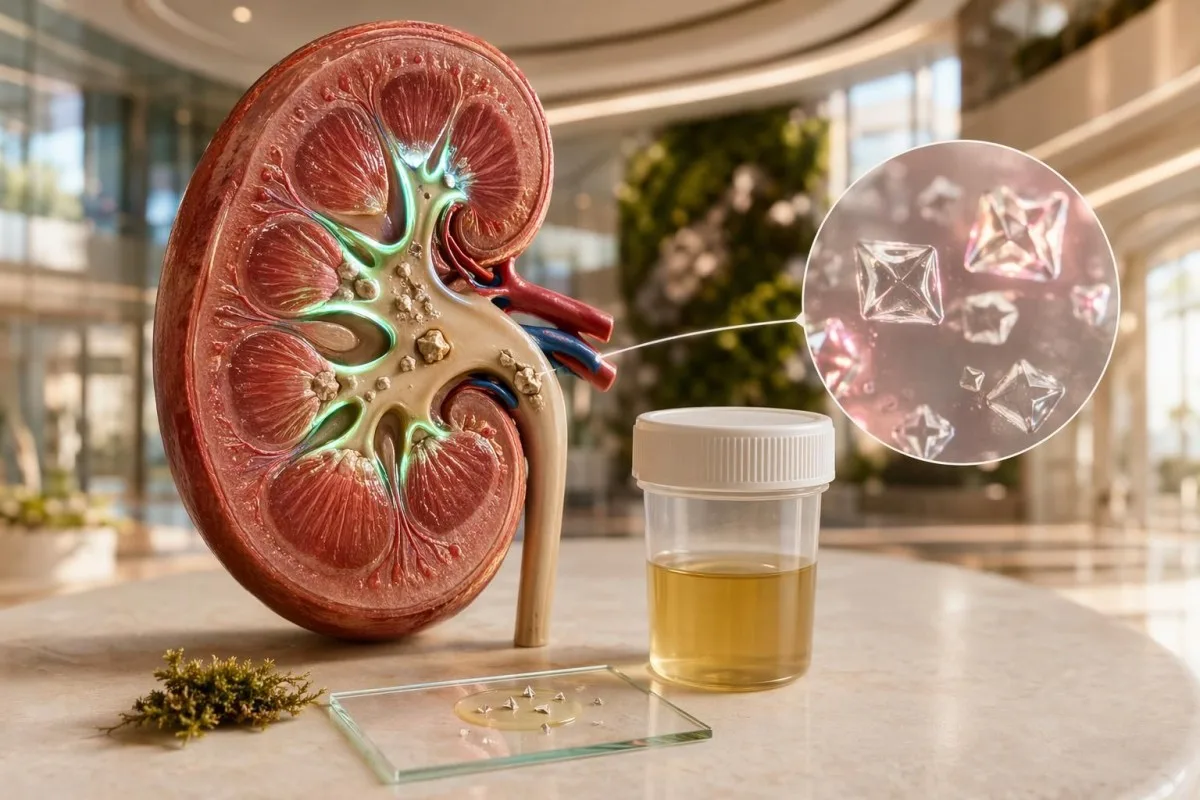
A single urinalysis can make crystals look scarier than they are. The pattern around the result — hydration, symptoms, urine pH, blood, and repeat testing — is what changes the next step.


- Calcium oxalate crystals in urine are common and often reflect concentrated urine, especially when urine specific gravity is above 1.020.
- Kidney stone risk rises when crystals recur, urine volume stays below 2.0 L/day, or urinalysis also shows red cells.
- Urine oxalate above about 40-45 mg/day on a 24-hour collection suggests hyperoxaluria and deserves targeted follow-up.
- Urine calcium above 250 mg/day in many women or 300 mg/day in many men can point toward hypercalciuria.
- Urine citrate below about 320 mg/day removes a natural stone inhibitor and is a common missed clue.
- Vitamin C supplements above 1,000 mg/day can raise urinary oxalate in susceptible people.
- Ethylene glycol exposure is rare but urgent when calcium oxalate monohydrate crystals appear with acidosis, confusion, or kidney injury.
- Next steps usually mean repeat clean-catch urinalysis, hydration review, kidney function blood tests, and 24-hour urine testing if risk is persistent.
What calcium oxalate crystals in urine usually mean
Calcium oxalate crystals in urine are often a dehydration or recent-food clue, not a diagnosis of kidney stones. They become a risk signal when they appear repeatedly, are reported as moderate or many, or travel with flank pain, red cells in urine, high urine specific gravity, low citrate, high urine calcium, or high urine oxalate.
As of June 15, 2026, I still see patients panic over a single urinalysis line that says calcium oxalate crystals present. In clinic, that line is usually a prompt to ask better questions, not to assume a stone is forming.
The crystals in urine meaning depends on the urine environment at the moment the sample was produced. A first-morning sample after a salty dinner can show crystals because urine sat in the bladder for 6-8 hours and became supersaturated.
Kantesti is an AI blood test analyzer that can place creatinine, eGFR, serum calcium, bicarbonate, and uric acid beside a urinalysis narrative; that paired view is often more useful than staring at the crystal line alone. For readers who want the full urine-marker context, our complete urinalysis guide explains the rest of the dipstick and microscopy pattern.
Thomas Klein, MD speaking plainly: I worry less about isolated crystals and more about the person who has crystals plus recurrent one-sided pain, visible dark urine, or a history of stones before age 30. Those combinations change the probability.
When crystals are probably just a dehydration clue
Crystals are more likely to be a harmless concentration clue when urine specific gravity is high, symptoms are absent, and the finding disappears after better fluid intake. A urine specific gravity of 1.020-1.030 commonly means the kidneys are conserving water, which makes calcium and oxalate more likely to meet and crystallize.
A practical hydration target for many stone-prone adults is enough fluid to make at least 2.0-2.5 L of urine per day. That often requires roughly 2.5-3.0 L of drinks daily, more in hot climates, heavy exercise, fever, or sauna use.
Urine color is a rough screen, but the lab number is better. A specific gravity near 1.005-1.015 usually suggests dilute urine, while values above 1.025 often explain why crystals appeared on that particular day; our urine specific gravity article goes deeper on that distinction.
Here is the sneaky bit: dehydration can also raise serum albumin, BUN, and sometimes creatinine just enough to look like a kidney issue. If those blood markers normalize with fluids, the crystal result becomes much less ominous.
If a patient tells me, I gave the sample after a long run and two coffees, I usually repeat the urinalysis under ordinary conditions before ordering imaging. Most people do not need a CT scan for one dry-looking urine specimen.
Diet and supplements that can cause calcium oxalate crystals
The common dietary causes of calcium oxalate crystals are high oxalate intake, low fluid intake, high salt intake, and sometimes low dietary calcium. Spinach, rhubarb, beet greens, almonds, cashews, cocoa, and large vitamin C doses can raise urinary oxalate in susceptible people.
Patients often assume calcium is the enemy because the crystal name contains calcium. The opposite is often true: eating calcium with meals binds oxalate in the gut, lowering oxalate absorption before it reaches urine.
Curhan et al. reported in the New England Journal of Medicine that higher dietary calcium was associated with lower symptomatic kidney stone risk in men, while supplemental calcium behaved differently depending on timing and diet pattern (Curhan et al., 1993). Borghi et al. later found fewer recurrent stones with a normal-calcium, low-salt, low-animal-protein diet than with a low-calcium diet in hypercalciuric men (Borghi et al., 2002).
Salt is the quieter culprit. For many people, each additional 100 mmol of sodium per day can push urinary calcium upward, so a salty diet may increase calcium oxalate supersaturation even if oxalate intake is ordinary.
High-protein diets are not automatically dangerous, but they can lower urine citrate and raise acid load in some stone formers. If you are increasing protein for training or weight loss, compare kidney and urea markers with our high-protein diet labs before blaming one food.
Urinalysis clues that shift concern toward kidney stones
Calcium oxalate crystals are more concerning when urinalysis also shows red cells, persistent high specific gravity, protein, casts, or signs of infection. A stone can irritate the urinary tract and cause microscopic red cells even when pain is mild or intermittent.
A common stone pattern is crystals plus red cells with few or no white cells. If leukocyte esterase, nitrite, fever, and urinary burning are present, infection enters the differential and the story changes.
A positive nitrite test is not required for a urinary infection, because not every organism converts nitrate to nitrite. Mixed bacterial growth or contamination can confuse the picture, so symptomatic patients should understand urine culture patterns before assuming crystals caused every urinary symptom.
Protein on the dipstick deserves context. Trace protein in concentrated urine can be benign, while persistent 1+ or higher protein with casts or reduced eGFR points away from a simple stone story and toward kidney tissue evaluation.
Some laboratories report calcium oxalate crystals as few, moderate, or many; others use 1+, 2+, or 3+. The wording is semi-quantitative, so a moderate result from one lab is not perfectly interchangeable with a 2+ result from another.
Symptoms that make crystals more than a lab curiosity
Crystals need urgent clinical attention when they come with severe flank pain, fever, vomiting, inability to pass urine, pregnancy, a single kidney, or known kidney disease. Pain that waves from the back toward the groin is classic for a moving ureteric stone, but real patients rarely read the textbook.
A blocked, infected kidney is the situation clinicians do not want to miss. Fever above 38°C, rigors, fast heart rate, and flank pain can indicate an obstructed infected system, which is usually an emergency rather than a wait-and-see problem.
A stone can be present even when crystals are absent, and crystals can be present even when no stone exists. That mismatch is why imaging decisions depend on symptoms, kidney function, and prior history, not microscopy alone.
If creatinine rises from a personal baseline of 0.8 mg/dL to 1.4 mg/dL during a painful episode, I treat that as more meaningful than a crystal description. Our guide to high creatinine clues explains why baseline comparison matters so much.
Ethylene glycol exposure is rare, but it is the dangerous exception clinicians remember. Calcium oxalate monohydrate crystals plus confusion, metabolic acidosis, low calcium, and acute kidney injury should trigger same-day emergency assessment.
Blood tests that complete the stone-risk picture
Blood tests help separate simple crystalluria from metabolic stone risk by checking kidney function, calcium balance, bicarbonate, uric acid, and sometimes parathyroid hormone. A basic kidney-stone workup often includes creatinine, eGFR, calcium, electrolytes, bicarbonate, and uric acid.
Serum calcium is usually about 8.6-10.2 mg/dL in many adult reference ranges, though albumin shifts total calcium interpretation. A repeatedly high calcium result should raise the question of hyperparathyroidism, especially if stones are recurrent.
Kantesti AI reads kidney-adjacent blood markers against age, sex, unit system, and trend direction, which matters because an eGFR of 72 mL/min/1.73 m² means something different at age 28 than at age 82. Our calcium blood range article explains why corrected and ionized calcium can disagree.
Low bicarbonate can hint at renal tubular acidosis, chronic diarrhea, or medication effects. A serum bicarbonate below about 22 mmol/L alongside stones should make clinicians think beyond dehydration.
Kantesti’s 15,000+ biomarker guide is useful here because stone prevention often sits across several panels: metabolic panel, renal panel, urinalysis, and sometimes endocrine labs. No single marker carries the whole story.
Questions to ask before accepting a crystal result
Before acting on calcium oxalate crystals, ask how the urine sample was collected, how long it sat before analysis, and whether it was first-morning, midstream, clean-catch, or taken after exercise. Crystals can form or become more visible as urine cools and stands.
A sample analyzed within 1-2 hours is usually more reliable for sediment than one that sat all afternoon. Delayed analysis can alter pH, bacterial growth, and crystal appearance.
Ask whether the report showed calcium oxalate monohydrate or dihydrate crystals. Dihydrate crystals often look like envelopes; monohydrate forms can look dumbbell-like or oval, and heavy monohydrate crystalluria has a different clinical feel when acidosis is present.
If the lab result has an asterisk, do not assume it means danger. It often means outside that laboratory’s reporting expectation; our guide on reading lab results explains why flags are not diagnoses.
My practical checklist is short: Was I dehydrated? Did I eat high-oxalate foods? Was there pain? Were red cells present? Has this happened before? Those five answers usually determine the next move.
When a 24-hour kidney stone urine test is worth doing
A 24-hour kidney stone urine test is most useful after recurrent stones, a first stone at a young age, stones in both kidneys, a single kidney, chronic kidney disease, bowel disease, bariatric surgery, or strong family history. It measures the chemistry that a spot urinalysis cannot quantify.
A proper 24-hour collection reports urine volume, calcium, oxalate, citrate, sodium, uric acid, pH, creatinine, and supersaturation indices. Creatinine in the collection helps judge whether the person actually collected the full day.
The AUA medical management guideline recommends metabolic testing in recurrent stone formers and high-risk first-time stone formers, because targeted prevention beats generic advice (Pearle et al., 2014). In my experience, the most actionable surprises are low urine volume, high sodium, and low citrate.
Kantesti is an AI lab test interpretation service that can help organize blood and urine-related lab patterns into plain language, but a clinician still needs to decide whether the collection was valid and whether imaging is needed. For kidney blood context, compare the result with BUN-creatinine ratio rather than reading urine chemistry in isolation.
Do not do the collection on a perfect behavior day unless your doctor asks. If you drink double your usual fluids just for the test, the result may underestimate your real-life supersaturation.
Calcium, oxalate, citrate and pH: the numbers that matter
Calcium oxalate stone risk rises when urine calcium and oxalate are high, urine volume and citrate are low, and supersaturation remains elevated. Urine pH matters, but calcium oxalate can form across a wider pH range than uric acid or struvite stones.
Citrate is underappreciated. It binds calcium in urine, so a citrate value below 320 mg/day removes a natural brake on calcium oxalate crystallization even when calcium intake is normal.
Urine pH below about 5.5 strongly favors uric acid stones, while pH above 7.0 raises other possibilities such as infection-related stones. Calcium oxalate risk is more about supersaturation than one pH cutoff.
Uric acid still belongs in the conversation because hyperuricosuria can promote calcium oxalate crystallization in some patients. If serum uric acid is high, our uric acid range guide explains how gout risk and stone risk overlap but are not identical.
Clinicians disagree about how aggressively to treat borderline urine calcium when the patient has no stone history. I usually weigh family history, imaging, diet sodium, bone health, and repeatability before considering medication.
Diet changes that reduce risk without making life miserable
The most evidence-based diet pattern for calcium oxalate stone prevention is normal dietary calcium, lower sodium, adequate fluids, moderate animal protein, and selective oxalate reduction. Severe oxalate restriction is rarely necessary and can make diets nutritionally poor.
Aim for about 1,000-1,200 mg/day of dietary calcium unless your clinician gives a different target. Taking calcium with meals is different from taking large calcium supplements away from food.
A reasonable sodium goal for many stone formers is under 2,300 mg/day, with some clinicians aiming closer to 1,500 mg/day if blood pressure also runs high. The reason is mechanical: sodium excretion drags calcium into urine.
Pair higher-oxalate foods with calcium-containing foods rather than banning everything. Spinach daily smoothies are a problem for some people; a varied diet with kale, yogurt, lentils, citrus, and enough water is often easier to sustain.
Patients with chronic kidney disease need individualized nutrition because potassium, phosphate, protein, and fluid targets may conflict. Our kidney disease diet guide is a safer starting point than copying a generic stone diet from the internet.
Medication, gut and rare causes doctors should not miss
Recurrent calcium oxalate crystals can be driven by gut malabsorption, bariatric surgery, chronic diarrhea, inflammatory bowel disease, high-dose vitamin C, topiramate, loop diuretics, or rare inherited hyperoxaluria. The cause matters because the prevention plan changes completely.
After Roux-en-Y gastric bypass or chronic fat malabsorption, fatty acids bind calcium in the gut and leave oxalate free for absorption. That can produce enteric hyperoxaluria, sometimes with urine oxalate well above 45 mg/day.
Topiramate is better known for calcium phosphate stone risk because it can raise urine pH and lower citrate, but mixed patterns happen. If crystals appear after a medication change, bring the medication timeline to the appointment.
High-dose vitamin C is a repeat offender in my clinic. Doses above 1,000 mg/day can increase oxalate production in some adults, and more is not always better.
Do not overlook kidney tissue markers if there is protein, reduced eGFR, or diabetes. The urine albumin-creatinine ratio in our kidney function test guide helps separate stone irritation from early kidney damage.
What to do after one abnormal urinalysis result
After one urinalysis showing calcium oxalate crystals, the usual next step is to repeat a clean-catch urinalysis under ordinary hydration and review symptoms, specific gravity, red cells, pH, and kidney blood tests. Most asymptomatic people do not need immediate imaging.
Repeat testing is best done when you are not acutely ill, not severely dehydrated, and not immediately after a long endurance workout. A midstream clean-catch sample analyzed promptly is more useful than a random sample that sat for hours.
If crystals disappear and the rest of the urinalysis is clean, I usually document it as transient crystalluria. If crystals persist on 2 or more samples, the threshold for diet review, blood chemistry, and sometimes 24-hour urine testing drops.
A repeat plan should be specific: date, hydration instructions, whether fasting matters, and which symptoms should trigger earlier care. Our article on repeat abnormal labs gives a practical framework for deciding timing without overtesting.
Keep a photo or PDF of the original report. Trend context matters, and patients often lose the semi-quantitative wording that helps clinicians compare results.
How Kantesti AI reads kidney-related lab patterns
Kantesti AI interprets kidney-related results by looking for patterns across blood chemistry, renal markers, mineral balance, and the timing of abnormal values. It does not diagnose a stone from crystals alone; it flags combinations that deserve follow-up.
Kantesti is an AI-powered blood test analysis tool used by people in more than 127 countries, and kidney-risk interpretation is one area where unit conversion and trend history matter. A creatinine reported in µmol/L, for example, should not be compared casually with a mg/dL result.
Kantesti’s neural network is designed to recognize that high BUN plus high albumin and high urine specific gravity often smells like dehydration, while rising creatinine plus protein and persistent urinary abnormalities is a different pattern. The technical approach is described in our technology guide.
Our clinical standards are documented through medical validation processes, including physician review of safety-sensitive outputs. That matters because a crystal result with fever or kidney injury should never be softened into wellness advice.
For readers asking who we are, Kantesti Ltd is described on our About Us page, and Thomas Klein, MD reviews kidney-related interpretation rules with the same bias I use in practice: do not frighten people with isolated noise, but do not miss dangerous combinations.
When to see a clinician, urologist or emergency care
See a clinician promptly if calcium oxalate crystals occur with pain, red cells, recurrent abnormal urinalyses, reduced eGFR, high calcium, pregnancy, a single kidney, or prior stones. Seek emergency care for fever with flank pain, uncontrolled vomiting, severe one-sided pain, confusion, or inability to pass urine.
A urologist is usually helpful after recurrent stones, stones larger than 5-6 mm, persistent obstruction, or complicated anatomy. A nephrologist may be better when the story involves reduced eGFR, proteinuria, tubular acidosis, or systemic metabolic disease.
Ultrasound avoids radiation and is often preferred in pregnancy and some younger patients, but low-dose non-contrast CT is more sensitive for many adult stone episodes. The right imaging test depends on risk, not just availability.
Bring three things to the visit: the urinalysis report, any blood chemistry results, and a one-week note of fluid intake, diet changes, supplements, and symptoms. That 10-minute preparation can save a month of vague advice.
Kantesti’s doctors and reviewers are listed through our Medical Advisory Board, because medical interpretation should have accountable humans behind it. My bottom line: crystals are a clue; the follow-up pattern decides whether they are harmless, preventable, or urgent.
Frequently Asked Questions
Are calcium oxalate crystals in urine normal?
Calcium oxalate crystals in urine can be normal, especially when urine is concentrated after overnight fasting, exercise, low fluid intake, or a high-oxalate meal. They are more reassuring when there is no pain, no red cells, no protein, and urine specific gravity improves toward about 1.005-1.015 after hydration. A single report of few crystals is not the same as kidney stone disease. Repeating a clean-catch urinalysis is usually the safest first step.
Do calcium oxalate crystals mean I have a kidney stone?
Calcium oxalate crystals do not prove that you have a kidney stone. Stones can occur without crystals on urinalysis, and crystals can appear without any stone on imaging. The finding becomes more suspicious when it repeats, is reported as moderate or many, or appears with flank pain, red cells, vomiting, or reduced kidney function. A kidney stone urine test or imaging is considered when the risk pattern is persistent or symptomatic.
What causes calcium oxalate crystals in urine?
Common calcium oxalate crystals causes include concentrated urine, high oxalate intake, high sodium intake, low dietary calcium with meals, high-dose vitamin C, gut malabsorption, bariatric surgery, and some medications. Vitamin C doses above 1,000 mg/day can raise urinary oxalate in susceptible adults. Urine oxalate above about 40-45 mg/day on a 24-hour urine collection suggests hyperoxaluria. The cause is best identified by pairing urinalysis with symptoms, diet history, and kidney-related blood tests.
What follow-up questions should I ask after a urinalysis shows crystals?
Ask whether the sample was first-morning or random, how soon it was analyzed, what the urine specific gravity was, whether red cells or protein were present, and whether the report said few, moderate, many, 1+, 2+, or 3+. Ask if urine pH, nitrite, leukocyte esterase, and culture results suggest infection. Also review recent fluid intake, high-oxalate foods, vitamin C supplements, exercise, and prior kidney stones. These answers usually determine whether repeat urinalysis, blood tests, 24-hour urine testing, or imaging is the next step.
When should I get a 24-hour kidney stone urine test?
A 24-hour kidney stone urine test is most useful for recurrent stones, a first stone at a young age, stones in both kidneys, a single kidney, chronic kidney disease, bowel disease, bariatric surgery, or strong family history. It measures urine volume, calcium, oxalate, citrate, sodium, uric acid, pH, creatinine, and supersaturation. Useful thresholds include urine volume below 2.0 L/day, oxalate above 40-45 mg/day, calcium above 250-300 mg/day, and citrate below 320 mg/day. A spot urinalysis cannot provide those daily excretion numbers.
Can drinking more water clear calcium oxalate crystals?
Drinking more water can reduce calcium oxalate crystals when the main driver is concentrated urine. Many stone-prevention plans aim for at least 2.0-2.5 L of urine output per day, which often requires 2.5-3.0 L of fluid intake depending on sweating, climate, and activity. If crystals disappear after hydration and no red cells, pain, or kidney abnormalities are present, the result is usually less concerning. Persistent crystals despite good urine volume deserve a broader evaluation.
Do I need kidney imaging if calcium oxalate crystals are found but I have no pain?
Usually not. Without pain, recurrent visible blood, infection, reduced kidney function, or a history of stones, isolated crystals generally warrant repeat urinalysis and hydration review rather than immediate CT; imaging is considered when symptoms or risk factors suggest a stone or blockage.
Get AI-Powered Blood Test Analysis Today
Join over 2 million users worldwide who trust Kantesti for instant, accurate lab test analysis. Upload your blood test results and receive comprehensive interpretation of 15,000+ biomarkers in seconds.
📚 Referenced Research Publications
Klein, T., Mitchell, S., & Weber, H. (2026). A Pre-Registered, Rubric-Based Automated Technical Benchmark of the Kantesti Blood-Test Interpretation Engine on 100,000 Synthetic Test Cases. Kantesti AI Medical Research.
Klein, T., Mitchell, S., & Weber, H. (2026). Clinical Validation Framework v2.0 (Medical Validation Page). Kantesti AI Medical Research.
📖 External Medical References
⚕️ Medical Disclaimer
This article is for educational purposes only and does not constitute medical advice. Always consult a qualified healthcare provider for diagnosis and treatment decisions.
E-E-A-T Trust Signals
Experience
Physician-led clinical review of lab interpretation workflows.
Expertise
Laboratory medicine focus on how biomarkers behave in clinical context.
Authoritativeness
Written by Dr. Thomas Klein with review by Dr. Sarah Mitchell and Prof. Dr. Hans Weber.
Trustworthiness
Evidence-based interpretation with clear follow-up pathways to reduce alarm.