
A negative home test does not always rule out pregnancy, particularly before a missed period or after heavy fluid intake. Here is the practical, medically cautious way to handle a result that does not fit your body or cycle.



- Testing timing matters most: test on the first day of a missed period, then repeat in 48 hours if pregnancy remains possible.
- Typical sensitivity for many urine tests is 20–25 mIU/mL hCG; early-result devices may detect about 10 mIU/mL under ideal conditions.
- First-morning urine is usually the best sample before a missed period because overnight concentration raises detectable hCG.
- A false negative pregnancy test is more common than a true false positive, especially with late ovulation, diluted urine, or an expired test.
- Serum β-hCG testing can detect roughly 1–2 IU/L and is useful when urine and symptoms disagree.
- hCG trigger injections can cause a positive test for about 10–14 days; birth-control pills, antibiotics, and ordinary pain relievers do not.
- Emergency symptoms include one-sided pelvic pain, shoulder-tip pain, fainting, severe dizziness, or heavy bleeding—seek urgent assessment even after a negative test.
- Borderline blood hCG results of 5–25 IU/L often need repeat measurement after 48 hours rather than a single yes-or-no interpretation.
What a home pregnancy test detects—and why timing changes everything
A urine pregnancy test can be negative despite pregnancy when hCG has not yet reached the test's detection threshold, most often because testing occurred before or around the expected period. Test on the first day of a missed period, use first-morning urine if you are testing early, and repeat after 48 hours if the result and your circumstances do not match.
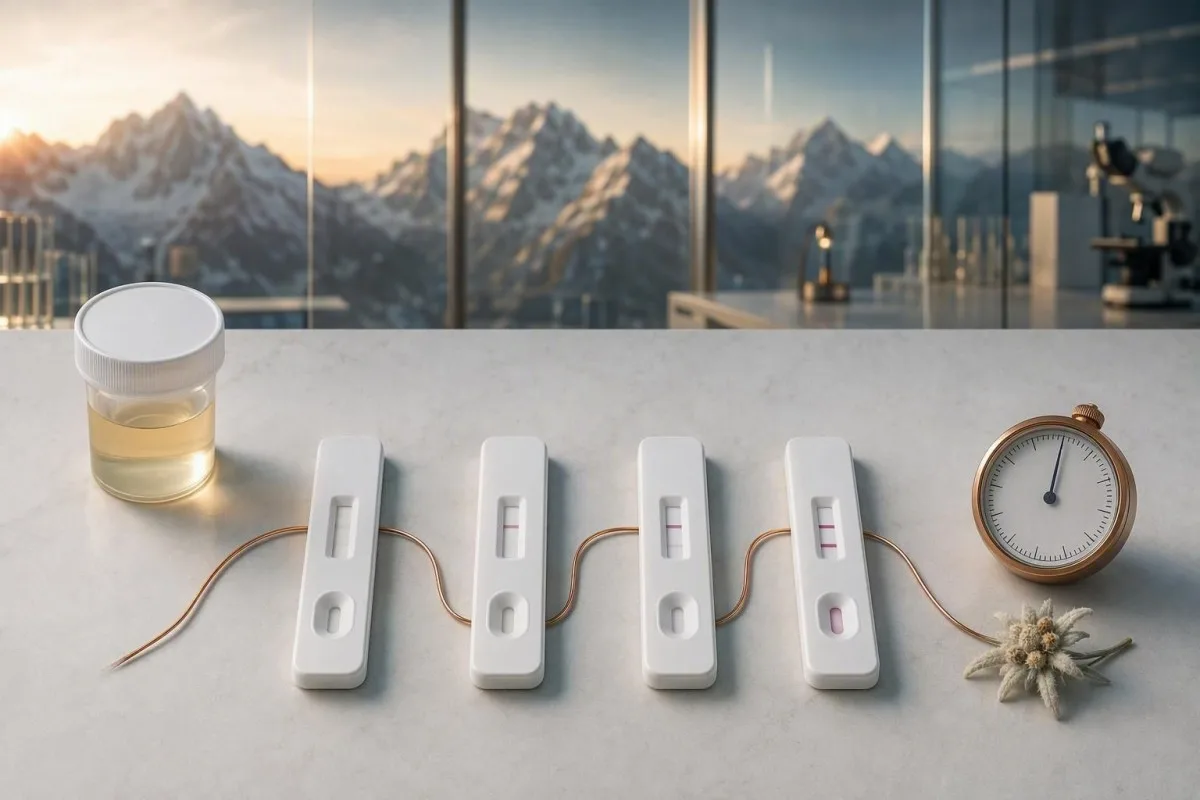
Home tests detect human chorionic gonadotropin (hCG), a hormone made after implantation begins. Many standard devices turn positive at 20–25 mIU/mL, while some early-result products claim detection near 10 mIU/mL; that small difference can matter during the first few days after implantation.
A test cannot reliably date a pregnancy. Implantation commonly occurs about 6–12 days after ovulation, and ovulation itself can shift by several days with illness, travel, breastfeeding, polycystic ovary syndrome, or simply a longer cycle. In my clinical experience, a person convinced they are "a week late" may actually be only 8 or 9 days past ovulation.
I, Thomas Klein, MD, advise treating a single negative test as a snapshot rather than a verdict when a period is absent. Kantesti is an AI blood test analyzer that can place a serum β-hCG result alongside timing, symptoms, and other laboratory context, but it does not replace pregnancy-care assessment. Our β-hCG week-by-week guide explains why one number rarely answers every question.
When to take a pregnancy test for the most reliable result
The most reliable time to take a home test is the first day your period is expected or later, not the day after sex. If cycles are irregular or dates are uncertain, test at least 21 days after the last episode of unprotected sex and repeat 48 hours later if negative.

hCG begins rising only after implantation, so testing 7 days after intercourse is usually too soon even if conception occurred. A urine result becomes increasingly dependable from the missed period onward because hCG often rises quickly in early pregnancy; still, the rate varies enough that a 48-hour repeat is more informative than repeating several tests on the same afternoon.
Johnson and colleagues reviewed home-test performance and found that marketed early-detection claims did not always translate into equal real-world accuracy, particularly at low hCG concentrations (Johnson et al., 2014). The practical lesson is simple: a test capable of detecting 10 mIU/mL in a laboratory may perform less consistently when used at home with a variable urine sample.
If you are trying to conceive, record the date of the last menstrual period, estimated ovulation, testing date, and result rather than relying on memory. That small timeline helps a clinician decide whether repeat urine testing, serum hCG, ultrasound, or ordinary cycle evaluation makes sense; our preconception blood-test overview covers useful tests before pregnancy begins.
How diluted urine can cause a negative result
Diluted urine can produce a false negative pregnancy test because it lowers the hCG concentration below the device threshold. This effect is most relevant before or just after a missed period, when the total amount of hCG is still relatively low.

Drinking 1–2 litres of water shortly before testing can make a marginal sample negative, even though the same person may test positive with concentrated morning urine. Diuretic medicines and drinks may contribute indirectly by increasing urine output, but they do not chemically interfere with hCG detection.
First-morning urine is generally most concentrated after several hours without drinking or urinating. If testing later in the day, most patients find it reasonable to avoid excessive fluids for about 2–3 hours beforehand rather than deliberately dehydrating themselves.
Urine specific gravity is a laboratory measure of concentration, with many adult samples falling around 1.005–1.030. A very pale, low-specific-gravity sample is not "bad" urine—it is simply less useful for an early qualitative hCG test; see our explanation of urine specific gravity for the clinical context.
False-negative pregnancy tests: the less obvious causes
A false-negative result most often reflects testing too early, but test sensitivity, procedural errors, unusual hCG forms, and very rarely the hook effect can also contribute. A negative urine result should never overrule concerning pregnancy symptoms.

Expired tests, storage in a hot bathroom, insufficient sample volume, and reading the device outside its stated window can all lead to an unreliable result. Most devices specify a reading interval of roughly 3–10 minutes; a line appearing after the maximum read time is not a dependable positive result.
In a large emergency-department cohort, 1.6% of visits with a negative point-of-care urine test ultimately had a pregnancy outcome recorded, and the proportion reached 3.6% among patients with abdominal pain or vaginal bleeding (Kleinschmidt et al., 2021). This does not mean home tests fail that often in routine use; it shows why symptoms and pre-test probability matter.
The high-dose hook effect is an exceptionally uncommon cause of a negative result when hCG is extremely high, such as some multiple or molar pregnancies. Excess hormone can overwhelm both antibodies in a sandwich assay; laboratories can investigate this by diluting a specimen, but this is not the usual explanation for an early negative test. For a wider discussion of unexpected laboratory results, review why lab values can differ between visits.
Why an early negative test can become positive two days later
A 48-hour interval gives a developing pregnancy time to increase measurable hCG rather than merely repeating the same borderline measurement. In viable early pregnancies, serum hCG may rise by at least 35% over 48 hours, although no single rise pattern proves location or viability on its own.
How to use a home test without creating avoidable errors
Correct technique reduces avoidable errors: check the expiry date, follow that product's timing instructions exactly, and confirm that the control indicator appears. A missing control mark means the test is invalid, not negative.

Use a clean, dry collection cup if the instructions allow dipping, or hold the absorbent tip in the urine stream only for the stated seconds. More sample is not better; flooding a cassette can disrupt fluid movement across the test membrane.
Set a timer before beginning. Looking too soon can miss a developing positive line, while looking 20–30 minutes later can reveal evaporation or dye-indent marks that are not evidence of hCG.
A genuinely faint coloured line within the approved read window should be treated as positive until confirmed, especially after a missed period. Home testing is different from formal urine collection for other conditions, where preservation and total volume can alter interpretation; our article on 24-hour urine collection errors shows how easily sample handling can affect a laboratory result.
When a blood hCG test is the better next step
A serum β-hCG test is appropriate when urine testing is negative or unclear despite a missed period, fertility treatment, recent pregnancy, or symptoms that could indicate an early complication. Quantitative serum testing usually detects about 1–2 IU/L, substantially below most home urine-test thresholds.
Most laboratories report serum hCG below 5 IU/L as negative, while values from 5–25 IU/L are commonly treated as indeterminate and repeated after 48 hours. Reference intervals vary by laboratory, so the range printed on the report takes priority over a universal internet cutoff.
A blood value tells us quantity, not pregnancy location. A rising hCG can occur with an intrauterine or ectopic pregnancy, and an ultrasound is often required once timing and hCG level make imaging informative. This is one of those areas where context matters more than a single number.
Kantesti is an AI biomarker interpretation platform that helps users organize quantitative hCG, complete blood count, thyroid, iron, and metabolic results for a clinician discussion; it does not diagnose an ectopic pregnancy or decide whether ultrasound is safe to delay. You can review the laboratory terms behind a result in our 15,000-plus biomarker guide.
False-positive pregnancy tests: what is real and what only looks positive
A true false positive pregnancy test is uncommon because hCG is a specific marker, but recent pregnancy, hCG-containing fertility medication, pituitary hCG, and rare medical conditions can produce a positive result without an ongoing pregnancy. Evaporation lines and testing after the read window are not true biochemical positives.

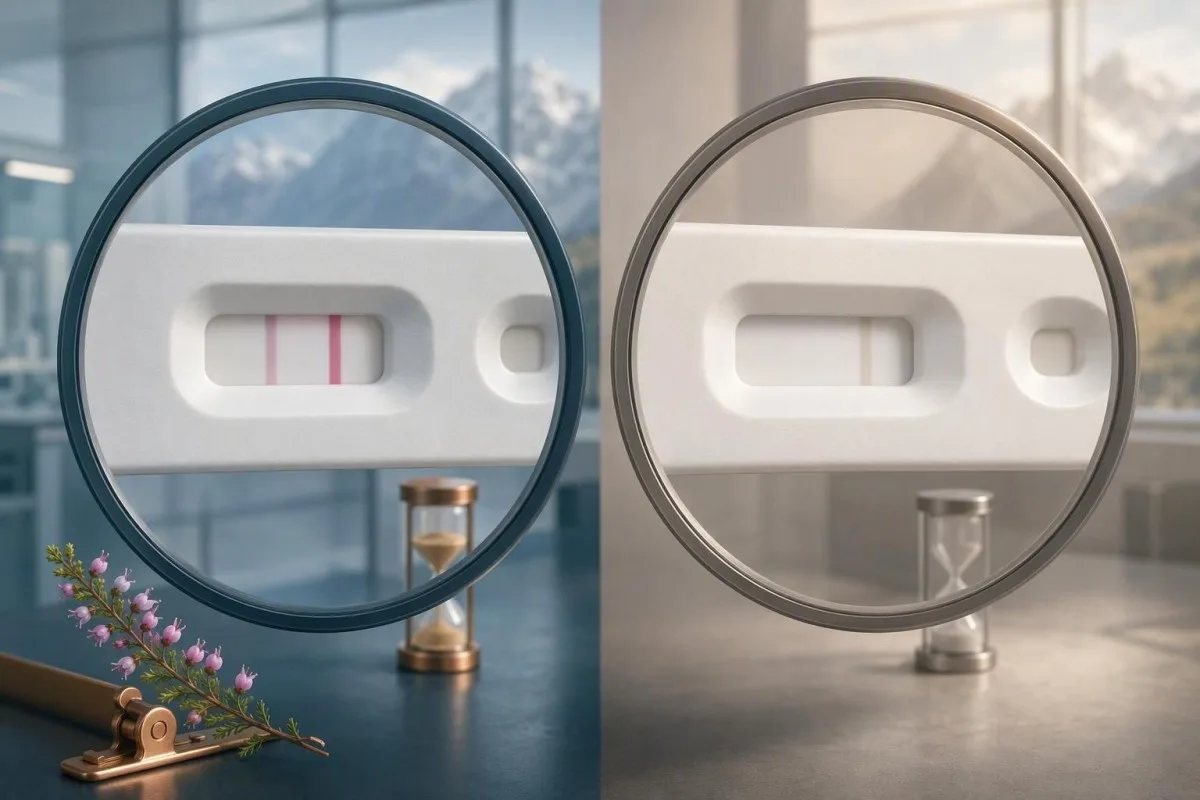
A coloured second line that appears inside the read window generally means hCG was detected, even if it is faint. A grey, colourless indent or shadow appearing after the allowed time is a device artefact and should be ignored rather than counted as a faint positive.
Very early losses—sometimes called biochemical pregnancies—can produce a short-lived positive test followed by bleeding and a later negative test. That result was not technically false: hCG was present, but the pregnancy did not continue. A clinician may recommend serial serum hCG where symptoms, fertility treatment, or prior ectopic pregnancy changes the risk.
Persistent low-level hCG has several explanations, and repeating the same test brand may not clarify them. A clinician may compare urine and serum samples, use a different assay, or review for antibody interference; this same principle of confirmation is useful in other screening contexts, including our article on confirming false-positive HIV blood tests.
Medications that do and do not affect pregnancy-test results
Only medicines that contain hCG are expected to cause a positive urine pregnancy test directly. Birth-control pills, antibiotics, paracetamol or acetaminophen, ibuprofen, antidepressants, and common allergy medicines do not create hCG and do not cause a true positive result.

Fertility trigger injections containing hCG can remain detectable for approximately 10–14 days, depending on dose, metabolism, and test sensitivity. Testing before the clinic's advised date can therefore detect medication rather than a newly implanted pregnancy.
Clomifene, letrozole, progesterone, metformin, and prenatal vitamins do not themselves contain hCG. They can shift ovulation timing, influence cycle symptoms, or support a fertility protocol, which is why people sometimes mistakenly attribute a changed test result to the medicine.
Ask a pharmacist or fertility clinic to check the exact active ingredient rather than stopping prescribed medication because of a test result. Hormonal contraception can also change bleeding patterns without affecting hCG; our review of estrogen results while using birth control explains why hormone symptoms and test interpretation are not interchangeable.
Why tests can remain positive after birth, miscarriage, or abortion
Pregnancy tests can remain positive for 2–4 weeks after a pregnancy ends because hCG does not disappear immediately. The exact duration depends on the hCG level before the pregnancy ended, retained tissue, and whether hCG is falling as expected.

After an uncomplicated early loss, hCG usually declines over days to weeks, but a persisting positive test deserves follow-up if bleeding, pain, fever, or pregnancy symptoms continue. A falling value is reassuring, whereas a plateauing or rising result can need urgent evaluation for retained pregnancy tissue or ectopic pregnancy.
A post-pregnancy home test cannot distinguish a resolving pregnancy from a new conception. If unprotected sex has occurred again, quantitative serum hCG measurements 48 hours apart and, when appropriate, ultrasound offer a safer answer than trying several brands of urine test.
Kantesti AI can help a patient retain a dated record of laboratory hCG values, but the interpretation must remain under clinician supervision after a loss or procedure. The shape of the trend is usually more informative than a single measurement; our hCG pregnancy timeline provides useful background before a follow-up appointment.
Symptoms that need urgent care despite a negative test
Possible pregnancy plus one-sided lower abdominal pain, shoulder-tip pain, fainting, severe dizziness, or heavy vaginal bleeding requires urgent medical assessment—even if a urine test is negative. A urine result alone cannot safely exclude an ectopic pregnancy in its earliest stages.

Ectopic pregnancy occurs when a pregnancy implants outside the uterine cavity, and symptoms may develop before urine hCG becomes clearly detectable. Pain that becomes sharp, localised, or associated with collapse is an emergency; do not wait 48 hours for another home test in that situation.
NICE guideline NG126 advises pregnancy testing and clinical assessment for people of reproductive age who present with pelvic pain or bleeding where pregnancy is possible (NICE, 2023). In practice, clinicians combine symptoms, examination, serum hCG, and transvaginal ultrasound rather than relying on any one result.
I have seen patients focus on whether the test line was faint while overlooking a far more useful clue: new shoulder-tip pain or feeling faint when standing. Thomas Klein, MD, would rather a person be assessed unnecessarily than miss a time-sensitive complication. Our overview of same-day pregnancy lab red flags lists additional reasons to call for care promptly.
Irregular periods, PCOS, and menopause: why dates can mislead
Irregular cycles make calendar-based testing less reliable because ovulation may occur much later than expected. In this setting, testing 21 days after unprotected sex is often more dependable than counting from a presumed missed period.

PCOS does not cause a positive pregnancy test, but it can delay ovulation by days or weeks. A person with a 35- to 60-day cycle may test negative at a date that seems late on a 28-day calendar but is actually before implantation.
In perimenopause and after menopause, the pituitary gland can produce very low concentrations of hCG. Serum hCG values below about 14 IU/L may represent pituitary hCG in a postmenopausal person, although clinicians consider age, symptoms, follicle-stimulating hormone, and the laboratory assay before assuming that explanation.
A high FSH value can support a menopausal pattern but does not independently rule out pregnancy in someone still ovulating intermittently. For context, our article on high FSH causes explains why hormone results must be interpreted with menstrual history and medication use.
A practical plan when your result does not fit your symptoms
When symptoms, menstrual timing, and a urine test disagree, repeat a fresh test in 48 hours using first-morning urine or ask for quantitative serum β-hCG testing. Do not keep testing every few hours; hCG changes too slowly for that to settle the question.

Write down the first day of the last period, usual cycle length, possible conception dates, test brand, expiry date, testing time, fluid intake, and whether a line appeared inside the stated window. That information can reveal a late ovulation or diluted sample faster than a vague recollection of several mixed results.
If a urine test is positive and bleeding begins, contact a maternity, sexual-health, primary-care, or urgent-care service rather than assuming it is just a period. If the result is negative but the period remains absent for 7 days, repeat testing or arrange a clinical review for pregnancy and non-pregnancy causes.
Kantesti's AI-powered blood test analysis tool can organize a laboratory PDF or photo into a dated summary, which may be useful when discussing serum hCG and accompanying results with a clinician. We explain safeguards, limitations, and context checks in our AI technology guide.
What to do after a clearly positive home pregnancy test
A clearly positive home test should prompt timely contact with an appropriate pregnancy-care provider, particularly if there is pain, bleeding, prior ectopic pregnancy, an intrauterine device, or fertility treatment. Routine blood hCG testing is not required for every uncomplicated positive home test.

Start or continue folic acid at 400 micrograms daily unless a clinician has advised a higher dose for a specific indication. Avoid alcohol and smoking, review all prescription and over-the-counter medicines promptly, and seek individualized advice before stopping drugs used for epilepsy, diabetes, thyroid disease, or mental health.
Early pregnancy bloodwork varies by country and clinical history, but commonly includes blood group, red-cell antibodies, infection screening, and anaemia assessment. A single hCG level is generally ordered for a clinical question—not as a routine reassurance test in every healthy early pregnancy.
Pregnancy changes several laboratory reference ranges, including albumin and platelet counts, so non-pregnancy ranges can be misleading. Our articles on pregnancy-safe supplement choices and albumin by trimester offer context for conversations with your maternity team.
Using laboratory information safely when pregnancy results are unclear
Laboratory information is safest when it supports, rather than substitutes for, clinical assessment. A serum hCG result should be interpreted with the test date, symptoms, medication history, prior pregnancy history, and ultrasound findings when indicated.

Kantesti is an AI lab test interpretation service designed to translate uploaded blood-test reports into understandable patterns, with privacy-focused processing and human clinical oversight principles. Our system can flag that an hCG result of 12 IU/L falls into a commonly indeterminate laboratory zone, but it cannot determine pregnancy location, viability, or urgency without a clinician.
Our medical team reviews the clinical boundaries of automated explanations, especially when pregnancy, acute pain, or possible ectopic pregnancy is involved. Readers can review our medical validation approach and the expertise behind our Medical Advisory Board before using any automated interpretation as part of their preparation for a medical appointment.
As of July 29, 2026, the safest bottom line remains unchanged: repeat a too-early negative test after 48 hours, confirm discordant results with serum β-hCG when appropriate, and seek urgent care for pain, collapse, shoulder-tip pain, or heavy bleeding. Kantesti's role is to make laboratory records easier to understand—not to delay hands-on pregnancy care.
Frequently Asked Questions
Can I be pregnant with a negative urine pregnancy test?
Yes. A negative urine pregnancy test can occur in early pregnancy when urine hCG remains below the device threshold, which is often 20–25 mIU/mL for standard home tests. Late ovulation, implantation 6–12 days after ovulation, and drinking large amounts of fluid shortly before testing are common explanations. Repeat the test in 48 hours with first-morning urine, or request a serum β-hCG test if your period is late, symptoms are concerning, or fertility treatment is involved.
How soon after sex can a pregnancy test be accurate?
A urine pregnancy test is generally most accurate on the first day of a missed period, not immediately after sex. If cycle timing is uncertain, testing 21 days after the last unprotected sex provides a more dependable rule because implantation and hCG production need time to occur. Some early-detection tests may detect 10 mIU/mL hCG before a missed period, but a negative result at that stage should be repeated after 48 hours.
Can drinking too much water cause a false negative pregnancy test?
Yes. Drinking 1–2 litres of fluid shortly before an early urine pregnancy test can dilute hCG enough to produce a false negative result. This matters most before or around the expected period, when hCG may only be near a test's 10–25 mIU/mL detection threshold. Use first-morning urine when possible or avoid excessive fluid intake for about 2–3 hours before retesting.
What medicines can cause a false positive pregnancy test?
Medicines containing hCG, including some fertility trigger injections, can cause a positive urine pregnancy test for about 10–14 days after administration. Birth-control pills, antibiotics, paracetamol or acetaminophen, ibuprofen, antidepressants, progesterone, clomifene, and letrozole do not contain hCG and do not cause a true positive result. Ask a pharmacist or fertility clinician to identify the exact active ingredient before interpreting a result or changing medication.
When should I get a blood hCG test after a negative home test?
A quantitative blood hCG test is sensible when a period is late and urine tests remain negative, when results alternate between faint positive and negative, or when fertility treatment or a recent pregnancy makes home testing hard to interpret. Serum testing can detect approximately 1–2 IU/L, while many urine tests need 20–25 mIU/mL. Values below 5 IU/L are commonly negative, while results from 5–25 IU/L often require repeat measurement after 48 hours.
Can an ectopic pregnancy have a negative urine test?
Yes, an ectopic pregnancy can occasionally have a negative urine pregnancy test very early, particularly when hCG is low or urine is dilute. One-sided lower abdominal pain, shoulder-tip pain, fainting, severe dizziness, or heavy vaginal bleeding needs urgent assessment if pregnancy is possible, regardless of a home-test result. Clinicians use symptoms, examination, serum β-hCG, and ultrasound together because no single urine result safely excludes an early ectopic pregnancy.
Get AI-Powered Blood Test Analysis Today
Join over 2 million users worldwide who trust Kantesti for instant, accurate lab test analysis. Upload your blood test results and receive comprehensive interpretation of 15,000+ biomarkers in seconds.
📚 Referenced Research Publications
Klein, T., Mitchell, S., & Weber, H. (2026). Multilingual AI Assisted Clinical Decision Support for Early Hantavirus Triage: Design, Engineering Validation, and Real-World Deployment Across 50,000 Interpreted Blood Test Reports. Kantesti AI Medical Research.
Klein, T., Mitchell, S., & Weber, H. (2026). A Pre-Registered, Rubric-Based Automated Technical Benchmark of the Kantesti Blood-Test Interpretation Engine on 100,000 Synthetic Test Cases. Kantesti AI Medical Research.
📖 External Medical References
National Institute for Health and Care Excellence (2023). Ectopic pregnancy and miscarriage: diagnosis and initial management. NICE Guideline NG126.






⚕️ Medical Disclaimer
This article is for educational purposes only and does not constitute medical advice. Always consult a qualified healthcare provider for diagnosis and treatment decisions.
E-E-A-T Trust Signals
Experience
Physician-led clinical review of lab interpretation workflows.
Expertise
Laboratory medicine focus on how biomarkers behave in clinical context.
Authoritativeness
Written by Dr. Thomas Klein with review by Dr. Sarah Mitchell and Prof. Dr. Hans Weber.
Trustworthiness
Evidence-based interpretation with clear follow-up pathways to reduce alarm.