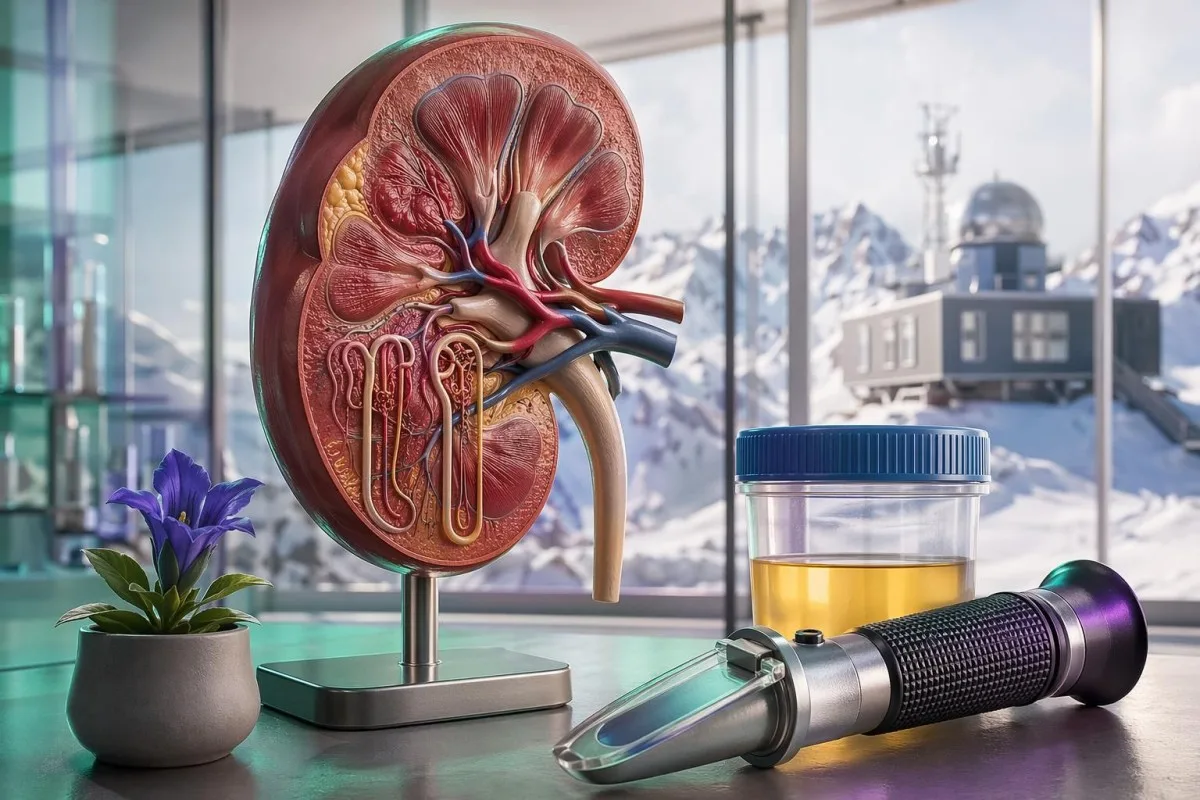
Urine specific gravity shows how concentrated or dilute your urine is. A single value often reflects recent fluid intake, but repeated high, low, or fixed results can reveal dehydration, glucose spillover, medication effects, or reduced kidney concentrating ability.


- Urine specific gravity is usually reported between 1.005 and 1.030 in adults; higher means more concentrated urine, lower means more dilute urine.
- Normal first-morning urine often falls around 1.015 to 1.025 because healthy kidneys concentrate urine overnight.
- High urine specific gravity above 1.030 often reflects dehydration, vomiting, diarrhea, heavy sweating, glucose in urine, protein in urine, or recent contrast dye.
- Low urine specific gravity below 1.005 usually means very dilute urine from high fluid intake, diuretics, diabetes insipidus, primary polydipsia, or impaired kidney concentrating ability.
- Fixed urine specific gravity near 1.010 on repeated tests is called isosthenuria and can suggest reduced tubular concentrating or diluting function.
- Repeat testing is reasonable when a result is mildly abnormal but symptoms are absent; use a fresh first-morning sample after normal fluid intake.
- Follow-up blood tests usually include sodium, glucose, BUN, creatinine, eGFR, and sometimes serum and urine osmolality.
- Urgent care is needed if abnormal urine specific gravity comes with confusion, fainting, severe thirst, very low urine output, persistent vomiting, or blood sodium below 130 or above 150 mmol/L.
What urine specific gravity measures on urinalysis
Urine specific gravity measures urine density compared with pure water, so it mainly tells us whether the kidneys are making concentrated or dilute urine. A normal random result is usually 1.005 to 1.030, but the right interpretation depends on fluid intake, timing, glucose, protein, medications, and blood chemistry.
I am Thomas Klein, MD, and when I review urinalysis results, I treat specific gravity as a hydration snapshot plus a kidney concentrating test. Simerville and colleagues described urinalysis as a fast screen for renal and metabolic clues in American Family Physician in 2005, and that still matches day-to-day clinical practice (Simerville et al., 2005).
A specific gravity of 1.000 would match pure water; urine almost never stays there because urea, sodium, potassium, creatinine, glucose, and proteins add weight. For a deeper urinalysis primer, our complete urinalysis guide explains how urine color, pH, protein, glucose, ketones, and sediment change the meaning of a single number.
Kantesti is an AI blood test interpretation platform that reads hydration clues such as sodium, BUN, creatinine, albumin and glucose beside a urine specific gravity result, rather than treating the urine number as a lonely flag. You can read more about our clinical team and governance on About Us.
Normal urine specific gravity values and timing
A typical adult urine specific gravity normal range is 1.005 to 1.030 on a random specimen. First-morning urine often reads 1.015 to 1.025, while urine collected after drinking several glasses of water may temporarily fall to 1.001 to 1.005 without disease.
The same person can have 1.004 at 2 p.m. after a large bottle of water and 1.024 at 7 a.m. after sleeping overnight. That swing is normal kidney physiology, not necessarily a lab error or a kidney problem.
A useful way to read urine test results explained in plain terms is this: below 1.005 usually means dilute, 1.005 to 1.030 is the usual random range, and above 1.030 is unusually concentrated or weighted by extra solutes. For broader range pitfalls, see our guide to why a blood test normal range can mislead when timing and context are ignored.
Some hospital laboratories flag values at 1.030, while others report up to 1.035 if they use refractometry. I prefer not to argue with the flag on the page; I ask whether the sample timing, symptoms, and paired blood tests tell the same story.
High urine specific gravity: common causes and clues
High urine specific gravity usually means urine is concentrated, most often from dehydration, fluid loss, or a first-morning specimen. Values above 1.030 deserve context because glucose, protein, ketones, and contrast dye can also raise the reading without simple dehydration.
A 52-year-old marathon runner once showed me a urine specific gravity of 1.033 after a hot race, with BUN 29 mg/dL and creatinine just above his usual baseline. Two days later, after rest and normal salt-water intake, the value was 1.017; that is the kind of repeat pattern that reassures me.
High values are less reassuring when the dipstick also shows glucose, ketones, or 2+ protein, because these solutes make urine heavier. If your blood panel also looks concentrated, our article on dehydration false highs explains why albumin, calcium, hemoglobin, and BUN can appear artificially high after fluid loss.
A high urine specific gravity with dizziness, fast pulse, reduced urination, or dry mouth is more concerning than the same number in a well person after sleep. In adults, urine output below about 400 to 500 mL per day is not just “dark urine”; it can signal clinically meaningful volume depletion or kidney stress.
Low urine specific gravity and dilute urine
Low urine specific gravity below 1.005 means the urine is very dilute. One low result commonly follows high water intake, but repeated low values with thirst, nighttime urination, or urine volume above 3 liters per day need follow-up for water-balance disorders.
The classic trap is the anxious patient who drinks two liters of water before every medical visit, then gets a value of 1.002 and worries about kidney failure. If sodium, creatinine, glucose, and symptoms are normal, I usually repeat the test with normal fluids rather than escalating immediately.
Persistent dilute urine can occur with diabetes insipidus, primary polydipsia, diuretic use, high calcium, low potassium, sickle cell trait, and tubulointerstitial kidney disease. Christ-Crain and colleagues describe diabetes insipidus as a disorder of excessive hypotonic urine output, often above 50 mL/kg/day in adults (Christ-Crain et al., 2019).
Low specific gravity becomes more urgent when paired with constant thirst, weight loss, new headaches, or abnormal sodium. Our constant thirst lab guide walks through the practical difference between high glucose, high sodium, and primary water drinking.
Fixed 1.010 results and kidney concentrating ability
A urine specific gravity repeatedly near 1.010 can suggest isosthenuria, meaning the kidneys are producing urine with density close to plasma filtrate. One result at 1.010 is common; repeated fixed values are the pattern that raises concern about tubular concentrating ability.
Healthy kidneys should swing: dilute after water loading and more concentrated after overnight fluid restriction. If several samples remain between 1.008 and 1.012 despite different fluid conditions, I start thinking about chronic kidney disease, acute tubular injury recovery, sickle trait, lithium exposure, or older scarring in the renal tubules.
Creatinine can look “normal” until kidney reserve has already fallen, especially in small or older adults with lower muscle mass. That is why I pair urine specific gravity with eGFR trends, urine albumin, and sometimes cystatin C; our eGFR age guide explains why a single creatinine value can understate early decline.
A fixed specific gravity is not a diagnosis by itself. It is a reason to ask whether the kidney can still respond to stress, because real life includes fever, fasting, heat, exercise, and nights when someone simply cannot drink much.
How laboratories measure urine specific gravity
Laboratories measure urine specific gravity by dipstick, refractometer, or automated urinalysis systems, and the method can change borderline results. Refractometry is usually more accurate than dipstick when urine contains glucose, protein, contrast agents, or unusual dissolved particles.
Dipstick specific gravity is convenient, but it estimates ionic concentration and can be less reliable in alkaline urine or in samples with large non-ionic solutes. A refractometer measures how urine bends light, so it better reflects total dissolved material.
Urine osmolality is often the better follow-up test when water-balance physiology is the question. Random urine osmolality commonly ranges from about 300 to 900 mOsm/kg, while values below 100 mOsm/kg suggest maximally dilute urine and values above 600 mOsm/kg show meaningful concentration.
Small unit or method differences explain many confusing urinalysis reports. If your result changed after a different laboratory, our guide to different lab units shows how method, calibration, and reference intervals can make results look more dramatic than they are.
Hydration, exercise and heat effects
Exercise, sauna exposure, fever, altitude, and hot weather can push urine specific gravity above 1.020 to 1.030 by increasing fluid loss. In athletes, the number is useful only when interpreted with body weight change, sodium, creatinine, CK, and symptoms.
I see this pattern often in endurance athletes: dark urine, specific gravity 1.028, mildly high BUN, and a normal creatinine after a long training block. The patient usually needs recovery and sensible rehydration, not panic or five specialist referrals.
Overhydration is the opposite danger, especially when someone drinks large volumes of plain water during long events. A urine specific gravity below 1.005 with serum sodium below 135 mmol/L can fit exercise-associated hyponatremia, which is treated very differently from dehydration.
Kantesti is an AI-powered blood test analysis tool used by 2M+ people across 127 countries; for urine specific gravity, our reports look for paired blood markers that change the urgency of follow-up. Athletes may also find our marathon runner labs useful when sodium, CK, creatinine, and hydration all move together.
Glucose, ketones and protein can raise the number
Urine specific gravity can be high because urine contains extra solutes, not just because the body is dehydrated. Glucose, ketones, protein, mannitol, and radiographic contrast can push results above 1.030 even when fluid intake has been reasonable.
Glucose is the common one. When blood glucose rises above the kidney threshold, often around 180 mg/dL but variable by person, glucose can spill into urine and raise specific gravity while also causing frequent urination and thirst.
Protein has a similar but slower clinical message. A urine specific gravity of 1.032 with 3+ protein needs a kidney work-up, while 1.032 after overnight sleep with no protein may simply be concentrated morning urine.
If glucose appears on urinalysis, check a plasma glucose and HbA1c rather than guessing from urine alone. Our guide to high glucose results explains why stress, steroids, meals, and diabetes risk can all change the next step.
Medication and imaging contrast effects
Several medications and medical exposures can change urine specific gravity by altering water handling or adding heavy solutes to urine. Lithium, diuretics, SGLT2 inhibitors, desmopressin, mannitol, and iodinated contrast are the medication-related patterns I check first.
Lithium can impair the kidney response to antidiuretic hormone and cause nephrogenic diabetes insipidus, sometimes with urine specific gravity persistently below 1.005. This can appear after months or years, not just when the lithium blood level is high.
SGLT2 inhibitors intentionally increase urinary glucose, so they may raise urine specific gravity while causing more urination. Desmopressin can do the opposite by concentrating urine; after dosing, a rise from 1.004 to 1.018 may show that the kidney can respond to antidiuretic signaling.
Bring the medication list to the interpretation, including over-the-counter diuretics, creatine, and recent imaging contrast. Our medication monitoring guide gives practical timelines for when drug-related lab shifts are expected versus suspicious.
When a high or low value should be repeated
Repeat urine specific gravity when the result is unexpectedly below 1.005, above 1.030, or fixed near 1.010, especially if symptoms or blood tests do not match. A fresh first-morning sample after normal fluid intake is the cleanest repeat for most stable adults.
My usual outpatient repeat plan is simple: avoid unusual water loading, alcohol, sauna, and hard endurance exercise for 24 to 48 hours, then collect the first urine of the morning. Do not intentionally dehydrate yourself; that creates a different false story.
If the repeat value returns to 1.010 to 1.025 and the dipstick is otherwise normal, most patients can discuss it at a routine visit. If it stays below 1.005 with thirst or above 1.030 with glucose, ketones, or protein, I would not leave it unexplained.
For general abnormal-result timing, our guide on when to repeat abnormal blood tests is useful because urine and blood markers share the same principle: repeat mild surprises under controlled conditions before labeling disease.
Follow-up tests that change the interpretation
The follow-up tests that most change urine specific gravity interpretation are serum sodium, glucose, BUN, creatinine, eGFR, urine albumin-creatinine ratio, serum osmolality, and urine osmolality. These tests separate hydration, diabetes, kidney damage, and water-balance disorders.
A high specific gravity with BUN/creatinine ratio above 20:1 can support volume depletion, although gastrointestinal bleeding, high protein intake, and steroids can also raise BUN. Our BUN creatinine guide explains why that ratio is helpful but never perfect.
KDIGO 2024 emphasizes eGFR and albuminuria together when assessing chronic kidney disease risk, not creatinine alone (KDIGO, 2024). A urine albumin-creatinine ratio of 30 mg/g or higher is abnormal in most adults, and our urine ACR guide shows why albumin can detect kidney stress earlier than creatinine.
For suspected diabetes insipidus, the key mismatch is high or high-normal serum sodium with inappropriately dilute urine. Sodium above 145 mmol/L plus urine osmolality below 300 mOsm/kg is not a “drink more water” situation; it deserves clinician-led evaluation.
Children, older adults and pregnancy pitfalls
Children, older adults, and pregnant patients can have urine specific gravity results that look misleading if adult outpatient assumptions are applied. Age, kidney maturity, pregnancy physiology, feeding status, fever, and medication burden can all change the expected concentration range.
Infants have less mature concentrating ability, so a dilute result is not interpreted like a 40-year-old adult result. In pediatrics, dehydration assessment also uses weight change, capillary refill, intake, wet nappies or diapers, and electrolytes; our pediatric lab ranges covers why age-specific ranges matter.
Older adults may have a blunted thirst response and reduced concentrating reserve, so a “normal” value of 1.015 does not rule out clinically relevant dehydration. I pay more attention to orthostatic symptoms, medication list, sodium, creatinine trend, and whether BUN has drifted upward over several visits.
Pregnancy adds another layer because vomiting, hyperemesis, urinary infection, glucose screening, and preeclampsia evaluation may overlap. A high urine specific gravity with ketones during persistent vomiting in pregnancy should be discussed promptly, and our guide to pregnancy lab red flags explains when same-day review is safer.
How Kantesti AI reads urine clues with blood results
Kantesti AI interprets urine specific gravity by pairing it with blood markers, symptoms, and prior trends rather than treating it as a standalone diagnosis. That pattern-based approach matters because 1.003 can be harmless water loading or a serious water-balance clue depending on sodium and urine volume.
Our AI biomarker interpretation platform at Kantesti tracks eGFR, sodium and glucose trends because a low urine specific gravity means very different things in a distance runner than in a patient with lithium exposure. The same value can trigger “repeat when stable” in one person and “check osmolality” in another.
Kantesti's neural network is built to flag combinations that clinicians actually worry about: low specific gravity plus sodium 148 mmol/L, high specific gravity plus glucose 250 mg/dL, or fixed 1.010 plus falling eGFR. Our medical validation page describes how we benchmark interpretation quality against clinical standards.
The limitation is real: no AI should diagnose diabetes insipidus, kidney disease, or dehydration from a screenshot alone. The safer role is triage, pattern recognition, and helping patients ask better questions when they bring urinalysis and blood chemistry together.
When to seek medical care for abnormal results
Seek medical care quickly when abnormal urine specific gravity comes with confusion, fainting, severe weakness, persistent vomiting, very low urine output, marked thirst, or abnormal sodium. A number alone rarely creates an emergency; the symptom-and-electrolyte combination does.
Same-day review is sensible for urine specific gravity below 1.005 with extreme thirst and urination above 3 liters per day, especially if sodium is high. It is also sensible for values above 1.030 with ketones, glucose, fever, severe diarrhea, or inability to keep fluids down.
Emergency care is more appropriate if there is confusion, seizure, chest pain, fainting, severe dehydration signs, or sodium below 130 mmol/L or above 150 mmol/L. Verbalis and colleagues' expert panel on hyponatremia highlighted that neurologic symptoms can reflect dangerous brain-water shifts, not just “low salt” on paper (Verbalis et al., 2013).
When Dr. Thomas Klein and our physicians review cases for Kantesti, we keep the same rule: the number starts the question, but symptoms and paired labs set the urgency. Our Medical Advisory Board supports this patient-safety approach across our lab interpretation work.
Frequently Asked Questions
What does urine specific gravity mean on a urinalysis?
Urine specific gravity measures how concentrated urine is compared with pure water. A typical adult random range is about 1.005 to 1.030, with higher values meaning more concentrated urine and lower values meaning more dilute urine. The result helps explain hydration status and kidney concentrating ability, but it must be read with fluid intake, timing, glucose, protein, sodium, BUN, creatinine, and symptoms.
What is a normal urine specific gravity result?
A normal urine specific gravity result is usually 1.005 to 1.030 for a random adult urine sample. First-morning urine often falls around 1.015 to 1.025 because the kidneys concentrate urine overnight. A value near 1.002 after heavy water intake can be normal, while the same value repeatedly with severe thirst or high urine output needs follow-up.
Is high urine specific gravity always dehydration?
High urine specific gravity above 1.030 often reflects dehydration or fluid loss, but it is not always simple dehydration. Glucose, ketones, protein, mannitol, and recent iodinated contrast can make urine heavier and raise the result. A high value with glucose, ketones, 2+ protein, vomiting, dizziness, or low urine output should be reviewed rather than dismissed as not drinking enough water.
What causes low urine specific gravity?
Low urine specific gravity below 1.005 usually means very dilute urine. Common causes include drinking a large volume of water, diuretic medicines, low-solute intake, primary polydipsia, diabetes insipidus, high calcium, low potassium, and some kidney tubular disorders. Persistent low values with urine volume above 3 liters per day, severe thirst, or sodium above 145 mmol/L deserve medical evaluation.
What does urine specific gravity of 1.010 mean?
A urine specific gravity of 1.010 can be normal as a single random result. The concern is repeated results near 1.010 under different fluid conditions, which may suggest isosthenuria, meaning the kidneys are not concentrating or diluting urine well. Follow-up usually includes creatinine, eGFR, urine albumin-creatinine ratio, sodium, and sometimes urine osmolality.
When should urine specific gravity be repeated?
Urine specific gravity should be repeated when it is unexpectedly below 1.005, above 1.030, or repeatedly near 1.010. For most stable adults, the best repeat is a fresh first-morning urine sample after 24 to 48 hours of normal fluid intake and no unusual sauna, endurance exercise, or deliberate water loading. If the repeat remains abnormal or the dipstick also shows glucose, ketones, blood, or protein, follow-up testing is appropriate.
Can urine specific gravity show kidney disease?
Urine specific gravity can suggest impaired kidney concentrating ability, but it does not diagnose kidney disease by itself. A fixed result around 1.010, persistent protein, rising creatinine, falling eGFR, or urine albumin-creatinine ratio above 30 mg/g gives stronger evidence of kidney involvement. Clinicians usually combine urinalysis with eGFR, albuminuria, blood pressure, medication history, and symptoms before deciding the next step.
Can a normal urine specific gravity rule out a kidney stone?
A normal urine specific gravity cannot rule out a kidney stone; assessment may include urine testing and imaging. Seek prompt care for severe side or back pain, and urgent care if it comes with fever, chills, or difficulty passing urine.
Can a urinary tract infection change urine specific gravity?
A urinary tract infection does not usually cause a meaningful change in specific gravity by itself. Fever, poor fluid intake, or vomiting can make urine more concentrated, so burning, urgency, fever, or flank pain should be assessed using symptoms, urine microscopy, and sometimes a culture.
Can a urine sample left at home too long change the specific gravity result?
Yes, an old or uncovered sample can become less reliable because evaporation and temperature changes may alter urine concentration. Use a clean-catch container and deliver it within 1–2 hours, or refrigerate it only if the lab advises.
Get AI-Powered Blood Test Analysis Today
Join over 2 million users worldwide who trust Kantesti for instant, accurate lab test analysis. Upload your blood test results and receive comprehensive interpretation of 15,000+ biomarkers in seconds.
📚 Referenced Research Publications
Klein, T., Mitchell, S., & Weber, H. (2026). Diarrhea After Fasting, Black Specks in Stool & GI Guide 2026. Kantesti AI Medical Research.
Klein, T., Mitchell, S., & Weber, H. (2026). Women's Health Guide: Ovulation, Menopause & Hormonal Symptoms. Kantesti AI Medical Research.
📖 External Medical References
Simerville JA et al. (2005). Urinalysis: A Comprehensive Review. American Family Physician.
Kidney Disease: Improving Global Outcomes CKD Work Group (2024). KDIGO 2024 Clinical Practice Guideline for the Evaluation and Management of Chronic Kidney Disease. Kidney International.
Christ-Crain M et al. (2019). Diabetes insipidus. Nature Reviews Disease Primers.
⚕️ Medical Disclaimer
This article is for educational purposes only and does not constitute medical advice. Always consult a qualified healthcare provider for diagnosis and treatment decisions.
E-E-A-T Trust Signals
Experience
Physician-led clinical review of lab interpretation workflows.
Expertise
Laboratory medicine focus on how biomarkers behave in clinical context.
Authoritativeness
Written by Dr. Thomas Klein with review by Dr. Sarah Mitchell and Prof. Dr. Hans Weber.
Trustworthiness
Evidence-based interpretation with clear follow-up pathways to reduce alarm.