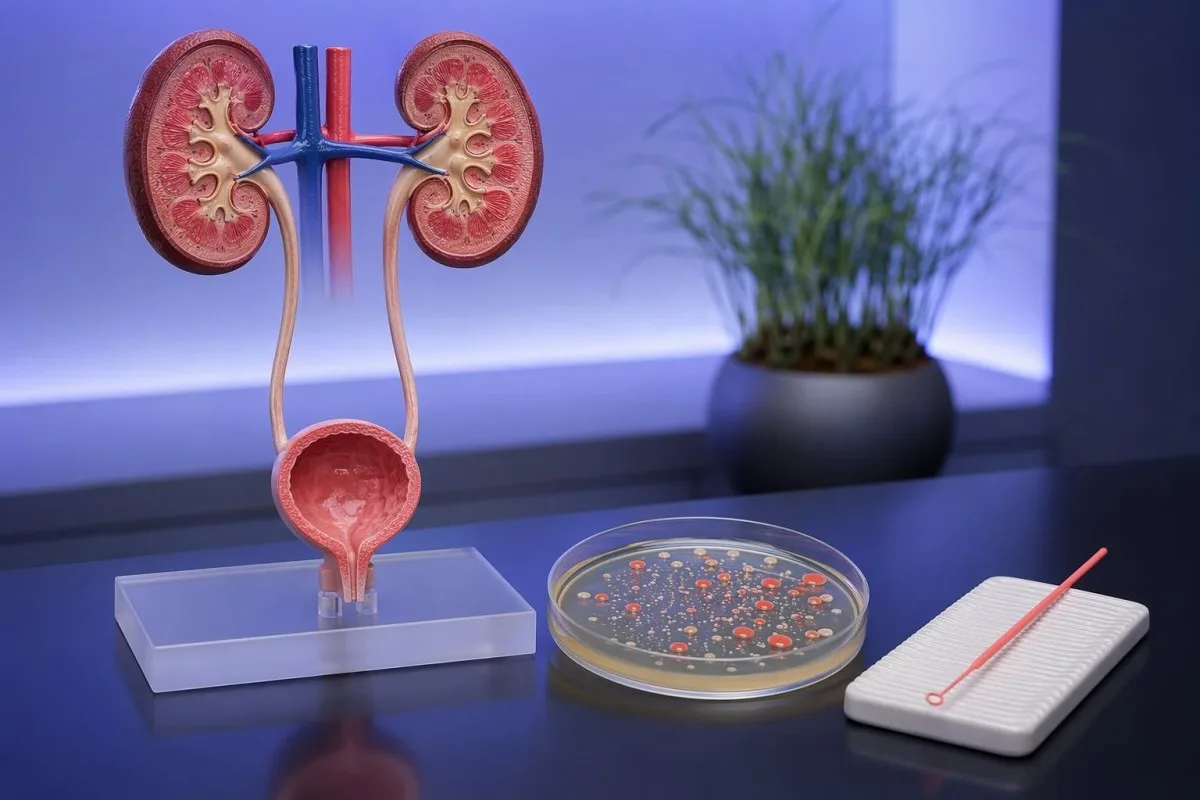
A positive urine culture usually means one likely UTI organism grew in meaningful quantity; a negative result does not always end the investigation. Mixed growth often means contamination, but the collection method and symptoms change the interpretation.


- Positive urine culture usually means one organism grew, often at ≥100,000 CFU/mL, but symptomatic patients can have true UTI at 1,000-10,000 CFU/mL.
- Negative culture means no significant growth after incubation, yet antibiotics before the sample, low-count infection, STI, stones, or bladder pain syndrome may still need follow-up.
- Mixed growth usually means 2-3 or more organisms grew from skin or genital contamination; a repeat clean-catch or catheter sample is often clearer.
- Colony count is reported as CFU/mL; ≥100,000 CFU/mL is the classic threshold for significant bacteriuria in a clean-catch specimen.
- Organism name matters because Escherichia coli, Klebsiella, Proteus, Enterococcus, Pseudomonas, and Candida have different treatment implications.
- Antibiotic susceptibility reports list S, I, or R; S means the organism is likely treatable with that drug at standard dosing for the infection site.
- Cloudy urine causes include dehydration, crystals, vaginal discharge, protein, semen, white cells, and bacteria; cloudiness alone does not diagnose a UTI.
- Follow-up is urgent with fever ≥38°C, flank pain, rigors, vomiting, pregnancy, male UTI symptoms, catheter-associated symptoms, or symptoms in a child under 3 months.
How to read urine culture results in the first minute
Urine culture results are read by matching 4 things: the organism, the colony count, the specimen type, and your symptoms. A positive culture with one typical organism supports UTI; a negative culture lowers the odds but does not rule out every cause of burning, urgency, cloudy urine, or pelvic pain.
A urine culture is not the same as a dipstick UTI urine test. Dipsticks look for clues such as nitrite and leukocyte esterase within minutes, while culture grows organisms for about 18-48 hours and then identifies what grew; our urinalysis guide explains the dipstick side of the workup.
The specimen source matters as much as the number. A clean-catch midstream sample, catheter sample, nephrostomy sample, and suprapubic aspirate do not use identical thresholds, which is why a result that looks borderline at 10,000 CFU/mL may be treated in one patient and ignored in another.
Kantesti is an AI blood test interpretation platform that helps patients place infection-related blood markers, kidney function, and inflammatory results beside urine findings rather than reading one result in isolation. Our clinical team describes how we work as a medical technology company on About Kantesti.
I’m Thomas Klein, MD, and in clinic I have seen many patients panic over the phrase mixed flora, then improve after a correctly collected repeat sample showed no UTI at all. The practical first pass is simple: one organism plus symptoms points toward UTI; several organisms plus few urine white cells usually points toward contamination.
What CFU/mL colony counts actually mean
CFU/mL means colony-forming units per millilitre, a count of how much organism grew from the urine sample. A clean-catch result of ≥100,000 CFU/mL is the classic significant threshold, but symptomatic women may have true infection with 1,000-10,000 CFU/mL.
The 100,000 CFU/mL cutoff came from older work designed to separate bladder bacteriuria from contamination, not to dismiss symptomatic low-count disease. Stamm et al. found in the New England Journal of Medicine that acutely dysuric women could have clinically meaningful coliform infection at far lower counts, sometimes near 100 CFU/mL (Stamm et al., 1982).
A count of 10,000-100,000 CFU/mL is the zone where I slow down and ask sharper questions: was the urine diluted, was the patient already taking antibiotics, and were there white cells on microscopy? Urine dilution can make counts look lower, so paired context from urine concentration is more useful than the culture number alone.
Catheter specimens are different because the sample bypasses much of the external contamination route. Many clinicians consider ≥1,000 CFU/mL from a catheter specimen meaningful when fever, suprapubic pain, flank pain, or new delirium in a frail patient is present, but asymptomatic catheter bacteriuria is common and often should not be treated.
A report saying less than 10,000 CFU/mL mixed organisms is usually not a UTI diagnosis. A report saying Escherichia coli 10,000 CFU/mL in a woman with 2 days of burning, frequency, and pyuria is a different story entirely.
Why the organism name changes the interpretation
The organism name tells your clinician whether the culture fits a typical UTI pattern. Escherichia coli causes most uncomplicated bladder infections, while Proteus, Pseudomonas, Enterococcus, Candida, or repeated Klebsiella can point to stones, catheters, diabetes, resistant organisms, or a more complicated source.
Escherichia coli is the organism I expect in a straightforward cystitis history: sudden burning, urgency, frequency, and no vaginal symptoms. When the report names E. coli at ≥100,000 CFU/mL with pyuria, the result usually fits the patient rather than the collection cup.
Proteus species deserve a second look because they split urea and can raise urine pH above 7.5, a pattern associated with struvite stones. If a patient has recurrent Proteus growth and flank discomfort, I am much quicker to ask about imaging than I am after a single E. coli culture.
Enterococcus may be resistant to cephalosporins even when the report looks reassuring in other ways, and Pseudomonas is uncommon in simple community UTI unless there has been catheter use, urinary tract instrumentation, or repeated antibiotics. A high fever with a concerning organism is when blood markers in an infection workup can add useful severity context.
Candida in urine is not automatically a yeast UTI. In my experience, Candida growth is often colonisation in catheter users or people recently exposed to antibiotics, while true Candida urinary infection is more likely with urinary obstruction, immune suppression, or symptoms plus repeated growth.
How to read antibiotic susceptibility and MIC
Antibiotic susceptibility shows which antibiotics are likely to work against the organism grown in culture. S means susceptible, I means susceptible with higher exposure or uncertain site coverage, and R means resistant at usual dosing for that organism and infection site.
An MIC is the minimum inhibitory concentration, usually reported in mg/L or µg/mL, but patients should not compare MIC numbers across different antibiotics as if lower always means better. A nitrofurantoin MIC of 32 µg/mL and a ciprofloxacin MIC of 0.5 µg/mL live under different breakpoint rules.
The 2010 IDSA/ESCMID guideline listed nitrofurantoin 100 mg twice daily for 5 days, trimethoprim-sulfamethoxazole 160/800 mg twice daily for 3 days when local resistance is ≤20%, and fosfomycin 3 g once as options for uncomplicated cystitis (Gupta et al., 2011). Those guideline doses are population-level guidance; kidney function, pregnancy, allergies, and local resistance still change the plan.
Susceptible does not always mean clinically right. Nitrofurantoin can be excellent for bladder infection, but it is not used for kidney infection because tissue levels are inadequate; this is exactly the kind of context we discuss in our AI interpretation limits.
Kantesti AI interprets related blood results by checking kidney markers, inflammatory markers, and medication safety patterns, not by replacing a clinician’s antibiotic choice. Our engineering approach is described in the technology guide for readers who want to know how clinical context is weighted.
What mixed growth or mixed flora usually means
Mixed growth usually means the sample picked up several organisms during collection rather than one bladder organism causing infection. Many labs report mixed urogenital flora when 2-3 or more organism types grow without a dominant pathogen.
The phrase mixed flora is frustrating because it sounds positive but often blocks a clear answer. In a clean-catch sample, several low-count organisms usually come from skin, genital surfaces, or delayed transport rather than the bladder.
There are exceptions. A catheterised patient, a person with a urinary diversion, or someone with a kidney stone and fever can have a true polymicrobial urinary infection, so the same words can be trivial in one person and clinically serious in another.
I usually repeat a mixed-growth culture when symptoms are convincing, the urinalysis shows pyuria above about 10 white cells per high-power field, or the patient is pregnant. When the repeat sample is clean, it often changes the entire treatment discussion; this is similar to how we approach lab error checks in blood results.
Mixed growth without symptoms should not automatically trigger antibiotics. Treating contaminated cultures can cause diarrhoea, yeast symptoms, drug reactions, and more resistant organisms within weeks.
Contamination clues doctors look for before treating
Contamination is suspected when the culture shows mixed organisms, the urinalysis has many squamous epithelial cells, and symptoms do not fit UTI. Squamous epithelial cells above roughly 15-20 per high-power field often suggest the sample contacted skin or genital surfaces.
A contaminated sample can still have leukocyte esterase because white cells may come from inflammation outside the bladder. That is why I do not treat leukocyte esterase alone when nitrite is negative, symptoms are vague, and the culture grows mixed flora.
Timing matters more than many patients realise. Urine sitting at room temperature for more than 2 hours can allow organisms to multiply, while refrigeration or a preservative tube keeps the result closer to the original sample.
Clean-catch technique is imperfect even when patients try hard. Washing, starting to urinate, then catching the midstream portion reduces contamination, but it does not remove every organism; when the report feels contradictory, understanding lab results can help patients ask better follow-up questions.
A catheter sample is cleaner but not automatically better for everyone because catheterisation has discomfort and small procedural risks. I reserve it for repeated contaminated samples, pregnancy with unclear results, severe symptoms, or situations where the answer changes urgent care.
When a negative urine culture still needs follow-up
A negative urine culture means routine growth was absent or below the lab’s reporting threshold, but persistent symptoms can still need medical review. Antibiotics before the sample, low-count UTI, fastidious organisms, STI, vaginitis, prostatitis, stones, or bladder pain syndrome can all produce UTI-like symptoms.
Wilson and Gaido’s Clinical Infectious Diseases review emphasised that laboratory diagnosis of UTI depends on specimen quality, quantitative culture, and clinical syndrome rather than one universal cutoff (Wilson and Gaido, 2004). In plain English: a no growth result is reassuring, but it is not a magic eraser for symptoms.
If someone took even 1-2 antibiotic doses before collection, culture yield can drop sharply. I often ask about leftover antibiotics, recent dental antibiotics, travel medicines, and online prescriptions because patients forget to mention a single tablet.
Burning with a negative culture and new sexual exposure should prompt testing for sexually transmitted infections rather than repeated UTI antibiotics. A separate STD testing guide explains why blood, urine, and swab tests answer different questions.
Follow-up is faster if there is fever ≥38°C, flank pain, vomiting, visible blood in urine, pregnancy, immune suppression, or symptoms in a man or child. A negative culture in those settings may lead to repeat culture, microscopy, imaging, blood tests, or urgent assessment rather than watchful waiting.
Cloudy urine causes that are not always infection
Cloudy urine causes include dehydration, phosphate crystals, urate crystals, vaginal discharge, semen, protein, mucus, white cells, and bacteria. Cloudiness alone does not diagnose UTI because urine can look cloudy with a completely negative culture.
Phosphate crystals often make urine look cloudy when the pH is alkaline, especially after meals or with delayed standing. The cloudiness may clear after acidification in the lab, which is one reason appearance is a weak standalone test.
Dehydration concentrates urine and can make odour and colour more noticeable without infection. When specific gravity is above about 1.030, I interpret cloudy urine differently than when the urine is dilute at 1.005.
Protein in urine can also create persistent foam or haze, and that deserves a different workup than a bladder infection. If protein is repeated on dipstick, urine albumin-creatinine ratio is more informative; see our kidney albumin checks for the early kidney-damage angle.
The clinical trick is pairing appearance with symptoms. Cloudy urine plus burning, frequency, nitrite positivity, pyuria, and one organism at ≥100,000 CFU/mL is persuasive; cloudy urine alone after a high-protein meal is not.
Why pregnancy, men, children and catheters change the rules
Pregnancy, male urinary symptoms, children, and catheter use change urine culture interpretation because the risk-benefit balance is different. A result that would be watched in a healthy adult may need treatment, repeat collection, or imaging in these groups.
In pregnancy, asymptomatic bacteriuria is usually defined as ≥100,000 CFU/mL of one organism on culture, and treatment reduces the risk of pyelonephritis. I am more cautious with mixed growth in pregnancy because a repeat clean sample can prevent both undertreatment and unnecessary antibiotics.
Men with culture-positive UTI symptoms often need a closer look at obstruction, prostatitis, stones, or recent instrumentation. If a PSA test is planned, clinicians often wait after infection because PSA can rise transiently; our guide to PSA after UTI covers timing in more detail.
Children are collection-sensitive. Bagged urine in infants has high contamination rates, so a positive bag culture is rarely enough by itself; catheter or suprapubic specimens are more reliable when the result will drive antibiotics.
Catheter users often have bacteriuria without symptoms within days to weeks. Treating every positive culture in a long-term catheter can select resistant organisms, so fever, flank pain, new pelvic discomfort, rigors, or systemic change carries more weight than colony count alone.
What happens after antibiotics and when to retest
Symptoms from uncomplicated cystitis often begin improving within 24-48 hours of the right antibiotic, but cultures are not routinely repeated after recovery. Retesting is more common in pregnancy, kidney infection, persistent symptoms, resistant organisms, or recurrent UTI.
A culture collected after antibiotics may be falsely negative even when symptoms began as a true UTI. If symptoms persist after 48-72 hours of treatment, I check adherence, susceptibility, dose, kidney involvement, and whether the diagnosis was UTI in the first place.
A test-of-cure culture is commonly considered in pregnancy about 1-2 weeks after treatment, although practices differ by country and risk level. For a healthy non-pregnant adult whose symptoms fully resolve, routine repeat culture usually adds little.
Recurrent UTI is usually defined as at least 2 infections in 6 months or 3 infections in 12 months. At that point, I want culture-proven episodes rather than repeated empirical treatment because organism pattern and resistance history guide prevention.
If the follow-up plan includes repeat blood or urine testing, timing matters. Our guide on repeat abnormal labs explains why checking too early can create noise rather than clarity.
Blood tests and imaging that may sit beside culture
Urine culture identifies organisms, while blood tests and imaging assess severity and complications. Fever, flank pain, vomiting, low blood pressure, pregnancy, kidney disease, or suspected obstruction may justify CBC, CRP, creatinine, eGFR, blood cultures, or renal imaging.
A CBC with high neutrophils, CRP above 100 mg/L, or rising creatinine changes the tone of the conversation. Those results do not prove UTI by themselves, but in a patient with flank pain and a positive culture they increase concern for pyelonephritis or systemic illness.
Kantesti is an AI-powered blood test analysis tool used by patients who want their creatinine, eGFR, CRP, and white cell count interpreted alongside the clinical story. A culture report still belongs to microbiology, but severity assessment often crosses into blood markers and kidney function.
Imaging is not routine for every UTI. It becomes more relevant with Proteus recurrence, suspected stone, obstruction, persistent fever beyond 72 hours, a single functioning kidney, or recurrent kidney infections.
When kidney markers are part of the picture, a renal function panel helps patients understand creatinine, electrolytes, bicarbonate, and albumin rather than focusing only on the culture organism.
Why one lab report says no growth and another says insignificant growth
Labs word urine culture results differently because they use different reporting thresholds, specimen categories, incubation methods, and local rules for when to identify organisms. No growth, no significant growth, mixed flora, and insignificant growth are not identical phrases.
No growth usually means nothing grew under routine aerobic culture conditions by the reporting time, often 18-24 hours for preliminary and 48 hours for final. No significant growth may mean organisms grew below the lab’s threshold or in a pattern judged unlikely to represent UTI.
Some laboratories do not fully identify organisms when the colony count is low or mixed because the result would not reliably guide treatment. Others identify a dominant organism even at 10,000 CFU/mL if the sample type or clinical notes suggest symptoms.
European and North American labs do not always use the same language around low-count bacteriuria. That can make a portal result look changed after travel or a clinic switch, much like unit and reference-range shifts in lab abbreviations.
If the wording is unclear, ask whether there was a dominant organism, what the colony count was, whether susceptibility was performed, and whether the sample quality looked contaminated. Those 4 questions usually get more traction than asking whether the result is simply positive or negative.
Questions to ask when your result does not fit your symptoms
If your urine culture result does not fit your symptoms, ask about specimen quality, colony count, organism identity, pyuria, antibiotic exposure, and alternate diagnoses. The safest plan depends on red flags and personal risk, not only on whether the portal shows positive or negative.
A useful first question is: was there one organism or mixed growth? A single E. coli result at ≥100,000 CFU/mL in a symptomatic patient carries very different weight from mixed organisms below 10,000 CFU/mL.
Next, ask whether the urinalysis showed pyuria, nitrite, blood, protein, or many squamous epithelial cells. Pyuria above about 10 white cells per high-power field supports inflammation, but it does not prove bacterial UTI without the right culture pattern.
Ask whether you need urgent care if symptoms escalate. Fever ≥38°C, shaking chills, flank pain, vomiting, confusion in an older adult, pregnancy, or a child under 3 months changes the time frame from routine messaging to same-day assessment.
If your clinician offers a virtual review, send the full report rather than a screenshot of only the abnormal flag. A structured telehealth review works best when the reviewer sees the culture comment, urinalysis, medications, and symptom timeline.
Bottom line: culture results need clinical context
The safest reading of urine culture results is pattern-based: symptoms, organism, colony count, pyuria, contamination clues, and risk group must agree. A positive culture can be colonisation, a negative culture can miss clinically relevant disease, and mixed growth usually deserves repeat sampling rather than reflex antibiotics.
Kantesti is an AI biomarker interpretation platform, so our role is strongest when urine findings intersect with blood markers such as creatinine, eGFR, CRP, neutrophils, glucose, and medication-safety labs. As of June 7, 2026, we still tell patients that urine culture interpretation and antibiotic decisions require a licensed clinician who can examine symptoms and local resistance patterns.
Our medical writing is reviewed against clinical standards rather than keyword checklists. You can see how our physicians and advisors govern this work through the Medical Advisory Board.
Kantesti’s neural network has been benchmarked on anonymised blood test cases with hyperdiagnosis trap cases, which is relevant because overcalling borderline results is a real patient-safety problem. The population-scale benchmark is available as a clinical validation DOI.
We also publish engineering validation where multilingual triage and real-world deployment are tested under clinical decision-support constraints. The hantavirus triage paper is not a urine culture study, but it shows our bias toward measured claims and safety checks in deployment validation.
Thomas Klein, MD reviews articles like this with a deliberately conservative lens: treat clear infections, repeat unclear contaminated samples, and do not let a portal flag replace clinical judgement. Our broader quality framework is described in medical validation.
Frequently Asked Questions
What does a positive urine culture result mean?
A positive urine culture result usually means an organism grew from the urine sample in a quantity the lab considers reportable, often ≥100,000 CFU/mL for a clean-catch specimen. The result is most convincing for UTI when one typical organism grows and the patient has burning, urgency, frequency, pelvic discomfort, fever, or pyuria. A positive culture without symptoms can be asymptomatic bacteriuria, which is not always treated except in groups such as pregnancy or before certain urologic procedures.
Can I have a UTI with a negative urine culture?
Yes, a person can have UTI-like symptoms with a negative urine culture, especially if antibiotics were taken before collection, the colony count was low, or the organism does not grow well on routine culture. A negative culture also raises the possibility of STI, vaginitis, prostatitis, stones, bladder pain syndrome, or irritation from non-infectious causes. Follow-up is more urgent with fever ≥38°C, flank pain, vomiting, pregnancy, male symptoms, visible blood in urine, or symptoms in a young child.
What does mixed growth in a urine culture mean?
Mixed growth usually means 2-3 or more organism types grew, often because the sample picked up skin or genital bacteria during collection. In a clean-catch specimen with low counts and many squamous epithelial cells, mixed flora is more consistent with contamination than UTI. If symptoms are strong, the usual next step is a repeat carefully collected midstream sample or, in selected cases, a catheter specimen.
Is 10,000 CFU/mL a UTI?
A urine culture count of 10,000 CFU/mL can be a true UTI in a symptomatic patient, especially if one typical organism such as Escherichia coli grew and the urinalysis shows pyuria. In an asymptomatic person or a sample with mixed organisms, 10,000 CFU/mL is often less convincing. Specimen type matters because catheter samples and samples collected after antibiotics may be interpreted at lower thresholds.
Why did my urine culture not include antibiotic susceptibility?
A lab may not perform antibiotic susceptibility if the culture shows no growth, mixed flora, low-count organisms judged insignificant, or organisms considered contaminants. Susceptibility testing is usually done when a clinically meaningful organism grows at a reportable count. If symptoms are severe or the patient is pregnant, immunocompromised, catheterised, or has recurrent UTI, the clinician can ask the lab whether further identification or repeat culture is appropriate.
Does cloudy urine always mean infection?
Cloudy urine does not always mean infection because dehydration, phosphate crystals, urate crystals, mucus, semen, vaginal discharge, protein, and cells can all make urine look cloudy. Cloudiness becomes more suspicious for UTI when it appears with burning, frequency, nitrite positivity, pyuria, and one organism on culture. Cloudy urine with a negative culture and no symptoms often needs hydration review or urinalysis follow-up rather than antibiotics.
When should urine culture results be repeated?
Urine culture results are often repeated when the first sample shows mixed growth, symptoms persist after 48-72 hours of treatment, the patient is pregnant, or there are recurrent UTIs defined as 2 infections in 6 months or 3 in 12 months. Repeat culture is also reasonable after a negative result if there are fever, flank pain, vomiting, or strong symptoms with prior antibiotic exposure. Routine repeat culture is usually unnecessary after uncomplicated cystitis when symptoms fully resolve.
Does my partner need antibiotics if my urine culture is positive?
For a typical bacterial UTI, your partner does not need antibiotics because these infections are not usually sexually transmitted. If you have genital discharge or a recent possible STI exposure, ask about separate STI testing, which may change whether your partner needs treatment.
Can I provide a urine culture sample while I am on my period?
Yes, but menstrual blood and vaginal cells can make the sample harder to interpret or increase contamination. Tell the clinician or laboratory; if testing is not urgent, collecting after bleeding stops may give a cleaner result, but urgent symptoms should be assessed without delay.
Can drinking a lot of water before a urine culture affect the result?
Yes, heavy fluid intake can dilute urine and sometimes lower the measured colony count. Drink normally before testing unless your clinician gives different instructions, and try not to urinate immediately before collecting the sample.
Get AI-Powered Blood Test Analysis Today
Join over 2 million users worldwide who trust Kantesti for instant, accurate lab test analysis. Upload your blood test results and receive comprehensive interpretation of 15,000+ biomarkers in seconds.
📚 Referenced Research Publications
Klein, T., Mitchell, S., & Weber, H. (2026). Clinical Validation of the Kantesti AI Engine (2.78T) on 100,000 Anonymised Blood Test Cases Across 127 Countries: A Pre-Registered, Rubric-Based, Population-Scale Benchmark Including Hyperdiagnosis Trap Cases — V11 Second Update. Kantesti AI Medical Research.
Klein, T., Mitchell, S., & Weber, H. (2026). Multilingual AI Assisted Clinical Decision Support for Early Hantavirus Triage: Design, Engineering Validation, and Real-World Deployment Across 50,000 Interpreted Blood Test Reports. Kantesti AI Medical Research.
📖 External Medical References
Gupta K et al. (2011). International clinical practice guidelines for the treatment of acute uncomplicated cystitis and pyelonephritis in women: A 2010 update by the Infectious Diseases Society of America and the European Society for Microbiology and Infectious Diseases. Clinical Infectious Diseases.
⚕️ Medical Disclaimer
This article is for educational purposes only and does not constitute medical advice. Always consult a qualified healthcare provider for diagnosis and treatment decisions.
E-E-A-T Trust Signals
Experience
Physician-led clinical review of lab interpretation workflows.
Expertise
Laboratory medicine focus on how biomarkers behave in clinical context.
Authoritativeness
Written by Dr. Thomas Klein with review by Dr. Sarah Mitchell and Prof. Dr. Hans Weber.
Trustworthiness
Evidence-based interpretation with clear follow-up pathways to reduce alarm.