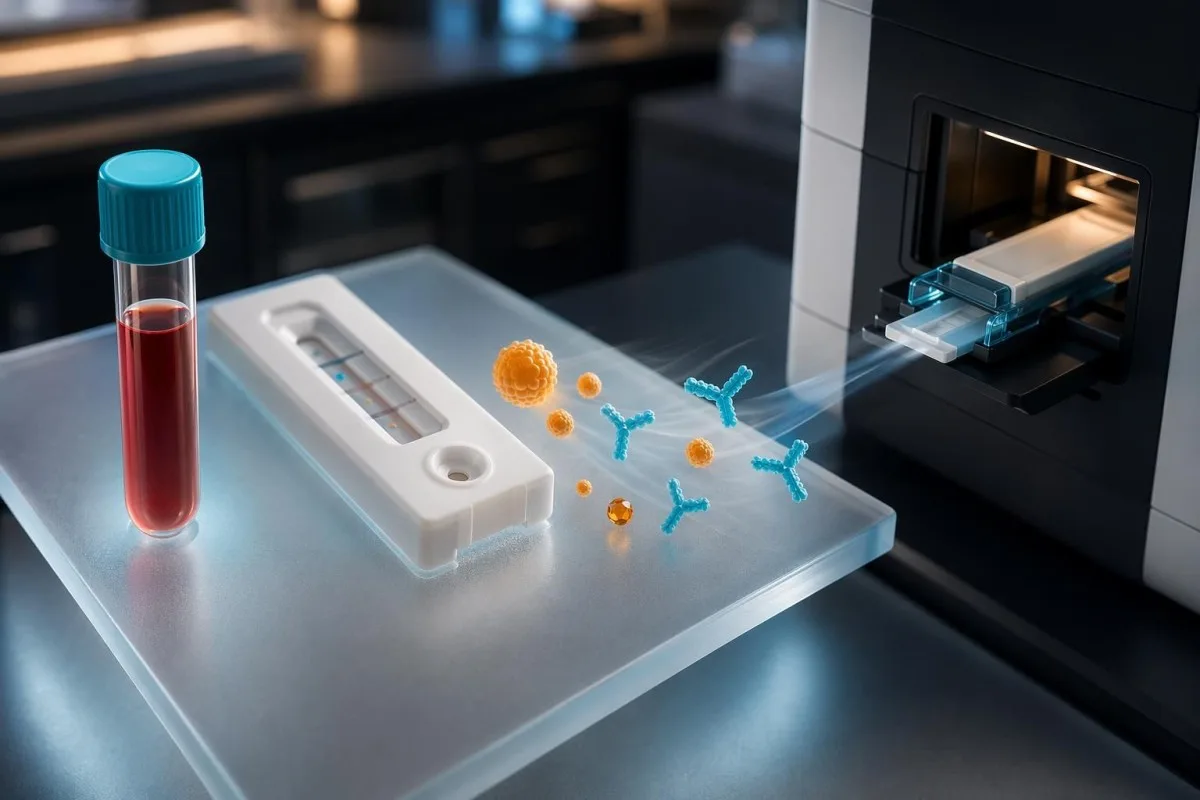
A reactive screen is frightening, but it is only the first step. Modern HIV testing uses a confirmatory sequence that separates true infection from cross-reactive or lab-related results.


- Reactive HIV blood test means the screening assay detected a signal; it does not prove HIV until confirmatory testing is complete.
- HIV screening test specificity is often above 99%, but false positives still occur when screening thousands of low-risk people.
- HIV confirmatory test usually means an HIV-1/HIV-2 antibody differentiation assay, followed by HIV-1 RNA NAT if results conflict.
- Fourth-generation lab tests detect p24 antigen and antibodies; most infections are detectable by about 45 days after exposure.
- HIV RNA testing can become positive around 10–12 days after infection and is used when acute HIV is possible.
- False positive HIV test causes include cross-reactive antibodies, pregnancy, autoimmune disease, recent immune activation, vaccine trial antibodies, and rare lab handling problems.
- While waiting use condoms or avoid sex, do not share injection equipment, and do not donate blood, plasma, organs, semen, or breast milk.
- PEP timing matters: if a possible exposure happened within 72 hours, seek urgent care immediately rather than waiting for routine confirmatory results.
A reactive HIV screen is not the final diagnosis
A reactive HIV blood test means the first screening assay detected a signal; it does not mean you are definitely HIV positive. The next step is an HIV confirmatory test, usually an HIV-1/HIV-2 differentiation assay and sometimes an HIV RNA test. Until those results are back, act cautiously but do not assume the worst.
I have sat with patients who were told “reactive” on a Friday afternoon and then spent 72 hours spiralling. In my experience, the most useful first sentence is simple: a reactive screen is a signal, not a diagnosis, and modern algorithms are built to catch the rare signal that is not HIV.
Kantesti is an AI blood test interpretation platform that can read an HIV blood test report, identify whether it is a screen or confirmatory result, and show the likely next step in plain language. Our AI does not diagnose HIV; it helps users understand why a second or third blood test is being ordered.
If your exposure was recent, timing matters as much as the word “reactive.” Our separate guide to the HIV window period explains why a negative test at 10 days and a negative test at 45 days do not carry the same weight.
Why HIV screening tests are designed to over-detect
An HIV screening test is intentionally sensitive because missing early HIV is more harmful than briefly flagging a sample that later proves negative. Most modern laboratory HIV antigen/antibody assays have specificity above 99%, but high sensitivity means weak cross-reactions can still be reported as reactive.
Screening is not the same job as confirmation. A fourth-generation HIV Ag/Ab assay looks for p24 antigen plus antibodies to HIV-1 and HIV-2, while the next test asks a narrower question: is the detected signal truly HIV-specific?
The US Preventive Services Task Force recommends HIV screening for adolescents and adults aged 15–65, plus younger or older people at increased risk (USPSTF, 2019). That broad testing policy saves lives, but it also means more low-risk people are screened, where the mathematics of false positives becomes visible.
If you are testing for several sexually transmitted infections at once, the HIV result should not be mentally lumped together with every other marker. Our STD blood test guide separates HIV, syphilis, hepatitis B, hepatitis C, and herpes testing because each has a different window period and confirmatory pathway.
How often a false positive HIV test happens
A false positive HIV test is uncommon, but it becomes more likely when many low-risk people are screened. In a population where true HIV prevalence is 0.1%, even a test with 99.8% specificity can produce more initial false reactive screens than true positives before confirmation.
Here is the arithmetic I use in clinic. If 10,000 very low-risk people are screened and 10 truly have HIV, a 99.8% specific screen could still flag about 20 people without HIV; confirmatory testing is what sorts those 20 from the 10.
That is why a single reactive screen in a low-risk setting feels more dramatic than it statistically deserves. A reactive screen after a high-risk exposure, symptoms of acute HIV, or a partner with known HIV deserves a different level of concern than a weak reactive result found during routine insurance or employment testing.
Result timing can add to anxiety because confirmatory assays may be send-outs rather than same-day tests. If your lab portal released only the screening result, our same-day results guide explains why the second result may appear 1–5 working days later.
How confirmatory HIV blood testing works
The standard HIV confirmatory test pathway starts with a reactive laboratory antigen/antibody screen, then an HIV-1/HIV-2 antibody differentiation assay. If the differentiation assay is negative or indeterminate, an HIV-1 RNA nucleic acid test is used to distinguish acute infection from a false reactive screen.
The CDC/APHL 2014 laboratory algorithm replaced routine Western blot confirmation in many settings because differentiation immunoassays detect HIV-1 versus HIV-2 more cleanly and identify acute infection faster (CDC/APHL, 2014). Some countries still use older pathways, so the test names on your report may vary.
Kantesti's medical team maps these assay names against current clinical standards, and our medical validation work is built around pattern recognition rather than isolated flags. For HIV, the pattern is everything: screen result, differentiation result, RNA result, exposure date, and specimen date.
A weakly reactive screening index is not a safe way to self-diagnose. Some assays report a signal-to-cutoff ratio above 1.0 as reactive, but clinicians disagree on how much a high ratio predicts true infection because the number is assay-specific.
What the final result pattern usually means
Final HIV interpretation depends on the combination of results, not one word in isolation. A reactive screen plus positive HIV-1 differentiation test usually means HIV-1 infection; a reactive screen plus negative differentiation and negative RNA usually means a false positive screen.
A reactive Ag/Ab screen with a positive HIV-2 differentiation result suggests HIV-2 infection, which is uncommon globally but more prevalent in parts of West Africa. HIV-2 needs specialist confirmation because some HIV-1 RNA tests do not quantify HIV-2 well.
A reactive screen, negative differentiation assay, and positive HIV-1 RNA test is the classic acute HIV pattern. In that situation, antibody production may still be developing, and treatment referral should be prompt rather than delayed for another antibody-only test.
If all confirmatory testing is negative, the clinic may still repeat testing if exposure occurred within the previous 2–4 weeks. Our article on repeating abnormal labs explains why repeating a result is sometimes a quality step, not a sign that your clinician is hiding bad news.
Medical reasons a screen can react without HIV
A false positive HIV screen can occur when non-HIV antibodies or immune proteins bind weakly to the assay. Reported associations include recent viral illness, autoimmune disease, pregnancy, recent vaccination, certain malignancies, and participation in HIV vaccine studies.
Most cross-reactions are not dangerous by themselves. I have seen weak reactive screens after influenza-like illnesses where the confirmatory differentiation assay and RNA were both negative within 48 hours, and the repeat screen later returned non-reactive.
Vaccination does not “give you HIV,” but immune activation can occasionally make antibody-based assays noisier for a short period. We see similar temporary marker shifts after vaccines in routine panels, which is why our post-vaccination lab guide focuses on timing rather than panic.
Autoimmune disease is a special case because antibodies such as ANA, rheumatoid factor, or antiphospholipid antibodies can interfere with some immunoassays. If you already carry a lupus, rheumatoid arthritis, Sjögren’s, or antiphospholipid diagnosis, tell the clinic before they interpret a weakly reactive result.
Lab and reporting issues that can mimic a false positive
A small number of apparent false positive HIV results are caused by pre-analytical or reporting problems rather than biology. Mislabelled specimens, contamination, instrument carryover, transcription mistakes, and portal release of an incomplete algorithm can all confuse patients.
Good laboratories use barcodes, two identifiers, internal controls, and repeat runs to reduce error rates. Still, no clinical lab system is zero-risk, which is why an unexpected HIV result should be reconciled against specimen date, collection site, and the exact assay name.
If the result appears impossible — for example, you had no exposure risk and a negative test 6 weeks earlier — ask whether the confirmatory sample should be recollected. That is not being difficult; it is basic clinical hygiene when a life-changing label is involved.
Kantesti AI can flag report inconsistencies such as missing confirmatory lines, mixed specimen dates, or confusing unit fields, and our lab error checks article shows the same principle across CBC, chemistry, and immunology reports. The final decision still belongs to the testing clinician and accredited laboratory.
When HIV RNA testing matters most
HIV RNA testing matters most when exposure was recent, symptoms fit acute HIV, or the screen is reactive but antibody confirmation is negative. HIV RNA can become detectable around 10–12 days after infection, earlier than many antibody-based results.
Acute HIV can look like flu, glandular fever, COVID, or another viral illness: fever, sore throat, rash, swollen lymph nodes, diarrhoea, headache, or night sweats. Symptoms usually appear 2–4 weeks after exposure, but symptoms alone are never reliable enough to diagnose or exclude HIV.
Delaney and colleagues in Clinical Infectious Diseases estimated that different HIV tests turn reactive at different times after infection, with laboratory antigen/antibody assays detecting infection earlier than antibody-only rapid tests (Delaney et al., 2017). That is why the date of exposure should be written beside the date of the sample.
Hepatitis B, hepatitis C, and HIV are often checked together after sexual or needle-related exposure, but they do not share identical timelines. Our hepatitis blood test guide explains why antibodies can mean past exposure, vaccination, or active infection depending on the marker.
Pregnancy, PrEP, PEP, and immune history change the reading
Pregnancy, PrEP, PEP, and immune conditions do not make HIV testing unreliable, but they can change how clinicians interpret borderline or early results. In these situations, exposure timing, medication timing, and RNA testing become more important.
Pregnancy is one of the settings where false reactive screens are seen because immune proteins shift, but confirmatory testing usually resolves the uncertainty quickly. A reactive screen in pregnancy should be handled urgently and calmly because rapid clarity protects both parent and baby.
PrEP and PEP can sometimes partially suppress early viral replication if started around the time of infection, which may blur the usual sequence of antigen, antibody, and RNA results. If you took PEP within 72 hours of exposure or are on PrEP, tell the clinician the exact start date and missed doses.
People planning pregnancy often collect multiple infectious disease markers in one visit. Our preconception blood test guide covers HIV, hepatitis B, rubella, varicella, syphilis, thyroid, iron, and diabetes screening in a single planning framework.
What to do while waiting for final HIV results
While waiting for confirmatory HIV results, behave as if transmission is possible but do not emotionally treat the screen as a diagnosis. Use condoms or avoid sex, do not share injection equipment, and do not donate blood, plasma, organs, semen, or breast milk.
If your possible exposure was within the past 72 hours, seek urgent assessment for PEP now; do not wait for a routine callback. PEP is time-sensitive, and most protocols are not started after 72 hours because effectiveness falls sharply.
You do not need to tell an employer, school, or casual contact about a reactive screening result. A current sexual partner may need a practical conversation if there was recent exposure risk, but broad disclosure before confirmation often causes avoidable harm.
Keep your result record, but avoid screenshot-based self-diagnosis from a single portal line. Our online results guide shows how to verify specimen dates, pending components, and amended reports before acting on partial information.
How to read the report without overcalling it
Read an HIV report by identifying the assay type, specimen date, result word, and whether confirmatory components are pending. The terms “reactive,” “preliminary positive,” “repeatedly reactive,” and “confirmed positive” do not mean the same thing.
A report that says “repeatedly reactive” usually means the lab repeated the screening assay on the same specimen and reproduced the signal. It still does not replace the differentiation assay or RNA test when the algorithm requires them.
Kantesti is an AI-powered blood test analysis tool used by 2M+ people across 127+ countries, and for HIV reports our parser looks for the test generation, confirmatory status, and any RNA value before explaining what the wording can and cannot prove. You can read how document parsing works in our PDF upload guide.
The technical side matters because a portal may show the screen at 09:00 and the confirmatory result at 16:00. Our technology guide explains how structured extraction reduces confusion when a report contains multiple dates, panels, and amendments.
When to involve a clinician urgently
You should involve a clinician urgently if exposure was within 72 hours, symptoms suggest acute HIV, you are pregnant, you are on PrEP or PEP, or the lab reports positive HIV RNA. These situations need same-day clinical judgement, not only portal monitoring.
In my practice, the highest-risk missed opportunity is not the false positive; it is the patient with recent exposure who waits for confirmation when PEP could still be started. If there is any chance the exposure was high risk and under 72 hours ago, call a sexual health clinic, emergency department, or urgent care service.
I am Thomas Klein, MD, and I would rather a patient ask one awkward question early than sit alone with a portal result for a weekend. Kantesti's physician review process is overseen with input from our Medical Advisory Board, but acute exposure decisions still require a real-time clinician who can prescribe treatment if needed.
Kantesti has also published validation work on clinical decision-support boundaries, including population-scale blood test interpretation benchmarks hosted on Figshare. That kind of validation is useful, but it does not replace urgent human care for PEP, pregnancy, or confirmed RNA-positive results.
Questions to ask before you leave the clinic
Before leaving the clinic, ask which HIV test was reactive, which confirmatory test has been ordered, when results are expected, and whether your exposure timing requires repeat testing. Four clear answers can prevent days of avoidable uncertainty.
A good question is: “Was this a fourth-generation laboratory Ag/Ab test, a rapid antibody test, or another assay?” The answer changes the window period and explains why one person may be told to repeat at 45 days while another is told 90 days.
Ask whether HIV-1 RNA is being ordered automatically if the differentiation test is negative or indeterminate. In many algorithms it should be, but local pathways differ and some smaller facilities send NAT testing to a reference laboratory.
At Kantesti, we build patient-facing explanations because patients deserve to understand the sequence, not just receive a frightening word. You can read more about our clinical mission and governance on About Us, including why we separate education from diagnosis.
A practical follow-up plan for 2026
As of May 30, 2026, the safest plan after a reactive HIV screen is to complete the confirmatory algorithm, document exposure dates, use temporary transmission precautions, and repeat testing if the exposure was recent. Do not stop at the screening result.
If the confirmatory differentiation test is positive, ask for prompt linkage to an HIV specialist; modern antiretroviral therapy can reduce viral load to undetectable levels, often below 20–50 copies/mL depending on the assay. Undetectable viral load prevents sexual transmission when maintained, a principle often called U=U.
If the confirmatory tests are negative and there was no recent exposure, the episode is usually closed as a false reactive screen. If exposure was within the previous 45 days for a lab Ag/Ab test or within 90 days for many rapid antibody/self-tests, schedule the repeat date before you leave.
Kantesti AI is an AI biomarker interpretation platform that helps users place HIV-related results beside other markers, dates, and clinical notes without turning a screening flag into a diagnosis. For broader context on how laboratory markers are organised, see our biomarkers guide.
Frequently Asked Questions
Can an HIV blood test be false positive?
Yes, an HIV blood test can be false positive, especially at the initial screening stage. Modern laboratory HIV screening tests are usually more than 99% specific, but false reactive results still occur when thousands of low-risk people are tested. Confirmation with an HIV-1/HIV-2 differentiation assay and sometimes HIV RNA testing is needed before diagnosing HIV.
What confirmatory test is done after a reactive HIV screen?
After a reactive HIV screening test, the usual confirmatory test is an HIV-1/HIV-2 antibody differentiation immunoassay. If that confirmatory antibody test is negative or indeterminate, an HIV-1 RNA nucleic acid test is used to check for acute infection. A reactive screen alone should not be treated as a final HIV diagnosis.
How long do HIV confirmatory blood test results take?
HIV confirmatory blood test results often return within 1–5 working days, depending on whether the laboratory performs the assay on site or sends it to a reference lab. HIV-1/HIV-2 differentiation testing may be faster than HIV RNA NAT in some systems. If you have a possible exposure within 72 hours, seek urgent PEP assessment instead of waiting for routine results.
What causes a false positive HIV test?
A false positive HIV test can be caused by cross-reactive antibodies, recent viral illness, pregnancy, autoimmune disease, recent immune activation, HIV vaccine trial antibodies, or rare laboratory handling and reporting errors. These causes usually affect the screening signal rather than the full confirmatory algorithm. The final interpretation depends on the screen, differentiation assay, RNA result, and exposure timing.
Should I avoid sex while waiting for confirmatory HIV results?
Yes, you should use condoms or avoid sex while waiting for confirmatory HIV results if transmission is possible. You should also avoid sharing injection equipment and should not donate blood, plasma, organs, semen, or breast milk until the result is resolved. These precautions are temporary and do not mean the screening result is definitely positive.
Can HIV RNA be negative after a reactive screen?
Yes, HIV RNA can be negative after a reactive screen, and that pattern often supports a false reactive screening result when the HIV-1/HIV-2 differentiation test is also negative. If the exposure was very recent, a clinician may still repeat testing because timing can affect interpretation. HIV RNA usually becomes detectable earlier than antibodies, often around 10–12 days after infection.
Does a weak reactive HIV result mean early HIV?
A weak reactive HIV result does not automatically mean early HIV. Some assays report any signal above a cutoff, often around an index of 1.0, as reactive even when the cause is non-HIV cross-reactivity. Early HIV is considered when exposure timing, symptoms, and HIV RNA results support it, not from the weak screening signal alone.
Will a reactive HIV screening result be reported to public health before confirmation?
Reporting procedures vary by location and laboratory, but a confirmed HIV diagnosis is generally reportable to public health. These reports are confidential and used for care and prevention services, not to notify an employer or family member.
Should I stop my regular medicines before a repeat HIV blood test?
No—keep taking prescribed medicines unless the clinician who prescribed them tells you otherwise. Common medicines such as antibiotics, antihistamines, and pain relievers do not usually interfere with laboratory HIV confirmation, but tell the testing team if you use PrEP, PEP, or any HIV medication.
Can I use an at-home HIV test to check whether the lab screen was wrong?
Do not rely on a home HIV test to overturn a reactive lab screen, because home tests usually do not perform the full confirmatory algorithm. The safest next step is the lab-based differentiation assay and, when needed, HIV RNA testing.
Get AI-Powered Blood Test Analysis Today
Join over 2 million users worldwide who trust Kantesti for instant, accurate lab test analysis. Upload your blood test results and receive comprehensive interpretation of 15,000+ biomarkers in seconds.
📚 Referenced Research Publications
Klein, T., Mitchell, S., & Weber, H. (2026). aPTT Normal Range: D-Dimer, Protein C Blood Clotting Guide. Kantesti AI Medical Research.
Klein, T., Mitchell, S., & Weber, H. (2026). Serum Proteins Guide: Globulins, Albumin & A/G Ratio Blood Test. Kantesti AI Medical Research.
📖 External Medical References
Centers for Disease Control and Prevention and Association of Public Health Laboratories (2014). Laboratory Testing for the Diagnosis of HIV Infection: Updated Recommendations. CDC/APHL Guidelines.
Delaney KP et al. (2017). Time Until Emergence of HIV Test Reactivity Following Infection With HIV-1: Implications for Interpreting Test Results and Retesting After Exposure. Clinical Infectious Diseases.
⚕️ Medical Disclaimer
This article is for educational purposes only and does not constitute medical advice. Always consult a qualified healthcare provider for diagnosis and treatment decisions.
E-E-A-T Trust Signals
Experience
Physician-led clinical review of lab interpretation workflows.
Expertise
Laboratory medicine focus on how biomarkers behave in clinical context.
Authoritativeness
Written by Dr. Thomas Klein with review by Dr. Sarah Mitchell and Prof. Dr. Hans Weber.
Trustworthiness
Evidence-based interpretation with clear follow-up pathways to reduce alarm.