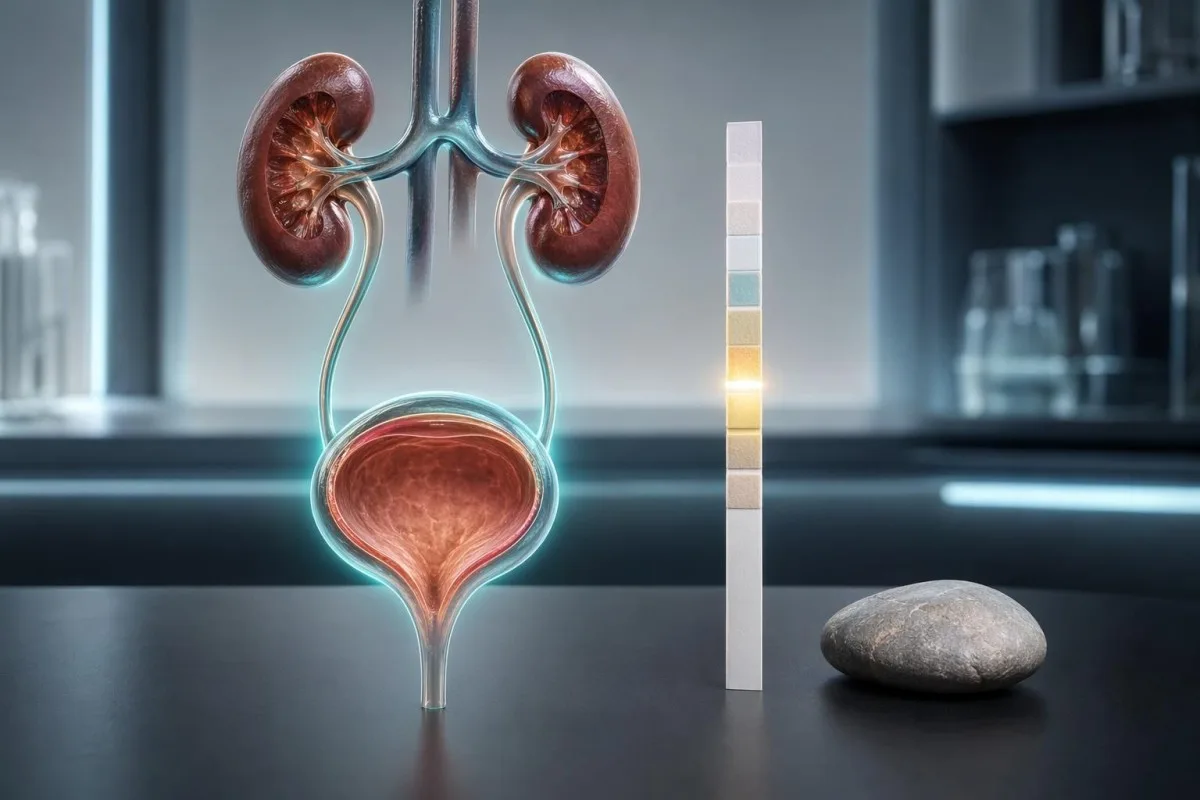
A positive nitrite dipstick usually means nitrate-reducing bacteria are present, especially when urinary symptoms are new. Leukocyte esterase, culture results, symptoms and risk factors decide whether this is a simple UTI, a false clue, or something that needs same-day care.


- Positive nitrites on a urine dipstick strongly suggest nitrate-reducing bacteria, most often E. coli, but the result alone does not prove tissue invasion.
- Leukocyte esterase in urine means white-cell enzyme activity; when nitrite and leukocyte esterase are both positive, UTI probability rises sharply in symptomatic adults.
- False-negative nitrites happen with bladder dwell time under about 4 hours, frequent urination, low dietary nitrate, dilute urine, vitamin C, antibiotics, or bacteria that do not reduce nitrate.
- Urine culture is usually needed in pregnancy, men, children, recurrent UTIs, catheter use, kidney symptoms, treatment failure, resistant-bacteria risk, or unclear dipstick results.
- Cloudy urine meaning is not automatically UTI; crystals, mucus, vaginal contamination, semen, dehydration and phosphate precipitation can all make urine look cloudy.
- Orange urine causes include phenazopyridine, rifampicin, dehydration, high-dose B vitamins, carotene-rich foods and bilirubin from liver or bile-flow problems.
- Urgent care is safer with fever of 38 °C or higher, flank pain, vomiting, pregnancy, confusion, low blood pressure, rapid pulse, or inability to pass urine.
- Culture thresholds vary: 100,000 CFU/mL is classic, but symptomatic women can have clinically meaningful infection at 100-1,000 CFU/mL.
What a positive nitrite result usually means
Nitrites in urine meaning is fairly specific: a positive dipstick suggests bacteria have converted dietary nitrate into nitrite in the bladder, and in a person with burning, urgency or frequent urination this is a strong UTI clue. It is not a cancer marker, kidney-failure marker, or proof that antibiotics are always needed.
The usual culprit is Escherichia coli, which causes roughly 70-90% of uncomplicated community UTIs in women. Kantesti is an AI blood test interpretation platform that helps patients understand related blood markers when a simple urine problem starts to look systemic, especially white cell count, creatinine and inflammatory markers in our biomarker guide.
In my clinic, the most misleading result is a positive nitrite in someone with no symptoms at all. Asymptomatic bacteriuria is common after age 65 and during catheter use; treating it can cause more harm than good unless the patient is pregnant or having certain urologic procedures.
A nitrite-positive dipstick usually has high specificity, often above 90% in symptomatic adults, but sensitivity is much lower because many true UTIs never produce nitrite. Bent et al. described this pattern in JAMA: nitrite positivity meaningfully raises the odds of UTI, while a negative nitrite result cannot safely exclude it (Bent et al., 2002).
How leukocyte esterase changes UTI probability
Leukocyte esterase in urine detects an enzyme from white blood cells, so it measures urinary tract inflammation rather than bacteria directly. When nitrite and leukocyte esterase are both positive in a person with classic symptoms, the probability of uncomplicated UTI can exceed 80-90% in many primary-care settings.
Nitrite answers, “Are nitrate-reducing organisms likely present?” Leukocyte esterase answers, “Are white cells reacting in the urine?” That distinction matters because pyuria can occur with stones, sexually transmitted infections, kidney inflammation, catheter irritation, or contamination from genital secretions.
A microscopy result of more than 5-10 white cells per high-power field supports pyuria, but pyuria alone is not the same as bacterial UTI. Devillé et al. found in a BMC Urology meta-analysis that dipstick tests perform best when interpreted as combinations, not as isolated colored squares (Devillé et al., 2004).
If you have urinary burning plus both nitrite and leukocyte esterase positive, culture is not always mandatory before treatment in a low-risk adult woman. If symptoms are vague or blood tests suggest a broader inflammatory picture, our guide to an infection blood test explains why CBC, CRP and procalcitonin can change the urgency.
Why nitrite can be negative when symptoms are real
A negative nitrite test does not rule out UTI because urine often needs about 4 hours in the bladder for nitrate-to-nitrite conversion. Frequent urination, early morning testing errors, low nitrate intake, dilute urine and certain bacteria can all produce a negative nitrite result despite genuine symptoms.
I see this in patients who are voiding every 20-30 minutes because urgency is severe; the bacteria simply do not get enough time to generate measurable nitrite. A first-morning urine sample is often more informative than a sample taken after drinking 1.5 litres of water.
Enterococcus and Staphylococcus saprophyticus are common examples of organisms that may not make nitrite reliably. These infections can still cause burning, urgency and leukocyte esterase positivity, so culture becomes more useful when symptoms and dipstick disagree.
Specific gravity adds a quiet but useful clue: very dilute urine can lower dipstick sensitivity, while concentrated urine can intensify color changes. If your report lists specific gravity as 1.002 or 1.030, read it alongside our urine concentration guide before assuming the dipstick is definitive.
Cloudy urine meaning: when cloudiness is not UTI
Cloudy urine meaning is broader than UTI: cloudiness can come from white cells, bacteria, crystals, mucus, vaginal fluid, semen, phosphate precipitation, dehydration or sample delay. A cloudy sample with positive nitrite and urinary symptoms is suspicious; a cloudy sample by itself is a weak diagnostic clue.
A practical trick: phosphate cloudiness often clears when a lab acidifies the sample, while cellular cloudiness usually does not. That detail rarely appears on patient portals, yet it can prevent overcalling UTI in someone with no burning, no urgency and a negative leukocyte esterase.
Calcium oxalate crystals can make urine look hazy and may appear after high-oxalate meals, dehydration, vitamin C excess or stone risk. If your microscopy mentions envelope-shaped crystals, our piece on calcium oxalate urine gives a more targeted next-step list.
Cloudy urine after sex, after a long run, or after a delayed sample sat at room temperature for 6-8 hours is a different clinical story from cloudy urine with fever and flank pain. The sample history is not small talk; it changes the pre-test probability before I even look at the strip.
Orange urine causes that can confuse the story
Orange urine causes include phenazopyridine, rifampicin, dehydration, B vitamins, carotene-rich foods and bilirubin from liver or bile-flow disease. Orange color does not mean nitrite is positive, and some orange dyes can make a dipstick harder to read or chemically unreliable.
Phenazopyridine is the classic trap: it can turn urine bright orange-red within hours and may interfere with dipstick color interpretation. If you took it before testing, tell the clinician; most of us would rather know about 1 tablet than guess from a strange strip pattern.
Bilirubin-related orange or tea-colored urine deserves different attention, especially if pale stools, itching, right-upper abdominal discomfort or yellowing of the eyes are present. Our guide to bilirubin patterns explains why direct bilirubin in urine points toward conjugated bilirubin rather than a simple bladder infection.
Dehydration can darken urine without infection, but it should improve after 12-24 hours of normal fluid intake. Persistent orange urine with a positive bilirubin pad, dark stools change, or abnormal ALT/ALP on blood work should be discussed promptly rather than treated as a UTI shortcut.
When to send a urine culture before antibiotics
A urine culture is needed when the patient is pregnant, male, a child, catheterized, immunosuppressed, recently on antibiotics, repeatedly infected, febrile, or not improving within 48-72 hours. Culture identifies the organism and reports antibiotic susceptibility, which a dipstick cannot do.
The classic “positive culture” threshold is 100,000 colony-forming units per millilitre, but symptomatic women can have true infection at 100-1,000 CFU/mL. This is why a report that says “low count growth” should be interpreted with symptoms, collection quality and whether antibiotics had already started.
At Kantesti, we often see patients upload blood results after a urine culture because the case has moved beyond simple cystitis. A rising creatinine, neutrophilia or CRP above 100 mg/L changes the conversation from “bladder symptoms” to possible upper-tract or systemic illness.
Culture wording can be surprisingly confusing: “mixed growth” often means contamination, while one named organism with susceptibilities is more actionable. Our plain-English guide to urine culture results walks through colony counts, mixed flora and antibiotic panels.
Who needs urgent care rather than a home dipstick
Urgent care is appropriate when urinary symptoms come with fever 38 °C or higher, flank pain, shaking chills, vomiting, pregnancy, confusion, severe weakness, low blood pressure, fast heart rate, or inability to pass urine. These signs raise concern for kidney infection, obstruction or systemic infection.
Dr Thomas Klein’s practical rule is simple: bladder-only symptoms can usually wait for a same-day clinic call, but fever plus flank pain should not wait overnight. Pyelonephritis can worsen within 12-24 hours, particularly in pregnancy, diabetes, kidney disease or older age.
Sepsis is not diagnosed by nitrite; it is diagnosed by the whole patient. A systolic blood pressure below 90 mmHg, new confusion, respiratory rate above 22 per minute, or lactate elevation changes the risk category quickly, and our sepsis marker guide covers the blood tests clinicians add.
Blood in urine can occur with cystitis, but clots, severe one-sided pain, or inability to urinate should be assessed urgently. I have seen “just a UTI” turn out to be an obstructing stone with infection; that combination is one of the scenarios doctors do not like to miss.
Men, pregnancy, children and catheters follow different rules
Positive nitrites are interpreted more cautiously in men, pregnancy, children and catheter users because the complication rate and differential diagnosis are wider. In these groups, culture is commonly recommended even when dipstick results seem obvious, and clinicians often check kidney function or systemic markers sooner.
Pregnancy is the big one: untreated bacteriuria can increase the risk of pyelonephritis and obstetric complications, so screening and culture-based treatment are more common. If urinary symptoms happen alongside abnormal BP, protein or swelling, our pregnancy guide to same-day lab red flags may help frame the bigger picture.
In men, a positive nitrite test can reflect bladder infection, prostatitis, obstruction, or post-procedure bacteriuria. PSA may rise temporarily after urinary infection, so our article on PSA after UTI explains why repeating PSA after recovery is often wiser than panicking over one number.
Catheter urine almost always becomes colonized over time; after 30 days, bacteriuria is very common even without illness. Treat the patient, not the bag: fever, suprapubic pain, flank pain, rigors or delirium carry more weight than nitrite alone.
How clinicians read symptoms with the dipstick
Symptoms change the meaning of nitrites more than most people realise. New dysuria plus urinary frequency and no vaginal discharge has a high pre-test probability of cystitis; adding positive nitrite pushes probability higher, while nitrite in an asymptomatic person may mean colonization.
Bent et al. reported that classic symptom clusters can be as informative as dipsticks in women with acute urinary symptoms (Bent et al., 2002). In practice, 2 minutes of symptom history often prevents 2 days of wrong treatment.
Frequency without burning can be bladder irritation, caffeine, high fluid intake, anxiety, diabetes, pregnancy, prostate enlargement, or overactive bladder. If night urination is the main complaint rather than pain, our guide to night urination labs covers glucose, kidney and PSA clues that a urine dipstick may miss.
Vaginal discharge, pelvic pain, genital ulcers or new sexual exposure should shift attention toward STI testing or pelvic assessment. A positive leukocyte esterase can occur in these settings because white cells entered the sample, not because bacteria are growing in the bladder.
Home dipsticks: collection errors I see often
Home dipsticks are useful screening tools, but false results happen when strips are expired, read too early or late, exposed to moisture, dipped in a contaminated cup, or used after phenazopyridine. A clean-catch midstream sample read at the manufacturer’s timing is essential.
Most nitrite pads are read at about 60 seconds, while leukocyte esterase may need closer to 2 minutes depending on the brand. Reading the strip at 10 minutes is a common reason patients see colors that the test was never designed to report.
A sample left unrefrigerated for more than 2 hours can change because cells break down and bacteria multiply outside the body. If results conflict with symptoms, repeating a properly collected sample is often more useful than arguing with the first strip.
When a lab result looks out of step with your body, the next question is usually repeat, culture or broaden the differential. Our guide to repeating abnormal labs gives a similar decision framework for blood tests, and the principle applies well to urinalysis.
What blood tests may be added when UTI looks complicated
Blood tests are added when UTI symptoms suggest kidney involvement, dehydration, sepsis, diabetes, pregnancy complications or impaired kidney function. Clinicians commonly check CBC, creatinine, eGFR, electrolytes, CRP and sometimes blood cultures when fever or flank pain is present.
Kantesti AI interprets urinary-risk follow-up by looking at blood-marker clusters rather than one isolated result. Kantesti is an AI biomarker interpretation platform that can flag patterns such as high neutrophils plus rising creatinine, which is more concerning than a borderline white count alone.
Creatinine can still look “normal” early in obstruction or dehydration, so trend matters. Our article on kidney blood clues explains why eGFR, BUN, electrolytes and urine findings often move in different time windows.
A WBC count above about 11.0 x 10^9/L supports systemic inflammation, but steroids, stress and pregnancy can raise it too. If the CBC is the confusing part, our guide to high WBC patterns helps separate infection-type neutrophilia from other common causes.
Albumin-to-creatinine ratio is not a UTI test, but it can reveal kidney vulnerability that changes follow-up. For patients with diabetes, hypertension or recurrent urinary abnormalities, the urine ACR guide is often more relevant than another dipstick alone.
Antibiotics, resistance and culture sensitivity
Antibiotic choice should consider symptoms, pregnancy status, kidney function, allergies, local resistance and culture susceptibility when available. The 2011 IDSA guideline recommends nitrofurantoin, trimethoprim-sulfamethoxazole where resistance is low, or fosfomycin as first-line options for uncomplicated cystitis in appropriate women (Gupta et al., 2011).
Nitrofurantoin is usually used for 5 days for uncomplicated cystitis, but it is not suitable for suspected kidney infection because tissue levels are inadequate. Fosfomycin is commonly given as a single 3 g dose, though some clinicians find symptom resolution slower than with multi-day regimens.
Culture sensitivity terms matter: “sensitive” means the organism is likely inhibited at achievable drug levels, while “resistant” means usual dosing may fail. A patient can feel better at 24 hours and still relapse if the selected antibiotic was mismatched.
Kantesti is an AI-powered blood test analysis tool used by people in 127+ countries, and our medical review workflow is designed to keep interpretation aligned with clinical standards rather than guesswork. For methodology and oversight, see our clinical validation page.
What to do after a positive nitrite result today
After a positive nitrite result, match the dipstick to symptoms first: classic bladder symptoms in a low-risk adult may need same-day primary-care treatment, while pregnancy, fever, flank pain, male sex, catheter use or recurrent infection usually needs culture and clinician review.
As of June 15, 2026, I advise patients not to start leftover antibiotics from a previous UTI. Old tablets may be expired, incomplete, wrong for the organism, or unsafe with kidney impairment; a 2-day partial course also makes cultures harder to interpret.
Kantesti’s neural network is built for blood-test context, not replacing urine culture, so we use it to clarify related risks: kidney function, inflammation, anemia, diabetes markers and medication safety. Our technology guide explains how our AI reads clusters and trends rather than isolated flags.
If your report includes urobilinogen, bilirubin, protein or specific gravity along with nitrite, the pattern can point beyond cystitis. Our detailed urinalysis guide explains those extra pads, including why bilirubin-positive orange urine is not treated like a simple UTI.
Bottom line from Dr Thomas Klein
The safest interpretation is this: positive nitrites are a strong bacterial clue, leukocyte esterase raises concern when symptoms fit, and culture or urgent care is needed when risk factors or systemic signs appear. Negative nitrites do not cancel classic UTI symptoms.
Dr Thomas Klein’s rule in practice is to avoid both extremes: do not ignore a positive nitrite with fever, and do not treat every abnormal strip in a well person with no urinary symptoms. That middle ground is where good medicine lives.
If symptoms are mild, you are not pregnant, and you have no fever or flank pain, contact primary care within 24 hours for advice on testing and treatment. If you are pregnant, male with fever, immunosuppressed, vomiting, confused, or in severe pain, same-day assessment is the safer path.
Kantesti’s doctors review our educational standards through a formal clinical process, and our medical advisory board helps keep patient-facing interpretation grounded in real-world medicine. A urine dipstick is a clue; the diagnosis still belongs to the whole clinical picture.
Frequently Asked Questions
What does nitrites in urine mean?
Nitrites in urine usually mean nitrate-reducing bacteria are present in the bladder, especially E. coli, which causes about 70-90% of uncomplicated community UTIs in women. The result is most meaningful when symptoms such as burning, urgency or frequent urination are new. A positive nitrite dipstick is fairly specific, often above 90% in symptomatic adults, but it does not show which antibiotic will work. A urine culture is needed when the case is complicated, recurrent, severe or high-risk.
Can you have a UTI with negative nitrites?
Yes, you can have a UTI with negative nitrites because the test often needs about 4 hours of urine sitting in the bladder before bacteria make enough nitrite to detect. Frequent urination, dilute urine, low dietary nitrate, vitamin C, recent antibiotics, Enterococcus and Staphylococcus saprophyticus can all cause false-negative nitrites. Leukocyte esterase, microscopy and culture become more helpful when symptoms are convincing but nitrite is negative. Fever, flank pain or vomiting should be assessed urgently even if nitrite is negative.
What does leukocyte esterase in urine mean with nitrites?
Leukocyte esterase in urine means white blood cell enzyme activity is present, which usually reflects inflammation in the urinary tract or contamination from nearby tissues. When leukocyte esterase and nitrite are both positive in a person with classic cystitis symptoms, UTI probability can rise above 80-90% in many primary-care settings. Leukocyte esterase alone is less specific because stones, STIs, catheter irritation and kidney inflammation can also cause pyuria. Culture is wise when symptoms are atypical or risk factors are present.
Does cloudy urine mean I have a UTI?
Cloudy urine does not automatically mean UTI because crystals, mucus, semen, vaginal fluid, dehydration, phosphate precipitation and delayed testing can all make urine cloudy. Cloudiness becomes more suspicious when it appears with burning, urgency, positive nitrites, leukocyte esterase or more than 5-10 white cells per high-power field on microscopy. A cloudy sample without symptoms is often not enough reason for antibiotics. If cloudiness persists for more than 24-48 hours or comes with fever, pain or visible blood, medical review is sensible.
When should a positive nitrite test get a urine culture?
A positive nitrite test should usually get a urine culture in pregnancy, men, children, catheter users, recurrent UTI, kidney symptoms, immune suppression, recent antibiotic use, treatment failure after 48-72 hours, or suspected resistant bacteria. Culture identifies the organism and reports antibiotic susceptibility, which a dipstick cannot provide. The classic positive threshold is 100,000 CFU/mL, but symptomatic women can have clinically meaningful infection at 100-1,000 CFU/mL. Mixed growth often suggests contamination and may require repeat collection.
Can orange urine affect nitrite test results?
Orange urine can make dipstick interpretation harder, especially after phenazopyridine, which may turn urine orange-red within hours and interfere with color pads. Other orange urine causes include dehydration, rifampicin, high-dose B vitamins, carotene-rich foods and bilirubin from liver or bile-flow problems. Orange color does not equal positive nitrite. If orange urine persists beyond 24 hours, appears with yellow eyes or pale stools, or has a positive bilirubin pad, it should not be treated as a routine UTI without review.
When is a UTI an emergency?
A UTI needs urgent assessment when urinary symptoms come with fever of 38 °C or higher, flank pain, shaking chills, vomiting, pregnancy, confusion, severe weakness, systolic blood pressure below 90 mmHg, fast breathing, or inability to pass urine. These features raise concern for pyelonephritis, obstruction or sepsis rather than simple bladder infection. A nitrite result cannot rule in or rule out these dangerous states by itself. People with diabetes, kidney disease, immune suppression or a catheter should seek care earlier.
Should I repeat a home urine dipstick after starting antibiotics to make sure the UTI is gone?
Usually no. Home dipsticks do not reliably confirm cure because leukocyte esterase can lag behind symptom improvement and collection affects results; contact your clinician if symptoms have not clearly improved within 48 hours or return soon after treatment.
Get AI-Powered Blood Test Analysis Today
Join over 2 million users worldwide who trust Kantesti for instant, accurate lab test analysis. Upload your blood test results and receive comprehensive interpretation of 15,000+ biomarkers in seconds.
📚 Referenced Research Publications
Klein, T., Mitchell, S., & Weber, H. (2026). AI Blood Test Analyzer: 2.5M Tests Analyzed | Global Health Report 2026. Kantesti AI Medical Research.
Klein, T., Mitchell, S., & Weber, H. (2026). RDW Blood Test: Complete Guide to RDW-CV, MCV & MCHC. Kantesti AI Medical Research.
📖 External Medical References
⚕️ Medical Disclaimer
This article is for educational purposes only and does not constitute medical advice. Always consult a qualified healthcare provider for diagnosis and treatment decisions.
E-E-A-T Trust Signals
Experience
Physician-led clinical review of lab interpretation workflows.
Expertise
Laboratory medicine focus on how biomarkers behave in clinical context.
Authoritativeness
Written by Dr. Thomas Klein with review by Dr. Sarah Mitchell and Prof. Dr. Hans Weber.
Trustworthiness
Evidence-based interpretation with clear follow-up pathways to reduce alarm.