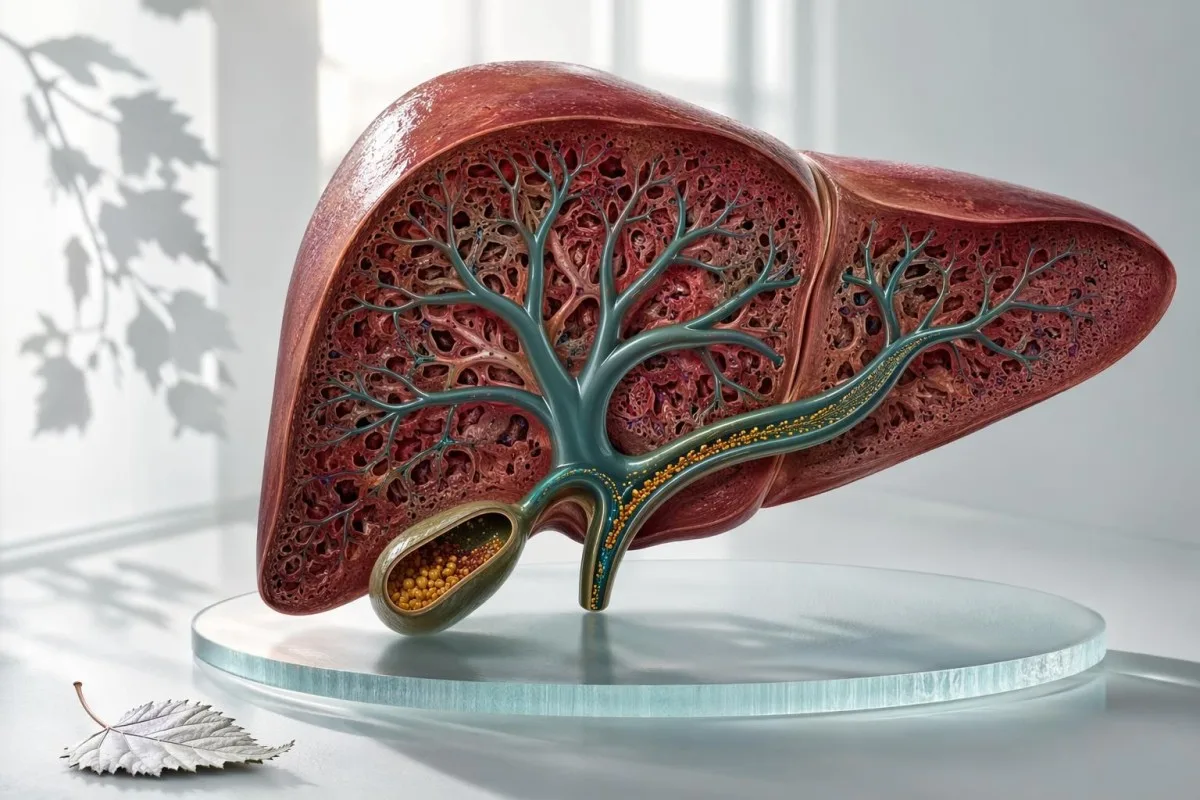
Fractionated bilirubin turns a vague high bilirubin flag into a pattern: bile flow, liver processing, or red blood cell turnover. The split often matters more than the total.


- Fractionated bilirubin separates total bilirubin into direct and indirect fractions, usually reported in mg/dL or µmol/L.
- Direct bilirubin above about 0.3 mg/dL, or more than 20% of total bilirubin, suggests impaired bile flow or liver excretion.
- Indirect bilirubin rises when bilirubin production exceeds liver conjugation, commonly from Gilbert syndrome, fasting, or red blood cell breakdown.
- Total bilirubin is usually 0.2–1.2 mg/dL in adults, but reference intervals differ by laboratory and measurement method.
- Visible jaundice usually appears when total bilirubin reaches roughly 2–3 mg/dL, though darker skin tones can make early jaundice harder to see.
- Dark urine points toward direct bilirubin because conjugated bilirubin is water-soluble and can spill into urine.
- Normal ALT, AST, ALP, and GGT with isolated indirect bilirubin under 3 mg/dL often fits Gilbert syndrome rather than liver damage.
- Urgent review is needed for jaundice with fever, confusion, severe abdominal pain, pale stools, or bilirubin rising quickly over days.
How fractionated bilirubin changes the diagnosis
Fractionated bilirubin separates total bilirubin into direct bilirubin and indirect bilirubin. A mostly direct rise points toward bile flow or liver excretion problems; a mostly indirect rise points toward red blood cell breakdown, fasting, Gilbert syndrome, or impaired conjugation. That split is often more useful than the total number alone, and Kantesti AI reads it alongside enzymes, CBC results, and trends.
Total bilirubin is the sum of conjugated and unconjugated pigment, but the body handles those two forms very differently. If your report only says total bilirubin 1.8 mg/dL, I cannot tell whether to think about bile obstruction, Gilbert syndrome, or recent red cell turnover without the fractions.
In clinic, I often see a patient panic over a yellow flag when the direct fraction is 0.2 mg/dL and the indirect fraction explains almost all of the rise. That pattern behaves very differently from a direct bilirubin of 2.0 mg/dL with alkaline phosphatase 450 IU/L, where bile flow becomes the main concern.
Pratt and Kaplan described the practical value of pattern recognition in abnormal liver chemistry back in the New England Journal of Medicine, and the same idea still holds in 2026: bilirubin should be interpreted with ALT, AST, ALP, GGT, albumin, INR, hemoglobin, and reticulocytes, not as a lonely number (Pratt & Kaplan, 2000). For baseline context, our bilirubin normal range guide explains how adult and newborn cutoffs differ.
Normal direct and indirect bilirubin ranges in adults
Adult total bilirubin levels are commonly about 0.2–1.2 mg/dL, direct bilirubin is usually below 0.3 mg/dL, and indirect bilirubin is often calculated as total minus direct. Some laboratories use µmol/L, where 1 mg/dL equals about 17.1 µmol/L.
The direct fraction is usually less than 20% of the total bilirubin in adults. A direct bilirubin of 0.4 mg/dL can be meaningful if total bilirubin is 0.7 mg/dL, yet less alarming if total bilirubin is 4.5 mg/dL and the clinical picture is resolving hemolysis.
Some European laboratories use lower upper limits for direct bilirubin, often around 5 µmol/L, while many US reports use 0.3 mg/dL. This is one reason our clinicians prefer the actual value, the unit, and the lab’s own reference interval rather than a generic internet cutoff.
When I’m Thomas Klein, MD, reviewing a report, I ask three questions before reacting: was the person fasting, is the direct fraction truly elevated, and are ALP or GGT also high? Patients comparing reports across countries should also watch unit changes; our guide on blood test normal ranges covers why the same biology can look different on two lab PDFs.
A mild isolated total bilirubin of 1.3–1.8 mg/dL is common and often benign when direct bilirubin is normal. A direct bilirubin above 1.0 mg/dL, especially with itching or pale stools, deserves a much more focused hepatobiliary review.
Why direct bilirubin rises when bile cannot drain
Direct bilirubin rises when conjugated bilirubin cannot move normally from liver cells into bile and then into the intestine. The classic pattern is high direct bilirubin with high ALP and GGT, which suggests cholestasis or obstruction more than simple overproduction.
Direct bilirubin is water-soluble because the liver has attached glucuronic acid to it. Once conjugated, bilirubin should travel through bile canaliculi, bile ducts, the gallbladder pathway, and eventually the intestine; when that route is blocked or inflamed, direct bilirubin backs up.
A common pattern is direct bilirubin 1.6 mg/dL, ALP 380 IU/L, and GGT 220 IU/L with right upper abdominal pain after meals. That cluster makes me think about gallstones, bile duct narrowing, medication-induced cholestasis, or less commonly an autoimmune bile duct condition.
The EASL cholestatic liver disease guideline emphasizes that ALP and GGT help localize a cholestatic pattern before imaging is chosen (EASL, 2009). Our guides on alkaline phosphatase changes and high GGT patterns go deeper into that enzyme pairing.
The overlooked detail is timing: direct bilirubin can lag behind ALP by 24–72 hours in evolving obstruction. I have seen patients with early duct blockage whose ALP was already high while bilirubin was still only 0.8 mg/dL, so symptoms and trend matter.
Why indirect bilirubin rises with red blood cell turnover
Indirect bilirubin rises when heme breakdown produces more unconjugated bilirubin than the liver can process. The usual lab clues are high indirect bilirubin with low haptoglobin, high LDH, higher reticulocytes, or falling hemoglobin.
Red blood cells live about 120 days, and their heme is recycled into bilirubin every day. If red cell destruction accelerates, indirect bilirubin can rise to 2–4 mg/dL even when the bile ducts are perfectly open.
A practical example: hemoglobin falls from 14.2 to 11.8 g/dL, reticulocytes rise to 5%, LDH is 520 IU/L, haptoglobin is undetectable, and indirect bilirubin is 2.3 mg/dL. That is a hemolysis pattern until proven otherwise, not a primary bile drainage pattern.
Most routine metabolic panels do not include haptoglobin or reticulocytes, so the bilirubin split may be the first clue. If the CBC looks off, our reticulocyte count guide helps patients understand whether bone marrow is compensating.
There is nuance here. Ineffective erythropoiesis from B12 or folate deficiency can raise indirect bilirubin without classic brisk hemolysis, which is why I like pairing bilirubin with MCV, RDW, B12, folate, and iron studies when fatigue or anemia is present.
Mixed bilirubin patterns in hepatitis and liver cell injury
A mixed bilirubin pattern means both direct and indirect fractions are elevated, often because injured liver cells cannot conjugate, transport, and excrete bilirubin efficiently. ALT and AST usually rise more than ALP in a hepatocellular pattern.
In acute hepatitis, ALT and AST can rise into the hundreds or thousands of IU/L before bilirubin peaks. Bilirubin may keep rising for several days even after enzymes begin falling because transport recovery is slower than enzyme leakage.
A 28-year-old traveler with ALT 1,150 IU/L, AST 860 IU/L, total bilirubin 5.2 mg/dL, and direct bilirubin 3.1 mg/dL is not the same story as a person with isolated indirect bilirubin 1.9 mg/dL after fasting. The pattern changes the urgency, the questions, and the next tests.
The AST/ALT ratio can add texture, although it should not be overread. A ratio above 2 can suggest alcohol-associated liver injury in the right setting, while viral hepatitis often has ALT higher than AST; our AST/ALT ratio guide explains the common traps.
Pratt and Kaplan’s 2000 review still matches what we see in practice: enzyme pattern comes before diagnosis. Bilirubin tells us whether liver processing and bile movement are affected, but ALT, AST, ALP, GGT, INR, and albumin tell us how broad the problem may be.
When high bilirubin with normal liver enzymes is usually Gilbert syndrome
Isolated indirect bilirubin with normal ALT, AST, ALP, GGT, CBC, and reticulocytes often fits Gilbert syndrome, especially when total bilirubin is below about 3 mg/dL. Gilbert syndrome is common, inherited, and usually harmless.
Gilbert syndrome is linked to reduced activity of UGT1A1, the enzyme that conjugates bilirubin. Bosma and colleagues identified the genetic basis for reduced bilirubin UDP-glucuronosyltransferase expression in a landmark New England Journal of Medicine paper in 1995 (Bosma et al., 1995).
The patient story is familiar: a healthy 34-year-old gets fasting labs before work, total bilirubin is 1.9 mg/dL, direct bilirubin is 0.2 mg/dL, ALT is 22 IU/L, and everything else looks boring. Two weeks later after normal meals and sleep, bilirubin drops to 1.1 mg/dL.
Fasting, dehydration, illness, intense exercise, and poor sleep can all nudge Gilbert bilirubin upward. We wrote separately about bilirubin during fasting because a 16-hour fast can be enough to reveal the pattern in susceptible people.
The reassuring pattern is indirect predominance with stable numbers over months or years. If total bilirubin climbs above 4 mg/dL, direct bilirubin rises, or liver enzymes become abnormal, the label Gilbert should be paused and the case reviewed again; our article on high bilirubin with normal enzymes covers that fork in the road.
The urine and stool clues that separate direct from indirect bilirubin
Dark urine suggests direct bilirubin because conjugated bilirubin is water-soluble and can pass into urine. Indirect bilirubin is albumin-bound and usually does not appear in urine.
Tea-colored urine with yellow eyes points more toward conjugated bilirubin than Gilbert syndrome. In practice, I ask whether the urine stays dark despite drinking water; concentrated morning urine should lighten later, but bilirubin-positive urine often remains distinctly dark.
Pale, grey, or clay-colored stools raise concern because less bile pigment is reaching the intestine. That symptom paired with direct bilirubin above 1 mg/dL and ALP above 2 times the upper limit deserves prompt medical assessment.
Urine dipsticks can detect bilirubin, but they are imperfect. Vitamin C, old test strips, light exposure, and timing can affect results, so a negative dipstick does not cancel a convincing direct bilirubin pattern.
A urine urobilinogen result adds another layer: low urobilinogen can fit obstruction, while high urobilinogen may appear with hemolysis or liver processing strain. Our urinalysis guide explains why urine chemistry often helps when the blood report feels ambiguous.
Lab artifacts, fasting, exercise, and medications that shift results
Bilirubin results can shift because of fasting, sample handling, strenuous exercise, illness, and medications. A borderline total bilirubin of 1.3–1.6 mg/dL is not interpreted the same way after a 20-hour fast as after a normal breakfast.
Bilirubin is light-sensitive, so prolonged light exposure can falsely lower measured levels. Hemolysis in the tube can also interfere with certain chemistry assays, which is why a report comment about sample quality should not be ignored.
Exercise adds a second wrinkle. A marathon runner may show AST 89 IU/L, CK 1,200 IU/L, and bilirubin 1.5 mg/dL after a hard race, and the liver may not be the main source of the enzyme rise.
Medication review is not optional. Atazanavir, indinavir, some anabolic agents, rifampicin, certain antibiotics, and hormonal therapies can change bilirubin handling or bile flow; the time course often tells the story better than the drug list alone.
For repeat testing, I usually suggest normal hydration, no extreme workout for 48 hours, and avoiding unnecessarily long fasting unless the ordering clinician requested it. Our fasting versus non-fasting guide gives practical timing rules for common chemistry panels.
How Kantesti AI reads bilirubin with the rest of the panel
Kantesti AI interprets bilirubin levels by checking the fractionated result against liver enzymes, CBC patterns, kidney markers, inflammation markers, units, age, pregnancy status, and prior results. Our AI does not treat bilirubin as a single isolated flag.
A direct bilirubin of 0.5 mg/dL means more when ALP is 310 IU/L than when ALP is 65 IU/L. Kantesti’s neural network compares these combinations across large-scale anonymised lab patterns, then presents likely explanations and sensible follow-up questions.
Our AI-powered blood test interpretation workflow is built for messy real reports: mixed units, scanned PDFs, photo uploads, missing fractions, and reference ranges that differ by country. The same bilirubin result may be low-risk in one cluster and urgent in another.
Kantesti AI maps bilirubin against more than 15,000 biomarkers and flags patterns such as indirect bilirubin plus high reticulocytes, direct bilirubin plus high GGT, or bilirubin plus prolonged INR. The method is described in our medical validation standards and our biomarker guide.
I’m Thomas Klein, MD, and I care about this distinction because overcalling Gilbert syndrome can miss obstruction, while overcalling liver disease can frighten a healthy person for no reason. If your report is hard to read, our PDF upload guide explains how the system extracts fractions, units, and lab comments.
Pregnancy, newborns, and children need different bilirubin rules
Newborns, children, and pregnant patients need different bilirubin interpretation because physiology, risk thresholds, and urgency are not the same as in a healthy adult. A newborn bilirubin of 12 mg/dL can be managed by age in hours, while an adult level of 12 mg/dL is a major red flag.
Newborn jaundice is usually indirect and often physiologic, but the safe range depends on gestational age, birth weight, hemolysis risk, and the baby’s age in hours. A single number without age in hours is not enough.
In pregnancy, mild ALP elevation can come from the placenta, so a cholestatic picture relies more heavily on symptoms, bile acids, GGT, ALT, AST, and direct bilirubin. Severe itching of palms or soles deserves attention even if bilirubin is still normal.
Children can have viral hepatitis, inherited conjugation disorders, hemolysis, gallstones, and medication effects, but the probabilities differ from adults. Our infant blood test ranges article explains why pediatric reference intervals must be age-specific.
One practical safety rule: any infant with jaundice in the first 24 hours needs same-day clinical assessment. In older children, jaundice plus dark urine, pale stools, fever, or abdominal pain should not wait for routine follow-up.
What clinicians usually order next after an abnormal fractionated result
The next tests after abnormal fractionated bilirubin depend on which fraction is high. Direct-predominant results usually lead toward liver enzymes and imaging, while indirect-predominant results usually lead toward CBC, reticulocytes, LDH, and haptoglobin.
For direct-predominant bilirubin, I expect a repeat liver panel with ALT, AST, ALP, GGT, albumin, and often PT/INR. If ALP and GGT are high or symptoms suggest obstruction, ultrasound is commonly the first imaging test because it can detect duct dilation and gallstones.
For indirect-predominant bilirubin, the follow-up is different: CBC, reticulocyte count, LDH, haptoglobin, peripheral cell sample review, and sometimes B12, folate, and iron studies. Ordering only another liver enzyme panel may miss the red cell turnover story.
The EASL cholestasis guideline supports a structured approach: confirm the biochemical pattern, review medications, exclude common obstruction, and then consider autoimmune or inherited causes when the usual explanations do not fit (EASL, 2009). Our liver function test guide walks through those enzyme clusters.
If hepatitis is possible, viral serology matters more than guessing from bilirubin alone. Our hepatitis blood test article explains why antibodies, antigen tests, and viral load answer different questions.
When bilirubin levels need urgent medical care
Bilirubin levels need urgent medical care when jaundice occurs with fever, confusion, severe abdominal pain, pale stools, dark urine, bleeding, pregnancy symptoms, or a rapidly rising result. The number matters, but the symptom cluster matters more.
A total bilirubin above 3 mg/dL with a direct fraction above 1–2 mg/dL is not automatically an emergency, but it should be taken seriously. Add fever and right upper quadrant pain, and the concern for ascending cholangitis becomes much higher.
Confusion, sleepiness, easy bleeding, black stools, vomiting blood, or INR prolongation can suggest impaired liver synthetic function. Those are not wait-and-see findings, especially when bilirubin is rising over days.
Pregnancy changes the threshold for action. Severe itching, jaundice, high bile acids, or abnormal liver tests in late pregnancy can affect both mother and baby, and same-day obstetric guidance is appropriate.
If you are deciding whether a result is critical, use symptoms plus the lab trend, not the color of a flag alone. Our article on critical blood test values explains which abnormal results commonly need same-day review.
How to track bilirubin trends instead of one-off flags
A bilirubin trend is more informative than a single borderline result because direction, fraction, and accompanying markers reveal the clinical story. A stable indirect bilirubin of 1.6 mg/dL for 5 years is very different from a direct bilirubin rising from 0.4 to 2.1 mg/dL in 10 days.
When I compare reports, I look for slope first. A rise of 0.2 mg/dL over 2 years often means less than a rise of 1.5 mg/dL over a week, even if both values are flagged on the same lab portal.
Track the fraction, not just total bilirubin. A patient whose total bilirubin stays near 1.8 mg/dL but direct bilirubin remains 0.2 mg/dL has a different risk profile than someone whose direct fraction climbs from 0.2 to 0.9 mg/dL.
Kantesti’s trend analysis can store old reports and compare bilirubin with ALT, AST, ALP, GGT, hemoglobin, and reticulocytes over time. If you want to understand slopes and swings, our lab trend graph guide is a useful companion.
A practical tracking interval is 1–4 weeks for unexplained new abnormalities, sooner if symptoms are present. For known Gilbert syndrome with stable enzymes, many clinicians simply recheck during routine annual labs unless the pattern changes.
Bottom line: what your direct-indirect pattern likely means
The direct versus indirect bilirubin pattern usually separates three buckets: bile flow or excretion problems, liver cell processing strain, and red blood cell breakdown or Gilbert-type conjugation limits. That is the clinical value of fractionated bilirubin.
Mostly direct bilirubin with high ALP or GGT points toward cholestasis, obstruction, or bile duct irritation. Mostly indirect bilirubin with normal enzymes and stable CBC often points toward Gilbert syndrome or fasting effects, while indirect bilirubin with anemia markers points toward red cell turnover.
Mixed direct and indirect elevation with high ALT or AST suggests liver cell injury, where hepatitis, medication effects, alcohol-associated injury, fatty liver flare, or systemic illness may be part of the picture. The next step is rarely one magic test; it is a pattern-based review.
As of May 25, 2026, our Try Free AI Blood Test Analysis option lets you upload a PDF or photo and receive a structured interpretation in about 60 seconds. Kantesti Ltd is described on our About Us page, and our physicians are listed through the Medical Advisory Board.
My plain advice: do not ignore a rising direct bilirubin, and do not let a stable mild indirect bilirubin ruin your week. If the pattern is unclear, repeat the test under normal conditions and review it with a clinician who will look at the whole panel.
Frequently Asked Questions
What does high direct bilirubin mean?
High direct bilirubin usually means conjugated bilirubin is not leaving the liver and bile ducts normally. A direct bilirubin above about 0.3 mg/dL, or more than 20% of total bilirubin, can suggest cholestasis, bile duct blockage, liver cell injury, medication effect, or inherited excretion disorders. The concern rises when ALP or GGT is high, urine is dark, stools are pale, or total bilirubin is above 2–3 mg/dL. A clinician usually confirms the pattern with repeat liver tests and may order ultrasound if obstruction is possible.
What does high indirect bilirubin mean?
High indirect bilirubin means unconjugated bilirubin is building up before liver conjugation or because production is increased. Common causes include Gilbert syndrome, fasting, dehydration, recent illness, hemolysis, ineffective red cell production, and some medicines. If indirect bilirubin is elevated but ALT, AST, ALP, GGT, hemoglobin, and reticulocytes are normal, Gilbert syndrome is often the explanation. If hemoglobin is falling, reticulocytes are high, LDH is high, or haptoglobin is low, red blood cell breakdown needs evaluation.
Is high bilirubin with normal liver enzymes dangerous?
High bilirubin with normal liver enzymes is often not dangerous when the elevation is mild, indirect-predominant, and stable. A typical Gilbert syndrome pattern is total bilirubin around 1.2–3.0 mg/dL, direct bilirubin under 0.3 mg/dL, and normal ALT, AST, ALP, GGT, CBC, and reticulocyte count. It becomes less reassuring if bilirubin rises quickly, the direct fraction increases, symptoms develop, or anemia markers appear. Repeat testing under normal eating and hydration conditions often clarifies borderline cases.
Can fasting raise bilirubin levels?
Yes, fasting can raise bilirubin levels, especially indirect bilirubin in people with Gilbert syndrome. Even a 16–24 hour fast can push total bilirubin above the reference range, often into the 1.3–2.5 mg/dL range, while direct bilirubin and liver enzymes remain normal. Dehydration, poor sleep, illness, and intense exercise can amplify the same effect. If the clinical situation is low-risk, repeating the test after normal meals and hydration may prevent unnecessary worry.
When should I worry about bilirubin levels?
You should worry about bilirubin levels when jaundice comes with fever, severe abdominal pain, confusion, pale stools, dark urine, easy bleeding, pregnancy symptoms, or a rapidly rising result. Total bilirubin above 3 mg/dL deserves careful review, and direct bilirubin above 1–2 mg/dL is more concerning when ALP or GGT is also high. The pattern matters more than the flag alone. Same-day care is reasonable if symptoms suggest bile duct obstruction, infection, or liver failure.
What tests are ordered after fractionated bilirubin is abnormal?
Follow-up testing after abnormal fractionated bilirubin depends on whether direct or indirect bilirubin is high. Direct-predominant results usually lead to ALT, AST, ALP, GGT, albumin, PT/INR, medication review, viral hepatitis tests, and sometimes ultrasound. Indirect-predominant results usually lead to CBC, reticulocyte count, LDH, haptoglobin, B12, folate, and iron studies. A repeat bilirubin test in 1–4 weeks is common when the person is well and the abnormality is mild.
Should my relatives be tested for Gilbert syndrome if I have it?
Gilbert syndrome often runs in families, but relatives usually do not need genetic or blood testing if they feel well. They should mention the family history if they develop recurrent mild jaundice or receive an unexplained bilirubin result.
Can alcohol raise direct or indirect bilirubin?
Alcohol can contribute to a mixed or predominantly direct bilirubin rise when it inflames or injures the liver, usually alongside abnormal liver enzymes. An isolated bilirubin result cannot prove alcohol is the cause, so discuss drinking honestly with your clinician and avoid alcohol until reviewed.
Can gallstones make bilirubin rise and then return to normal?
Yes, a small gallstone can temporarily block the bile duct, causing direct bilirubin and bile enzymes to rise, then improve when the stone moves. Recurrent right-sided abdominal pain, fever, jaundice, or dark urine should be checked promptly.
Get AI-Powered Blood Test Analysis Today
Join over 2 million users worldwide who trust Kantesti for instant, accurate lab test analysis. Upload your blood test results and receive comprehensive interpretation of 15,000+ biomarkers in seconds.
📚 Referenced Research Publications
Klein, T., Mitchell, S., & Weber, H. (2026). B Negative Blood Type, LDH Blood Test & Reticulocyte Count Guide. Kantesti AI Medical Research.
Klein, T., Mitchell, S., & Weber, H. (2026). Diarrhea After Fasting, Black Specks in Stool & GI Guide 2026. Kantesti AI Medical Research.
📖 External Medical References
⚕️ Medical Disclaimer
This article is for educational purposes only and does not constitute medical advice. Always consult a qualified healthcare provider for diagnosis and treatment decisions.
E-E-A-T Trust Signals
Experience
Physician-led clinical review of lab interpretation workflows.
Expertise
Laboratory medicine focus on how biomarkers behave in clinical context.
Authoritativeness
Written by Dr. Thomas Klein with review by Dr. Sarah Mitchell and Prof. Dr. Hans Weber.
Trustworthiness
Evidence-based interpretation with clear follow-up pathways to reduce alarm.