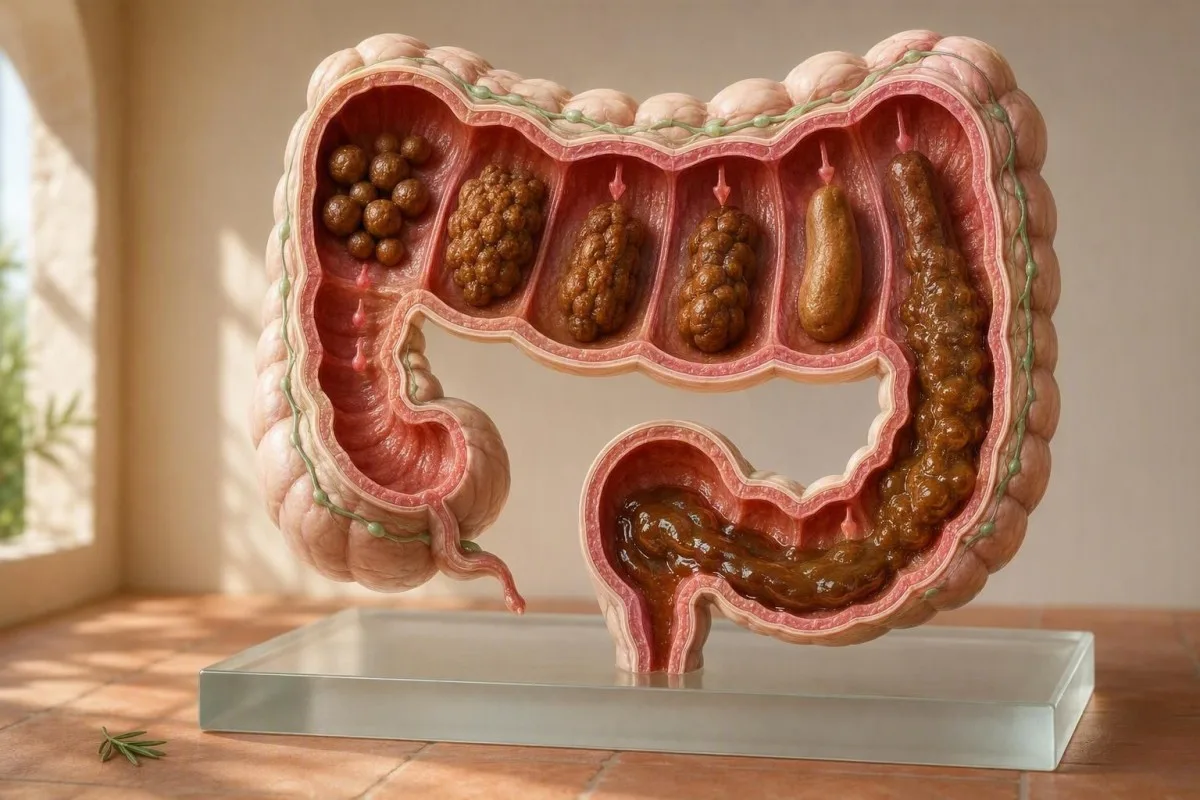
The Bristol stool chart groups stool into seven forms: Types 3–4 are usually typical, Types 1–2 suggest slower transit, and Types 6–7 suggest faster transit. It is a useful language for noticing change, not a diagnosis on its own.


- Types 3–4 are the usual target range because stool is formed without requiring straining or urgency.
- Types 1–2 often reflect slow colonic transit, low fluid intake, low fibre intake, medication effects, or pelvic-floor difficulty.
- Types 6–7 can follow infection, medication, anxiety, high-dose magnesium, bile-acid diarrhoea, or inflammatory bowel conditions.
- Blood in stool that is black, maroon, or repeatedly bright red needs clinical assessment; black tarry stool can signal upper gastrointestinal bleeding.
- Diarrhoea lasting more than 7 days in an adult, or more than 48 hours in a young child, deserves medical advice even without fever.
- Unintentional weight loss of 5% or more over 6–12 months alongside a persistent bowel change is a red-flag combination.
- Hydration changes stool form, but drinking excessive plain water will not correct constipation caused by slow transit or medication.
- A 14-day stool diary that records type, frequency, urgency, pain, food changes, and medicines is more useful than a single unusual bowel movement.
What the Bristol Stool Scale Actually Measures
The Bristol stool chart describes stool form as a visible proxy for how long contents have spent moving through the colon. Types 1 through 7 reflect a continuum of water reabsorption and transit time, but they cannot diagnose irritable bowel syndrome, infection, cancer, or food intolerance by themselves.
The original seven-point scale was developed by Stephen Lewis and Kenneth Heaton after work in 66 adults and was published in the Scandinavian Journal of Gastroenterology in 1997. Their key observation still holds: firmer, separate lumps generally mean slower transit, whereas loose or watery stool usually means quicker transit (Lewis and Heaton, 1997).
In clinic, I ask about form before frequency. Someone who opens their bowels twice daily with painless Type 4 stool may be entirely well, while someone passing Type 1 pellets every morning can still be constipated if they strain, feel blocked, or never feel empty.
As of July 29, 2026, I advise patients to use the chart as a two-week pattern-recognition tool rather than aiming for a perfect Type 4 every day. Kantesti is an AI blood test analyzer, and our clinical work treats bowel symptoms as context that may change which laboratory patterns deserve a closer look.
Why Transit Time Changes Stool Consistency
Stool becomes harder when it remains in the colon longer because the colon reabsorbs more water; it becomes looser when transit is faster and less water is reclaimed. A change from Type 4 to Type 1 over several weeks is therefore more meaningful than one firm stool after a long flight.
The large bowel normally reabsorbs roughly 1 to 2 litres of fluid each day, leaving about 100 to 200 g of stool for most adults. Slow movement gives the colon extra time to remove water, which is why Types 1–2 are dry and fragmented rather than simply small.
Fast transit is not always diarrhoea from an infection. Caffeine, a sudden high-fibre diet, menstruation, metformin, antibiotics, magnesium-containing products, and anxiety can all shorten transit for a day or two; persistent urgency is the detail that changes my concern.
A stool type can also vary within the same bowel movement, especially when the rectum holds older stool while newer contents arrive behind it. That mixed pattern matters in people with constipation and occasional leakage; our guide to constipation-related blood tests explains when thyroid, calcium, glucose, and electrolyte testing can be sensible.
Types 1 and 2: Pebbles, Lumps and Constipation Patterns
Type 1 consists of separate hard pellets, while Type 2 is a lumpy sausage-shaped stool; both commonly indicate constipation when they recur for at least 3 months. They are most useful clinically when paired with straining, a blocked sensation, fewer than three spontaneous bowel movements weekly, or incomplete emptying.
Type 1 does not automatically mean dehydration. I often see it in patients who drink 2 litres daily but take iron, opioid pain relief, anticholinergic medication, calcium supplements, or GLP-1 medicines; these can slow gut motility even when fluid intake is adequate.
Type 2 can be a useful clue to outlet constipation when the urge is present but the stool feels difficult to release. A 41-year-old teacher I reviewed was eating 30 g of fibre daily, yet Type 2 stool persisted until pelvic-floor physiotherapy addressed chronic straining rather than adding more bran.
Do not respond to ongoing hard stool by escalating fibre indefinitely. A rapid jump of more than 10 g daily can worsen bloating when transit is already slow; introduce fibre gradually, review medicines, and consider the metabolic and thyroid issues discussed in our basic metabolic panel guide.
Types 3 and 4: The Usual Healthy Stool Range
Type 3 is sausage-shaped with surface cracks, and Type 4 is smooth, soft, and snake-like; both are generally considered typical stool forms. Neither type proves that the gut is healthy, but painless passage without urgency or straining is reassuring.
Type 3 may look a little dry yet still be normal if it passes comfortably. The useful distinction is effort: taking longer than 10 minutes on the toilet, regularly using manual assistance, or feeling incompletely emptied shifts the story toward constipation even if the shape looks acceptable.
Type 4 is often called the ideal stool, though that label is too rigid. People with a high-fibre Mediterranean-style diet may normally pass a Type 4 or 5 once or twice daily, while another healthy person may alternate between Type 3 and 4 every other day.
Dr. Thomas Klein’s practical rule is simple: your own stable baseline carries more weight than an online ideal. If a new Type 3–4 pattern comes with unexplained abdominal pain, waking at night to defecate, anemia symptoms, or weight loss, the form alone should not reassure you.
Type 5: Soft Pieces and the Middle Ground
Type 5 consists of soft blobs with clear edges and usually signals slightly faster transit than Types 3–4. It is often harmless when occasional, painless, and linked to a larger meal, extra coffee, stress, or a recent fibre increase.
The clinical question is whether Type 5 is your ordinary stool or a new change. A person passing Type 5 once each morning without urgency may need no testing, whereas five urgent Type 5 bowel movements after antibiotics needs a different conversation.
Sugar alcohols such as sorbitol and xylitol can pull water into the bowel and produce Type 5 or 6 stool at doses above about 10 to 20 g per day. Protein bars, chewing gum, and sugar-free sweets are common sources that patients genuinely overlook.
Loose pieces after a high-fat meal can also point toward bile-acid sensitivity or impaired fat digestion, particularly if stool floats, looks greasy, or is unusually difficult to flush. Those features are better assessed with a faecal fat result guide than with the Bristol scale alone.
Types 6 and 7: Loose Stool, Diarrhoea and Fluid Loss
Type 6 is fluffy, mushy stool with ragged edges, while Type 7 is entirely liquid with no solid pieces; recurrent Type 6–7 stool meets the everyday description of diarrhoea. The immediate priorities are duration, hydration, fever, severe pain, blood, recent travel, antibiotic exposure, and immune status.
Acute diarrhoea lasting under 72 hours is commonly self-limited, but Type 7 stool can cause clinically relevant fluid and salt loss quickly in infants, older adults, and people taking diuretics. Reduced urination, dizziness on standing, a resting heart rate above 100 beats per minute, or unusual sleepiness are reasons to seek urgent advice.
For adults, oral rehydration solution works better than large volumes of plain water because glucose and sodium use coupled intestinal transport. A typical prepared solution provides about 75 mmol/L sodium; follow the packet instructions rather than making concentrated home mixtures.
Persistent diarrhoea can raise creatinine through volume depletion and alter potassium, bicarbonate, and magnesium. Our diarrhoea blood-test overview explains why laboratory testing is chosen for dehydration risk rather than to label every loose stool.
Hydration, Electrolytes and Stool Form
Low fluid intake can make existing constipation worse, but drinking more water alone does not reliably cure chronic Type 1–2 stool. Fluids help most when low intake, heat exposure, vomiting, diarrhoea, or a fibre increase is part of the picture.
A reasonable starting point for many adults is to drink to thirst and aim for pale-yellow urine, then adjust for climate, exercise, pregnancy, fever, or diarrhoea. There is no universal 2-litre prescription; a 55 kg sedentary adult and a 95 kg outdoor worker do not have the same fluid needs.
High-dose magnesium is a frequent hidden cause of loose stool. Magnesium citrate and oxide are more likely than glycinate to loosen the bowel, and a supplement providing 300 to 400 mg elemental magnesium can be enough to matter in sensitive people.
Kantesti is an AI blood test interpretation platform that can place sodium, potassium, bicarbonate, urea, and creatinine in context after prolonged diarrhoea or vomiting. A high urea-to-creatinine pattern may reflect reduced circulating fluid, although kidney disease, bleeding, protein intake, and steroid exposure can produce similar patterns; see our BUN and creatinine explanation for the limits.
Fibre, Food Changes and the Stool Consistency Chart
Fibre can improve stool regularity, but the type, dose, and rate of change determine whether it firms stool or makes bloating and urgency worse. Soluble, gel-forming fibre such as psyllium has better evidence for global irritable bowel syndrome symptoms than wheat bran (Lacy et al., 2021).
Psyllium usually starts at 3 to 5 g once daily and can be increased every 4 to 7 days toward 10 g daily if tolerated. It absorbs water and may help both hard and loose stool, whereas coarse insoluble bran often aggravates gas, cramping, and urgency in people with sensitive guts.
Kiwi fruit, prunes, oats, lentils, and vegetables can support softer, more regular stool, but food effects take several days to judge. Prunes contain sorbitol; in some people, 50 g or about five to six prunes is helpful, while larger portions trigger Type 6 stool.
A low-FODMAP trial is not a lifelong diet and should not be started casually in someone with weight loss or restrictive eating. For a measured approach to diet-related symptoms, read our guide to foods that support gut health and reintroduce foods systematically.
Medicines and Supplements That Alter Stool Type
Medication is one of the most common reversible causes of a changed Bristol stool scale pattern. Iron, opioids, calcium-channel blockers, anticholinergics, and some antidepressants tend to harden stool, while antibiotics, metformin, laxatives, magnesium, and some diabetes medicines can loosen it.
Iron salts commonly cause dark stool and constipation, but black tarry, sticky stool with weakness or light-headedness should never be assumed to be iron-related. The contrast matters: iron-darkened stool is often formed, whereas melena is typically jet-black, tar-like, and unusually foul-smelling.
Metformin-associated diarrhoea can improve with slow dose escalation, taking it with meals, or an extended-release formulation, but do not alter a prescription without discussing it with the prescriber. The American College of Gastroenterology guideline supports a positive, symptom-based approach to IBS rather than reflexive exhaustive testing in patients without alarm features (Lacy et al., 2021).
If you take a long-term proton-pump inhibitor, chronic loose stool, B12 deficiency risk, magnesium changes, and infection exposure may each deserve review rather than a single explanation. Our article on laboratory monitoring with PPIs covers the lab side of that discussion.
When Stool Changes Need Same-Day Medical Care
Seek urgent medical assessment for black tarry stool, maroon stool, heavy rectal bleeding, severe or worsening abdominal pain, fainting, confusion, or diarrhoea with clear dehydration. A new bowel habit lasting more than 3 weeks also warrants a clinician review, especially from age 50 onward or earlier with a strong family history.
Blood mixed through stool, persistent mucus with fever, or night-time diarrhoea that wakes you repeatedly are not typical functional bowel features. NICE guidance on irritable bowel syndrome advises clinicians to assess for red flags including rectal bleeding, unintentional weight loss, and anemia before settling on a functional diagnosis (NICE, 2017).
Unintentional loss of 5% of body weight over 6 to 12 months is clinically significant. For someone weighing 80 kg, that is 4 kg; paired with ongoing bowel change, fatigue, or reduced appetite, it deserves timely assessment even if stools are only Type 5.
Pale clay-coloured stool and dark urine can point to reduced bile reaching the intestine, particularly when jaundice or itching occurs. Review our explanation of pale stool and bile patterns and contact a clinician promptly rather than trying a fibre supplement first.
How to Track a Bowel Pattern Before Testing
A 14-day diary gives a clinician more useful information than one photograph or a single Bristol stool chart number. Record each bowel movement’s type, time, urgency, pain from 0 to 10, visible blood or mucus, medication timing, major food changes, menstrual timing, and overnight symptoms.
Frequency needs context: three bowel movements per day to three per week can fall within a broad population range. A personal change that persists for 2 to 3 weeks, particularly with urgency or straining, is usually more informative than comparing yourself with someone else’s routine.
Stool testing is targeted. Clinicians may request faecal calprotectin when inflammatory bowel disease is plausible, stool culture or parasite testing after relevant exposures, FIT for colorectal cancer screening or selected symptoms, and pancreatic elastase when greasy, bulky stool suggests maldigestion.
Kantesti is an AI-powered blood test analysis tool that helps users organize blood-test context alongside a symptom diary, but stool form cannot be inferred from a blood panel. If inflammatory symptoms are present, our faecal calprotectin guide explains what a raised result can and cannot establish.
When Blood Tests Add Useful Clues to Stool Changes
Blood tests are useful when altered stool comes with persistent symptoms, weight loss, fatigue, dehydration, suspected malabsorption, or a medication risk; they are not routine for every change from Type 4 to Type 5. A clinician may use a complete blood count, ferritin, CRP, electrolytes, liver tests, thyroid tests, coeliac serology, and kidney function selectively.
A low hemoglobin or ferritin result can support concern about chronic blood loss or iron deficiency, while a normal result does not rule out every gastrointestinal condition. For context, ferritin under 15 µg/L is highly specific for depleted iron stores in many adults, but inflammation can make ferritin look falsely reassuring.
With prolonged Type 6–7 stool, bicarbonate may fall because intestinal losses contain bicarbonate, and creatinine may rise with volume depletion. In my experience, the combination of persistent diarrhoea, low bicarbonate, and dizziness deserves quicker review than a loose stool description alone.
Dr. Thomas Klein recommends asking what question each test is meant to answer. Kantesti’s medical validation framework is built around pattern interpretation and clinical follow-up prompts, not diagnosing gastrointestinal disease from isolated laboratory flags.
How Age and Pregnancy Change Stool Interpretation
The Bristol stool chart can be used in children, pregnancy, and later life, but the threshold for seeking advice is lower when dehydration, growth concerns, pregnancy complications, frailty, or multiple medicines are present. In babies, stool colour and feeding behaviour often matter more than matching an adult stool-form category.
In children, Type 1–2 stool with painful withholding can become a cycle: a hard bowel movement hurts, the child avoids the toilet, and stool becomes still drier. A child with vomiting, marked abdominal swelling, poor growth, blood not clearly from a fissure, or no urine for 8 hours needs prompt medical advice.
Pregnancy commonly slows transit because progesterone relaxes smooth muscle, while iron supplements add to constipation. New severe constipation with vomiting, or diarrhoea combined with fever, reduced fetal movement, or dehydration should be discussed with maternity services the same day.
Older adults may have muted thirst, limited mobility, denture-related diet restrictions, and several constipating prescriptions. A sudden new bowel change after age 50 should not be dismissed as ageing; our blood-test guide for older adults discusses related risks such as dehydration, anemia, and frailty.
A Practical 14-Day Plan for Healthier Stool Patterns
For uncomplicated stool changes, start with a 14-day plan: keep meals and fluid intake steady, avoid abrupt fibre escalation, review new medicines with a pharmacist, walk after meals when able, and record Bristol type plus symptoms. Seek care sooner if red flags appear at any point.
For recurrent Types 1–2, begin with a consistent toilet time 15 to 30 minutes after breakfast, avoid straining longer than 10 minutes, and add one change at a time. A footstool that places knees above hips can reduce the angle of the rectum and helps many patients, though it is not a cure for every constipation cause.
For Types 6–7, pause non-essential magnesium and sugar alcohols, use oral rehydration when losses are substantial, and avoid anti-diarrhoeal medicines if there is fever, blood, severe pain, or suspected food poisoning. If symptoms continue beyond 7 days, contact a clinician; sooner if you are pregnant, immunocompromised, or over 65.
Kantesti is an AI lab test interpretation service designed to help people prepare clearer questions about laboratory results, symptoms, and trends for their clinician. Our Medical Advisory Board supports clinical oversight, and the Bristol stool scale should always remain one observation within that broader medical conversation.
Frequently Asked Questions
What is the healthiest Bristol stool chart type?
Types 3 and 4 are generally the most typical Bristol stool chart forms because they are formed, soft, and usually pass without straining or urgency. Type 3 has surface cracks, while Type 4 is smoother and more sausage-like. A person can still be well with occasional Type 2 or Type 5 stool, especially after travel, illness, dietary change, or a different routine. Persistent change for more than 2 to 3 weeks matters more than chasing a perfect Type 4.
Is Type 5 stool considered diarrhoea?
Type 5 stool is soft and separate, but it is not necessarily diarrhoea if it occurs once or twice daily without urgency, pain, dehydration, or a change from your usual pattern. Recurrent Type 5 stool with urgency, cramping, nighttime bowel movements, or more than 3 bowel movements daily can indicate faster transit and deserves assessment. Sugar alcohols above roughly 10 to 20 g daily, caffeine, metformin, and high-fat meals are common triggers. A 14-day diary can separate a brief food-related pattern from persistent symptoms.
Can dehydration cause hard stool?
Dehydration can contribute to Types 1 and 2 because the colon reabsorbs more water from stool when overall fluid availability is low. It is not the only cause: iron, opioid pain medicines, calcium-channel blockers, low activity, pelvic-floor dysfunction, and slow transit can produce hard stool even when fluid intake is adequate. Adults with reduced urine output, dizziness on standing, or a resting pulse above 100 beats per minute may have clinically significant fluid loss. Persistent constipation should be reviewed rather than treated by excessive water intake alone.
When should I worry about Type 6 or Type 7 stool?
Type 6 or 7 stool needs prompt medical advice when it lasts more than 7 days, causes dehydration, contains blood, follows antibiotics, or occurs with fever, severe abdominal pain, fainting, or confusion. Type 7 is fully watery stool and can lead to sodium, potassium, bicarbonate, and kidney-function changes, particularly in infants, older adults, and people on diuretics. Oral rehydration solution is preferable to plain water during substantial losses because it replaces sodium and glucose together. Same-day assessment is appropriate for black or maroon stool at any age.
Does the Bristol stool chart diagnose IBS?
The Bristol stool chart does not diagnose irritable bowel syndrome because it measures stool form rather than the full symptom pattern. IBS diagnosis usually requires recurrent abdominal pain linked to defecation and a change in stool frequency or form over time, after clinicians consider alarm features and appropriate testing. The 2021 American College of Gastroenterology guideline supports a positive diagnostic strategy when there are no alarm signs. Rectal bleeding, anemia, unintentional loss of 5% body weight, or nocturnal symptoms require further assessment rather than self-diagnosis.
What stool colour changes are more concerning than stool type?
Black tarry stool, maroon stool, persistent bright-red blood mixed with stool, pale clay-coloured stool, and dark urine with yellow skin are more concerning than ordinary changes between Bristol types. Black stool caused by iron is often dark but formed; melena is typically sticky, tar-like, and can be accompanied by weakness or light-headedness. Pale stool may reflect reduced bile entering the intestine, especially when jaundice or itching occurs. Seek urgent medical advice for black tarry stool, heavy bleeding, fainting, or severe abdominal pain.
Get AI-Powered Blood Test Analysis Today
Join over 2 million users worldwide who trust Kantesti for instant, accurate lab test analysis. Upload your blood test results and receive comprehensive interpretation of 15,000+ biomarkers in seconds.
📚 Referenced Research Publications
Klein, T., Mitchell, S., & Weber, H. (2026). RDW Blood Test: Complete Guide to RDW-CV, MCV & MCHC. Kantesti AI Medical Research.
Klein, T., Mitchell, S., & Weber, H. (2026). BUN/Creatinine Ratio Explained: Kidney Function Test Guide. Kantesti AI Medical Research.
📖 External Medical References
National Institute for Health and Care Excellence (2017). Irritable bowel syndrome in adults: diagnosis and management. NICE Clinical Guideline CG61.
⚕️ Medical Disclaimer
This article is for educational purposes only and does not constitute medical advice. Always consult a qualified healthcare provider for diagnosis and treatment decisions.
E-E-A-T Trust Signals
Experience
Physician-led clinical review of lab interpretation workflows.
Expertise
Laboratory medicine focus on how biomarkers behave in clinical context.
Authoritativeness
Written by Dr. Thomas Klein with review by Dr. Sarah Mitchell and Prof. Dr. Hans Weber.
Trustworthiness
Evidence-based interpretation with clear follow-up pathways to reduce alarm.