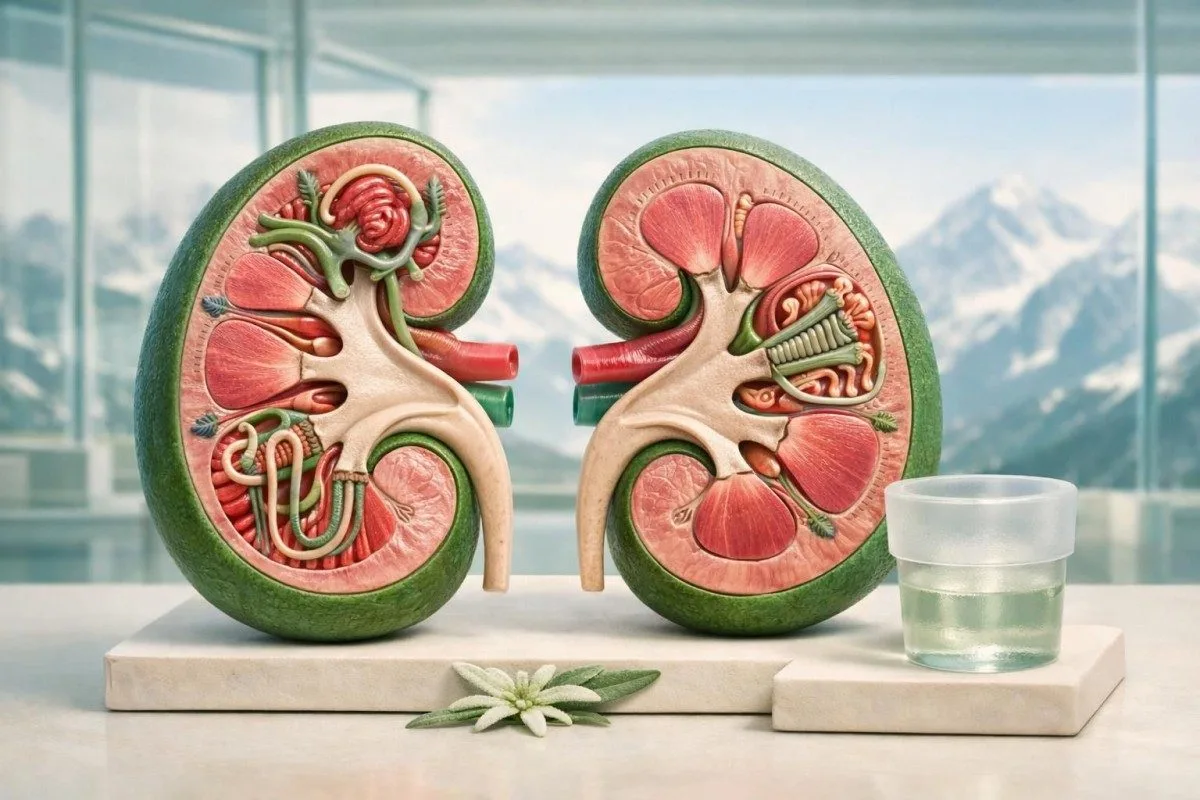
A mildly high creatinine often comes from dehydration, recent hard exercise, larger muscle mass, cooked meat, creatine, or medications that change tubular secretion—not always kidney disease. The next step is to compare it with your baseline, eGFR, BUN, potassium, urine protein, and symptoms.


- Creatinine normal range for many adult labs is about 0.6-1.3 mg/dL (53-115 µmol/L), but sex, age, muscle mass, and pregnancy change what is expected.
- A single high creatinine does not diagnose kidney disease; a rise of 0.3 mg/dL within 48 hours is more concerning than one isolated borderline value.
- eGFR below 60 mL/min/1.73 m² for at least 3 months meets a chronic kidney disease threshold in KDIGO guidance.
- Urine albumin-creatinine ratio above 30 mg/g adds concern for kidney damage even when creatinine is only mildly elevated.
- BUN/creatinine ratio above 20:1 often points toward dehydration, reduced effective blood flow, or high protein breakdown rather than intrinsic kidney disease.
- Trimethoprim, cimetidine, dolutegravir, cobicistat, and fenofibrate can raise creatinine without true loss of filtration.
- Potassium above 5.5 mmol/L with rising creatinine needs prompt review; 6.0 mmol/L or higher is generally an emergency.
- Creatine supplements and hard exercise can temporarily nudge creatinine upward for 24-72 hours, especially when CK is also elevated.
What a high creatinine result usually means on routine labs
High creatinine usually means one of two things: your kidneys are clearing creatinine less efficiently, or your body temporarily made more of it because of dehydration, recent hard exercise, higher muscle mass, cooked meat, creatine, or certain drugs. A single mildly high result does not diagnose kidney disease; the next step is to compare your baseline, eGFR, BUN, potassium, urine protein, and symptoms.
Serum creatinine comes from creatine in skeletal muscle and is cleared mostly by glomerular filtration. Many adult labs flag values above roughly 1.2-1.3 mg/dL, but when Kantesti AI reviews a result, we look at context before we worry. If you have never been told what your creatinine normal range really means, that is the first blind spot to fix.
The change from your own baseline often carries more signal than the single value. As Thomas Klein, MD, I spend more time on the slope of change than the red highlight itself; a rise from 0.7 to 1.0 mg/dL in a thin 78-year-old can matter more than a stable 1.3 mg/dL in a muscular 30-year-old, which is why I ask patients to review their lab history over time.
Creatinine is a useful kidney function test, but it is an imperfect marker of filtration. Levey et al., 2021 improved eGFR estimation with the race-free CKD-EPI equation, yet the paper also reinforces a point clinicians know well: creatinine becomes less reliable at the extremes of muscle mass, diet, and frailty.
Creatinine normal range: why the reference interval can fool you
Creatinine normal range is not one universal number. Adult women often fall around 0.59-1.04 mg/dL and adult men around 0.74-1.35 mg/dL, but lab method, age, muscle mass, and pregnancy can shift what is truly normal for you.
Reference intervals are population averages, not a diagnosis. Some European labs use an upper limit near 1.10 mg/dL for women and 1.25 mg/dL for men, which is one reason the same result can look normal at one lab and borderline at another; our blood test normal range explainer goes into that trap in detail.
The assay matters more than patients are usually told. The older Jaffe method can read falsely high when ketones, cefoxitin, or severe hyperglycemia are present, while enzymatic assays are less interference-prone but not universal across laboratories.
Body size changes the story. A creatinine of 1.2 mg/dL may be routine for a 95-kg strength athlete and genuinely abnormal for a 48-kg older adult, so when our AI reviews this pattern it leans heavily on your usual value rather than the population midpoint; our baseline-focused lab guide explains why that works better.
Pregnancy deserves its own mental range. Because glomerular filtration rises early in pregnancy, creatinine often sits at 0.4-0.8 mg/dL, so a value of 1.0 mg/dL that looks only mildly high on a standard report can actually be more concerning than many patients realize.
When a normal-looking creatinine is still not reassuring
A creatinine of 0.9 mg/dL can coexist with an eGFR below 60 mL/min/1.73 m² in a small older adult. That mismatch is why creatinine and eGFR should be read together, not as separate stories.
Common non-kidney reasons creatinine levels go up
High creatinine is commonly caused by dehydration, large muscle mass, recent intense exercise, creatine supplements, and a meat-heavy meal before testing. These causes usually raise creatinine modestly and temporarily, often without albumin in the urine or a lasting eGFR drop.
Dehydration reduces kidney blood flow and concentrates serum values. A BUN/creatinine ratio above 20:1, dark urine, or high urine specific gravity pushes me toward volume depletion, and our guide to dehydration-related false highs is the page I send most often after hot-weather lab work.
Hard exercise can push creatinine up for 24-72 hours, especially after downhill running, heavy deadlifts, or heat exposure. I recently reviewed a 52-year-old marathoner whose creatinine was 1.48 mg/dL and CK 1,260 U/L the morning after a race; three days later, with rest and ordinary hydration, he was back at 1.08 mg/dL, which is why athletes should know their recovery-focused lab markers.
Creatine monohydrate at 3-5 g/day can nudge serum creatinine upward because the assay is measuring a downstream metabolite, not kidney injury itself. Cooked meat can do the same for several hours, while vegetarians often run lower baseline creatinine; this is one of those areas where context matters more than the number.
Medications and supplements that can raise creatinine
Several medications and supplements raise creatinine without true kidney damage, while others cause real kidney stress. The practical problem is separating a blocked secretion effect from falling filtration.
Trimethoprim, cimetidine, cobicistat, dolutegravir, and bictegravir can raise creatinine by a few tenths of a mg/dL because they reduce tubular secretion rather than true GFR. A pattern I see in clinic is a quick bump within days of starting the drug, no new proteinuria, and stable potassium; that is very different from a steadily worsening renal injury.
NSAIDs, dehydration layered onto diuretics, iodinated contrast, aminoglycosides, and occasionally proton pump inhibitors are different—they can cause genuine kidney injury. According to KDIGO, a creatinine rise up to about 30% after starting an ACE inhibitor or ARB can be acceptable if it stabilizes and potassium stays safe, but anything beyond that deserves a call.
Lab interference is the other blind spot. Cefoxitin, flucytosine, and ketoacids can confuse some assays, so if the chemistry panel makes no clinical sense I review whether it came from a CMP or a renal panel and sometimes repeat it with a different method; our renal panel vs. CMP guide helps patients see what was actually ordered.
When the rest of the panel is muddy, I often ask patients to check the broader context in our blood test biomarkers guide. Saying 'my kidneys are bad' after one medication-related rise is often far too dramatic.
A practical medication checklist
Bring the exact bottle or a phone photo to your visit. Saying 'blood pressure pill' is not enough—lisinopril, ibuprofen, hydrochlorothiazide, trimethoprim, and a creatine tub tell very different stories.
When high creatinine points to possible kidney dysfunction
High creatinine points more strongly to kidney dysfunction when it persists, travels with a low eGFR, or appears beside urine protein, abnormal potassium, acidosis, or swelling. The number becomes much more meaningful when it joins a pattern.
As of April 21, 2026, KDIGO still defines chronic kidney disease as eGFR below 60 mL/min/1.73 m² for at least 3 months or evidence of kidney damage such as albuminuria. A urine albumin-creatinine ratio above 30 mg/g raises concern even when creatinine is only mildly high. That is why I often point patients first to our kidney marker guide. I also send them this explainer on low GFR with normal creatinine.
Acute kidney injury has a very specific definition. KDIGO flags a creatinine rise of at least 0.3 mg/dL within 48 hours or 1.5 times baseline within 7 days, and creatinine is a lagging marker, so the lab may look only mildly off even when the injury started 24-48 hours earlier.
I worry more when creatinine rises with potassium above 5.5 mmol/L, bicarbonate below 22 mmol/L, foamy urine, new ankle swelling, or a sudden jump in blood pressure. A urine ACR above 300 mg/g or persistent anemia makes the story feel more chronic and higher-risk, and Kantesti AI is designed to flag that combination rather than the creatinine value in isolation.
Pattern clues that separate dehydration, muscle, and kidney causes
Pattern matching is the fastest way to sort dehydration, muscle-related creatinine, and genuine renal disease. The most useful companions are the BUN/creatinine ratio, cystatin C, urinalysis, CK, and your time trend.
A BUN/creatinine ratio above 20:1 often points toward dehydration, a catabolic state, or upper GI protein load rather than intrinsic kidney disease. A normal ratio does not clear the kidneys, but the pattern is useful enough that I routinely send patients to our BUN/creatinine ratio guide before the follow-up visit.
Cystatin C is less affected by muscle mass than creatinine. Inker et al., 2012 showed that combining creatinine with cystatin C gives a more accurate eGFR than either alone, so when a bodybuilder, amputee, or frail older adult lands in my clinic, I often ask for both and then review the mismatch with our GFR vs. eGFR explainer.
CK above about 1,000 U/L after heavy exertion pushes me toward muscle breakdown, especially if the urine is tea-colored or the legs are very sore. Protein, blood, casts, or concentrated urine on a complete urinalysis can redirect the workup in minutes, and Kantesti AI treats a creatinine-cystatin C split as a real clue rather than a nuisance.
One underused clue
If creatinine rises but cystatin C stays normal, the issue is often muscle mass, creatine use, or blocked tubular secretion. If both rise together, true filtration loss moves higher on the list.
What to do next after a mildly high creatinine result
After a mildly high creatinine result, the usual next step is not panic—it is a structured recheck. Review symptoms, hydration, exercise, supplements, and medications first, then repeat the labs on a sensible timeline.
If you feel well and the result is only mildly high, most patients do best by avoiding hard training for 48 hours, skipping creatine, using normal hydration rather than force-drinking liters, and repeating the test within a few days to 2 weeks. Our borderline lab guide is useful here because 'slightly high' means very different things at age 25 and age 75.
Ask what was included. I usually want creatinine, eGFR, BUN, electrolytes, urinalysis, and urine albumin-creatinine ratio at minimum; if the story is odd, cystatin C joins the order, and if the rise followed vomiting, diarrhea, or a new prescription, timing becomes the whole story.
This is where our AI blood test platform is genuinely practical. Upload the PDF or photo, and Kantesti compares the current value with prior results, flags risky pairings such as creatinine plus hyperkalemia, and applies review standards from our Medical Advisory Board.
Thomas Klein, MD here—I still tell patients the same thing I told them in clinic long before we built these tools: write down every prescription, over-the-counter pain reliever, supplement, and workout in the 72 hours before the test. That little timeline solves more 'mystery' creatinine cases than people expect.
Symptoms and lab combinations that need urgent attention
High creatinine needs urgent evaluation when it rises quickly or comes with low urine output, shortness of breath, swelling, confusion, severe vomiting, or dangerous electrolytes. The number alone matters less than the combination.
A potassium level of 6.0 mmol/L or higher is generally an emergency, especially when creatinine is rising, because arrhythmia risk climbs fast. I send patients with that pattern straight to our high potassium warning guide and then to urgent care or the ER, not to a message board.
A new creatinine of 2.0 mg/dL can be very serious if your baseline was 0.8 mg/dL last month. On the other hand, a stable 1.8 mg/dL in someone with known chronic kidney disease may be less urgent than it looks, which is why our critical lab values explainer keeps pushing readers back to trend and symptoms.
Call the same day if you have almost no urine for 6-8 hours, sudden puffiness around the eyes, marked leg swelling, persistent diarrhea or vomiting, flank pain, or a new medication started just before the rise. One-sentence rule: fast change plus symptoms beats any arbitrary cutoff.
Special situations: athletes, older adults, pregnancy, and one-kidney living
The same creatinine levels do not mean the same thing in athletes, older adults, pregnancy, or people living with one kidney. Population context can flip an apparently mild result into either a false alarm or a real concern.
Athletes often run higher creatinine because muscle turnover and lean mass are higher. Older adults need the opposite caution—very little muscle can make a 'normal' creatinine hide a real fall in filtration, which is one reason I push repeat trends rather than one-off screening numbers.
A creatinine of 0.9-1.0 mg/dL in a small 82-year-old may pair with an eGFR under 60 mL/min/1.73 m², which is why I recommend regular senior lab tracking instead of waiting for symptoms. Frailty, low protein intake, and recent weight loss all lower creatinine production and can make the kidneys look better than they are.
Pregnancy usually lowers creatinine into the 0.4-0.8 mg/dL range, so a value near 1.0 mg/dL deserves prompt obstetric review and a look at blood pressure and urine protein; our trimester blood test guide explains why. People with one kidney can still have normal creatinine because the remaining kidney hyperfilters, so trend and urine albumin matter more than a single snapshot.
Using Kantesti to interpret high creatinine safely
Kantesti helps interpret high creatinine by placing it beside the rest of your chemistry panel, your prior results, and the clinical context that changes meaning. It works best as a decision-support layer, not as a substitute for urgent medical care.
As of April 21, 2026, About Kantesti explains how our team supports users in 127+ countries and 75+ languages. In our analysis of more than 2 million lab reports, the most common mistake around creatinine is treating an isolated red number as a diagnosis rather than a clue.
Kantesti's neural network and 2.78T-parameter health model review creatinine alongside eGFR, BUN, potassium, bicarbonate, albumin, glucose, HbA1c, and trend direction. Our medical validation standards outline the clinical safety framework. If you want the technical side, our AI interpretation technology guide shows how PDF and photo parsing are normalized before medical reasoning begins.
Most patients want one thing: a sane next step. You can try the free blood test review to see whether your result behaves more like dehydration, muscle mass, a medication effect, or kidney dysfunction, and you can take that organized summary to your own clinician in about 60 seconds.
One last point from my side as Thomas Klein, MD: if you have red-flag symptoms, skip the upload and seek urgent care first. Good digital interpretation is helpful, but it should never delay treatment for a fast-moving kidney problem.
Frequently Asked Questions
Can dehydration cause high creatinine?
Yes. Mild dehydration can raise creatinine because kidney blood flow drops and serum becomes more concentrated, and a BUN/creatinine ratio above 20:1 often supports that explanation. Many temporary dehydration-related increases improve within 24-72 hours after normal fluid intake and removal of heat or exercise stress. If you also have low urine output, dizziness, vomiting, or abnormal potassium, do not assume it is simple dehydration.
Is a creatinine of 1.3 high?
A creatinine of 1.3 mg/dL can be normal for a muscular younger man and abnormal for a small older adult, a woman whose usual value is 0.7 mg/dL, or someone who is pregnant. Context matters more than the isolated number. The practical next step is to compare it with your baseline, your eGFR, your urine albumin, and whether the number stays high on repeat testing. A sudden rise to 1.3 matters more than a stable lifelong 1.3.
Can creatine supplements raise creatinine without kidney damage?
Yes. Creatine monohydrate at 3-5 g/day can raise serum creatinine modestly because creatinine is a downstream metabolite of creatine, not because the kidneys are necessarily failing. In many healthy users, cystatin C and urine albumin remain normal even when creatinine drifts up. If the result is confusing, repeat the test after stopping creatine for several days and avoiding intense exercise for 48 hours.
What test should I ask for if creatinine seems misleading?
Ask for eGFR, urinalysis, urine albumin-creatinine ratio, and often cystatin C. A urine ACR above 30 mg/g suggests kidney damage even when creatinine is only mildly elevated, and a creatinine-cystatin C mismatch can reveal muscle-related distortion. Inker et al., 2012 found that combining creatinine with cystatin C improves GFR estimation compared with either marker alone. That is especially useful in athletes, frail older adults, amputees, and anyone taking a drug that affects tubular secretion.
When should I go to the ER for high creatinine?
Go urgently if creatinine is rising and you have almost no urine, shortness of breath, confusion, marked swelling, chest symptoms, or severe vomiting or diarrhea. A potassium level of 6.0 mmol/L or higher with rising creatinine is generally an emergency because of arrhythmia risk. A new creatinine of 2.0 mg/dL can also be urgent if your recent baseline was 0.8 mg/dL. Symptoms and speed of change matter more than one universal cutoff.
Can high creatinine be temporary after exercise?
Yes. Intense exercise can raise creatinine for 24-72 hours, especially after heavy lifting, endurance racing, heat exposure, or dehydration. The clue is often a transient pattern with elevated CK, no persistent albuminuria, and return toward baseline after rest. If creatinine stays high after several days of hydration and no training, the workup should widen to kidney causes and medication effects.
Can a urinary blockage raise creatinine, and how would I know?
Yes. A blockage from an enlarged prostate, a stone, or another pelvic problem can raise creatinine when it affects both kidneys or a single functioning kidney; seek urgent care for inability to urinate, fever, severe flank pain, or worsening swelling.
Should I stop my blood pressure medicine if my creatinine is high?
Do not stop an ACE inhibitor, ARB, diuretic, or SGLT2 inhibitor on your own. Some kidney-protective medicines can cause a small early creatinine rise, but your clinician may adjust treatment if the increase is large, potassium is high, or you are unwell.
Can high creatinine happen even if my eGFR is normal?
Yes. Creatinine can be slightly above the lab range in muscular people or after creatine, exercise, or a meat-heavy meal, while eGFR remains reassuring. Your clinician will usually compare trends and may add urine testing or cystatin C if the result does not fit your situation.
Get AI-Powered Blood Test Analysis Today
Join over 2 million users worldwide who trust Kantesti for instant, accurate lab test analysis. Upload your blood test results and receive comprehensive interpretation of 15,000+ biomarkers in seconds.
📚 Referenced Research Publications
Klein, T., Mitchell, S., & Weber, H. (2026). Urobilinogen in Urine Test: Complete Urinalysis Guide 2026. Kantesti AI Medical Research.
Klein, T., Mitchell, S., & Weber, H. (2026). Iron Studies Guide: TIBC, Iron Saturation & Binding Capacity. Kantesti AI Medical Research.
📖 External Medical References
Kidney Disease: Improving Global Outcomes (KDIGO) (2024). KDIGO 2024 Clinical Practice Guideline for the Evaluation and Management of Chronic Kidney Disease. Kidney International.
⚕️ Medical Disclaimer
This article is for educational purposes only and does not constitute medical advice. Always consult a qualified healthcare provider for diagnosis and treatment decisions.
E-E-A-T Trust Signals
Experience
Physician-led clinical review of lab interpretation workflows.
Expertise
Laboratory medicine focus on how biomarkers behave in clinical context.
Authoritativeness
Written by Dr. Thomas Klein with review by Dr. Sarah Mitchell and Prof. Dr. Hans Weber.
Trustworthiness
Evidence-based interpretation with clear follow-up pathways to reduce alarm.