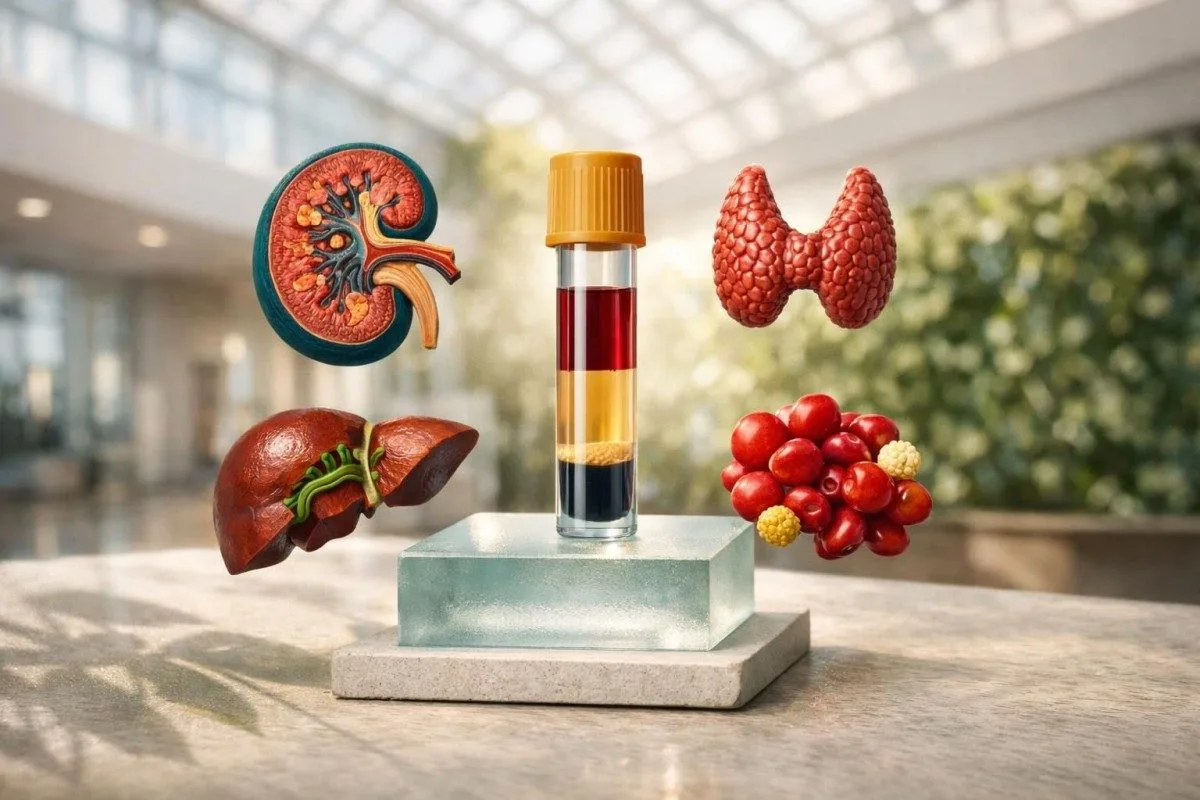
The lab range is a starting point, not a verdict. A creatinine of 1.0 mg/dL, ferritin of 25 ng/mL, or TSH of 3.8 mIU/L can be reassuring, misleading, or urgent depending on whose result it is.


- Reference interval usually means the central 95% of a selected population, so about 1 in 20 healthy people will fall outside it by design.
- Ferritin below 30 ng/mL often supports iron deficiency, even before hemoglobin drops and even when the lab still prints normal.
- TSH of 3.8 mIU/L may be acceptable in one adult but handled more cautiously in first-trimester pregnancy, where many clinicians still aim below 2.5 mIU/L.
- Creatinine rising by 0.3 mg/dL within 48 hours meets one acute kidney injury criterion, even if the final number still sits inside the reference range.
- Biotin at 5,000-10,000 mcg/day can distort some thyroid and troponin immunoassays and create falsely reassuring or alarming results.
- ALT upper limits are often too broad; several experts consider roughly 19-25 IU/L in women and 29-33 IU/L in men closer to truly healthy values.
- eGFR below 60 mL/min/1.73 m² for at least 3 months suggests chronic kidney disease, but creatinine alone can miss this in people with low muscle mass.
- Blood test trend analysis becomes useful after 3 comparable results; 5 or more makes your personal baseline much clearer.
- Borderline B12 in the 200-300 pg/mL range can still fit real symptoms, especially if methylmalonic acid or homocysteine is abnormal.
Why the same blood test result can mean different things
A personalized blood test means reading your result against your baseline, not just the printed range. The same ferritin, TSH, creatinine, or ALT can be reassuring, misleading, or urgent once we factor in age, sex, medications, symptoms, timing, and prior results.
Most people are handed a lab report and told only whether a number is high or low. At Kantesti AI, we see every day that a single snapshot often misses what real lab trends over time make obvious.
Take TSH. A value of 3.8 mIU/L may be acceptable in an asymptomatic older adult, too high for someone with thyroid symptoms and positive TPO antibodies, and usually handled more cautiously in the first trimester of pregnancy, where many clinicians still aim below 2.5 mIU/L.
As of April 17, 2026, the safest interpretation is still contextual rather than automatic. As Thomas Klein, MD, I keep seeing patients told normal after a ferritin of 22 ng/mL, even though the combination of hair shedding, fatigue, and a falling MCV makes early iron depletion much more likely than the lab flag suggests.
A printed range is a starting point, nothing more. An ALP of 180 U/L worries me very differently in a growing 14-year-old than it does in a sedentary 64-year-old with weight loss, and that is exactly why baseline matters.
How labs build reference ranges—and why they miss individuals
Labs usually build a reference interval from the central 95% of results in a selected healthy population. That approach is useful, but it is blunt, and blunt tools miss individual physiology all the time.
About 1 in 20 healthy people will fall outside a reference range by design, which is one reason a standard blood test can mislead when used as a verdict rather than a clue. That false-alarm rate is built into the math, not a sign that the patient did something wrong.
Reference populations are not universal. The Kantesti team reviews reports from 127+ countries, and the upper limit for ALT may sit near 35 U/L in one lab and 55 U/L in another even before you account for sex-specific recommendations.
Prati and colleagues argued years ago that truly healthy ALT limits are lower than many legacy ranges—roughly 19-25 IU/L in women and 29-33 IU/L in men. Some European labs have moved closer to that; others still report broader cutoffs, so the same ALT of 41 IU/L may be flagged on one report and ignored on another.
Pre-analytic noise adds another layer. Hydration, posture, recent exercise, tourniquet time, and sample handling can nudge albumin, hematocrit, potassium, lactate, and bilirubin enough to change the story, and a clenched fist during collection can push potassium up by roughly 0.2-0.4 mmol/L.
Why blood test trend analysis often beats a single snapshot
Serial results show direction and rate of change, and that is often more clinically useful than one isolated number. In plain language: a trend can be abnormal before a value looks abnormal.
Many biomarkers have a personal set point and relatively small within-person variation. Fraser’s work on biological variation is why laboratorians talk about reference change value, and that is exactly why patients who track blood test results online usually understand their health faster than patients who collect disconnected PDFs.
For several routine markers, the index of individuality is low enough that your own baseline beats a broad population interval. A creatinine rise from 0.7 to 1.0 mg/dL may still print as normal, yet that 43% jump is not something we shrug off.
The same logic applies to a platelet count drifting from 280 to 150 ×10^9/L or an ALT moving from 18 to 34 IU/L. If those shifts happen under similar conditions, they carry more weight than a lonely value that happens to brush the lab cutoff.
Assay noise is real, so technique matters. If one HbA1c is run at Lab A and the next at Lab B, a difference of 0.2-0.3 percentage points can be method noise; a move from 5.5% to 6.1% under matched conditions is far harder to dismiss.
How age, sex, cycle timing, and muscle mass reframe a value
Age and sex change interpretation because physiology changes the baseline before disease ever enters the picture. Hemoglobin, ferritin, creatinine, ALP, lipids, and hormones all behave differently across life stages.
Adult hemoglobin usually sits around 13.5-17.5 g/dL in men and 12.0-15.5 g/dL in women, and pregnancy, altitude, and hydration move those numbers further. That is why our hemoglobin range guide is more useful than a single universal cutoff.
Hormones are even more context-sensitive. Estradiol can be completely ordinary at 40 pg/mL on one cycle day and unexpectedly low or high on another, so timing matters; our estradiol timing guide shows why phase of cycle often matters as much as the value itself.
Then there is creatinine. A muscular 28-year-old man on creatine may live around 1.2 mg/dL for years, while a frail 82-year-old with sarcopenia can have a deceptively fine creatinine of 0.8 mg/dL despite reduced kidney reserve.
We see the same effect with ALP and ferritin. ALP is often higher in adolescents and late pregnancy, and ferritin tends to run lower in menstruating adults, so a ferritin of 25 ng/mL is not interchangeable across sexes and life stages.
Which medications, supplements, and timing can distort a personalized blood test
Medications and supplements change blood tests in two ways: they alter physiology, or they interfere with the assay itself. If you ignore that, you can misread a perfectly real number.
The classic example is biotin. Many hair and nail products contain 5,000-10,000 mcg daily, enough to distort some thyroid and troponin immunoassays, which we cover in our biotin and thyroid testing article.
Short courses of prednisone can raise neutrophils within hours through demargination, sometimes by 2-5 ×10^9/L without any infection at all. Before a panel, review the basics in our fasting blood test guide, because coffee, dehydration, and a hard workout the day before can change glucose, triglycerides, AST, CK, BUN, and hematocrit.
Everyday prescriptions matter too. Metformin and proton-pump inhibitors can lower vitamin B12 over time, oral estrogen can increase thyroid-binding globulin and total T4, and amiodarone can raise TSH, free T4, liver enzymes, or all three.
Supplements complicate this further. Creatine can raise creatinine by roughly 0.1-0.3 mg/dL in some users without kidney injury, and statins can nudge AST and CK, especially after strenuous exercise; the evidence is honestly mixed on the exact size of the shift, but the direction is real enough that I never interpret the panel blind.
Why symptoms and lab patterns matter more than one out-of-range number
Isolated mild abnormalities are often less important than a pattern of related changes plus symptoms. Diseases usually disturb clusters of markers, not single pixels.
If ferritin is 22 ng/mL, MCV is drifting below 84 fL, RDW is above 14.5%, and platelets are nudging upward, early iron deficiency becomes much more likely even if hemoglobin is still normal. That is why serum iron alone often misleads in our iron interpretation guide.
I see this pattern in runners all the time. A 52-year-old marathoner with AST 89 IU/L, ALT 31 IU/L, CK 620 U/L, and normal bilirubin is more likely showing muscle release than primary liver disease, and our AST clue guide explains why the AST-to-context ratio matters.
The reverse also happens. A mild ALT rise becomes more concerning when GGT and ALP are also up, just as a borderline white count matters more when CRP is high and the symptoms fit infection or tissue response.
This is one of those areas where context matters more than the number. When results and symptoms do not line up, the practical move is to repeat the test under matched conditions and add the related markers that complete the pattern.
What your blood test history reveals that the lab range cannot
Your blood test history creates a personal set point, and deviation from that set point can matter before the report turns red. In clinic, this is often the clue that separates noise from early disease.
On our AI blood test platform, a creatinine rise of 0.3 mg/dL within 48 hours is treated seriously because KDIGO uses that change as one criterion for acute kidney injury, even when the final creatinine still looks ordinary. The same logic applies to a platelet count dropping from 320 to 170 ×10^9/L or sodium sliding from 141 to 136 mmol/L in the right clinical context.
Hospital labs use delta checks for the same reason: they compare a new result with prior ones and ask whether the gap is biologically plausible. Our clinical validation standards describe how unit normalization, specimen type, and assay method are handled so a sodium of 139 mmol/L is not naively compared with a differently reported panel.
A personal baseline also helps with follow-up timing. TSH usually needs about 6 weeks after a levothyroxine dose change, ferritin is often rechecked in 6-8 weeks after iron treatment, and HbA1c needs roughly 8-12 weeks to reflect a meaningful lifestyle or medication shift.
When I, Thomas Klein, review serial panels, the question is rarely Is this abnormal. It is usually Is this new, is it sustained, and does it fit the rest of the physiology.
When a normal blood test result is not actually reassuring
A normal-looking result can miss early disease when the wrong test is ordered, the value is borderline for your physiology, or related markers are ignored. Normal is a distribution statement, not an all-clear.
A creatinine that looks ordinary can coexist with an eGFR below 60 mL/min/1.73 m², especially in older adults with low muscle mass. Our low GFR with normal creatinine guide shows why kidney function is often underestimated when clinicians look only at creatinine.
Borderline results are another trap. A vitamin B12 level of 200-300 pg/mL is often called low-normal, yet neuropathy, glossitis, or cognitive symptoms can still be real, and our B12 interpretation article explains why methylmalonic acid or homocysteine can settle the argument.
Ferritin behaves similarly. A ferritin of 25 ng/mL may fit the lab interval and still line up with hair shedding, restless legs, or exercise intolerance, while a calcium of 10.2 mg/dL looks less innocent if PTH is not suppressed.
Troponin is another classic example. A single normal value early after chest pain does not reliably exclude myocardial injury; what matters is the rise or fall over time, the assay used, and the clinical picture.
How Kantesti AI turns a generic report into personalized interpretation
Kantesti AI personalizes interpretation by reading the actual report, standardizing units, layering age and sex context, and comparing serial values rather than scoring each number in isolation. That sounds technical, but the clinical goal is simple: make the result fit the person.
If you want to see how we parse a report safely, our PDF upload guide walks through the process from photo or file to interpretation in about 60 seconds. That same workflow now serves 2M+ users across 127+ countries and 75+ languages.
We built that workflow with physician oversight because pattern recognition without clinical guardrails is risky. Our Medical Advisory Board reviews edge cases, and as Thomas Klein, MD, I care most about the gray-zone results—ferritin 20-40 ng/mL, TSH 3-5 mIU/L, creatinine shifts that stay normal, and panels altered by supplements or recent illness.
Under the hood, Kantesti's neural network maps biomarkers to physiology instead of treating them as isolated rows. The method is outlined in our AI technology guide, and it is powered by our 2.78T-parameter health AI.
We are careful about limits. Bad scans, missing collection times, pregnancy, pediatric panels, and rapidly changing acute illness can still require direct clinician review, which is why our CE-marked, HIPAA-, GDPR-, and ISO 27001-aligned workflow is built to support decision-making rather than replace it.
How to build a blood test history your doctor can actually use
The best baseline comes from consistent testing conditions, not from endless testing. Same lab if possible, same time of day, similar fasting status, a short symptom log, and at least 3 comparable results will get you surprisingly far.
Start with boring consistency. If you want a reminder of how strongly fluids can skew chemistry, read our dehydration and false-high guide; albumin, calcium, BUN, hemoglobin, and hematocrit can all look higher than they really are when the draw follows poor hydration.
Keep a tiny note with each result: cycle day, infection, fever, alcohol, a race or heavy gym session, new supplements, and medication changes. Our symptom decoder helps patients pair symptoms with the right follow-up markers, which matters because serum iron after a rushed breakfast is simply not comparable with a fasting morning draw.
Three comparable results are usually enough to start a trend, and five are better. If you want to track blood test results without hand-building spreadsheets, try our free blood test demo and upload the same markers over time so the pattern—not just the flag—becomes visible.
Most patients find this surprisingly calming. Once you can see that your ALT always sits around 17-22 IU/L or that your ferritin predictably dips every winter, a mild wobble becomes easier to interpret and true changes stand out faster.
Research publications and deeper reading
If you want marker-level detail, start with red-cell distribution and kidney pattern papers because personalized interpretation often hinges on relationships and trends, not isolated numbers. These are useful complements when you want to go deeper than a standard lab handout.
We keep related updates on the Kantesti blog, where articles are revised as lab practice changes and new clinical edge cases appear.
RDW Blood Test: Complete Guide to RDW-CV, MCV & MCHC. (2025). Zenodo. DOI record: https://doi.org/10.5281/zenodo.18202598. Searchable ResearchGate record. Searchable Academia.edu record.
BUN/Creatinine Ratio Explained: Kidney Function Test Guide. (2025). Zenodo. DOI record: https://doi.org/10.5281/zenodo.18207872. Searchable ResearchGate record. Searchable Academia.edu record.
Frequently Asked Questions
What is a personalized blood test?
A personalized blood test is not a different tube or special lab panel; it is a way of interpreting results against your own baseline, age, sex, symptoms, medications, and prior values. A creatinine of 1.0 mg/dL can be ordinary if it has been stable for years, but concerning if it rose from 0.7 mg/dL in 48 hours. Most labs print population reference intervals, usually the middle 95% of selected healthy adults. Personalized interpretation asks whether the value is normal for you, not just whether it sits between two printed numbers.
Can a normal blood test still mean something is wrong?
Yes. A ferritin of 25 ng/mL, a vitamin B12 of 240 pg/mL, or a creatinine that looks normal with an eGFR below 60 mL/min/1.73 m² can still fit real symptoms or early disease. This is especially common when related markers are ignored, the sample timing is off, or the patient has an unusual baseline because of age, sex, muscle mass, pregnancy, or medication use. A normal range is a population tool, not a guarantee that nothing is wrong.
How many previous results are enough for blood test trend analysis?
Three comparable results are usually enough to start useful blood test trend analysis, and five or more make the personal baseline much clearer. Comparable means the same marker, similar collection time, similar fasting status, and ideally the same laboratory method. In practice, a trend from ferritin 18 to 24 to 31 ng/mL tells me more than one isolated ferritin of 24 ng/mL. The same is true for creatinine, HbA1c, ALT, platelets, and TSH.
Should I use the same lab each time I track blood test results?
Yes, when you can. Different analyzers and calibration methods can create small differences, and for markers like HbA1c a shift of 0.2-0.3 percentage points may reflect method variation rather than biology. Using the same lab reduces that noise and makes your baseline cleaner. If you must switch labs, compare units carefully and treat small changes more cautiously.
Which supplements or medicines most often distort blood tests?
Biotin, prednisone, creatine, statins, metformin, proton-pump inhibitors, oral estrogen, and amiodarone are frequent troublemakers. Biotin at 5,000-10,000 mcg daily can distort some thyroid and troponin immunoassays, while prednisone can raise neutrophils within hours without infection. Creatine may push creatinine up by about 0.1-0.3 mg/dL, and metformin or PPIs can lower vitamin B12 over time. The safest habit is to record the drug name, dose, and last dose time with every panel.
When is a change in blood test results urgent?
Urgency depends on both the value and the rate of change. A creatinine rise of 0.3 mg/dL within 48 hours, potassium above 6.0 mmol/L or below 2.5 mmol/L, sodium below 125 mmol/L, a new troponin rise, or a hemoglobin drop of more than 2 g/dL with symptoms deserves prompt medical attention. A single borderline result without symptoms is different from a fast shift with weakness, chest pain, shortness of breath, confusion, or fainting. In my experience, it is the combination of speed plus symptoms that gets missed most often.
How does Kantesti AI use blood test history?
Kantesti AI uses blood test history by extracting markers from a PDF or photo, normalizing units, and comparing serial values rather than grading each number alone. Our system weighs age, sex, medication context, and related biomarker patterns so a stable creatinine of 1.2 mg/dL is not treated the same way as a new rise from 0.8 to 1.2 mg/dL. That is especially useful for gray-zone results such as ferritin 20-40 ng/mL, TSH 3-5 mIU/L, or mild ALT changes. Across 2M+ users, the practical value is simple: patterns become visible faster.
Can at-home blood test kits be used to build a personal baseline?
They can help track a trend when you use the same validated kit and collect samples under similar conditions, but results may not be interchangeable with venous laboratory testing. Confirm unexpected, persistent, or clinically significant results with a clinician-ordered laboratory test.
Can I compare blood test results from different countries if the units or reference ranges are different?
Yes, but compare them only after confirming the units and test method, because values like glucose, cholesterol, ferritin, and vitamin D may be reported differently. Keep the original report so your doctor or AI tool can interpret the number accurately.
Can dehydration make my kidney or blood count results look abnormal?
Yes. Dehydration can concentrate the blood and temporarily raise creatinine, urea/BUN, sodium, albumin, or hematocrit, making results look worse than your true baseline. If you were ill, sweating, or drinking little, ask whether a repeat test after rehydration makes sense.
Get AI-Powered Blood Test Analysis Today
Join over 2 million users worldwide who trust Kantesti for instant, accurate lab test analysis. Upload your blood test results and receive comprehensive interpretation of 15,000+ biomarkers in seconds.
📚 Referenced Research Publications
Klein, T., Mitchell, S., & Weber, H. (2026). RDW Blood Test: Complete Guide to RDW-CV, MCV & MCHC. Kantesti AI Medical Research.
Klein, T., Mitchell, S., & Weber, H. (2026). BUN/Creatinine Ratio Explained: Kidney Function Test Guide. Kantesti AI Medical Research.
⚕️ Medical Disclaimer
This article is for educational purposes only and does not constitute medical advice. Always consult a qualified healthcare provider for diagnosis and treatment decisions.
E-E-A-T Trust Signals
Experience
Physician-led clinical review of lab interpretation workflows.
Expertise
Laboratory medicine focus on how biomarkers behave in clinical context.
Authoritativeness
Written by Dr. Thomas Klein with review by Dr. Sarah Mitchell and Prof. Dr. Hans Weber.
Trustworthiness
Evidence-based interpretation with clear follow-up pathways to reduce alarm.