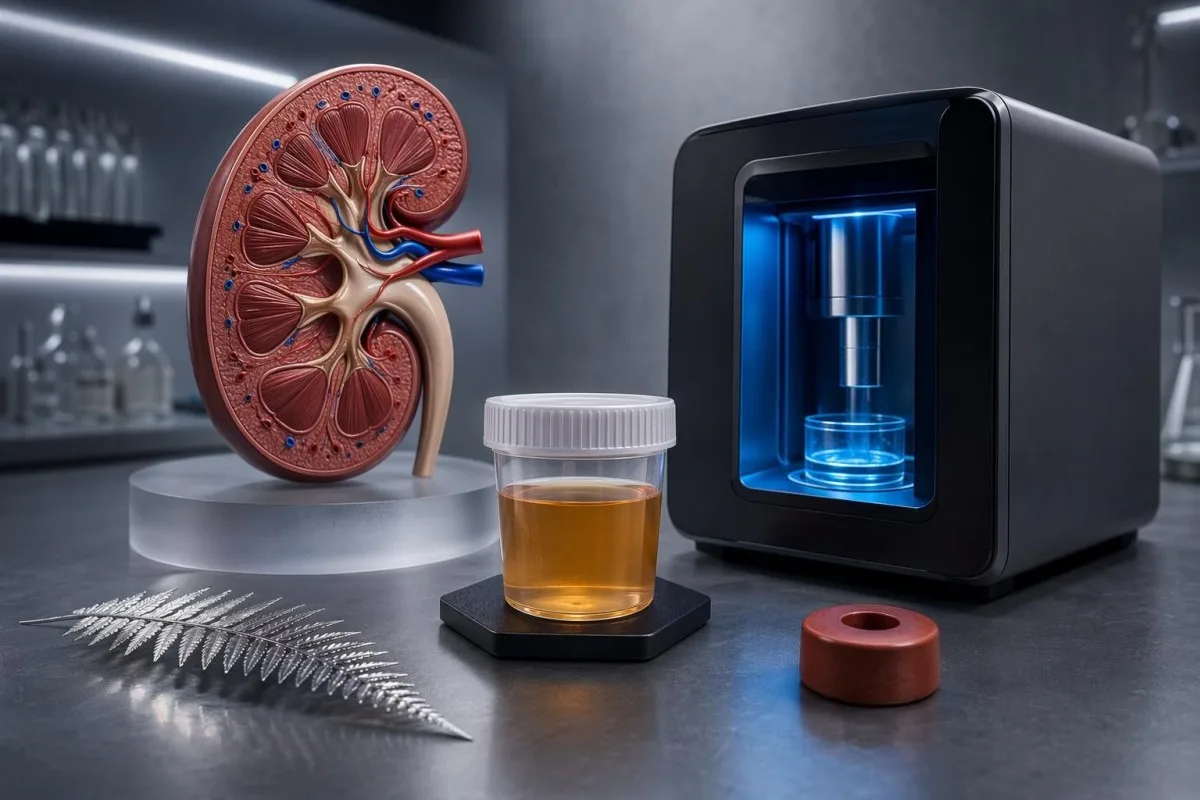
Urine concentration only becomes clinically useful when it is read beside serum sodium, serum osmolality and urine sodium. That pattern can separate dehydration from excess water intake, SIADH, diabetes insipidus and kidney concentrating failure.


- Urine osmolality test measures urine particle concentration in mOsm/kg and shows whether the kidneys are conserving or dumping water.
- Urine osmolality normal range is broad: roughly 50–1200 mOsm/kg, with many random daytime samples landing around 300–900 mOsm/kg.
- Low urine osmolality below 100 mOsm/kg usually means very dilute urine from excess water intake, low solute intake, or appropriate water excretion.
- High urine osmolality above 800 mOsm/kg often supports dehydration or water conservation if serum sodium and clinical signs fit.
- SIADH pattern is low serum sodium, low serum osmolality, urine osmolality above 100 mOsm/kg, and urine sodium usually above 30 mmol/L.
- Diabetes insipidus pattern is high or high-normal serum sodium with urine osmolality often below 300 mOsm/kg despite thirst and large urine volumes.
- Kidney concentrating problems often produce urine osmolality near plasma, about 250–350 mOsm/kg, even when the body needs concentrated urine.
- Urine sodium below 20–30 mmol/L supports salt and water conservation, while values above 30–40 mmol/L shift suspicion toward SIADH, diuretics or renal salt loss.
What the urine osmolality test actually measures
A urine osmolality test measures how many dissolved particles sit in 1 kg of urine, and it helps explain whether the kidneys are saving water, losing water, or responding inappropriately. High urine osmolality usually means concentrated urine; low urine osmolality means dilute urine. The result is most useful when paired with serum sodium, serum osmolality and urine sodium.
In clinic, I rarely treat a urine osmolality number as a stand-alone answer. A result of 850 mOsm/kg can be a normal early-morning finding, a dehydration clue after vomiting, or a worrying SIADH clue if the serum sodium is 124 mmol/L.
Kantesti is an AI blood test interpretation platform that reads fluid-balance clues across blood and urine results, not as isolated flags. As Thomas Klein, MD, I see the same mistake often: a patient panics over “high” urine concentration when the real story is simply a low fluid day or a long overnight fast.
Urine osmolality is more precise than urine specific gravity because it measures particle number rather than urine density. If your report also lists specific gravity, our guide to urine specific gravity explains why glucose, protein and contrast dye can distort density more than osmolality.
A practical anchor: serum osmolality is usually about 275–295 mOsm/kg, while urine can swing from under 100 to over 1000 mOsm/kg in the same healthy person. That huge swing is exactly why the test is useful.
Urine osmolality normal range and why it is so wide
The usual urine osmolality normal range is about 50–1200 mOsm/kg, but random adult samples commonly sit around 300–900 mOsm/kg. A single value is not “good” or “bad” until you know fluid intake, time of day, serum sodium and the reason the test was ordered.
Morning urine is often concentrated because overnight antidiuretic hormone, also called vasopressin, rises and water intake stops for 6–10 hours. A first-morning osmolality of 700–1000 mOsm/kg can be entirely appropriate in a healthy adult.
After drinking 1–2 litres of water quickly, urine osmolality may fall below 100–200 mOsm/kg within a few hours if kidney function is intact. That is not kidney failure; it is the kidney doing its job by clearing free water.
Some labs print narrower reference intervals, such as 300–900 mOsm/kg, because they are describing random outpatient specimens rather than the full physiologic range. If your report uses unfamiliar units or flags, the Kantesti biomarker guide can help decode the reporting style.
I tell patients to ask, “Was my urine supposed to be concentrated at that moment?” That one question prevents a lot of unnecessary anxiety about a number that changes hourly.
Low urine osmolality: when urine is too dilute
Low urine osmolality means the urine contains fewer dissolved particles than expected, often below 100–300 mOsm/kg. The main possibilities are excess water intake, low dietary solute, diabetes insipidus, recovery from acute kidney injury, or a kidney tubule problem.
A urine osmolality under 100 mOsm/kg with low serum sodium usually points toward primary polydipsia or very low solute intake, sometimes called “tea and toast” physiology. The kidney is trying to dump water, but it cannot excrete unlimited water without enough sodium, potassium and urea to carry it.
A urine osmolality under 300 mOsm/kg with serum sodium above 145 mmol/L is a very different pattern. That combination raises concern for diabetes insipidus or impaired thirst access, especially when daily urine volume exceeds 3 litres in adults.
I see this pattern in endurance athletes who overcorrect hydration advice. Someone drinks constantly, eats lightly, and arrives dizzy with sodium at 128 mmol/L and urine osmolality at 70 mOsm/kg; the urine result proves the kidney is trying to protect them by excreting water.
Constant thirst deserves a wider check than urine concentration alone. Our article on constant thirst labs covers glucose, calcium and sodium patterns that can mimic or coexist with dilute urine.
High urine osmolality and dehydration clues
High urine osmolality usually means the kidneys are conserving water, and values above 800–900 mOsm/kg often support dehydration if the person has thirst, dry mouth, low urine output or a rising BUN. It does not prove dehydration by itself.
True dehydration usually creates a coordinated pattern: urine osmolality rises, urine volume falls, BUN may rise out of proportion to creatinine, and urine sodium often drops below 20–30 mmol/L. The body is squeezing every reasonable drop of water back into circulation.
A 52-year-old runner I reviewed after a hot race had urine osmolality of 1015 mOsm/kg, sodium 146 mmol/L, and BUN/creatinine ratio above 25:1. That pattern was much more convincing than urine colour, which can be dark from vitamins, ketones or morning concentration.
Albumin and hematocrit may look mildly high when plasma volume is contracted. If your chemistry panel shows high albumin alongside concentrated urine, our guide to albumin and dehydration explains why that cluster is often reversible.
The caution: high urine osmolality also happens after a high-protein meal, mannitol, glycosuria, radiology contrast or marked urea generation. Dehydration is a pattern, not a single lab adjective.
Pairing urine osmolality with serum sodium
Serum sodium tells you whether the body has too much water relative to salt, too little water, or a mixed problem. A urine osmolality test becomes clinically powerful when serum sodium is below 135 mmol/L or above 145 mmol/L.
When serum sodium is low, concentrated urine is often inappropriate unless there is true volume depletion. The 2013 hyponatremia expert panel by Verbalis et al. emphasized serum osmolality, urine osmolality and urine sodium as the first diagnostic split in hypotonic hyponatremia.
When serum sodium is high, dilute urine is inappropriate. A serum sodium of 150 mmol/L with urine osmolality of 150 mOsm/kg means the kidneys are failing to conserve water, which is the classic diabetes insipidus direction until proven otherwise.
Kantesti AI interprets sodium patterns by comparing the direction of serum sodium, urine concentration, kidney markers and medication context. For a deeper look at high sodium patterns, see our guide to high sodium causes.
Normal serum sodium, around 135–145 mmol/L, does not make urine osmolality meaningless; it simply lowers the urgency. In that setting, trends and symptoms usually matter more than one random urine result.
Why urine sodium changes the interpretation
Urine sodium shows whether the kidney is conserving salt, and it often separates dehydration from SIADH. A urine sodium below 20–30 mmol/L supports sodium conservation; a value above 30–40 mmol/L suggests SIADH, diuretics, adrenal problems or renal salt wasting in the right setting.
In vomiting, diarrhoea or poor intake, the kidney usually lowers urine sodium to protect circulating volume. If urine osmolality is 900 mOsm/kg and urine sodium is 10 mmol/L, dehydration or effective volume depletion becomes much more likely.
In SIADH, urine sodium is often above 30 mmol/L because total body volume is not truly depleted. The kidney is not desperately holding sodium, even though the urine remains too concentrated for a low serum sodium state.
Diuretics complicate this neatly drawn map. A thiazide can push urine sodium above 40 mmol/L while the patient is actually volume depleted, which is why medication timing from the last 24–48 hours matters.
Kidney markers help when urine sodium looks contradictory. Our explainer on BUN versus urea is useful for readers comparing US, UK and European reports.
SIADH pattern: concentrated urine with low sodium
SIADH typically shows low serum sodium, low serum osmolality below 275 mOsm/kg, urine osmolality above 100 mOsm/kg, and urine sodium usually above 30 mmol/L. The key clue is that the urine stays concentrated when it should be dilute.
The European hyponatraemia guideline by Spasovski et al. in 2014 uses urine osmolality >100 mOsm/kg as an early branch point in hypotonic hyponatremia. In plain English: if sodium is low and urine is not dilute, vasopressin is probably active.
Common SIADH triggers include pneumonia, central nervous system disease, severe nausea, pain, postoperative states and medicines such as SSRIs, carbamazepine and some chemotherapy agents. In older adults, I have seen sodium drift from 136 to 126 mmol/L over 2–3 weeks after a new antidepressant.
SIADH is a diagnosis of exclusion. Adrenal insufficiency and hypothyroidism can mimic it, and a morning cortisol or thyroid panel may be needed before the label is safe; our guide to low cortisol symptoms explains one of the common traps.
The dangerous part is correction speed. Chronic sodium below 120 mmol/L may need hospital care because raising sodium too quickly can injure brain cells, even when the patient initially feels only tired or foggy.
Diabetes insipidus pattern: dilute urine despite thirst
Diabetes insipidus is suggested when urine stays dilute, often below 300 mOsm/kg, despite high serum sodium, high serum osmolality, intense thirst and large urine volumes. Adult urine output above 3 litres/day is a common practical threshold.
Central diabetes insipidus means the brain is not releasing enough vasopressin; nephrogenic diabetes insipidus means the kidney is not responding to it. Lithium, chronic high calcium, low potassium and some inherited kidney channel problems can create the nephrogenic pattern.
The 2018 NEJM study by Fenske et al. showed that copeptin-based testing can distinguish central diabetes insipidus from primary polydipsia more accurately than older water-deprivation approaches in many patients. Copeptin is a stable surrogate marker for vasopressin release.
A classic pattern is sodium 148–155 mmol/L, serum osmolality above 295 mOsm/kg, urine osmolality 80–250 mOsm/kg, and constant waking to urinate. If night urination is your main symptom, our guide to night urination labs covers glucose, kidney and prostate-related clues too.
Do not attempt a water-deprivation test at home. In true diabetes insipidus, withholding water can drive sodium upward quickly, and a supervised protocol is safer.
Kidney concentrating problems and fixed osmolality
Kidney concentrating problems often produce urine osmolality that sits near plasma, roughly 250–350 mOsm/kg, even when the body needs more dilution or concentration. This pattern is sometimes called isosthenuria and suggests tubular concentrating limits.
Chronic kidney disease, tubulointerstitial disease, sickle cell trait, lithium exposure and longstanding obstruction can blunt the medullary gradient that concentrates urine. A patient may report nocturia for years before creatinine becomes obviously abnormal.
A urine osmolality of 300 mOsm/kg is not automatically normal. If serum sodium is 150 mmol/L, it is too low; if serum sodium is 122 mmol/L, it is too high; if kidney function is reduced, it may show the kidney cannot move far from plasma tonicity.
Creatinine and eGFR add important context, but they do not fully measure tubular concentrating ability. Our guide to eGFR by age explains why a “normal” filtration number can still miss early tubular or medullary problems.
One subtle clue is loss of first-morning concentration. If repeated first-morning urine osmolality remains under 400 mOsm/kg despite no overnight drinking, clinicians may consider a renal concentrating defect, especially with nocturia.
Symptoms and red flags that change urgency
Urine osmolality results become urgent when they occur with severe sodium abnormalities, confusion, fainting, seizures, very low urine output or extreme thirst. Serum sodium below 125 mmol/L or above 150 mmol/L usually deserves same-day medical review.
Low sodium can cause headache, nausea, gait instability, confusion and seizures, especially when the fall happens over less than 48 hours. A person with sodium 118 mmol/L and new confusion should not wait for an outpatient message.
High sodium often causes intense thirst, irritability, weakness and reduced alertness. The most vulnerable patients are infants, older adults, people without reliable water access, and anyone with impaired thirst or cognition.
Low urine output matters too. Producing less than about 400–500 mL/day in an adult, especially with rising creatinine or potassium, is a different problem from passing large volumes of dilute urine.
Dizziness after diarrhoea, heat exposure or medication changes often reflects more than one lab shift. Our guide to dizziness lab clues walks through anemia, glucose and salt patterns that can overlap with osmolality results.
Collection timing, prep and common false clues
Urine osmolality should be interpreted with the collection time, recent fluid intake, diet, exercise and medications. A random sample after drinking 1 litre of water and a first-morning sample after 8 hours without fluids can look completely different in the same healthy person.
For dehydration questions, a first-morning urine sample can be informative because it tests overnight concentrating ability. For suspected diabetes insipidus, clinicians often prefer paired blood and urine samples taken at the same time, because sodium and urine concentration must be compared directly.
Caffeine and alcohol can change urine volume, but they are rarely the whole explanation for extreme values. Diuretics, SGLT2 inhibitors, lithium, mannitol, high glucose and recent IV fluids are much more likely to distort the pattern.
Heavy exercise can raise urine concentration through sweating and vasopressin release. After a long run, urine osmolality above 900 mOsm/kg may reflect appropriate water conservation rather than kidney disease.
If your urine report includes many dipstick fields, osmolality is only one part of the urinalysis story. Our urinalysis guide explains how protein, glucose, ketones and microscopic findings can change the interpretation.
Other labs that sharpen the diagnosis
The best follow-up labs for an abnormal urine osmolality test are serum sodium, potassium, chloride, bicarbonate or CO2, BUN or urea, creatinine, glucose, calcium, serum osmolality and urine sodium. These tests separate water balance from kidney filtration, salt balance and endocrine causes.
Potassium matters because low potassium can impair kidney concentrating ability and mimic partial nephrogenic diabetes insipidus. A potassium of 3.0 mmol/L with polyuria is not a footnote; it may be part of the mechanism.
Calcium matters for the same reason. Persistent calcium above 2.60 mmol/L or 10.4 mg/dL can reduce responsiveness to vasopressin and cause thirst, constipation and frequent urination.
Kantesti is an AI-powered blood test analysis tool used by people in more than 127 countries, so our reports handle both BUN and urea terminology. If your kidney panel timing is confusing, our guide to renal panel fasting explains which values shift after meals.
Chloride and bicarbonate add acid-base context. Vomiting often lowers chloride and raises bicarbonate, while diarrhoea can lower bicarbonate; those two patterns can both produce dehydration but demand different clinical thinking.
How Kantesti AI reads fluid-balance patterns
Kantesti AI pairs urine concentration with blood sodium, kidney markers, glucose, calcium, medicines and previous results to flag whether a result looks physiologic or mismatched. The goal is pattern recognition, not replacing a clinician who can assess volume status at the bedside.
Kantesti is an AI biomarker interpretation platform that can compare a current sodium of 132 mmol/L with a prior baseline of 140 mmol/L, then notice that urine osmolality is still 620 mOsm/kg. That trend often carries more clinical weight than a single flag.
Our methodology treats medication timing as structured context. A thiazide started 10 days ago, a new SSRI, or lithium exposure changes the probability map for hyponatremia, SIADH-like patterns and nephrogenic concentrating problems.
Kantesti’s neural network is benchmarked against synthetic and real-world lab scenarios, and our clinical validation page explains how physician oversight is built into that process. The technology guide gives more detail on how multi-marker reasoning is engineered.
I still tell patients to bring symptoms and fluid history to their doctor. An algorithm can see that sodium and osmolality conflict; a clinician can see dry mucous membranes, low blood pressure on standing, or new confusion.
Research, review standards and publication notes
As of July 3, 2026, our clinical approach to urine osmolality follows established hyponatremia and polyuria frameworks while adding practical lab-pattern education for patients. Research publications support transparency, but individual care still depends on symptoms, medicines and clinician review.
My review process as Thomas Klein, MD, starts with a safety question: could this sodium-water pattern be dangerous today? Sodium below 125 mmol/L, sodium above 150 mmol/L, seizures, severe confusion or inability to drink safely moves the result out of wellness interpretation and into urgent care.
Kantesti’s medical governance includes physician review and escalation logic for high-risk patterns. Our medical advisers help keep patient explanations aligned with current clinical standards rather than lab folklore.
For readers interested in our broader publication record, Kantesti has published related patient-education research on Figshare, including a digestive symptoms guide and a women’s health guide. Those papers are not urine osmolality guidelines, but they show the documentation style we use for complex symptom-and-lab interpretation.
The honest limit is that urine osmolality cannot replace an exam. If the lab pattern suggests SIADH, diabetes insipidus or acute dehydration, the next step is medical assessment, not simply drinking more or restricting water on your own.
Frequently Asked Questions
What does a urine osmolality test show?
A urine osmolality test shows how concentrated or dilute the urine is by measuring dissolved particles in mOsm/kg. Healthy kidneys can vary urine osmolality from below 100 mOsm/kg after heavy water intake to above 900–1000 mOsm/kg during dehydration or overnight water conservation. The result is most useful when compared with serum sodium, serum osmolality and urine sodium.
What is the normal range for urine osmolality?
The broad urine osmolality normal range is about 50–1200 mOsm/kg, while many random adult samples fall around 300–900 mOsm/kg. First-morning urine is often more concentrated, sometimes 700–1000 mOsm/kg, because fluid intake stops overnight. A value outside the printed lab range is not automatically dangerous unless the serum sodium, symptoms or clinical context make it inappropriate.
Does high urine osmolality mean dehydration?
High urine osmolality can support dehydration, especially when it is above 800–900 mOsm/kg with thirst, low urine volume, high-normal or high serum sodium, and urine sodium below 20–30 mmol/L. It does not prove dehydration by itself because high protein intake, glucose in urine, mannitol, contrast dye and overnight fasting can also concentrate urine. Dehydration is best diagnosed from a pattern of symptoms, exam findings and blood chemistry.
What does low urine osmolality mean with high sodium?
Low urine osmolality with high serum sodium is concerning because the kidneys should be conserving water. A serum sodium above 145 mmol/L with urine osmolality below 300 mOsm/kg suggests diabetes insipidus or impaired kidney concentrating response, especially if urine volume exceeds 3 litres per day. This pattern should be reviewed by a clinician because unsupervised water restriction can be unsafe.
How does SIADH appear on urine osmolality testing?
SIADH usually shows low serum sodium below 135 mmol/L, low serum osmolality below 275 mOsm/kg, urine osmolality above 100 mOsm/kg, and urine sodium often above 30 mmol/L. The defining clue is that urine remains too concentrated even though the blood sodium is low. Doctors also exclude adrenal insufficiency, thyroid disease, diuretic effects and kidney failure before confirming SIADH.
Can drinking too much water lower urine osmolality?
Yes, drinking a large amount of water can lower urine osmolality, often below 100–200 mOsm/kg within a few hours if kidney function is normal. If serum sodium is also low, the pattern may reflect primary polydipsia or low solute intake rather than diabetes insipidus. The risk rises when water intake exceeds the kidney’s excretion capacity or when the diet is very low in salt and protein.
Is urine osmolality the same as urine specific gravity?
Urine osmolality and urine specific gravity both describe urine concentration, but they measure different things. Osmolality counts dissolved particles in mOsm/kg, while specific gravity measures density and can be distorted by glucose, protein or contrast dye. Osmolality is usually preferred when doctors are evaluating hyponatremia, diabetes insipidus or kidney concentrating ability.
Which medications can affect a urine osmolality result?
Yes. Diuretics can increase urine sodium, while lithium can reduce the kidney's ability to concentrate urine; desmopressin changes urine concentration directly. Bring a complete medication and supplement list, but do not stop prescribed medicine unless the clinician who ordered the test tells you to.
Get AI-Powered Blood Test Analysis Today
Join over 2 million users worldwide who trust Kantesti for instant, accurate lab test analysis. Upload your blood test results and receive comprehensive interpretation of 15,000+ biomarkers in seconds.
📚 Referenced Research Publications
Klein, T., Mitchell, S., & Weber, H. (2026). Diarrhea After Fasting, Black Specks in Stool & GI Guide 2026. Kantesti AI Medical Research.
Klein, T., Mitchell, S., & Weber, H. (2026). Women's Health Guide: Ovulation, Menopause & Hormonal Symptoms. Kantesti AI Medical Research.
📖 External Medical References
⚕️ Medical Disclaimer
This article is for educational purposes only and does not constitute medical advice. Always consult a qualified healthcare provider for diagnosis and treatment decisions.
E-E-A-T Trust Signals
Experience
Physician-led clinical review of lab interpretation workflows.
Expertise
Laboratory medicine focus on how biomarkers behave in clinical context.
Authoritativeness
Written by Dr. Thomas Klein with review by Dr. Sarah Mitchell and Prof. Dr. Hans Weber.
Trustworthiness
Evidence-based interpretation with clear follow-up pathways to reduce alarm.