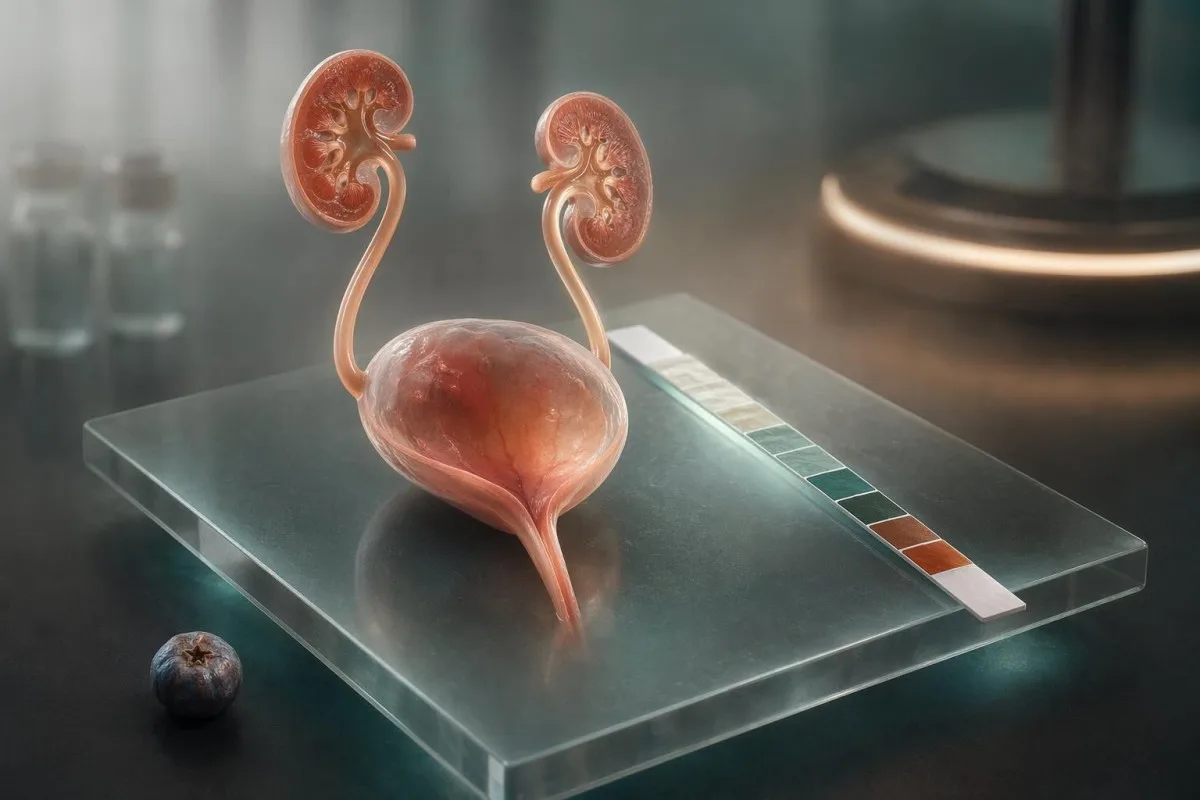
Leukocyte esterase usually means white blood cells have reached the urine, but it does not prove a bacterial UTI by itself. Symptoms, nitrites, collection quality and culture decide what the result really means.


- Leukocyte esterase in urine is a dipstick marker of white blood cell enzyme activity; negative is normal, while trace to 3+ suggests pyuria or contamination.
- Positive leukocyte esterase supports UTI most strongly when burning, frequency, urgency or cloudy urine are present at the same time.
- Leukocyte esterase and nitrites together are more convincing than either alone because nitrites suggest nitrate-reducing bacteria, while leukocyte esterase suggests immune cells.
- Trace leukocyte esterase in urine is often not enough to diagnose UTI if there are no symptoms, no nitrites and no visible bacteria on microscopy.
- False positives commonly come from vaginal discharge, menstrual fluid, poor midstream collection, trichomonas, urethritis, stones, catheters or bladder inflammation.
- Sterile pyuria means leukocytes are present but routine culture is negative; causes include stones, recent antibiotics, sexually transmitted infections and kidney inflammation.
- Urine culture is the tie-breaker when symptoms are atypical, pregnancy is present, fever or flank pain occurs, or dipstick results conflict.
- Urgent care signs include fever of 38°C or higher, flank pain, vomiting, confusion, pregnancy with symptoms, or visible blood with severe pain.
What a Positive Leukocyte Esterase Result Actually Means
Leukocyte esterase in urine turns positive when enzymes from neutrophils, a type of white blood cell, are detected on a urine dipstick. It suggests pyuria, not necessarily UTI. A true UTI becomes more likely when positive leukocyte esterase appears with urinary burning, urgency, frequency, nitrites or bacteria on microscopy.
In clinic, I explain this result as a smoke alarm, not a fire report. A dipstick can detect leukocyte esterase from intact or broken-down white cells, so it may stay positive even when microscopy shows only a few cells per high-power field.
Most laboratories report leukocyte esterase as negative, trace, 1+, 2+ or 3+, although the chemistry behind those labels differs by strip brand. A common microscopy threshold for pyuria is more than 5 white cells per high-power field or roughly 10 white cells per microlitre, but laboratories do not all use the same cut-off.
I’m Thomas Klein, MD, and I see the most confusion when patients treat a single dipstick pad as a diagnosis. Kantesti is an AI blood test analyzer that helps people understand lab patterns in context, and our clinical writing sits within who we are rather than replacing a clinician who can examine you.
When Leukocyte Esterase Points Toward a UTI
Positive leukocyte esterase suggests UTI when it matches the symptom pattern: burning on urination, new frequency, urgency, suprapubic discomfort or cloudy urine. In an otherwise healthy adult woman with classic symptoms and no vaginal discharge, the pre-test probability of cystitis is already high before the strip is dipped.
The 2004 BMC Urology meta-analysis by Devillé et al. found wide variation in dipstick accuracy, but the practical message still holds: leukocyte esterase is more useful when the clinical story already sounds urinary. A positive result in a person with dysuria and frequency carries a very different meaning from the same result during a routine check-up.
Timing matters. If someone has urinated every 20 minutes all morning, bacteria may not have had enough bladder dwell time to generate nitrite, but leukocyte esterase can still become positive from the immune response.
For a deeper comparison of screening versus confirmation, our guide to urinalysis and culture explains why a dipstick can be fast and useful yet still miss resistant organisms, mixed growth or non-bacterial causes.
Leukocyte Esterase and Nitrites: Why the Pair Matters
Leukocyte esterase and nitrites are strongest together because they answer different questions. Leukocyte esterase suggests white cells in urine, while nitrites suggest nitrate-reducing bacteria such as many Escherichia coli strains after several hours in the bladder.
Nitrites are specific but not very sensitive. Enterococcus, Staphylococcus saprophyticus and some Pseudomonas infections may be nitrite-negative, and nitrites can be negative when urine has sat in the bladder for less than about 4 hours.
Leukocyte esterase is more sensitive for pyuria but less specific for bacterial UTI. In the Devillé et al. meta-analysis, dipstick performance varied substantially across age groups and settings, which is one reason I dislike yes-or-no interpretations without symptoms.
If nitrites are confusing, our separate explainer on nitrites in urine goes into the bacterial chemistry and the common reasons a proven UTI can still have a nitrite-negative dipstick.
Trace Leukocyte Esterase in Urine: Recheck or Treat?
Trace leukocyte esterase in urine usually means a small leukocyte signal, not an automatic infection. If there are no urinary symptoms, no nitrites and no bacteria on microscopy, trace leukocyte esterase is often best handled with a clean repeat sample rather than immediate antibiotics.
Trace results are especially common after exercise, during menstruation, with vaginal discharge, after sexual activity or when the urine cup catches the first stream rather than the midstream portion. A low-grade pad reaction can also appear when white cells have lysed and are no longer easy to count under microscopy.
A practical recheck is simple: collect a midstream sample, deliver it within 2 hours, and avoid testing during active menstrual bleeding if the question is UTI. If the repeat is negative and symptoms are absent, most clinicians would not treat.
For readers who want the full dipstick context, including pH, protein, blood and urobilinogen, our complete urinalysis guide explains why single-pad interpretation is weaker than pattern reading.
Contamination, Vaginal Discharge and False Positives
Vaginal discharge and poor sample collection are among the most common reasons leukocyte esterase looks positive without a bladder UTI. The dipstick cannot tell whether leukocytes came from the bladder, urethra, vagina, skin or a contaminated collection cup.
One memorable case was a 28-year-old with repeated positive leukocyte esterase, no dysuria and three negative cultures. The turning point was asking about discharge and pelvic symptoms; her urine was being contaminated before it ever reached the lab.
Microscopy can help. Many squamous epithelial cells, often reported as more than 5 to 10 per high-power field, suggest the sample may include skin or genital tract material, although the exact threshold varies by laboratory.
When discharge, genital sores or new sexual exposure are present, a UTI dipstick is the wrong final test. A separate STD testing guide explains why chlamydia, gonorrhoea and trichomonas can cause urinary burning or sterile pyuria while routine urine culture stays negative.
Stones, Crystals and Sterile Pyuria
Kidney stones can cause leukocyte esterase to turn positive even when urine culture is negative. The stone irritates the urinary tract lining, draws in white cells and often causes blood on dipstick or microscopy at the same time.
A classic stone pattern is flank pain that comes in waves, microscopic blood, crystals and leukocyte esterase with negative nitrites. Fever changes the risk category completely; stone plus fever can mean an obstructed infected system, which is an emergency.
Sterile pyuria is usually defined as white cells in urine with no growth on standard culture. Common causes include stones, recent antibiotics, urethritis, interstitial cystitis, kidney tuberculosis in high-risk settings, autoimmune kidney disease and contamination.
Calcium oxalate crystals are not a UTI diagnosis, but they can be part of the stone story. Our guide to calcium oxalate crystals covers dehydration, diet, urine pH and when imaging becomes more useful than repeating dipsticks.
Pregnancy, Children and Older Adults Need Different Rules
Leukocyte esterase has different consequences in pregnancy, children and older adults because the harm of missing infection is different. Pregnant patients usually need urine culture confirmation, while children and older adults need symptom-specific interpretation rather than dipstick-only decisions.
In pregnancy, asymptomatic bacteriuria matters because untreated infection can increase the risk of pyelonephritis and pregnancy complications. Leukocyte esterase alone is not enough; culture is commonly used because contamination and vaginal leukocytes are frequent during pregnancy.
In older adults, leukocyte esterase is often over-interpreted. Bacteriuria without urinary symptoms becomes more common with age, and treating a dipstick rather than a patient can cause diarrhoea, drug reactions and resistant organisms.
Pregnancy lab interpretation often requires different thresholds across blood and urine testing. Our guide to pregnancy blood tests explains why fever, kidney function, anaemia and blood pressure can change the urgency of a urinary result.
Collection Technique: The Small Details That Change the Result
A leukocyte esterase result is only as reliable as the urine sample. Midstream clean-catch urine tested within 2 hours is more trustworthy than first-stream, delayed, leaked, refrigerated-then-warmed, or poorly labelled urine.
The middle of the stream matters because early urine washes urethral and skin cells into the cup. If the lab report shows many squamous epithelial cells, mucus and mixed flora, I usually ask for a repeat rather than arguing over the dipstick grade.
Delay changes chemistry. Urine left at room temperature for more than 2 hours can grow organisms, alter pH and degrade cells, while very dilute urine may reduce the concentration of leukocytes enough to soften the dipstick reaction.
Specific gravity gives a useful clue about dilution and concentration. If your report also lists concentrated or dilute urine, our specific gravity guide explains why a value around 1.005 means very dilute urine and 1.030 means concentrated urine in many labs.
When a Urine Culture Becomes the Tie-Breaker
Urine culture matters when symptoms are significant, the dipstick is mixed, the patient is pregnant, male, immunocompromised, catheterised, febrile or not improving. Culture identifies the organism and reports antibiotic susceptibility, which a leukocyte esterase pad cannot do.
The old culture threshold of 100,000 CFU/mL is useful for clean-catch screening but not absolute. In symptomatic women, 100 to 1,000 CFU/mL of a typical uropathogen can still be clinically meaningful, especially if collection was clean and pyuria is present.
Mixed growth is the phrase that frustrates patients. It usually means several organisms grew together, often from contamination, and the lab may not issue sensitivities unless one organism clearly predominates.
If your report lists colony counts, organism names or mixed flora, our plain-English urine culture guide walks through why Escherichia coli, Enterococcus and mixed growth lead to different next steps.
Treat, Wait or Seek Urgent Care?
A positive leukocyte esterase result should be treated urgently only when symptoms or risk factors make infection dangerous. Fever of 38°C or higher, flank pain, vomiting, pregnancy, confusion, sepsis features or severe pain with blood in urine should not wait for a routine recheck.
NICE lower UTI guidance uses symptoms such as dysuria, new nocturia and cloudy urine to decide when treatment is likely, while vaginal discharge lowers the probability of bacterial cystitis. This is exactly why symptom questions are not small talk; they change the maths.
Gupta et al. 2011 IDSA/ESCMID guidelines list nitrofurantoin 100 mg twice daily for 5 days as one first-line option for uncomplicated cystitis in appropriate patients, but antibiotic choice depends on allergies, kidney function, pregnancy, local resistance and culture results. Do not borrow leftover antibiotics for a positive strip.
When I, Thomas Klein, MD, see UTI-like symptoms in men, I also think about prostate irritation and recent instrumentation. Our article on PSA after UTI explains why urinary infection or inflammation can temporarily raise prostate-related blood markers.
Blood Tests That Change the Meaning of a Urine Result
Blood tests do not diagnose a simple bladder UTI, but they can change concern when leukocyte esterase is positive. A high white cell count, rising creatinine, low eGFR or markedly elevated CRP suggests the problem may be systemic, upper-tract or kidney-related rather than a minor bladder issue.
A white blood cell count above about 11.0 x 10⁹/L with neutrophilia supports a systemic immune response, especially with fever or rigors. A CRP above 50 mg/L is not specific, but in the right clinical setting it pushes me to ask about pyelonephritis, obstruction or another inflammatory source.
Kantesti is an AI lab test interpretation service that reads CBC, CRP, creatinine, eGFR and electrolytes together rather than treating each result as a lonely flag. For broader context, our biomarkers guide maps how common blood markers interact with urinary and kidney clues.
If the question is infection severity, our guide to infection blood tests compares CBC, CRP and procalcitonin so patients can understand why a doctor may escalate from a urine strip to bloodwork or imaging.
Medicines, Hydration and Strip Interference
Leukocyte esterase can be misleading when urine chemistry or medicines interfere with the dipstick reaction. Very concentrated urine, very dilute urine, high glucose, heavy protein, oxidising cleaners, phenazopyridine colour change and recent antibiotics can all distort the story.
Vitamin C is better known for false-negative nitrite or blood reactions, but some strip systems also show reduced sensitivity for leukocyte esterase at high urinary ascorbate levels. The evidence is strip-dependent, so I avoid giving a universal milligram cut-off.
Recent antibiotics are a classic trap. A patient may have persistent leukocytes for several days after bacterial counts fall, or a culture may be negative because antibiotics suppressed growth before the sample was collected.
Glucose, protein and ketones can travel with urinary symptoms in diabetes, dehydration or illness. Our guide to glucose in urine explains why sugar on a urine strip changes the risk conversation even when leukocyte esterase is the headline abnormality.
Home Dipsticks: Useful, but Easy to Overread
Home dipsticks can help people decide whether to seek care, but they are not reliable enough to diagnose or exclude UTI in every situation. Reading time, lighting, storage moisture and colour perception can change a leukocyte esterase pad within minutes.
Most leukocyte esterase pads are read at about 2 minutes, while nitrite pads are often read earlier, around 60 seconds depending on the brand. Reading too late can create a false impression because pads continue to darken as they dry.
Kantesti is not a urine-strip diagnosis app; in Kantesti workflows, uploaded blood results and longitudinal patterns are interpreted alongside the clinical question. Our technology guide explains how our AI handles units, reference intervals and result patterns rather than guessing from a single colour pad.
If you repeat home testing, write down symptoms, time since last urination, hydration, antibiotics and menstrual timing. Our lab result tracker is built around that same principle: context saved today prevents confused interpretation next month.
How We Review Urine Clues Inside a Wider Lab Story
As of July 3, 2026, our medical review approach treats leukocyte esterase as one clue inside a wider clinical and laboratory story. A urine dipstick can start the question, but symptoms, microscopy, culture, kidney function and medication history decide the answer.
Kantesti is an AI biomarker interpretation platform used by more than 2M+ users across 127+ countries, and we are careful not to overstate what any one marker can prove. Urine leukocyte esterase is a good example: it is useful, fast and imperfect.
Our physician-led editorial process is supported by clinical oversight, multilingual review and privacy-focused handling aligned with GDPR principles. You can read more about our clinical standards on the medical validation page, including how we separate educational interpretation from diagnosis.
The medical team behind Kantesti reviews high-risk topics with extra caution because UTI, pregnancy and kidney infection can deteriorate quickly. Our medical advisory board exists for exactly this reason: lab interpretation should be warm and readable, but it must stay medically disciplined.
Frequently Asked Questions
Does leukocyte esterase in urine always mean a UTI?
Leukocyte esterase in urine does not always mean a UTI; it means a urine dipstick detected enzyme activity from white blood cells. UTI is more likely when leukocyte esterase is positive with burning, urgency, frequency, nitrites or bacteria on microscopy. False positives occur with vaginal discharge, contamination, stones, catheters and sterile inflammation. If symptoms are absent and the result is only trace, a clean repeat sample is often more useful than antibiotics.
What does trace leukocyte esterase in urine mean?
Trace leukocyte esterase in urine means a very small white-cell enzyme signal was detected on the dipstick. By itself, trace leukocyte esterase is a weak finding, especially if nitrites are negative and there are no urinary symptoms. Common explanations include mild contamination, recent exercise, menstrual fluid, vaginal discharge or a poorly timed sample. A midstream repeat sample tested within 2 hours is usually the cleanest next step.
Is positive leukocyte esterase with negative nitrites still a UTI?
Positive leukocyte esterase with negative nitrites can still be a UTI, but it is less specific than having both positive. Nitrites may stay negative when urine has been in the bladder for less than about 4 hours or when the organism does not reduce nitrate. This pattern can also occur with stones, urethritis, contamination, interstitial cystitis or recent antibiotics. Symptoms and urine culture decide the next step.
Can vaginal discharge cause positive leukocyte esterase?
Yes, vaginal discharge can cause positive leukocyte esterase because leukocytes from the genital tract may enter the urine cup during collection. The dipstick cannot identify where the white cells came from. Many squamous epithelial cells, often more than 5 to 10 per high-power field depending on the lab, support possible contamination. If discharge, pelvic pain or new sexual exposure is present, STI testing may be needed rather than UTI treatment alone.
When should I get a urine culture after positive leukocyte esterase?
A urine culture is recommended when positive leukocyte esterase occurs with pregnancy, fever, flank pain, male sex, immune suppression, catheter use, recurrent UTI, recent antibiotics or symptoms that do not improve. Culture is also useful when leukocyte esterase and nitrites disagree or when microscopy suggests contamination. The classic positive threshold is 100,000 CFU/mL, but lower counts such as 100 to 1,000 CFU/mL can matter in symptomatic patients. Culture also provides antibiotic susceptibility results.
Can kidney stones cause leukocyte esterase in urine?
Kidney stones can cause leukocyte esterase in urine because stones irritate the urinary tract and attract white blood cells. This often appears with blood on dipstick or microscopy and sometimes crystals, while nitrites and routine culture may be negative. Fever with stone symptoms is dangerous because an obstructed infected system can become an emergency. Severe flank pain, vomiting or fever of 38°C or higher needs urgent medical assessment.
Can I use home UTI strips to decide on antibiotics?
Home UTI strips can support a decision to seek care, but they should not be the only reason to start antibiotics. Leukocyte esterase pads are often read around 2 minutes, and late reading, expired strips, moisture exposure or poor lighting can mislead results. Antibiotic decisions depend on symptoms, pregnancy status, kidney risk, previous cultures and local resistance patterns. If you have fever, flank pain, pregnancy, vomiting or confusion, do not rely on home testing.
Can I still have a UTI if leukocyte esterase is negative?
Yes. A negative dipstick makes a UTI less likely but cannot fully exclude it, particularly early in infection or when the sample is very dilute. Contact a clinician if burning or frequent urination persists for 24 to 48 hours, or sooner with fever, flank pain, or pregnancy.
Get AI-Powered Blood Test Analysis Today
Join over 2 million users worldwide who trust Kantesti for instant, accurate lab test analysis. Upload your blood test results and receive comprehensive interpretation of 15,000+ biomarkers in seconds.
📚 Referenced Research Publications
Klein, T., Mitchell, S., & Weber, H. (2026). Nipah Virus Blood Test: Early Detection & Diagnosis Guide 2026. Kantesti AI Medical Research.
Klein, T., Mitchell, S., & Weber, H. (2026). B Negative Blood Type, LDH Blood Test & Reticulocyte Count Guide. Kantesti AI Medical Research.
📖 External Medical References
NICE (2024). Urinary tract infection (lower): antimicrobial prescribing. NICE guideline NG109. National Institute for Health and Care Excellence.
⚕️ Medical Disclaimer
This article is for educational purposes only and does not constitute medical advice. Always consult a qualified healthcare provider for diagnosis and treatment decisions.
E-E-A-T Trust Signals
Experience
Physician-led clinical review of lab interpretation workflows.
Expertise
Laboratory medicine focus on how biomarkers behave in clinical context.
Authoritativeness
Written by Dr. Thomas Klein with review by Dr. Sarah Mitchell and Prof. Dr. Hans Weber.
Trustworthiness
Evidence-based interpretation with clear follow-up pathways to reduce alarm.