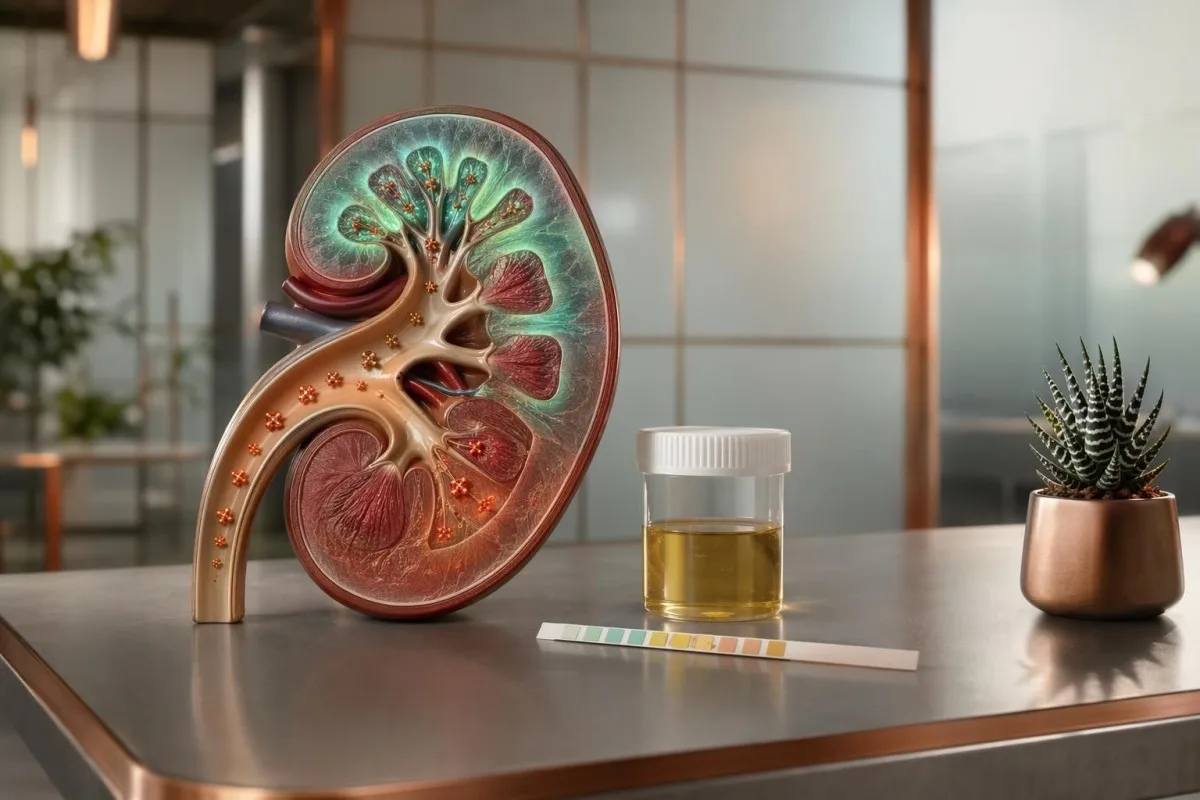
A positive urine glucose strip is not a diabetes diagnosis by itself. The clue becomes useful when you pair it with blood glucose, A1c, pregnancy status, kidney threshold and medication history.


- Glucose in urine usually means filtered glucose exceeded kidney reabsorption, often when blood glucose rises above about 180 mg/dL, but the threshold varies widely.
- Urine glucose can be positive in pregnancy because the kidney threshold falls, even when a diabetes diagnosis has not been made.
- Diabetes cutoffs are blood-based: fasting glucose ≥126 mg/dL, A1c ≥6.5%, or random glucose ≥200 mg/dL with symptoms.
- Prediabetes is suggested by fasting glucose 100-125 mg/dL or A1c 5.7-6.4%; urine strips often miss this early stage.
- SGLT2 medicines such as empagliflozin or dapagliflozin deliberately cause sugar in urine and can keep urine glucose positive even when blood glucose improves.
- Pregnancy screening usually needs a glucose tolerance test; urine glucose alone cannot diagnose gestational diabetes.
- Urgent clues include glucose in urine plus moderate or large ketones, vomiting, confusion, dehydration, or very high blood glucose.
- Next tests usually include fasting plasma glucose, HbA1c, sometimes an oral glucose tolerance test, kidney function, and urine albumin-creatinine ratio.
What does glucose in urine mean right now?
Glucose in urine means sugar has passed through the kidney filter into urine; it can happen before a diabetes diagnosis, during pregnancy, with a lower kidney threshold, or because of SGLT2 medication. It should usually be followed by blood glucose and HbA1c, not guessed from the dipstick alone.
Most urine dipsticks do not become positive from tiny traces; many pads start reacting when urine glucose reaches roughly 50-100 mg/dL, though brands differ. As Thomas Klein, MD, I would not diagnose diabetes from a strip alone because the glucose urine test reflects kidney handling as much as blood sugar.
Kantesti is an AI blood test interpretation platform that reads glucose, HbA1c, kidney markers and urine context together rather than treating one abnormal flag as the whole story. Our clinical team is described on the Kantesti organization page because patients deserve to know who is behind medical explanations.
The common teaching says glucose spills into urine when blood glucose passes about 180 mg/dL, or 10 mmol/L. In real clinics I see useful exceptions: one person spills at 155 mg/dL, another not until 220 mg/dL, which is why a proper diabetes blood test matters.
How a urine glucose dipstick works, and where it misleads
A urine glucose dipstick detects glucose using an enzyme reaction, usually glucose oxidase and peroxidase, that changes a color pad. The result is semi-quantitative, so a strip marked trace or 1+ cannot tell you your exact blood glucose.
A typical strip reports negative, trace, 1+, 2+, 3+ or 4+, but each manufacturer maps those colors to different mg/dL ranges. I have seen two clinics record the same urine as 1+ and 2+ simply because one strip was read at 30 seconds and the other at 60 seconds.
False negatives happen. High vitamin C intake, delayed reading, expired strips and very dilute urine can blunt the reaction, so a negative urine glucose strip does not rule out a post-meal spike; our complete urinalysis guide goes deeper into timing and pad chemistry.
False positives are less common, but contamination with peroxide-containing cleaning agents or oxidizing chemicals can produce odd colors. If the color looks patchy, if the sample sat for more than 2 hours at room temperature, or if the strip bottle was left open in humidity, I repeat the sample before calling it glycosuria.
Why the kidney threshold can spill sugar before diabetes
The kidney threshold for glucose is the blood glucose level at which kidney tubules can no longer reclaim filtered glucose. In many adults it is near 180 mg/dL, but a personal threshold from about 160-220 mg/dL is common.
Glucose is filtered by the kidney and then reabsorbed mainly in the proximal tubule through sodium-glucose transporters. If filtered glucose exceeds transporter capacity, sugar appears in urine even before a formal diabetes label is attached.
Some people have renal glycosuria, where urine glucose is positive despite normal fasting glucose and normal A1c. This can be inherited, usually benign, and sometimes missed for years unless someone checks urine during a work physical or pregnancy visit.
Kidney context changes the interpretation. A normal creatinine does not always mean normal tubular handling, so I usually pair urine glucose with eGFR, electrolytes and albumin leakage; our guide to early kidney blood changes explains why tubular clues can appear before creatinine moves.
When urine glucose points toward diabetes or prediabetes
Urine glucose can be a diabetes clue when it appears with high blood glucose, thirst, frequent urination, weight loss or blurred vision. Diabetes is diagnosed by blood tests, not by sugar in urine alone.
As of June 22, 2026, the ADA diagnostic cutoffs remain blood-based: fasting plasma glucose ≥126 mg/dL, HbA1c ≥6.5%, 2-hour OGTT glucose ≥200 mg/dL, or random plasma glucose ≥200 mg/dL with classic symptoms. The ADA Standards of Care describe these criteria clearly (American Diabetes Association Professional Practice Committee, 2024).
Prediabetes is a quieter zone: fasting plasma glucose 100-125 mg/dL, A1c 5.7-6.4%, or 2-hour OGTT glucose 140-199 mg/dL. Many patients with prediabetes have negative urine glucose because their peaks do not consistently exceed the kidney threshold.
A practical clinic pattern is a positive urine strip after a large carbohydrate meal, followed by a fasting glucose that looks fine at 94 mg/dL. In that situation I often ask for A1c and a targeted post-meal or random sugar cutoff check rather than dismissing the urine result.
Pregnancy: why urine glucose can appear with or without gestational diabetes
Pregnancy can cause urine glucose because kidney filtration rises and the renal threshold for glucose often falls. A positive urine strip in pregnancy is common, but it does not diagnose gestational diabetes.
In pregnancy, plasma volume and kidney filtration increase early, and some filtered glucose escapes reabsorption. I have seen healthy pregnant patients with intermittent trace or 1+ urine glucose and completely normal glucose tolerance testing.
Screening still matters. The USPSTF recommends screening for gestational diabetes at or after 24 weeks of gestation in asymptomatic pregnant people (US Preventive Services Task Force, 2021), and our pregnancy glucose tolerance guide explains the usual preparation and timing.
Common diagnostic thresholds for a 75 g oral glucose tolerance test are fasting ≥92 mg/dL, 1-hour ≥180 mg/dL, or 2-hour ≥153 mg/dL, depending on local criteria. If urine glucose is repeatedly 2+ or higher in pregnancy, I would check blood glucose sooner rather than waiting for the routine screening week.
SGLT2 medicines deliberately put glucose into urine
SGLT2 inhibitors are designed to cause glucose in urine by blocking kidney glucose reabsorption. If you take empagliflozin, dapagliflozin, canagliflozin or ertugliflozin, a positive urine glucose strip is expected.
These medicines can lead to roughly 50-80 g of glucose loss in urine per day when kidney function allows it. That is the treatment effect, not necessarily a sign that diabetes is uncontrolled.
The benefit-risk profile is not trivial. A Lancet meta-analysis by Zelniker et al. reported that SGLT2 inhibitors reduced hospitalization for heart failure and kidney disease progression in high-risk patients, while clinicians still watch for genital infections, volume depletion and ketoacidosis risk (Zelniker et al., 2019).
Medication context is one reason Kantesti AI asks users to record prescriptions when interpreting labs. A urine strip that would worry me in an untreated patient may be perfectly predictable in someone whose medication monitoring timeline includes an SGLT2 inhibitor started 3 weeks earlier.
Red flags: when sugar in urine needs same-day help
Glucose in urine becomes urgent when it occurs with moderate or large ketones, vomiting, confusion, dehydration, rapid breathing, or blood glucose persistently above 250 mg/dL. These features can signal diabetic ketoacidosis or severe hyperglycemia.
A urine strip showing glucose plus ketones is a different story from glucose alone. In type 1 diabetes, diabetic ketoacidosis often appears with glucose above 250 mg/dL, bicarbonate below 18 mmol/L, and acid buildup, though home strips cannot measure all of that.
SGLT2 medicines create a special trap: euglycemic ketoacidosis can happen with glucose below 250 mg/dL. When I, Thomas Klein, MD, review a case with nausea, abdominal pain, ketones and an SGLT2 drug, I do not let a modest glucose reading reassure me too much.
If symptoms are mild but repeated readings are high, a same-day clinician call is sensible. Our guide to urgent high glucose cutoffs separates numbers that can wait for office follow-up from patterns that deserve urgent care.
Which blood glucose or A1c tests should be checked next?
The next tests after glucose in urine are usually fasting plasma glucose, HbA1c, and sometimes a random glucose or oral glucose tolerance test. Kidney function and urine albumin-creatinine ratio help decide whether the urine clue is metabolic, renal, or both.
Kantesti is an AI-powered blood test analysis tool used by people across 127+ countries, and our system treats a positive urine glucose result as a prompt to look for a matching blood pattern. HbA1c reflects roughly 8-12 weeks of glycemia, while fasting glucose is a snapshot of that morning.
If the urine result followed a meal, fasting glucose alone can miss the problem. I often add a 1- to 2-hour post-meal glucose check or an OGTT when symptoms are present but A1c is borderline; our biomarker reference guide lists common glucose-related markers and units.
Do not over-fasten by accident. Water is fine for most fasting blood tests, and a non-fasting sample may still be useful for random glucose; the details in our fasting versus non-fasting guide prevent avoidable repeat visits.
Why A1c can look normal while urine glucose is positive
A normal A1c can coexist with urine glucose when glucose spikes are brief, recent, meal-related, pregnancy-related, or caused by a low kidney threshold. A1c is an average, not a peak detector.
HbA1c is heavily influenced by red cell lifespan, usually about 120 days. If a person had high post-meal glucose for only 2 weeks, the A1c may still sit at 5.5% while urine glucose appears after large meals.
A1c can also mislead in iron deficiency, recent blood loss, kidney disease, hemoglobin variants, pregnancy and some anemias. Our A1c accuracy guide explains why a number can be technically correct but clinically incomplete.
One patient pattern I remember: fasting glucose 91 mg/dL, A1c 5.4%, urine glucose 1+ after breakfast, and a 1-hour post-meal glucose of 214 mg/dL. That patient did not need panic; they needed a structured post-meal assessment and a realistic nutrition plan.
Urine ketones, protein, nitrites and specific gravity change the story
Other urine findings decide whether glucose in urine looks like isolated glycosuria, dehydration, infection, kidney stress, or uncontrolled diabetes. Glucose plus ketones, protein, or abnormal specific gravity is more informative than glucose alone.
Specific gravity usually ranges from about 1.005-1.030, and a very dilute sample can understate several dipstick findings. If urine glucose is negative in a very dilute sample but symptoms are strong, I check blood glucose rather than trusting the strip.
Protein changes the renal question. Persistent albumin-creatinine ratio ≥30 mg/g suggests increased kidney leak, so a glucose-positive urine sample with protein deserves a kidney-focused follow-up; start with our urine specific gravity guide if hydration is muddying the result.
Nitrites or leukocytes point toward a urinary infection, while protein can suggest glomerular stress. The practical split is covered in our guides to protein in urine and nitrite-positive urine, because glucose should not be interpreted in a vacuum.
Children and young adults: do not miss type 1 diabetes
In children and young adults, glucose in urine needs faster follow-up when there is thirst, frequent urination, bedwetting, weight loss, fatigue or vomiting. New type 1 diabetes can progress quickly.
A child with new bedwetting and urine glucose is not a watch-and-wait scenario for several weeks. A fingerstick or plasma glucose the same day can prevent a missed ketoacidosis presentation.
Diagnostic cutoffs are broadly the same: random plasma glucose ≥200 mg/dL with symptoms is highly concerning, and fasting glucose ≥126 mg/dL needs urgent clinician review in a symptomatic child. Parents can compare meal timing and illness context using our child blood sugar ranges guide.
There is a calmer possibility: familial renal glycosuria can show positive urine glucose with normal growth, normal fasting glucose and normal A1c. Even then, I prefer one confirmatory blood test rather than telling a family that sugar in urine is harmless from memory alone.
Temporary causes: meals, stress, illness and steroids
A single positive urine glucose result can be temporary after a high-carbohydrate meal, acute illness, severe stress, or steroid medication. The difference is whether blood glucose normalizes and whether the finding repeats.
Post-meal glucose normally rises and then falls; many healthy adults stay below 140 mg/dL at 2 hours, though a 1-hour peak can be higher. If the peak briefly exceeds a low kidney threshold, urine glucose may appear even when fasting labs look tidy.
Steroids are a frequent culprit. Prednisolone 20-40 mg can push afternoon and evening glucose up while morning fasting glucose still looks deceptively normal, so timing matters more than many lab sheets admit.
I usually ask patients to record the last meal, steroid dose, infection symptoms and exercise within 24 hours of the urine test. Our after-eating glucose range guide helps make those notes useful instead of vague.
How trend tracking prevents overreaction to one urine strip
Trend tracking turns glucose in urine from a scary isolated flag into a pattern: repeated positives, matching blood glucose, medication timing, pregnancy week, and kidney markers. One strip is a clue; a timeline is clinical information.
Kantesti is an AI biomarker interpretation platform that compares uploaded blood tests with prior results, medication notes and symptom context in about 60 seconds. Our neural network is not trying to replace a clinician; it is trying to surface patterns that humans can review more efficiently.
For urine glucose, the trend I care about is simple: did it happen once after a meal, repeatedly in fasting samples, or only after an SGLT2 medicine was started? Patients can organize that sequence with blood test trend analysis instead of keeping screenshots scattered across phones.
Kantesti AI works across 75+ languages and uses GDPR-aligned privacy practices because lab interpretation often involves families, pregnancy records and long-term medication data. The technical logic behind our contextual interpretation is outlined in the AI technology guide.
Research notes, clinical review and when to call a clinician
Kantesti’s research and medical review process supports pattern-based lab interpretation, but glucose in urine still needs clinician follow-up when symptoms, pregnancy, ketones or high blood glucose are present. Same-day care is sensible if you feel unwell or glucose is repeatedly very high.
Our interpretation methods are reviewed against clinical standards and internal benchmarks, not just surface-level reference ranges. The clinical validation process explains how Kantesti separates educational interpretation from diagnosis, and our medical advisory board gives physician oversight to high-risk content.
For readers who track the broader Kantesti research library, two recent formal citations are: Kantesti LTD. (2026). aPTT Normal Range: D-Dimer, Protein C Blood Clotting Guide. Zenodo. https://doi.org/10.5281/zenodo.18262555. See also ResearchGate and Academia.edu search records. Kantesti LTD. (2026). Serum Proteins Guide: Globulins, Albumin & A/G Ratio Blood Test. Zenodo. https://doi.org/10.5281/zenodo.18316300. The related internal resources are our coagulation marker guide and serum protein guide.
Bottom line from my clinic desk: if urine glucose is positive once and you feel well, arrange blood glucose and A1c promptly; if you are pregnant, a child, taking an SGLT2 inhibitor with ketones, or have vomiting or confusion, do not wait. I, Thomas Klein, MD, would rather repeat one normal blood test than miss early diabetes or ketoacidosis.
Frequently Asked Questions
Does glucose in urine always mean diabetes?
Glucose in urine does not always mean diabetes, because pregnancy, renal glycosuria, SGLT2 medicines and a low kidney threshold can all cause urine glucose. Diabetes is diagnosed with blood tests such as fasting plasma glucose ≥126 mg/dL, HbA1c ≥6.5%, or random glucose ≥200 mg/dL with symptoms. A positive urine glucose strip should usually trigger blood glucose or A1c testing rather than a diagnosis by itself.
What blood test should I get after a positive urine glucose test?
After a positive urine glucose test, the usual next blood tests are fasting plasma glucose and HbA1c. If symptoms are present, a random plasma glucose can be checked immediately, and a value ≥200 mg/dL with classic symptoms is concerning for diabetes. If pregnancy or post-meal spikes are suspected, an oral glucose tolerance test may be more informative than fasting glucose alone.
Can pregnancy cause sugar in urine without gestational diabetes?
Pregnancy can cause sugar in urine without gestational diabetes because kidney filtration rises and the renal glucose threshold may fall. Trace or intermittent 1+ urine glucose can occur in otherwise normal pregnancies. Repeated 2+ urine glucose, symptoms, or risk factors should prompt blood glucose testing or a pregnancy glucose tolerance test, commonly performed at or after 24 weeks.
Why is my urine glucose positive but my A1c normal?
Urine glucose can be positive with a normal A1c when glucose spikes are brief, recent, post-meal, pregnancy-related, or caused by a low kidney threshold. HbA1c reflects roughly 8-12 weeks of average glucose and does not reliably show short peaks. If urine glucose repeats, a fasting glucose, post-meal glucose, or oral glucose tolerance test may explain the mismatch.
Do SGLT2 medications make urine glucose positive?
SGLT2 medications intentionally make urine glucose positive by blocking kidney glucose reabsorption. Empagliflozin, dapagliflozin, canagliflozin and ertugliflozin can cause roughly 50-80 g of glucose to be lost in urine per day when kidney function is adequate. A positive urine glucose strip is expected on these medicines, but ketones, vomiting or abdominal pain need urgent medical advice.
When is glucose in urine an emergency?
Glucose in urine is more urgent when it appears with moderate or large ketones, vomiting, confusion, dehydration, rapid breathing, severe weakness, or blood glucose persistently above 250 mg/dL. These features can signal diabetic ketoacidosis or severe hyperglycemia. People taking SGLT2 inhibitors can develop ketoacidosis even with glucose below 250 mg/dL, so symptoms and ketones matter.
Can a urine glucose test miss diabetes?
A urine glucose test can miss diabetes or prediabetes because urine glucose usually appears only after blood glucose exceeds the person’s renal threshold, often around 180 mg/dL. Prediabetes cutoffs, such as fasting glucose 100-125 mg/dL or A1c 5.7-6.4%, may not produce urine glucose. Blood testing is more reliable for diagnosis and monitoring.
Should I stop an SGLT2 medicine before a urine glucose test?
No. Do not stop an SGLT2 medicine such as empagliflozin or dapagliflozin just to change a urine result; glucose in the urine is an expected effect. Tell the clinician and laboratory that you take it so they interpret the test correctly.
Can vitamin C supplements affect a urine glucose dipstick result?
Yes. Large doses of vitamin C can interfere with some dipstick brands and occasionally produce a falsely low or negative glucose result; tell the clinician or laboratory about supplements and confirm an unexpected result with blood glucose testing.
Get AI-Powered Blood Test Analysis Today
Join over 2 million users worldwide who trust Kantesti for instant, accurate lab test analysis. Upload your blood test results and receive comprehensive interpretation of 15,000+ biomarkers in seconds.
📚 Referenced Research Publications
Klein, T., Mitchell, S., & Weber, H. (2026). Kantesti LTD. (2026). aPTT Normal Range: D-Dimer, Protein C Blood Clotting Guide. Zenodo. DOI: 10.5281/zenodo.18262555. ResearchGate: https://www.researchgate.net/search/publication?q=aPTT%20Normal%20Range%20D-Dimer%20Protein%20C%20Blood%20Clotting%20Guide. Academia.edu: https://www.academia.edu/search?q=aPTT%20Normal%20Range%20D-Dimer%20Protein%20C%20Blood%20Clotting%20Guide.. Kantesti AI Medical Research.
Klein, T., Mitchell, S., & Weber, H. (2026). Kantesti LTD. (2026). Serum Proteins Guide: Globulins, Albumin & A/G Ratio Blood Test. Zenodo. DOI: 10.5281/zenodo.18316300. ResearchGate: https://www.researchgate.net/search/publication?q=Serum%20Proteins%20Guide%20Globulins%20Albumin%20A%2FG%20Ratio%20Blood%20Test. Academia.edu: https://www.academia.edu/search?q=Serum%20Proteins%20Guide%20Globulins%20Albumin%20A%2FG%20Ratio%20Blood%20Test.. Kantesti AI Medical Research.
📖 External Medical References
⚕️ Medical Disclaimer
This article is for educational purposes only and does not constitute medical advice. Always consult a qualified healthcare provider for diagnosis and treatment decisions.
E-E-A-T Trust Signals
Experience
Physician-led clinical review of lab interpretation workflows.
Expertise
Laboratory medicine focus on how biomarkers behave in clinical context.
Authoritativeness
Written by Dr. Thomas Klein with review by Dr. Sarah Mitchell and Prof. Dr. Hans Weber.
Trustworthiness
Evidence-based interpretation with clear follow-up pathways to reduce alarm.