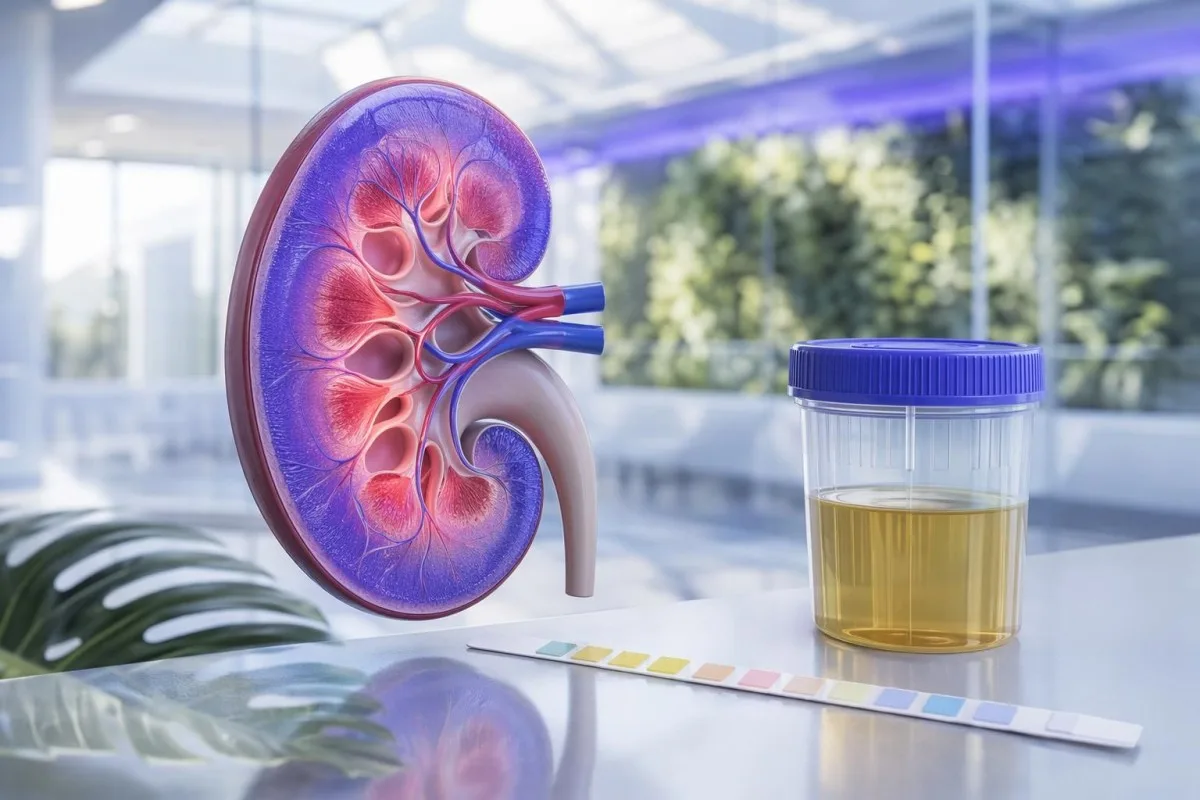
Trace or 1+ protein is often temporary, but persistent proteinuria deserves a urine ACR. 2+ or 3+ protein, swelling, high blood pressure, blood in urine, or pregnancy changes should be handled faster.


- Trace protein on a urine dipstick often reflects dehydration, exercise, fever, or concentrated urine and is usually repeated with a first-morning sample.
- 1+ protein usually approximates 30 mg/dL on many dipsticks, but concentration and urine specific gravity can make this look bigger or smaller than it is.
- 2+ protein often approximates 100 mg/dL and should usually be confirmed with a urine albumin-to-creatinine ratio, especially if it persists.
- 3+ protein often approximates 300 mg/dL and needs timely medical review, particularly with swelling, high blood pressure, low eGFR, or blood in urine.
- Urine ACR below 30 mg/g, or below 3 mg/mmol, is generally considered normal to mildly increased albumin excretion.
- Moderately increased ACR is 30-300 mg/g, or 3-30 mg/mmol, and can be the first measurable sign of kidney damage in diabetes or hypertension.
- Severely increased ACR is above 300 mg/g, or above 30 mg/mmol, and usually needs a kidney-focused assessment rather than simple reassurance.
- Pregnancy proteinuria after 20 weeks with blood pressure of 140/90 mmHg or higher can suggest preeclampsia and should not wait for a routine appointment.
- Urgent symptoms include new face or leg swelling, shortness of breath, severe headache, visual symptoms, very high blood pressure, reduced urination, or cola-colored urine.
What protein in urine usually means
Protein in urine means the urine dipstick or lab has detected protein that should mostly stay in the bloodstream. Trace or 1+ can be temporary; 2+ or 3+ is more concerning, and any persistent result should be confirmed with a urine albumin-to-creatinine ratio, usually called urine ACR.
As of June 22, 2026, my usual approach is simple: repeat a mild result under cleaner conditions, quantify anything persistent, and move faster when symptoms or pregnancy are involved. Kantesti is an AI blood test interpretation platform built by Kantesti LTD that helps connect urine findings with eGFR, creatinine, albumin, glucose, HbA1c, and blood pressure patterns.
A dipstick does not measure total kidney risk. It mainly detects albumin and can miss smaller proteins, light chains, or dilute low-grade albumin loss; our urinalysis guide explains why a positive strip and a quantitative urine result sometimes disagree.
In my clinic, a 29-year-old runner with trace protein after a hot 18 km training run is a different patient from a 63-year-old with diabetes, ankle swelling, eGFR 52 mL/min/1.73 m², and 2+ protein. Thomas Klein, MD, reads those two patterns very differently because the risk sits in the cluster, not the single square on the strip.
Trace, 1+, 2+ and 3+ protein on urinalysis results
Dipstick protein levels are rough concentration bands, not exact daily protein loss. Many strips read trace around 10-20 mg/dL, 1+ around 30 mg/dL, 2+ around 100 mg/dL, and 3+ around 300 mg/dL, although manufacturers and urine concentration change the meaning.
A trace protein result in very concentrated urine may disappear when the urine specific gravity returns from 1.030 to 1.015. A 1+ protein result in watery urine worries me more than trace protein in dehydrated urine because dilution should make protein harder to detect.
A 2+ protein result is not automatically kidney failure, but it should not be ignored for months. When patients see symbols, stars, or color blocks on lab portals, I often point them to our guide on reading abnormal results because the flag tells you what happened, not why.
A 3+ protein result often represents a high enough concentration to look for edema, hypertension, low serum albumin, reduced eGFR, and blood in urine. In nephrotic-range proteinuria, total protein excretion is typically above 3.5 g/day, which is far beyond what a dipstick can quantify accurately.
When to repeat with urine ACR
A urine ACR is the preferred repeat test when protein on dipstick persists, appears at 1+ or higher, or occurs in someone with diabetes, hypertension, reduced eGFR, pregnancy risk, or swelling. A first-morning urine ACR reduces false swings from hydration and activity.
KDIGO 2024 classifies albuminuria as A1 below 30 mg/g, A2 from 30-300 mg/g, and A3 above 300 mg/g; the mmol/mmol equivalents are below 3, 3-30, and above 30. That classification is why our urine ACR explainer focuses on risk categories rather than dipstick color alone.
For trace or 1+ protein without symptoms, I usually repeat a clean-catch first-morning sample within 1-2 weeks if dehydration, fever, or exercise was likely. If protein appears on 2 of 3 samples over about 3 months, the word persistent proteinuria becomes fair.
Kantesti AI interprets ACR alongside serum creatinine, eGFR, HbA1c, CRP, albumin, and medication history because albuminuria without those details is easy to overcall or undercall. The evidence here is not perfectly tidy; clinicians disagree on the fastest pathway for isolated 1+ protein in a healthy 22-year-old, but they do not usually disagree about persistent ACR above 300 mg/g.
Temporary causes that can raise urine protein
Temporary proteinuria can follow heavy exercise, fever, dehydration, emotional stress, cold exposure, or a recent infection. These causes usually improve when the trigger settles, which is why timing and repeat sampling matter.
Exercise proteinuria is usually short-lived and often clears within 24-48 hours. I have seen trace to 1+ protein after long runs, CrossFit sessions, and military fitness tests, particularly when urine specific gravity is above 1.025; our guide to exercise-related lab shifts covers the blood-test side of that pattern.
Fever can increase glomerular permeability for a few days, and a respiratory or urinary illness may leave mild protein on dipstick after symptoms improve. The practical move is to avoid repeating urine during the peak of fever unless there are red flags such as blood in urine, flank pain, or reduced urine output.
Orthostatic proteinuria is a niche but real finding, especially in adolescents and young adults. Protein appears later in the day but not in first-morning urine, and total daily protein is usually below 1 g/day; that distinction saves a surprising number of worried families from unnecessary imaging.
Kidney causes doctors check first
Persistent protein in urine can come from glomerular kidney disease, diabetic kidney disease, hypertensive kidney damage, tubulointerstitial disease, or medication-related injury. The combination of ACR, eGFR, urine blood, blood pressure, and serum albumin usually points the direction.
Glomerular causes often produce albumin-predominant proteinuria because the filtration barrier becomes leakier than it should be. When proteinuria occurs with blood in urine and red cell casts, the workup becomes more urgent than a simple repeat dipstick.
Creatinine can stay normal early, especially in people with more kidney reserve. That is why our article on kidney changes before creatinine rises stresses albuminuria, cystatin C, and trends rather than a single creatinine value.
NICE CKD guidance recommends using ACR rather than reagent-strip protein alone for detecting and monitoring proteinuria in many adult kidney-risk pathways (NICE, 2021). In plain terms, a normal-looking creatinine and a repeatedly abnormal ACR can still be a meaningful kidney signal.
Diabetes, hypertension and metabolic risk patterns
Diabetes and high blood pressure are two of the most common chronic causes of persistent albumin in urine. ACR can become abnormal before symptoms appear, often while eGFR is still above 60 mL/min/1.73 m².
In diabetes, ACR 30-300 mg/g is often the earliest measurable kidney-warning band. I take that more seriously when HbA1c is above 7.0%, systolic blood pressure sits above 130-140 mmHg, or triglycerides are high; our diabetes blood test guide walks through the blood markers that travel with kidney risk.
Hypertension-related proteinuria is usually modest at first, but the pattern becomes concerning when blood pressure is repeatedly above 140/90 mmHg and ACR stays above 30 mg/g. KDIGO 2024 uses both eGFR and albuminuria categories because the same eGFR can carry very different risk at ACR 10 mg/g versus 600 mg/g (KDIGO CKD Work Group, 2024).
Kantesti is an AI-powered blood test analysis tool used by people in 127+ countries, and our neural network is trained to notice when glucose, HbA1c, creatinine, potassium, albumin, and lipid results point toward a kidney-risk cluster. That does not diagnose kidney disease, but it helps patients bring a cleaner question to their clinician.
UTI, blood in urine and sample contamination
A urinary tract infection, visible or microscopic blood, menstrual contamination, semen, or a poorly collected sample can make urine protein look abnormal. Protein should be rechecked after the interfering issue has cleared.
UTIs commonly add leukocytes, nitrites, blood, and some protein to the same specimen. When nitrites or leukocyte esterase are positive, I interpret the protein result differently and often wait until 1-2 weeks after treatment to repeat; our urine culture guide explains colony counts and mixed growth.
Blood in urine can raise the protein pad because hemoglobin and plasma proteins enter the sample together. A dipstick showing protein plus blood after intense exercise is usually less alarming than protein plus blood with high blood pressure, rising creatinine, or red cell casts.
Collection technique matters more than patients are told. A midstream clean-catch sample reduces false positives, and first-morning urine avoids the daytime protein swing that can mislead both patients and clinicians.
Symptoms with proteinuria that need faster care
Proteinuria needs faster care when it comes with swelling, shortness of breath, very high blood pressure, reduced urination, cola-colored urine, chest discomfort, severe headache, confusion, or new weakness. Those symptoms suggest the result may be part of a wider kidney, vascular, or systemic problem.
New ankle, eyelid, or face swelling with 2+ or 3+ protein deserves timely review because heavy albumin loss can lower serum albumin below about 3.0 g/dL. Our guide to swelling and lab clues explains why albumin, kidney markers, liver tests, and heart markers may be checked together.
Blood pressure above 180/120 mmHg with protein in urine is a same-day medical situation, even if the person feels oddly well. The reason is not the protein alone; it is the possibility of acute kidney strain, vascular injury, stroke risk, or pregnancy-related hypertension.
Foamy urine by itself is unreliable. I have met patients with dramatic foam and normal ACR, and patients with ACR above 1000 mg/g who noticed no foam at all; symptoms help, but quantitative testing settles the argument.
Protein in urine during pregnancy
Protein in urine after 20 weeks of pregnancy is more concerning when blood pressure is 140/90 mmHg or higher. In that setting, clinicians think about preeclampsia and usually confirm protein with ACR, PCR, or 24-hour urine rather than relying on dipstick alone.
ACOG Practice Bulletin No. 222 defines proteinuria in preeclampsia as 300 mg or more in 24 hours, a protein-to-creatinine ratio of 0.3 or higher, or dipstick 2+ only when quantitative methods are not available (ACOG, 2020). For blood pressure thresholds and home readings, our pregnancy BP guide is a useful companion.
Same-day assessment is sensible for severe headache, visual symptoms, right upper abdominal pain, shortness of breath, sudden swelling, reduced fetal movements, or blood pressure of 160/110 mmHg or higher. Platelets below 100,000/µL, creatinine above 1.1 mg/dL, or liver enzymes above twice the upper limit add weight to the concern.
In my experience, the dangerous pregnancy pattern is not one lonely trace protein result at 24 weeks. It is a cluster: rising blood pressure, new symptoms, worsening protein, platelet fall, creatinine rise, or fetal growth concern.
Children, athletes and orthostatic proteinuria
Children, teenagers, and endurance athletes often have benign or transient proteinuria, but persistence still matters. First-morning urine is the deciding sample when orthostatic proteinuria or exercise proteinuria is suspected.
Orthostatic proteinuria is uncommon in older adults but can explain daytime protein in adolescents. A first-morning urine protein-to-creatinine ratio below about 0.2 mg/mg is generally reassuring in many pediatric pathways, assuming blood pressure and urine microscopy are normal.
Athletes can show temporary protein, ketones, high specific gravity, and exercise-related creatinine or CK changes after hard sessions. The pattern overlaps with our marathon runner lab guide, where hydration, muscle stress, sodium, and kidney markers all need context.
I usually ask athletes to repeat urine after 48 hours without heavy training and with normal hydration. If protein persists despite rest, or if there is blood, hypertension, or eGFR decline, I stop calling it a training artifact.
Blood tests that complete the picture
Proteinuria is interpreted with blood tests such as creatinine, eGFR, urea or BUN, electrolytes, serum albumin, HbA1c, lipids, CBC, CRP, and sometimes autoimmune markers. Urine alone rarely tells the whole story.
A renal function panel usually includes creatinine, eGFR, urea or BUN, sodium, potassium, bicarbonate, calcium, phosphate, and albumin depending on the country and lab. Our renal panel guide shows why potassium and bicarbonate can change the urgency of a kidney result.
Low serum albumin with high urine protein suggests the body may be losing protein faster than the liver can replace it. When albumin falls below about 3.0 g/dL and urine protein is heavy, clinicians look for nephrotic syndrome features such as edema, high LDL cholesterol, and clotting risk.
Kantesti is an AI biomarker interpretation platform that maps urine concerns against blood biomarkers from our 15,000+ marker guide. Thomas Klein, MD, and our medical team still treat AI output as decision support, not a substitute for a clinician who can examine the patient.
ACR, PCR, eGFR and 24-hour urine: how they differ
ACR measures albumin loss, PCR estimates total protein loss, eGFR estimates filtering capacity, and 24-hour urine measures daily excretion. These tests answer different questions, so one normal result does not always cancel out another abnormal one.
Urine ACR is best for early albumin leakage, especially in diabetes and hypertension. Urine PCR is useful when non-albumin proteins may be present or when total protein burden matters; our eGFR age guide explains how filtration estimates change with age.
A 24-hour urine collection is annoying but sometimes clarifies confusing spot results. Normal total urine protein is typically below 150 mg/day, while nephrotic-range proteinuria is usually above 3.5 g/day.
Urea and creatinine patterns add another layer. Our research-backed BUN/creatinine ratio guide is useful when dehydration, high protein intake, gastrointestinal fluid loss, or kidney perfusion might be distorting the picture.
How to prepare for a repeat urine test
For a repeat urine protein test, use a first-morning clean-catch sample, avoid heavy exercise for 24-48 hours, hydrate normally, and avoid testing during active fever or menstrual contamination when possible. Do not stop prescribed medicines unless your clinician tells you to.
Normal hydration means pale-yellow urine, not forced overhydration. Drinking 2-3 liters right before testing can dilute albumin and create false reassurance, while dehydration can concentrate protein and push a borderline dipstick into trace or 1+.
Bring the previous urinalysis, ACR, creatinine, eGFR, blood pressure readings, and medication list to the repeat visit. Our guide on repeating abnormal labs explains why retesting too early or under different conditions creates noise instead of clarity.
Medication context matters. NSAIDs, lithium, some antibiotics, certain antivirals, immune therapies, and contrast exposure can affect kidney markers, while ACE inhibitors and ARBs may reduce albuminuria over weeks to months.
How Kantesti helps interpret proteinuria patterns
Kantesti helps by organizing the blood-test context around a urine protein finding: eGFR, creatinine, albumin, glucose, HbA1c, lipids, electrolytes, inflammation markers, and prior trends. The safest interpretation is pattern-based, not dipstick-based.
Kantesti's neural network checks whether a proteinuria concern is isolated or part of a broader risk signal, and our methods are described in the technology guide. A 1+ dipstick with eGFR 96, ACR 8 mg/g, normal blood pressure, and recent fever usually lands differently from 1+ protein with ACR 220 mg/g and HbA1c 8.4%.
Our clinical governance matters because medical interpretation is not just pattern recognition. Kantesti AI is reviewed with standards described in our medical validation, and our physicians advise conservative escalation when pregnancy, reduced urination, severe hypertension, or rapidly worsening kidney markers are present.
Bottom line: repeat mild, explainable protein; quantify persistent protein with ACR; and move quickly for 2+ or 3+ protein with symptoms, pregnancy, high blood pressure, blood in urine, or falling eGFR. The clinicians on our Medical Advisory Board built that cautious workflow because missing kidney disease is worse than repeating one extra urine test.
Frequently Asked Questions
Is trace protein in urine serious?
Trace protein in urine is often not serious when it appears once during dehydration, fever, heavy exercise, or concentrated urine. Many dipsticks detect trace protein around 10-20 mg/dL, which can disappear on a first-morning repeat sample. Trace protein becomes more meaningful if it persists on 2 or more tests, occurs with high blood pressure, or is accompanied by blood in urine, swelling, or reduced eGFR.
What does 1+ protein in urine mean?
1+ protein in urine usually means the dipstick detected roughly 30 mg/dL of protein, although the exact value varies by strip and urine concentration. A single 1+ result may be temporary, but persistent 1+ protein should usually be confirmed with urine ACR. If the ACR is 30-300 mg/g, or 3-30 mg/mmol, clinicians call that moderately increased albuminuria.
When should I worry about 2+ or 3+ protein in urine?
2+ or 3+ protein in urine is more concerning than trace or 1+ because many dipsticks estimate 2+ near 100 mg/dL and 3+ near 300 mg/dL. You should seek faster medical advice if 2+ or 3+ protein occurs with swelling, blood in urine, high blood pressure, shortness of breath, reduced urination, pregnancy, or a low eGFR. A urine ACR, urine PCR, blood pressure check, creatinine, eGFR, and serum albumin are commonly used to clarify the risk.
What urine ACR level is abnormal?
A urine ACR below 30 mg/g, or below 3 mg/mmol, is generally considered normal to mildly increased. ACR from 30-300 mg/g, or 3-30 mg/mmol, is moderately increased and may be an early kidney-risk marker. ACR above 300 mg/g, or above 30 mg/mmol, is severely increased and usually needs a kidney-focused review if confirmed.
Can dehydration cause protein in urine?
Yes, dehydration can make protein in urine appear higher because the urine is more concentrated. A urine specific gravity above about 1.025 often means the sample is concentrated, and a trace or 1+ protein result may vanish after normal hydration. Forced overhydration is not a good fix because it can dilute the sample and hide a real albumin leak.
What does protein in urine mean during pregnancy?
Protein in urine during pregnancy is most concerning after 20 weeks when blood pressure is 140/90 mmHg or higher. Preeclampsia proteinuria is often defined as 300 mg or more in 24 hours, a protein-to-creatinine ratio of 0.3 or higher, or dipstick 2+ when quantitative testing is unavailable. Severe headache, visual symptoms, right upper abdominal pain, shortness of breath, sudden swelling, reduced fetal movements, or blood pressure of 160/110 mmHg or higher needs same-day assessment.
Can a UTI cause protein in urine?
A UTI can cause protein in urine because infection, urinary white cells, and blood can affect the dipstick result. Protein should usually be repeated 1-2 weeks after UTI symptoms resolve or treatment finishes, especially if the original test also showed nitrites, leukocyte esterase, or blood. Persistent protein after the infection clears should be checked with urine ACR or PCR.
Do I need to eat less protein if protein is found in my urine?
Do not start a low-protein diet on your own. Most people should keep a balanced diet while the cause is clarified; if kidney disease is confirmed, a clinician or renal dietitian can tailor protein and salt intake to your kidney function and overall health.
Can medications cause protein in urine?
Yes. Anti-inflammatory pain medicines such as ibuprofen or naproxen can sometimes worsen kidney blood flow and contribute to protein leakage, especially with dehydration or existing kidney disease. Do not stop prescribed medicines alone; ask your clinician or pharmacist to review them.
Get AI-Powered Blood Test Analysis Today
Join over 2 million users worldwide who trust Kantesti for instant, accurate lab test analysis. Upload your blood test results and receive comprehensive interpretation of 15,000+ biomarkers in seconds.
📚 Referenced Research Publications
Klein, T., Mitchell, S., & Weber, H. (2026). Urobilinogen in Urine Test: Complete Urinalysis Guide 2026. Kantesti AI Medical Research.
Klein, T., Mitchell, S., & Weber, H. (2026). Iron Studies Guide: TIBC, Iron Saturation & Binding Capacity. Kantesti AI Medical Research.
📖 External Medical References
KDIGO CKD Work Group (2024). KDIGO 2024 Clinical Practice Guideline for the Evaluation and Management of Chronic Kidney Disease. Kidney International.
National Institute for Health and Care Excellence (2021). Chronic kidney disease: assessment and management. NICE Guideline NG203.
⚕️ Medical Disclaimer
This article is for educational purposes only and does not constitute medical advice. Always consult a qualified healthcare provider for diagnosis and treatment decisions.
E-E-A-T Trust Signals
Experience
Physician-led clinical review of lab interpretation workflows.
Expertise
Laboratory medicine focus on how biomarkers behave in clinical context.
Authoritativeness
Written by Dr. Thomas Klein with review by Dr. Sarah Mitchell and Prof. Dr. Hans Weber.
Trustworthiness
Evidence-based interpretation with clear follow-up pathways to reduce alarm.