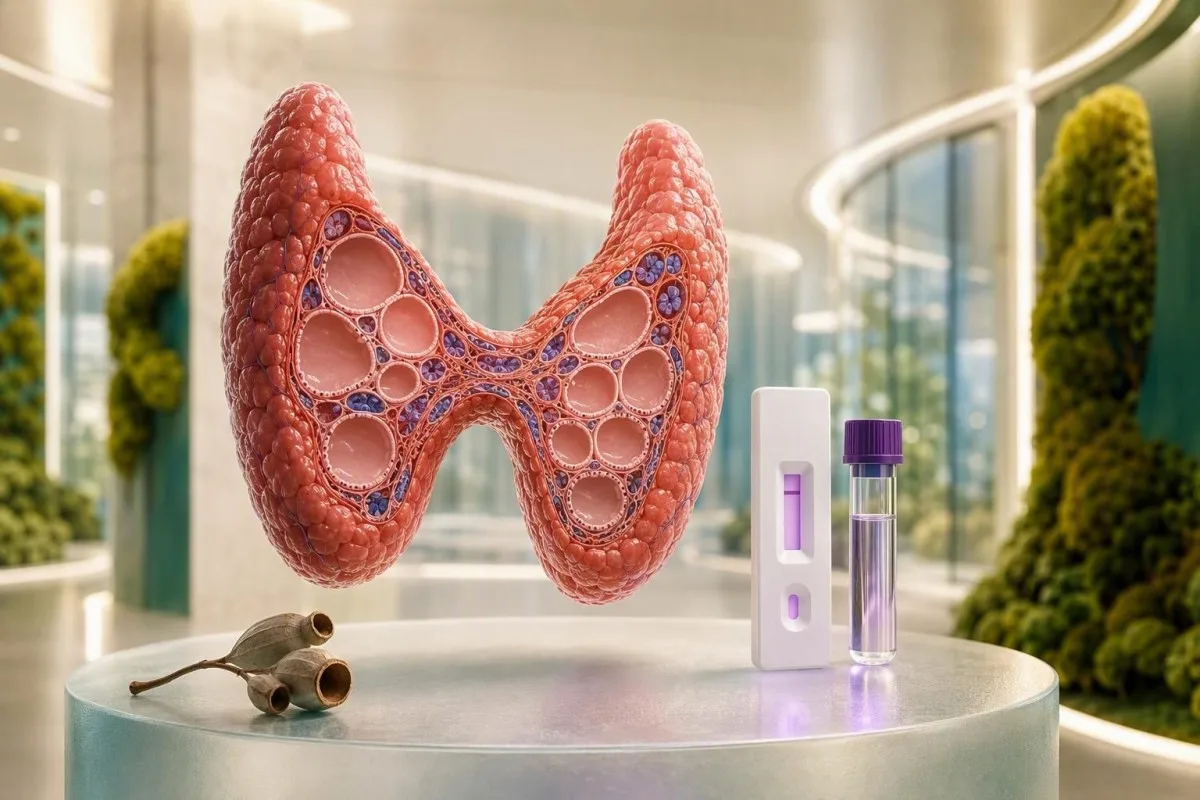
An isolated high free T3 result deserves a careful laboratory check before it is labelled hyperthyroidism. Supplements, assay design, and antibodies can create a convincing but incorrect result.


- High free T3 with normal TSH and free T4 is more often a discordant laboratory pattern than overt hyperthyroidism.
- Biotin interference can produce falsely high free T3 and free T4 with a falsely low TSH on susceptible streptavidin-biotin assays.
- Biotin doses of 5-10 mg/day in hair and nail supplements can affect some thyroid immunoassays; 48 hours off biotin is a practical minimum for many routine tests.
- Free T3 reference intervals commonly run about 2.0-4.4 pg/mL or 3.1-6.8 pmol/L, but the reporting laboratory's interval always takes priority.
- Heterophile antibodies can bridge assay antibodies and create a false thyroid result even when no supplement is involved.
- TSH below 0.1 mIU/L plus raised free T3 is much more concerning for true thyrotoxicosis than high free T3 alone.
- Repeat testing on a different assay platform is often more informative than repeating the same test at the same laboratory.
- Do not stop prescribed thyroid medicine solely because of one unexpected free T3 result; confirm the pattern with the clinician who prescribed it.
What an Unexpected High Free T3 Result Usually Means
What does high free T3 mean? It can indicate genuine thyroid hormone excess, but an isolated high result—especially with normal TSH and free T4—often reflects test interference rather than hyperthyroidism. In my 15 years of clinical practice, I have seen patients referred urgently for a number that disappeared when we repeated the sample correctly.
Most adult laboratories report free T3 in a range near 2.0-4.4 pg/mL or 3.1-6.8 pmol/L, although calibration and assay chemistry create meaningful differences between sites. A result of 4.8 pg/mL is not remotely equivalent to 9.0 pg/mL, and neither number diagnoses hyperthyroidism without the accompanying TSH, free T4, symptoms, medication list, and collection details.
The physiologic pattern of overt T3 thyrotoxicosis is raised free or total T3 with a suppressed TSH, usually below 0.1 mIU/L. By contrast, high free T3 with TSH around 1.0-2.5 mIU/L and a normal free T4 should make the ordering clinician pause before prescribing an antithyroid drug; our free T3 reference guide explains why the laboratory interval is only the starting point.
Kantesti AI is an AI blood test analyzer that reads free T3 alongside TSH, free T4, prior results, medications, and the laboratory's stated method rather than treating one flagged value as a diagnosis. Dr. Thomas Klein's rule in clinic is simple: when the chemistry and the patient do not agree, verify the chemistry first.
The first three details to check
Check the exact value and unit, the TSH, and whether the report names an immunoassay method before drawing conclusions. A conversion error between pg/mL and pmol/L can make a normal result appear alarming, because 1 pg/mL of free T3 is approximately 1.54 pmol/L.
Why Free T3 Is More Vulnerable to Discordant Results
Free T3 is technically difficult to measure because only a tiny fraction of circulating T3 is unbound, and routine tests estimate that fraction indirectly. The free concentration is roughly 0.2-0.5% of total T3, so small assay disturbances can look disproportionately large.
Routine free T3 immunoassays do not physically isolate every free hormone molecule; they infer concentration from antibody binding under controlled conditions. Changes in binding proteins, unusual antibodies, or a competing substance can therefore distort free T3 more readily than total T3, which measures protein-bound and free hormone together.
A useful laboratory clue is a high free T3 with normal total T3 and no suppressed TSH. This does not prove interference, but it is a good reason to request a method review or a reference technique such as equilibrium dialysis followed by mass spectrometry when the clinical stakes are high.
Pregnancy, severe systemic illness, and high concentrations of thyroid-binding globulin can shift the relation between total and free thyroid measures. That is why a thyroid panel should never be read as a row of independent flags; see our explanation of free versus total T4 for the same principle applied to T4.
A surprisingly common reporting trap
Some laboratories report free T3 in pg/mL, while others use pmol/L, and reference intervals are not interchangeable between assays. A patient moving between countries can appear to have a dramatic change when the apparent difference is mostly units and laboratory calibration.
How Biotin Creates False Thyroid Results
Biotin can falsely raise free T3 and free T4 while falsely lowering TSH when an assay uses streptavidin-biotin capture chemistry. This is a measurement artifact, not a sudden burst of thyroid hormone production.
Biotin is vitamin B7, sold in many hair, skin, nail, prenatal, and multivitamin products at 30 micrograms to 10,000 micrograms (10 mg) per dose. The dietary requirement for adults is about 30 micrograms daily, whereas cosmetic products often contain 5-10 mg—roughly 167-333 times that amount.
In competitive free T3 assays, excess circulating biotin can reduce the assay signal in a way the analyzer interprets as more hormone. In sandwich TSH assays, the same excess may reduce captured signal and be reported as less TSH, creating a remarkably believable false hyperthyroid pattern; the AACC guidance document by Li et al. (2020) details this opposite-direction effect.
In practice, I ask patients to stop non-essential biotin for at least 48 hours before routine thyroid testing, and longer—often 72 hours to 7 days—after doses of 20-100 mg/day or when kidney function is reduced. Do not stop a prescribed product used for a metabolic disorder without the prescriber’s advice, and review our practical guide to supplements that alter fasting labs.
Why a “biotin-free” label does not settle it
Biotin may be listed as vitamin B7, d-biotin, or part of a proprietary beauty blend, and patients frequently forget energy drinks, gummies, and combination supplements. One 5 mg capsule taken on the morning of the draw can matter more than a daily multivitamin containing 30 micrograms.
The Assay Design Behind Free T3 Test Interference
Free T3 test interference occurs when something in the sample alters antibody-based detection rather than hormone concentration. Biotin is one mechanism, but it is not the only one and not every laboratory method is biotin-sensitive.
Most high-throughput thyroid testing uses an immunoassay, which pairs an antibody with a signal-generating system. The report may not state whether it is a one-step or two-step competitive assay, yet that detail can explain why two laboratories produce substantially different free T3 values from samples drawn 30 minutes apart.
Interference is more plausible when the result changes by more than the assay's expected analytic variation without a matching clinical change. For free T3, a shift of 30-50% across platforms is far more suspicious than a stable 5-10% difference, particularly when TSH remains within its own reference interval.
Kantesti AI is an AI blood test interpretation platform that flags discordance patterns for human follow-up rather than declaring an assay artifact with certainty. A reader can compare a result against previous panels using our blood test change guide, but the laboratory itself must investigate suspected interference.
Why the same sample can give two answers
A different manufacturer may use different antibodies, blocking reagents, incubation times, and signal detection. Agreement across two independent methods makes true elevation more likely, while a normal result on an alternate method is powerful evidence that the original value was method-dependent.
Heterophile Antibodies and Other Antibody Effects
Heterophile antibodies can falsely elevate or lower free T3 by binding the assay antibodies in unintended ways. They are uncommon, but they matter most when thyroid numbers conflict with a person’s pulse, symptoms, examination, and previous results.
Heterophile antibodies are broad-reacting human antibodies that may arise after exposure to animals, therapeutic monoclonal antibodies, autoimmune disease, transfusion, or sometimes no identifiable event. Their prevalence depends on the assay and population; clinically significant interference is much rarer than detectable antibody reactivity, generally well below 1% of routine samples.
A laboratory can investigate suspected interference using heterophile-blocking tubes, serial dilution, polyethylene glycol precipitation in selected settings, or remeasurement on an alternate platform. Nonlinearity on dilution is suggestive, not definitive, because free hormone assays do not always dilute perfectly even in an unaffected sample.
Favresse et al. (2018) recommend a structured laboratory-clinician dialogue when thyroid immunoassay results are implausible, rather than reflexively ordering imaging. Patients with autoimmune thyroid disease may also have meaningful TPO antibody results, but TPO positivity does not itself explain every high free T3 result.
Rheumatoid factor is a clue, not a verdict
High rheumatoid factor can interfere with some immunoassays, yet most people with rheumatoid factor do not have misleading thyroid values. The key clinical trigger is inconsistency: a striking result, no compatible symptoms, and a normal or contradictory TSH.
Thyroid Hormone Antibodies and Binding Protein Clues
Thyroid hormone autoantibodies and abnormal binding proteins can make measured free T3 look high without true tissue thyrotoxicosis. These causes are distinct from TPO antibodies and are often missed on a standard thyroid panel.
Anti-T3 or anti-T4 autoantibodies can bind hormone or assay reagents and produce platform-specific readings. They occur more often in autoimmune thyroid disorders, and the clue may be an implausibly high free T3 paired with normal total T3, normal TSH, and no adrenergic symptoms.
Familial dysalbuminemic hyperthyroxinemia typically affects T4 more than T3, but altered albumin or transthyretin binding can still make free hormone immunoassays unreliable. Genetic binding variants usually create a stable pattern over years, not a new abnormality appearing after a supplement or medication change.
Kantesti AI functions as an AI lab test interpretation service by identifying when thyroid values and antibody context do not form a physiologic pattern. If thyroid antibody testing is being considered, our overview of thyroglobulin antibody testing clarifies why each antibody answers a different question.
Why TPO antibodies are not proof of overactivity
TPO antibodies identify thyroid autoimmunity, not the current hormone state. A person can have positive TPO antibodies with a TSH of 2.1 mIU/L and normal free T4 for years, while another has Graves’ disease with negative TPO antibodies but positive TSH-receptor antibodies.
When High Free T3 Is Genuine Thyroid Overactivity
True high free T3 most often comes from Graves’ disease, toxic nodules, thyroiditis, or excess thyroid medication. The likelihood rises sharply when TSH is suppressed, symptoms are compatible, and a repeat measurement confirms the same pattern.
Graves’ disease can initially present as T3-predominant thyrotoxicosis, with high T3, normal free T4, and low TSH. The 2016 American Thyroid Association guideline by Ross et al. recommends confirming biochemical thyrotoxicosis and establishing the cause with TSH-receptor antibodies, uptake testing, or Doppler ultrasound when the diagnosis is not clinically obvious.
Autonomous thyroid nodules become more common with age and often produce a gradual fall in TSH before free T4 rises. In a 68-year-old with new atrial fibrillation, a free T3 of 7.9 pmol/L and TSH of 0.03 mIU/L is a very different clinical problem from a free T3 of 7.0 pmol/L with TSH 1.8 mIU/L.
Excess liothyronine, desiccated thyroid extract, and occasionally levothyroxine dosing can raise serum T3, particularly if the sample is taken within 2-4 hours of a T3-containing dose. For medication-related free T4 findings, our high free T4 causes guide covers the parallel reasoning.
Thyroiditis is a release problem
In thyroiditis, stored hormone leaks from inflamed thyroid tissue rather than being newly manufactured. TSH may be below 0.1 mIU/L, but uptake is low and antithyroid drugs usually do not help because they block synthesis, not release.
How Clinicians Read TSH, Free T4, and T3 Together
TSH is usually the best first cross-check for a high free T3 result because it integrates thyroid hormone exposure over weeks. A normal TSH does not exclude every thyroid disorder, but it makes sustained clinically important thyrotoxicosis much less likely.
The classic overt hyperthyroid pattern is TSH below 0.1 mIU/L with free T4 and/or T3 above the laboratory upper limit. Subclinical hyperthyroidism means TSH is low while free T4 and T3 remain within range; isolated high free T3 with normal TSH does not fit either definition neatly.
Central causes such as TSH-secreting pituitary adenoma and thyroid hormone resistance can produce non-suppressed TSH with high thyroid hormones, but they are rare and usually show persistent elevation across several markers and methods. In these cases, endocrinologists may add alpha-subunit, sex hormone-binding globulin, family history, imaging, and specialized testing rather than relying on one repeat free T3.
A good report includes collection time and medication timing because TSH has a circadian rhythm and T3-containing tablets peak quickly. Our article on TSH day-to-day variation explains why a change from 1.4 to 0.8 mIU/L may be biologic variation, whereas a fall to 0.05 mIU/L warrants attention.
A Safer Repeat-Test Protocol for High Free T3
The best repeat test is a controlled repeat, not simply another blood draw. Stopping non-essential biotin, documenting medication timing, and using an alternate assay can answer more than repeating the same method the next morning.
For a routine, non-urgent discordant result, hold non-essential biotin for 48-72 hours, avoid taking liothyronine until after the draw if the prescriber agrees, and record the exact last dose time. Levothyroxine alone usually has less immediate effect on T3, but taking it after rather than before the sample improves consistency across visits.
Ask the laboratory or clinician whether the repeat can be run on a different manufacturer's platform, with total T3 added if appropriate. An endocrinologist may request free T3 by equilibrium dialysis or ultrafiltration with LC-MS/MS confirmation, although these reference methods are less available and can take several days.
An abrupt one-off change should also prompt a laboratory delta check for specimen identity, analyzer flags, and changes in assay generation. In my experience, patients are relieved to learn that asking for verification is not dismissing their symptoms—it is good diagnostic medicine.
What not to do before the repeat
Do not deliberately fast for 24 hours, take extra thyroid supplements, or stop prescribed antithyroid therapy to “see what happens.” These actions can generate a second hard-to-interpret panel and, in the case of prescribed medication, create genuine risk.
Medicines, Pregnancy, Illness, and Other Special Contexts
Medication timing and physiologic state can change thyroid results without indicating new thyroid disease. Liothyronine, amiodarone, heparin, high-dose steroids, pregnancy-related binding changes, and acute illness each require a different interpretive lens.
Liothyronine reaches a serum peak roughly 2-4 hours after ingestion, so a sample drawn shortly after the tablet can show transiently high T3 even when average exposure is appropriate. People using combination therapy should use the same dose-to-draw interval for each monitoring visit and tell the laboratory what time they took it.
Heparin can increase free fatty acids in stored samples and falsely elevate measured free thyroid hormones in some assays, particularly when sample processing is delayed. Acute illness more commonly lowers T3 through non-thyroidal illness physiology, but mixed patterns occur in intensive care settings and should not be overinterpreted in isolation.
Pregnancy changes thyroid-binding globulin beginning early in gestation, and trimester- and assay-specific reference intervals matter. A thyroid testing guide for children makes a related point: adult free T3 ranges cannot simply be applied to every age group.
Amiodarone is not a simple “high iodine” story
Amiodarone contains substantial iodine and inhibits conversion of T4 to T3, often causing high free T4 with normal or low-normal T3 rather than isolated high T3. It can also cause true hypo- or hyperthyroidism, so interpretation should be coordinated with cardiology and endocrinology rather than based on a single assay.
Symptoms That Make a High Free T3 Result More Urgent
High free T3 needs urgent assessment when it accompanies chest pain, fainting, severe breathlessness, confusion, fever, or a sustained very fast or irregular pulse. The result itself is not an emergency number; the combination of symptoms, vital signs, and suppressed TSH determines urgency.
Hyperthyroidism commonly causes tremor, heat intolerance, frequent stools, unintentional weight loss, anxiety, and palpitations, but these symptoms overlap with menopause, panic, stimulant use, anemia, and infection. A resting pulse consistently above 120 beats per minute, particularly if irregular, deserves same-day medical advice even before the thyroid explanation is settled.
Thyroid storm is rare and is a clinical syndrome, not merely a high laboratory value. Fever above 38.5°C, agitation or delirium, vomiting or diarrhea, heart failure symptoms, and marked tachycardia in a person with known or suspected thyrotoxicosis warrant emergency care.
Palpitations can be frightening but have many causes; our blood test guide for palpitations outlines the broader work-up. Dr. Thomas Klein advises patients not to let a normal smartwatch tracing overrule severe symptoms, and not to let one abnormal hormone result overrule a normal clinical assessment.
When symptoms are mild
If you feel well, TSH is normal, and free T3 is only slightly above range, a planned repeat within 1-2 weeks after controlling supplements and medication timing is usually more sensible than emergency testing. The exception is pregnancy, significant heart disease, or a history of thyroid cancer, where the treating team may set a faster timetable.
Using Longitudinal Patterns Rather Than One Flagged Number
A thyroid trend is more useful than a single high free T3 because true disease usually produces a coherent direction of change. Repeated normal TSH values over 6-12 months weigh strongly against sustained hormone excess, even if one free T3 assay is marginally high.
Kantesti AI is an AI-powered blood test analysis tool that compares thyroid results across different dates and highlights a new free T3 flag beside stable TSH and free T4 values. This pattern does not prove interference, but it is exactly the sort of mismatch that should trigger questions about supplements, assay methods, and a controlled repeat.
When uploading a report, include the result date, laboratory name, reference interval, medicines, pregnancy status, and supplement list. A photo of the actual report is preferable to manually typed numbers because an overlooked unit, a less-than sign, or a transcription error can change clinical interpretation.
Trend review works best when you save the context around each draw—illness, exercise, dose timing, and supplements—not just the number. Our guides to longitudinal blood testing and out-of-range result flags show why laboratory flags are screening signals, not diagnoses.
What an AI interpretation cannot replace
An AI report cannot palpate a thyroid, assess eye signs, listen for atrial fibrillation, or select a specialized interference study. Kantesti AI can organize the pattern in about 60 seconds, while a clinician and laboratory medicine team decide whether the result is biologically real.
Questions to Ask Your Clinician and the Laboratory
The most useful question after discordant high free T3 is: “Could this be assay interference, and can we confirm it another way?” That wording directs attention to the sample, method, and pattern without assuming your symptoms are imaginary.
Ask whether the TSH was suppressed, whether total T3 agrees with free T3, and whether the laboratory uses a biotin-sensitive assay. You can also ask if the specimen had hemolysis, analyzer flags, delayed processing, or a change in assay platform compared with your prior test.
Bring every supplement container or a clear phone photo of its ingredients, including gummies and cosmetic products. A “hair vitamin” containing 10,000 micrograms of biotin is clinically more relevant to this result than a standard multivitamin containing 30 micrograms, and the difference is easy to miss in conversation.
If the first explanation feels unsatisfactory, a second-opinion blood test review can help structure your questions. Dr. Thomas Klein routinely tells patients that uncertainty is not incompetence here—free hormone immunoassays genuinely have known blind spots.
A short message you can copy
“My free T3 was high but my TSH was ___ mIU/L and free T4 was ___. I take ___ mg or micrograms of biotin and took my thyroid medicine at ___. Could we repeat the panel after holding non-essential biotin and consider another assay?” This gives the clinical team the three details most likely to change the next step.
Common Mistakes After a High Free T3 Result
The most common mistake is treating a laboratory flag as a diagnosis before checking the TSH and supplement list. A close second is stopping or changing thyroid medication without the prescriber, which can turn a questionable value into a real thyroid imbalance.
Do not start iodine, selenium, “thyroid support,” or glandular supplements to correct an unexplained high T3 result. Many thyroid support products contain iodine or undisclosed thyroid-active compounds, and iodine doses above 1,100 micrograms/day can trigger dysfunction in susceptible people.
Another error is repeating the panel at the same laboratory without changing any pre-test condition, then assuming the second similar result proves disease. If biotin is still circulating or the same interfering antibody affects the same assay architecture, the repeat may reproduce the artifact perfectly.
People often combine wellness supplements without considering laboratory effects; our review of thyroid health supplements offers safer context on iodine and selenium. A sensible test plan is usually boring: consistent timing, a documented medication list, and no avoidable confounders.
Do not use symptoms to “override” every result either
Symptoms matter, but anxiety, insomnia, sweating, and weight change are not specific to thyroid excess. A patient with tremor and a free T3 of 4.7 pg/mL may have true early thyrotoxicosis, medication effects, caffeine excess, or an unrelated condition; confirmation determines the treatment.
How We Validate Thyroid-Result Interpretation at Kantesti AI
Kantesti AI treats discordant high free T3 as a follow-up pattern, not an automatic hyperthyroidism label. The system prioritizes result provenance, reference intervals, TSH-T4-T3 concordance, trend direction, and clinically relevant interference prompts.
Kantesti AI is an AI biomarker interpretation platform designed to surface questions patients can take to their own clinician: Was biotin used? Is TSH suppressed? Does the value persist? Is another assay needed? Its purpose is clinical orientation, not diagnosis or treatment substitution.
Our clinical methodology is reviewed against documented validation standards and physician oversight, including the medical validation framework. As of August 5, 2026, a patient-facing system should be explicit about uncertainty when the laboratory method itself may be the source of an abnormal result.
For broader marker context, the blood biomarker guide explains how reference intervals, units, and collection conditions alter interpretation. Our Medical Advisory Board provides clinical oversight, and we still recommend an endocrinology or primary-care review for persistent high free T3, suppressed TSH, pregnancy, heart symptoms, or planned treatment changes.
The sensible bottom line
A confirmed high free T3 with suppressed TSH deserves timely evaluation; a lone mildly high free T3 with normal TSH deserves verification first. That distinction can prevent unnecessary scans and medication while ensuring genuine thyrotoxicosis is not missed.
Frequently Asked Questions
Can biotin cause high free T3?
Yes. Biotin can cause falsely high free T3 and free T4 results, plus a falsely low TSH, when the laboratory uses a susceptible streptavidin-biotin immunoassay. Hair and nail products commonly contain 5-10 mg of biotin, while the usual adult dietary requirement is only about 30 micrograms daily. For a non-urgent thyroid retest, holding non-essential biotin for at least 48 hours is a practical starting point, although high-dose treatment or reduced kidney function may require a longer interval decided by the clinician.
What does high free T3 with normal TSH mean?
High free T3 with normal TSH most often indicates either a mild, transient finding or possible assay interference rather than sustained overt hyperthyroidism. Overt T3 thyrotoxicosis usually produces a suppressed TSH, commonly below 0.1 mIU/L, because the pituitary senses excess thyroid hormone over time. A clinician may repeat TSH, free T4, free T3, and total T3 after reviewing biotin, thyroid medication timing, and the assay method. Rare exceptions, including thyroid hormone resistance and TSH-secreting pituitary disorders, require endocrine assessment and usually cause persistent abnormalities across multiple tests.
How long should I stop biotin before a thyroid blood test?
Most people taking ordinary cosmetic doses of biotin can stop non-essential supplements for 48-72 hours before a thyroid blood test. A 5-10 mg daily hair supplement can interfere with some assays, while doses of 20-100 mg/day used for specific medical conditions may need a longer washout of 3-7 days or more. Kidney impairment may prolong clearance, so the ordering clinician or laboratory should advise on timing. Do not stop prescribed biotin therapy without discussing it with the clinician who prescribed it.
Can antibodies cause a falsely high free T3 result?
Yes. Heterophile antibodies, anti-reagent antibodies, and thyroid hormone autoantibodies can cause a falsely high free T3 result by disrupting the antibody binding steps of an immunoassay. Significant interference is uncommon, generally affecting well under 1% of routine samples, but it becomes more likely when high free T3 conflicts with normal TSH, normal total T3, absent symptoms, or prior normal results. Laboratories can investigate with blocking reagents, dilution studies, or testing on a different assay platform. An alternate platform result that returns to normal is strong evidence for method-related interference.
Is high free T3 dangerous?
High free T3 can be dangerous when it reflects true thyrotoxicosis and is paired with a suppressed TSH, especially below 0.1 mIU/L, rapid pulse, atrial fibrillation, chest pain, shortness of breath, or severe weight loss. A slightly high isolated result with normal TSH and normal free T4 is usually not an emergency, but it should be checked methodically. Seek same-day medical advice for a resting pulse above 120 beats per minute, fainting, chest symptoms, confusion, fever above 38.5°C, or a fast irregular heartbeat. The laboratory number alone does not determine urgency.
Should I stop my thyroid medication if free T3 is high?
Do not stop prescribed thyroid medication solely because of one high free T3 result unless the clinician managing your treatment tells you to do so. Liothyronine can transiently raise T3 for about 2-4 hours after a dose, and biotin or antibody interference can create a false high result. The safer approach is to document the exact medication timing, check TSH and free T4, and arrange a controlled repeat test. Sudden withdrawal can cause real hypothyroidism or destabilize treatment for people who have had thyroid surgery or established thyroid disease.
Get AI-Powered Blood Test Analysis Today
Join over 2 million users worldwide who trust Kantesti for instant, accurate lab test analysis. Upload your blood test results and receive comprehensive interpretation of 15,000+ biomarkers in seconds.
📚 Referenced Research Publications
Klein, T., Mitchell, S., & Weber, H. (2026). Clinical Validation Framework v2.0 (Medical Validation Page). Kantesti AI Medical Research.
Klein, T., Mitchell, S., & Weber, H. (2026). AI Blood Test Analyzer: 2.5M Tests Analyzed | Global Health Report 2026. Kantesti AI Medical Research.
📖 External Medical References
⚕️ Medical Disclaimer
This article is for educational purposes only and does not constitute medical advice. Always consult a qualified healthcare provider for diagnosis and treatment decisions.
E-E-A-T Trust Signals
Experience
Physician-led clinical review of lab interpretation workflows.
Expertise
Laboratory medicine focus on how biomarkers behave in clinical context.
Authoritativeness
Written by Dr. Thomas Klein with review by Dr. Sarah Mitchell and Prof. Dr. Hans Weber.
Trustworthiness
Evidence-based interpretation with clear follow-up pathways to reduce alarm.