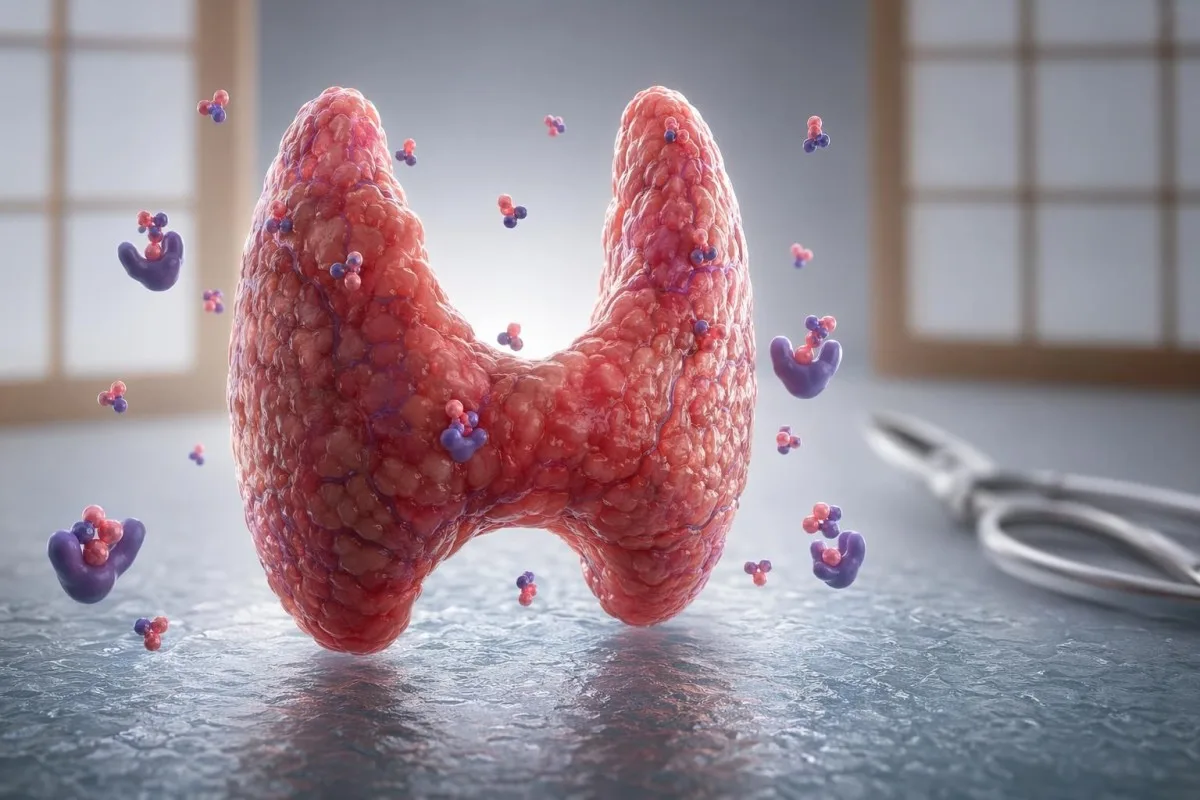
Free T4 is usually the more clinically useful thyroxine result, but total T4 still matters when binding proteins change. The disagreement is often not a lab error — it is physiology showing up on paper.


- Free T4 usually reflects the unbound, biologically available thyroxine fraction; typical adult reference ranges are about 10-22 pmol/L or 0.8-1.8 ng/dL.
- Total T4 measures bound plus unbound thyroxine; typical adult non-pregnant ranges are about 5-12 µg/dL or 64-154 nmol/L.
- Binding proteins carry more than 99.9% of circulating T4, mainly thyroxine-binding globulin, transthyretin and albumin.
- Pregnancy can raise thyroxine-binding globulin 2- to 3-fold, making total T4 higher even when free T4 is normal.
- Oral estrogen therapy often raises total T4 by increasing thyroxine-binding globulin; transdermal estrogen has a smaller effect.
- Liver disease or protein loss can lower binding proteins, causing low total T4 with a normal free T4 and normal TSH.
- TSH plus free T4 is the usual first-line interpretation pair for suspected hypothyroidism or hyperthyroidism in stable adults.
- Assay interference from biotin, heparin, severe illness or abnormal proteins can make free T4 misleading, so repeat testing may be safer than changing dose immediately.
Which T4 result matters most in real thyroid care?
Free T4 usually matters more than total T4 because it estimates the small fraction of thyroxine not attached to carrier proteins and available to tissues. In the free T4 vs total T4 question, I usually trust free T4 with TSH first — unless pregnancy, estrogen therapy, liver disease, kidney protein loss, or binding-protein abnormalities are in the picture.
The practical pair is TSH plus free T4 for most adults with fatigue, weight change, palpitations, cold intolerance or dose monitoring. A typical adult free T4 blood test range is about 10-22 pmol/L, while TSH is commonly interpreted around 0.4-4.0 mIU/L, though age and pregnancy shift that frame; our TSH range guide explains those shifts in more detail.
Kantesti is an AI blood test analyzer that interprets free T4, total T4 and TSH together rather than treating one flagged thyroid value as the whole diagnosis. In our review of large multilingual lab uploads, the most common avoidable panic is a high total T4 in someone taking oral estrogen with a perfectly ordinary free T4.
The laboratory medicine guideline by Baloch et al. in Thyroid states that free hormone estimates are clinically central when binding-protein changes are suspected (Baloch et al., 2003). I agree with that in practice: when the numbers disagree, the question is rarely 'which lab is wrong?' and more often 'what changed the binding proteins?'
As of June 25, 2026, I would not diagnose thyroid disease from total T4 alone in a stable outpatient. I would look at symptoms, TSH, free T4, medications, pregnancy status and prior results, then compare the whole pattern against a broader biomarker guide before calling it thyroid failure or excess.
What is the difference between free thyroxine and total thyroxine?
Free thyroxine vs total thyroxine is a bound-versus-unbound measurement problem. Total T4 counts nearly all thyroxine in the bloodstream, while free T4 estimates the tiny active fraction that is not attached to thyroxine-binding globulin, transthyretin or albumin.
More than 99.9% of T4 is protein-bound, and only about 0.02-0.03% circulates as free hormone. That small free fraction is what crosses into cells, helps set metabolic rate and participates in feedback to the pituitary gland.
Total T4 rises when binding proteins rise, even if the thyroid gland has not increased hormone production. This is why a total T4 blood test can look high in pregnancy or with oral estrogen while the patient is not truly hyperthyroid.
Free T4 can still mislead. Severe illness, heparin exposure, unusual albumin variants and some immunoassay quirks can distort a free T4 blood test, which is why binding clues such as the T3 uptake test occasionally remain useful.
I often explain it with a taxi analogy, imperfect but memorable: total T4 counts passengers in taxis plus those walking, while free T4 counts the walkers. If the city suddenly adds twice as many taxis, the passenger count changes, but the number of walkers may not.
What ranges should you expect for free T4 and total T4?
Free T4 is commonly reported around 10-22 pmol/L or 0.8-1.8 ng/dL in non-pregnant adults, while total T4 is often about 5-12 µg/dL or 64-154 nmol/L. Ranges vary by assay, country and pregnancy trimester, so the lab’s own interval matters.
The unit conversion is a frequent source of false alarm. A free T4 of 14 pmol/L is not the same scale as 1.4 ng/dL, and a total T4 of 100 nmol/L may be reported as roughly 7.8 µg/dL depending on rounding.
Some European laboratories set free T4 lower limits near 9 pmol/L, while many US laboratories use about 0.8 ng/dL as the lower boundary. That is why I never compare thyroid values across labs without checking unit changes, a problem we also cover in our unit conversion guide.
Borderline results deserve humility. A free T4 of 9.8 pmol/L with TSH 3.2 mIU/L in a well adult may mean something very different from free T4 9.8 pmol/L with TSH 18 mIU/L and new constipation, hoarse voice and rising LDL cholesterol.
If your report uses asterisks or high-low flags, remember that the flag is based on the laboratory interval, not your personal baseline. A shift from free T4 18 to 11 pmol/L over 18 months can matter even if both values still sit inside the printed range.
Why does free T4 often reflect active thyroid hormone better?
Free T4 often reflects active thyroid hormone better because only unbound hormone can readily enter tissues and participate in feedback control. Total T4 is heavily influenced by carrier proteins, so it can change without a true change in thyroid hormone effect.
The pituitary gland responds mainly to circulating free thyroid hormone and intracellular T3 generated from T4. That is why a low free T4 with high TSH is much more persuasive for primary hypothyroidism than a low total T4 by itself.
Kantesti's neural network reads free T4 alongside TSH, medication timing, age and assay units, using clinically reviewed logic described in our validation work. A free T4 of 11 pmol/L may be normal in one context and concerning in another if TSH has climbed from 1.1 to 6.8 mIU/L over six months.
The catch is that free T4 is not a direct tissue hormone measurement. The brain, liver and muscle convert T4 to T3 at different rates, so some patients with normal free T4 still feel unwell for reasons that are thyroid-adjacent rather than thyroid-caused.
When patients ask why symptoms and labs do not match, I look for anaemia, ferritin below 30 ng/mL, B12 deficiency, sleep disruption, depression, calorie restriction and inflammatory disease before blaming a mid-range free T4. Thyroid numbers are powerful, but they do not explain every tired human being.
When is a total T4 blood test still useful?
A total T4 blood test is useful when free T4 assays may be unreliable or when binding-protein physiology is the main question. It can help in pregnancy, suspected familial binding-protein variants, severe illness and some medication-related puzzles.
Total T4 is not obsolete. In pregnancy, many endocrinologists still use total T4 adjusted upward by about 50% after the first trimester when trimester-specific free T4 ranges are unavailable.
Kantesti is an AI blood test interpretation platform that can flag a high total T4 with normal TSH as a binding-pattern possibility rather than automatically suggesting hyperthyroidism. That distinction prevents a very real mistake: stopping or reducing thyroid medication in someone whose thyroid status is actually stable.
Familial dysalbuminaemic hyperthyroxinaemia is rare but memorable. These patients can show high total T4 and sometimes abnormal free T4 immunoassay results, while TSH remains normal and the person looks clinically euthyroid.
Total T4 also helps when a free T4 result is technically suspicious, such as an unexpected jump from 13 to 29 pmol/L with no TSH suppression and no symptoms. In that situation, I would repeat the test, check timing and consider a method such as equilibrium dialysis rather than treating a single strange number.
Why do pregnancy results make free T4 and total T4 disagree?
Pregnancy makes free T4 and total T4 disagree because estrogen raises thyroxine-binding globulin and human chorionic gonadotropin stimulates the thyroid early in gestation. Total T4 commonly rises, while free T4 interpretation depends strongly on trimester and assay method.
Thyroxine-binding globulin can rise 2- to 3-fold during pregnancy, especially after the first trimester. The 2017 American Thyroid Association pregnancy guideline recommends trimester-specific reference ranges whenever possible (Alexander et al., 2017).
A pregnant patient at 18 weeks may have total T4 above the non-pregnant upper limit and still be appropriately replaced. If trimester-specific free T4 ranges are missing, some clinicians interpret total T4 using a pregnancy-adjusted range about 1.5 times the non-pregnant interval.
TSH also behaves differently in early pregnancy because hCG has weak TSH-like activity. For more detail on why the first-trimester TSH target is not the same as a general adult target, see our pregnancy TSH guide.
I am cautious with dose changes in pregnancy because fetal brain development depends on adequate maternal thyroid hormone, especially before about 16-18 weeks. A patient with Hashimoto’s on levothyroxine often needs a dose increase early, but that decision should be based on TSH, free T4 or adjusted total T4, symptoms and obstetric context.
How do estrogen therapy and contraceptives change T4 results?
Oral estrogen therapy and many combined oral contraceptives raise total T4 by increasing thyroxine-binding globulin. Free T4 often stays normal after the body re-equilibrates, but levothyroxine-treated patients may need dose review within 6-8 weeks.
The liver produces more thyroxine-binding globulin under oral estrogen exposure. Total T4 may rise within weeks because more hormone is carried in the bound compartment, even when tissue thyroid effect has not increased.
Transdermal estrogen usually has less hepatic first-pass effect, so the binding-protein rise is smaller. That is a clinically useful distinction for a 52-year-old starting hormone therapy whose total T4 climbs but free T4 and TSH barely move.
Patients taking levothyroxine are a special group. When binding capacity increases, some may require a higher dose to maintain the same free hormone level, so I recheck TSH and free T4 about 6-8 weeks after starting or changing oral estrogen.
If estrogen symptoms, cycle timing or hormone panels are part of your wider picture, our guide to high estrogen patterns may help you organize what belongs to thyroid physiology and what belongs elsewhere.
How do liver disease and low proteins affect total T4?
Liver disease, nephrotic-range protein loss and low albumin can lower total T4 while free T4 and TSH remain normal. This happens because the bloodstream has fewer carrier proteins, not necessarily because the thyroid gland is failing.
The liver makes major thyroid hormone carrier proteins, including thyroxine-binding globulin, transthyretin and albumin. A low albumin below about 35 g/L can signal a broader protein problem that makes total hormone tests harder to interpret.
Nephrotic syndrome can spill protein into urine at more than 3.5 g/day, lowering albumin and sometimes lowering total T4. In that situation, I pay more attention to free T4, TSH, urine protein and kidney markers than to total T4 alone.
Chronic liver disease can push results in either direction because inflammation, protein synthesis and medication metabolism all interact. If albumin, globulin or A/G ratio is also abnormal, our serum proteins guide gives useful background.
A pattern I see: total T4 is low, free T4 is 14 pmol/L, TSH is 1.7 mIU/L, albumin is 30 g/L and urine protein is positive. That is not classic hypothyroidism; it is a protein-binding story until proven otherwise.
Which medications and interferences can distort free T4?
Biotin, heparin, severe illness, abnormal binding proteins and some antibodies can distort free T4 results. When free T4 does not fit TSH or the patient’s condition, repeating the test with careful timing is often safer than changing thyroid treatment immediately.
Biotin doses of 5-10 mg/day, common in hair and nail supplements, can interfere with some thyroid immunoassays. Depending on the assay design, it may create falsely high or falsely low thyroid-related results.
Heparin can increase free fatty acids in the sample after collection and sometimes falsely raise measured free T4. This is one reason a hospitalized patient’s thyroid panel can look more dramatic than their true thyroid state.
Kantesti AI flags implausible thyroid patterns in the same spirit as our lab error checks: a free T4 of 32 pmol/L with TSH 3.0 mIU/L and no symptoms is a recheck pattern, not an automatic Graves’ disease label.
If you take high-dose biotin, I usually suggest asking your clinician whether to stop it for 48-72 hours before repeat thyroid testing. Do not stop prescribed thyroid, heart, seizure or anticoagulant medicines without medical advice; that is a different risk category.
How should TSH be read with free T4 and total T4?
TSH explains most T4 patterns because it is the pituitary’s response to circulating thyroid hormone. High TSH with low free T4 suggests primary hypothyroidism, while low TSH with high free T4 suggests thyrotoxicosis in most stable adults.
A TSH above 10 mIU/L with low free T4 is usually overt primary hypothyroidism. A TSH below 0.1 mIU/L with high free T4 is usually overt hyperthyroidism, although illness and medications still deserve review.
The grey zone is where doctors earn their coffee. TSH 5.8 mIU/L with free T4 13 pmol/L may be subclinical hypothyroidism, early Hashimoto’s, recovery from illness, a missed levothyroxine pattern or just a transient fluctuation.
Our high TSH guide walks through these pairings, including when antibodies and repeat testing add value. TPO antibodies, for example, increase the chance that mild TSH elevation will persist over time.
TSH lags behind free T4 after dose changes. If levothyroxine changed last week, the free T4 may move sooner, but the TSH often needs 6 weeks or more to settle into a new steady state.
Where do free T3, reverse T3 and symptoms fit?
Free T3 can help in selected hyperthyroid or conversion questions, but it should not replace TSH and free T4 as the main thyroid pair. Reverse T3 is mainly affected by illness and calorie stress, and it often creates more confusion than clarity in routine care.
T4 is a prohormone, and tissues convert it into T3 using deiodinase enzymes. Free T3 is usually about 3-6 pmol/L in many adult assays, but reference intervals vary enough that the lab’s method matters.
In Graves’ disease, T3 can rise disproportionately; a low TSH with high T3 but normal free T4 is sometimes called T3-toxicosis. That pattern is easy to miss if only TSH and free T4 are checked.
During severe illness or under-eating, T3 often falls while reverse T3 rises, which is part of the non-thyroidal illness response. Our free T3 guide explains when T3 is worth ordering and when it is mostly noise.
I am careful with patients who arrive convinced that every symptom is 'low T3.' Cold hands, hair shedding and brain fog can come from ferritin 12 ng/mL, low calorie intake, sleep debt or perimenopause even when thyroid conversion is normal.
Why acute illness can make thyroid results look wrong
Acute illness can lower total T4, lower T3 and sometimes alter free T4 without primary thyroid disease. This non-thyroidal illness pattern is common in hospitalized patients and should usually be rechecked after recovery before starting long-term thyroid treatment.
In intensive illness, the body changes hormone binding, conversion and clearance. T3 often falls first; total T4 may fall in more severe illness, and TSH can be low, normal or mildly high during recovery.
This is why a free T4 result drawn during sepsis, major surgery or starvation does not carry the same meaning as an outpatient morning test. A repeat panel 4-8 weeks after recovery is often the cleaner diagnostic moment.
Our article on euthyroid sick syndrome covers this pattern because it is one of the most overtreated thyroid-looking lab clusters. Treating the lab instead of the illness can expose patients to palpitations, bone loss and anxiety.
One clinical anecdote stays with me: a 71-year-old in hospital had low T3 and low total T4, but free T4 was borderline and TSH was not convincingly high. Six weeks after pneumonia resolved, his thyroid panel normalized without thyroid medication.
What should you do when free T4 and total T4 disagree?
When free T4 and total T4 disagree, first check TSH, pregnancy status, estrogen use, protein levels, medication timing, supplement use and lab method. Most disagreements have a physiological explanation, and repeating the test is often better than reacting to one isolated value.
Start with the simplest question: does TSH agree with free T4? If TSH is normal, free T4 is normal and only total T4 is abnormal, binding proteins are usually more likely than true thyroid disease.
Next, check for known binding modifiers: pregnancy, oral estrogen, tamoxifen, androgens, glucocorticoids, nephrotic protein loss and liver disease. Albumin below 35 g/L or significant urine protein changes the interpretation of total T4 immediately.
If you are on levothyroxine, timing matters. Taking the tablet shortly before testing can transiently raise free T4, so many clinicians prefer a consistent pre-dose morning draw when monitoring therapy; our levothyroxine timeline explains why rechecks are usually spaced 6-8 weeks apart.
Bring the actual report, not just screenshots of flagged numbers. Dr. Thomas Klein often tells patients that the reference interval, units and collection time are part of the result — without them, a thyroid panel is only half a sentence.
How Kantesti AI reads thyroid panels in context
Kantesti AI reads thyroid results by combining free T4, total T4, TSH, units, medications, pregnancy clues, protein markers and trends. That pattern-based approach is safer than treating a single free T4 or total T4 flag as a diagnosis.
Kantesti is an AI-powered blood test analysis tool used by people across 127+ countries, so our thyroid logic has to handle pmol/L, ng/dL, µg/dL and nmol/L without losing clinical meaning. A unit error can create a fake thyroid emergency on paper.
Our AI does not diagnose Graves’ disease, Hashimoto’s or central hypothyroidism from one line. It triages patterns: high TSH plus low free T4, low TSH plus high free T4, discordant total T4 with normal free T4, and possible assay interference.
The technical side is described in our AI technology guide, but the clinical principle is plain: compare thyroid markers with adjacent labs. Albumin, liver enzymes, pregnancy markers, kidney protein clues and medication history often explain why total T4 wandered off.
Trend analysis is where I find the most value. A free T4 drifting from 17 to 12 to 9 pmol/L while TSH rises from 2.0 to 7.5 mIU/L over a year tells a different story from one borderline value after a viral illness.
When should abnormal T4 results prompt medical review?
Abnormal T4 results should prompt medical review when free T4 is clearly outside range, TSH is strongly abnormal, symptoms are significant, pregnancy is present, or results changed after thyroid medication. Urgent review is needed for severe palpitations, confusion, chest pain, fainting or marked weakness.
Call promptly if TSH is below 0.1 mIU/L with high free T4 and you have racing heart, tremor, weight loss or chest discomfort. In older adults and people with atrial fibrillation risk, overtreatment with thyroid hormone can be dangerous even when symptoms feel mild.
Call promptly if TSH is above 10 mIU/L with low free T4, especially with pregnancy, infertility treatment, slow heart rate, swelling, severe constipation or worsening depression. The 2014 ATA hypothyroidism guideline emphasizes TSH-guided levothyroxine management for most primary hypothyroidism cases (Jonklaas et al., 2014).
Do not adjust levothyroxine, antithyroid drugs or supplements such as iodine based on total T4 alone. I have seen patients make themselves hyperthyroid with kelp capsules containing more than 500 µg iodine per day, while the original issue was simply estrogen-related binding protein change.
At Kantesti, Dr. Thomas Klein and our clinical reviewers treat thyroid interpretation as medical context, not numerology; our Medical Advisory Board supports that standard. If your labs and symptoms do not fit neatly, ask for a repeat panel and a human clinician’s review rather than chasing the most alarming number.
Frequently Asked Questions
Is free T4 more important than total T4?
Free T4 is usually more important than total T4 because it estimates the unbound thyroxine fraction available to tissues. A typical adult free T4 range is about 10-22 pmol/L or 0.8-1.8 ng/dL, while total T4 is heavily affected by binding proteins. Total T4 still helps in pregnancy, estrogen therapy, protein loss and suspected assay problems. The best interpretation usually combines TSH, free T4, symptoms and medication history.
Why is my total T4 high but free T4 normal?
High total T4 with normal free T4 most often reflects increased thyroid hormone binding proteins rather than true hyperthyroidism. Pregnancy and oral estrogen therapy can raise thyroxine-binding globulin 2- to 3-fold, which increases bound T4 and pushes total T4 above the usual adult range of 5-12 µg/dL. If TSH is normal and symptoms are absent, clinicians usually check context and repeat testing before treating. Do not stop thyroid medication based only on high total T4.
Can total T4 be low while free T4 is normal?
Total T4 can be low while free T4 is normal when carrier proteins are reduced. Low albumin below about 35 g/L, liver disease, nephrotic-range protein loss above 3.5 g/day and severe illness can all lower the bound hormone pool. If TSH and free T4 are normal, this pattern is not classic hypothyroidism. Doctors usually review protein markers, urine protein, liver tests and recent illness before diagnosing thyroid disease.
Which thyroid test is best during pregnancy?
During pregnancy, TSH with trimester-specific free T4 is often preferred, but adjusted total T4 can be useful when free T4 assay ranges are unreliable. Thyroxine-binding globulin rises substantially in pregnancy, so total T4 may need interpretation against a range about 1.5 times the non-pregnant interval after the first trimester. The 2017 American Thyroid Association pregnancy guideline recommends trimester-specific reference ranges whenever available. Pregnant patients should not change thyroid medication without obstetric or endocrine guidance.
Can biotin affect free T4 results?
Biotin can affect some free T4 and TSH immunoassays, especially at supplement doses of 5-10 mg/day used for hair and nail products. Depending on the assay, biotin interference may make thyroid results look falsely high or falsely low. Many clinicians advise stopping non-prescribed high-dose biotin for 48-72 hours before repeat thyroid testing, but the exact advice depends on the lab method and clinical risk. Prescription medicines should not be stopped without medical advice.
Should levothyroxine dose be based on free T4 or TSH?
For most adults with primary hypothyroidism, levothyroxine dose is mainly adjusted using TSH, with free T4 used for confirmation and special situations. TSH often needs 6-8 weeks to stabilize after a dose change, while free T4 can shift sooner. Free T4 becomes more central in pregnancy, pituitary disease, recent dose changes, suspected malabsorption or unusual assay patterns. Symptoms matter, but they should be interpreted alongside TSH, free T4, timing and adherence.
Do I need to fast before a free T4 or total T4 blood test?
Usually no: fasting is not required for TSH, free T4, or total T4 testing. Try to use the same laboratory and time of day for repeat tests, and follow any medication instructions from your clinician.
Can calcium or iron supplements affect my thyroid blood results?
Calcium and iron do not usually interfere with the laboratory measurement itself, but they can reduce absorption of levothyroxine and raise TSH over time. Keep them at least 4 hours apart from levothyroxine unless your prescriber advises otherwise.
Get AI-Powered Blood Test Analysis Today
Join over 2 million users worldwide who trust Kantesti for instant, accurate lab test analysis. Upload your blood test results and receive comprehensive interpretation of 15,000+ biomarkers in seconds.
📚 Referenced Research Publications
Klein, T., Mitchell, S., & Weber, H. (2026). B Negative Blood Type, LDH Blood Test & Reticulocyte Count Guide. Kantesti AI Medical Research.
Klein, T., Mitchell, S., & Weber, H. (2026). Diarrhea After Fasting, Black Specks in Stool & GI Guide 2026. Kantesti AI Medical Research.
📖 External Medical References
⚕️ Medical Disclaimer
This article is for educational purposes only and does not constitute medical advice. Always consult a qualified healthcare provider for diagnosis and treatment decisions.
E-E-A-T Trust Signals
Experience
Physician-led clinical review of lab interpretation workflows.
Expertise
Laboratory medicine focus on how biomarkers behave in clinical context.
Authoritativeness
Written by Dr. Thomas Klein with review by Dr. Sarah Mitchell and Prof. Dr. Hans Weber.
Trustworthiness
Evidence-based interpretation with clear follow-up pathways to reduce alarm.