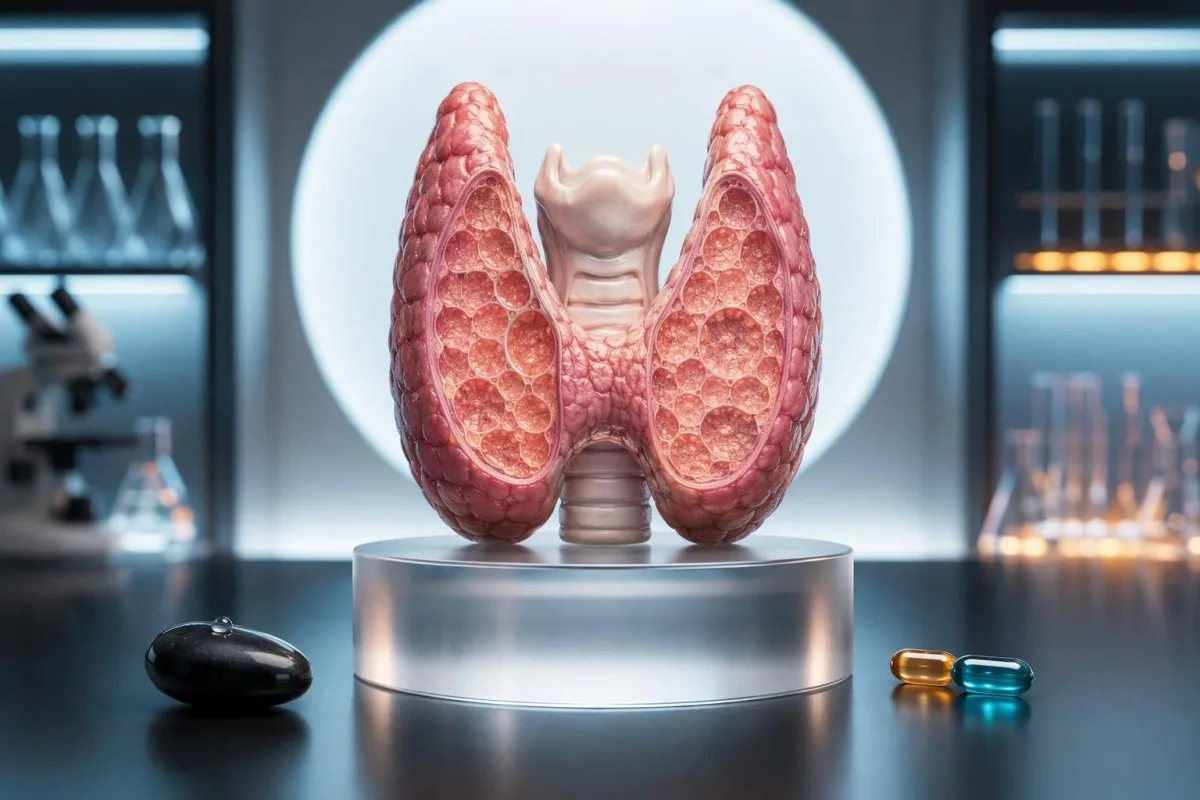
A patient-first guide to iodine, selenium, thyroid labs, medication timing, and the supplement patterns that deserve medical review before you start.


- Iodine helps when intake is low, but adult needs are only 150 mcg/day and the adult upper limit is 1,100 mcg/day.
- Selenium is usually dosed at 55 mcg/day from diet or 100-200 mcg/day short term; chronic intake above 400 mcg/day can cause toxicity.
- TSH is commonly about 0.4-4.0 mIU/L in adults, but pregnancy, age, illness, and levothyroxine timing change the interpretation.
- Low TSH below 0.1 mIU/L should prompt medical review before iodine, kelp, thyroid glandulars, or stimulant-style thyroid blends.
- Positive TPO antibodies can occur with normal TSH; iodine megadoses may worsen autoimmune thyroid activity in susceptible patients.
- Levothyroxine should usually be separated from calcium, iron, magnesium, and multivitamins by at least 4 hours.
- Biotin can distort TSH, free T4, free T3, and thyroid antibody immunoassays; many clinicians pause it for 48-72 hours before testing.
- Retesting is usually most meaningful 6-8 weeks after changing thyroid medication or iodine intake because TSH moves slowly.
Which supplements for thyroid health may actually help?
The best supplements for thyroid health are targeted: iodine only when intake is low, selenium only when the dose is safe, and no glandular or kelp product when TSH is already low. Iodine and selenium can help the thyroid make and regulate hormones, but either can backfire if your lab pattern suggests Hashimoto’s, Graves’ disease, nodular thyroid disease, pregnancy, or medication interference.
I am Thomas Klein, MD, Chief Medical Officer at Kantesti AI, and the pattern I see most often is not deficiency; it is guessing. Kantesti is an AI blood test interpretation platform that helps patients read thyroid labs in context, and as an organization we explain our clinical approach on About Us.
A normal adult thyroid contains roughly 15-20 mg of iodine, mostly stored in thyroid hormone precursors. That sounds like an argument for iodine pills, but in iodine-sufficient countries the more common problem is taking 500-1,000 mcg/day without proving a need.
Here is the practical filter I use in clinic: supplement only when the lab pattern and diet history point the same way. Fatigue with TSH 2.1 mIU/L, normal free T4, ferritin 9 ng/mL, and heavy periods is usually not an iodine story; it is more likely an iron story wearing a thyroid costume.
Which labs should you check before starting thyroid supplements?
Before starting thyroid supplements, review TSH, free T4, thyroid antibodies, medication timing, and recent biotin use. If symptoms are strong or TSH is abnormal, add free T3, TPO antibodies, thyroglobulin antibodies, and sometimes TRAb or urinary iodine rather than buying a broad supplement blend.
Adult TSH is often reported around 0.4-4.0 mIU/L, but some laboratories use upper limits closer to 4.5 or 5.0 mIU/L. Free T4 is commonly about 0.8-1.8 ng/dL, or 10-23 pmol/L, depending on the assay and country.
Kantesti AI interprets thyroid results against units, flags, medications, age, sex, and repeated measurements rather than treating a single asterisk as a diagnosis. Our biomarkers guide is useful if your report uses unfamiliar thyroid abbreviations or different international units.
I like a baseline before supplements because the pre-supplement pattern becomes the safety anchor. If you are changing iodine, selenium, iron, or biotin, our guide to tracking labs around supplements explains why a 6-8 week comparison often beats a same-week retest.
When does an iodine supplement help the thyroid?
An iodine supplement thyroid plan helps mainly when iodine intake is genuinely low, such as low iodized salt use, little seafood or dairy, vegan diets without iodine planning, or pregnancy with inadequate prenatal iodine. It can backfire in Hashimoto’s, Graves’ disease, multinodular goitre, or after sudden high-dose kelp exposure.
The adult recommended iodine intake is 150 mcg/day, rising to 220 mcg/day in pregnancy and 290 mcg/day during lactation. The adult tolerable upper intake level is 1,100 mcg/day, and many kelp products exceed that unpredictably.
Median urinary iodine of 100-199 mcg/L suggests adequate iodine intake in non-pregnant adults; 150-249 mcg/L is considered adequate in pregnancy. A single spot urine test is noisy for one person, but it can still flag very low or very high exposure, and we cover the caveats in our urinary iodine guide.
Zimmermann and Boelaert’s Lancet Diabetes & Endocrinology review linked iodine deficiency to goitre and hypothyroidism, but also noted that rapid iodine repletion can increase thyroid autoimmunity in some populations (Zimmermann and Boelaert, 2015). In clinic, the red flag is a patient who starts kelp, then develops palpitations, tremor, and TSH below 0.1 mIU/L within weeks.
What does selenium do for thyroid health?
A selenium thyroid supplement may support deiodinase enzymes and antioxidant proteins inside the thyroid, but the clinical benefit is modest and inconsistent. Selenium is not a thyroid hormone replacement, and higher doses do not reliably improve fatigue, weight, hair loss, or TSH.
Adult selenium needs are about 55 mcg/day, with pregnancy around 60 mcg/day and lactation around 70 mcg/day. The adult upper limit is 400 mcg/day; chronic excess can cause brittle nails, hair shedding, garlic-like breath, metallic taste, gastrointestinal upset, and peripheral nerve symptoms.
Negro et al. reported that 200 mcg/day selenium during pregnancy in TPO-antibody-positive women reduced postpartum thyroid dysfunction in one trial, but that does not make selenium a universal Hashimoto’s treatment (Negro et al., 2007). The evidence here is honestly mixed, and my usual ceiling is 100-200 mcg/day for a defined period, not indefinitely.
Food-first selenium is often safer because one or two Brazil nuts can contain anything from about 50 to more than 90 mcg each, depending on soil. If you eat them daily, read our selenium food guide before adding capsules on top.
How do Hashimoto’s antibodies change supplement decisions?
Positive TPO antibodies or thyroglobulin antibodies make iodine megadoses riskier and make selenium more plausible, though still not guaranteed to help. A patient with normal TSH and positive antibodies usually needs monitoring, not a pile of thyroid-stimulating supplements.
Many laboratories call TPO antibodies positive above roughly 35 IU/mL, but cutoffs vary by assay. Thyroglobulin antibody positivity often starts around 40 IU/mL, and the trend can matter more than a single borderline number.
The pattern I watch is TPO antibody positivity plus TSH drifting from 2.0 to 4.8 mIU/L over 12-24 months. Our article on positive TPO antibodies explains why normal TSH does not erase autoimmune risk, especially if family history is strong.
Iodine can worsen autoimmune thyroid activity in susceptible people because more iodine inside thyroid follicles can increase oxidative stress during hormone synthesis. Selenium may buffer part of that oxidative load, but it does not cancel the risk of taking 1,000 mcg/day iodine from kelp.
Which lab patterns mean avoid thyroid-stimulating supplements?
Avoid iodine, kelp, thyroid glandulars, and stimulant thyroid blends when TSH is low, especially below 0.1 mIU/L, or when free T4 or free T3 is high. That pattern can suggest Graves’ disease, thyroiditis, excess thyroid medication, or iodine-triggered hyperthyroidism.
Free T3 is commonly reported around 2.3-4.2 pg/mL, though ranges differ. A TSH below 0.1 mIU/L with high free T4 or free T3 deserves prompt medical review, particularly if pulse is above 100 beats per minute, tremor is present, or weight is falling unintentionally.
Graves’ disease is usually evaluated with TSH receptor antibodies, often called TRAb or TSI depending on the lab. Our guide to Graves and hypothyroid patterns shows why low TSH is not the same diagnosis in every patient.
One 34-year-old patient I reviewed had a TSH of 0.03 mIU/L after starting a thyroid energy blend containing kelp and animal glandular extract. The supplement label looked harmless; the lab pattern did not.
How do thyroid supplements interact with levothyroxine?
Levothyroxine absorption is easily reduced by calcium, iron, magnesium, zinc, fiber powders, coffee, and some antacids. Most patients should take levothyroxine on an empty stomach and separate mineral supplements by at least 4 hours unless their clinician gives a different plan.
The American Thyroid Association guideline by Jonklaas et al. recommends consistent levothyroxine administration because absorption changes can destabilize TSH (Jonklaas et al., 2014). In practice, a TSH rising from 1.9 to 6.2 mIU/L after starting iron is often a timing problem, not thyroid failure.
Our levothyroxine timeline guide explains why TSH is usually rechecked 6-8 weeks after dose or timing changes. If you also take calcium or iron, our supplement timing article on what not to combine is worth reading before the next blood draw.
Biotin is different: it may not change your thyroid biology, but it can distort the assay. A patient taking 5,000-10,000 mcg/day for hair often gets a falsely low TSH or falsely high free T4 depending on the lab platform.
What changes during pregnancy, postpartum, and breastfeeding?
Pregnancy increases iodine needs, changes TSH interpretation, and makes self-directed thyroid supplementation riskier. People who are pregnant, trying to conceive, postpartum, or breastfeeding should review thyroid labs and prenatal iodine content before adding iodine or selenium separately.
Iodine need rises to about 220 mcg/day in pregnancy and 290 mcg/day during lactation because fetal and infant thyroid hormone production depends on maternal iodine supply. Too little iodine is harmful, but repeated high-dose kelp is not a safe shortcut.
TSH reference ranges are lower early in pregnancy because hCG can stimulate the thyroid. Our pregnancy TSH guide explains why trimester, gestational age, and local reference intervals matter more than a generic adult cutoff.
Postpartum thyroiditis often starts with a temporary hyperthyroid phase and may later shift to hypothyroidism. I have seen selenium considered for TPO-antibody-positive patients, but I still want a clinician involved because palpitations at 8 weeks postpartum can be thyroiditis, anxiety, anemia, or all three.
Can diet cover iodine and selenium needs safely?
Diet can cover iodine and selenium needs for many people without high-dose capsules. Iodized salt, dairy, eggs, seafood, seaweed in small predictable amounts, legumes, grains, and Brazil nuts can all contribute, but the safest mix depends on country, soil, pregnancy status, and kidney function.
Iodized salt usually contains enough iodine that about half a teaspoon can approach a daily adult iodine target, though concentration varies by country and storage. Seaweed is the wild card: one serving may contain less than 100 mcg iodine or several thousand mcg.
Selenium intake varies dramatically by soil; the same grain can provide different selenium amounts in different countries. If fatigue, hair shedding, or brittle nails are driving supplement use, first compare thyroid labs with iron, B12, vitamin D, and protein markers using our nutrient deficiency guide.
The informal rule I give patients is simple: food first, then one targeted supplement if the pattern supports it. Stacking iodine, selenium, zinc, tyrosine, ashwagandha, and glandular extract makes it almost impossible to know what helped or harmed.
Which thyroid supplement ingredients distort lab results?
Biotin, glandular extracts, kelp, ashwagandha, tyrosine, and high-dose iodine are the supplement ingredients I ask about first when thyroid labs look odd. Biotin is especially tricky because it can create a hyperthyroid-looking lab pattern without true hyperthyroidism.
Many hair, skin, and nail products contain 5,000-10,000 mcg biotin, which is 167-333 times the 30 mcg/day adult adequate intake. Some immunoassays use biotin-streptavidin chemistry, so excess biotin can interfere with TSH, free T4, free T3, and antibody measurements.
Kantesti is an AI-powered blood test analysis tool used by patients in more than 127 countries, and our AI flags discordant thyroid patterns that may reflect assay interference rather than disease. For a deeper look, see our article on AI lab error checks.
Ashwagandha is another ingredient I treat carefully because case reports link it with thyrotoxicosis-like presentations in susceptible people. If you are using it for stress, our ashwagandha safety guide explains why cortisol claims and thyroid effects should not be mixed casually.
Which thyroid lab patterns need medical review first?
Medical review is advised before thyroid supplements if TSH is below 0.1 mIU/L, TSH is above 10 mIU/L, free T4 is abnormal, thyroid antibodies are strongly positive, TRAb is positive, or symptoms include chest pain, fainting, severe palpitations, confusion, or rapid weight loss.
A TSH above 10 mIU/L with low or low-normal free T4 is not a supplement-first situation. It may represent overt hypothyroidism, and delaying treatment can worsen cholesterol, constipation, menstrual changes, infertility risk, and, rarely, severe hypothyroid complications.
Kantesti’s clinical reviewers and our Medical Advisory Board treat a low TSH plus palpitations as a different safety category than a borderline TSH plus fatigue. If your result sits near a cutoff, our borderline TSH guide explains when a mild flag needs repeat testing rather than immediate action.
As Thomas Klein, MD, I worry most about older adults, people with atrial fibrillation, osteoporosis, thyroid nodules, or previous thyroid cancer. A supplement that nudges a 25-year-old into mild tremor can push a 78-year-old into a dangerous rhythm problem.
When should you retest thyroid labs after supplements?
Retest TSH and free T4 about 6-8 weeks after changing thyroid medication, iodine intake, or a thyroid-affecting supplement. Antibodies change more slowly, and symptom improvement should be tracked alongside pulse, weight, bowel pattern, sleep, and menstrual changes.
TSH has biological lag because the pituitary responds gradually to circulating thyroid hormone levels. Testing 5 days after starting iodine or selenium usually tells you more about anxiety than thyroid adaptation.
Kantesti’s AI biomarker interpretation platform reads thyroid results longitudinally, so a TSH shift from 2.7 to 3.4 mIU/L is treated differently from a shift from 2.7 to 8.9 mIU/L. Our blood test trend guide shows why slope, timing, and symptoms often matter more than one isolated flag.
For selenium, I usually reassess symptoms and thyroid labs after 8-12 weeks if there was a specific reason to try it. For antibodies, 3-6 months is more realistic, and even then a lower antibody number does not always mean the patient feels better.
Who should be extra cautious with thyroid supplements?
Children, older adults, pregnant people, patients after thyroidectomy, people with thyroid nodules, kidney disease, heart rhythm disorders, or thyroid cancer history should not start iodine, selenium, glandular extracts, or thyroid blends without review. Their safe ranges and treatment goals often differ from standard adult wellness advice.
Children have age-specific TSH and free T4 ranges, and growth velocity matters as much as the number. Our pediatric thyroid guide explains why adult supplement doses should not be scaled casually by body size.
After thyroidectomy, iodine supplements do not replace missing thyroid tissue, and levothyroxine targets may be deliberately lower or higher depending on cancer history. Our thyroidectomy lab guide covers why a TSH of 0.2 mIU/L can be intentional in one patient and unsafe in another.
Kidney disease adds another layer because selenium and mineral supplements may accumulate or interact with phosphate, potassium, or magnesium management. If eGFR is below 60 mL/min/1.73 m², I want the kidney panel on the table before any long-term mineral regimen.
How Kantesti reviews thyroid supplement safety
Kantesti reviews thyroid supplement safety by combining thyroid markers, units, medications, symptoms, pregnancy status, and longitudinal trends rather than ranking supplements in isolation. The goal is to identify when iodine or selenium is reasonable, when it is unnecessary, and when the lab pattern needs clinician review first.
Kantesti is an AI lab test interpretation service that processes uploaded blood test reports in about 60 seconds, while our physicians set the clinical safety rules for high-risk patterns. The engineering details are described in our technology guide.
Our validation work focuses on whether the system flags dangerous combinations, such as low TSH with high free T4, high TSH with low free T4, or supplement interference clues. The clinical oversight model is outlined on our medical validation page and in a pre-registered technical benchmark.
As of June 18, 2026, my advice remains deliberately conservative: use iodine and selenium like medications, not wellness decorations. The best supplements for thyroid health are the ones that match your labs, your diet, and your risk profile.
Frequently Asked Questions
What are the best supplements for thyroid health?
The best supplements for thyroid health are iodine when intake is low, selenium when intake is low or a clinician recommends a short trial, and correction of related deficiencies such as iron, vitamin D, or B12 when labs support them. Adults need about 150 mcg/day iodine and 55 mcg/day selenium, not megadoses. If TSH is below 0.1 mIU/L, free T4 is high, or thyroid antibodies are positive, medical review should come before thyroid support blends.
Can iodine supplements make thyroid problems worse?
Yes, iodine supplements can worsen thyroid problems in people with Hashimoto’s thyroiditis, Graves’ disease, multinodular goitre, or iodine-sensitive thyroid tissue. The adult iodine target is about 150 mcg/day, while the upper limit is 1,100 mcg/day. Kelp products can exceed this unpredictably, so low TSH, palpitations, tremor, or positive thyroid antibodies should prompt review before use.
How much selenium is safe for thyroid support?
Most adults need about 55 mcg/day selenium, and thyroid studies often use 100-200 mcg/day for a limited period. The adult upper limit is 400 mcg/day from food and supplements combined. Chronic excess can cause hair shedding, brittle nails, garlic-like breath, stomach upset, and nerve symptoms, so selenium should not be stacked with Brazil nuts and multivitamins without counting the total dose.
Should I take iodine if my TSH is high?
A high TSH does not automatically mean you need iodine. TSH above 4.0-10 mIU/L may reflect subclinical hypothyroidism, Hashimoto’s thyroiditis, missed levothyroxine doses, medication interactions, or true iodine deficiency depending on free T4, antibodies, diet, and pregnancy status. If TSH is above 10 mIU/L or free T4 is low, a clinician should review the result before iodine supplementation.
Can selenium lower thyroid antibodies?
Selenium may lower TPO antibody levels in some studies, but the effect is inconsistent and does not always improve symptoms or normalize TSH. A common trial dose is 100-200 mcg/day for 8-12 weeks, with the total daily intake kept below 400 mcg/day. Positive antibodies with normal TSH usually require monitoring and risk assessment rather than automatic long-term supplementation.
Do thyroid supplements interfere with levothyroxine?
Mineral supplements can interfere with levothyroxine absorption, especially calcium, iron, magnesium, zinc, and multivitamins. Many patients are advised to separate levothyroxine from these supplements by at least 4 hours and to take levothyroxine consistently on an empty stomach. TSH is usually rechecked 6-8 weeks after timing or dose changes because the result lags behind the change.
Should I stop biotin before a thyroid blood test?
Many clinicians ask patients to stop biotin for 48-72 hours before thyroid blood tests, especially if they take 5,000-10,000 mcg/day hair or nail supplements. Biotin can interfere with some immunoassays and create misleading TSH, free T4, free T3, or antibody results. High-dose or prescribed biotin may require a longer pause, so ask the ordering clinician or laboratory for test-specific advice.
Can I take ashwagandha for stress if I have a thyroid condition?
Ashwagandha may affect thyroid hormone production and has occasionally been linked with an overactive-thyroid pattern. Avoid starting it without clinician advice if you have low TSH, Graves’ disease, thyroid nodules, or take thyroid medication; seek prompt care for palpitations, tremor, or new heat intolerance.
Get AI-Powered Blood Test Analysis Today
Join over 2 million users worldwide who trust Kantesti for instant, accurate lab test analysis. Upload your blood test results and receive comprehensive interpretation of 15,000+ biomarkers in seconds.
📚 Referenced Research Publications
Klein, T., Mitchell, S., & Weber, H. (2026). Clinical Validation Framework v2.0 (Medical Validation Page). Kantesti AI Medical Research.
Klein, T., Mitchell, S., & Weber, H. (2026). AI Blood Test Analyzer: 2.5M Tests Analyzed | Global Health Report 2026. Kantesti AI Medical Research.
📖 External Medical References
⚕️ Medical Disclaimer
This article is for educational purposes only and does not constitute medical advice. Always consult a qualified healthcare provider for diagnosis and treatment decisions.
E-E-A-T Trust Signals
Experience
Physician-led clinical review of lab interpretation workflows.
Expertise
Laboratory medicine focus on how biomarkers behave in clinical context.
Authoritativeness
Written by Dr. Thomas Klein with review by Dr. Sarah Mitchell and Prof. Dr. Hans Weber.
Trustworthiness
Evidence-based interpretation with clear follow-up pathways to reduce alarm.