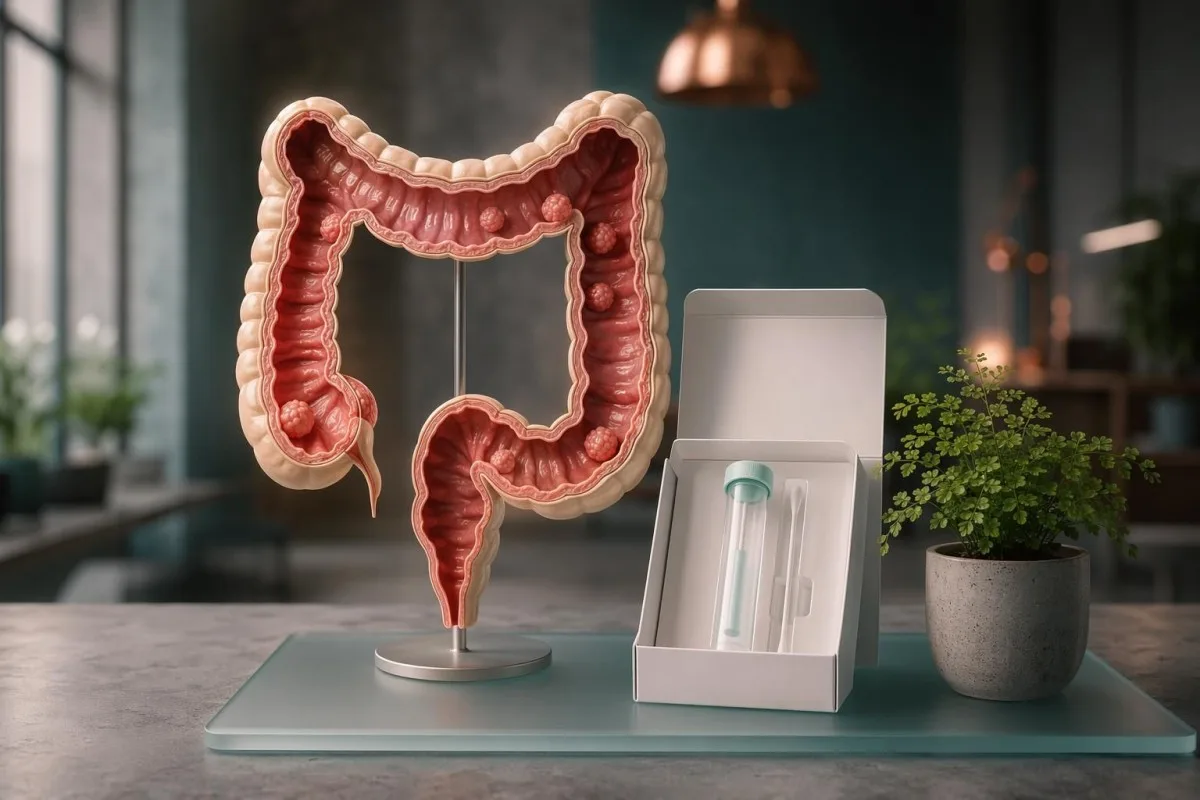
A stool DNA screening result can be useful, but it is not a diagnosis. The real question is what you do next — especially after a positive result or symptoms despite a negative one.


- Positive Cologuard result means abnormal stool DNA and/or hemoglobin markers were detected; it does not diagnose cancer, but it requires colonoscopy.
- Negative Cologuard result means no screening signal was detected, yet colorectal cancer and advanced polyps are not fully excluded.
- Stool DNA test sensitivity for colorectal cancer was 92.3% in the pivotal NEJM trial, compared with 73.8% for FIT in the same study.
- Advanced precancerous lesions were detected by multitarget stool DNA testing about 42.4% of the time in Imperiale et al., so many high-risk polyps can still be missed.
- False positives happen because hemorrhoids, inflammation, benign polyps, diverticular disease, and age-related DNA shedding can trigger stool markers.
- False negatives happen when a cancer or polyp sheds little DNA, bleeds intermittently, sits in a flat serrated pattern, or is missed by sampling.
- Colonoscopy after positive stool DNA should usually be scheduled within months; delays beyond 9 to 12 months after a positive fecal test are linked with higher cancer and later-stage diagnosis risk.
- Average-risk screening with Cologuard is generally intended for adults 45 years and older without symptoms, previous high-risk polyps, inflammatory bowel disease, or strong family history.
- Symptoms override screening: rectal bleeding, iron-deficiency anemia, unexplained weight loss, or a persistent bowel habit change needs medical review even after a negative test.
What Cologuard test results mean in plain clinical terms
Cologuard test results are screening signals, not diagnoses: a positive result means stool DNA and/or hemoglobin markers were detected and colonoscopy is needed; a negative result means no signal was detected but cancer and advanced polyps are not fully excluded. A stool DNA test is meant for average-risk screening, not for symptoms. Kantesti is an AI blood test interpretation platform that helps patients understand related blood markers, but a positive stool DNA result still needs visual evaluation of the colon.
The test looks for altered DNA markers and a hemoglobin signal in stool, because colorectal growths often shed cells and tiny amounts of blood unevenly. That uneven shedding is the whole reason a single result can be useful without being perfect; the same biology explains both false positives and false negatives.
In my experience, patients often read “positive” as “I have cancer.” That is not what it means. Most positive stool DNA tests do not turn out to be cancer, but the result is strong enough that repeating the kit is usually the wrong move; for comparison, our guide to FIT and FOBT differences explains why stool screening tests are designed to trigger colonoscopy rather than settle the diagnosis.
Kantesti, as an organization described on our About Us page, focuses on translating lab data into understandable risk context across countries and units. For Cologuard, the context is simple but serious: screening narrows the field, colonoscopy confirms what is actually present.
What a positive Cologuard result usually means
A positive Cologuard result means the stool DNA test detected molecular markers, a hemoglobin signal, or both, and the next medical step is colonoscopy. It does not tell you whether the source is cancer, an advanced adenoma, a serrated polyp, hemorrhoids, inflammation, or another benign cause.
In the pivotal NEJM study by Imperiale et al. in 2014, multitarget stool DNA testing detected 92.3% of colorectal cancers and 42.4% of advanced precancerous lesions. That cancer sensitivity is high for a noninvasive screen, but the lower advanced-polyp sensitivity is why a positive result must be followed by a direct look rather than another stool test.
I’m Thomas Klein, MD, and the conversation I have most often after a positive result is surprisingly practical: “When can we get the colonoscopy booked?” The answer is usually within the next few months, not tonight in the emergency department unless there is heavy bleeding, severe pain, black stool, fainting, or major anemia; our FIT versus colonoscopy guide shows why colonoscopy becomes the diagnostic test after any positive stool screen.
The positive predictive value depends heavily on age and baseline risk. In a 46-year-old with no symptoms, the probability of cancer after a positive test is much lower than in a 72-year-old with new iron deficiency, but both patients still need colonoscopy because the test cannot identify the source.
What a negative Cologuard result can and cannot rule out
A negative Cologuard result means the test did not detect its target stool DNA or hemoglobin signals at that collection, but it cannot rule out every colorectal cancer or advanced polyp. A negative result is reassuring only when the person is average risk, symptom-free, and within the intended screening schedule.
Imperiale et al. reported a colorectal cancer sensitivity of 92.3%, which also means about 7.7% of cancers in that study were not detected by the stool DNA test. For advanced precancerous lesions, the miss rate was much higher because detection was 42.4%, not 90% plus.
This is where patients get tripped up by the phrase “normal.” A negative report is not the same as a normal colonoscopy, just as a blood result marked within range may still need clinical context; I often point people to our guide on within normal limits when they are trying to understand why normal-looking reports can still have limits.
If you are average risk and the test is negative, the usual repeat interval is 3 years. If you develop rectal bleeding, unexplained weight loss, persistent diarrhea, constipation that is new for you, or iron-deficiency anemia during those 3 years, the old negative result should not be used as a shield.
Why false-positive stool DNA results happen
False-positive Cologuard results happen when the stool DNA test detects blood or DNA changes that do not come from colorectal cancer. Hemorrhoids, diverticular disease, inflammatory bowel activity, benign polyps, recent irritation, and age-related cellular shedding can all produce a positive screen with a normal or non-cancer colonoscopy.
Specificity in the 2014 NEJM trial was 86.6% among people without colorectal cancer or advanced precancerous lesions, meaning roughly 13.4% of those individuals had a positive stool DNA screen despite not having the target findings. That number surprises patients, but it is a predictable trade-off for higher cancer sensitivity.
The hemoglobin part of the assay can be nudged by lower-gut bleeding from hemorrhoids or fragile vessels, while the DNA component may rise when the lining is turning over more actively. If someone has chronic diarrhea, urgency, or mucus, a separate inflammatory workup such as fecal calprotectin testing may help clinicians decide whether bowel inflammation is part of the story.
A false positive is not a “bad test.” It is a screening test doing what screening tests do: casting a wider net. The clinical mistake is treating the net as the fish, or dismissing it without colonoscopy.
Why false-negative stool DNA results happen
False-negative Cologuard results happen when a cancer or advanced polyp does not shed enough detectable DNA or blood into the sampled stool. Flat serrated lesions, intermittent bleeding, small sample variation, and right-sided growth patterns can all reduce stool test detection.
The biology is messy. A polyp may shed cells on Monday and very little on Tuesday, and the home kit only captures what was present in that sample; this is why a negative stool DNA test is less definitive than colonoscopy.
Serrated polyps are a good example of the gray zone. They may be flat, mucus-covered, and less likely to bleed than a protruding adenoma, so they can be harder for stool screening to detect even when they matter clinically.
Patients sometimes ask whether a newer blood-based cancer screen would solve this problem. The honest answer is no single screening technology solves all miss patterns, and our discussion of liquid biopsy limits explains why molecular signals in body fluids still need careful clinical interpretation.
When colonoscopy is needed after a positive result
Colonoscopy is needed after every positive Cologuard result because stool DNA screening cannot locate, biopsy, or remove the source of the signal. Repeating Cologuard after a positive result can delay diagnosis and is generally not considered an adequate follow-up.
A colonoscopy allows the clinician to inspect the entire colon, remove many polyps during the same procedure, and send tissue for examination when needed. That makes it both diagnostic and preventive, which a stool kit can never be.
Corley et al. reported in JAMA in 2017 that waiting 10 to 12 months after a positive fecal test was associated with higher colorectal cancer risk and more advanced-stage disease compared with earlier colonoscopy. I usually advise patients to aim for weeks to a few months, not “sometime next year,” unless there is a medical reason to delay.
When Thomas Klein, MD reviews a patient’s follow-up plan, the most useful document is often a one-page timeline: stool test date, result date, symptoms, medications, prior colonoscopy, and family history. A structured doctor visit checklist can prevent the classic problem of remembering the aspirin but forgetting the father’s colon cancer at 52.
When colonoscopy is still needed after a negative result
Colonoscopy may still be needed after a negative Cologuard result if symptoms, anemia, family history, prior polyps, inflammatory bowel disease, or hereditary risk change the clinical picture. Screening tests are for people who feel well; symptoms move the situation into diagnostic territory.
The red flags I take seriously are visible rectal bleeding, black stool, iron-deficiency anemia, unexplained weight loss, persistent abdominal pain, and a bowel habit change lasting more than 4 to 6 weeks. A negative stool DNA test from 8 months ago does not make those findings harmless.
A 58-year-old patient I saw years ago had a negative stool screen, then developed ferritin of 9 ng/mL with no obvious dietary explanation. That pattern deserves gastrointestinal evaluation, and our guide to low ferritin without heavy periods explains why adults with unexplained iron deficiency are not “average-risk screening” patients anymore.
Unintentional weight loss is another category where screening shortcuts can mislead. If someone loses 5% of body weight over 6 to 12 months without trying, clinicians often pair colon evaluation with blood work, and our unexplained weight loss labs guide covers the first tests doctors usually check.
What no result, invalid, or sample problem wording means
An invalid or “no result” Cologuard report means the lab could not produce an interpretable positive or negative result from the sample. It should be repeated with a new kit or replaced by another appropriate screening method, depending on timing, symptoms, and clinician advice.
Common reasons include too little stool, excess liquid, delayed shipping, collection outside the stability window, or a processing control issue. The practical point is blunt: “no result” is not a negative result.
Kantesti is an AI-powered blood test analysis tool used by 2M+ people across 127 countries, so we see a similar human behavior with many lab reports: people treat unclear wording as reassuring because it is less scary than “positive.” That is understandable, but unclear is not clean.
If your report language is confusing, save the exact wording and date before calling the ordering clinician. Our guide on understanding lab results gives a simple way to separate status words, flags, and actual clinical meaning.
Who is a good candidate for stool DNA screening
Cologuard is intended for average-risk colorectal cancer screening, generally in adults aged 45 and older who have no symptoms and no high-risk history. People with prior colorectal cancer, high-risk polyps, inflammatory bowel disease, hereditary syndromes, or strong family history usually need colonoscopy-based plans instead.
As of July 11, 2026, the USPSTF recommends colorectal cancer screening for adults aged 45 to 75 years, with individualized decisions from 76 to 85 years and routine screening generally stopped after 85 years (USPSTF, 2021). Cologuard every 3 years is one accepted option for average-risk adults, but not the only option.
Family history changes the math. If a first-degree relative had colorectal cancer or an advanced adenoma before age 60, many clinicians start colonoscopy at age 40 or 10 years before the relative’s diagnosis, then repeat about every 5 years depending on findings.
Screening decisions should be coordinated with the rest of preventive care, especially after 60 when anemia, kidney function, glucose, and medication risk start to overlap. Our preventive blood test guide shows how routine lab surveillance fits beside cancer screening without replacing it.
How soon to repeat testing after a negative stool DNA result
After a negative Cologuard result, average-risk adults usually repeat stool DNA screening in 3 years, not every year. Repeating earlier is not usually helpful unless the first test was invalid, symptoms develop, or a clinician changes the screening plan.
The 3-year interval reflects the balance between cancer detection, false positives, colonoscopy burden, and the time course of many colorectal precancers. Annual repetition would increase false positives without necessarily improving outcomes enough to justify the extra colonoscopies in average-risk people.
A delay is different from a planned interval. If your negative test was 4 years ago, you are not in crisis, but you are overdue and should restart screening rather than wait for symptoms.
Patients who track multiple tests sometimes mix up repeat intervals: A1c might be 3 months, lipids 6 to 12 months, Cologuard 3 years. Our guide on repeating abnormal tests explains why each test has its own biologic clock.
Symptoms that override Cologuard screening results
Rectal bleeding, black stool, persistent mucus, iron-deficiency anemia, unexplained weight loss, and a new bowel habit change can override both positive and negative stool DNA screening results. These symptoms require clinical assessment because they may reflect cancer, inflammation, infection, medication effects, or other gastrointestinal disease.
Mucus alone is often benign, especially after constipation or irritation, but mucus plus blood, weight loss, nighttime diarrhea, fever, or anemia is different. Our guide to mucus in stool separates common patterns from the red-flag combinations I would not ignore.
Diarrhea lasting more than 2 to 4 weeks after travel, antibiotics, immune suppression, or a known exposure deserves a different workup than screening. Stool culture, ova and parasite testing, inflammatory markers, and blood chemistry may be more relevant than repeating a DNA screen; our diarrhea lab guide covers those first-line checks.
The thing is, symptoms are not a failure of screening. They are a change in category. Once symptoms appear, the clinical question shifts from “Am I due for screening?” to “What is causing this now?”
Blood tests doctors often check around stool DNA follow-up
Blood tests do not confirm or refute Cologuard results, but they help clinicians judge urgency and look for complications such as anemia, inflammation, liver disease, or nutritional deficiency. A CBC, ferritin, iron studies, CMP, CRP, and sometimes B12 or folate can change how quickly follow-up is arranged.
Kantesti AI interprets blood test patterns by combining results such as hemoglobin, MCV, ferritin, CRP, albumin, and liver enzymes rather than reading one flag in isolation. Our biomarker guide covers 15,000+ markers, which matters when a stool result arrives beside a borderline CBC.
Kantesti is an AI biomarker interpretation platform that can flag patterns such as hemoglobin 10.8 g/dL, MCV 72 fL, ferritin 6 ng/mL, and elevated CRP as a higher-urgency discussion than a positive stool DNA result in a completely well person with normal blood counts. Our technology guide explains how our AI handles pattern-based interpretation without pretending to replace the clinician.
Microcytic anemia is one of the most actionable patterns. If hemoglobin is low and MCV is under 80 fL, clinicians often look for iron deficiency, and our anemia pattern guide explains how CBC indices point toward blood loss, inflammation, B12 deficiency, or marrow problems.
What colonoscopy may find after a stool DNA result
Colonoscopy after a stool DNA result may find colorectal cancer, advanced adenomas, serrated polyps, small benign polyps, inflammation, diverticular disease, hemorrhoids, or no visible abnormality. A normal colonoscopy after a positive Cologuard result usually means the stool screen was false positive or the source was outside what the test could localize.
If polyps are removed, the follow-up interval depends on number, size, histology, and dysplasia. One or two small low-risk adenomas may lead to a longer interval than multiple adenomas, a large serrated lesion, or high-grade dysplasia.
If colonoscopy is normal but diarrhea, urgency, or fever continues, the next step may be stool testing for infection rather than more cancer screening. Our stool culture guide explains why “normal flora,” mixed growth, and named organisms mean different things clinically.
A normal colonoscopy is generally far more reassuring than a negative stool DNA test. Still, if the bowel preparation was poor or the cecum was not reached, the exam may need earlier repetition because the technical quality determines how much reassurance the result deserves.
How Kantesti helps place stool screening beside lab context
Kantesti helps patients understand blood test context around stool DNA screening, but it does not replace colonoscopy, pathology, or a clinician’s judgment after a positive Cologuard result. Our role is to make related blood markers clearer so patients arrive at appointments prepared, not falsely reassured.
As Thomas Klein, MD, I want patients to know what their tests can and cannot answer. Kantesti’s neural network may help explain why ferritin 8 ng/mL with hemoglobin 11.2 g/dL deserves faster discussion, but it cannot look inside the colon or remove a polyp.
Our medical review process is overseen by physicians and advisors listed on the Medical Advisory Board, and our accuracy methodology is described in medical validation. That matters because GI screening decisions often involve uncertainty, time pressure, and multiple data sources rather than one neat answer.
For readers who want deeper background on gastrointestinal symptom patterns beyond stool DNA screening, our research-style GI testing guide discusses stool changes, fasting-related diarrhea, and lab context. Bottom line: a positive stool DNA result needs colonoscopy, a negative result needs the right interval, and symptoms need a clinician even when screening looked reassuring.
Frequently Asked Questions
Does a positive Cologuard result mean I have cancer?
A positive Cologuard result does not mean you have cancer; it means the stool DNA test detected abnormal DNA markers and/or a hemoglobin signal that needs colonoscopy. In the pivotal NEJM trial, multitarget stool DNA testing detected 92.3% of colorectal cancers, but many positive tests were not cancer. The result should be treated as a prompt for diagnostic colonoscopy, not as a diagnosis.
What should I do first after a positive Cologuard result?
After a positive Cologuard result, the first step is to contact the ordering clinician and schedule colonoscopy. Repeating the stool DNA test is usually not the right follow-up because it can delay diagnosis. Evidence from fecal testing programs shows that delays beyond about 9 to 12 months after a positive stool test are associated with higher colorectal cancer risk and later-stage diagnosis.
Can Cologuard miss colon cancer or advanced polyps?
Yes, Cologuard can miss colorectal cancer and advanced polyps because stool markers are shed unevenly. In Imperiale et al., multitarget stool DNA testing detected 92.3% of colorectal cancers but only 42.4% of advanced precancerous lesions. A negative result is reassuring for average-risk, symptom-free adults, but it is not equivalent to a normal colonoscopy.
How often should Cologuard be repeated after a negative result?
For average-risk adults with a negative Cologuard result, the usual repeat interval is 3 years. This interval is used because repeating too frequently increases false positives and colonoscopy burden without clearly improving outcomes for most average-risk people. Symptoms such as rectal bleeding, iron-deficiency anemia, or unexplained weight loss should trigger medical review before the 3-year interval ends.
Why would Cologuard be positive if colonoscopy is normal?
A positive Cologuard with a normal colonoscopy is usually considered a false-positive stool DNA screen or a marker signal without a colon finding at that exam. Benign bleeding, hemorrhoids, diverticular disease, inflammation, sample variability, and age-related DNA shedding can contribute. The quality of colonoscopy still matters; poor bowel preparation or an incomplete exam may require earlier repeat evaluation.
Is Cologuard appropriate if I have a family history of colon cancer?
Cologuard may not be the best option for people with a strong family history of colorectal cancer or advanced adenomas. If a first-degree relative was diagnosed before age 60, many clinicians recommend colonoscopy beginning at age 40 or 10 years before the relative’s diagnosis, often repeated about every 5 years depending on findings. Family history changes someone from average-risk screening into a more individualized surveillance plan.
Can blood tests confirm a positive or negative Cologuard result?
Blood tests cannot confirm or overturn Cologuard results because stool DNA screening and blood biomarkers answer different questions. A CBC, ferritin, iron studies, CMP, and CRP can help judge urgency, especially if hemoglobin is low or ferritin is below about 15 ng/mL. A positive stool DNA test still needs colonoscopy even if blood tests are normal.
Do I need to change my diet or stop medications before collecting a Cologuard sample?
No special diet or routine medication changes are generally required before collection. Follow the kit instructions carefully, and contact your clinician or the test provider before collecting if you have diarrhea or active rectal bleeding.
Get AI-Powered Blood Test Analysis Today
Join over 2 million users worldwide who trust Kantesti for instant, accurate lab test analysis. Upload your blood test results and receive comprehensive interpretation of 15,000+ biomarkers in seconds.
📚 Referenced Research Publications
Klein, T., Mitchell, S., & Weber, H. (2026). Serum Proteins Guide: Globulins, Albumin & A/G Ratio Blood Test. Kantesti AI Medical Research.
Klein, T., Mitchell, S., & Weber, H. (2026). C3 C4 Complement Blood Test & ANA Titer Guide. Kantesti AI Medical Research.
📖 External Medical References
⚕️ Medical Disclaimer
This article is for educational purposes only and does not constitute medical advice. Always consult a qualified healthcare provider for diagnosis and treatment decisions.
E-E-A-T Trust Signals
Experience
Physician-led clinical review of lab interpretation workflows.
Expertise
Laboratory medicine focus on how biomarkers behave in clinical context.
Authoritativeness
Written by Dr. Thomas Klein with review by Dr. Sarah Mitchell and Prof. Dr. Hans Weber.
Trustworthiness
Evidence-based interpretation with clear follow-up pathways to reduce alarm.