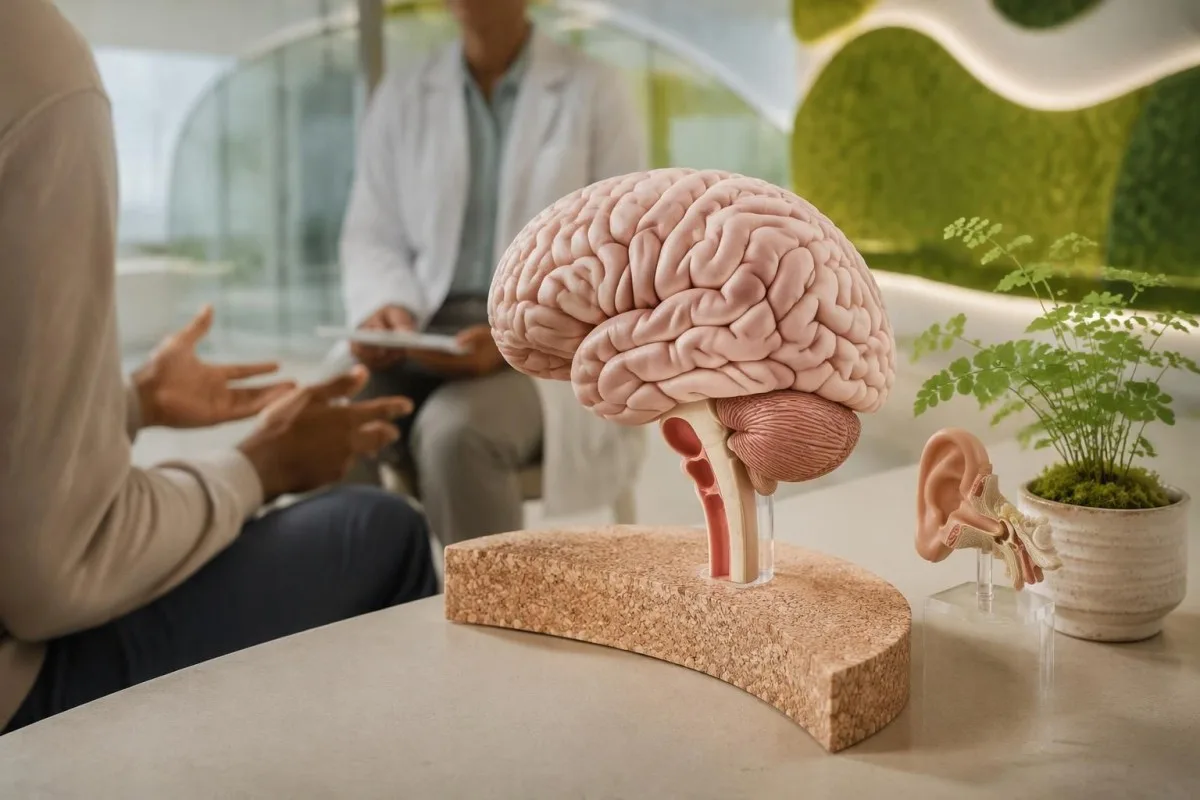
Objawy schizofrenii mogą obejmować omamy, urojenia, zdezorganizowaną mowę, obniżoną motywację i trudności poznawcze. Same wczesne zmiany nie pozwalają rozpoznać schizofrenii: rozstrzyga ocena kliniczna, a bezpośrednie zagrożenie, silne splątanie lub niezdolność do zaspokojenia podstawowych potrzeb wymagają pilnej pomocy.

Najważniejsze wnioski
- Objawy schizofrenii obejmują zmiany w postrzeganiu, przekonaniach, mowie, motywacji i myśleniu; 1 objaw ani nieprawidłowy wynik badania laboratoryjnego nie wystarczają do postawienia diagnozy.
- Wczesne objawy takie jak wycofanie, problemy ze snem lub pogorszenie wyników są nieswoiste. Jeśli to pomocne, zapisuj zmiany przez 7 dni, ale nie odkładaj oceny w przypadku nowych doświadczeń psychotycznych.
- Omamy to spostrzeżenia bez odpowiadającego im bodźca zewnętrznego. Doświadczenia występujące wyłącznie podczas zasypiania lub budzenia mają inne znaczenie kliniczne niż głosy słyszane uporczywie w ciągu dnia.
- Objawy negatywne obejmują osłabienie ekspresji emocjonalnej, mowy, motywacji, odczuwania przyjemności i zaangażowania społecznego — 5 często opisywanych obszarów, które nie świadczą o lenistwie.
- Czas postawienia diagnozy różni się: DSM-5-TR na ogół wymaga co najmniej 6 miesięcy nieprzerwanego zaburzenia, podczas gdy ICD-11 wymaga charakterystycznych objawów przez co najmniej 1 miesiąc. Pomoc należy rozpocząć, zanim zostanie osiągnięty którykolwiek z tych progów.
- Badania krwi może zbadać czynniki medyczne i monitorować bezpieczeństwo leczenia; nie istnieją żadne zwalidowane rutynowe progi wyników badań krwi, które pozwalają zdiagnozować schizofrenię.
- Pomoc w nagłych wypadkach jest potrzebna w przypadku bezpośredniego zagrożenia samookaleczeniem, niebezpiecznych poleceń, którym dana osoba może ulec, silnego splątania lub niemożności jedzenia bądź picia. W Wielkiej Brytanii w przypadku bezpośredniego zagrożenia należy dzwonić pod numer 999 lub 112.
- Leczenie zazwyczaj łączy leki, opiekę psychologiczną i praktyczne wsparcie. NICE zaleca co najmniej 16 zaplanowanych sesji indywidualnej terapii poznawczo-behawioralnej w psychozie.
Które wczesne objawy schizofrenii wymagają oceny?
Wczesne objawy schizofrenii mogą obejmować wycofanie społeczne, pogorszenie funkcjonowania, nietypowe doświadczenia oraz zmiany snu lub myślenia, ale żaden z nich sam w sobie nie ma wartości diagnostycznej. Nowy zespół objawów dotyczący 2 lub więcej obszarów codziennego życia wymaga uwagi, szczególnie gdy dana osoba odczuwa lęk lub traci dotychczasowe zdolności.

Zmiana względem typowego stanu danej osoby ma większe znaczenie niż to, czy dane zachowanie wydaje się nietypowe dla kogoś innego. Na przykład hipotetyczny student, który przestaje uczestniczyć w 3 zajęciach, które wcześniej sprawiały mu przyjemność, ma trudności ze śledzeniem rozmów i staje się coraz bardziej podejrzliwy, wymaga innej oceny niż osoba, która zawsze wolała samotność.
Zaburzenia snu są wskazówką, a nie rozstrzygającym dowodem. U hipotetycznej osoby dorosłej, która w okresie egzaminów śpi po 3 godziny na dobę, może wystąpić słaba koncentracja lub nietypowe spostrzeżenia wskutek wyczerpania; nasz poradnik dotyczący niedoboru snu a badań wyjaśnia, dlaczego wywiad dotyczący snu wpływa również na interpretację towarzyszących wyników badań laboratoryjnych.
Kantesti to analizator AI do badań krwi które mogą wyjaśnić towarzyszące wyniki badań laboratoryjnych, ale nie pozwalają ustalić, czy wczesne zmiany w zachowaniu wskazują na schizofrenię. Nasza firma i jej cel opisują naszą rolę; 7-dniowy dzienniczek objawów warto udostępnić lekarzowi, ale nie służy on do postawienia diagnozy psychiatrycznej.
NICE zaleca pilne skierowanie na ocenę, gdy niepokojowi i pogorszeniu funkcjonowania społecznego towarzyszą przemijające lub osłabione objawy psychotyczne albo określone inne wskaźniki ryzyka (NICE, 2014). Ocena po 1 niepokojącym epizodzie może wykazać depresję, traumę, skutki zażywania substancji lub rozwijające się zaburzenie psychotyczne; nie oznacza automatycznego przypisania rozpoznania schizofrenii.
Jak odczuwa się omamy i co jeszcze może je powodować?
Omamy to doznania zmysłowe bez odpowiadającego im bodźca zewnętrznego; słyszenie głosów często występuje w schizofrenii, ale omamy pojawiają się również w innych schorzeniach. W ocenie rozpatruje się co najmniej 3 pytania: co się wydarzyło, kiedy do tego doszło i czy wiąże się to z cierpieniem lub zagrożeniem.
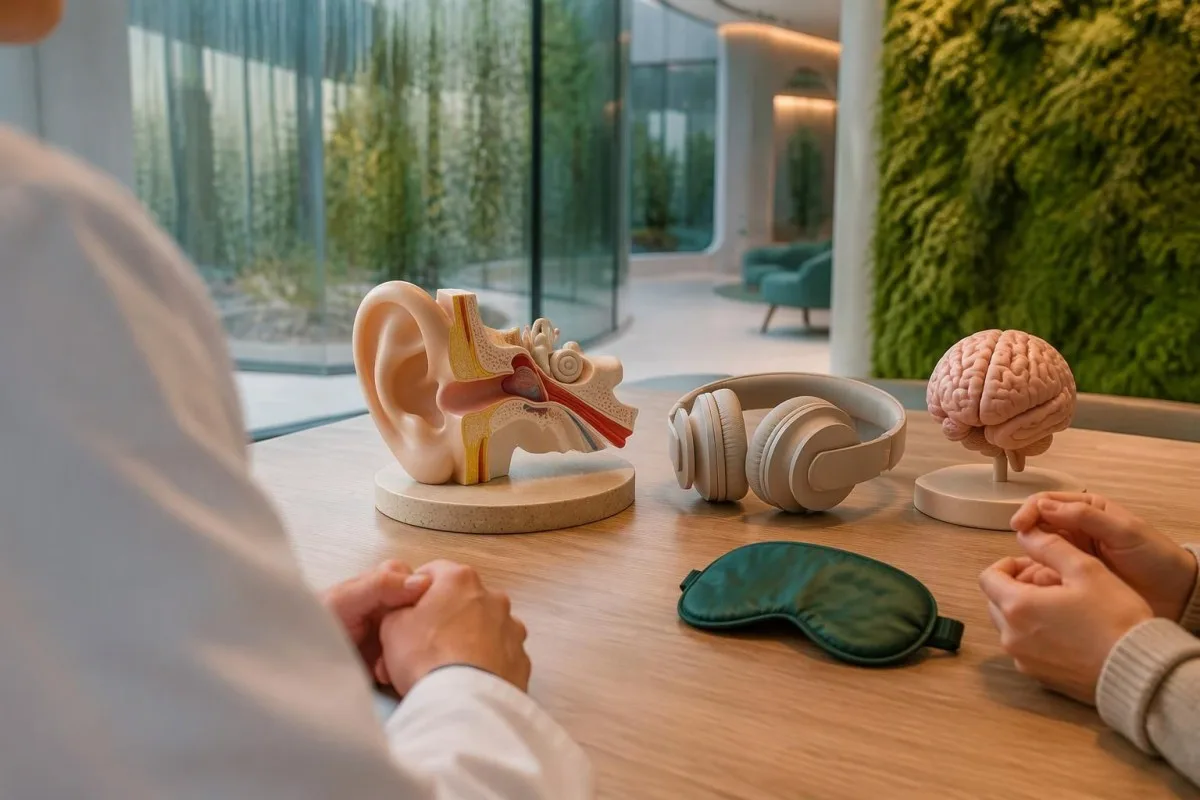
Doznania słuchowe mogą przypominać komentarz, rozmowę, muzykę lub instrukcje i mogą być odbierane jako wewnętrzne lub zewnętrzne. W ciągu 24-godzinnego okresu lekarz może zapytać, czy doznania występują w stanie pełnej przytomności, jak długo trwają i czy można je wyjaśnić dźwiękami z otoczenia; umiejscowienie ich wewnątrz głowy nie oznacza, że są automatycznie nieszkodliwe.
Doznania na granicy snu i czuwania różnią się od uporczywych omamów na jawie i mogą występować bez zaburzenia psychotycznego. Jeśli nietypowe spostrzeżenia pojawiają się wyłącznie podczas zasypiania lub budzenia się, nadmierna senność w ciągu dnia i powiązane objawy mogą wskazywać na potrzebę diagnostyki snu; nasze objaśnienie badań w kierunku narkolepsji opisuje, dlaczego lekarze wykorzystują więcej niż 1 wskazówkę związaną ze snem.
Upośledzenie zmysłów, żałoba, leki, zatrucie, odstawienie substancji i choroby neurologiczne również mogą powodować omamy. Hipotetyczna osoba w wieku 72 lat, u której pojawiły się nowe doznania wzrokowe i zmienna uwaga trwająca od 2 dni, wymaga oceny pod kątem majaczenia lub innej przyczyny medycznej, a nie założenia schizofrenii o późnym początku.
Command voices require a safety assessment, not an automatic assumption that someone will act on them. Ask about 3 concrete factors: what the voice says, whether the person feels compelled to obey, and whether they can stay safe; commands involving harm with intent or inability to resist warrant immediate help.
Czym urojenia różnią się od zmartwień lub nietypowych przekonań?
Delusions are beliefs held with strong conviction despite compelling contrary evidence, assessed within the person's cultural and social context. Clinicians examine at least 3 dimensions—conviction, openness to alternatives, and consequences—rather than diagnosing schizophrenia because a belief sounds unfamiliar or implausible to an observer.
Persecutory delusions can involve beliefs that others are monitoring, targeting, or plotting against the person; referential delusions can involve interpreting ordinary events as personally directed messages. A hypothetical person changing travel routes 4 times to avoid an alleged surveillance team may need assessment of both the belief and the resulting disruption.
Real threats must not be dismissed as delusions. Abuse, discrimination, stalking, and exploitation can occur, including in people with established psychiatric diagnoses; 1 unusual detail does not invalidate an entire account, and a clinician should investigate plausible safety concerns rather than use psychiatric history as a shortcut.
Mood timing changes the differential diagnosis. A hypothetical adult who develops grandiose beliefs during 5 days of markedly increased energy and little need for sleep may have a manic episode; our mood swings and laboratories explains why testing can address contributors without distinguishing bipolar disorder from schizophrenia.
Repeated confrontation often damages trust without resolving a firmly held belief. A supporter can use 2 steps: acknowledge the fear or distress, then offer practical help without endorsing the explanation; discussing whether the person is eating, sleeping, or feeling safe is usually more useful than trying to win an argument.
Czym są objawy negatywne schizofrenii?
Negative symptoms of schizophrenia describe reductions in ordinary emotional expression, speech, motivation, pleasure, or social engagement. These 5 domains are commonly termed blunted affect, alogia, avolition, anhedonia, and asociality; they describe difficulties in functioning, not character flaws or a person's capacity to care.

Avolition means difficulty initiating or sustaining purposeful activity, even when the person understands its value. A hypothetical adult may want to prepare breakfast yet remain unable to begin for 2 hours; simply adding pressure can miss problems with initiation, planning, fatigue, or anticipation of reward.
Reduced expression does not reliably reveal the intensity of someone's internal feelings. A person who gives 1-word answers or shows little facial movement may still feel affection, anxiety, or sadness; communication should allow extra time and avoid interpreting a quiet response as indifference or refusal to participate.
Secondary negative symptoms can arise from depression, sedating medicines, ongoing paranoia, substance use, or a low-stimulation environment. Our low motivation laboratory guide addresses selected medical contributors, but 1 thyroid or vitamin result cannot distinguish primary negative symptoms from these overlapping causes.
Pleasure can be uneven: some people struggle more with anticipating enjoyment than with enjoying an activity once it starts. A practical experiment is 1 short, supported activity chosen by the person, followed by asking how it actually felt; the result guides support, not a diagnosis or a promise of recovery.
Jakie zmiany poznawcze i w mowie mogą towarzyszyć schizofrenii?
Cognitive changes can affect attention, working memory, processing speed, and planning, while disorganized speech can make connections between ideas difficult to follow. These are distinct problems: an assessment should separate at least 2 issues—trouble organizing thought and trouble performing a task under everyday demands.

Disorganized speech may involve frequent derailment, answers loosely connected to questions, or speech that becomes difficult to understand. A hypothetical conversation moving through 4 unrelated topics can raise concern, but language proficiency, hearing, anxiety, developmental differences, and the person's usual communication style must be considered before interpreting it.
Working-memory difficulty can make multistep tasks unexpectedly hard. Someone may remember the first of 3 instructions but lose the remaining steps; offering one instruction at a time, using reminders, and reducing distractions are accommodations that can help before the precise cause of the difficulty is established.
A lifelong attention pattern is different from a recent decline. Our adult ADHD symptom guide explains why a history extending back to childhood matters; a new deterioration over 2 months should not be explained away by an unconfirmed ADHD label.
At Kantesti, we treat laboratory explanations of fatigue or brain fog as separate from psychiatric diagnostic reasoning. A hypothetical person with corrected anemia who remains unable to follow a 10-minute conversation still needs follow-up; improvement in a laboratory value does not prove that cognitive symptoms have resolved or identify their cause.
Jak objawy schizofrenii u dorosłych zmieniają się wraz z wiekiem?
Schizophrenia symptoms in adults vary in onset, severity, and impact; the same symptom can have different implications at different ages. A first presentation at 22 and a first presentation at 72 both need assessment, but later onset increases the need to investigate medical, neurological, medication, and sensory contributors.

Schizophrenia commonly begins in late adolescence or early adulthood, but age alone cannot confirm or exclude it. For a hypothetical 24-year-old, clinicians may reconstruct the relationship between missed work, unusual beliefs, substance exposure, and sleep across several months instead of relying only on what happens during 1 appointment.
First-onset psychosis in an older adult should prompt careful review of medicines, cognition, physical health, hearing, and vision. Our przewodnika dla seniorów po działaniach leków explains why a newly added treatment or a dose change 2 weeks earlier can be a more useful clue than a broad psychiatric label.
People can have episodic worsening, persistent difficulties, or substantial improvement with treatment and support. A hypothetical adult managing work for 5 years before a recurrence does not erase the original diagnosis; equally, a first psychotic episode does not establish what the person's long-term course will be.
Schizophrenia is not a split personality, and psychosis does not mean someone is inherently violent. Risk assessment concerns specific circumstances—such as intoxication, severe fear, access to means, or expressed intent—not a diagnosis alone; 1 frightened presentation should not define how family members or services treat a person.
Jak ocena kliniczna pozwala rozpoznać schizofrenię?
Schizophrenia is diagnosed clinically, using the symptom pattern, duration, functioning, and exclusion of better explanations—not a blood test or online checklist. DSM-5-TR generally requires at least 6 months of continuous disturbance; ICD-11 requires characteristic symptoms for at least 1 month, with additional requirements in both systems.
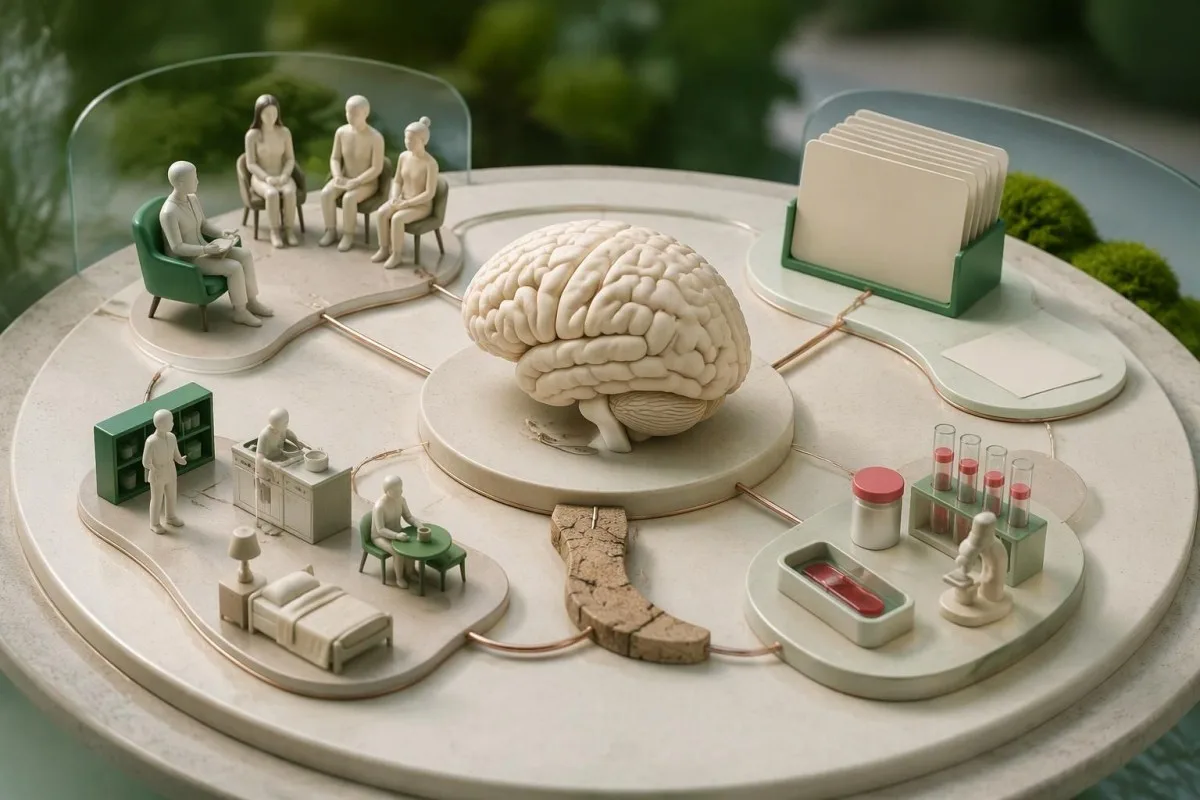
DSM-5-TR requires at least 2 characteristic symptoms during a significant portion of a 1-month period, or less if successfully treated, with at least one being delusions, hallucinations, or disorganized speech. It also requires functional deterioration and a longer course of disturbance; the criteria are not a self-scoring tool.
ICD-11 uses a different structure and requires at least 2 characteristic symptoms, including at least one from its core group, present most of the time for 1 month or more. WHO's clinical requirements emphasize the overall presentation and differential diagnosis rather than mechanically translating every DSM rule into ICD terminology (WHO, 2024).
Assessment often takes more than 1 conversation, particularly when symptoms are new or the history is unclear. With appropriate consent and attention to confidentiality, information from relatives, previous records, and the person's own account can clarify timing; lack of agreement between accounts should be explored rather than treated as proof that someone is unreliable.
Support should not wait for a 6-month diagnostic threshold to pass. A first episode may initially receive a broader working diagnosis while treatment and investigation proceed; our zasady odpowiedzialnego korzystania ze sztucznej inteligencji reflect why automated laboratory interpretation must not substitute for this evolving clinical judgment.
Czy badania krwi mogą wykryć schizofrenię lub wyjaśnić objawy?
No routine blood test diagnoses schizophrenia, and normal results do not rule it out. Laboratories serve 2 different purposes in this setting: investigating plausible medical contributors and establishing physical-health or medication-safety baselines; neither purpose turns a biomarker panel into a schizophrenia screening test.

Testing is selected from the history and examination, rather than ordered as an unlimited panel. A clinician may consider a CBC, electrolytes, kidney or liver tests, thyroid function, B12, or other investigations; our wyjaśnienie dotyczące hormonów tarczycy shows why 2 related thyroid measurements can be more informative than one isolated result.
B12 deficiency can contribute to neurological or cognitive symptoms, sometimes without marked anemia. In a hypothetical example, B12 of 160 pg/mL against that laboratory's 200–900 pg/mL interval warrants medical review; our graniczna interpretacja wyniku B12 explains why assay ranges and follow-up testing matter, without claiming that deficiency explains every symptom.
Kantesti to platforma do interpretacji wyników badań krwi AI that can help explain these 2 laboratory roles without converting results into a psychiatric label. We encourage readers to bring the original report, medicine list, and symptom timeline to the assessing clinician; an interpretation should preserve uncertainty when symptoms and laboratory findings do not fit neatly together.
Research measurements of immune activity, metabolism, proteins, or genetic associations are not validated routine diagnostic thresholds for schizophrenia. A result showing 1 elevated inflammatory marker may reflect many unrelated processes; commercial-sounding claims that a panel can confirm psychosis should be questioned for independent validation and clear intended-use limits.
Jakie schorzenia mogą przypominać schizofrenię?
Psychosis can arise from mood disorders, substances, medicines, delirium, and neurological or other medical illnesses, as well as schizophrenia-spectrum disorders. Timing is central: symptoms developing over 2 days with fluctuating attention require a different workup from a gradual change over several months with preserved alertness.
Delirium typically involves disturbed attention and an acute, fluctuating course, and it can include hallucinations or unusual beliefs. A hypothetical person alternating between coherent conversation and marked disorientation over 24 hours needs urgent medical assessment; a pre-existing schizophrenia diagnosis does not make delirium impossible.
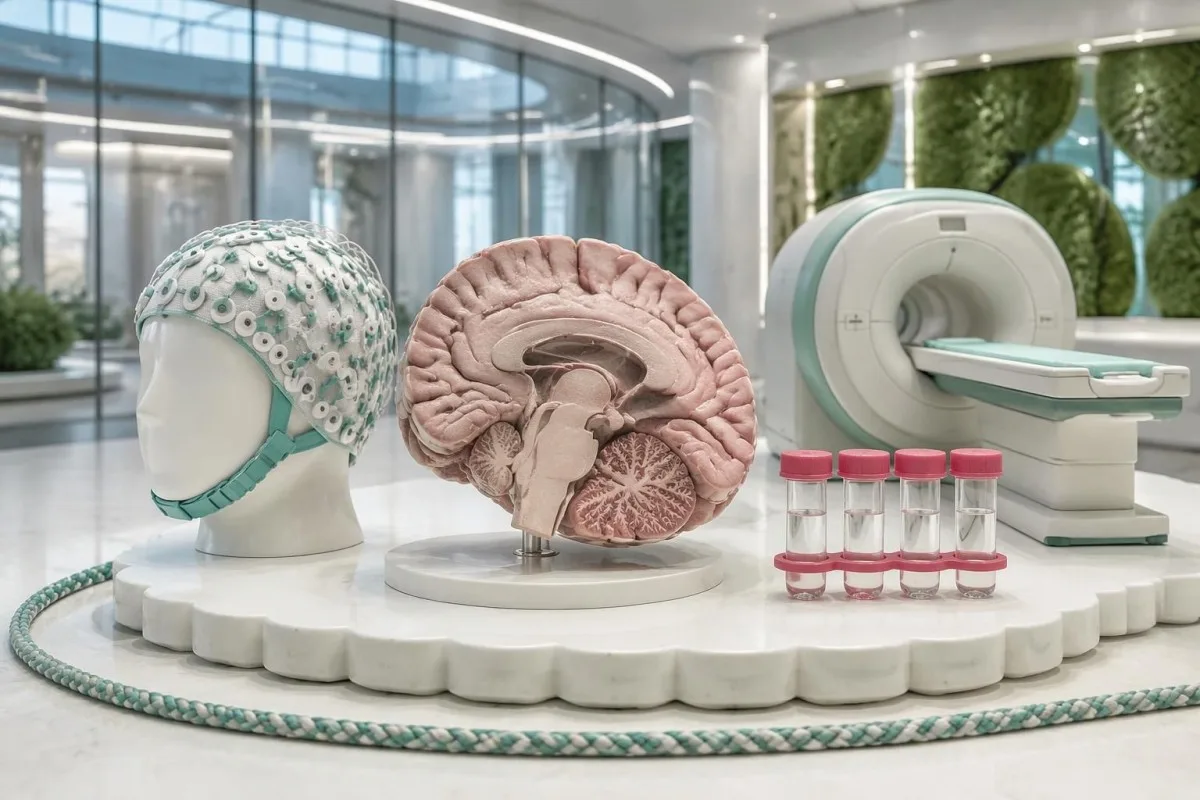
New seizures, abnormal movements, reduced consciousness, or rapid cognitive decline can raise concern for an inflammatory brain disorder or another neurological cause. Our autoimmune encephalitis workup explains how MRI, EEG, and cerebrospinal fluid may contribute; 1 positive serum antibody does not independently establish that diagnosis.
Rare medical causes deserve targeted investigation when the accompanying pattern fits, not blanket screening of everyone. Severe episodic abdominal symptoms plus neurological or psychiatric changes can prompt a porphyria workup; our porphyria testing explanation describes why a correctly timed urine test can matter more than 1 general blood panel.
Substance and medication histories should be specific and nonjudgmental. Ask what was taken, approximate amounts, and timing during the preceding 48 hours and earlier weeks; cannabis, stimulants, corticosteroids, and withdrawal states can change diagnostic reasoning, while a negative toxicology screen cannot exclude every exposure or every detection-window limitation.
Kiedy objawy schizofrenii wymagają pilnej pomocy?
Seek emergency help for immediate danger, suicidal intent, dangerous commands someone may act on, severe confusion, or inability to meet basic needs. In the UK, call 999 or 112 for an emergency; new psychotic symptoms without immediate danger still warrant prompt assessment rather than waiting for a routine laboratory appointment.
Possible catatonia needs urgent assessment, including when someone becomes unusually immobile, stops speaking, maintains unusual postures, or refuses fluids. A hypothetical adult drinking nothing for 24 hours and remaining largely motionless should not be managed as simple low motivation; fever, rigidity, or reduced responsiveness further increases concern.
Sudden speech difficulty, one-sided weakness, collapse, or a severe new headache requires emergency medical evaluation. Our objawach ostrzegawczych udaru explain why 1 new focal neurological sign should not be attributed to psychiatric illness, even when hallucinations or a previous mental-health diagnosis are also present.
New psychosis after childbirth is a medical emergency, particularly with little sleep, rapidly changing mood, or confused behavior. If a parent develops these changes 1 week after delivery, seek urgent assessment and ensure both parent and infant have safe support; do not wait to see whether the symptoms fit schizophrenia.
If there is no immediate danger, contact a local crisis service, primary-care clinician, or early-intervention service promptly. In England, NHS 111 offers a mental-health option; in the US, 988 provides crisis support and 911 handles immediate danger, while readers elsewhere should use local emergency or crisis services and avoid leaving an immediately unsafe person alone when it is safe to remain.
Jak pomóc osobie, u której może występować psychoza?
Help by listening calmly, checking immediate safety, and offering a specific route to assessment, rather than arguing about beliefs or announcing a diagnosis. A useful first conversation covers 3 practical needs: whether the person feels safe, whether they are eating and sleeping, and what assistance they would accept.

Short sentences and a quieter environment can make communication easier when attention is strained. Offer 2 realistic choices, such as contacting a clinician together or accompanying the person to an assessment, instead of several simultaneous demands; avoid crowding, sudden touching, or using threats to force cooperation.
Validate distress without confirming an unverified explanation. If someone believes their food is being tampered with, a supporter can acknowledge the fear and offer an acceptable meal while arranging help; asking how much they have eaten in the last 24 hours identifies a practical risk without requiring a debate about the belief.
A brief timeline can improve an appointment more than a long list of labels. Record 5 kinds of information: observed changes, approximate onset, sleep, substances or medicine changes, and effects on daily functioning; distinguish what you directly observed from what someone else reported, and ask the person's permission whenever possible.
Materiały Kantesti wytyczne dotyczące prywatności i danych is relevant when accompanying laboratory reports contain sensitive personal information. Share only what is needed and seek consent where possible; having access to 1 family member's report does not automatically authorize uploading their records, and emergency safety concerns should be addressed through clinical services rather than an AI tool.
Jakie leczenie pomaga po pierwszym epizodzie psychotycznym?
Treatment for first-episode psychosis commonly combines antipsychotic medication, psychological interventions, and practical support, tailored to diagnosis, preferences, and safety. NICE recommends individual CBT with at least 16 planned sessions and family intervention where appropriate; treatment should address everyday functioning as well as voices or delusions.

Medication choice is a shared clinical decision, including discussion of metabolic effects, movement symptoms, sedation, hormonal effects, and cardiovascular considerations. NICE advises treating an antipsychotic prescription as an explicit individual trial, generally assessing response after 4–6 weeks at an optimum dose while reviewing tolerability throughout (NICE, 2014).
Psychological treatment does not require the clinician to endorse a delusion or tell someone that their experience is imaginary. CBT for psychosis explores distress, interpretations, coping, and functioning; NICE describes family intervention as at least 10 planned sessions over 3 months to 1 year, adapted to the family's circumstances.
Clozapine is recommended for treatment-resistant schizophrenia after inadequate response to 2 adequate antipsychotic trials, subject to clinical assessment and local requirements. The APA guideline also recommends clozapine when suicide risk remains substantial despite other treatments (APA, 2020); our clozapine safety monitoring guide explains why monitoring is treatment-specific.
Recovery goals should be personal and measurable rather than limited to symptom counts. A hypothetical first goal might be returning to 2 supported study sessions weekly or preparing a regular meal; occupational, educational, housing, and social support can address barriers that medication alone does not remove, and prescriptions should never be changed through an automated laboratory interpretation.
Dlaczego kontrola stanu zdrowia fizycznego jest częścią opieki nad osobami ze schizofrenią?
Physical-health checks identify medication effects and health risks that deserve care independently of psychiatric symptoms. NICE recommends baseline assessment and repeat glucose or HbA1c and lipid testing at 12 weeks, 1 year, and annually during antipsychotic treatment; individual medicines and existing conditions may require additional monitoring.

Weight, blood pressure, movement symptoms, nutrition, and activity deserve discussion alongside laboratory results. NICE recommends weighing weekly for the first 6 weeks of antipsychotic treatment, then at 12 weeks, 1 year, and annually; early changes can support a timely conversation about treatment options rather than blame about willpower.
HbA1c of 6.5% equals 48 mmol/mol and is a diabetes diagnostic threshold, usually requiring confirmation when there are no clear symptoms. Our sygnały ostrzegawcze wysokiego poziomu glukozy explains why thirst, frequent urination, weight loss, or acute illness can change urgency; this threshold says nothing about the severity of psychosis.
Some antipsychotics raise prolactin, which can affect sexual function, menstruation, fertility, or other aspects of health. A result 2 times the laboratory upper limit needs interpretation with symptoms, medicines, sampling conditions, and sometimes repeat testing; our mildly elevated prolactin guide explains why one result should not trigger unsupervised medication changes.
Smoking changes can alter clozapine exposure, because combustion products—not nicotine alone—affect its metabolism. A hypothetical person stopping cigarettes during a 1-week admission needs the prescribing team's attention; diet and supplements also deserve review, but no meal plan, vitamin panel, or supplement regimen has been established as a substitute for schizophrenia treatment.
Publikacje naukowe i ograniczenia interpretacji badań laboratoryjnych
The research references below distinguish schizophrenia guidance from supporting laboratory education. The 2 Zenodo guides explain serum proteins and immune tests; they are not schizophrenia diagnostic studies, and their DOIs do not establish peer review, psychiatric screening accuracy, or evidence that these tests should be ordered for early behavioral changes.
Kantesti to usługa interpretacji wyników badań AI that explains reported measurements rather than diagnosing psychiatric disorders. Our nadzór techniczny i kliniczny describes the scope of our methodology; performance on laboratory interpretation is not evidence of accuracy for schizophrenia assessment, and those are 2 separate validation questions.
Serum albumin, globulins, and the A/G ratio reflect broad physiological processes, not a schizophrenia signature. Our białka surowicy guide provides context for that laboratory family; a hypothetical A/G ratio of 0.9 must be interpreted against its laboratory interval and clinical setting, not converted into a psychiatric risk score.
Complement and ANA testing answer targeted immune questions, and indiscriminate testing can produce findings unrelated to the presenting symptoms. Our przewodnik po dopełniaczu i ANA explains those limits; an isolated ANA titer of 1:80 does not establish an autoimmune explanation for psychosis or justify immune treatment without supporting clinical evidence.
Kantesti's role is to help readers understand accompanying reports while keeping diagnosis and urgent care with qualified clinicians. For a first episode—or a change after 5 stable years—bring the symptom timeline and original results to assessment; the NICE, WHO, and APA references below support the clinical discussion, while the repository publications support narrower laboratory education.
Często zadawane pytania
Jakie są pierwsze objawy schizofrenii?
Możliwe wczesne objawy schizofrenii obejmują wycofanie się z kontaktów, pogorszenie funkcjonowania, nietypowe spostrzeżenia, podejrzliwość oraz zmiany w myśleniu lub śnie, ale objawy te nie są wystarczająco charakterystyczne, by na ich podstawie zdiagnozować schizofrenię. Występowanie objawów dotyczących 2 lub więcej obszarów życia może być szczególnie dobrym powodem do przeprowadzenia oceny, choć nie jest to próg diagnostyczny. Nowo pojawiające się głosy, silnie utrwalone nietypowe przekonania lub wyraźne pogorszenie funkcjonowania wymagają pilnej oceny klinicznej. Nie czekaj z szukaniem pomocy, aż objawy utrzymają się przez wiele miesięcy lub pojawi się wynik badania krwi.
Czy można chorować na schizofrenię i nie słyszeć głosów?
Osoba może chorować na schizofrenię, nie słysząc głosów, ponieważ omamy słuchowe nie występują w każdym przypadku. DSM-5-TR wymaga co najmniej 2 charakterystycznych objawów w fazie aktywnej, w tym co najmniej jednego z następujących: urojenia, omamy lub zdezorganizowana mowa, a także spełnienia dodatkowych kryteriów dotyczących czasu trwania i funkcjonowania. Ktoś może zatem mieć nasilone urojenia lub zdezorganizowaną mowę, ale nie doświadczać omamów słuchowych. Lekarz musi również ocenić inne możliwe przyczyny psychiatryczne, związane z używaniem substancji i medyczne.
Czy badanie krwi może zdiagnozować schizofrenię?
Żadne rutynowe badanie krwi nie pozwala rozpoznać schizofrenii ani jej wykluczyć; nie ma też żadnych 0 zwalidowanych progów rutynowych biomarkerów służących temu celowi. Badania krwi mogą pomóc wykryć czynniki medyczne wpływające na stan pacjenta lub monitorować bezpieczeństwo farmakoterapii, ale są to odrębne kwestie kliniczne. Na przykład badanie czynności tarczycy lub stężenia witaminy B12 może być wskazane, gdy wywiad sugeruje takie problemy. Prawidłowe wyniki badań laboratoryjnych nie oznaczają, że można bezpiecznie zignorować utrzymujące się omamy, urojenia lub pogorszenie funkcjonowania.
Czy brak motywacji i wycofanie społeczne są objawami schizofrenii?
Low motivation and social withdrawal can occur among the negative symptoms of schizophrenia, but they also occur with depression, sleep problems, medicines, stress, and other conditions. Clinicians commonly describe 5 negative-symptom domains: reduced expression, speech, motivation, pleasure, and social engagement. The assessment considers the person's baseline, associated symptoms, and alternative causes rather than counting behaviors on a checklist. New or persistent changes affecting daily life deserve assessment without assuming schizophrenia.
Jak długo muszą utrzymywać się objawy, aby zdiagnozować schizofrenię?
Wymagany czas trwania zależy od przyjętego systemu diagnostycznego i pełnego obrazu objawów. DSM-5-TR na ogół wymaga co najmniej 6 miesięcy utrzymujących się zaburzeń, w tym fazy aktywnej trwającej zwykle co najmniej 1 miesiąc lub krócej, jeśli leczenie przyniosło efekty. ICD-11 wymaga występowania charakterystycznych objawów przez większość czasu przez co najmniej 1 miesiąc, a także spełnienia dodatkowych kryteriów diagnostycznych. Te progi pomagają postawić diagnozę, ale nie określają, kiedy należy szukać pomocy: pierwszy epizod psychotyczny powinien zostać niezwłocznie oceniony przez specjalistę.
Kiedy osoba z podejrzeniem schizofrenii powinna zgłosić się na ostry dyżur?
Wymagana jest pomoc w nagłym wypadku, gdy istnieje bezpośrednie ryzyko samookaleczenia, pojawiają się niebezpieczne polecenia, których dana osoba może posłuchać, występuje silna dezorientacja, ograniczona reaktywność lub niemożność zaspokojenia podstawowych potrzeb. W Wielkiej Brytanii w sytuacji bezpośredniego zagrożenia dzwoń pod numer 999 lub 112; w USA w nagłym wypadku dzwoń pod numer 911, a po wsparcie w kryzysie — pod numer 988. Nagłe objawy neurologiczne, gorączka ze sztywnością mięśni oraz nowa psychoza po porodzie również wymagają pilnej oceny lekarskiej. Nowe objawy psychotyczne, nawet jeśli nie wiążą się z bezpośrednim zagrożeniem, nadal wymagają szybkiego kontaktu z lekarzem lub lokalnym ośrodkiem interwencji kryzysowej.
Dowiedz się, jak czytać wyniki badań krwi
Prześlij wynik badania laboratoryjnego, a sztuczna inteligencja Kantesti w kilka sekund objaśni prostym językiem każdy biomarker. Z narzędzia korzysta ponad 2 miliony osób na całym świecie.
Odniesienia
- Klein, T., Mitchell, S. i Weber, H. (2026). Przewodnik po białkach surowicy: globuliny, albumina i stosunek A/G w badaniu krwi. Badania medyczne z wykorzystaniem sztucznej inteligencji Kantesti. DOI
- Klein, T., Mitchell, S. i Weber, H. (2026). Poradnik dotyczący badania krwi C3, C4 i miana ANA. Badania medyczne z wykorzystaniem sztucznej inteligencji Kantesti. DOI
- National Institute for Health and Care Excellence (2014). Psychosis and schizophrenia in adults: prevention and management (CG178). Wytyczne kliniczne NICE.
- World Health Organization (2024). Clinical descriptions and diagnostic requirements for ICD-11 mental, behavioural and neurodevelopmental disorders. Światowa Organizacja Zdrowia.
- American Psychiatric Association (2020). The American Psychiatric Association Practice Guideline for the Treatment of Patients With Schizophrenia, Third Edition. American Psychiatric Association Publishing. DOI
- 2 mln+Analizowane badania
- 127+Kraje
- 100+Języki
O zespole medycznym


Sygnały zaufania E-E-A-T
Doświadczenie
Kliniczna weryfikacja procesów interpretacji przez lekarza.
Ekspertyza
Medycyna laboratoryjna skupiona na tym, jak zachowują się biomarkery w kontekście klinicznym.
Autorytatywność
Recenzja medyczna: dr Thomas Klein, przy współpracy dr Sarah Mitchell i prof. dr. Hansa Webera.
Solidność
Interpretacja oparta na dowodach, z jasnymi ścieżkami dalszego postępowania, aby ograniczyć alarm.






Zastrzeżenie medyczne
Ten artykuł ma wyłącznie charakter edukacyjny i nie stanowi porady medycznej. Zawsze konsultuj decyzje dotyczące diagnozy i leczenia z wykwalifikowanym pracownikiem ochrony zdrowia.
Opublikowano · Skontaktuj się z zespołem redakcyjnym
Opublikowano przez Kantesti Ltd, zarejestrowaną w Anglii i Walii, numer firmy. 17090423, Londyn, Wielka Brytania.
