Symptomen fan skizofreny kinne hallusinaasjes, waanfoarstellingen, ûnorganisearre spraak, minder motivaasje en kognitive swierrichheden omfetsje. Iere feroaringen allinnich stelle skizofreny net fêst: dat docht de klinyske beoardieling, en fuortendaliks gefaar, slimme betizing of it net foldwaan kinne oan basisbehoeften fereasket driuwende help.

Wichtichste punten
- Symptomen fan skizofreny omfetsje feroaringen yn waarnimming, oertsjûgingen, spraak, motivaasje en tinken; 1 symptoom of in abnormale laboratoariumútslach kin de diagnoaze net fêststelle.
- Iere tekens lykas it mijen fan oaren, minne sliep of ôfnimmende prestaasjes binne net-spesifyk. Hâld feroaringen by oer 7 dagen as dat helpt, mar stel beoardieling net út by nije psychotyske ûnderfiningen.
- Hallusinaasjes binne waarnimmingen sûnder in oerienkommende eksterne prikkel. Underfiningen dy't allinnich foarkomme by it ynsliepen of wekker wurden hawwe in oare klinyske betsjutting as oanhâldende stimmen oerdeis.
- Negative symptomen omfetsje minder emosjonele ekspresje, spraak, motivaasje, wille en sosjale belutsenens—5 faak beskreaune domeinen, gjin bewiis dat immen lui is.
- Tiidstip fan diagnoaze ferskilt: DSM-5-TR fereasket oer it algemien op syn minst 6 moannen fan oanhâldende steuring, wylst ICD-11 karakteristike symptomen foar op syn minst 1 moanne fereasket. Help moat begjinne foardat ien fan beide drompels berikt is.
- Bloedûndersiken kin medyske bydragen ûndersykje en de feiligens fan behanneling yn it each hâlde; der binne 0 falidearre drompelwearden foar routine bloedûndersyk dy't skizofreny diagnostisearje.
- Help by needgefallen is nedich by driigjende selsbeskeadiging, gefaarlike opdrachten dêr't immen nei hannelje kin, slimme betizing, of it ûnfermogen om te iten of drinken. Yn it Feriene Keninkryk, belje 999 of 112 by daliks gefaar.
- Behanneling kombinearret ornaris medisinen, psychologyske soarch en praktyske stipe. NICE advisearret op syn minst 16 plande sesjes foar yndividuele CBT foar psychose.
Hokker iere tekens fan skizofreny moatte beoardiele wurde?
Iere tekens fan skizofreny kinne sosjale weromlûking, ôfnimmend funksjonearjen, ûngewoane ûnderfiningen en feroaringen yn sliep of tinken omfetsje, mar gjinien dêrfan is op himsels diagnostysk. In nije groep feroaringen dy't 2 of mear gebieten fan it deistich libben beynfloedet, fertsjinnet omtinken, benammen as de persoan bang is of syn gewoane fermogens ferliest.

Feroaring yn ferliking mei it gewoane funksjonearjen fan de persoan is wichtiger as oft in gedrach immen oars ûngewoan foarkomt. Bygelyks, in hypotetyske studint dy't ophâldt mei it bywenjen fan 3 aktiviteiten dêr't dy earder nocht oan hie, muoite hat om petearen te folgjen en hieltyd erchtinkender wurdt, hat in oare beoardieling nedich as immen dy't altyd leaver allinnich west hat.
Fersteurde sliep is in oanwizing, gjin einoardiel. In hypotetyske folwoeksene dy't yn eksamenperioaden 3 oeren de nacht sliept, kin troch útputting in minne konsintraasje of ûngewoane waarnimmingen ûntwikkelje; ús hantlieding oer minne sliep en testen leit út wêrom't de sliepskiednis ek feroaret hoe't byhearrende laboratoariumfynsten ynterpretearre wurde.
Kantesti is in AI-bloedtestanalyzer dy't byhearrende laboratoariumfynsten ferklearje kinne, mar net fêststelle kinne oft iere gedrachsferoaringen op skizofreny wize. Us bedriuw en doel beskriuwe ús rol; in symptoomregister fan 7 dagen is wat om mei in klinikus te dielen, net in ynfier dy't in psychiatryske diagnoaze opleveret.
NICE advisearret ferwizing sûnder fertraging as need en ôfnimmend sosjaal funksjonearjen foarkomme neist foarbygeande of ferswakke psychotyske symptomen, of bepaalde oare risiko-yndikatoaren (NICE, 2014). In beoardieling nei 1 soarchlik foarfal kin depresje, trauma, effekten fan substansgebrûk of in ûntwikkeljende psychotyske steuring oan it ljocht bringe; dêr wurdt net automatysk it etiket skizofreny op plakt.
Hoe fiele hallusinaasjes, en wat oars kin se feroarsaakje?
Hallusinaasjes binne sintúchlike ûnderfiningen sûnder in oerienkommende eksterne prikkel; stimmen hearre komt faak foar by skizofreny, mar hallusinaasjes komme ek foar by oare tastannen. By de beoardieling wurde op syn minst 3 fragen útinoar holden: wat der bard is, wannear't it bard is, en oft it need of gefaar feroarsaket.
Auditive ûnderfiningen kinne klinke as kommentaar, petear, muzyk of ynstruksjes, en kinne yntern of ekstern lykje. Yn in perioade fan 24 oeren kin in klinikus freegje oft de ûnderfiningen foarkomme wylst de persoan folslein wekker is, hoe lang se duorje en oft lûden út 'e omjouwing se ferklearje kinne; dat se yn 'e holle sitte, makket se net automatysk ûnskealik.
Underfiningen by de oergong tusken sliep en wekker wêzen ferskille fan oanhâldende hallusinaasjes by wekker wêzen en kinne foarkomme sûnder in psychotyske steuring. As ûngewoane waarnimmingen allinnich foarkomme by it ynsliepen of wekker wurden, kinne oermjittige slieperigens oerdeis en besibbe symptomen wize op in sliepbeoardieling; ús útlis oer testen op narkolepsy beskriuwt wêrom't klinisy mear as 1 sliepbesibbe oanwizing brûke.
Sintúchlike beheining, rou, medisinen, ferslaving, ûntlûkingsferskynsels en neurologyske sykte kinne ek hallusinaasjes feroarsaakje. In hypotetyske 72-jierrige mei nije fisuele ûnderfiningen en wikseljende oandacht oer 2 dagen hat in beoardieling nedich op delirium of in oare medyske oarsaak, ynstee fan derfan út te gean dat it om skizofreny mei in let begjin giet.
Command voices require a safety assessment, not an automatic assumption that someone will act on them. Ask about 3 concrete factors: what the voice says, whether the person feels compelled to obey, and whether they can stay safe; commands involving harm with intent or inability to resist warrant immediate help.
Hoe ferskille waanfoarstellingen fan soargen of ûngewoane oertsjûgingen?
Delusions are beliefs held with strong conviction despite compelling contrary evidence, assessed within the person's cultural and social context. Clinicians examine at least 3 dimensions—conviction, openness to alternatives, and consequences—rather than diagnosing schizophrenia because a belief sounds unfamiliar or implausible to an observer.
Persecutory delusions can involve beliefs that others are monitoring, targeting, or plotting against the person; referential delusions can involve interpreting ordinary events as personally directed messages. A hypothetical person changing travel routes 4 times to avoid an alleged surveillance team may need assessment of both the belief and the resulting disruption.
Real threats must not be dismissed as delusions. Abuse, discrimination, stalking, and exploitation can occur, including in people with established psychiatric diagnoses; 1 unusual detail does not invalidate an entire account, and a clinician should investigate plausible safety concerns rather than use psychiatric history as a shortcut.
Mood timing changes the differential diagnosis. A hypothetical adult who develops grandiose beliefs during 5 days of markedly increased energy and little need for sleep may have a manic episode; our mood swings and laboratories explains why testing can address contributors without distinguishing bipolar disorder from schizophrenia.
Repeated confrontation often damages trust without resolving a firmly held belief. A supporter can use 2 steps: acknowledge the fear or distress, then offer practical help without endorsing the explanation; discussing whether the person is eating, sleeping, or feeling safe is usually more useful than trying to win an argument.
Wat binne de negative symptomen fan skizofreny?
Negative symptoms of schizophrenia describe reductions in ordinary emotional expression, speech, motivation, pleasure, or social engagement. These 5 domains are commonly termed blunted affect, alogia, avolition, anhedonia, and asociality; they describe difficulties in functioning, not character flaws or a person's capacity to care.

Avolition means difficulty initiating or sustaining purposeful activity, even when the person understands its value. A hypothetical adult may want to prepare breakfast yet remain unable to begin for 2 hours; simply adding pressure can miss problems with initiation, planning, fatigue, or anticipation of reward.
Reduced expression does not reliably reveal the intensity of someone's internal feelings. A person who gives 1-word answers or shows little facial movement may still feel affection, anxiety, or sadness; communication should allow extra time and avoid interpreting a quiet response as indifference or refusal to participate.
Secondary negative symptoms can arise from depression, sedating medicines, ongoing paranoia, substance use, or a low-stimulation environment. Our low motivation laboratory guide addresses selected medical contributors, but 1 thyroid or vitamin result cannot distinguish primary negative symptoms from these overlapping causes.
Pleasure can be uneven: some people struggle more with anticipating enjoyment than with enjoying an activity once it starts. A practical experiment is 1 short, supported activity chosen by the person, followed by asking how it actually felt; the result guides support, not a diagnosis or a promise of recovery.
Hokker kognitive feroaringen en spraakferoaringen kinne mei skizofreny geargean?
Cognitive changes can affect attention, working memory, processing speed, and planning, while disorganized speech can make connections between ideas difficult to follow. These are distinct problems: an assessment should separate at least 2 issues—trouble organizing thought and trouble performing a task under everyday demands.

Disorganized speech may involve frequent derailment, answers loosely connected to questions, or speech that becomes difficult to understand. A hypothetical conversation moving through 4 unrelated topics can raise concern, but language proficiency, hearing, anxiety, developmental differences, and the person's usual communication style must be considered before interpreting it.
Working-memory difficulty can make multistep tasks unexpectedly hard. Someone may remember the first of 3 instructions but lose the remaining steps; offering one instruction at a time, using reminders, and reducing distractions are accommodations that can help before the precise cause of the difficulty is established.
A lifelong attention pattern is different from a recent decline. Our adult ADHD symptom guide explains why a history extending back to childhood matters; a new deterioration over 2 months should not be explained away by an unconfirmed ADHD label.
At Kantesti, we treat laboratory explanations of fatigue or brain fog as separate from psychiatric diagnostic reasoning. A hypothetical person with corrected anemia who remains unable to follow a 10-minute conversation still needs follow-up; improvement in a laboratory value does not prove that cognitive symptoms have resolved or identify their cause.
Hoe feroarje symptomen fan skizofreny by folwoeksenen mei de leeftyd?
Schizophrenia symptoms in adults vary in onset, severity, and impact; the same symptom can have different implications at different ages. A first presentation at 22 and a first presentation at 72 both need assessment, but later onset increases the need to investigate medical, neurological, medication, and sensory contributors.

Schizophrenia commonly begins in late adolescence or early adulthood, but age alone cannot confirm or exclude it. For a hypothetical 24-year-old, clinicians may reconstruct the relationship between missed work, unusual beliefs, substance exposure, and sleep across several months instead of relying only on what happens during 1 appointment.
First-onset psychosis in an older adult should prompt careful review of medicines, cognition, physical health, hearing, and vision. Our hantlieding oer de effekten fan medisinen by senioaren explains why a newly added treatment or a dose change 2 weeks earlier can be a more useful clue than a broad psychiatric label.
People can have episodic worsening, persistent difficulties, or substantial improvement with treatment and support. A hypothetical adult managing work for 5 years before a recurrence does not erase the original diagnosis; equally, a first psychotic episode does not establish what the person's long-term course will be.
Schizophrenia is not a split personality, and psychosis does not mean someone is inherently violent. Risk assessment concerns specific circumstances—such as intoxication, severe fear, access to means, or expressed intent—not a diagnosis alone; 1 frightened presentation should not define how family members or services treat a person.
Hoe stelt in klinyske beoardieling skizofreny fêst?
Schizophrenia is diagnosed clinically, using the symptom pattern, duration, functioning, and exclusion of better explanations—not a blood test or online checklist. DSM-5-TR generally requires at least 6 months of continuous disturbance; ICD-11 requires characteristic symptoms for at least 1 month, with additional requirements in both systems.
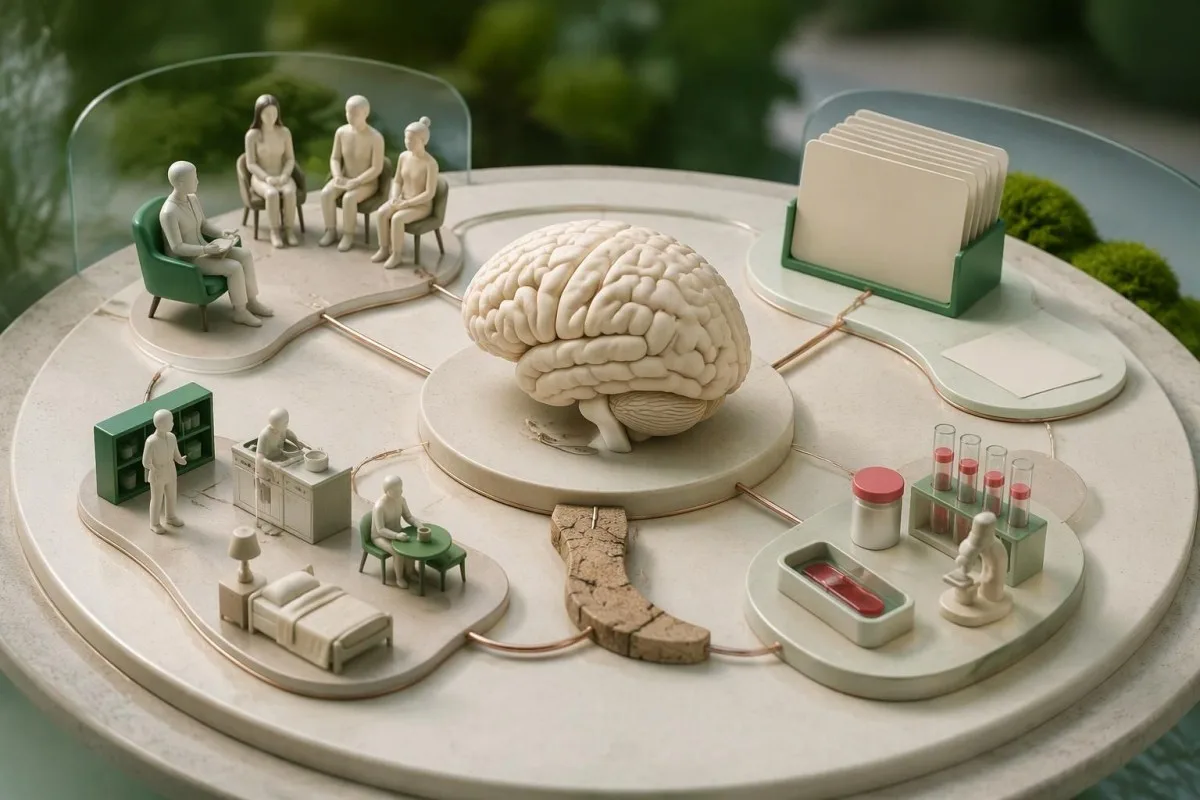
DSM-5-TR requires at least 2 characteristic symptoms during a significant portion of a 1-month period, or less if successfully treated, with at least one being delusions, hallucinations, or disorganized speech. It also requires functional deterioration and a longer course of disturbance; the criteria are not a self-scoring tool.
ICD-11 uses a different structure and requires at least 2 characteristic symptoms, including at least one from its core group, present most of the time for 1 month or more. WHO's clinical requirements emphasize the overall presentation and differential diagnosis rather than mechanically translating every DSM rule into ICD terminology (WHO, 2024).
Assessment often takes more than 1 conversation, particularly when symptoms are new or the history is unclear. With appropriate consent and attention to confidentiality, information from relatives, previous records, and the person's own account can clarify timing; lack of agreement between accounts should be explored rather than treated as proof that someone is unreliable.
Support should not wait for a 6-month diagnostic threshold to pass. A first episode may initially receive a broader working diagnosis while treatment and investigation proceed; our prinsipes foar ferantwurde AI reflect why automated laboratory interpretation must not substitute for this evolving clinical judgment.
Kinne bloedûndersiken skizofreny opspoare of symptomen ferklearje?
No routine blood test diagnoses schizophrenia, and normal results do not rule it out. Laboratories serve 2 different purposes in this setting: investigating plausible medical contributors and establishing physical-health or medication-safety baselines; neither purpose turns a biomarker panel into a schizophrenia screening test.

Testing is selected from the history and examination, rather than ordered as an unlimited panel. A clinician may consider a CBC, electrolytes, kidney or liver tests, thyroid function, B12, or other investigations; our útlis oer skildklierhormoanen shows why 2 related thyroid measurements can be more informative than one isolated result.
B12 deficiency can contribute to neurological or cognitive symptoms, sometimes without marked anemia. In a hypothetical example, B12 of 160 pg/mL against that laboratory's 200–900 pg/mL interval warrants medical review; our grinsweardige ynterpretaasje fan B12 explains why assay ranges and follow-up testing matter, without claiming that deficiency explains every symptom.
Kantesti is in AI-bloedtest-útslachplatfoarm that can help explain these 2 laboratory roles without converting results into a psychiatric label. We encourage readers to bring the original report, medicine list, and symptom timeline to the assessing clinician; an interpretation should preserve uncertainty when symptoms and laboratory findings do not fit neatly together.
Research measurements of immune activity, metabolism, proteins, or genetic associations are not validated routine diagnostic thresholds for schizophrenia. A result showing 1 elevated inflammatory marker may reflect many unrelated processes; commercial-sounding claims that a panel can confirm psychosis should be questioned for independent validation and clear intended-use limits.
Hokker oandwaningen kinne op skizofreny lykje?
Psychosis can arise from mood disorders, substances, medicines, delirium, and neurological or other medical illnesses, as well as schizophrenia-spectrum disorders. Timing is central: symptoms developing over 2 days with fluctuating attention require a different workup from a gradual change over several months with preserved alertness.
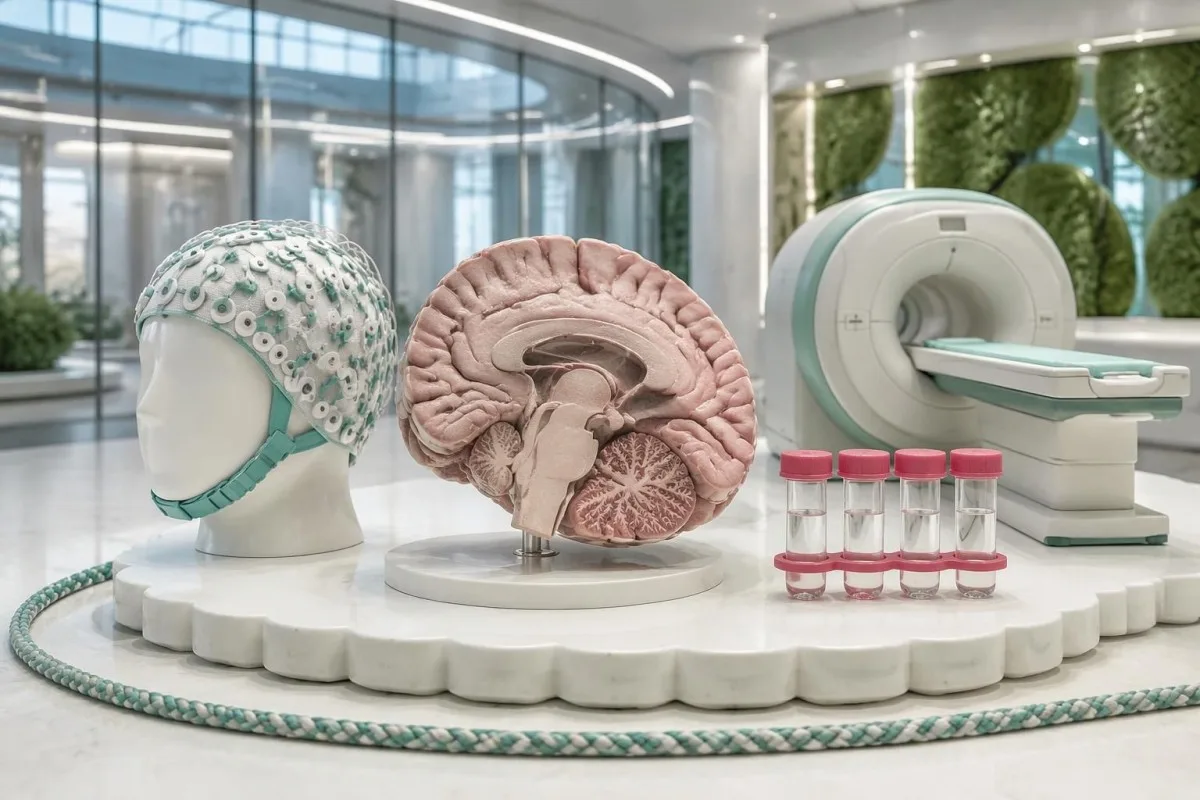
Delirium typically involves disturbed attention and an acute, fluctuating course, and it can include hallucinations or unusual beliefs. A hypothetical person alternating between coherent conversation and marked disorientation over 24 hours needs urgent medical assessment; a pre-existing schizophrenia diagnosis does not make delirium impossible.
New seizures, abnormal movements, reduced consciousness, or rapid cognitive decline can raise concern for an inflammatory brain disorder or another neurological cause. Our autoimmune encephalitis workup explains how MRI, EEG, and cerebrospinal fluid may contribute; 1 positive serum antibody does not independently establish that diagnosis.
Rare medical causes deserve targeted investigation when the accompanying pattern fits, not blanket screening of everyone. Severe episodic abdominal symptoms plus neurological or psychiatric changes can prompt a porphyria workup; our porphyria testing explanation describes why a correctly timed urine test can matter more than 1 general blood panel.
Substance and medication histories should be specific and nonjudgmental. Ask what was taken, approximate amounts, and timing during the preceding 48 hours and earlier weeks; cannabis, stimulants, corticosteroids, and withdrawal states can change diagnostic reasoning, while a negative toxicology screen cannot exclude every exposure or every detection-window limitation.
Wannear fereaskje symptomen fan skizofreny driuwende help?
Seek emergency help for immediate danger, suicidal intent, dangerous commands someone may act on, severe confusion, or inability to meet basic needs. In the UK, call 999 or 112 for an emergency; new psychotic symptoms without immediate danger still warrant prompt assessment rather than waiting for a routine laboratory appointment.
Possible catatonia needs urgent assessment, including when someone becomes unusually immobile, stops speaking, maintains unusual postures, or refuses fluids. A hypothetical adult drinking nothing for 24 hours and remaining largely motionless should not be managed as simple low motivation; fever, rigidity, or reduced responsiveness further increases concern.
Sudden speech difficulty, one-sided weakness, collapse, or a severe new headache requires emergency medical evaluation. Our warskôgingstekens fan in beroerte explain why 1 new focal neurological sign should not be attributed to psychiatric illness, even when hallucinations or a previous mental-health diagnosis are also present.
New psychosis after childbirth is a medical emergency, particularly with little sleep, rapidly changing mood, or confused behavior. If a parent develops these changes 1 week after delivery, seek urgent assessment and ensure both parent and infant have safe support; do not wait to see whether the symptoms fit schizophrenia.
If there is no immediate danger, contact a local crisis service, primary-care clinician, or early-intervention service promptly. In England, NHS 111 offers a mental-health option; in the US, 988 provides crisis support and 911 handles immediate danger, while readers elsewhere should use local emergency or crisis services and avoid leaving an immediately unsafe person alone when it is safe to remain.
Hoe kinne jo ien helpe dy't mooglik in psychose ûnderfynt?
Help by listening calmly, checking immediate safety, and offering a specific route to assessment, rather than arguing about beliefs or announcing a diagnosis. A useful first conversation covers 3 practical needs: whether the person feels safe, whether they are eating and sleeping, and what assistance they would accept.
Short sentences and a quieter environment can make communication easier when attention is strained. Offer 2 realistic choices, such as contacting a clinician together or accompanying the person to an assessment, instead of several simultaneous demands; avoid crowding, sudden touching, or using threats to force cooperation.
Validate distress without confirming an unverified explanation. If someone believes their food is being tampered with, a supporter can acknowledge the fear and offer an acceptable meal while arranging help; asking how much they have eaten in the last 24 hours identifies a practical risk without requiring a debate about the belief.
A brief timeline can improve an appointment more than a long list of labels. Record 5 kinds of information: observed changes, approximate onset, sleep, substances or medicine changes, and effects on daily functioning; distinguish what you directly observed from what someone else reported, and ask the person's permission whenever possible.
De begelieding oer privacy en gegevens is relevant when accompanying laboratory reports contain sensitive personal information. Share only what is needed and seek consent where possible; having access to 1 family member's report does not automatically authorize uploading their records, and emergency safety concerns should be addressed through clinical services rather than an AI tool.
Hokker behanneling helpt nei in earste psychotyske ôflevering?
Treatment for first-episode psychosis commonly combines antipsychotic medication, psychological interventions, and practical support, tailored to diagnosis, preferences, and safety. NICE recommends individual CBT with at least 16 planned sessions and family intervention where appropriate; treatment should address everyday functioning as well as voices or delusions.
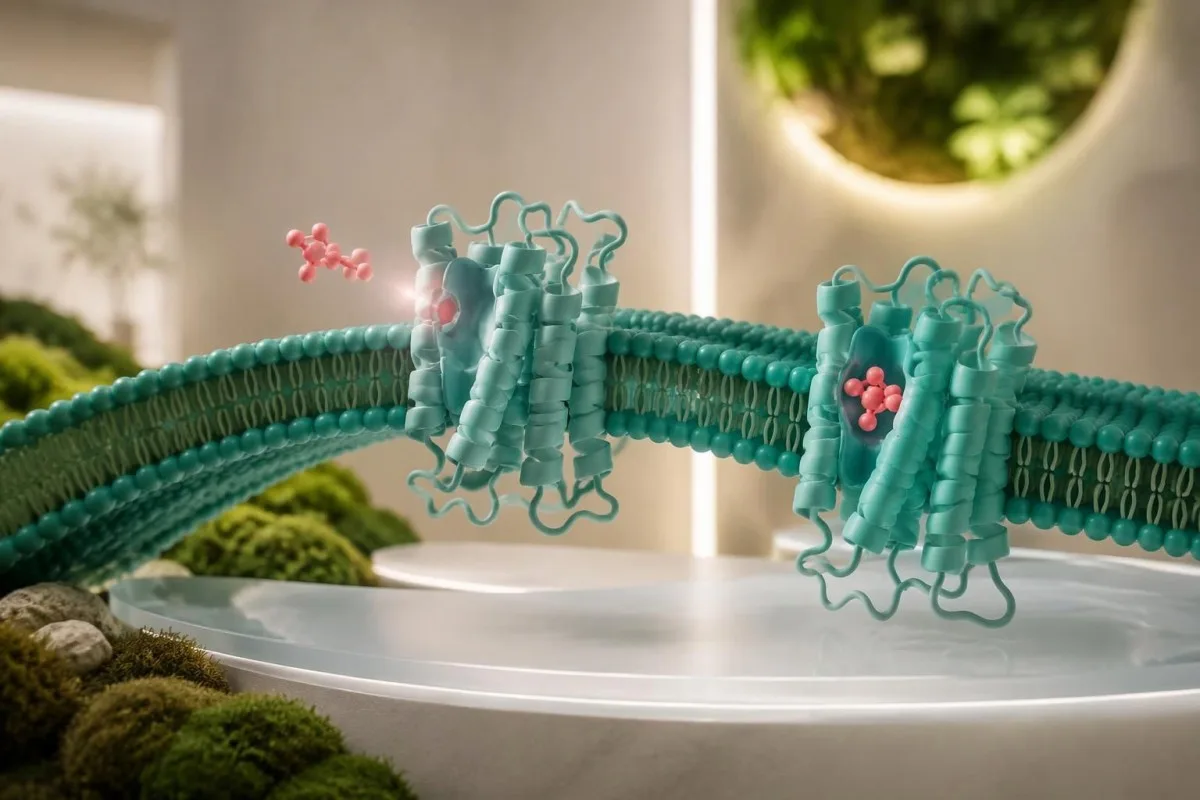
Medication choice is a shared clinical decision, including discussion of metabolic effects, movement symptoms, sedation, hormonal effects, and cardiovascular considerations. NICE advises treating an antipsychotic prescription as an explicit individual trial, generally assessing response after 4–6 weeks at an optimum dose while reviewing tolerability throughout (NICE, 2014).
Psychological treatment does not require the clinician to endorse a delusion or tell someone that their experience is imaginary. CBT for psychosis explores distress, interpretations, coping, and functioning; NICE describes family intervention as at least 10 planned sessions over 3 months to 1 year, adapted to the family's circumstances.
Clozapine is recommended for treatment-resistant schizophrenia after inadequate response to 2 adequate antipsychotic trials, subject to clinical assessment and local requirements. The APA guideline also recommends clozapine when suicide risk remains substantial despite other treatments (APA, 2020); our clozapine safety monitoring guide explains why monitoring is treatment-specific.
Recovery goals should be personal and measurable rather than limited to symptom counts. A hypothetical first goal might be returning to 2 supported study sessions weekly or preparing a regular meal; occupational, educational, housing, and social support can address barriers that medication alone does not remove, and prescriptions should never be changed through an automated laboratory interpretation.
Wêrom binne sûnenskontrôles ûnderdiel fan de soarch by skizofreny?
Physical-health checks identify medication effects and health risks that deserve care independently of psychiatric symptoms. NICE recommends baseline assessment and repeat glucose or HbA1c and lipid testing at 12 weeks, 1 year, and annually during antipsychotic treatment; individual medicines and existing conditions may require additional monitoring.

Weight, blood pressure, movement symptoms, nutrition, and activity deserve discussion alongside laboratory results. NICE recommends weighing weekly for the first 6 weeks of antipsychotic treatment, then at 12 weeks, 1 year, and annually; early changes can support a timely conversation about treatment options rather than blame about willpower.
HbA1c of 6.5% equals 48 mmol/mol and is a diabetes diagnostic threshold, usually requiring confirmation when there are no clear symptoms. Our tekens fan hege glukoaze explains why thirst, frequent urination, weight loss, or acute illness can change urgency; this threshold says nothing about the severity of psychosis.
Some antipsychotics raise prolactin, which can affect sexual function, menstruation, fertility, or other aspects of health. A result 2 times the laboratory upper limit needs interpretation with symptoms, medicines, sampling conditions, and sometimes repeat testing; our mildly elevated prolactin guide explains why one result should not trigger unsupervised medication changes.
Smoking changes can alter clozapine exposure, because combustion products—not nicotine alone—affect its metabolism. A hypothetical person stopping cigarettes during a 1-week admission needs the prescribing team's attention; diet and supplements also deserve review, but no meal plan, vitamin panel, or supplement regimen has been established as a substitute for schizophrenia treatment.
Undersykspublikaasjes en de grinzen fan laboratoariumynterpretaasje
The research references below distinguish schizophrenia guidance from supporting laboratory education. The 2 Zenodo guides explain serum proteins and immune tests; they are not schizophrenia diagnostic studies, and their DOIs do not establish peer review, psychiatric screening accuracy, or evidence that these tests should be ordered for early behavioral changes.
Kantesti is in AI-labtest-ynterpretaasjetsjinst that explains reported measurements rather than diagnosing psychiatric disorders. Our technysk en klinysk tafersjoch describes the scope of our methodology; performance on laboratory interpretation is not evidence of accuracy for schizophrenia assessment, and those are 2 separate validation questions.
Serum albumin, globulins, and the A/G ratio reflect broad physiological processes, not a schizophrenia signature. Our gids foar serum-aaiwiten provides context for that laboratory family; a hypothetical A/G ratio of 0.9 must be interpreted against its laboratory interval and clinical setting, not converted into a psychiatric risk score.
Complement and ANA testing answer targeted immune questions, and indiscriminate testing can produce findings unrelated to the presenting symptoms. Our komplement- en ANA-gids explains those limits; an isolated ANA titer of 1:80 does not establish an autoimmune explanation for psychosis or justify immune treatment without supporting clinical evidence.
Kantesti's role is to help readers understand accompanying reports while keeping diagnosis and urgent care with qualified clinicians. For a first episode—or a change after 5 stable years—bring the symptom timeline and original results to assessment; the NICE, WHO, and APA references below support the clinical discussion, while the repository publications support narrower laboratory education.
Faak stelde fragen
Wat binne de earste tekens fan skizofreny?
Mooglike iere tekens fan skizofreny binne ûnder oare it weromlûken fan oaren, minder goed funksjonearjen, ûngewoane waarnimmingen, erchtinkendheid en feroaringen yn it tinken of sliepen, mar dizze ferskynsels binne net spesifyk genôch om skizofreny te diagnostisearjen. In kombinaasje fan ferskynsels dy't 2 of mear libbensgebieten beynfloedet, kin in beoardieling benammen nuttich meitsje, hoewol dat gjin diagnostyske drompel is. Nije stimmen hearre, sterk fêsthâlde oan ûngewoane oertsjûgingen of in dúdlike efterútgong fertsjinje in snelle klinyske beoardieling. Wachtsje net moannenlang op symptomen of op in bloedtestresultaat foardat jo help sykje.
Kinne jo skizofreny hawwe sûnder stimmen te hearren?
Immen kin skizofreny hawwe sûnder stimmen te hearren, om't hallusinaasjes op it mêd fan it gehoar net by elke foarm fan skizofreny foarkomme hoege. De DSM-5-TR fereasket op syn minst 2 karakteristike symptomen yn de aktive faze, mei dêrûnder op syn minst ien fan wanen, hallusinaasjes of desorganisearre spraak, tegearre mei ekstra kritearia oangeande de doer en it funksjonearjen. Immen kin dus opfallende wanen of desorganisearre spraak hawwe sûnder hallusinaasjes op it mêd fan it gehoar. In klinikus moat ek oare psychiatryske, substansrelatearre en medyske ferklearrings beoardielje.
Kin in bloedtest skizofreny diagnostisearje?
Gjin routinemjittige bloedtest kin skizofreny fêststelle of útslute, en der binne 0 falidearre routinemjittige biomarkerdrompels foar dat doel. Bloedtests kinne medyske bydragende faktoaren ûndersykje of de feiligens fan medisinen kontrolearje, mar dat binne oare klinyske fragen. Sa kin bygelyks ûndersyk nei de skildklier of B12 passend wêze as de syktehistoarje op dy problemen wiist. Normale laboratoariumútslaggen betsjutte net dat oanhâldende hallusinaasjes, waanfoarstellingen of efterútgong yn it funksjonearjen feilich negearre wurde kinne.
Binne lege motivaasje en sosjale weromlûking tekens fan skizofreny?
Low motivation and social withdrawal can occur among the negative symptoms of schizophrenia, but they also occur with depression, sleep problems, medicines, stress, and other conditions. Clinicians commonly describe 5 negative-symptom domains: reduced expression, speech, motivation, pleasure, and social engagement. The assessment considers the person's baseline, associated symptoms, and alternative causes rather than counting behaviors on a checklist. New or persistent changes affecting daily life deserve assessment without assuming schizophrenia.
Hoe lang moatte symptomen duorje foardat skizofreny diagnostisearre wurdt?
De fereaske doer hinget ôf fan it diagnostyske ramt en it folsleine symptoompatroan. DSM-5-TR fereasket oer it generaal teminsten 6 moannen fan oanhâldende steuring, ynklusyf in aktive faze dy't meastal teminsten 1 moanne duorret, of koarter as de behanneling suksesfol is. ICD-11 fereasket karakteristike symptomen it grutste part fan 'e tiid, teminsten 1 moanne lang, mei oanfoljende diagnostyske easken. Dizze drompels binne rjochtlinen foar de diagnoaze, net foar it momint dat help socht wurde moat: in earste psychotyske ôflevering moat sa gau mooglik beoardiele wurde.
Wannear moat immen mei mooglike skizofreny nei de spoedeaskjende help?
By driigjende selsbeskeadiging, gefaarlike opdrachten dêr't immen nei hannelje kin, slimme betizing, fermindere reagearfermogen of it ûnfermogen om yn basisbehoeften te foarsjen, is needsoarch nedich. Yn it Feriene Keninkryk belje jo 999 of 112 by fuortendaliks gefaar; yn de FS belje jo 911 by in needgefal of 988 foar stipe by in krisis. Hommelse neurologyske symptomen, koarts mei stivens en nije psychose nei de befalling freegje ek om driuwende medyske beoardieling. Nije psychotyske symptomen sûnder fuortendaliks gefaar freegje noch altyd om gau kontakt mei in behanneler of lokale krisistsjinst.
Lit jo bloedtest resultaten útlizze
Laad jo laboratoariumrapport op en de AI fan Kantesti leit elke biomarker binnen sekonden út yn gewoane taal. Brûkt troch mear as 2 miljoen minsken wrâldwiid.
Referinsjes
- Klein, T., Mitchell, S., & Weber, H. (2026). Gids foar serumproteïnen: Globulinen, albumine en de A/G-ferhâlding yn in bloedtest. Kantesti AI Medysk Undersyk. DOI
- Klein, T., Mitchell, S., & Weber, H. (2026). Gids foar C3 C4-komplementbloedtests en ANA-titers. Kantesti AI Medysk Undersyk. DOI
- National Institute for Health and Care Excellence (2014). Psychosis and schizophrenia in adults: prevention and management (CG178). NICE Clinical Guideline.
- World Health Organization (2024). Clinical descriptions and diagnostic requirements for ICD-11 mental, behavioural and neurodevelopmental disorders. Wrald sûnens organisaasje.
- American Psychiatric Association (2020). The American Psychiatric Association Practice Guideline for the Treatment of Patients With Schizophrenia, Third Edition. American Psychiatric Association Publishing. DOI
- 2M+Analysearre tests
- 127+Lannen
- 100+Talen
Oer it medyske team


E-E-A-T fertrouwensignalen
Ûnderfining
Dokter-oandreaune klinyske resinsje fan lab-ynterpretaasje-wurkprosessen.
Ekspertize
Fokus fan laboratoariummedisyne op hoe’t biomarkers har gedrage yn in klinyske kontekst.
Autoriteit
Medysk beoardiele troch Dr. Thomas Klein, mei bydragen fan Dr. Sarah Mitchell en prof. dr. Hans Weber.
Betrouberens
Bewiis-basearre ynterpretaasje mei dúdlike ferfolchpaadkes om alarm te ferminderjen.






Medyske disclaimer
Dit artikel is allinnich foar ûnderwiisdoelen en foarmet gjin medysk advys. Rieplachtsje altyd in kwalifisearre soarchferliener foar besluten oer diagnoaze en behanneling.
Publisearre · Nim kontakt op mei it redaksjeteam
Publisearre troch Kantesti Ltd, registrearre yn Ingelân en Wales, bedriuwsnûmer. 17090423, Londen, Feriene Keninkryk.
