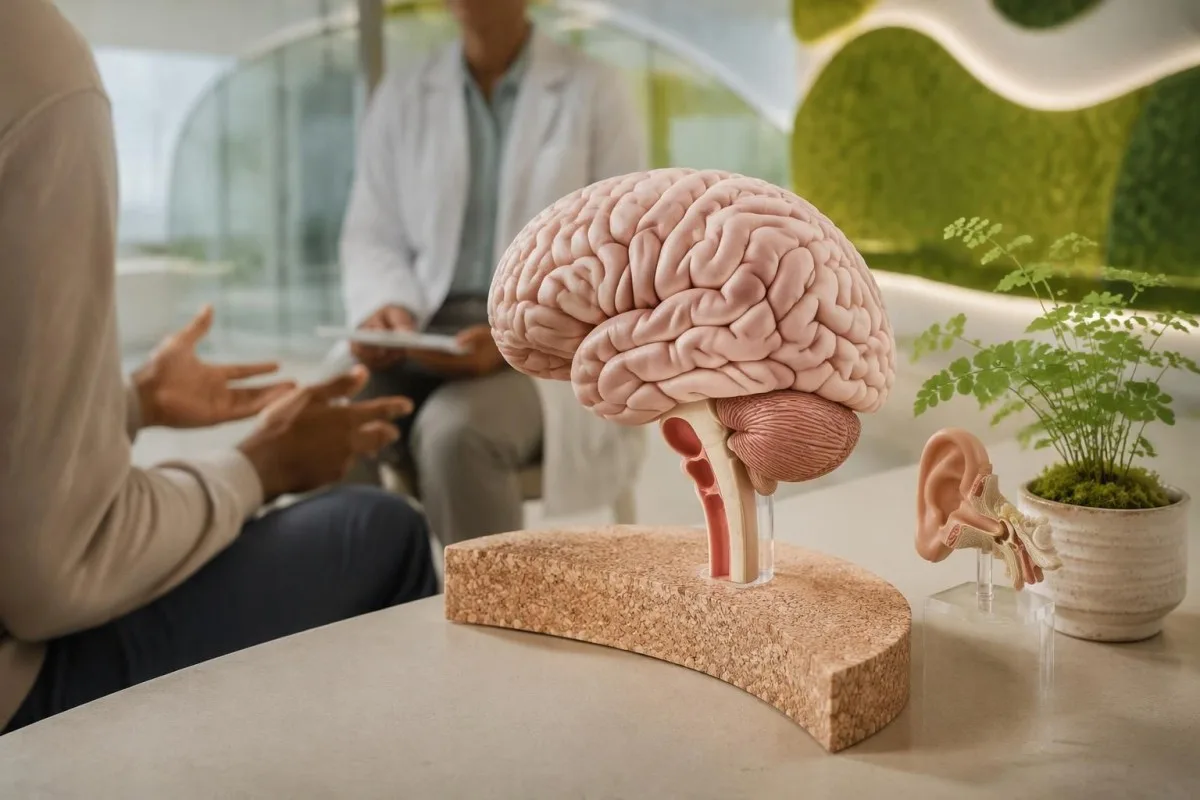
Симптомите на шизофренията могат да включват халюцинации, налудности, дезорганизирана реч, намалена мотивация и когнитивни затруднения. Само ранните промени не установяват шизофрения: това става чрез клинична оценка, а непосредствена опасност, тежко объркване или невъзможност за задоволяване на основни потребности налагат спешна помощ.

Основни изводи
- Симптоми на шизофренията включват промени във възприятията, убежденията, речта, мотивацията и мисленето; 1 симптом или отклонение в лабораторен резултат не може да установи диагнозата.
- Ранни признаци като отдръпване, лош сън или влошаване на резултатите са неспецифични. Ако е полезно, записвайте промените в продължение на 7 дни, но не отлагайте оценката при нови психотични преживявания.
- Халюцинациите са възприятия без съответстващ външен стимул. Преживяванията, които възникват само при заспиване или събуждане, имат различно клинично значение от постоянните гласове през деня.
- Негативните симптоми включват намалена емоционална изразност, реч, мотивация, удоволствие и социална ангажираност — 5 често описвани области, а не доказателство, че някой е мързелив.
- Диагностично времеяне се различава: DSM-5-TR обикновено изисква поне 6 месеца непрекъснато нарушение, докато ICD-11 изисква характерни симптоми в продължение на поне 1 месец. Помощта трябва да започне, преди да бъде достигнат който и да е от двата прага.
- Кръвни изследвания може да изследва медицинските фактори и да следи безопасността на лечението; няма 0 валидирани рутинни прагове за кръвни изследвания, които да диагностицират шизофрения.
- Спешна помощ е необходима при непосредствен риск от самонараняване, опасни заповеди, които човекът може да изпълни, тежко объркване или невъзможност за хранене или пиене. В Обединеното кралство се обадете на 999 или 112 при непосредствена опасност.
- Лечение обикновено съчетава медикаменти, психологическа грижа и практическа подкрепа. NICE препоръчва поне 16 планирани сеанса индивидуална КПТ при психоза.
Кои ранни признаци на шизофренията заслужават оценка?
Ранни признаци на шизофрения могат да включват социално отдръпване, влошаване на функционирането, необичайни преживявания и промени в съня или мисленето, но сами по себе си не са диагностични. Нова съвкупност от промени, засягащи 2 или повече области от ежедневието, заслужава внимание, особено ако човекът е уплашен или губи обичайните си способности.

Промяната спрямо обичайното състояние на човека е по-важна от това дали дадено поведение изглежда необичайно на някой друг. Например, хипотетичен студент, който спира да посещава 3 дейности, които преди са му доставяли удоволствие, трудно следи разговори и става все по-подозрителен, се нуждае от различна оценка от човек, който винаги е предпочитал уединението.
Нарушенията на съня са насока, а не присъда. Хипотетичен възрастен, който спи по 3 часа на нощ по време на изпити, може вследствие на изтощение да развие затруднена концентрация или необичайни възприятия; нашето ръководство за лош сън и изследвания обяснява защо данните за съня променят и начина, по който се тълкуват съпътстващите лабораторни находки.
Kantesti е анализатор на кръвни изследвания с AI които могат да обяснят съпътстващите лабораторни находки, но не могат да установят дали ранните промени в поведението представляват шизофрения. Нашите компания и цел описват нашата роля; 7-дневният дневник на симптомите е нещо, което да споделите с клиницист, а не входни данни, от които се поставя психиатрична диагноза.
NICE препоръчва незабавно насочване, когато дистресът и влошаването на социалното функциониране са съпроводени от преходни или отслабени психотични симптоми или от определени други показатели за риск (NICE, 2014). Оценка след 1 тревожен епизод може да установи депресия, травма, ефекти от употреба на вещества или развиващо се психотично разстройство; тя не води автоматично до поставяне на диагноза шизофрения.
Как се преживяват халюцинациите и какво друго ги причинява?
Халюцинациите са сетивни преживявания без съответстващ външен стимул; чуването на гласове е често срещано при шизофрения, но халюцинации се наблюдават и при други състояния. Оценката разграничава поне 3 въпроса: какво се е случило, кога се е случило и дали причинява дистрес или опасност.
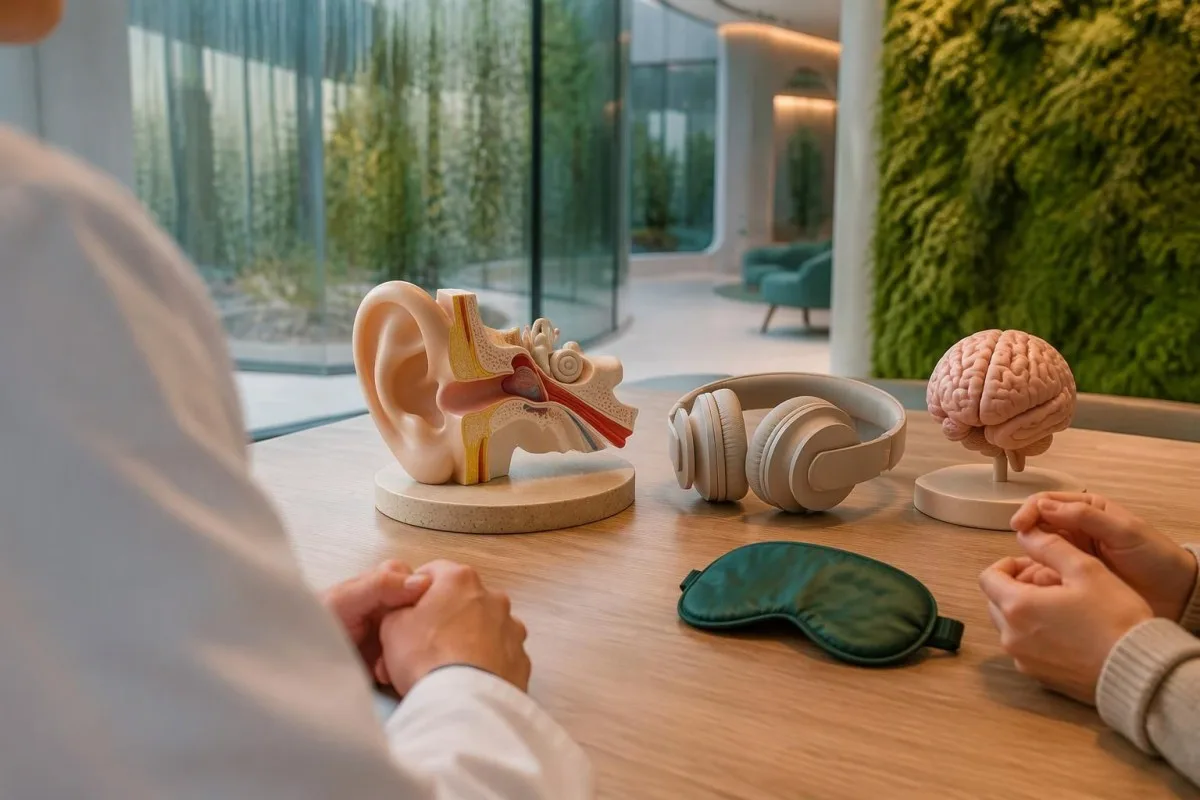
Слуховите преживявания могат да звучат като коментар, разговор, музика или инструкции и да изглеждат вътрешни или външни. В рамките на 24-часов период клиницистът може да попита дали преживяванията настъпват при пълно събуждане, колко продължават и дали могат да бъдат обяснени с околни звуци; усещането, че са в главата, не означава автоматично, че са безвредни.
Преживяванията при прехода към сън се различават от постоянните халюцинации в будно състояние и могат да възникнат без психотично разстройство. Ако необичайните възприятия се появяват само при заспиване или събуждане, прекомерната дневна сънливост и свързаните с нея симптоми могат да насочат към оценка на съня; нашето обяснение за изследването за нарколепсия описва защо клиницистите използват повече от 1 свързана със съня насока.
Сетивните увреждания, загубата на близък, лекарствата, интоксикацията, абстиненцията и неврологичните заболявания също могат да причинят халюцинации. Хипотетичен 72-годишен човек с новопоявили се зрителни преживявания и колебания във вниманието в продължение на 2 дни се нуждае от оценка за делириум или друга медицинска причина, а не от предположение за шизофрения с късно начало.
Command voices require a safety assessment, not an automatic assumption that someone will act on them. Ask about 3 concrete factors: what the voice says, whether the person feels compelled to obey, and whether they can stay safe; commands involving harm with intent or inability to resist warrant immediate help.
По какво налудностите се различават от тревогата или необичайните убеждения?
Delusions are beliefs held with strong conviction despite compelling contrary evidence, assessed within the person's cultural and social context. Clinicians examine at least 3 dimensions—conviction, openness to alternatives, and consequences—rather than diagnosing schizophrenia because a belief sounds unfamiliar or implausible to an observer.
Persecutory delusions can involve beliefs that others are monitoring, targeting, or plotting against the person; referential delusions can involve interpreting ordinary events as personally directed messages. A hypothetical person changing travel routes 4 times to avoid an alleged surveillance team may need assessment of both the belief and the resulting disruption.
Real threats must not be dismissed as delusions. Abuse, discrimination, stalking, and exploitation can occur, including in people with established psychiatric diagnoses; 1 unusual detail does not invalidate an entire account, and a clinician should investigate plausible safety concerns rather than use psychiatric history as a shortcut.
Mood timing changes the differential diagnosis. A hypothetical adult who develops grandiose beliefs during 5 days of markedly increased energy and little need for sleep may have a manic episode; our mood swings and laboratories explains why testing can address contributors without distinguishing bipolar disorder from schizophrenia.
Repeated confrontation often damages trust without resolving a firmly held belief. A supporter can use 2 steps: acknowledge the fear or distress, then offer practical help without endorsing the explanation; discussing whether the person is eating, sleeping, or feeling safe is usually more useful than trying to win an argument.
Какви са негативните симптоми на шизофренията?
Negative symptoms of schizophrenia describe reductions in ordinary emotional expression, speech, motivation, pleasure, or social engagement. These 5 domains are commonly termed blunted affect, alogia, avolition, anhedonia, and asociality; they describe difficulties in functioning, not character flaws or a person's capacity to care.

Avolition means difficulty initiating or sustaining purposeful activity, even when the person understands its value. A hypothetical adult may want to prepare breakfast yet remain unable to begin for 2 hours; simply adding pressure can miss problems with initiation, planning, fatigue, or anticipation of reward.
Reduced expression does not reliably reveal the intensity of someone's internal feelings. A person who gives 1-word answers or shows little facial movement may still feel affection, anxiety, or sadness; communication should allow extra time and avoid interpreting a quiet response as indifference or refusal to participate.
Secondary negative symptoms can arise from depression, sedating medicines, ongoing paranoia, substance use, or a low-stimulation environment. Our low motivation laboratory guide addresses selected medical contributors, but 1 thyroid or vitamin result cannot distinguish primary negative symptoms from these overlapping causes.
Pleasure can be uneven: some people struggle more with anticipating enjoyment than with enjoying an activity once it starts. A practical experiment is 1 short, supported activity chosen by the person, followed by asking how it actually felt; the result guides support, not a diagnosis or a promise of recovery.
Кои когнитивни промени и промени в речта могат да съпътстват шизофренията?
Cognitive changes can affect attention, working memory, processing speed, and planning, while disorganized speech can make connections between ideas difficult to follow. These are distinct problems: an assessment should separate at least 2 issues—trouble organizing thought and trouble performing a task under everyday demands.

Disorganized speech may involve frequent derailment, answers loosely connected to questions, or speech that becomes difficult to understand. A hypothetical conversation moving through 4 unrelated topics can raise concern, but language proficiency, hearing, anxiety, developmental differences, and the person's usual communication style must be considered before interpreting it.
Working-memory difficulty can make multistep tasks unexpectedly hard. Someone may remember the first of 3 instructions but lose the remaining steps; offering one instruction at a time, using reminders, and reducing distractions are accommodations that can help before the precise cause of the difficulty is established.
A lifelong attention pattern is different from a recent decline. Our adult ADHD symptom guide explains why a history extending back to childhood matters; a new deterioration over 2 months should not be explained away by an unconfirmed ADHD label.
At Kantesti, we treat laboratory explanations of fatigue or brain fog as separate from psychiatric diagnostic reasoning. A hypothetical person with corrected anemia who remains unable to follow a 10-minute conversation still needs follow-up; improvement in a laboratory value does not prove that cognitive symptoms have resolved or identify their cause.
Как се променят симптомите на шизофренията при възрастни с възрастта?
Schizophrenia symptoms in adults vary in onset, severity, and impact; the same symptom can have different implications at different ages. A first presentation at 22 and a first presentation at 72 both need assessment, but later onset increases the need to investigate medical, neurological, medication, and sensory contributors.

Schizophrenia commonly begins in late adolescence or early adulthood, but age alone cannot confirm or exclude it. For a hypothetical 24-year-old, clinicians may reconstruct the relationship between missed work, unusual beliefs, substance exposure, and sleep across several months instead of relying only on what happens during 1 appointment.
First-onset psychosis in an older adult should prompt careful review of medicines, cognition, physical health, hearing, and vision. Our ръководство за ефектите на лекарствата при възрастни хора explains why a newly added treatment or a dose change 2 weeks earlier can be a more useful clue than a broad psychiatric label.
People can have episodic worsening, persistent difficulties, or substantial improvement with treatment and support. A hypothetical adult managing work for 5 years before a recurrence does not erase the original diagnosis; equally, a first psychotic episode does not establish what the person's long-term course will be.
Schizophrenia is not a split personality, and psychosis does not mean someone is inherently violent. Risk assessment concerns specific circumstances—such as intoxication, severe fear, access to means, or expressed intent—not a diagnosis alone; 1 frightened presentation should not define how family members or services treat a person.
Как клиничната оценка установява шизофрения?
Schizophrenia is diagnosed clinically, using the symptom pattern, duration, functioning, and exclusion of better explanations—not a blood test or online checklist. DSM-5-TR generally requires at least 6 months of continuous disturbance; ICD-11 requires characteristic symptoms for at least 1 month, with additional requirements in both systems.
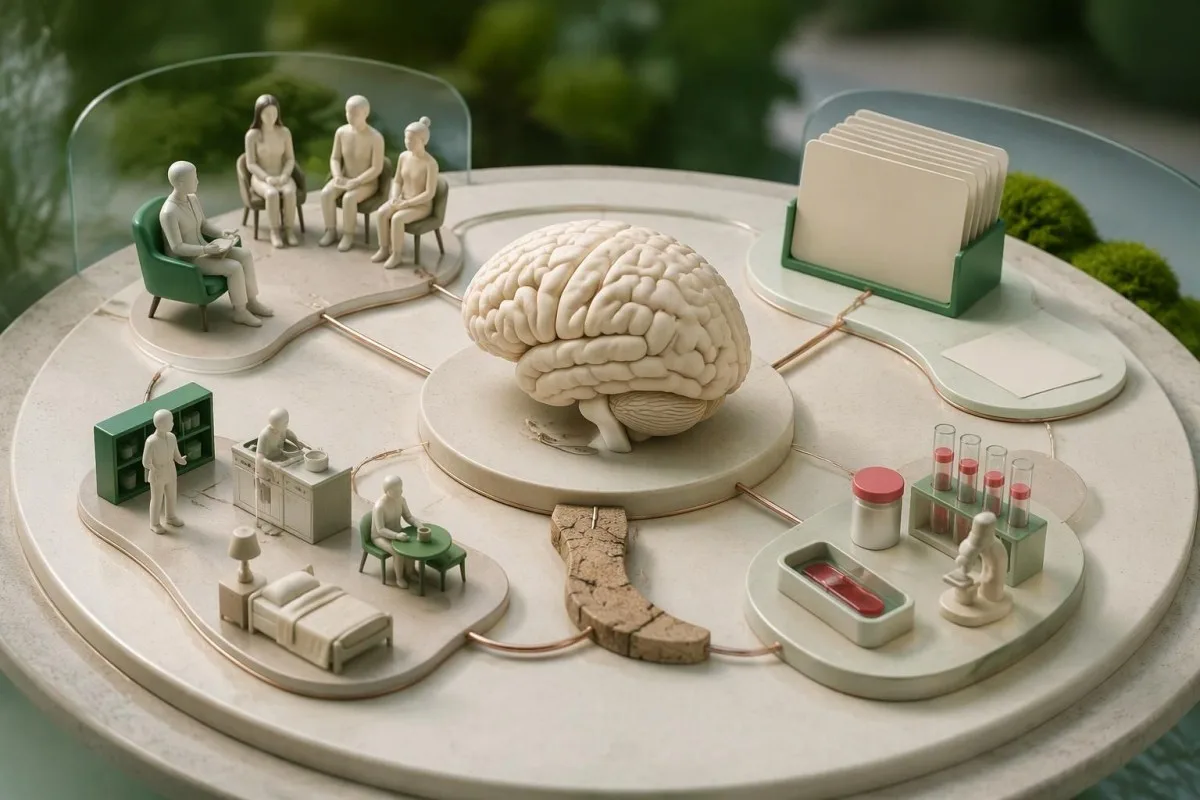
DSM-5-TR requires at least 2 characteristic symptoms during a significant portion of a 1-month period, or less if successfully treated, with at least one being delusions, hallucinations, or disorganized speech. It also requires functional deterioration and a longer course of disturbance; the criteria are not a self-scoring tool.
ICD-11 uses a different structure and requires at least 2 characteristic symptoms, including at least one from its core group, present most of the time for 1 month or more. WHO's clinical requirements emphasize the overall presentation and differential diagnosis rather than mechanically translating every DSM rule into ICD terminology (WHO, 2024).
Assessment often takes more than 1 conversation, particularly when symptoms are new or the history is unclear. With appropriate consent and attention to confidentiality, information from relatives, previous records, and the person's own account can clarify timing; lack of agreement between accounts should be explored rather than treated as proof that someone is unreliable.
Support should not wait for a 6-month diagnostic threshold to pass. A first episode may initially receive a broader working diagnosis while treatment and investigation proceed; our принципи за отговорен ИИ reflect why automated laboratory interpretation must not substitute for this evolving clinical judgment.
Могат ли кръвните изследвания да открият шизофрения или да обяснят симптомите?
No routine blood test diagnoses schizophrenia, and normal results do not rule it out. Laboratories serve 2 different purposes in this setting: investigating plausible medical contributors and establishing physical-health or medication-safety baselines; neither purpose turns a biomarker panel into a schizophrenia screening test.

Testing is selected from the history and examination, rather than ordered as an unlimited panel. A clinician may consider a CBC, electrolytes, kidney or liver tests, thyroid function, B12, or other investigations; our хормоните на щитовидната жлеза shows why 2 related thyroid measurements can be more informative than one isolated result.
B12 deficiency can contribute to neurological or cognitive symptoms, sometimes without marked anemia. In a hypothetical example, B12 of 160 pg/mL against that laboratory's 200–900 pg/mL interval warrants medical review; our гранично тълкуване на B12 explains why assay ranges and follow-up testing matter, without claiming that deficiency explains every symptom.
Kantesti е платформа за кръвни изследвания тълкуване с AI that can help explain these 2 laboratory roles without converting results into a psychiatric label. We encourage readers to bring the original report, medicine list, and symptom timeline to the assessing clinician; an interpretation should preserve uncertainty when symptoms and laboratory findings do not fit neatly together.
Research measurements of immune activity, metabolism, proteins, or genetic associations are not validated routine diagnostic thresholds for schizophrenia. A result showing 1 elevated inflammatory marker may reflect many unrelated processes; commercial-sounding claims that a panel can confirm psychosis should be questioned for independent validation and clear intended-use limits.
Какви състояния могат да наподобяват шизофрения?
Psychosis can arise from mood disorders, substances, medicines, delirium, and neurological or other medical illnesses, as well as schizophrenia-spectrum disorders. Timing is central: symptoms developing over 2 days with fluctuating attention require a different workup from a gradual change over several months with preserved alertness.
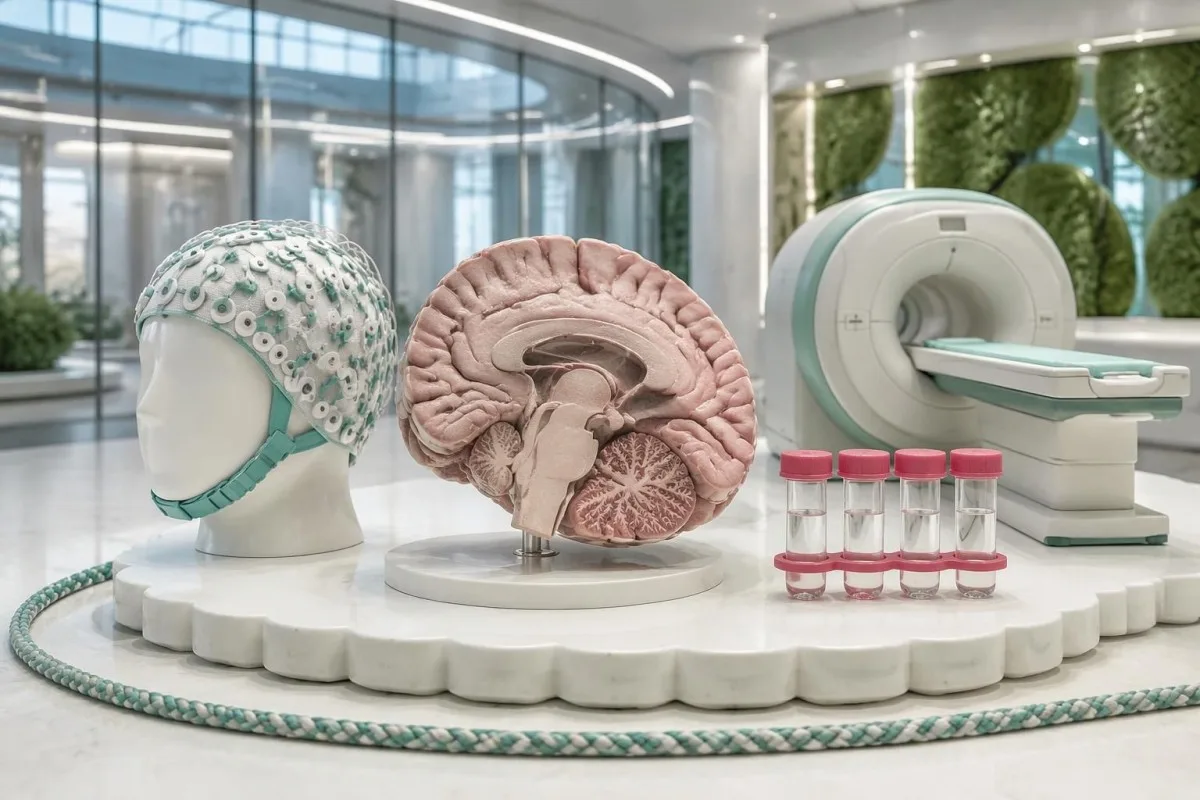
Delirium typically involves disturbed attention and an acute, fluctuating course, and it can include hallucinations or unusual beliefs. A hypothetical person alternating between coherent conversation and marked disorientation over 24 hours needs urgent medical assessment; a pre-existing schizophrenia diagnosis does not make delirium impossible.
New seizures, abnormal movements, reduced consciousness, or rapid cognitive decline can raise concern for an inflammatory brain disorder or another neurological cause. Our autoimmune encephalitis workup explains how MRI, EEG, and cerebrospinal fluid may contribute; 1 positive serum antibody does not independently establish that diagnosis.
Rare medical causes deserve targeted investigation when the accompanying pattern fits, not blanket screening of everyone. Severe episodic abdominal symptoms plus neurological or psychiatric changes can prompt a porphyria workup; our porphyria testing explanation describes why a correctly timed urine test can matter more than 1 general blood panel.
Substance and medication histories should be specific and nonjudgmental. Ask what was taken, approximate amounts, and timing during the preceding 48 hours and earlier weeks; cannabis, stimulants, corticosteroids, and withdrawal states can change diagnostic reasoning, while a negative toxicology screen cannot exclude every exposure or every detection-window limitation.
Кога симптомите на шизофренията налагат спешна помощ?
Seek emergency help for immediate danger, suicidal intent, dangerous commands someone may act on, severe confusion, or inability to meet basic needs. In the UK, call 999 or 112 for an emergency; new psychotic symptoms without immediate danger still warrant prompt assessment rather than waiting for a routine laboratory appointment.
Possible catatonia needs urgent assessment, including when someone becomes unusually immobile, stops speaking, maintains unusual postures, or refuses fluids. A hypothetical adult drinking nothing for 24 hours and remaining largely motionless should not be managed as simple low motivation; fever, rigidity, or reduced responsiveness further increases concern.
Sudden speech difficulty, one-sided weakness, collapse, or a severe new headache requires emergency medical evaluation. Our предупредителни признаци за инсулт explain why 1 new focal neurological sign should not be attributed to psychiatric illness, even when hallucinations or a previous mental-health diagnosis are also present.
New psychosis after childbirth is a medical emergency, particularly with little sleep, rapidly changing mood, or confused behavior. If a parent develops these changes 1 week after delivery, seek urgent assessment and ensure both parent and infant have safe support; do not wait to see whether the symptoms fit schizophrenia.
If there is no immediate danger, contact a local crisis service, primary-care clinician, or early-intervention service promptly. In England, NHS 111 offers a mental-health option; in the US, 988 provides crisis support and 911 handles immediate danger, while readers elsewhere should use local emergency or crisis services and avoid leaving an immediately unsafe person alone when it is safe to remain.
Как можете да помогнете на човек, който може да преживява психоза?
Help by listening calmly, checking immediate safety, and offering a specific route to assessment, rather than arguing about beliefs or announcing a diagnosis. A useful first conversation covers 3 practical needs: whether the person feels safe, whether they are eating and sleeping, and what assistance they would accept.

Short sentences and a quieter environment can make communication easier when attention is strained. Offer 2 realistic choices, such as contacting a clinician together or accompanying the person to an assessment, instead of several simultaneous demands; avoid crowding, sudden touching, or using threats to force cooperation.
Validate distress without confirming an unverified explanation. If someone believes their food is being tampered with, a supporter can acknowledge the fear and offer an acceptable meal while arranging help; asking how much they have eaten in the last 24 hours identifies a practical risk without requiring a debate about the belief.
A brief timeline can improve an appointment more than a long list of labels. Record 5 kinds of information: observed changes, approximate onset, sleep, substances or medicine changes, and effects on daily functioning; distinguish what you directly observed from what someone else reported, and ask the person's permission whenever possible.
На Kantesti насоки за поверителност и данни is relevant when accompanying laboratory reports contain sensitive personal information. Share only what is needed and seek consent where possible; having access to 1 family member's report does not automatically authorize uploading their records, and emergency safety concerns should be addressed through clinical services rather than an AI tool.
Какво лечение помага след първи психотичен епизод?
Treatment for first-episode psychosis commonly combines antipsychotic medication, psychological interventions, and practical support, tailored to diagnosis, preferences, and safety. NICE recommends individual CBT with at least 16 planned sessions and family intervention where appropriate; treatment should address everyday functioning as well as voices or delusions.
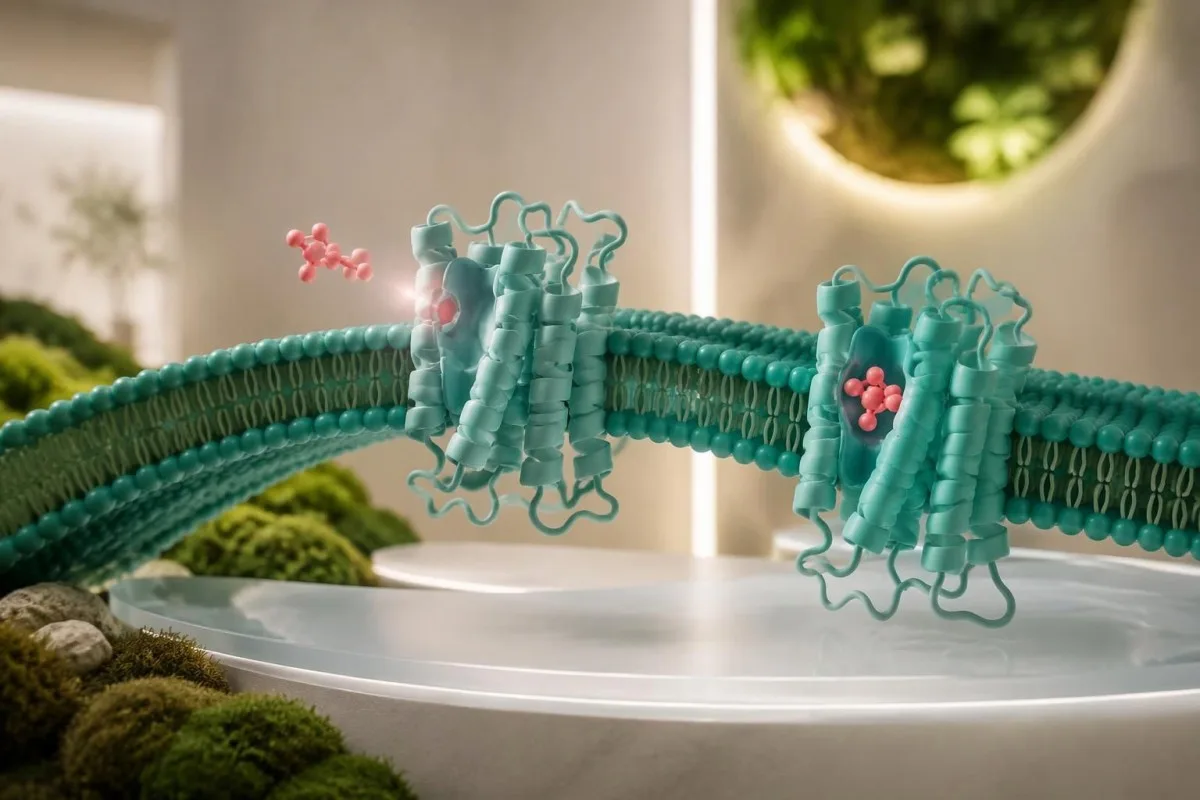
Medication choice is a shared clinical decision, including discussion of metabolic effects, movement symptoms, sedation, hormonal effects, and cardiovascular considerations. NICE advises treating an antipsychotic prescription as an explicit individual trial, generally assessing response after 4–6 weeks at an optimum dose while reviewing tolerability throughout (NICE, 2014).
Psychological treatment does not require the clinician to endorse a delusion or tell someone that their experience is imaginary. CBT for psychosis explores distress, interpretations, coping, and functioning; NICE describes family intervention as at least 10 planned sessions over 3 months to 1 year, adapted to the family's circumstances.
Clozapine is recommended for treatment-resistant schizophrenia after inadequate response to 2 adequate antipsychotic trials, subject to clinical assessment and local requirements. The APA guideline also recommends clozapine when suicide risk remains substantial despite other treatments (APA, 2020); our clozapine safety monitoring guide explains why monitoring is treatment-specific.
Recovery goals should be personal and measurable rather than limited to symptom counts. A hypothetical first goal might be returning to 2 supported study sessions weekly or preparing a regular meal; occupational, educational, housing, and social support can address barriers that medication alone does not remove, and prescriptions should never be changed through an automated laboratory interpretation.
Защо проверките на физическото здраве са част от грижите при шизофрения?
Physical-health checks identify medication effects and health risks that deserve care independently of psychiatric symptoms. NICE recommends baseline assessment and repeat glucose or HbA1c and lipid testing at 12 weeks, 1 year, and annually during antipsychotic treatment; individual medicines and existing conditions may require additional monitoring.

Weight, blood pressure, movement symptoms, nutrition, and activity deserve discussion alongside laboratory results. NICE recommends weighing weekly for the first 6 weeks of antipsychotic treatment, then at 12 weeks, 1 year, and annually; early changes can support a timely conversation about treatment options rather than blame about willpower.
HbA1c of 6.5% equals 48 mmol/mol and is a diabetes diagnostic threshold, usually requiring confirmation when there are no clear symptoms. Our предупредителни знаци за висока глюкоза explains why thirst, frequent urination, weight loss, or acute illness can change urgency; this threshold says nothing about the severity of psychosis.
Some antipsychotics raise prolactin, which can affect sexual function, menstruation, fertility, or other aspects of health. A result 2 times the laboratory upper limit needs interpretation with symptoms, medicines, sampling conditions, and sometimes repeat testing; our mildly elevated prolactin guide explains why one result should not trigger unsupervised medication changes.
Smoking changes can alter clozapine exposure, because combustion products—not nicotine alone—affect its metabolism. A hypothetical person stopping cigarettes during a 1-week admission needs the prescribing team's attention; diet and supplements also deserve review, but no meal plan, vitamin panel, or supplement regimen has been established as a substitute for schizophrenia treatment.
Научни публикации и ограниченията при тълкуване на лабораторни резултати
The research references below distinguish schizophrenia guidance from supporting laboratory education. The 2 Zenodo guides explain serum proteins and immune tests; they are not schizophrenia diagnostic studies, and their DOIs do not establish peer review, psychiatric screening accuracy, or evidence that these tests should be ordered for early behavioral changes.
Kantesti е услуга за интерпретация на AI лабораторни изследвания that explains reported measurements rather than diagnosing psychiatric disorders. Our технически и клиничен надзор describes the scope of our methodology; performance on laboratory interpretation is not evidence of accuracy for schizophrenia assessment, and those are 2 separate validation questions.
Serum albumin, globulins, and the A/G ratio reflect broad physiological processes, not a schizophrenia signature. Our водещо ръководство за серумни белтъци provides context for that laboratory family; a hypothetical A/G ratio of 0.9 must be interpreted against its laboratory interval and clinical setting, not converted into a psychiatric risk score.
Complement and ANA testing answer targeted immune questions, and indiscriminate testing can produce findings unrelated to the presenting symptoms. Our ориентирът за комплемент и ANA explains those limits; an isolated ANA titer of 1:80 does not establish an autoimmune explanation for psychosis or justify immune treatment without supporting clinical evidence.
Kantesti's role is to help readers understand accompanying reports while keeping diagnosis and urgent care with qualified clinicians. For a first episode—or a change after 5 stable years—bring the symptom timeline and original results to assessment; the NICE, WHO, and APA references below support the clinical discussion, while the repository publications support narrower laboratory education.
Често задавани въпроси
Кои са първите признаци на шизофрения?
Възможните ранни признаци на шизофрения включват затваряне в себе си, влошаване на функционирането, необичайни възприятия, подозрителност и промени в мисленето или съня, но тези прояви не са достатъчно специфични, за да се постави диагноза шизофрения. Съвкупност от признаци, засягащи 2 или повече области от живота, може да направи оценката особено полезна, макар че това не е диагностичен праг. Появата на нови гласове, силно застъпвани необичайни убеждения или ясно изразен упадък налагат своевременна клинична оценка. Не чакайте симптомите да продължат с месеци или да получите резултат от кръвен тест, преди да потърсите помощ.
Възможно ли е да имате шизофрения, без да чувате гласове?
Човек може да има шизофрения, без да чува гласове, тъй като слуховите халюцинации не са задължителни при всяка клинична изява. DSM-5-TR изисква наличието на поне 2 характерни симптома през активната фаза, включително поне един от следните: налудности, халюцинации или дезорганизирана реч, както и изпълнението на допълнителни критерии за продължителност и функционално увреждане. Следователно при някого може да са налице изразени налудности или дезорганизирана реч без слухови халюцинации. Клиничният специалист трябва да оцени и други психиатрични, свързани с употреба на вещества и медицински обяснения.
Може ли кръвен тест да диагностицира шизофрения?
Нито едно рутинно кръвно изследване не може да диагностицира или изключи шизофрения, а няма и 0 валидирани прагови стойности за рутинни биомаркери за тази цел. Кръвните изследвания могат да помогнат за установяване на медицински фактори, допринасящи за състоянието, или за проследяване на безопасността на медикаментозното лечение, но това са различни клинични въпроси. Например изследване на функцията на щитовидната жлеза или на нивата на B12 може да е уместно, когато анамнезата насочва към такива проблеми. Нормалните лабораторни резултати не означават, че продължителните халюцинации, налудностите или влошаването на функционалността могат безопасно да бъдат пренебрегнати.
Ниската мотивация и социалното отдръпване признаци ли са на шизофрения?
Low motivation and social withdrawal can occur among the negative symptoms of schizophrenia, but they also occur with depression, sleep problems, medicines, stress, and other conditions. Clinicians commonly describe 5 negative-symptom domains: reduced expression, speech, motivation, pleasure, and social engagement. The assessment considers the person's baseline, associated symptoms, and alternative causes rather than counting behaviors on a checklist. New or persistent changes affecting daily life deserve assessment without assuming schizophrenia.
Колко дълго трябва да продължават симптомите, преди да бъде поставена диагноза шизофрения?
Необходимата продължителност зависи от диагностичната система и пълната картина на симптомите. DSM-5-TR обикновено изисква най-малко 6 месеца непрекъснато нарушение, включително активна фаза, която обичайно продължава поне 1 месец или по-малко при успешно лечение. ICD-11 изисква характерните симптоми да са налице през по-голямата част от времето в продължение на поне 1 месец, както и да са изпълнени допълнителни диагностични изисквания. Тези прагове служат за поставяне на диагноза, а не определят кога да потърсите помощ: първият психотичен епизод трябва да бъде оценен своевременно.
Кога човек със съмнение за шизофрения трябва да потърси спешна медицинска помощ?
Спешна помощ е необходима при непосредствен риск от самонараняване, опасни заповеди, които човек може да изпълни, тежко объркване, понижена реактивност или невъзможност да се погрижи за основните си нужди. В Обединеното кралство се обадете на 999 или 112 при непосредствена опасност; в САЩ се обадете на 911 при спешен случай или на 988 за кризисна подкрепа. Внезапни неврологични симптоми, висока температура със скованост и новопоявила се психоза след раждане също налагат спешна медицинска оценка. Новопоявили се психотични симптоми без непосредствена опасност все пак налагат бърз контакт с медицински специалист или местна кризисна служба.
Получете обяснение на резултатите от кръвните си изследвания
Качете лабораторния си доклад и AI на Kantesti ще обясни всеки биомаркер на разбираем език за секунди. Използва се от над 2 милиона души по света.
Референции
- Klein, T., Mitchell, S., & Weber, H. (2026). Ръководство за серумните протеини: глобулини, албумин и съотношение албумин/глобулин в кръвното изследване. Медицински изследвания с Kantesti AI. ДОИ
- Klein, T., Mitchell, S., & Weber, H. (2026). Ръководство за кръвен тест за C3, C4, комплемент и титър на ANA. Медицински изследвания с Kantesti AI. ДОИ
- National Institute for Health and Care Excellence (2014). Psychosis and schizophrenia in adults: prevention and management (CG178). Клинично ръководство на NICE.
- World Health Organization (2024). Clinical descriptions and diagnostic requirements for ICD-11 mental, behavioural and neurodevelopmental disorders. Световна здравна организация.
- American Psychiatric Association (2020). The American Psychiatric Association Practice Guideline for the Treatment of Patients With Schizophrenia, Third Edition. American Psychiatric Association Publishing. ДОИ
- 2 милиона+Анализирани тестове
- 127+Държави
- 100+Езици
За медицинския екип


Сигнали за доверие E-E-A-T
Опит
Медицински преглед, воден от лекар, на работните процеси за интерпретация на лабораторни резултати.
Експертиза
Фокус в лабораторната медицина върху това как се държат биомаркерите в клиничен контекст.
Авторитетност
Медицинска рецензия от д-р Thomas Klein, с принос от д-р Sarah Mitchell и проф. д-р Hans Weber.
Надеждност
Интерпретация, основана на доказателства, с ясни последващи стъпки за намаляване на тревогата.






Медицински отказ от отговорност
Тази статия е само с образователна цел и не представлява медицински съвет. Винаги се консултирайте с квалифициран медицински специалист за решения относно диагностика и лечение.
Публикувано · Свържете се с редакционния екип
Издава се от Kantesti Ltd, регистрирана в Англия и Уелс, дружество №. 17090423, Лондон, Обединено кралство.
