
Патогенен вариант на BRCA1 или BRCA2 увеличава наследствения риск от рак; той не поставя диагноза рак. Вариант с неясно клинично значение не бива да е основание за превантивна операция. Отрицателният резултат е истински отрицателен само когато изключва известен фамилен вариант — в противен случай наследственият риск може да остане неизяснен.

Основни изводи
- Положителен резултат означава, че е установен патогенен или вероятно патогенен вариант; наследствената предразположеност не е диагноза рак.
- Пет класификации описват генетичните варианти: патогенен, вероятно патогенен, с неясно клинично значение, вероятно доброкачествен и доброкачествен.
- Риск при BRCA1 в проспективно проучване на JAMA достига приблизително 72% за рак на гърдата и 44% за рак на яйчниците до 80-годишна възраст при жени, носителки на патогенни варианти.
- Риск при BRCA2 в същото проучване достига приблизително 69% за рак на гърдата и 17% за рак на яйчниците до 80-годишна възраст; това са оценки за групи, а не индивидуални прогнози.
- Поведение при вариант с неясно клинично значение трябва да се основава на личната и фамилната анамнеза, а не на несигурния вариант; VUS сам по себе си не оправдава превантивна операция.
- Истински отрицателен резултат означава, че лабораторията не е открила конкретния патогенен вариант, вече установен във вашето семейство.
- Неинформативен отрицателен резултат означава, че изследването не е открило обяснение за предполагаем наследствен риск; силната фамилна анамнеза все пак може да оправдае допълнителна оценка.
- Фамилно унаследяване обикновено дава на всяко дете на носител на герминативен патогенен вариант в BRCA1 или BRCA2 50% вероятност да наследи този вариант.
- Генетично консултиране помага да се свържат точният вариант, обхватът на изследването, двете страни на семейството и зависимите от възрастта възможности за скрининг или превенция.
Какво всъщност означават резултатите от генетичния тест за BRCA?
Резултати от генетично изследване за BRCA обикновено се разделят на 3 практически групи: положителни, несигурни или отрицателни. Положителният наследен резултат установява предразположение към рак, а вариант с несигузна значимост остава неуточнен, а отрицателният резултат трябва да се разглежда в контекста на фамилната анамнеза, преди да се приеме за успокоителен.

A герминативно изследване за BRCA изследва ДНК, обикновено от лабораторна проба кръв или слюнка, а не измерва концентрация на протеин. Резултатът не може да се интерпретира като стойност в ng/mL: клинично полезната информация се състои в гена, точния вариант, класификацията и обхвата на изследването.
Повечето хора имат 2 копия на BRCA1 и 2 копия на BRCA2, като по едно копие от всеки ген е наследено от всеки биологичен родител. Вредна промяна в едно копие може да увеличи предразположението към рак, но обикновено за развитието на рак допринасят и допълнителни клетъчни промени — наследяването не е обратно броене до заболяване.
При хипотетичен 38-годишен човек без рак патогенен резултат за BRCA2 може да промени бъдещите обсъждания на скрининг и превенция, без да установява настояща диагноза рак. При човек, който вече се лекува от рак, същата наследена находка може да повлияе и на допустимостта за лечение и оценката на бъдещи ракови заболявания.
Кантести е един AI кръвен анализатор за рутинна лабораторна интерпретация, а не като заместител на клинична генетична лаборатория. Информацията за нашата организация помага да се разграничи образователната ни роля от специализираната работа, необходима за интерпретиране на резултат от изследване за наследствен рак.
Кои подробности в лабораторния доклад за BRCA са важни?
Най-полезните данни в доклад за BRCA са генът, точният вариант, класификацията, видът на пробата и методът на изследване. Клиничните лаборатории обикновено използват 5 класификации на вариантите, а думата “вариант” сама по себе си не ви казва дали находката е вредна.

Рамката ACMG/AMP разделя патогенни, вероятно патогенни, с неясно значение, вероятно доброкачествени и доброкачествени находки (Richards et al., 2015). Патогенните и вероятно патогенните варианти обикновено предполагат един и същ подход към клиничното поведение; разграничението показва степента на увереност в данните, а не два различни процента риск от рак.
Описанията на вариантите могат да включват промяна на ниво ДНК, започваща с c. and a protein-level consequence beginning with p. These are coordinates, not severity scores; two reports may describe the same change differently because they use different transcripts or historical naming conventions.
Look for both sequence analysis и deletion/duplication analysis when evaluating a comprehensive BRCA1/BRCA2 test. Reading individual DNA changes and detecting missing or extra gene segments require complementary methods, so a report stating “sequencing negative” may not answer every relevant question.
A hypothetical report can contain 2 findings: a pathogenic BRCA1 variant and an unrelated BRCA2 VUS. Management follows the established pathogenic finding, not an average of the two classifications; our guide to categorical versus numerical results explains why laboratory result types require different reading strategies.
Значение на положителен резултат за BRCA1: предразположеност, а не сигурност
BRCA1 positive meaning depends on the classification: a germline pathogenic or likely pathogenic BRCA1 variant indicates inherited cancer susceptibility. In a prospective study, women carrying pathogenic BRCA1 variants had an estimated 72% breast cancer risk and 44% ovarian cancer risk by age 80.
Kuchenbaecker et al. reported those age-80 estimates in JAMA, with 95% confidence intervals of 65–79% for breast cancer и 36–53% for ovarian cancer (2017). The intervals describe uncertainty around population estimates; they do not mean an individual’s risk can be read directly from the laboratory report.
A hypothetical 30-year-old BRCA1 carrier should not interpret a 72% age-80 estimate as a 72% risk this year. Personal counseling separates near-term risk from longer-term risk and considers age, prior cancer, relatives’ diagnoses and any preventive procedures already completed.
BRCA1-associated breast cancers are more often triple-negative than breast cancers in the general population, but receptor status cannot be predicted from an inherited result alone. An existing cancer still requires its own pathological and receptor assessment; a genetic finding does not replace those separate tests.
One family can also have more than one inherited explanation for cancer, particularly when diagnoses cluster on both parental branches. For example, several colorectal and endometrial cancers may justify a separate assessment of Lynch syndrome results rather than assuming a BRCA1 finding explains every diagnosis.
По какво се различава рискът от рак при мутация в BRCA2?
BRCA2 mutation cancer risk includes breast and ovarian cancer susceptibility, with particular relevance to male breast, prostate and pancreatic cancer assessment. In the same prospective JAMA study, women carrying pathogenic BRCA2 variants had estimated risks of 69% for breast cancer and 17% for ovarian cancer by age 80.
The BRCA2 estimates had 95% confidence intervals of 61–77% for breast cancer и 11–25% for ovarian cancer (Kuchenbaecker et al., 2017). BRCA2’s lower average ovarian cancer risk compared with BRCA1 helps explain why preventive ovary-and-tube removal is commonly discussed later for BRCA2 carriers.
A previous breast cancer creates a different risk question: the chance of another cancer in the opposite breast. Kuchenbaecker et al. estimated 20-year contralateral breast cancer risks of 26% for BRCA2 and 40% for BRCA1; those figures are not the same as first-cancer risk and should not be substituted for it.
Prostate screening discussions may begin around age 40 in men with pathogenic BRCA2 variants, depending on the applicable clinical pathway. PSA is a screening measurement rather than a symptom generator; our explanation of what elevated PSA means separates the laboratory number from a diagnosis.
Pancreatic surveillance is another area where eligibility criteria differ, including the importance assigned to family history. A hypothetical 52-year-old BRCA2 carrier with an affected first-degree relative needs a specialist discussion about MRI-based imaging or endoscopic ultrasound—not routine CA 19-9 testing as a substitute.
Какво означава вариант на BRCA с неясно клинично значение?
A BRCA variant of uncertain significance, or VUS, means available evidence cannot establish whether a DNA change increases cancer risk. A VUS is not a positive result, and it should not independently determine preventive mastectomy or removal of the ovaries and fallopian tubes.

The ACMG/AMP standards state that a VUS не трябва да се използва при вземането на клинични решения (Richards et al., 2015). Among the 5 classification categories, uncertainty is an evidence status—not a diagnosis, not a halfway-positive result and not a 50% probability that the variant causes cancer.
For example, a hypothetical 42-year-old with a BRCA1 VUS and no significant family history should not be offered risk-reducing surgery because of that VUS alone. Another 42-year-old with the same VUS and a substantial family history may qualify for intensified surveillance because of the history, not because the uncertain variant became actionable.
Ancestry can affect how often laboratories encounter uncertainty because population databases do not represent every group equally. Two people with the same cancer history can therefore receive different levels of interpretive certainty; this reflects evidence gaps and does not establish a biological difference in the seriousness of their results.
At Kantesti, we separate finding a genetic change from proving that the change warrants action. The same distinction helps readers understand common MTHFR variant findings, although MTHFR results and BRCA-associated cancer susceptibility have very different clinical implications.
Може ли класификацията на вариант на BRCA с неясно клинично значение да се промени по-късно?
A BRCA VUS can be reclassified when new evidence clarifies its clinical significance. Many reclassified VUS move toward benign categories, but neither the direction nor the timing can be promised for an individual finding; reinterpretation usually reviews existing DNA data rather than requiring another sample.

Useful new evidence can come from 3 broad sources: population frequency, carefully validated functional work and observations of the variant in families. A computer prediction alone is usually insufficient; expert curation weighs whether the evidence actually addresses the disease mechanism and meets classification standards.
Laboratories can disagree because their evidence differs or their interpretations were issued at different times. Record 2 separate dates when available—the original report date and the most recent classification date—and ask whether a specialist expert-panel assessment exists, rather than counting database entries as votes.
Routine testing of unaffected relatives for a VUS usually does not guide care, although a genetics team may arrange selected family studies to help classification. A hypothetical family with 3 affected relatives should not independently order VUS testing for everyone and interpret who carries it as proof of causation.
Ask which laboratory manages reinterpretation, how amended reports reach you and whether your contact details remain current; there is no universal recontact interval. Our discussion of inherited TTR variant interpretation illustrates the broader need to connect exact genetic findings with disease-specific evidence.
Кога отрицателният резултат за BRCA е истински отрицателен?
A true negative BRCA result means testing did not find the specific pathogenic or likely pathogenic variant already identified in a biological relative. It removes the inherited risk attributable to that familial variant, but it does not eliminate ordinary cancer risk or unrelated risks from the other family branch.
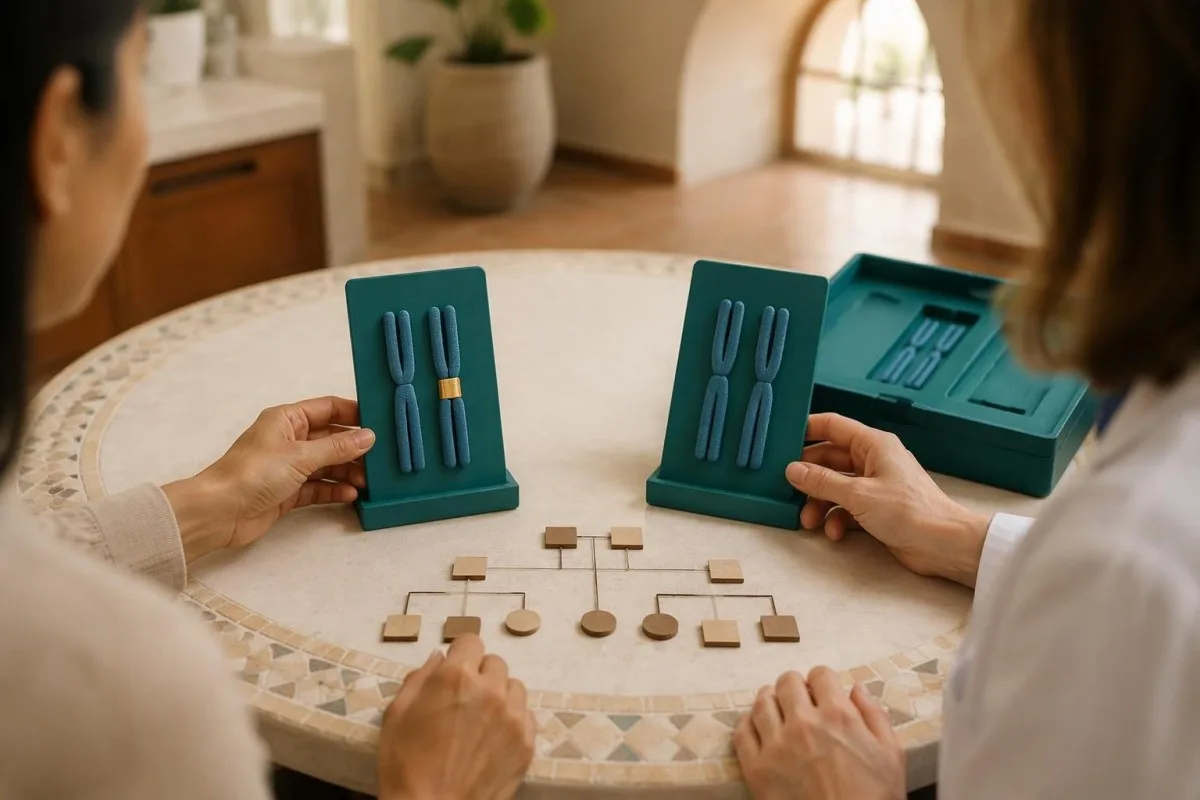
Suppose a hypothetical mother has a confirmed pathogenic BRCA1 variant and her adult daughter’s targeted test excludes that exact variant. Before testing, the daughter generally had a вероятност за унаследяване от 50%; afterward, she is not considered a carrier of that maternal finding and cannot pass that uncarried variant to her children.
A negative result becomes less definitive if nobody knows the affected relative’s exact finding. Bring a copy of the original family report rather than a verbal account of “BRCA positive”; a gene name alone cannot distinguish a pathogenic variant from a VUS or identify which change the laboratory should test.
An independently concerning paternal history can remain relevant despite a maternal true negative. For example, 2 close paternal relatives with early breast cancer may warrant separate risk assessment, because excluding one maternal variant does not explain another branch of the pedigree.
The logic of matching a relative’s exact finding also appears in family-based Alport genetic testing, although the genes and inheritance patterns differ. Ask for a written statement identifying which familial variant was excluded and what remaining screening recommendation follows from your own history.
Защо отрицателният резултат за BRCA може да е неинформативен?
Един неинформативен отрицателен резултат means no actionable BRCA finding was detected, but testing has not explained a suspicious personal or family cancer history. The result may reflect another gene, a technical limitation or a familial risk pattern that cannot currently be assigned to one detectable variant.
Testing an affected relative first usually provides more information than testing an unaffected relative. A hypothetical unaffected 35-year-old’s negative panel does not prove that her mother’s ovarian cancer lacked an inherited cause; testing the mother, when possible, can establish whether there is a familial finding to exclude.
A broader panel may consider genes such as PALB2, ATM, CHEK2, RAD51C, RAD51D and BRIP1, depending on the cancer pattern. These genes do not share identical cancer risks or prevention recommendations, so “panel positive” still requires gene-specific interpretation rather than applying the BRCA pathway to every result.
Older tests or limited consumer tests may assess only selected variants, whereas comprehensive clinical testing can include sequencing and deletion/duplication analysis. Our explanation of hidden carrier-screening limitations illustrates why a reassuring-looking result can still depend on methodology, although SMA uses a different genetic model.
Kantesti AI does not establish the completeness of a genetic assay or certify that a family’s inherited risk has been excluded. If a hypothetical family has 3 related cancers despite negative testing, clinical genetics can decide whether updated testing, another affected relative or a formal family-history risk model would answer the unresolved question.
Означава ли откриването на BRCA в тумор, че вариантът е наследен?
A BRCA variant found in tumor tissue is not automatically inherited. Tumor testing can detect acquired changes confined to cancer cells; germline testing examines a suitable non-tumor specimen to determine whether the finding is constitutional and relevant to relatives.
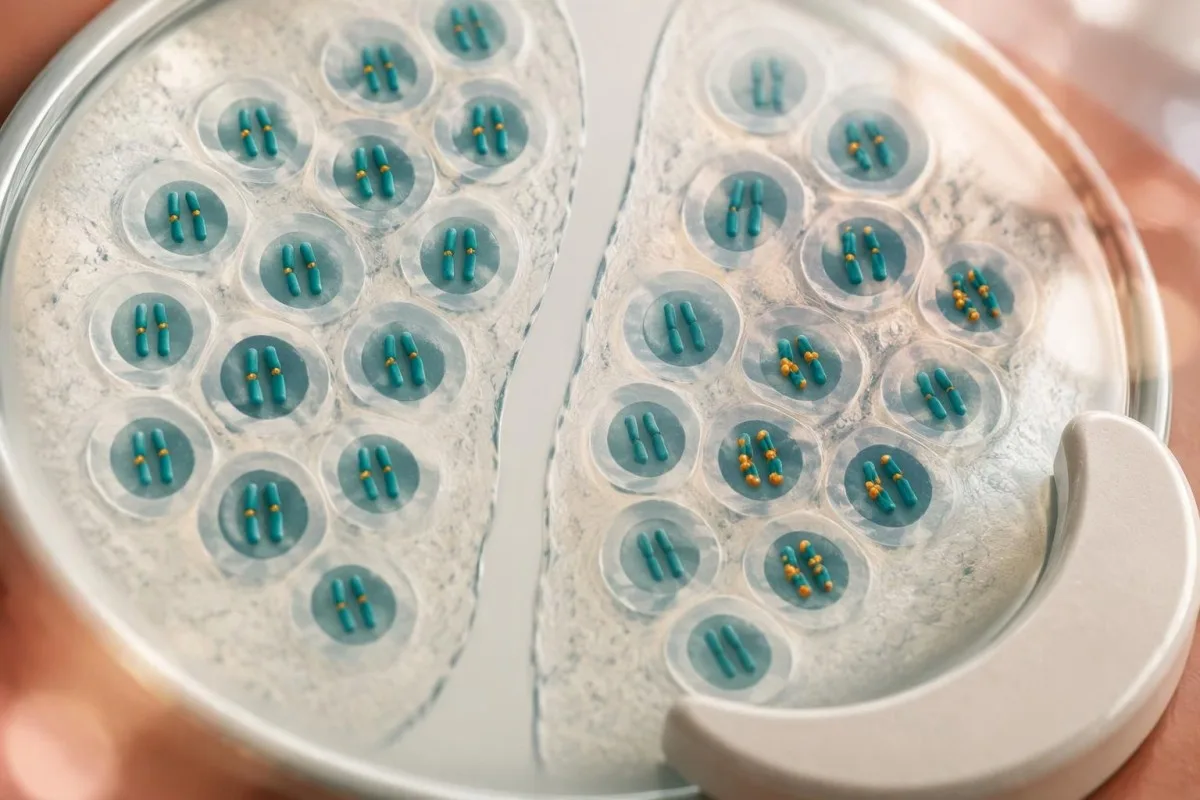
A tumor report may show a variant allele fraction near 50%, but that number does not prove germline origin. Tumor purity, copy-number changes and loss of the other gene copy can all shift the fraction; a percentage on a tumor report cannot replace a properly selected germline test.
Some oncology reports describe homologous recombination deficiency, or HRD, rather than a specific inherited variant. HRD can arise through more than one mechanism, and an HRD-positive result does not establish that a person or their children carry a pathogenic BRCA1 or BRCA2 variant.
After an allogeneic stem-cell transplant, a blood-derived DNA sample may reflect the donor, and saliva can also contain donor-derived cells. A hypothetical transplant recipient therefore needs the genetics laboratory to select an appropriate specimen—sometimes cultured skin fibroblasts—rather than assuming that 2 easily obtained samples answer the inheritance question.
The distinction between acquired and inherited DNA changes also matters in UBA1-related VEXAS testing, although VEXAS is a different condition. For a tumor BRCA finding, ask whether germline confirmation has been completed, is pending or was never requested.
Кога генетичното консултиране е най-полезно?
Genetic counseling helps before testing and whenever a result could change screening, treatment or family testing. It is especially useful for pathogenic findings, unresolved VUS, limited negative tests and family patterns involving young diagnoses, ovarian cancer, male breast cancer or multiple related cancers.

A practical pedigree usually covers 3 поколения and records cancer type, age at diagnosis, biological relationships and both maternal and paternal branches. “Abdominal cancer” is less useful than a confirmed primary site; ovarian, pancreatic and metastatic cancers can otherwise be misremembered as the same diagnosis.
Small families, early deaths and few female relatives can hide hereditary breast-and-ovarian cancer patterns. A hypothetical father with 2 sons and no sisters can carry and transmit a BRCA variant even when the family has no obvious breast cancer cluster; paternal inheritance deserves the same attention as maternal inheritance.
Кантести е един Платформа за кръвни изследвания тълкуване с AI, not a genetic counseling service. Our guidance on age-appropriate family testing separates routine laboratory needs from predictive BRCA testing, which is generally deferred in children under 18 because management usually begins in adulthood.
Before an appointment, gather the actual family report, pathology details if available and your previous test methods. Use separate consent for each relative’s records; our discussion of family health consent explains why a shared family history does not give one person automatic permission to access everyone’s medical information.
Какво проследяване се прави след патогенен резултат за BRCA?
A germline pathogenic BRCA result warrants a personalized prevention plan, not automatic surgery. Options include enhanced breast screening, discussion of risk-reducing procedures and assessment of other gene-associated cancers; age, reproductive plans, previous cancer and local guidance determine the timing.

Many high-risk pathways use annual breast MRI beginning around ages 25–30, with mammography commonly added around age 30, but national recommendations differ. The reason for combining methods is that each detects some findings the other can miss; more imaging is not simply a substitute for understanding age-specific benefit and false-positive risk.
NICE guideline NG241 lists risk-reducing removal of ovaries and fallopian tubes no earlier than age 35 for BRCA1 and 40 for BRCA2, with individualized assessment (NICE, 2024). Common clinical discussions use windows of approximately 35–40 and 40–45 years, respectively, after childbearing; these are planning ranges, not instructions for every carrier.
Removing only the fallopian tubes while delaying ovary removal has not been established as equivalent protection and remains a trial-based strategy in NICE guidance. Surgical menopause can affect symptoms, cardiovascular health and bones; our ръководство за хормоналното здраве на жените explains why prevention planning includes consequences beyond cancer risk.
Hormone treatment after premenopausal risk-reducing surgery may be considered until the usual menopause age, approximately 51, but previous breast cancer and other contraindications change that discussion. Bone-density assessment and evaluation of secondary bone-loss causes are distinct tasks; our guide to bone health laboratory assessment explains what routine tests can and cannot answer.
Какво означава резултатът за BRCA за роднините и децата?
Each child of a germline BRCA pathogenic-variant carrier usually has a 50% chance of inheriting the variant, regardless of sex. Adult relatives can consider targeted testing for the established family finding; inheriting susceptibility does not mean inheriting an existing cancer.
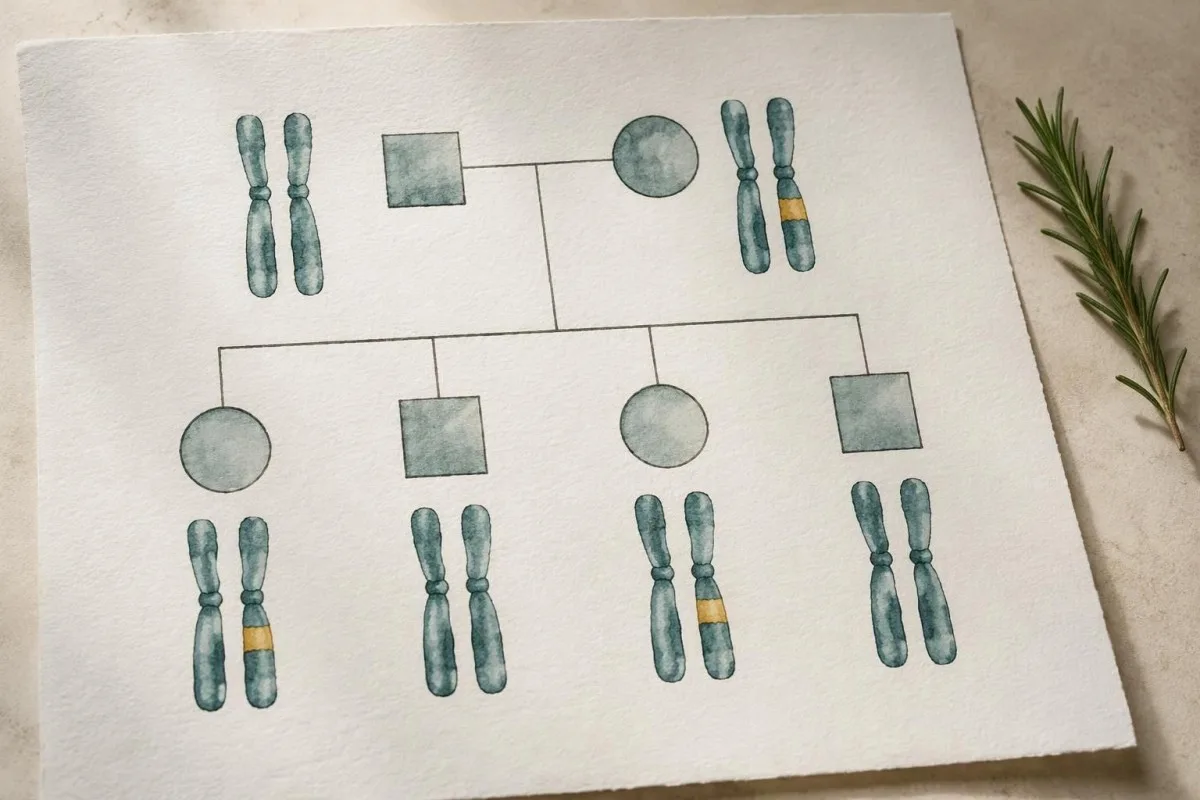
Four children do not imply that exactly 2 will inherit a parent’s BRCA variant. Each pregnancy is an independent event, so all, none or any number in between can inherit it; the 50% figure describes probability rather than a guaranteed family distribution.
A carrier’s siblings often have a 50% шанс of sharing the variant when a parent carries it, but that estimate should not be applied without checking the pedigree. Identifying which parent carries the finding helps determine which cousins, aunts and uncles should receive an invitation to discuss testing.
Reproductive options can include natural conception, prenatal diagnosis or IVF with preimplantation genetic testing for a known familial variant. These are preference-sensitive choices, not obligations; our explanation of reproductive genetic result counseling shows why gene-specific inheritance matters, although FMR1 repeat expansion behaves differently from BRCA inheritance.
A rare additional question arises when both partners carry pathogenic variants in мутация BRCA2: each pregnancy has a 25% chance of inheriting pathogenic variants in both copies, which can cause a Fanconi anemia phenotype. Partner testing is not automatically required for every BRCA carrier, but ancestry, relatedness and reproductive planning can justify specialist assessment.
Могат ли симптомите или туморните маркери да потвърдят рак, свързан с BRCA?
Neither a BRCA result nor a tumor-marker concentration confirms that cancer is present. New symptoms need their own assessment, and a negative genetic result does not make them harmless; examination, imaging and sometimes tissue assessment answer a different question from inherited susceptibility testing.
CA-125 can rise in benign conditions and can remain normal in ovarian cancer, particularly earlier disease. Routine CA-125 and ultrasound screening have not demonstrated a mortality benefit sufficient to replace established risk-reduction discussions; our guide to CA-125 limits and symptoms explains why the usual 35 U/mL cutoff is not a cancer yes-or-no boundary.
CA 15-3 and CA 27-29 are not appropriate tests for deciding whether an unaffected BRCA carrier has developed breast cancer. A hypothetical carrier with a normal marker still needs assessment of a new breast lump; our explanation of CA 15-3 interpretation separates selected monitoring uses from screening.
Kantesti does not infer BRCA carrier status from routine laboratory markers. For example, a CA 19-9 result of 80 U/mL can have non-cancer explanations and cannot establish pancreatic cancer or inherited BRCA2 risk; our guide to CA 19-9 limitations explains the need for clinical and imaging context.
Persistent bloating, early satiety, unexplained weight loss, a new breast change or unexplained jaundice deserve timely medical review regardless of genetic classification. A hypothetical person with 3 weeks of new persistent symptoms should not wait for VUS reclassification or a routine genetics appointment before seeking a separate assessment.
Използвайте обясненията на ИИ, без да заменяте генетичното консултиране
AI explanations can support understanding, but they cannot independently classify a BRCA variant or authorize preventive surgery. A safe workflow preserves 3 essentials: the original laboratory report, specialist interpretation and a written follow-up plan that distinguishes inherited risk from evaluation of any current symptoms.

Кантести е един Платформа за интерпретация на биомаркери с AI that explains routine laboratory findings, with interpretation generally available in about 60 seconds. That turnaround is not a timetable for genetic counseling, and our информация за клиничната методология should not be read as validation of independent BRCA classification or hereditary cancer risk calculation.
Genetic reports can reveal information relevant to more than 1 човек, including biological relatives who have not chosen testing. Read our практики за поверителност и обработване на данни before sharing sensitive documents, and avoid uploading another relative’s identifiable report without their permission.
The 2 research publications listed below concern our global routine-test report and RDW educational material; they are not BRCA cancer-risk studies, clinical prevention guidelines or evidence supporting surgery. The medical recommendations in this article instead draw on the ACMG/AMP classification standards, the prospective JAMA risk study and NICE familial ovarian cancer guidance.
Before acting, ask your genetics team to document whether the result is germline, which exact variant is actionable and whether a negative is true or uninformative. Our принципи за отговорен ИИ support keeping those clinical decisions with qualified professionals rather than treating an automated explanation as another laboratory classification.
Често задавани въпроси
Положителният резултат от тест за BRCA1 или BRCA2 означава ли, че имам рак?
Положителният тест за герминативна мутация в BRCA1 или BRCA2 установява патогенен или вероятно патогенен наследствен вариант; той не диагностицира рак. В проспективното проучване на Kuchenbaecker et al. в JAMA оцененият риск от рак на гърдата до 80-годишна възраст е 72% за BRCA1 и 69% за BRCA2 при жените, носителки на патогенни варианти. Това са популационни оценки, а не вероятността ракът да е налице в момента. Диагностицирането на активен рак изисква отделна клинична оценка.
Трябва ли да се подложа на профилактична операция заради вариант с неясно клинично значение в гена BRCA?
Вариант на BRCA с неясно клинично значение не бива сам по себе си да определя решението за профилактична операция. Рамката на ACMG/AMP включва VUS сред 5-те класификации, основани на доказателства, и гласи, че вариантите с неясно значение не бива да се използват при вземането на клинични решения. Личната или семейната анамнеза може сама по себе си да е основание за медицински грижи при повишен риск, но това решение не бива да изхожда от предположението, че VUS е патогенен. Специалист по генетика може да обясни кои доказателства действително подкрепят предложената процедура.
Каква е разликата между истински отрицателен и неинформативен отрицателен резултат за BRCA?
Истинният отрицателен резултат изключва конкретния патогенен или вероятно патогенен вариант на BRCA, вече установен при биологичен роднина. При дете на носител той може да разреши първоначално изчислената вероятност от 50% за унаследяване на този вариант в семейството. Неинформативният отрицателен резултат не открива клинично значим вариант, без да установява защо в семейството са възникнали случаи на рак. Други клонове на семейството, допълнителни гени и ограниченията на теста може да останат от значение и при двата резултата.
Може ли BRCA вариант с неясно клинично значение да стане положителен по-късно?
Вариант с неясно клинично значение (VUS) в ген BRCA впоследствие може да бъде прекласифициран като патогенен или вероятно патогенен, но може да бъде прекласифициран и като вероятно доброкачествен или доброкачествен. При прекласификацията доказателствата се преразглеждат в рамките на същата система от 5 категории; това не означава, че ДНК на човека се е променила. Няма универсален срок или гарантирана посока на прекласификация за отделен вариант. Попитайте първоначалната лаборатория или генетичната служба как се обработват коригираните доклади и повторният контакт.
Мога ли да наследя вариант на BRCA от баща си?
Патогенен вариант на BRCA1 или BRCA2 може да бъде наследен от всеки от двамата биологични родители. Всяко дете на носител на зародишна мутация обикновено има 50% вероятност да наследи този вариант, независимо дали носителят е майката или бащата. В семейството по бащина линия може да има малко роднини от женски пол и почти да липсват данни за рак на гърдата или яйчниците, въпреки че се носи вариант. Затова при генетичното консултиране трябва да се вземат предвид и двете родословни линии.
Означава ли откритата в тумора ми мутация в BRCA, че децата ми са изложени на риск?
Откриването на мутация в BRCA в туморната тъкан не доказва, че тя е наследствена. Дори вариантният алелен дял в тумора да е близо до 50%, това не може надеждно да докаже герминативен произход, тъй като туморната чистота и промените в броя на копията влияят върху този процент. За да се установи наследствен характер, е необходимо герминативно изследване с подходяща проба. Обичайната вероятност за предаване от 50% важи само когато родителят носи герминативен вариант.
Трябва ли всяка година да повтарям отрицателен тест за BRCA?
Обикновено не е необходимо ежегодно да се повтаря изследването на BRCA ДНК, тъй като наследственият вариант не се появява просто с напредването на възрастта. Отрицателният резултат може да се нуждае от преглед, ако първоначалният тест е бил с ограничен обхват, установен е нов семеен вариант или друг роднина развие свързан с него рак. Например изследването само за 3 избрани варианта не е равностойно на цялостно секвениране на BRCA1/BRCA2 плюс анализ за делеции/дупликации. Попитайте генетична служба дали повторното тълкуване, целевото изследване на роднини или друг генетичен панел биха предоставили допълнителна информация.
Получете обяснение на резултатите от кръвните си изследвания
Качете лабораторния си доклад и AI на Kantesti ще обясни всеки биомаркер на разбираем език за секунди. Използва се от над 2 милиона души по света.
Референции
- Klein, T., Mitchell, S., & Weber, H. (2026). AI анализатор на кръвни изследвания: 2,5M изследвания анализирани | Global Health Report 2026. Медицински изследвания с Kantesti AI. ДОИ
- Klein, T., Mitchell, S., & Weber, H. (2026). Кръвен тест RDW: Пълно ръководство за RDW-CV, MCV и MCHC. Медицински изследвания с Kantesti AI. ДОИ
- Richards S et al. (2015). Стандарти и насоки за интерпретация на варианти в последователността: съвместна консенсусна препоръка на Американския колеж по медицинска генетика и геномика и Асоциацията за молекулярна патология. Genetics in Medicine. ДОИ PubMed
- Kuchenbaecker KB et al. (2017). Risks of Breast, Ovarian, and Contralateral Breast Cancer for BRCA1 and BRCA2 Mutation Carriers. JAMA. ДОИ PubMed
- National Institute for Health and Care Excellence (2024). Ovarian cancer: identifying and managing familial and genetic risk. NICE guideline NG241.
- 2 милиона+Анализирани тестове
- 127+Държави
- 100+Езици
За медицинския екип


Сигнали за доверие E-E-A-T
Опит
Медицински преглед, воден от лекар, на работните процеси за интерпретация на лабораторни резултати.
Експертиза
Фокус в лабораторната медицина върху това как се държат биомаркерите в клиничен контекст.
Авторитетност
Медицинска рецензия от д-р Thomas Klein, с принос от д-р Sarah Mitchell и проф. д-р Hans Weber.
Надеждност
Интерпретация, основана на доказателства, с ясни последващи стъпки за намаляване на тревогата.






Медицински отказ от отговорност
Тази статия е само с образователна цел и не представлява медицински съвет. Винаги се консултирайте с квалифициран медицински специалист за решения относно диагностика и лечение.
Публикувано · Свържете се с редакционния екип
Издава се от Kantesti Ltd, регистрирана в Англия и Уелс, дружество №. 17090423, Лондон, Обединено кралство.
