
Patogena varijanta BRCA1 ili BRCA2 povećava nasljedni rizik od raka; ne dijagnosticira rak. Varijanta nejasnog značenja ne bi trebala biti razlog za preventivnu operaciju. Negativan rezultat pravi je negativan rezultat samo kada isključuje poznatu obiteljsku varijantu — u suprotnom nasljedni rizik može ostati nerazjašnjen.

Ključne napomene
- Positive result znači da je utvrđena patogena ili vjerojatno patogena varijanta; nasljedna sklonost nije dijagnoza raka.
- Pet klasifikacija opisuje genetske varijante: patogene, vjerojatno patogene, nejasnog značenja, vjerojatno benigne i benigne.
- Rizik povezan s BRCA1 u prospektivnom istraživanju JAMA dosegnuo je približno 72% za rak dojke i 44% za rak jajnika do 80. godine u žena koje nose patogene varijante.
- Rizik povezan s BRCA2 u istom istraživanju dosegnuo je približno 69% za rak dojke i 17% za rak jajnika do 80. godine; to su procjene za skupinu, a ne osobne prognoze.
- Postupanje kod varijante nejasnog značenja treba slijediti osobnu i obiteljsku anamnezu, a ne neizvjesnu varijantu; sama VUS ne opravdava preventivni kirurški zahvat.
- Istinski negativan nalaz znači da laboratorij nije pronašao specifičnu patogenu varijantu već utvrđenu u vašoj obitelji.
- Negativan nalaz koji ne pruža informaciju znači da testiranje nije otkrilo objašnjenje za sumnju na nasljedni rizik; snažna obiteljska anamneza i dalje može opravdati dodatnu procjenu.
- Nasljeđivanje u obitelji obično daje svakom djetetu nositelja patogene zametne varijante BRCA1 ili BRCA2 50-postotnu vjerojatnost nasljeđivanja te varijante.
- Genetsko savjetovanje pomaže povezati točnu varijantu, obuhvat testiranja, obje strane obitelji i odluke o probiru ili prevenciji ovisne o dobi.
Što rezultati genetskog testiranja BRCA zapravo znače?
Rezultati genetskog testiranja BRCA gena obično se svrstavaju u 3 praktične skupine: pozitivne, neizvjesne ili negativne. Pozitivan nasljedni nalaz ukazuje na podložnost raku, a varijanta nejasnog značaja ostaje nerazjašnjen, dok negativan nalaz treba sagledati u obiteljskom kontekstu prije nego što se može smatrati ohrabrujućim.

A zametni test BRCA gena ispituje DNA, obično iz laboratorijskog uzorka krvi ili sline, umjesto da mjeri koncentraciju proteina. Njegov rezultat ne može se tumačiti poput vrijednosti u ng/mL: klinički korisne informacije čine gen, točna varijanta, klasifikacija i opseg testiranja.
Većina ljudi ima 2 kopije gena BRCA1 i 2 kopije gena BRCA2, pri čemu se po jedna kopija svakog nasljeđuje od svakog biološkog roditelja. Štetna promjena u jednoj kopiji može povećati podložnost raku, no razvoju raka općenito pridonose i dodatne stanične promjene — nasljeđivanje nije odbrojavanje do bolesti.
Kod hipotetske osobe u dobi od 38 godina koja nema rak, patogeni nalaz BRCA2 može promijeniti rasprave o budućem probiru i prevenciji, a da pritom ne utvrđuje trenutačnu dijagnozu raka. Kod osobe koja se već liječi od raka, isti nasljedni nalaz može utjecati i na ispunjavanje uvjeta za liječenje te na procjenu budućih karcinoma.
Kantesti je Analizator krvnih testova s umjetnom inteligencijom za rutinsko laboratorijsko tumačenje, a ne kao zamjena za klinički genetički laboratorij. Informacije o našoj organizaciji pomažu razlikovati našu edukativnu ulogu od specijalističkog rada potrebnog za tumačenje nasljednog nalaza raka.
Koji su podaci u laboratorijskom nalazu BRCA važni?
Najkorisniji podaci u nalazu BRCA testa jesu gen, točna varijanta, klasifikacija, vrsta uzorka i metoda testiranja. Klinički laboratoriji obično primjenjuju 5 klasifikacija varijanti, a sama riječ “varijanta” ne govori je li nalaz štetan.

Okvir ACMG/AMP razvrstava patogene, vjerojatno patogene, neizvjesnog značaja, vjerojatno benigne i benigne nalaze (Richards i sur., 2015). Patogene i vjerojatno patogene varijante općenito upućuju na isti put kliničkog zbrinjavanja; razlika opisuje pouzdanost dokaza, a ne dvije različite razine rizika od raka.
Opisi varijanti mogu uključivati promjenu na razini DNA koja počinje s c. and a protein-level consequence beginning with p. These are coordinates, not severity scores; two reports may describe the same change differently because they use different transcripts or historical naming conventions.
Look for both sequence analysis i deletion/duplication analysis when evaluating a comprehensive BRCA1/BRCA2 test. Reading individual DNA changes and detecting missing or extra gene segments require complementary methods, so a report stating “sequencing negative” may not answer every relevant question.
A hypothetical report can contain 2 findings: a pathogenic BRCA1 variant and an unrelated BRCA2 VUS. Management follows the established pathogenic finding, not an average of the two classifications; our guide to categorical versus numerical results explains why laboratory result types require different reading strategies.
Značenje pozitivnog nalaza BRCA1: sklonost, a ne sigurnost
BRCA1 positive meaning depends on the classification: a germline pathogenic or likely pathogenic BRCA1 variant indicates inherited cancer susceptibility. In a prospective study, women carrying pathogenic BRCA1 variants had an estimated 72% breast cancer risk and 44% ovarian cancer risk by age 80.
Kuchenbaecker et al. reported those age-80 estimates in JAMA, with 95% confidence intervals of 65–79% for breast cancer i 36–53% for ovarian cancer (2017). The intervals describe uncertainty around population estimates; they do not mean an individual’s risk can be read directly from the laboratory report.
A hypothetical 30-year-old BRCA1 carrier should not interpret a 72% age-80 estimate as a 72% risk this year. Personal counseling separates near-term risk from longer-term risk and considers age, prior cancer, relatives’ diagnoses and any preventive procedures already completed.
BRCA1-associated breast cancers are more often triple-negative than breast cancers in the general population, but receptor status cannot be predicted from an inherited result alone. An existing cancer still requires its own pathological and receptor assessment; a genetic finding does not replace those separate tests.
One family can also have more than one inherited explanation for cancer, particularly when diagnoses cluster on both parental branches. For example, several colorectal and endometrial cancers may justify a separate assessment of Lynch syndrome results rather than assuming a BRCA1 finding explains every diagnosis.
Po čemu se rizik od raka povezan s mutacijom BRCA2 razlikuje?
BRCA2 mutation cancer risk includes breast and ovarian cancer susceptibility, with particular relevance to male breast, prostate and pancreatic cancer assessment. In the same prospective JAMA study, women carrying pathogenic BRCA2 variants had estimated risks of 69% for breast cancer and 17% for ovarian cancer by age 80.
The BRCA2 estimates had 95% confidence intervals of 61–77% for breast cancer i 11–25% for ovarian cancer (Kuchenbaecker et al., 2017). BRCA2’s lower average ovarian cancer risk compared with BRCA1 helps explain why preventive ovary-and-tube removal is commonly discussed later for BRCA2 carriers.
A previous breast cancer creates a different risk question: the chance of another cancer in the opposite breast. Kuchenbaecker et al. estimated 20-year contralateral breast cancer risks of 26% for BRCA2 and 40% for BRCA1; those figures are not the same as first-cancer risk and should not be substituted for it.
Prostate screening discussions may begin around age 40 in men with pathogenic BRCA2 variants, depending on the applicable clinical pathway. PSA is a screening measurement rather than a symptom generator; our explanation of what elevated PSA means separates the laboratory number from a diagnosis.
Pancreatic surveillance is another area where eligibility criteria differ, including the importance assigned to family history. A hypothetical 52-year-old BRCA2 carrier with an affected first-degree relative needs a specialist discussion about MRI-based imaging or endoscopic ultrasound—not routine CA 19-9 testing as a substitute.
Što znači varijanta BRCA nejasnog značenja?
A BRCA variant of uncertain significance, or VUS, means available evidence cannot establish whether a DNA change increases cancer risk. A VUS is not a positive result, and it should not independently determine preventive mastectomy or removal of the ovaries and fallopian tubes.

The ACMG/AMP standards state that a VUS ne smije upotrebljavati pri donošenju kliničkih odluka (Richards et al., 2015). Among the 5 classification categories, uncertainty is an evidence status—not a diagnosis, not a halfway-positive result and not a 50% probability that the variant causes cancer.
For example, a hypothetical 42-year-old with a BRCA1 VUS and no significant family history should not be offered risk-reducing surgery because of that VUS alone. Another 42-year-old with the same VUS and a substantial family history may qualify for intensified surveillance because of the history, not because the uncertain variant became actionable.
Ancestry can affect how often laboratories encounter uncertainty because population databases do not represent every group equally. Two people with the same cancer history can therefore receive different levels of interpretive certainty; this reflects evidence gaps and does not establish a biological difference in the seriousness of their results.
At Kantesti, we separate finding a genetic change from proving that the change warrants action. The same distinction helps readers understand common MTHFR variant findings, although MTHFR results and BRCA-associated cancer susceptibility have very different clinical implications.
Može li se klasifikacija varijante BRCA nejasnog značenja naknadno promijeniti?
A BRCA VUS can be reclassified when new evidence clarifies its clinical significance. Many reclassified VUS move toward benign categories, but neither the direction nor the timing can be promised for an individual finding; reinterpretation usually reviews existing DNA data rather than requiring another sample.

Useful new evidence can come from 3 broad sources: population frequency, carefully validated functional work and observations of the variant in families. A computer prediction alone is usually insufficient; expert curation weighs whether the evidence actually addresses the disease mechanism and meets classification standards.
Laboratories can disagree because their evidence differs or their interpretations were issued at different times. Record 2 separate dates when available—the original report date and the most recent classification date—and ask whether a specialist expert-panel assessment exists, rather than counting database entries as votes.
Routine testing of unaffected relatives for a VUS usually does not guide care, although a genetics team may arrange selected family studies to help classification. A hypothetical family with 3 affected relatives should not independently order VUS testing for everyone and interpret who carries it as proof of causation.
Ask which laboratory manages reinterpretation, how amended reports reach you and whether your contact details remain current; there is no universal recontact interval. Our discussion of inherited TTR variant interpretation illustrates the broader need to connect exact genetic findings with disease-specific evidence.
Kada je negativan nalaz BRCA pravi negativan rezultat?
A true negative BRCA result means testing did not find the specific pathogenic or likely pathogenic variant already identified in a biological relative. It removes the inherited risk attributable to that familial variant, but it does not eliminate ordinary cancer risk or unrelated risks from the other family branch.
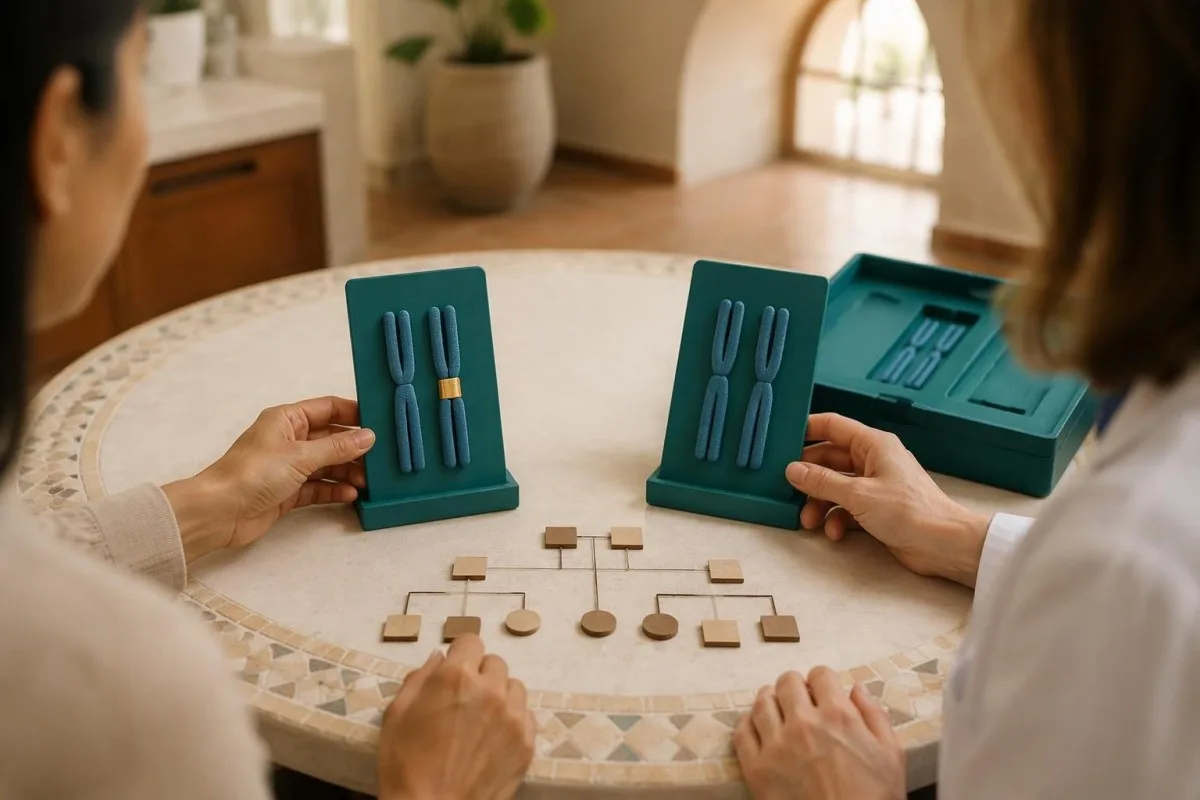
Suppose a hypothetical mother has a confirmed pathogenic BRCA1 variant and her adult daughter’s targeted test excludes that exact variant. Before testing, the daughter generally had a 50%; afterward, she is not considered a carrier of that maternal finding and cannot pass that uncarried variant to her children.
A negative result becomes less definitive if nobody knows the affected relative’s exact finding. Bring a copy of the original family report rather than a verbal account of “BRCA positive”; a gene name alone cannot distinguish a pathogenic variant from a VUS or identify which change the laboratory should test.
An independently concerning paternal history can remain relevant despite a maternal true negative. For example, 2 close paternal relatives with early breast cancer may warrant separate risk assessment, because excluding one maternal variant does not explain another branch of the pedigree.
The logic of matching a relative’s exact finding also appears in family-based Alport genetic testing, although the genes and inheritance patterns differ. Ask for a written statement identifying which familial variant was excluded and what remaining screening recommendation follows from your own history.
Zašto negativan nalaz BRCA može biti neinformativan?
Jedan neinformativan negativan rezultat means no actionable BRCA finding was detected, but testing has not explained a suspicious personal or family cancer history. The result may reflect another gene, a technical limitation or a familial risk pattern that cannot currently be assigned to one detectable variant.
Testing an affected relative first usually provides more information than testing an unaffected relative. A hypothetical unaffected 35-year-old’s negative panel does not prove that her mother’s ovarian cancer lacked an inherited cause; testing the mother, when possible, can establish whether there is a familial finding to exclude.
A broader panel may consider genes such as PALB2, ATM, CHEK2, RAD51C, RAD51D and BRIP1, depending on the cancer pattern. These genes do not share identical cancer risks or prevention recommendations, so “panel positive” still requires gene-specific interpretation rather than applying the BRCA pathway to every result.
Older tests or limited consumer tests may assess only selected variants, whereas comprehensive clinical testing can include sequencing and deletion/duplication analysis. Our explanation of hidden carrier-screening limitations illustrates why a reassuring-looking result can still depend on methodology, although SMA uses a different genetic model.
Kantesti AI does not establish the completeness of a genetic assay or certify that a family’s inherited risk has been excluded. If a hypothetical family has 3 related cancers despite negative testing, clinical genetics can decide whether updated testing, another affected relative or a formal family-history risk model would answer the unresolved question.
Znači li nalaz BRCA u tumoru da je varijanta naslijeđena?
A BRCA variant found in tumor tissue is not automatically inherited. Tumor testing can detect acquired changes confined to cancer cells; germline testing examines a suitable non-tumor specimen to determine whether the finding is constitutional and relevant to relatives.
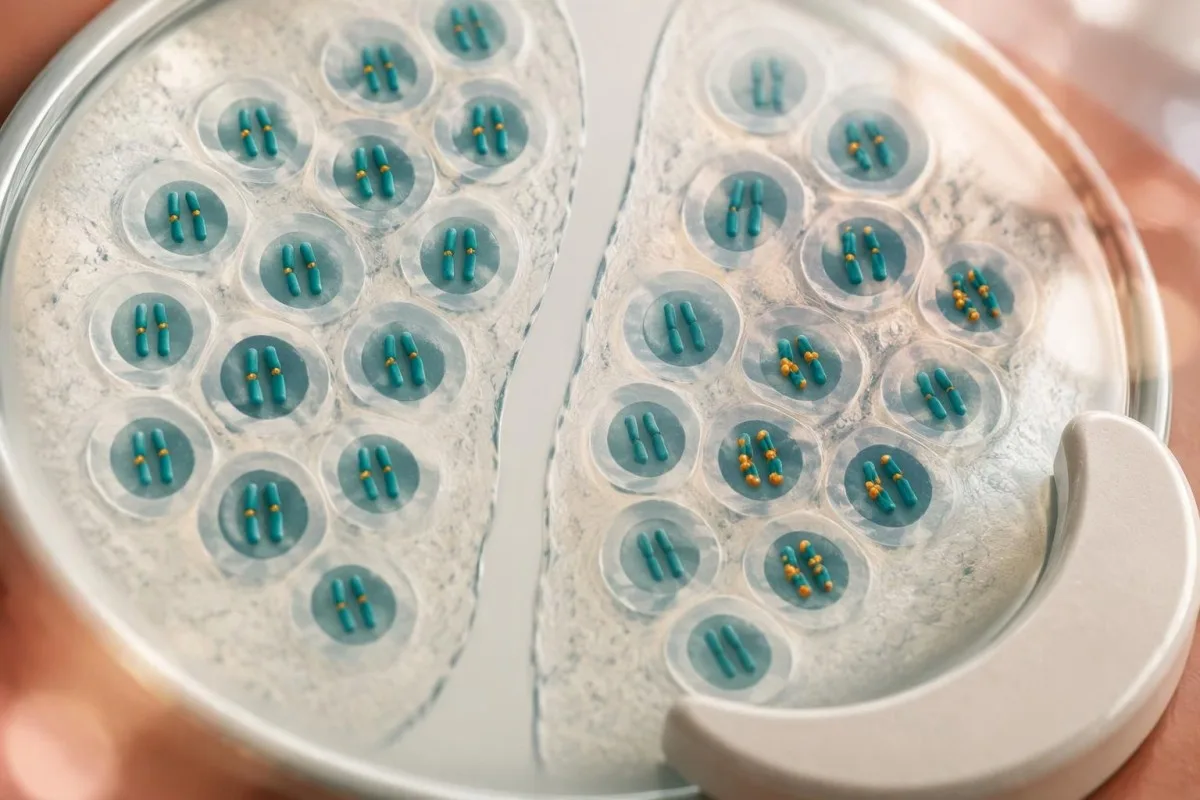
A tumor report may show a variant allele fraction near 50%, but that number does not prove germline origin. Tumor purity, copy-number changes and loss of the other gene copy can all shift the fraction; a percentage on a tumor report cannot replace a properly selected germline test.
Some oncology reports describe homologous recombination deficiency, or HRD, rather than a specific inherited variant. HRD can arise through more than one mechanism, and an HRD-positive result does not establish that a person or their children carry a pathogenic BRCA1 or BRCA2 variant.
After an allogeneic stem-cell transplant, a blood-derived DNA sample may reflect the donor, and saliva can also contain donor-derived cells. A hypothetical transplant recipient therefore needs the genetics laboratory to select an appropriate specimen—sometimes cultured skin fibroblasts—rather than assuming that 2 easily obtained samples answer the inheritance question.
The distinction between acquired and inherited DNA changes also matters in UBA1-related VEXAS testing, although VEXAS is a different condition. For a tumor BRCA finding, ask whether germline confirmation has been completed, is pending or was never requested.
Kada genetsko savjetovanje najviše pomaže?
Genetic counseling helps before testing and whenever a result could change screening, treatment or family testing. It is especially useful for pathogenic findings, unresolved VUS, limited negative tests and family patterns involving young diagnoses, ovarian cancer, male breast cancer or multiple related cancers.

A practical pedigree usually covers 3 generacije and records cancer type, age at diagnosis, biological relationships and both maternal and paternal branches. “Abdominal cancer” is less useful than a confirmed primary site; ovarian, pancreatic and metastatic cancers can otherwise be misremembered as the same diagnosis.
Small families, early deaths and few female relatives can hide hereditary breast-and-ovarian cancer patterns. A hypothetical father with 2 sons and no sisters can carry and transmit a BRCA variant even when the family has no obvious breast cancer cluster; paternal inheritance deserves the same attention as maternal inheritance.
Kantesti je Platforma za tumačenje krvnih nalaza pomoću AI-a, not a genetic counseling service. Our guidance on age-appropriate family testing separates routine laboratory needs from predictive BRCA testing, which is generally deferred in children under 18 because management usually begins in adulthood.
Before an appointment, gather the actual family report, pathology details if available and your previous test methods. Use separate consent for each relative’s records; our discussion of family health consent explains why a shared family history does not give one person automatic permission to access everyone’s medical information.
Koje praćenje slijedi nakon patogenog nalaza BRCA?
A germline pathogenic BRCA result warrants a personalized prevention plan, not automatic surgery. Options include enhanced breast screening, discussion of risk-reducing procedures and assessment of other gene-associated cancers; age, reproductive plans, previous cancer and local guidance determine the timing.

Many high-risk pathways use annual breast MRI beginning around ages 25–30, with mammography commonly added around age 30, but national recommendations differ. The reason for combining methods is that each detects some findings the other can miss; more imaging is not simply a substitute for understanding age-specific benefit and false-positive risk.
NICE guideline NG241 lists risk-reducing removal of ovaries and fallopian tubes no earlier than age 35 for BRCA1 and 40 for BRCA2, with individualized assessment (NICE, 2024). Common clinical discussions use windows of approximately 35–40 and 40–45 years, respectively, after childbearing; these are planning ranges, not instructions for every carrier.
Removing only the fallopian tubes while delaying ovary removal has not been established as equivalent protection and remains a trial-based strategy in NICE guidance. Surgical menopause can affect symptoms, cardiovascular health and bones; our vodič za hormonsko zdravlje žena explains why prevention planning includes consequences beyond cancer risk.
Hormone treatment after premenopausal risk-reducing surgery may be considered until the usual menopause age, approximately 51, but previous breast cancer and other contraindications change that discussion. Bone-density assessment and evaluation of secondary bone-loss causes are distinct tasks; our guide to bone health laboratory assessment explains what routine tests can and cannot answer.
Što nalaz BRCA znači za rodbinu i djecu?
Each child of a germline BRCA pathogenic-variant carrier usually has a 50% chance of inheriting the variant, regardless of sex. Adult relatives can consider targeted testing for the established family finding; inheriting susceptibility does not mean inheriting an existing cancer.
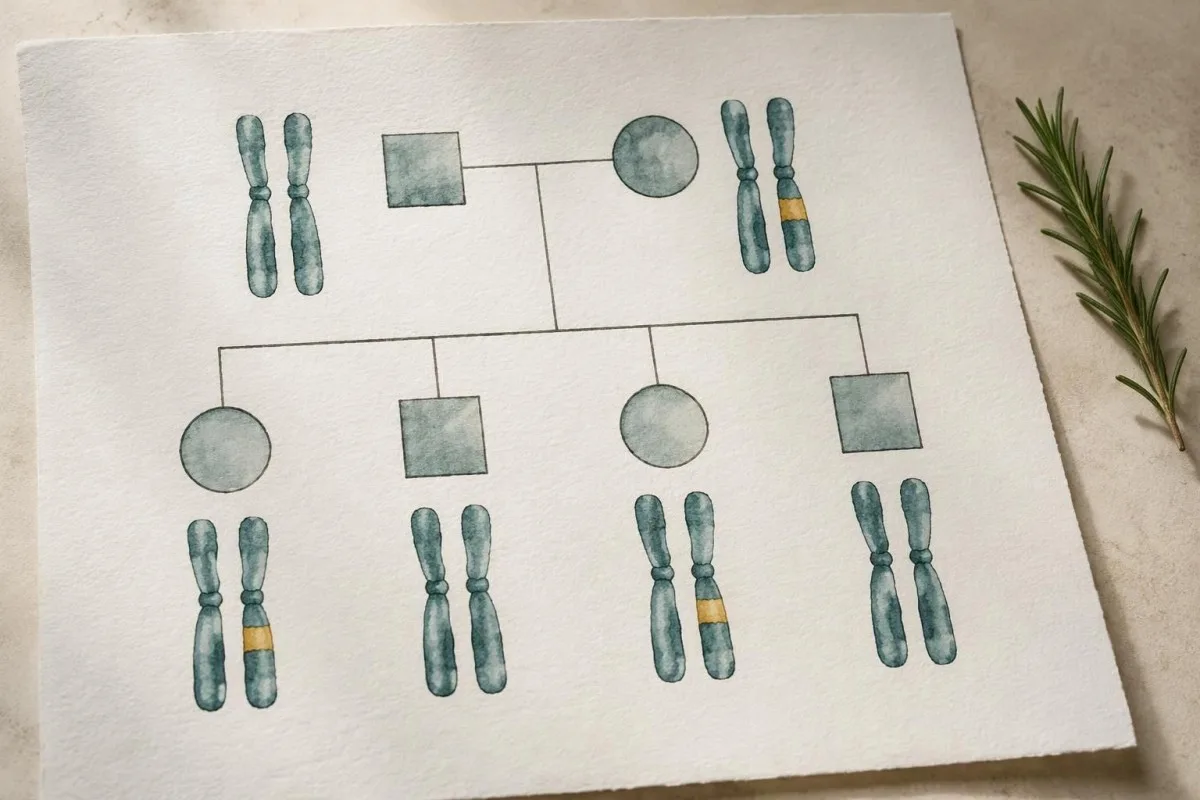
Four children do not imply that exactly 2 will inherit a parent’s BRCA variant. Each pregnancy is an independent event, so all, none or any number in between can inherit it; the 50% figure describes probability rather than a guaranteed family distribution.
A carrier’s siblings often have a 50% vjerojatnost of sharing the variant when a parent carries it, but that estimate should not be applied without checking the pedigree. Identifying which parent carries the finding helps determine which cousins, aunts and uncles should receive an invitation to discuss testing.
Reproductive options can include natural conception, prenatal diagnosis or IVF with preimplantation genetic testing for a known familial variant. These are preference-sensitive choices, not obligations; our explanation of reproductive genetic result counseling shows why gene-specific inheritance matters, although FMR1 repeat expansion behaves differently from BRCA inheritance.
A rare additional question arises when both partners carry pathogenic variants in mutacijom BRCA2: each pregnancy has a 25% chance of inheriting pathogenic variants in both copies, which can cause a Fanconi anemia phenotype. Partner testing is not automatically required for every BRCA carrier, but ancestry, relatedness and reproductive planning can justify specialist assessment.
Mogu li simptomi ili tumorski biljezi potvrditi rak povezan s BRCA?
Neither a BRCA result nor a tumor-marker concentration confirms that cancer is present. New symptoms need their own assessment, and a negative genetic result does not make them harmless; examination, imaging and sometimes tissue assessment answer a different question from inherited susceptibility testing.

CA-125 can rise in benign conditions and can remain normal in ovarian cancer, particularly earlier disease. Routine CA-125 and ultrasound screening have not demonstrated a mortality benefit sufficient to replace established risk-reduction discussions; our guide to CA-125 limits and symptoms explains why the usual 35 U/mL cutoff is not a cancer yes-or-no boundary.
CA 15-3 and CA 27-29 are not appropriate tests for deciding whether an unaffected BRCA carrier has developed breast cancer. A hypothetical carrier with a normal marker still needs assessment of a new breast lump; our explanation of CA 15-3 interpretation separates selected monitoring uses from screening.
Kantesti does not infer BRCA carrier status from routine laboratory markers. For example, a CA 19-9 result of 80 U/mL can have non-cancer explanations and cannot establish pancreatic cancer or inherited BRCA2 risk; our guide to CA 19-9 limitations explains the need for clinical and imaging context.
Persistent bloating, early satiety, unexplained weight loss, a new breast change or unexplained jaundice deserve timely medical review regardless of genetic classification. A hypothetical person with 3 weeks of new persistent symptoms should not wait for VUS reclassification or a routine genetics appointment before seeking a separate assessment.
Koristite objašnjenja umjetne inteligencije bez zamjene za genetsko savjetovanje
AI explanations can support understanding, but they cannot independently classify a BRCA variant or authorize preventive surgery. A safe workflow preserves 3 essentials: the original laboratory report, specialist interpretation and a written follow-up plan that distinguishes inherited risk from evaluation of any current symptoms.

Kantesti je platforma za tumačenje biomarkera pomoću AI-a that explains routine laboratory findings, with interpretation generally available in about 60 seconds. That turnaround is not a timetable for genetic counseling, and our informacije o kliničkoj metodologiji should not be read as validation of independent BRCA classification or hereditary cancer risk calculation.
Genetic reports can reveal information relevant to more than 1 osobe, including biological relatives who have not chosen testing. Read our postupci zaštite privatnosti i upravljanja podacima before sharing sensitive documents, and avoid uploading another relative’s identifiable report without their permission.
The 2 research publications listed below concern our global routine-test report and RDW educational material; they are not BRCA cancer-risk studies, clinical prevention guidelines or evidence supporting surgery. The medical recommendations in this article instead draw on the ACMG/AMP classification standards, the prospective JAMA risk study and NICE familial ovarian cancer guidance.
Before acting, ask your genetics team to document whether the result is germline, which exact variant is actionable and whether a negative is true or uninformative. Our načela odgovorne umjetne inteligencije support keeping those clinical decisions with qualified professionals rather than treating an automated explanation as another laboratory classification.
Često postavljana pitanja
Znači li pozitivan nalaz BRCA1 ili BRCA2 da imam rak?
Pozitivan test zametne linije BRCA1 ili BRCA2 utvrđuje patogenu ili vjerojatno patogenu nasljednu varijantu; ne postavlja dijagnozu raka. U prospektivnoj studiji koju su proveli Kuchenbaecker i suradnici, objavljenoj u časopisu JAMA, procijenjeni rizici od raka dojke do 80. godine života iznosili su 72% za BRCA1 i 69% za BRCA2 u žena koje nose patogene varijante. To su populacijske procjene, a ne vjerojatnost da je rak prisutan upravo sada. Za dijagnozu trenutačnog raka potrebna je zasebna klinička procjena.
Trebam li se podvrgnuti preventivnoj operaciji zbog varijante BRCA nepoznatog kliničkog značaja?
BRCA varijanta nejasnog značenja ne bi smjela sama po sebi biti razlog za preventivni kirurški zahvat. Klasifikacija ACMG/AMP svrstava VUS među 5 klasifikacija utemeljenih na dokazima i navodi da se varijante nejasnog značenja ne bi trebale koristiti u kliničkom odlučivanju. Osobna ili obiteljska anamneza može zasebno opravdati skrb za osobe s povišenim rizikom, ali ta odluka ne smije polaziti od pretpostavke da je VUS patogena. Stručnjak za genetiku može objasniti koji dokazi doista podupiru predloženi zahvat.
Koja je razlika između istinski negativnog i neinformativnog negativnog rezultata testiranja na BRCA mutacije?
Pravi negativan rezultat isključuje konkretnu patogenu ili vjerojatno patogenu varijantu gena BRCA koja je već utvrđena u biološkog srodnika. Za dijete nositelja takav rezultat može razriješiti početnu vjerojatnost nasljeđivanja od 50 % za tu obiteljsku gensku varijantu. Neinformativan negativan rezultat ne utvrđuje nijednu klinički značajnu varijantu, ali ni razlog pojave raka u obitelji. Druge grane obitelji, dodatni geni i ograničenja testiranja mogu ostati važni nakon bilo kojeg rezultata.
Može li BRCA VUS kasnije postati pozitivan?
BRCA varijanta nejasnog značaja (VUS) kasnije se može reklasificirati kao patogena ili vjerojatno patogena, ali može se reklasificirati i kao vjerojatno benigna ili benigna. Reklasifikacijom se dokazi ponovno procjenjuju u okviru istog sustava s 5 kategorija; to ne znači da se DNK osobe promijenila. Ne postoji univerzalan rok ni zajamčeni smjer reklasifikacije pojedine varijante. Upitajte izvorni laboratorij ili genetičku službu kako postupaju s izmijenjenim nalazima i ponovnim kontaktiranjem.
Mogu li naslijediti varijantu gena BRCA od oca?
Patogena varijanta gena BRCA1 ili BRCA2 može se naslijediti od bilo kojeg biološkog roditelja. Svako dijete nositelja zametne varijante obično ima 50-postotnu vjerojatnost nasljeđivanja te varijante, neovisno o tome je li nositelj majka ili otac. U očevoj obitelji s malo ženskih članica uočljiva povijest raka dojke ili jajnika može biti oskudna unatoč prisutnosti varijante. Genetsko savjetovanje stoga treba uzeti u obzir obje obiteljske grane.
Znači li BRCA mutacija pronađena u mom tumoru da su moja djeca u opasnosti?
Mutacija BRCA utvrđena u tumorskom tkivu ne dokazuje da je naslijeđena. Čak ni udio varijantnog alela u tumoru blizu 50 % ne može pouzdano dokazati da je riječ o mutaciji zametne linije jer na taj postotak utječu čistoća tumora i promjene broja kopija. Za utvrđivanje naslijeđenog statusa potrebno je testiranje zametne linije na odgovarajućem uzorku. Uobičajena vjerojatnost prijenosa od 50 % vrijedi samo kada roditelj nosi varijantu zametne linije.
Trebam li svake godine ponavljati negativan test na BRCA mutacije?
Godišnje ponavljanje testiranja BRCA DNA u pravilu nije potrebno jer se nasljedna varijanta ne pojavljuje samo zbog starenja. Negativan rezultat možda treba ponovno razmotriti ako je izvorna analiza bila ograničena, ako se utvrdi nova obiteljska varijanta ili ako drugi član obitelji oboli od relevantnog raka. Primjerice, testiranje samo 3 odabrane varijante nije isto što i sveobuhvatno sekvenciranje gena BRCA1/BRCA2 uz analizu delecija/duplikacija. Pitajte genetičku službu bi li reinterpretacija rezultata, ciljano testiranje članova obitelji ili drukčiji panel pružili dodatne informacije.
Saznajte kako čitati krvnu sliku
Prenesite svoj laboratorijski nalaz i AI alata Kantesti objasnit će svaki biomarker jednostavnim jezikom u nekoliko sekundi. Koristi ga više od 2 milijuna ljudi diljem svijeta.
Reference
- Klein, T., Mitchell, S., & Weber, H. (2026). AI analizator krvnih testova: analizirano 2,5M testova | Global Health Report 2026. Medicinsko istraživanje uz Kantesti AI. DOI
- Klein, T., Mitchell, S., & Weber, H. (2026). RDW u krvnoj slici: cjelovit vodič za RDW-CV, MCV i MCHC. Medicinsko istraživanje uz Kantesti AI. DOI
- Richards S i sur. (2015). Standardi i smjernice za tumačenje varijanti sekvenci: zajednička konsenzusna preporuka American College of Medical Genetics and Genomics i Association for Molecular Pathology. Genetics in Medicine. DOI PubMed
- Kuchenbaecker KB et al. (2017). Risks of Breast, Ovarian, and Contralateral Breast Cancer for BRCA1 and BRCA2 Mutation Carriers. JAMA. DOI PubMed
- National Institute for Health and Care Excellence (2024). Ovarian cancer: identifying and managing familial and genetic risk. NICE guideline NG241.
- 2 milijuna+Analizirani testovi
- 127+Zemlje
- 100+Jezici
O medicinskom timu


E-E-A-T signal(i) povjerenja
Iskustvo
Liječnički vođena klinička revizija radnih tokova tumačenja laboratorijskih nalaza.
Stručnost
Fokus laboratorijske medicine na to kako se biomarkeri ponašaju u kliničkom kontekstu.
Autoritativnost
Medicinski recenzirao dr. Thomas Klein, uz doprinose dr. Sarah Mitchell i prof. dr. Hansa Webera.
Pouzdanost
Tumačenje utemeljeno na dokazima, s jasnim putovima praćenja kako bi se smanjila uzbuna.






Medicinsko odricanje od odgovornosti
Ovaj je članak samo u obrazovne svrhe i ne predstavlja medicinski savjet. Za odluke o dijagnozi i liječenju uvijek se posavjetujte s kvalificiranim pružateljem zdravstvenih usluga.
Objavljeno · Obratite se uredničkom timu
Izdaje Kantesti Ltd, registrirana u Engleskoj i Walesu, broj tvrtke. 17090423, London, Ujedinjeno Kraljevstvo.
