Els símptomes de l’esquizofrènia poden incloure al·lucinacions, deliris, discurs desorganitzat, motivació reduïda i dificultats cognitives. Els canvis inicials, per si sols, no estableixen un diagnòstic d’esquizofrènia: ho fa l’avaluació clínica, i el perill immediat, la confusió greu o la incapacitat per cobrir les necessitats bàsiques requereixen ajuda urgent.

Conclusions principals
- Símptomes de l’esquizofrènia inclouen canvis en la percepció, les creences, la parla, la motivació i el pensament; 1 símptoma o un resultat anormal de laboratori no permeten establir el diagnòstic.
- Signes inicials com ara l’aïllament, dormir malament o un rendiment en declivi són inespecífics. Si et resulta útil, registra els canvis durant 7 dies, però no ajornis l’avaluació si apareixen experiències psicòtiques noves.
- Al·lucinacions són percepcions sense un estímul extern corresponent. Les experiències que només es produeixen en adormir-se o en despertar-se tenen un significat clínic diferent del de les veus persistents durant el dia.
- Símptomes negatius inclouen una expressió emocional, una parla, una motivació, un plaer i una participació social reduïts —5 dominis descrits habitualment, que no indiquen que algú sigui gandul.
- Moment del diagnòstic difereix: el DSM-5-TR generalment exigeix almenys 6 mesos d’alteració contínua, mentre que la CIM-11 exigeix símptomes característics durant almenys 1 mes. Cal demanar ajuda abans d’assolir qualsevol d’aquests llindars.
- Anàlisis de sang pot investigar factors mèdics contribuents i supervisar la seguretat del tractament; no hi ha cap llindar validat de proves rutinàries de sang que permeti diagnosticar l’esquizofrènia.
- Ajuda d’emergència cal si hi ha risc imminent d’autolesió, ordres perilloses que algú podria obeir, confusió greu o incapacitat per menjar o beure. Al Regne Unit, truqueu al 999 o al 112 en cas de perill immediat.
- Tractament habitualment combina medicació, atenció psicològica i suport pràctic. NICE recomana almenys 16 sessions programades de TCC individual per a la psicosi.
Quins signes inicials d’esquizofrènia mereixen una avaluació?
Signes inicials d’esquizofrènia poden incloure aïllament social, deteriorament del funcionament, experiències inusuals i canvis en el son o el pensament, però cap d’aquests signes, per si sol, és diagnòstic. Un nou conjunt de canvis que afecti 2 o més àmbits de la vida quotidiana mereix atenció, sobretot quan la persona està espantada o perd capacitats que abans tenia.

El canvi respecte del funcionament habitual de la persona és més important que no pas si un comportament sembla inusual a algú altre. Per exemple, un estudiant hipotètic que deixa d’assistir a 3 activitats que abans li agradaven, té dificultats per seguir converses i es torna cada vegada més desconfiat necessita una avaluació diferent de la d’algú que sempre ha preferit la solitud.
Les alteracions del son són un indici, no pas un veredicte. Un adult hipotètic que dorm 3 hores cada nit durant els exàmens pot tenir dificultats de concentració o percepcions inusuals per esgotament; la nostra guia sobre el son deficient i les proves explica per què l’historial del son també canvia la interpretació de les troballes de laboratori concomitants.
Kantesti és un analitzador d’AI de proves de sang que poden explicar les troballes de laboratori concomitants, però no determinar si els canvis de comportament inicials corresponen a esquizofrènia. La nostra empresa i propòsit descriuen el nostre paper; un registre de símptomes de 7 dies és un document per compartir amb un professional clínic, no una dada que permeti obtenir un diagnòstic psiquiàtric.
NICE recomana derivar sense demora quan el malestar i el deteriorament del funcionament social coincideixen amb símptomes psicòtics transitoris o atenuats, o amb determinats altres indicadors de risc (NICE, 2014). Una avaluació després d’1 episodi preocupant pot identificar depressió, trauma, efectes de substàncies o un trastorn psicòtic en desenvolupament; no comporta automàticament un diagnòstic d’esquizofrènia.
Com se senten les al·lucinacions i què més les pot causar?
Al·lucinacions són experiències sensorials sense un estímul extern corresponent; sentir veus és habitual en l’esquizofrènia, però les al·lucinacions també es produeixen en altres trastorns. L’avaluació separa almenys 3 qüestions: què ha passat, quan ha passat i si provoca malestar o perill.
Les experiències auditives poden sonar com comentaris, converses, música o instruccions, i poden semblar internes o externes. Al llarg d’un període de 24 hores, un professional clínic pot preguntar si les experiències es produeixen quan la persona està completament desperta, quant duren i si podrien explicar-se per sons ambientals; que se sentin dins del cap no vol dir que siguin inofensives automàticament.
Les experiències en la transició entre la vigília i el son són diferents de les al·lucinacions persistents durant la vigília i poden produir-se sense que hi hagi un trastorn psicòtic. Si les percepcions inusuals només es produeixen en adormir-se o en despertar-se, la somnolència diürna excessiva i els símptomes relacionats poden indicar que cal una avaluació del son; la nostra explicació de les proves de narcolèpsia descriu per què els professionals clínics utilitzen més d’1 indici relacionat amb el son.
Les deficiències sensorials, el dol, els medicaments, la intoxicació, l’abstinència i les malalties neurològiques també poden causar al·lucinacions. Un adult hipotètic de 72 anys amb noves experiències visuals i atenció fluctuant durant 2 dies necessita una avaluació per detectar un deliri o una altra causa mèdica, en lloc de donar per fet que té esquizofrènia d’inici tardà.
Command voices require a safety assessment, not an automatic assumption that someone will act on them. Ask about 3 concrete factors: what the voice says, whether the person feels compelled to obey, and whether they can stay safe; commands involving harm with intent or inability to resist warrant immediate help.
En què es diferencien els deliris de les preocupacions o les creences inusuals?
Delusions are beliefs held with strong conviction despite compelling contrary evidence, assessed within the person's cultural and social context. Clinicians examine at least 3 dimensions—conviction, openness to alternatives, and consequences—rather than diagnosing schizophrenia because a belief sounds unfamiliar or implausible to an observer.
Persecutory delusions can involve beliefs that others are monitoring, targeting, or plotting against the person; referential delusions can involve interpreting ordinary events as personally directed messages. A hypothetical person changing travel routes 4 times to avoid an alleged surveillance team may need assessment of both the belief and the resulting disruption.
Real threats must not be dismissed as delusions. Abuse, discrimination, stalking, and exploitation can occur, including in people with established psychiatric diagnoses; 1 unusual detail does not invalidate an entire account, and a clinician should investigate plausible safety concerns rather than use psychiatric history as a shortcut.
Mood timing changes the differential diagnosis. A hypothetical adult who develops grandiose beliefs during 5 days of markedly increased energy and little need for sleep may have a manic episode; our mood swings and laboratories explains why testing can address contributors without distinguishing bipolar disorder from schizophrenia.
Repeated confrontation often damages trust without resolving a firmly held belief. A supporter can use 2 steps: acknowledge the fear or distress, then offer practical help without endorsing the explanation; discussing whether the person is eating, sleeping, or feeling safe is usually more useful than trying to win an argument.
Quins són els símptomes negatius de l’esquizofrènia?
Negative symptoms of schizophrenia describe reductions in ordinary emotional expression, speech, motivation, pleasure, or social engagement. These 5 domains are commonly termed blunted affect, alogia, avolition, anhedonia, and asociality; they describe difficulties in functioning, not character flaws or a person's capacity to care.

Avolition means difficulty initiating or sustaining purposeful activity, even when the person understands its value. A hypothetical adult may want to prepare breakfast yet remain unable to begin for 2 hours; simply adding pressure can miss problems with initiation, planning, fatigue, or anticipation of reward.
Reduced expression does not reliably reveal the intensity of someone's internal feelings. A person who gives 1-word answers or shows little facial movement may still feel affection, anxiety, or sadness; communication should allow extra time and avoid interpreting a quiet response as indifference or refusal to participate.
Secondary negative symptoms can arise from depression, sedating medicines, ongoing paranoia, substance use, or a low-stimulation environment. Our low motivation laboratory guide addresses selected medical contributors, but 1 thyroid or vitamin result cannot distinguish primary negative symptoms from these overlapping causes.
Pleasure can be uneven: some people struggle more with anticipating enjoyment than with enjoying an activity once it starts. A practical experiment is 1 short, supported activity chosen by the person, followed by asking how it actually felt; the result guides support, not a diagnosis or a promise of recovery.
Quins canvis cognitius i de la parla poden acompanyar l’esquizofrènia?
Cognitive changes can affect attention, working memory, processing speed, and planning, while disorganized speech can make connections between ideas difficult to follow. These are distinct problems: an assessment should separate at least 2 issues—trouble organizing thought and trouble performing a task under everyday demands.

Disorganized speech may involve frequent derailment, answers loosely connected to questions, or speech that becomes difficult to understand. A hypothetical conversation moving through 4 unrelated topics can raise concern, but language proficiency, hearing, anxiety, developmental differences, and the person's usual communication style must be considered before interpreting it.
Working-memory difficulty can make multistep tasks unexpectedly hard. Someone may remember the first of 3 instructions but lose the remaining steps; offering one instruction at a time, using reminders, and reducing distractions are accommodations that can help before the precise cause of the difficulty is established.
A lifelong attention pattern is different from a recent decline. Our adult ADHD symptom guide explains why a history extending back to childhood matters; a new deterioration over 2 months should not be explained away by an unconfirmed ADHD label.
At Kantesti, we treat laboratory explanations of fatigue or brain fog as separate from psychiatric diagnostic reasoning. A hypothetical person with corrected anemia who remains unable to follow a 10-minute conversation still needs follow-up; improvement in a laboratory value does not prove that cognitive symptoms have resolved or identify their cause.
Com varien amb l’edat els símptomes de l’esquizofrènia en adults?
Schizophrenia symptoms in adults vary in onset, severity, and impact; the same symptom can have different implications at different ages. A first presentation at 22 and a first presentation at 72 both need assessment, but later onset increases the need to investigate medical, neurological, medication, and sensory contributors.

Schizophrenia commonly begins in late adolescence or early adulthood, but age alone cannot confirm or exclude it. For a hypothetical 24-year-old, clinicians may reconstruct the relationship between missed work, unusual beliefs, substance exposure, and sleep across several months instead of relying only on what happens during 1 appointment.
First-onset psychosis in an older adult should prompt careful review of medicines, cognition, physical health, hearing, and vision. Our guia dels efectes de la medicació en la gent gran explains why a newly added treatment or a dose change 2 weeks earlier can be a more useful clue than a broad psychiatric label.
People can have episodic worsening, persistent difficulties, or substantial improvement with treatment and support. A hypothetical adult managing work for 5 years before a recurrence does not erase the original diagnosis; equally, a first psychotic episode does not establish what the person's long-term course will be.
Schizophrenia is not a split personality, and psychosis does not mean someone is inherently violent. Risk assessment concerns specific circumstances—such as intoxication, severe fear, access to means, or expressed intent—not a diagnosis alone; 1 frightened presentation should not define how family members or services treat a person.
Com estableix l’avaluació clínica el diagnòstic d’esquizofrènia?
Schizophrenia is diagnosed clinically, using the symptom pattern, duration, functioning, and exclusion of better explanations—not a blood test or online checklist. DSM-5-TR generally requires at least 6 months of continuous disturbance; ICD-11 requires characteristic symptoms for at least 1 month, with additional requirements in both systems.
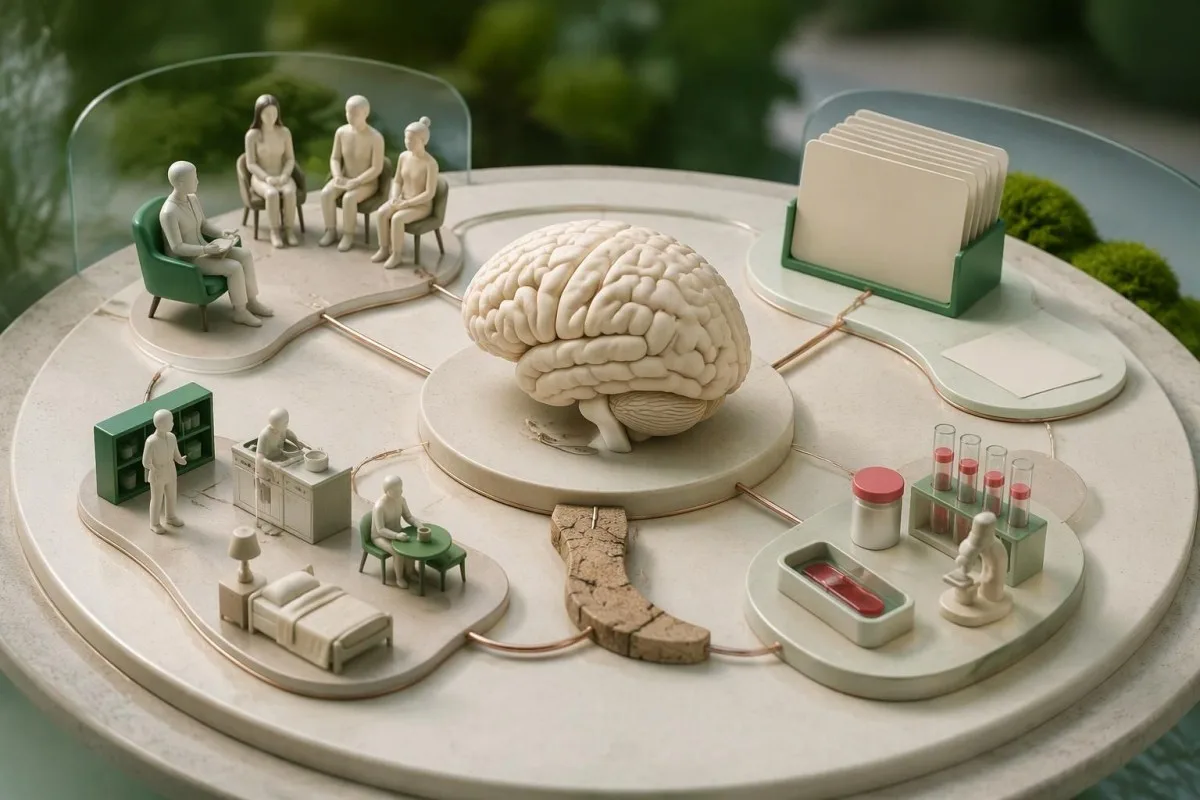
DSM-5-TR requires at least 2 characteristic symptoms during a significant portion of a 1-month period, or less if successfully treated, with at least one being delusions, hallucinations, or disorganized speech. It also requires functional deterioration and a longer course of disturbance; the criteria are not a self-scoring tool.
ICD-11 uses a different structure and requires at least 2 characteristic symptoms, including at least one from its core group, present most of the time for 1 month or more. WHO's clinical requirements emphasize the overall presentation and differential diagnosis rather than mechanically translating every DSM rule into ICD terminology (WHO, 2024).
Assessment often takes more than 1 conversation, particularly when symptoms are new or the history is unclear. With appropriate consent and attention to confidentiality, information from relatives, previous records, and the person's own account can clarify timing; lack of agreement between accounts should be explored rather than treated as proof that someone is unreliable.
Support should not wait for a 6-month diagnostic threshold to pass. A first episode may initially receive a broader working diagnosis while treatment and investigation proceed; our principis d'IA responsable reflect why automated laboratory interpretation must not substitute for this evolving clinical judgment.
Les anàlisis de sang poden detectar l’esquizofrènia o explicar-ne els símptomes?
No routine blood test diagnoses schizophrenia, and normal results do not rule it out. Laboratories serve 2 different purposes in this setting: investigating plausible medical contributors and establishing physical-health or medication-safety baselines; neither purpose turns a biomarker panel into a schizophrenia screening test.

Testing is selected from the history and examination, rather than ordered as an unlimited panel. A clinician may consider a CBC, electrolytes, kidney or liver tests, thyroid function, B12, or other investigations; our explicació sobre les hormones tiroïdals shows why 2 related thyroid measurements can be more informative than one isolated result.
B12 deficiency can contribute to neurological or cognitive symptoms, sometimes without marked anemia. In a hypothetical example, B12 of 160 pg/mL against that laboratory's 200–900 pg/mL interval warrants medical review; our interpretació limítrofa de la vitamina B12 explains why assay ranges and follow-up testing matter, without claiming that deficiency explains every symptom.
Kantesti és una plataforma d’interpretació d’anàlisi de sang amb IA that can help explain these 2 laboratory roles without converting results into a psychiatric label. We encourage readers to bring the original report, medicine list, and symptom timeline to the assessing clinician; an interpretation should preserve uncertainty when symptoms and laboratory findings do not fit neatly together.
Research measurements of immune activity, metabolism, proteins, or genetic associations are not validated routine diagnostic thresholds for schizophrenia. A result showing 1 elevated inflammatory marker may reflect many unrelated processes; commercial-sounding claims that a panel can confirm psychosis should be questioned for independent validation and clear intended-use limits.
Quines afeccions poden assemblar-se a l’esquizofrènia?
Psychosis can arise from mood disorders, substances, medicines, delirium, and neurological or other medical illnesses, as well as schizophrenia-spectrum disorders. Timing is central: symptoms developing over 2 days with fluctuating attention require a different workup from a gradual change over several months with preserved alertness.
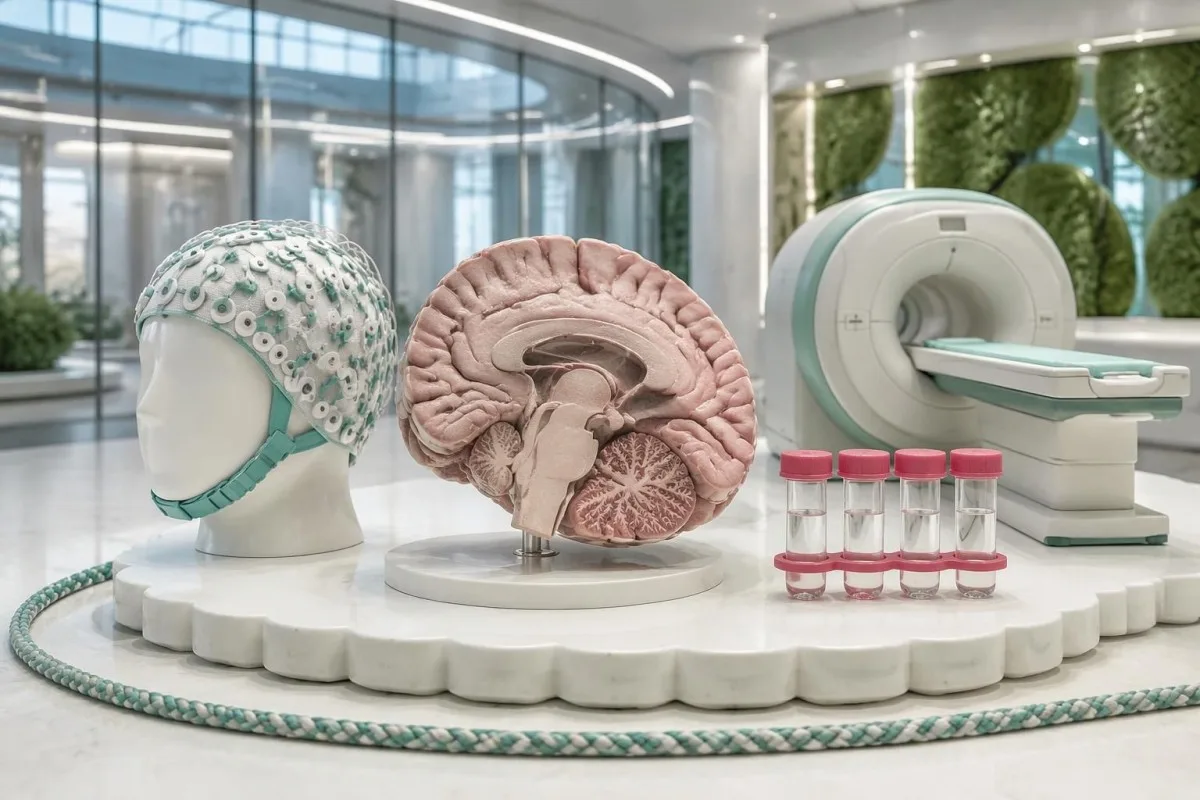
Delirium typically involves disturbed attention and an acute, fluctuating course, and it can include hallucinations or unusual beliefs. A hypothetical person alternating between coherent conversation and marked disorientation over 24 hours needs urgent medical assessment; a pre-existing schizophrenia diagnosis does not make delirium impossible.
New seizures, abnormal movements, reduced consciousness, or rapid cognitive decline can raise concern for an inflammatory brain disorder or another neurological cause. Our autoimmune encephalitis workup explains how MRI, EEG, and cerebrospinal fluid may contribute; 1 positive serum antibody does not independently establish that diagnosis.
Rare medical causes deserve targeted investigation when the accompanying pattern fits, not blanket screening of everyone. Severe episodic abdominal symptoms plus neurological or psychiatric changes can prompt a porphyria workup; our porphyria testing explanation describes why a correctly timed urine test can matter more than 1 general blood panel.
Substance and medication histories should be specific and nonjudgmental. Ask what was taken, approximate amounts, and timing during the preceding 48 hours and earlier weeks; cannabis, stimulants, corticosteroids, and withdrawal states can change diagnostic reasoning, while a negative toxicology screen cannot exclude every exposure or every detection-window limitation.
Quan requereixen ajuda urgent els símptomes de l’esquizofrènia?
Seek emergency help for immediate danger, suicidal intent, dangerous commands someone may act on, severe confusion, or inability to meet basic needs. In the UK, call 999 or 112 for an emergency; new psychotic symptoms without immediate danger still warrant prompt assessment rather than waiting for a routine laboratory appointment.
Possible catatonia needs urgent assessment, including when someone becomes unusually immobile, stops speaking, maintains unusual postures, or refuses fluids. A hypothetical adult drinking nothing for 24 hours and remaining largely motionless should not be managed as simple low motivation; fever, rigidity, or reduced responsiveness further increases concern.
Sudden speech difficulty, one-sided weakness, collapse, or a severe new headache requires emergency medical evaluation. Our signes d’alarma d’ictus explain why 1 new focal neurological sign should not be attributed to psychiatric illness, even when hallucinations or a previous mental-health diagnosis are also present.
New psychosis after childbirth is a medical emergency, particularly with little sleep, rapidly changing mood, or confused behavior. If a parent develops these changes 1 week after delivery, seek urgent assessment and ensure both parent and infant have safe support; do not wait to see whether the symptoms fit schizophrenia.
If there is no immediate danger, contact a local crisis service, primary-care clinician, or early-intervention service promptly. In England, NHS 111 offers a mental-health option; in the US, 988 provides crisis support and 911 handles immediate danger, while readers elsewhere should use local emergency or crisis services and avoid leaving an immediately unsafe person alone when it is safe to remain.
Com pots ajudar algú que pot estar patint una psicosi?
Help by listening calmly, checking immediate safety, and offering a specific route to assessment, rather than arguing about beliefs or announcing a diagnosis. A useful first conversation covers 3 practical needs: whether the person feels safe, whether they are eating and sleeping, and what assistance they would accept.

Short sentences and a quieter environment can make communication easier when attention is strained. Offer 2 realistic choices, such as contacting a clinician together or accompanying the person to an assessment, instead of several simultaneous demands; avoid crowding, sudden touching, or using threats to force cooperation.
Validate distress without confirming an unverified explanation. If someone believes their food is being tampered with, a supporter can acknowledge the fear and offer an acceptable meal while arranging help; asking how much they have eaten in the last 24 hours identifies a practical risk without requiring a debate about the belief.
A brief timeline can improve an appointment more than a long list of labels. Record 5 kinds of information: observed changes, approximate onset, sleep, substances or medicine changes, and effects on daily functioning; distinguish what you directly observed from what someone else reported, and ask the person's permission whenever possible.
Els materials de Kantesti privacitat i orientació sobre dades is relevant when accompanying laboratory reports contain sensitive personal information. Share only what is needed and seek consent where possible; having access to 1 family member's report does not automatically authorize uploading their records, and emergency safety concerns should be addressed through clinical services rather than an AI tool.
Quin tractament ajuda després d’un primer episodi psicòtic?
Treatment for first-episode psychosis commonly combines antipsychotic medication, psychological interventions, and practical support, tailored to diagnosis, preferences, and safety. NICE recommends individual CBT with at least 16 planned sessions and family intervention where appropriate; treatment should address everyday functioning as well as voices or delusions.
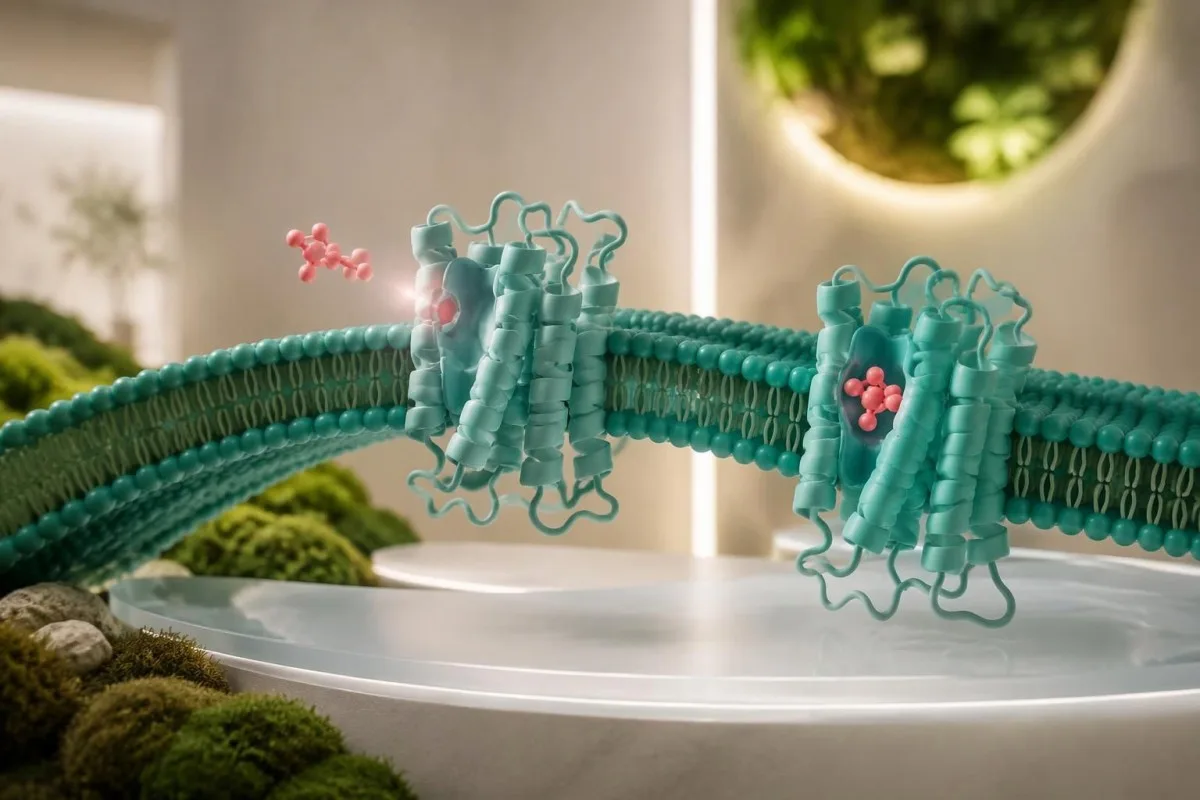
Medication choice is a shared clinical decision, including discussion of metabolic effects, movement symptoms, sedation, hormonal effects, and cardiovascular considerations. NICE advises treating an antipsychotic prescription as an explicit individual trial, generally assessing response after 4–6 weeks at an optimum dose while reviewing tolerability throughout (NICE, 2014).
Psychological treatment does not require the clinician to endorse a delusion or tell someone that their experience is imaginary. CBT for psychosis explores distress, interpretations, coping, and functioning; NICE describes family intervention as at least 10 planned sessions over 3 months to 1 year, adapted to the family's circumstances.
Clozapine is recommended for treatment-resistant schizophrenia after inadequate response to 2 adequate antipsychotic trials, subject to clinical assessment and local requirements. The APA guideline also recommends clozapine when suicide risk remains substantial despite other treatments (APA, 2020); our clozapine safety monitoring guide explains why monitoring is treatment-specific.
Recovery goals should be personal and measurable rather than limited to symptom counts. A hypothetical first goal might be returning to 2 supported study sessions weekly or preparing a regular meal; occupational, educational, housing, and social support can address barriers that medication alone does not remove, and prescriptions should never be changed through an automated laboratory interpretation.
Per què les revisions de salut física formen part de l’atenció de l’esquizofrènia?
Physical-health checks identify medication effects and health risks that deserve care independently of psychiatric symptoms. NICE recommends baseline assessment and repeat glucose or HbA1c and lipid testing at 12 weeks, 1 year, and annually during antipsychotic treatment; individual medicines and existing conditions may require additional monitoring.

Weight, blood pressure, movement symptoms, nutrition, and activity deserve discussion alongside laboratory results. NICE recommends weighing weekly for the first 6 weeks of antipsychotic treatment, then at 12 weeks, 1 year, and annually; early changes can support a timely conversation about treatment options rather than blame about willpower.
HbA1c of 6.5% equals 48 mmol/mol and is a diabetes diagnostic threshold, usually requiring confirmation when there are no clear symptoms. Our signes d'advertència d'alt nivell de glucosa explains why thirst, frequent urination, weight loss, or acute illness can change urgency; this threshold says nothing about the severity of psychosis.
Some antipsychotics raise prolactin, which can affect sexual function, menstruation, fertility, or other aspects of health. A result 2 times the laboratory upper limit needs interpretation with symptoms, medicines, sampling conditions, and sometimes repeat testing; our mildly elevated prolactin guide explains why one result should not trigger unsupervised medication changes.
Smoking changes can alter clozapine exposure, because combustion products—not nicotine alone—affect its metabolism. A hypothetical person stopping cigarettes during a 1-week admission needs the prescribing team's attention; diet and supplements also deserve review, but no meal plan, vitamin panel, or supplement regimen has been established as a substitute for schizophrenia treatment.
Publicacions de recerca i els límits de la interpretació de laboratori
The research references below distinguish schizophrenia guidance from supporting laboratory education. The 2 Zenodo guides explain serum proteins and immune tests; they are not schizophrenia diagnostic studies, and their DOIs do not establish peer review, psychiatric screening accuracy, or evidence that these tests should be ordered for early behavioral changes.
Kantesti és un servei d’interpretació de proves d’IA that explains reported measurements rather than diagnosing psychiatric disorders. Our supervisió tècnica i clínica describes the scope of our methodology; performance on laboratory interpretation is not evidence of accuracy for schizophrenia assessment, and those are 2 separate validation questions.
Serum albumin, globulins, and the A/G ratio reflect broad physiological processes, not a schizophrenia signature. Our guia de proteïnes sèriques provides context for that laboratory family; a hypothetical A/G ratio of 0.9 must be interpreted against its laboratory interval and clinical setting, not converted into a psychiatric risk score.
Complement and ANA testing answer targeted immune questions, and indiscriminate testing can produce findings unrelated to the presenting symptoms. Our guia de complement i ANA explains those limits; an isolated ANA titer of 1:80 does not establish an autoimmune explanation for psychosis or justify immune treatment without supporting clinical evidence.
Kantesti's role is to help readers understand accompanying reports while keeping diagnosis and urgent care with qualified clinicians. For a first episode—or a change after 5 stable years—bring the symptom timeline and original results to assessment; the NICE, WHO, and APA references below support the clinical discussion, while the repository publications support narrower laboratory education.
Preguntes freqüents
Quins són els primers signes de l'esquizofrènia?
Els possibles signes inicials de l’esquizofrènia inclouen l’aïllament, el deteriorament del funcionament, les percepcions inusuals, la suspicàcia i els canvis en el pensament o el son, però aquestes manifestacions no són prou específiques per diagnosticar l’esquizofrènia. Un conjunt de signes que afecti 2 o més àmbits de la vida pot fer que una valoració sigui especialment útil, tot i que no es tracta d’un llindar diagnòstic. L’aparició de veus noves, creences inusuals fermament arrelades o un deteriorament marcat requereix una valoració clínica ràpida. No espereu que passin mesos amb símptomes ni que arribi el resultat d’una anàlisi de sang abans de demanar ajuda.
Es pot tenir esquizofrènia sense sentir veus?
Una persona pot tenir esquizofrènia sense sentir veus, perquè les al·lucinacions auditives no són necessàries en totes les presentacions. El DSM-5-TR exigeix almenys 2 símptomes característics durant la fase activa, entre els quals hi ha d’haver almenys un dels següents: deliris, al·lucinacions o parla desorganitzada, juntament amb altres criteris de durada i funcionament. Per tant, una persona pot presentar deliris destacats o parla desorganitzada sense al·lucinacions auditives. Un professional clínic també ha d’avaluar altres possibles explicacions psiquiàtriques, relacionades amb el consum de substàncies o mèdiques.
Es pot diagnosticar l’esquizofrènia amb una anàlisi de sang?
Cap an anàlisi de sang rutinària pot diagnosticar o descartar l’esquizofrènia, i no hi ha cap llindar de biomarcador rutinari validat per a aquest propòsit. Les anàlisis de sang poden investigar possibles factors mèdics o controlar la seguretat de la medicació, però es tracta de qüestions clíniques diferents. Per exemple, pot ser adequat fer proves de la funció tiroïdal o de la vitamina B12 quan l’anamnesi faci sospitar aquests problemes. Uns resultats de laboratori normals no són motiu per ignorar al·lucinacions persistents, deliris o un deteriorament funcional.
La baixa motivació i l’aïllament social són signes d’esquizofrènia?
Low motivation and social withdrawal can occur among the negative symptoms of schizophrenia, but they also occur with depression, sleep problems, medicines, stress, and other conditions. Clinicians commonly describe 5 negative-symptom domains: reduced expression, speech, motivation, pleasure, and social engagement. The assessment considers the person's baseline, associated symptoms, and alternative causes rather than counting behaviors on a checklist. New or persistent changes affecting daily life deserve assessment without assuming schizophrenia.
Quant de temps han de durar els símptomes abans que es diagnostiqui l’esquizofrènia?
La durada necessària depèn del marc diagnòstic i del conjunt de símptomes. En general, el DSM-5-TR requereix almenys 6 mesos d’alteració contínua, inclosa una fase activa que acostuma a durar almenys 1 mes, o menys si el tractament és eficaç. La CIM-11 requereix símptomes característics la major part del temps durant almenys 1 mes, a més d’altres requisits diagnòstics. Aquests llindars orienten el diagnòstic, però no determinen quan cal demanar ajuda: cal avaluar aviat un primer episodi psicòtic.
Quan hauria d’acudir a urgències una persona amb possible esquizofrènia?
Cal atenció d’urgència si hi ha risc imminent d’autolesió, ordres perilloses que algú podria obeir, confusió greu, disminució del nivell de resposta o incapacitat per satisfer les necessitats bàsiques. Al Regne Unit, truqueu al 999 o al 112 si hi ha perill immediat; als EUA, truqueu al 911 en cas d’emergència o al 988 per rebre suport en una crisi. Els símptomes neurològics sobtats, la febre amb rigidesa i l’aparició de psicosi després del part també requereixen una valoració mèdica urgent. Si apareixen símptomes psicòtics nous sense que hi hagi un perill immediat, també convé contactar aviat amb un professional sanitari o amb el servei local d’atenció en crisi.
Fes que t’expliquin els resultats anàlisi de sang
Puja l’informe del laboratori i la IA de Kantesti t’explicarà cada biomarcador en llenguatge planer en qüestió de segons. Més de 2 milions de persones d’arreu del món ja l’han utilitzat.
Referències
- Klein, T., Mitchell, S., & Weber, H. (2026). Guia de les proteïnes sèriques: anàlisi de sang de globulines, albúmina i relació A/G. Recerca mèdica amb IA de Kantesti. DOI
- Klein, T., Mitchell, S., & Weber, H. (2026). Guia de les proves de sang C3 C4 del complement i del títol d'ANA. Recerca mèdica amb IA de Kantesti. DOI
- National Institute for Health and Care Excellence (2014). Psychosis and schizophrenia in adults: prevention and management (CG178). Directriu clínica del NICE.
- World Health Organization (2024). Clinical descriptions and diagnostic requirements for ICD-11 mental, behavioural and neurodevelopmental disorders. Organització Mundial de la Salut.
- American Psychiatric Association (2020). The American Psychiatric Association Practice Guideline for the Treatment of Patients With Schizophrenia, Third Edition. American Psychiatric Association Publishing. DOI
- Més de 2 milionsProves analitzades
- 127+Països
- 100+Idiomes
Sobre l’equip mèdic


Senyals de confiança E-E-A-T
Experiència
Revisió clínica liderada per metges dels fluxos de treball d’interpretació de laboratori.
Experiència
Enfocament en medicina de laboratori sobre com es comporten els biomarcadors en context clínic.
Autoritat
Revisat mèdicament pel Dr. Thomas Klein, amb aportacions de la Dra. Sarah Mitchell i el Prof. Dr. Hans Weber.
Fiabilitat
Interpretació basada en l’evidència amb vies de seguiment clares per reduir l’alarma.






Exempció de responsabilitat mèdica
Aquest article és només per a finalitats educatives i no constitueix assessorament mèdic. Consulteu sempre un professional sanitari qualificat per a decisions de diagnòstic i tractament.
Publicat · Contacteu amb l’equip editorial
Publicat per Kantesti Ltd, registrat a Anglaterra i Gal·les, número de societat. 17090423, Londres, Regne Unit.
