A heavy metals blood test is best for recent or ongoing exposure to lead, methylmercury, and selected workplace or implant-related metals. It is not a general measure of “body toxins”: urine, metal speciation, exposure history, and repeat timing often determine whether a result is meaningful.


- Whole-blood lead reflects mainly recent or continuing exposure over roughly 1 month; no blood lead level is considered risk-free.
- CDC’s child blood lead reference value is 3.5 µg/dL, a follow-up threshold rather than a toxicity diagnosis.
- Mercury blood testing is most useful for recent methylmercury exposure from fish and some occupational sources; it does not reliably measure old exposure.
- Urine arsenic with speciation is preferred for suspected inorganic arsenic exposure, especially after avoiding seafood for 48-72 hours.
- Urine cadmium generally better reflects cumulative kidney burden, while blood cadmium is more weighted toward recent exposure.
- Hair testing can support a narrow methylmercury question but is unreliable as a broad diagnostic toxin screen.
- Provoked urine testing after a chelating agent cannot establish poisoning because it deliberately increases urinary metal excretion.
- Broad toxin panels frequently detect trace metals without showing illness, source, dose, or a need for treatment.
What a heavy metals blood test actually checks
A badanie krwi w kierunku metali ciężkich measures the concentration of specific elements circulating at the time of collection; it does not measure a person’s lifetime “toxin load.” Whole blood is particularly useful for lead and methylmercury, while the best specimen changes for arsenic, cadmium, chromium, cobalt, and thallium.
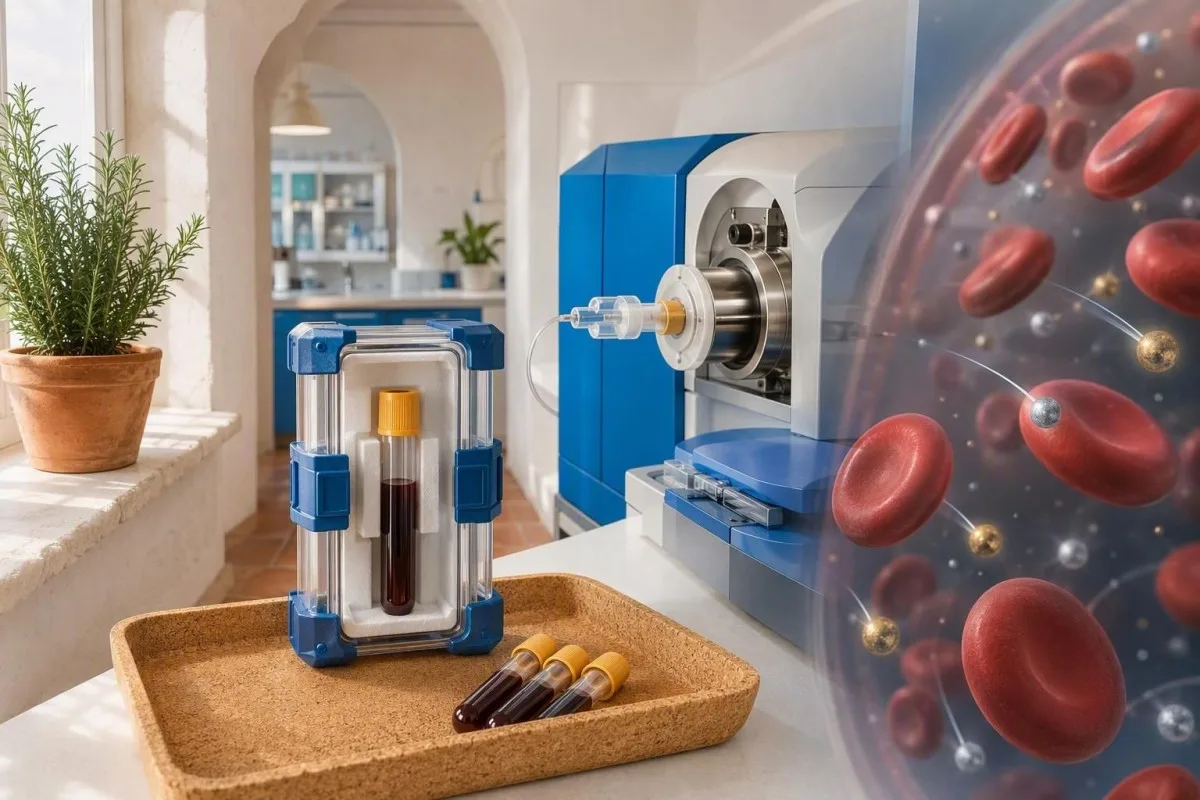
Most clinical laboratories use inductively coupled plasma mass spectrometry, or ICP-MS, which can detect metals at micrograms per litre or below. Detection is not diagnosis: a result must be compared with the laboratory’s method, the collection tube, the person’s job, diet, supplements, kidney function, and the time since the suspected contact.
A panel badań krwi w kierunku toksyn marketed as a 20- or 40-metal screen can sound comprehensive, but many measured elements have no validated disease threshold in an asymptomatic person. In my practice, the useful question is nearly always narrower: “Could this particular exposure explain this result or symptom?”
Kantesti jest Analizator do badań krwi AI that places trace-element results beside the rest of a report, including creatinine, liver markers, and red-cell indices. Our przewodnik referencyjny po biomarkerach helps distinguish a result that needs prompt clinical review from one that mainly needs a better exposure history.
Which metals can blood testing detect reliably?
Blood testing can reliably quantify several metals, but a measurable concentration has different meaning for each one. Lead, mercury, manganese, cobalt, and chromium are commonly measured in whole blood; arsenic and cadmium often need urine testing for the clinically relevant question.
A badanie krwi na ołów should use whole blood collected in a certified trace-element tube because lead partitions strongly into red cells. Venous sampling is preferred when a screening capillary result is elevated, since dust on skin can falsely raise a finger-prick result.
A badanie krwi na rtęć is most informative for methylmercury from seafood and elemental-mercury exposure occurring in recent weeks. Whole-blood mercury commonly falls after a change in fish intake; the biological half-life of methylmercury is about 50 days, so a repeat result at 6-8 weeks can be more informative than a result 3 days later.
Cobalt and chromium blood concentrations have a defined role in selected people with metal-on-metal hip components, although symptoms, imaging, implant type, and serial change matter more than one isolated number. Our guide to chromium testing choices explains why laboratories may report different units.
Lead blood testing: thresholds, timing and follow-up
A venous blood lead level is the standard test for recent lead exposure in children and adults. In US children, 3.5 µg/dL is the current CDC blood lead reference value; it identifies children with higher exposure than most peers and is not a line between safe and unsafe.
Blood lead levels usually reflect exposure during the prior 28-36 days, though lead stored in bone can re-enter blood during pregnancy, menopause, fracture healing, or severe illness. A level can therefore fall after leaving a source without proving that the earlier exposure was harmless.
The CDC’s 2021 update lowered the child reference value from 5.0 to 3,5 µg/dL because lower concentrations still correlate with developmental risk at a population level (Ruckart et al., 2021). Chelation is not routine for a child at 3.5 µg/dL; source identification, nutrition, developmental surveillance, and repeat testing are the usual first steps.
For adults, occupational thresholds and removal rules differ by country, sex, pregnancy potential, and industry. A result of 45 µg/dl lub wyższym warrants urgent specialist discussion in many clinical settings, while 70 µg/dl lub wyższym is generally treated as a medical emergency requiring immediate exposure removal and expert management.
Mercury blood tests after fish, work or a spill
A badanie krwi na rtęć best captures recent methylmercury exposure from seafood and can help assess recent elemental-mercury exposure. It does not, by itself, identify the mercury form, source, duration, or degree of neurological risk.
For an adult with regular fish intake, a total blood mercury result below 10 µg/L is often seen, but laboratory reference intervals vary widely by geography and diet. A result above 20 µg/L deserves a careful exposure review, especially in pregnancy or before conception, rather than reflex detoxification.
Clarkson and Magos describe why mercury chemistry matters: methylmercury concentrates in red cells, whereas inorganic mercury is more readily represented in urine (Clarkson and Magos, 2006). That distinction is why total mercury alone can create unnecessary alarm after several servings of large predatory fish.
I have seen an anxious patient repeat a mercury level the morning after sushi; that repeat answered almost nothing. A more useful plan is to record fish species and portions for 2 weeks, choose lower-mercury options, then repeat at about 6-8 weeks if the original result was genuinely raised; see our seafood mercury follow-up guide.
When urine testing is better than a blood test
Urine testing is preferable when the metal is excreted in urine or when clinicians need to estimate cumulative rather than same-day exposure. Arsenic, cadmium, inorganic mercury, and thallium are common examples where urine can answer the clinical question better than blood.
A 24-hour urine collection measures total excretion over a day, but a spot urine sample corrected for creatinine is often used when collection quality is doubtful. A missed collection, unusually high fluid intake, or creatinine at either extreme can distort a 24-hour estimate; collection technique deserves the same scrutiny as the number.
Urine cadmium reflects long-term renal accumulation more than blood cadmium, which is influenced by recent smoking or occupational exposure. Cadmium interpretation should include urine albumin or ACR and tubular markers when clinically indicated, because the concern is often kidney tubular injury rather than a vague toxicity score.
Timing errors are common. Our practical przewodnik do dobowej zbiórki moczu details the usual failure points, including starting at the wrong time and forgetting the final specimen.
Arsenic testing needs speciation, not a generic total
Suspected arsenic exposure is usually assessed with urine arsenic speciation, not a blood panel. Total urine arsenic can rise dramatically after seafood because organic arsenobetaine is excreted in urine but is far less toxic than inorganic arsenic.
People should avoid seafood for 48–72 godziny before a planned urine arsenic test unless a toxicologist advises otherwise. A total urine arsenic result above 50 µg/L can merit follow-up, but it cannot be interpreted responsibly without identifying inorganic arsenic and its metabolites.
Blood arsenic has a short useful window—often hours after a substantial exposure—so a normal blood value does not rule out a relevant exposure from days earlier. In the 15 years I have worked with laboratory reports, this is among the most frequent reasons a broad panel gives false reassurance.
ATSDR’s arsenic profile supports urine testing with speciation when exposure is suspected, particularly after well-water, industrial, or herbal-product concerns (ATSDR, 2007). Do not stop prescribed medicines or attempt chelation while waiting for a result; a clinician can help identify whether water, work, or a product is the plausible source.
Cadmium, chromium and cobalt require exposure-specific testing
Cadmium, chromium, and cobalt results are meaningful only when matched to a plausible source and the correct specimen. Urine cadmium is often selected for cumulative exposure, while blood cobalt and chromium are mainly used for recent occupational exposure or selected implant surveillance.
Smoking can materially increase cadmium concentrations, and certain workplaces add inhalational exposure; dietary intake alone rarely explains a striking result. Kidney function matters because reduced filtration can alter urine concentrations independently of exposure, so creatinine and urine protein context are useful.
For a person with a metal hip implant, new hip pain, reduced function, hearing or vision symptoms, cardiomyopathy symptoms, or a rising cobalt trend requires direct clinical assessment. A one-off blood cobalt concentration is not a screen for nonspecific tiredness, brain fog, or joint aches.
Kantesti AI can compare renal markers across dates, which is useful when a metal result raises a kidney question rather than proving causation. Review a GFR result after dehydration before assuming a small creatinine shift represents metal-related damage.
Collection errors can create a false metal result
Trace-metal results are unusually vulnerable to contamination from collection tubes, skin dust, topical products, and lab processing. A surprising low-level result should often be repeated using a certified trace-element tube before it triggers invasive investigations or supplements.
Powder from gloves, dust from a worksite, zinc-containing denture adhesives, and even a non-certified collection tube can affect testing. Hemolysis can also alter interpretation for some elements because cellular contents enter serum or plasma; a red-tinged specimen should prompt the laboratory to comment on sample quality.
The correct matrix matters: krew pełną, serum, plasma, and urine are not interchangeable. A report labelled “serum mercury” should not be compared casually with a public-health threshold developed for whole blood.
Kantesti jest platforma do interpretacji biomarkerów przez AI that reads the reported specimen type, unit, and reference interval before offering context. Our technology and methods guide explains why a result outside one laboratory’s range cannot automatically be mapped onto another laboratory’s decision limit.
Why hair, nail and home toxin panels often mislead
Hair and nail tests cannot diagnose most heavy-metal poisoning in an individual because external contamination, cosmetic treatment, growth rate, and laboratory preparation can dominate the result. Hair has a limited supporting role for longer-term methylmercury exposure, not for a catch-all detox assessment.
Hair grows about 1 cm per month, but that simple fact does not make each centimetre a reliable exposure calendar. Hair dye, bleaching, swimming-pool water, dust, and shampoos can alter measured concentrations; washing protocols differ substantially between laboratories.
Nail testing has similar limitations and has little role in routine clinical diagnosis. When a panel reports 25 elements, it will usually flag something statistically unusual even in healthy people—an expected consequence of multiple comparisons, not evidence that the body needs cleansing.
If symptoms are the concern, clinicians should first look for standard explanations that have a clearer diagnostic pathway: anaemia, thyroid disease, kidney disease, medication effects, sleep disruption, and nutrition. Our article on badań krwi w przypadku niezrozumiałego bólu shows how to begin without reducing every symptom to toxicity.
Why provoked urine tests cannot prove metal poisoning
A provoked urine metal test cannot diagnose chronic heavy-metal poisoning because the chelating drug intentionally mobilises and increases urinary excretion of metals. Reference ranges from an unprovoked urine specimen do not apply after EDTA, DMSA, DMPS, or another chelator.
Chelators bind metals that are normally present in tissues and circulation, so nearly everyone will excrete more after receiving one. The crucial missing piece is a validated post-chelation reference population, which most commercial reports do not provide.
Chelation is not benign. Depending on the agent and person, it can contribute to low calcium, kidney stress, allergic reactions, mineral depletion, and interactions with prescribed treatments; treatment should follow a documented exposure and specialist assessment.
Dr. Thomas Klein’s practical rule is simple: establish the exposure, obtain a properly collected baseline test, then discuss treatment. The podejście do walidacji medycznej used by Kantesti AI is designed to flag when an assay’s limits make a confident interpretation inappropriate.
Symptoms that need urgent care rather than another panel
Acute confusion, seizures, severe vomiting, new weakness, shortness of breath, chest pain, or a known high-dose exposure need urgent medical assessment, not a mail-order toxin panel. A normal blood result can occur if testing is too late or measures the wrong metal.
For a child, pica, peeling paint exposure, developmental regression, or a sibling with high lead should trigger prompt paediatric advice. Lead poisoning is often silent, so behaviour alone cannot estimate a blood lead level.
Elemental mercury vapour exposure can cause cough, breathlessness, tremor, or neuropsychiatric symptoms, while inorganic arsenic may cause severe gastrointestinal illness and cardiovascular instability after major exposure. These patterns are uncommon, but delay is the risk—call emergency services or a poison centre when the exposure is recent or symptoms are significant.
A clinician may order electrolytes, creatinine, liver tests, ECG monitoring, and targeted toxicology alongside a metal assay. Our electrolyte red-flag guide explains why metal toxicity is never assessed from one concentration alone.
How to handle a borderline metal result
A borderline metal result is usually managed by confirming the specimen, reconstructing exposure, and repeating the correct test after an appropriate interval. It rarely justifies supplements, fasting regimens, or chelation on its own.
Start with a timeline: occupation, hobbies, renovation work, imported spices or remedies, water source, firing ranges, jewellery work, fish intake, and implant history. Record dates, frequency, protective equipment, and whether others sharing the environment have symptoms or abnormal results.
Repeat testing should use the same matrix and, where possible, the same laboratory. A 20% change may reflect ordinary biological or analytical variation for some trace elements, whereas a sustained fall after a documented source removal supports the exposure hypothesis more strongly.
Kantesti can organise serial laboratory reports, but it cannot replace exposure investigation or medical examination. Our przewodnik po wynikach obok siebie is useful for preparing a concise timeline for an occupational physician or GP.
Food, supplements and the limits of “detox”
No juice cleanse, sauna, supplement, or fasting protocol has been shown to remove clinically important metal exposure safely in place of source control. The first treatment for most low-level exposures is stopping the source and supporting ordinary nutrition, hydration, and medical follow-up.
Adequate calcium, iron, and vitamin C intake can reduce gastrointestinal lead absorption in children with nutritional deficiency, but food is not a substitute for environmental remediation. Iron deficiency can increase lead uptake, which is one reason clinicians often review ferritin and a complete blood count when lead exposure is confirmed.
High-dose zinc can create copper deficiency, and unsupervised selenium can itself cause toxicity. A supplement marketed as a metal binder should be treated cautiously, particularly if it contains multiple minerals that may complicate subsequent testing.
For sensible nutrition questions, read our guide to foods high in iron i naszym przeglądem bezpieczeństwa dawek selenu. The evidence for commercial detox programmes is honestly weak.
How to read a metal result alongside routine blood work
Metal results become clinically useful when interpreted alongside kidney function, liver markers, full blood count, symptoms, and a credible exposure source. A value slightly above a reference interval without any of those supporting features often has limited clinical significance.
Lead exposure may coexist with microcytosis or iron deficiency, but a normal CBC does not exclude lead exposure. Cadmium questions deserve attention to creatinine and urinary protein, while marked liver abnormalities should not automatically be blamed on a low-level metal finding.
Kantesti AI to usłudze interpretacji testów laboratoryjnych AI that translates unit-specific laboratory data into questions for a clinician, rather than declaring a diagnosis from a broad toxin screen. Dr. Thomas Klein and our Rada doradcza ds. medycznych emphasise source verification, reproducible testing, and clear escalation advice.
Before uploading any report, remove unnecessary identifiers and check that the specimen type, collection date, and units are visible. Our checklist jakości przesyłania PDF can prevent a simple transcription error from becoming a frightening interpretation.
A practical testing plan for suspected exposure in 2026
As of September 3, 2026, the safest testing plan starts with a specific exposure hypothesis, then chooses the right metal, specimen, and collection date. Broad screening is reasonable only when an occupational or public-health clinician identifies a defined multi-metal exposure.
For old paint, imported pottery, shooting, battery work, or contaminated dust, request venous whole-blood lead. For frequent high-mercury fish intake, start with whole-blood total mercury; for well water or suspected arsenic, request urine arsenic with speciation after seafood avoidance.
Bring photographs of product labels, workplace safety sheets, renovation dates, and water-test results to the appointment. That evidence can be more diagnostic than adding 15 metals to a panel, and it makes public-health action possible when a home or job source is real.
Kantesti is used across 127+ countries, but local thresholds and workplace reporting rules vary. Our clinical use-case examples show how structured questions can support—not replace—your own clinician, toxicology service, or local public-health team.
Często zadawane pytania
Jakie metale można wykryć za pomocą badania krwi?
Badanie krwi na obecność metali ciężkich może określić ilościowo ołów, rtęć całkowitą, mangan, kobalt, chrom i kilka innych pierwiastków, zazwyczaj we krwi pełnej. Krew jest najbardziej przydatna w przypadku niedawnego lub trwającego narażenia, a nie do pomiaru nagromadzenia w ciągu całego życia. Ołów jest powszechnie oznaczany poprzez badanie krwi pełnej pobranej z żyły, a okres półtrwania metylortęci we krwi wynosi około 50 dni. Arsen, kadm, rtęć nieorganiczna i tal często wymagają badania moczu, aby uzyskać bardziej użyteczną klinicznie odpowiedź.
Jak długo metale ciężkie pozostają we krwi?
The time a metal remains measurable depends on its chemical form and the specimen tested. Blood lead generally reflects exposure during the previous 28-36 days, while methylmercury commonly declines over about 50 days after exposure decreases. Arsenic in blood may be useful for only hours after a substantial exposure, so a normal result later does not rule it out. Cadmium can persist in the body for years, but urine is usually more informative for accumulated cadmium burden.
Czy badanie krwi na obecność metali ciężkich jest dobrym ogólnym badaniem przesiewowym w kierunku toksyn?
A broad toxin blood test is usually a poor general screen for unexplained fatigue, headaches, or brain fog because trace detection does not establish toxicity. Panels that measure 20 or more elements increase the chance of at least one borderline flag even in healthy people. A targeted test based on work, water, paint, seafood, supplements, or an implant is more likely to produce an actionable result. A clinician should interpret any elevated concentration with the specimen type, units, timing, symptoms, and exposure history.
Czy powinnam pościć przed badaniem krwi na metale ciężkie?
Fasting is not required for most lead or mercury blood tests. The more relevant preparation is avoiding contamination and documenting recent exposure, such as fish eaten during the prior 1-2 weeks or workplace contact on the day of testing. For urine arsenic, avoid seafood for 48-72 hours before collection unless a clinician advises otherwise, because organic seafood arsenic can raise total urine arsenic. Do not stop prescribed medicines or take a chelating product before testing.
Jaki poziom ołowiu we krwi jest niepokojący?
For children in the United States, a venous blood lead level of 3.5 µg/dL or higher meets the CDC blood lead reference value and should prompt exposure follow-up. This is not a safe-versus-dangerous cutoff, because no level of lead exposure is known to be completely without risk. Levels of 20-44 µg/dL warrant prompt clinical assessment, and levels of 45 µg/dL or higher generally require urgent specialist discussion. Adult occupational action levels differ by country, job, sex, and pregnancy potential.
Czy testy z włosów są dokładne w wykrywaniu metali ciężkich?
Hair tests are not reliable for diagnosing most heavy-metal poisoning because external dust, hair dye, bleaching, shampoo, and laboratory washing methods can change results. Hair grows about 1 cm monthly, but it is not a precise historical exposure record for an individual. Hair analysis may occasionally support assessment of longer-term methylmercury exposure under specialist guidance. An abnormal hair result should not be used alone to justify chelation or a detox programme.
Can chelation testing show if I have metal toxicity?
No, urine collected after a chelating medication cannot prove metal poisoning because the medication deliberately increases metal excretion. Standard urine reference ranges are derived from samples collected without a chelator and cannot be compared with a post-chelation result. Chelation can cause kidney stress, mineral disturbances, and other adverse effects, especially when used without a documented indication. Properly collected baseline blood or urine testing and exposure investigation should come first.
Uzyskaj analizę wyników badań krwi zasilaną przez AI już dziś
Dołącz do ponad 2 milionów użytkowników na całym świecie, którzy ufają Kantesti w zakresie natychmiastowej, dokładnej analizy badań laboratoryjnych. Prześlij swoje wyniki badań krwi i otrzymaj kompleksową interpretację biomarkerów 15,000+ w kilka sekund.
📚 Publikacje badawcze z odniesieniami
Klein, T., Mitchell, S., & Weber, H. (2026). Biegunka po poście, czarne plamki w stolcu i przewodnik po układzie pokarmowym 2026. Kantesti AI Medical Research.
Klein, T., Mitchell, S., & Weber, H. (2026). Poradnik zdrowia kobiet: owulacja, menopauza i objawy hormonalne. Kantesti AI Medical Research.
📖 Zewnętrzne medyczne źródła odniesienia
Agency for Toxic Substances and Disease Registry (2007). Toxicological Profile for Arsenic. Departament Zdrowia i Opieki Społecznej USA.
⚕️ Zastrzeżenie medyczne
Ten artykuł ma wyłącznie charakter edukacyjny i nie stanowi porady medycznej. Zawsze konsultuj decyzje dotyczące diagnozy i leczenia z wykwalifikowanym pracownikiem ochrony zdrowia.
Sygnały zaufania E-E-A-T
Doświadczenie
Kliniczna weryfikacja procesów interpretacji przez lekarza.
Ekspertyza
Medycyna laboratoryjna skupiona na tym, jak zachowują się biomarkery w kontekście klinicznym.
Autorytatywność
Napisane przez dr. Thomasa Kleina, z recenzją dr Sarah Mitchell i prof. dr. Hansa Webera.
Solidność
Interpretacja oparta na dowodach, z jasnymi ścieżkami dalszego postępowania, aby ograniczyć alarm.