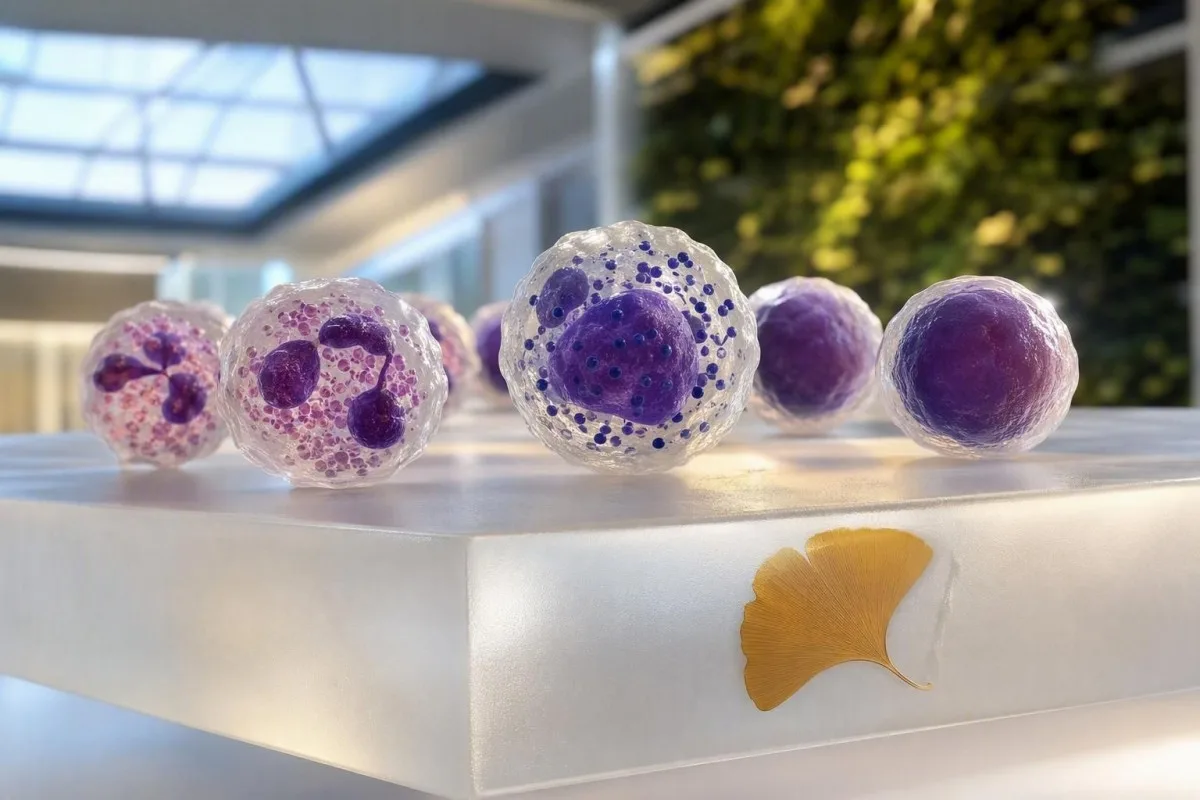
De flesta vuxna har absoluta basofiler på 0,00–0,10 × 10⁹/L (0–100/µL), medan procentandelen vanligtvis är 0–11 %. En lätt ovanlig procentandel återspeglar ofta skiftningar i andra vita blodkroppar; den absoluta basofilräkningen är det resultat som vanligtvis styr uppföljningen.


- Absoluta basofiler är vanligtvis 0,00–0,10 × 10⁹/L (0–100/µL) hos vuxna och är mer kliniskt användbart än enbart en procentandel.
- Basofilprocent är vanligtvis 0–11 % av vita blodkroppar, men det kan stiga när neutrofiler eller lymfocyter faller även om det absoluta antalet är normalt.
- Barn använder ofta samma praktiska övre gräns på 0,10 × 10⁹/L efter spädbarnsåldern, men laboratoriets åldersspecifika intervall har prioritet.
- En upprepad CBC om 2–8 veckor är rimlig för isolerad, mild basofili efter en allergi, infektion eller medicinändring.
- Ihållande basofili över 0,20 × 10⁹/L förtjänar klinisk granskning, särskilt vid höga vita blodkroppar, anemi, splenomegali eller konstitutionella symtom.
- Snar granskning är motiverad vid uttalad leukocytos, oförklarlig viktnedgång, svettningar nattetid, feber eller tidig mättnadskänsla under vänster revben.
- Noll basofiler på ett automatiserat differentialräknande är vanligt och har normalt ingen klinisk betydelse.
- Kantesti AI läser basofiler tillsammans med totala vita blodkroppar, eosinofiler, blodplättar, hemoglobin och tidigare resultat snarare än att behandla en flagga som en diagnos.
Absoluta basofiler jämfört med basofilprocent
Absoluta basofiler på 0,00–0,10 × 10⁹/L är generellt normala hos vuxna, medan ett basofilprocent på 0–1% endast är en del av den totala mängden vita blodkroppar. När dessa två skiljer sig åt, lägger kliniker oftast större vikt vid det absoluta resultatet.
En procentandel kan se hög ut helt enkelt för att en annan typ av vita blodkroppar är låg. Till exempel ger 1,5% basofiler med ett antal vita blodkroppar på 3,0 × 10⁹/L ett absolut antal på endast 0,045 × 10⁹/L – väl inom många intervall för vuxna. Därför berättar en ensam procentuell flagga sällan hela historien.
Beräkningen är enkel: totala vita blodkroppar × basofilprocent ÷ 100. Ett antal vita blodkroppar på 12,0 × 10⁹/L och basofiler på 2% ger 0,24 × 10⁹/L, vilket är en verklig ökning. För det bredare sammanhanget, se vår guide till vad ett CBC innehåller.
Kantesti är en AI blodprovsanalysator som omvandlar procentandelar till kliniskt jämförbara absoluta antal när källrapporten innehåller en differentialräkning. Enligt min erfarenhet förhindrar den enda omvandlingen en hel del onödig oro efter en rutinmässig hälsokontroll.
Varför det absoluta antalet är stabilare
Automatiserade analysatorer räknar tusentals cellhändelser, men basofiler är normalt sällsynta – ofta färre än 1 av 100 vita blodkroppar. Små analytiska och biologiska skift kan därför flytta procentandelen mer märkbart än det absoluta antalet.
Praktiska referensintervall för basofiler efter ålder
De flesta laboratorier använder ett absolut referensintervall för basofiler på 0,00–0,10 × 10⁹/L från barndom till vuxen ålder, men nyföddhetsintervall kan vara bredare. Använd intervallet som skrivits ut bredvid ditt eget resultat, eftersom referensgränserna beror på analysmetoden och laboratoriets lokala friska population.
För spädbarn under de första levnadsveckorna accepterar vissa pediatriska laboratorier absoluta basofiler upp till cirka 0,20–0,40 × 10⁹/L. Det nyfödda immunsystemet anpassar sig snabbt, så vuxna gränser bör inte påtvingas ett nyföddhetsresultat utan pediatrisk bedömning.
Från cirka 1 års ålder tillämpar många tjänster en praktisk övre gräns nära 0,10 × 10⁹/L, eller 100/µL. Ett resultat på 0,11 × 10⁹/L hos ett friskt barn med ett normalt totalantal vita blodkroppar är vanligtvis en fråga om omprövning och kontext, inte en nödsituation.
CLSI EP28-A3c förklarar varför laboratorier fastställer eller verifierar sina egna referensintervall snarare än att låna ett universellt intervall (CLSI, 2010). Vår guide till neutrofilers åldersintervall visar samma princip för en annan differentialräkning.
Förståelse av basofil-enheter på brittiska, amerikanska och internationella rapporter
Ett basofilvärde på 0,10 × 10⁹/L motsvarar 100/µL, så rapporter med olika enheter kan beskriva samma resultat. Brittiska fullständiga blodkroppsmätningar rapporterar ofta ×10⁹/L, medan amerikanska laboratorier vanligtvis använder celler/µL eller K/µL.
För att konvertera ×10⁹/L till celler/µL multiplicerar du med 1 000. Därmed motsvarar 0,05 × 10⁹/L 50/µL; 0,25 × 10⁹/L motsvarar 250/µL. En rapport som visar 0,0 kan vara avrundad till en decimal snarare än att bevisa att det bokstavligen inte finns några basofiler.
Ett värde som anges som 0,2 K/µL motsvarar 0,20 × 10⁹/L. Den distinktionen är viktig eftersom 0,2% och 0,2 K/µL är helt olika mätningar. Patienter blandar regelbundet ihop dem när de jämför rapporter från två länder.
Om din rapport anger FBC istället för CBC, är komponenterna i stort sett desamma; vår förklaring av brittisk fullständig blodkroppsmätning översätter den vanliga terminologin.
Varför basofilantalet stiger eller sjunker
Mild basofili åtföljer oftast allergi, kronisk inflammation, återhämtning från en infektion eller en medicinrelaterad immunologisk förändring. Ett lågt antal eller noll basofiler är vanligtvis inte meningsfullt eftersom dessa celler cirkulerar i mycket små mängder.
Basofiler bär receptorer för IgE och kan frisätta histamin och andra medlare efter allergenexponering. Säsongsbunden allergisk rinit, kronisk urtikaria, astma och vissa hudsjukdomar kan sammanfalla med en liten ökning, även om ett normalt antal inte utesluter eller bekräftar någon av dem.
Hypotyreos, inflammatorisk tarmsjukdom, reumatiska sjukdomar och vissa kroniska infektioner kan också associeras med basofili. Den användbara frågan är inte “vilken sjukdom orsakar detta?” utan “vilka andra signaler finns?”—CRP, eosinofiler, symtom, medicinhistorik och förloppet spelar alla roll.
Ett förhöjt IgE och eosinofilvärde kan stödja ett allergiskt mönster, medan isolerad klåda kan kräva en bredare genomgång; vår artikel om blodprov för kliande hud förklarar de praktiska begränsningarna av CBC-testning.
När ska du upprepa en CBC för basofiler?
Upprepa en CBC om 2–8 veckor vid en mild, isolerad basofilförhöjning efter en tillfällig utlösare, förutsatt att du mår bra och resten av mätningen är betryggande. Upprepa tidigare, vanligtvis inom dagar till 2 veckor, när totala antalet vita blodkroppar ökar eller det finns flera onormala cellinjer.
För ett absolut basofilvärde på 0,11–0,20 × 10⁹/L efter en förkylning, utbrott av hösnuva, vaccination eller en kort kortisonbehandling föredrar jag ofta en lugn upprepning över en kedja av tester. Försök att använda samma laboratorium och notera nyligen genomgången sjukdom, nya mediciner, förändringar i rökning och kortisonexponering.
Försök inte att “förbättra” antalet före en omtestning. Vätskeintag är rimligt, men kosttillskott, antihistaminer, kortikosteroider och intensiv uthållighetsträning kan förändra den bredare differentialräkningen. Vår guiden för blodprovstagning beskriver vanliga tidseffekter.
Kantesti är en AI-plattform för tolkning av blodprov som jämför den aktuella differentialräkningen med tidigare CBCs och flaggar en konsekvent ökning annorlunda än en engångsflagga. En trend över 3–6 månader är ofta mer informativ än en enskild decimal.
Hur man förbereder sig för en tillförlitlig basofil-omtestning
Basofiltester kräver vanligtvis inte fasta, men ett upprepat CBC är mest tolkbart när du inte är akut sjuk och insamlingsförhållandena är liknande. Sträva efter normala vätskeintag, vanliga måltider och en rutinmässig dag snarare än extrema förändringar.
Undvik att schemalägga en icke-brådskande omtestning under feber, en betydande allergisk reaktion, eller dagen efter ett ovanligt hårt uthållighetsevent om målet är att fastställa baslinjen. Akuta stresshormoner och vätskeförskjutningar kan påverka flera vita blodkroppsundergrupper i timmar till dagar.
Informera läkaren eller blodprovstagaren om systemiska kortikosteroider, litium, epinefrin-innehållande behandlingar, nyligen genomförd biologisk terapi och eventuella nya kosttillskott. Steroider sänker oftare cirkulerande basofiler och eosinofiler, så ett “normalt” resultat när du tar dem kanske inte representerar din obehandlade baslinje.
Provkvalitet är fortfarande viktig. Klumpade EDTA-prover och fördröjd analys kan göra automatiserade differentialräkningar mindre tillförlitliga; om flera CBC-värden ser ovanliga ut tillsammans, granska när en ny provtagning behövs.
CBC-mönster som gör förhöjda basofiler mer signifikanta
Basofili är mer oroande när absoluta basofiler överstiger 0,20 × 10⁹/L och förekommer med ihållande vita blodkroppar över 11,0 × 10⁹/L, anemi, trombocydförändringar eller omogna celler. Kombinationen – inte bara basofiler – avgör hur snabbt läkare undersöker.
En 44-årig patient jag granskade hade basofiler på 0,28 × 10⁹/L, vita blodkroppar på 16,4 × 10⁹/L, trombocyter på 610 × 10⁹/L och tidig mättnad. Det mönstret motiverade en hematologiväg under samma vecka; det enskilda basofilresultatet ställde inte diagnosen, men det var en viktig ledtråd.
Basofili tillsammans med höga neutrofiler och spleniska symtom kan förekomma vid myeloproliferativa neoplasmer, inklusive kronisk myeloisk leukemi. European LeukemiaNet rekommenderar molekylär testning och specialistbedömning när det kliniska och blodprovsmönstret väcker den möjligheten (Hochhaus et al., 2020).
En perifer blodutstrykning kan skilja verkliga differentialförändringar från analysatorosäkerhet och kan visa vänsterförskjutning eller atypiska celler. Läs mer om blodcancersjukdomars CBC-vägar utan att anta att en onormal räkning betyder cancer.
Symtom och resultat som kräver omedelbar medicinsk uppmärksamhet
Sök omedelbar medicinsk bedömning för basofili med feber, svettningar på natten, oförklarlig viktnedgång, nya blåmärken, andfåddhet, svår trötthet eller fyllnadskänsla i övre vänstra delen av buken. Dessa symtom orsakas inte av ett milt förhöjt basofilresultat i sig; de signalerar att den bredare kliniska bilden behöver bedömas.
Ett totalt antal vita blodkroppar över 30 × 10⁹/L, snabbt ökande värden eller synliga omogna granulocyter på en rapport bör diskuteras omedelbart med den ordinerande läkaren. Svår huvudvärk, synförändringar, bröstsmärta eller neurologiska symtom kräver akut utredning oavsett basofilantalet.
De flesta personer med 0,11–0,20 × 10⁹/L basofiler och inga symtom behöver inte akutvård. Ändå är detta ett av de områden där sammanhanget spelar större roll än siffran, särskilt om tidigare resultat var 0,02 × 10⁹/L och den nya räkningen klättrar.
Om du också har andnöd eller blekhet, kan de medföljande hemoglobin- och trombocytvärdena spela större roll omedelbart; se vår guide för blodprov vid andfåddhet.
Vad låga basofiler eller ett resultat av noll innebär
Ett basofilresultat på 0,00 × 10⁹/L är vanligtvis normalt och behöver sällan upprepas ensamt. Basofiler kan ligga under analysinstrumentets rapporteringströskel eftersom de naturligt är glesa i cirkulationen.
Akut stress, infektion, graviditet, hypertyreos och kortikosteroidbehandling kan alla tillfälligt minska cirkulerande basofiler. Ändå finns det inget erkänt symtomkomplex orsakat av isolerade låga basofiler, till skillnad från kliniskt signifikant neutropeni.
Det analytiska problemet är lätt att missa: om bara några få basofiler räknas kan den rutinmässiga provtagningsvariabiliteten omvandla 0,01 × 10⁹/L till 0,00 × 10⁹/L vid ett senare prov. Det är inte nödvändigtvis en biologisk förändring.
Dr. Thomas Kleins praktiska råd är att ignorera en flagga för låga basofiler när resten av CBC är god och det inte finns några relevanta symtom. Vår dedikerade guide förklarar basofiler vid noll.
Basofiler under graviditet och senare i livet
Graviditet och åldrande har inte en enda speciell basofil avgränsning; den rapporterande laboratoriets intervall och det fullständiga vita blodkroppsmönstret förblir den bästa referensen. Graviditet ökar vanligtvis totala vita blodkroppar genom neutrofiler, vilket kan få basofilprocenten att verka lägre utan en verklig basofilreduktion.
Under graviditet kan ett totalt antal vita blodkroppar på 12–15 × 10⁹/L vara fysiologiskt, särskilt senare i graviditeten, så procentbaserad tolkning blir ännu mindre tillförlitlig. Ett absolut basofilantal förblir att föredra, men oroande symtom överskrider fortfarande ett referensintervall.
Hos äldre vuxna förtjänar ett nyuppstått ihållande basofilantal över 0,20 × 10⁹/L uppmärksamhet eftersom läkemedelsbördan och märgsjukdomar blir vanligare med åldern. Det gör det inte diagnostiskt; det sänker helt enkelt tröskeln för att titta på CBC-trenden och utstryket.
För andra graviditetsspecifika tolkningsfallgropar, se graviditetsblodprovsvarningssignaler.
Läkemedel, allergier och basofil-fluktuationer
Allergisymtom kan sammanfalla med lätt förhöjda basofiler, medan systemiska kortikosteroider ofta sänker dem inom några dagar. Inget av dessa mönster bekräftar en allergidiagnos eller bevisar att ett läkemedel är ansvarigt.
Antihistaminer blockerar primärt histaminreceptorer; de normaliserar inte på ett tillförlitligt sätt ett basofilantal. Oral prednisolon och andra systemiska glukokortikoider kan omfördela vita blodkroppar, ofta minska eosinofiler och basofiler samtidigt som de ökar cirkulerande neutrofiler.
Litium är en mindre vanlig men användbar ledtråd om läkemedel eftersom det kan öka produktionen av vita blodkroppar. Biologiska läkemedel, kemoterapi och immunmodulerande behandlingar ska aldrig stoppas på grund av ett enda CBC-resultat – fråga det förskrivande teamet hur resultatet passar in i deras övervakningsplan.
Ett förhöjt basofilantal tillsammans med väsande andning, nässelfeber, ansiktssvullnad eller svimningskänsla bör hanteras som ett symtomproblem, inte ett laboratoriepussel. Vår guide för högt IgE förklarar var allergimarkörer hjälper och var de vilseleder.
Vad kliniker kontrollerar efter ihållande basofili
Ihållande absolut basofili leder vanligtvis till upprepade CBC, manuell utstryksgranskning, granskning av läkemedel och symtom, sedan riktad testning om det totala antalet vita blodkroppar eller andra cellinjer är onormala. Bred cancerpaneler är inte det vanliga första steget för en liten isolerad ökning.
Den första förgreningspunkten är om resultatet är isolerat. Ett stabilt hemoglobin, trombocyter, antal vita blodkroppar och ett normalt utstryk stöder starkt en konservativ plan; anemi, trombocytos, leukocytos eller splenomegali flyttar bedömningen i en annan riktning.
När en myeloproliferativ sjukdom är möjlig kan kliniker begära BCR::ABL1-testning, JAK2-testning, laktatdehydrogenas, urat och specialistgranskning. Valent et al. beskriver ihållande basofili som ett meningsfullt fynd i klassificeringen av basofila och myeloida neoplastiska sjukdomar (Valent et al., 2022).
Kantesti:s neurala nätverk identifierar kombinationer som är värda att granska men diagnostiserar inte leukemi från en CBC. Vår metod för medicinsk validering förklarar varför laboratorietolkning kräver klinisk tillsyn.
Hur man följer basofiler utan att överreagera
En meningsfull basofil-trend är en ihållande riktningsförändring över jämförbara CBC:er, inte en enskild rörelse från 0,04 till 0,08 × 10⁹/L. Med en referensgräns för vuxna på 0,10 × 10⁹/L, ligger båda värdena fortfarande inom intervallet trots att de är numeriskt olika.
Spara det absoluta antalet, procentandelen, totalt antal vita blodkroppar, neutrofiler, eosinofiler, hemoglobin, trombocyter, datum, nyligen genomgången sjukdom och mediciner efter varje provtagning. Denna lilla journal ger din läkare mer användbar information än skärmdumpar av isolerade varningssignaler.
Kantesti är en AI-baserat analysverktyg för blodprov används i 127+ länder för att jämföra CBC-resultat longitudinellt samtidigt som källans laboratorie angivna intervall bevaras. Dr. Thomas Klein rekommenderar att man granskar minst två jämförbara resultat innan man tillskriver en gränsfallsdifferensförändring någon betydelse.
En användbar regel: om det absoluta antalet förblir under 0,10 × 10⁹/L, det totala antalet vita blodkroppar är stabilt och du mår bra, räcker vanligtvis regelbunden uppföljning vid din nästa planerade blodprovstagning. Använd vår guide för skillnader i blodprov för att bedöma om en förändring sannolikt är verklig.
Frågor att ställa vid ett uppföljningsbesök
Den bästa uppföljningsfrågan är: “Vad är mitt absoluta basofilantal, och vad mer förändrades på CBC:n?” Den formuleringen riktar samtalet mot de variabler som faktiskt påverkar den kliniska risken.
Fråga om antalet är nytt, ihållande, ökande eller troligen reaktivt; om en utstrykningsgranskning behövs; och när nästa CBC bör tas. Ta med en lista över nyligen genomgångna infektioner, allergisymptom, mediciner, kosttillskott, resor och familjehistoria av blodsjukdomar.
Om du har ett absolut antal över 0,20 × 10⁹/L plus förhöjda totala vita blodkroppar, fråga om hematologisk input är lämplig. Om antalet bara är något över intervallet och isolerat, fråga vilken förändring som skulle utlösa tidigare testning snarare än att anta det värsta.
Kantesti:s läkargranskade utbildningsstandarder övervakas genom vår Medicinsk rådgivande nämnd. Från och med den 30 augusti 2026 är den säkraste metoden fortfarande enkel: tolka det absoluta antalet, bekräfta ihållande, och agera snabbare endast när det bredare mönstret motiverar det.
Vanliga frågor
Vilket är det normala basofilantalet hos vuxna?
Det vanliga referensintervallet för absoluta basofiler hos vuxna är 0,00–0,10 × 10⁹/L, vilket motsvarar 0–100 celler/µL. De flesta laboratorier rapporterar en basofilprocent på 0–1%, även om procentandelen kan vara missvisande när det totala antalet vita blodkroppar förändras. Referensintervallet som ditt eget laboratorium anger har företräde eftersom metoder och lokala referenspopulationer skiljer sig åt. Ett enskilt resultat på 0,11 × 10⁹/L motiverar vanligtvis kontext eller planerad upprepning snarare än akutvård.
Är 2% basofiler höga?
En basofilprocent på 2% ligger över många laboratoriers procentintervall, men det räcker inte för att bedöma risk utan det totala antalet vita blodkroppar. Med vita blodkroppar på 4,0 × 10⁹/L motsvarar 2% ett absolut antal basofiler på 0,08 × 10⁹/L, vilket ofta är normalt. Med vita blodkroppar på 15,0 × 10⁹/L motsvarar samma 2% 0,30 × 10⁹/L och motiverar klinisk granskning. Lokalisera alltid det absoluta antalet basofiler innan du tolkar procentandelen.
När ska jag upprepa ett CBC för höga basofiler?
En upprepad CBC om 2–8 veckor är ofta rimlig för mild isolerad basofili på cirka 0,11–0,20 × 10⁹/L efter en sjukdom, allergisk exacerbation eller medicinändring. Upprepa tidigare när det totala antalet vita blodkroppar ökar, basofilantalet är över 0,20 × 10⁹/L, eller hemoglobin och trombocyter också är onormala. Använd samma laboratorium när det är möjligt eftersom analysmetoder och referensintervall varierar. Feber, viktnedgång, nattliga svettningar, blåmärken eller fullhetskänsla i övre vänstra delen av buken motiverar snar medicinsk bedömning snarare än att vänta på en rutinmässig omtestning.
Är basofiler noll farliga?
Ett basofilvärde på 0,00 × 10⁹/L är vanligtvis inte farligt och kräver generellt ingen uppföljning om resten av CBC är normal. Basofiler är sällsynta celler, så en rutinmässig automatiserad differentialräkning kan rapportera noll eftersom antalet som upptäcks ligger under avrundnings- eller rapporteringsnoggrannheten. Kortikosteroider, akut stress, graviditet och infektioner kan tillfälligt sänka cirkulerande basofiler. Kliniker diagnostiserar inte immunbrist utifrån isolerade låga basofilvärden.
Kan allergier orsaka förhöjda basofiler?
Allergiska tillstånd kan sammanfalla med lätt förhöjda basofiler eftersom basofiler deltar i IgE-relaterade immunförsvarssvar och frisätter mediatorer som histamin. Ett högt antal basofiler bevisar inte att allergi är orsaken, och många personer med betydande allergisymtom har normala antal basofiler. Antal över 0,20 × 10⁹/L som kvarstår efter att allergisymtomen har lagt sig bör granskas tillsammans med hela CBC. Eosinofiler, totalt IgE, hudsymtom och exponering för läkemedel kan ge mer användbar kontext.
Vilken basofilkvot tyder på leukemi?
Ingen enskild basofilräkning diagnostiserar leukemi, men ihållande absolut basofili över 0,20 × 10⁹/L med leukocytos, anemi, trombocytavvikelser, omogna granulocyter eller mjältrelaterade symtom bör föranleda medicinsk bedömning. Basofili kan förekomma vid kronisk myeloisk leukemi och andra myeloproliferativa neoplasier, men reaktiva orsaker är fortfarande vanligare vid små isolerade ökningar. Kliniker kan beställa ett utstryk och riktad molekylär testning såsom BCR::ABL1 endast när det bredare mönstret stöder det. Ett normalt totalt antal vita blodkroppar och en stabil CBC förändrar väsentligt graden av oro.
Få AI-drivna analyser av blodprov redan idag
Gå med i över 2 miljoner användare världen över som litar på Kantesti för snabb och korrekt analys av blodprover. Ladda upp dina blodprovsresultat och få en heltäckande tolkning av 15,000+-biomarkörer på sekunder.
📚 Refererade forskningspublikationer
Klein, T., Mitchell, S., & Weber, H. (2026). Guide för blodgrupp B negativ, LDH-blodprov och retikulocytantal. Kantesti AI Medical Research.
Klein, T., Mitchell, S., & Weber, H. (2026). Diarré efter fasta, svarta fläckar i avföringen och GI-guide 2026. Kantesti AI Medical Research.
📖 Externa medicinska referenser
Clinical and Laboratory Standards Institute (2010). Definiera, fastställa och verifiera referensintervall i kliniska laboratoriet. CLSI EP28-A3c.
⚕️ Medicinsk ansvarsfriskrivning
Den här artikeln är endast avsedd för utbildningsändamål och utgör inte medicinsk rådgivning. Rådgör alltid med en behörig vårdgivare för beslut om diagnos och behandling.
E-E-A-T förtroendesignaler
Uppleva
Läkarledd klinisk granskning av arbetsflöden för laboratorietolkning.
Expertis
Laboratoriemedicinskt fokus på hur biomarkörer beter sig i kliniskt sammanhang.
Auktoritet
Skrivet av Dr. Thomas Klein med granskning av Dr. Sarah Mitchell och Prof. Dr. Hans Weber.
Trovärdighet
Evidensbaserad tolkning med tydliga uppföljningsspår för att minska larm.