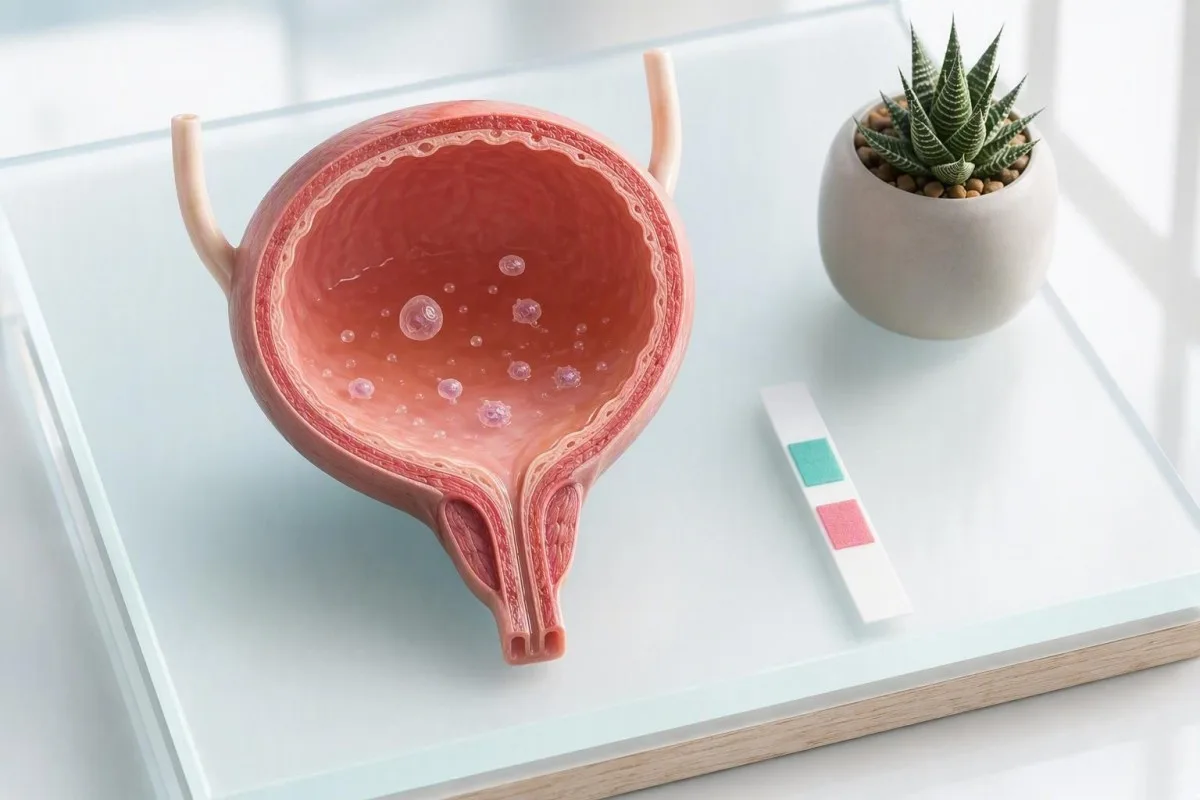
This discordant dipstick pattern often reflects urinary white cells, but it does not confirm a UTI on its own. Symptoms, collection quality, pregnancy status, and urine culture determine what should happen next.


- Leukocyte esterase detects an enzyme released by white blood cells; a positive result suggests urinary inflammation, not automatically infection.
- Nitrite negative does not rule out a UTI because some bacteria do not make nitrite and urine must usually remain in the bladder for about 4 hours.
- Culture first is usually more useful than repeating a dipstick when symptoms are significant, pregnancy is possible, antibiotics have failed, or infection keeps returning.
- Contamination clues include many squamous epithelial cells, mixed bacterial growth, vaginal discharge, and an improperly collected specimen.
- Urgent symptoms include fever of 38.0°C or higher, flank pain, vomiting, pregnancy with urinary symptoms, confusion in an older adult, or inability to pass urine.
- Asymptomatic bacteriuria should generally not be treated in non-pregnant adults, even when dipstick results are abnormal.
- Microscopy matters because more than 5 white blood cells per high-power field supports pyuria but still requires clinical context.
- A negative nitrite test is especially common with Enterococcus, Staphylococcus saprophyticus, short bladder dwell time, dilute urine, and low dietary nitrate intake.
What This Dipstick Combination Actually Means
Leukocyte esterase positive, nitrite negative means the urine contains evidence of white blood cells but no detectable bacterial nitrite reaction. In a person with burning urine and new frequency, this can still be a UTI; in someone without symptoms, contamination or non-infectious irritation is often more likely.
Leukocyte esterase is an enzyme associated mainly with neutrophils, the white cells that migrate into urine during irritation or infection. A trace or 1+ result carries much less weight than 2+ or 3+ leukocyte esterase combined with symptoms, visible pyuria, and a single-organism culture. The dipstick does not identify the cause of those cells, which is why it is a screening test rather than a diagnosis.
Nitrite reflects a different process: certain bacteria convert dietary nitrate to nitrite while urine sits in the bladder. A person who drinks frequently, urinates every 1 to 2 hours, or provides a very dilute sample may have a real infection yet remain nitrite negative. The complete urinalysis guide explains why dipstick chemistry and microscopy can disagree.
As of August 28, 2026, I would interpret this pattern as a question to answer, not a result to treat. Dr. Thomas Klein has seen patients receive unnecessary antibiotics after one positive square on a strip, while others with classic cystitis symptoms needed a culture despite a completely negative nitrite field.
Why Leukocyte Esterase and Nitrite Can Disagree
The two dipstick pads measure separate biological events: white-cell activity versus bacterial nitrate reduction. A discordant result is therefore biologically plausible and fairly common, particularly early in a symptomatic lower urinary infection.
A positive leukocyte esterase result suggests pyuria, while a nitrite result depends on bacterial species, urinary nitrate, bladder dwell time, and strip handling. In the systematic review by Devillé et al. (2004), dipstick performance varied substantially across clinical settings; neither pad alone reliably confirmed infection. Combining symptoms with results is more accurate than treating either color change as decisive.
Most nitrate-reducing Enterobacterales, including many Escherichia coli strains, can produce nitrite under the right conditions. Enterococcus species and Staphylococcus saprophyticus commonly produce nitrite-negative UTIs, and a sample collected after only 30 to 60 minutes in the bladder may not accumulate measurable nitrite even with E. coli.
Kantesti is an AI blood test analyzer that places laboratory findings in clinical context, but a home urine strip cannot replace culture-based organism identification. When a urine report accompanies kidney markers, our kidney-result guide can help patients prepare more focused questions for their clinician.
When Nitrite-Negative Results Still Point to a UTI
A nitrite-negative dipstick can still support a UTI when urinary symptoms are new and localized, especially dysuria, urgency, frequency, or suprapubic discomfort. The probability rises further when microscopy shows more than 5 white blood cells per high-power field.
In an otherwise well non-pregnant woman with new dysuria and frequency but no vaginal discharge, the pre-test probability of acute cystitis is already high. Leukocyte esterase adds support, but a negative nitrite result does not meaningfully dismiss that clinical picture. The useful question is whether symptoms are confined to the bladder or suggest a more serious upper-tract process.
A 29-year-old patient I reviewed had 3+ leukocyte esterase, negative nitrite, 20 to 30 white cells per high-power field, and repeated urination every 45 minutes. Her culture later grew Enterococcus faecalis, illustrating why a negative nitrite square should not be treated as a clean bill of health. See our practical comparison of urinalysis and culture for the different roles of each test.
Classical bacterial cystitis usually causes burning and frequency without high fever or flank pain. Fever at or above 38.0°C, pain below the ribs at the back, rigors, or vomiting changes the risk assessment because kidney involvement becomes possible. Those symptoms deserve same-day clinical advice rather than another over-the-counter strip.
Contamination Is a Common Explanation for Positive Leukocyte Esterase
Contamination can cause positive leukocyte esterase because white cells from vaginal secretions, skin, or an unclean collection enter the container. Many squamous epithelial cells on microscopy make a contaminated midstream sample more likely, although they do not prove it.
A clean-catch midstream specimen means washing the surrounding area, beginning to urinate into the toilet, then collecting the middle portion without touching the inside of the container. Delays matter too: urine left at room temperature for more than 2 hours can allow bacterial changes that distort sediment and chemistry. Refrigeration slows those changes if prompt processing is unavailable.
Menstrual flow, vaginal thrush, bacterial vaginosis, genital skin inflammation, and heavy discharge can all add leukocytes to a sample. In this setting, repeating a carefully collected sample after symptoms settle may be sensible, but culture is preferable if urinary symptoms are substantial. Our guide to epithelial cells in urine helps distinguish a collection issue from a urinary-tract clue.
Mixed growth on culture often means collection contamination rather than several true urinary pathogens, particularly when there is no dominant organism. That said, people with catheters, urinary reconstruction, or complicated infections can genuinely have polymicrobial cultures, so clinicians should not dismiss mixed growth automatically. Context beats shortcuts.
Other Causes of White Blood Cells in Urine
White blood cells in urine can occur without a routine bacterial UTI. Stones, sexually transmitted infections, recent instrumentation, interstitial cystitis, kidney inflammation, and certain medicines can produce sterile pyuria—pyuria with a negative standard culture.
Sterile pyuria is usually defined as urine white cells with no growth on routine culture, although exact cutoffs differ by laboratory. A recent antibiotic dose can suppress culture growth for 24 to 48 hours while inflammation persists. This is one reason clinicians ask whether antibiotics were started before the sample was collected.
Kidney stones often cause colicky side pain and blood on urinalysis, while chlamydia can produce dysuria and pyuria with a negative routine urine culture. A sexual-health nucleic acid test—not a conventional urine culture—is appropriate when exposure history, urethral symptoms, or pelvic symptoms fit. Visible or microscopic blood merits its own hematuria assessment.
Drug-induced interstitial nephritis is uncommon but clinically meaningful; proton-pump inhibitors, non-steroidal anti-inflammatory drugs, and some antibiotics are recognized triggers. Pyuria plus rising creatinine, rash, fever, or eosinophilia needs medical review promptly. Dr. Thomas Klein would not reassure a patient based solely on a negative nitrite result when kidney function is changing.
Symptoms That Change How Quickly You Need Care
Fever, flank pain, vomiting, pregnancy, systemic weakness, or confusion make a leukocyte esterase positive result more urgent because they can signal infection beyond uncomplicated cystitis. Severe illness can occur with either a nitrite-positive or nitrite-negative strip.
Seek same-day care for temperature of 38.0°C or higher, shaking chills, pain in the flank, repeated vomiting, new confusion, or inability to keep fluids down. These features raise concern for pyelonephritis or systemic illness, where delayed treatment can matter. In adults with suspected sepsis, urgent assessment includes vital signs and often blood work, as described in our sepsis-marker overview.
Pregnancy deserves a lower threshold for contact because urinary infections can progress more quickly and may affect pregnancy outcomes. Urinary symptoms in pregnancy should prompt a properly collected culture, even when the dipstick is equivocal. Group B streptococcus, for example, changes obstetric planning when found at significant counts; see pregnancy GBS testing.
Older adults complicate this picture. Cloudy or smelly urine alone is not enough to diagnose UTI, and baseline bacteriuria is common; acute fever, urinary symptoms, haemodynamic instability, or a clear alternative explanation should guide evaluation. A dipstick is not a diagnosis of delirium.
When a Urine Culture Is Better Than Repeating a Dipstick
Urine culture is more useful than a repeat dipstick when symptoms persist, infection recurs, pregnancy is present, antibiotics have not worked, or the presentation is complicated. Culture identifies the organism and reports antibiotic susceptibility; a dipstick cannot do either.
A repeat dipstick merely repeats an indirect chemical screen, often with the same collection weaknesses. Culture is generally collected before antibiotics when practical, because even one or two doses can reduce bacterial recovery. A reported count of at least 10^5 colony-forming units per mL was historically used as a benchmark, but symptomatic patients may have meaningful lower counts depending on the organism and sampling method.
For recurrent uncomplicated UTI, defined by many guidelines as at least 2 episodes in 6 months or 3 in 12 months, obtaining culture during an acute episode helps separate relapse, reinfection, resistance, and noninfectious mimics. Review urine culture counts and mixed growth before assuming every positive report needs the same treatment.
Kantesti is an AI lab test interpretation service that can organize kidney function, inflammatory markers, and prior laboratory history, but culture-directed prescribing remains a clinician-led decision. A culture is especially valuable after recent travel, urinary procedures, catheter use, immunosuppression, or resistant infection history.
How to Read the Rest of the Urinalysis Pattern
Leukocyte esterase becomes more meaningful when paired with urine microscopy, blood, protein, specific gravity, and symptoms. No single urinalysis element has a universal “normal range” equivalent to a blood chemistry result.
More than 5 white blood cells per high-power field commonly supports pyuria, while more than 3 red blood cells per high-power field on a properly collected specimen is microscopic hematuria that may need follow-up. Protein at 1+ or more can be transient during fever or infection, but persistent protein needs quantitative assessment. Our guide to protein in urine explains why albumin-to-creatinine ratio is often the next test.
Specific gravity below 1.005 indicates very dilute urine in many laboratories and can reduce the concentration of cells and nitrite. Specific gravity above 1.030 may reflect dehydration, glucose, or other solutes, and concentrated urine can make symptoms feel worse. The specific gravity guide discusses collection timing and hydration effects.
White-cell casts are different from free-floating white cells: they point toward a kidney source and warrant prompt evaluation. Granular casts, rising creatinine, and hypertension suggest a broader renal assessment rather than simple cystitis. A strip cannot reliably identify casts; microscopy is required.
Medicines, Vitamin C, and Handling Errors That Affect Results
Vitamin C, recent antibiotics, very dilute urine, and delayed strip reading can alter dipstick reliability. False-negative nitrite results are particularly associated with ascorbic acid exposure and short bladder incubation time.
Large vitamin C doses can interfere with several dipstick oxidation reactions, although the effect varies by strip manufacturer and urine concentration. If you take 500 to 1,000 mg daily, tell the clinician or laboratory rather than stopping prescribed supplements without advice. A first-morning specimen may improve nitrite detection because it has usually remained in the bladder longer.
Phenazopyridine can turn urine orange and make color interpretation unreliable, while antibiotics may leave leukocyte esterase positive after bacterial burden has fallen. Dipsticks should be read at the manufacturer-specified time—often around 60 to 120 seconds depending on the pad—because late reading can create misleading color changes. Our review of urine color changes covers benign and concerning causes.
Home strips are useful for noticing patterns but poor at determining whether antibiotics are necessary. If symptoms and strip results conflict, prioritize symptoms and professional evaluation. In my experience, photographing the strip beside its timing instructions can help clinicians understand what was actually observed.
What If You Feel Well but the Dipstick Is Abnormal?
An abnormal dipstick without urinary symptoms usually should not trigger antibiotics in non-pregnant adults. Asymptomatic bacteriuria and pyuria are common, particularly in older adults and people with diabetes, catheters, or urinary abnormalities.
The 2019 IDSA guideline led by Nicolle et al. recommends screening and treating asymptomatic bacteriuria mainly in pregnancy and before selected invasive urologic procedures. Treating colonization in most other groups does not improve outcomes and can select resistant organisms. Positive leukocyte esterase alone is even less specific than a positive culture.
A non-pregnant adult who feels entirely well, has no fever, and has no urinary symptoms usually needs neither an urgent repeat strip nor leftover antibiotics. Exceptions are individualized: planned urinary tract instrumentation, severe immune compromise, or a clinician investigating unexplained renal findings may change the plan. This distinction is a practical safeguard against overtreatment.
Kantesti AI interprets laboratory patterns alongside reported context rather than declaring a UTI from leukocyte esterase alone. Our medical validation approach describes why findings that lack symptoms are flagged for clinical correlation rather than converted into a diagnosis.
Pregnancy, Children, Men, and Catheter Users Need Different Rules
Pregnancy, childhood, male urinary symptoms, and catheter use lower the reliability of simple dipstick-based decisions and often increase the value of culture. The same positive leukocyte esterase negative nitrite pattern has different implications across these groups.
During pregnancy, clinicians commonly culture urine when symptoms are present and screen for asymptomatic bacteriuria early in prenatal care. A culture with 10^5 colony-forming units per mL of a single organism has traditionally supported asymptomatic bacteriuria, although management of lower counts depends on organism and circumstances. Dipstick negative nitrite does not safely exclude pregnancy-related infection.
In children, collection method is crucial. A bag specimen can be useful for screening but has a high contamination rate; catheterized or clean-catch samples are better for confirming infection depending on age and toilet training. Fever without an obvious source in a young child needs pediatric assessment, not an adult home-strip algorithm.
Urinary symptoms in men are less often straightforward cystitis and can reflect prostatitis, obstruction, stones, or sexually transmitted infection. Catheter users often have bacteria and white cells without symptoms, so fever, pelvic discomfort, flank pain, or systemic signs matter more than urine appearance. For urinary frequency without infection, review blood tests for frequent urination.
A Sensible Next-Step Plan After This Result
The next step after leukocyte esterase positive, nitrite negative depends on symptoms and risk, not on how dark the test pad looks. Mild uncomplicated symptoms may justify a clinician-guided assessment within 24 to 48 hours, while red flags need same-day care.
If you have mild new burning or frequency but no fever, flank pain, vomiting, pregnancy, or major illness, contact a clinician or local pharmacy service for advice and ask whether culture is needed. Bring a list of antibiotic allergies, recent antibiotic use, prior culture results, and whether symptoms started after sexual activity. Those details often change the initial plan more than a second strip.
If contamination seems likely and symptoms are absent or minimal, repeat one carefully collected midstream specimen rather than repeatedly testing random samples. Avoid testing immediately after drinking several litres of water; dilute urine can obscure sediment findings. New mucus may be benign, but persistent symptoms with it deserve context from our mucus-in-urine guide.
Do not self-start antibiotics saved from an earlier episode. An incomplete or mismatched course can reduce culture yield and increase resistance without treating the true cause. The practical aim is simple: obtain a good sample before treatment when possible, then match intervention to symptoms and risk.
Questions to Bring to Your Clinician or Pharmacist
The best questions are specific: whether the sample was contaminated, whether microscopy supports pyuria, whether culture is indicated, and which symptoms would require urgent reassessment. Asking these questions helps turn an ambiguous dipstick into a safe plan.
Ask, “Were squamous epithelial cells present, and was this a clean-catch specimen?” Then ask whether there were more than 5 white blood cells per high-power field, red cells, protein, or casts. These details distinguish a positive chemistry pad from a pattern that deserves renal or urologic follow-up.
If antibiotic treatment is proposed, ask whether a culture was obtained first and what result would prompt a change in therapy. Ask for a timeframe: uncomplicated symptoms should generally begin to improve within 48 to 72 hours after effective treatment, while worsening symptoms need earlier review. The nitrite-in-urine explainer can help you understand why organism biology affects strips.
Kantesti is an AI-powered blood test analysis tool used across 127+ countries to help people understand laboratory context and prepare for clinical conversations. Our doctors and medical reviewers set safety boundaries for that work; readers can review the Medical Advisory Board and should use urgent local care when symptoms are severe.
The Bottom Line on Discordant Urine Dipsticks
Positive leukocyte esterase with negative nitrite indicates urinary white-cell activity without detectable nitrate-reducing bacterial activity. It can fit a UTI, but it can also reflect contamination, dilute urine, a non-nitrite-producing organism, recent antibiotics, stones, or noninfectious inflammation.
For people with clear bladder symptoms, negative nitrite does not rule out infection; culture is particularly useful when symptoms are recurrent, complicated, severe, or treatment-resistant. For people without symptoms, abnormal dipstick findings usually should not lead to antibiotics. That distinction prevents both missed illness and unnecessary treatment.
The most clinically useful evidence chain is symptoms plus clean collection plus microscopy or culture—not multiple home strips. Keep a brief record of fever, pain location, pregnancy status, fluid intake, medications, and previous organisms. This is the same principle we use when interpreting trends rather than isolated values in our lab-trend analysis.
Dr. Thomas Klein’s final practical advice is uncomplicated: do not panic over one discordant strip, but do not ignore fever, flank pain, vomiting, pregnancy, or worsening illness. Kantesti’s AI technology guide explains how our clinical-context approach separates a laboratory signal from a diagnosis.
Frequently Asked Questions
Can you have a UTI with positive leukocyte esterase and negative nitrite?
Yes. A UTI can produce positive leukocyte esterase and negative nitrite because nitrite requires particular bacteria, adequate dietary nitrate, and usually about 4 hours of bladder dwell time. Enterococcus and Staphylococcus saprophyticus commonly cause nitrite-negative infections. New dysuria, urgency, frequency, and more than 5 white blood cells per high-power field make infection more likely, while urine culture identifies the organism.
Does positive leukocyte esterase always mean infection?
No. Positive leukocyte esterase indicates white blood cells or their enzyme activity in urine, not a confirmed bacterial infection. Vaginal contamination, kidney stones, sexually transmitted infections, recent antibiotics, interstitial cystitis, and kidney inflammation can all produce this result. In a person with no urinary symptoms, a positive dipstick alone usually does not justify antibiotics.
How long should urine stay in the bladder for nitrite to become positive?
Urine generally needs to remain in the bladder for approximately 4 hours for nitrate-reducing bacteria to generate enough nitrite for many dipsticks to detect. First-morning urine may therefore be more likely to test nitrite positive than a sample collected after frequent daytime urination. Even after 4 hours, Enterococcus and some other organisms may remain nitrite negative because they do not reliably reduce nitrate.
Should I repeat a dipstick or ask for a urine culture?
A urine culture is usually more informative than repeating a dipstick when urinary symptoms persist beyond 48 hours, symptoms recur, pregnancy is present, fever or flank pain occurs, or antibiotics have not helped. Culture reports the organism and antibiotic susceptibility, whereas a dipstick only detects indirect chemical signals. A carefully collected repeat dipstick can be reasonable when contamination is likely and symptoms are absent or very mild.
What leukocyte esterase result is concerning?
A 2+ or 3+ leukocyte esterase result is more suggestive of substantial urinary white-cell activity than trace or 1+, but no leukocyte esterase grade alone defines severity. Clinical urgency depends on symptoms such as fever of 38.0°C or higher, flank pain, vomiting, pregnancy, and impaired immune function. Microscopy showing more than 5 white blood cells per high-power field and a positive single-organism culture provide stronger evidence than dipstick grade alone.
Can dehydration cause positive leukocyte esterase?
Dehydration does not usually create leukocyte esterase by itself, but concentrated urine can make existing cells and symptoms more noticeable and can complicate strip interpretation. Specific gravity above 1.030 often suggests concentrated urine, although glucose and other solutes can also raise it. Hydration may improve comfort, but it should not be used to delay assessment of fever, flank pain, vomiting, or worsening urinary symptoms.
Get AI-Powered Blood Test Analysis Today
Join over 2 million users worldwide who trust Kantesti for instant, accurate lab test analysis. Upload your blood test results and receive comprehensive interpretation of 15,000+ biomarkers in seconds.
📚 Referenced Research Publications
Klein, T., Mitchell, S., & Weber, H. (2026). Diarrhea After Fasting, Black Specks in Stool & GI Guide 2026. (2026). Figshare. https://doi.org/10.6084/m9.figshare.31438111. ResearchGate: https://www.researchgate.net/; Academia.edu: https://www.academia.edu/. Kantesti AI Medical Research.
Klein, T., Mitchell, S., & Weber, H. (2026). Women's Health Guide: Ovulation, Menopause & Hormonal Symptoms. (2026). Figshare. https://doi.org/10.6084/m9.figshare.31830721. ResearchGate: https://www.researchgate.net/; Academia.edu: https://www.academia.edu/. Kantesti AI Medical Research.
📖 External Medical References
⚕️ Medical Disclaimer
This article is for educational purposes only and does not constitute medical advice. Always consult a qualified healthcare provider for diagnosis and treatment decisions.
E-E-A-T Trust Signals
Experience
Physician-led clinical review of lab interpretation workflows.
Expertise
Laboratory medicine focus on how biomarkers behave in clinical context.
Authoritativeness
Written by Dr. Thomas Klein with review by Dr. Sarah Mitchell and Prof. Dr. Hans Weber.
Trustworthiness
Evidence-based interpretation with clear follow-up pathways to reduce alarm.