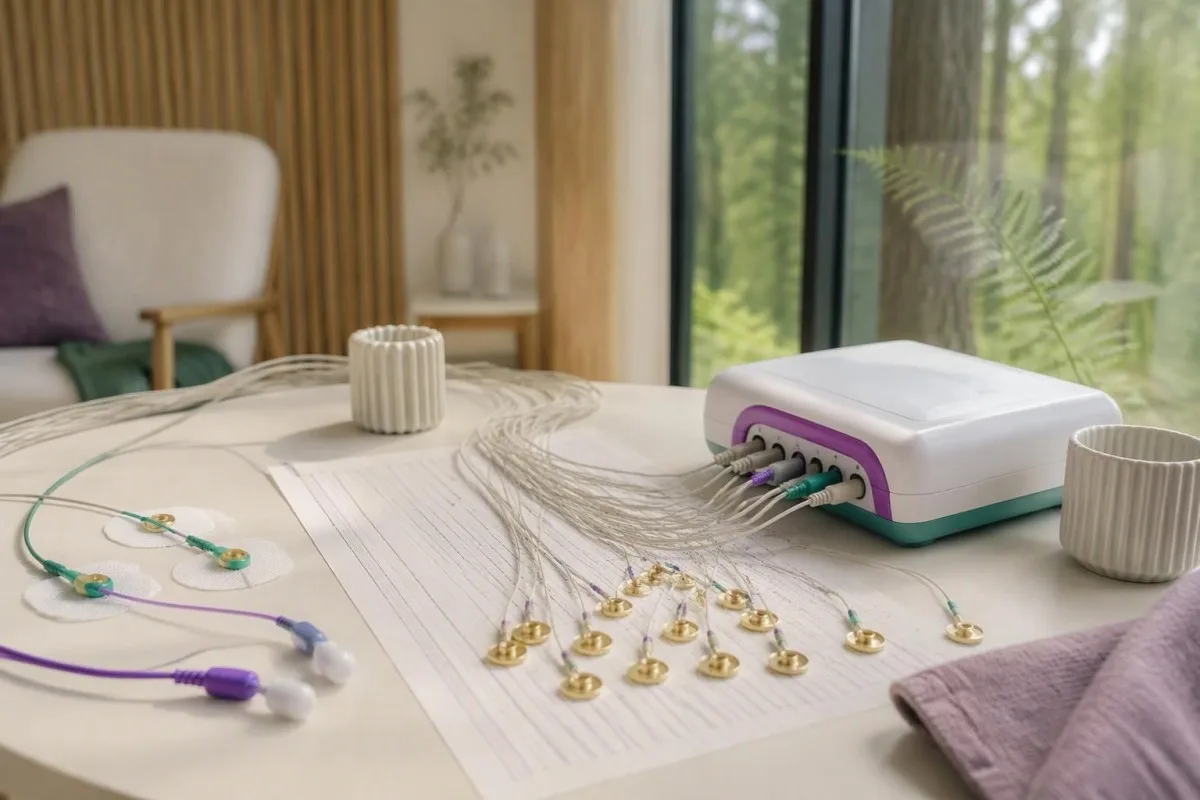
The right diagnosis depends on what happens before the sleep study—not just how quickly you fall asleep during it. Here is how specialists separate narcolepsy from sleep debt, medication effects and other causes of daytime sleepiness.


- Narcolepsy test usually means an attended overnight sleep study followed by a next-day multiple sleep latency test; routine bloodwork cannot confirm the diagnosis.
- MSLT threshold is a mean sleep latency of 8 minutes or less with at least 2 sleep-onset REM periods, interpreted alongside symptoms and testing conditions.
- Overnight REM beginning within 15 minutes of sleep onset can count as 1 qualifying sleep-onset REM period.
- Sleep preparation generally includes 2 weeks of sleep diaries and, when available, actigraphy to document sufficient sleep and a stable schedule.
- Overnight sleep minimum for the standard adult MSLT pathway is at least 7 hours in bed and 6 hours asleep during the preceding polysomnogram.
- Medication planning often requires approximately 2 weeks of clinician-directed adjustment; some long-half-life medicines need up to 6 weeks.
- CSF hypocretin-1 at 110 pg/mL or less, or below one-third of the normal mean for the same standardized assay, supports narcolepsy type 1 in the appropriate clinical setting.
- Driving safety comes before diagnostic certainty: do not drive if you cannot reliably remain awake, and discuss local licensing requirements with your clinician.
What is the usual narcolepsy testing pathway?
A narcolepsy test usually combines an attended overnight polysomnogram with a next-day multiple sleep latency test, after adequate sleep and medication review. A mean sleep latency of 8 minutes or less plus at least 2 sleep-onset REM periods supports diagnosis in the right clinical setting; selected patients need cerebrospinal fluid hypocretin testing instead. Routine bloodwork cannot confirm narcolepsy.
Testing begins with the history, not a laboratory booking. Specialists ask about unintended naps, work schedules, nighttime sleep, snoring, emotion-triggered weakness and medicines; persistent daytime sleepiness for approximately 3 months is particularly relevant to narcolepsy type 2 criteria, although referral should happen sooner when safety is affected.
Kantesti is an AI blood test analyzer that can help explain preliminary findings such as hemoglobin or thyroid results, but it does not diagnose narcolepsy or replace the 2-part sleep-laboratory assessment. Our role is to clarify possible contributors to tiredness without turning a normal laboratory panel into false reassurance.
I’m Thomas Klein, Chief Medical Officer at Kantesti, and my clinical approach is to separate 3 questions: is the patient genuinely sleepy, was the sleep test technically valid, and does the overall pattern meet diagnostic criteria? The scope of our organization is blood-test interpretation—not automated certification of sleep disorders.
A positive MSLT is not a diagnosis by itself. Someone sleeping 5 hours nightly can produce a convincing-looking result for the wrong reason, while someone taking a REM-suppressing antidepressant may have narcolepsy without the expected REM pattern; preparation belongs in the interpretation, not in the small print.
When does daytime sleepiness warrant a specialist assessment?
Excessive daytime sleepiness means difficulty staying awake or unintended sleep during waking activities; fatigue means low energy without necessarily falling asleep. An Epworth Sleepiness Scale score above 10 suggests increased sleepiness, but no questionnaire score can confirm or exclude narcolepsy.
Sleepiness during active tasks carries more immediate risk than dozing during a quiet evening. Ask whether sleep occurs during conversations, meals or driving, and record 2 or 3 concrete examples; “I am exhausted” gives a specialist less useful information than “I fall asleep while speaking with colleagues.”
The Epworth scale ranges from 0 to 24, using eight everyday situations. A person may underestimate symptoms because they avoid sedentary activities, whereas depression, sedating medicines or untreated sleep apnea can increase the score without narcolepsy; the questionnaire measures a problem, not its cause.
Fatigue and sleepiness can coexist. A hypothetical 34-year-old who feels drained but never naps needs a different initial assessment from someone with irresistible sleep episodes despite adequate opportunity to sleep; our discussion of medical causes of low motivation explains why overlapping language can misdirect testing.
There is no need to wait 3 months to discuss a safety problem. Seek prompt assessment for recurrent unintended sleep, workplace near misses or inability to stay awake while supervising children; sudden new drowsiness with confusion, breathing difficulty or focal weakness needs urgent medical evaluation rather than a routine narcolepsy referral.
Which symptoms make narcolepsy more likely?
Cataplexy—brief loss of muscle tone triggered by emotion, usually with preserved awareness—is the strongest clinical clue to narcolepsy type 1. Episodes often last seconds to approximately 2 minutes; sleep paralysis and dreamlike experiences at sleep transitions are less specific.
Cataplexy does not always mean collapsing. Laughter may cause a slack jaw, head drop, slurred speech or knees that briefly give way, while the person remains aware; a 10-second episode can matter as much as a more visible event if the trigger and preserved consciousness are characteristic.
A description of the trigger helps distinguish competing explanations. Weakness after amusement is different from fainting after standing, weakness after prolonged exertion or a seizure with impaired awareness; fatigable weakness and antibody testing concern another diagnostic pathway, not a substitute narcolepsy test.
Sleep paralysis can occur without narcolepsy, particularly with sleep deprivation or irregular schedules. Record whether episodes occur on falling asleep or waking, and whether dreamlike images last seconds or minutes; symptoms outside sleep transitions may need a broader neurological or mental-health assessment.
A witness can add details the patient cannot observe. With consent, a short safely obtained video of 1 typical weakness episode may help a specialist assess facial tone and awareness, but nobody should provoke an episode, withhold treatment or create a fall risk merely to capture evidence.
How should you prepare during the two weeks before testing?
Adult MSLT preparation generally requires 2 weeks of sleep diaries, with actigraphy when available, to document sufficient sleep and a stable schedule. Most adults need approximately 7–9 hours nightly, and the laboratory should time testing around the person’s usual major sleep period rather than impose an unsuitable schedule.
Sleep opportunity and actual sleep are different measurements. A diary should record bedtime, estimated sleep onset, awakenings, final waking, naps and work shifts for 14 days; actigraphy estimates movement-related sleep patterns but cannot identify REM sleep or independently diagnose narcolepsy.
The AASM adult protocol recommends documenting adequate sleep before the MSLT and arranging sufficient overnight sleep during the preceding study (Krahn et al., 2021). One good laboratory night cannot reliably erase a fortnight of restricted sleep, so a specialist may postpone testing rather than interpret an avoidably ambiguous result.
Shift work needs individualized scheduling. A rotating worker who moves from nights to days only 48 hours before testing may still have substantial circadian misalignment; ask the laboratory how much schedule stabilization it requires, and disclose recent travel rather than assuming a daytime nap test fits everyone.
Poor sleep can also change preliminary laboratory measurements, but those changes do not identify narcolepsy. Our guide to results after poor sleep helps distinguish bloodwork context from the much stricter 2-week preparation needed for a valid sleepiness assessment.
Which medicines can distort MSLT results?
Alerting, sedating and REM-modulating medicines can distort the MSLT, so the sleep specialist should create a written medication plan before testing. The AASM adult protocol commonly uses approximately 2 weeks of adjustment or washout, with up to 6 weeks for selected long-half-life drugs; never stop prescribed medication independently.
REM suppression can produce a false-negative narcolepsy pattern. Many antidepressants reduce REM expression, meaning a patient may fall asleep quickly yet show fewer than 2 sleep-onset REM periods; the report should identify the specific medicine, dose, last administration and whether withdrawal was feasible.
Abrupt withdrawal can create the opposite problem: REM rebound. Stopping a REM-suppressing medicine shortly before testing may increase early REM and resemble narcolepsy, while antidepressant withdrawal can also destabilize mood; Krahn et al. (2021) recommend individualized planning rather than a universal stop-everything instruction.
Sedating medicines may shorten sleep latency, while stimulants and wake-promoting drugs may lengthen it. Bring a list covering prescriptions, nonprescription products and recreational substances, including antihistamines and cannabis; medication effects in older adults illustrate why symptoms and laboratory values must be interpreted together.
Safety can outweigh an ideal washout. If stopping treatment risks severe depression, seizures or another unstable condition, the clinician may test with documented limitations, defer the MSLT or consider an alternative diagnostic route; “off medication for 14 days” is not automatically safer or more scientifically appropriate for every patient.
What does the overnight sleep study measure?
Overnight polysomnography measures sleep stages, breathing, oxygen levels, heart rhythm and movement before the daytime MSLT. The standard adult protocol requires at least 7 hours in bed and 6 hours of recorded sleep during the preceding study; a home sleep apnea test cannot provide the required sleep-stage assessment.
The preceding study is attended and uses brain-wave recording. Scalp EEG, eye-movement channels and chin muscle activity distinguish REM from non-REM sleep, while breathing sensors identify apnea; an oxygen recorder alone cannot tell whether REM began within 15 minutes of sleep onset.
Untreated sleep apnea can undermine interpretation, particularly when breathing disturbances substantially fragment sleep. A person already prescribed PAP treatment should ask whether to bring their device and mask, and whether 2 weeks of downloaded treatment data are needed; effectiveness and actual use matter more than owning the equipment.
An MSLT should not ordinarily follow a split-night study or PAP-titration night. Those procedures change the night’s structure and may leave insufficient representative sleep; the laboratory can recommend a separate diagnostic sequence instead of forcing 2 different investigations into one visit (Krahn et al., 2021).
Sleep-study preparation is not blood-test fasting preparation. Ask about meals, caffeine, hair products and equipment-specific instructions; if your clinician also orders preliminary labs, preparing for baseline bloodwork is a separate task, and an unnecessary overnight fast may make the next day less comfortable.
What happens during the multiple sleep latency test?
The multiple sleep latency test usually provides 5 daytime nap opportunities, beginning approximately 1.5–3 hours after the overnight study ends. Each trial measures time to sleep onset and whether REM appears soon afterward; naps normally begin approximately 2 hours apart.
A trial ends after 20 minutes if no sleep occurs. If sleep starts, recording generally continues for 15 minutes after sleep onset to look for REM; the laboratory, rather than the patient’s perception of having slept, determines the scored latency from physiological recordings.
No-sleep trials count as a 20-minute latency in the mean calculation. This matters because one rapid nap does not determine the result: five latencies of 2, 4, 8, 12 and 20 minutes average 9.2 minutes, which does not meet the usual narcolepsy latency threshold.
Between naps, patients must remain awake, following the laboratory’s instructions about activity, light exposure and meals. Unrecorded dozing can reduce sleep pressure before the next trial; a 4-nap test is acceptable only under specified protocol conditions, not simply because someone wants to leave early.
Kantesti cannot infer sleep latency from a routine laboratory PDF. A sleep specialist needs the scored recordings, preparation history and clinical symptoms; our guide to checking medical report explanations explains why a confident explanation is not equivalent to having the correct source data for 5 monitored naps.
How are MSLT results for narcolepsy interpreted?
MSLT results for narcolepsy usually require a mean sleep latency of 8 minutes or less and at least 2 sleep-onset REM periods, alongside compatible symptoms and exclusion of other explanations. A qualifying REM period on the preceding polysomnogram can replace 1 of the daytime REM periods.
A sleep-onset REM period means REM begins within 15 minutes of sleep onset. Early REM is useful because it reflects an unusual sleep-stage transition, not merely severe tiredness; insufficient sleep, circadian timing and medicine effects can nevertheless create similar transitions without narcolepsy.
The 8-minute cutoff is a diagnostic convention, not a biological cliff. Results of 7.9 and 8.1 minutes are close physiologically but fall on different sides of the criterion, so the clinician should consider protocol quality, symptoms and alternative diagnoses rather than treat rounding as certainty.
One abnormal component is insufficient for the usual MSLT-based narcolepsy diagnosis. A mean latency of 5 minutes with no SOREMPs demonstrates substantial sleep propensity but not the characteristic REM pattern; two SOREMPs with a mean above 8 minutes likewise require further clinical interpretation.
These are diagnostic criteria, not ordinary laboratory reference intervals. Our explanation of out-of-range laboratory results provides a useful contrast: a positive-pattern MSLT must still be matched to a syndrome and a valid testing protocol.
Can insufficient sleep cause a false-positive narcolepsy test?
Insufficient sleep and circadian misalignment can produce a false-positive MSLT pattern, including short sleep latency and early REM. Documenting 2 weeks of adequate sleep is therefore part of diagnosis, not an optional lifestyle recommendation; one adequate overnight study does not automatically eliminate chronic sleep debt.
Shift work is a recognized predictor of positive MSLTs outside clear narcolepsy. Goldbart et al. (2014), studying the Wisconsin Sleep Cohort, found associations with shift work and short sleep; the practical lesson is to scrutinize the schedule before interpreting the REM count as disease-specific.
Delayed sleep timing can also cause trouble. If a person naturally sleeps from 3 a.m. to 11 a.m., waking them at 6 a.m. for a conventional laboratory schedule truncates sleep and changes circadian context; the specialist should plan the overnight and daytime testing together.
Recent travel belongs in the history, even when the patient feels they have adjusted. Crossing several time zones can alter sleep timing and preliminary bloodwork; our discussion of jet lag and test timing is relevant context, but a sleep laboratory needs its own stabilization plan.
Caffeine withdrawal is another avoidable confounder. A habitual intake of 300 mg daily stopped suddenly on test morning can cause headache and sleepiness, so ask about a supervised taper; the AASM adult protocol aims for test-day abstinence while minimizing withdrawal rather than leaving patients to improvise.
What if the MSLT is negative but symptoms remain convincing?
A negative MSLT does not exclude narcolepsy in every circumstance, especially when REM-suppressing medication, inadequate preparation or an unsuitable schedule affects testing. If symptoms remain convincing, a specialist may recommend a properly prepared repeat study or, when type 1 is suspected, CSF hypocretin-1 testing.
Repeatability differs between narcolepsy types. Ruoff et al. (2018) found that MSLT findings were more repeatable in narcolepsy type 1 than type 2 in a retrospective study; this does not mean type 2 is unreal, but it does mean a single threshold-based label deserves careful review.
The first step is an audit, not an automatic repeat booking. Check 5 items: the two-week sleep record, overnight sleep duration, medication plan, test timing and nap-by-nap results; our report accuracy checklist encourages the same habit of checking source information before accepting a summary.
A repeat test should correct an identifiable problem when possible. If an antidepressant could not be withdrawn safely, repeating the same protocol 1 month later without any change may add little; a specialist should explain what new information the second assessment is expected to provide.
Very short latency without sufficient SOREMPs can point toward another hypersomnolence disorder. Idiopathic hypersomnia may involve long sleep time, severe sleep inertia and unrefreshing naps, with assessment sometimes requiring 24-hour sleep measurement or extended actigraphy; these findings cannot be sorted out from the MSLT mean alone.
How do specialists distinguish narcolepsy type 1 from type 2?
Narcolepsy type 1 is associated with hypocretin deficiency or characteristic cataplexy with qualifying sleep findings; type 2 requires a qualifying MSLT without cataplexy and without a better explanation. Type 2 criteria include persistent daytime sleepiness for at least 3 months.
Low CSF hypocretin can identify type 1 even without recognized cataplexy. The accepted deficient range is 110 pg/mL or less, or below one-third of the normal mean using the same standardized assay; absence of obvious weakness therefore does not automatically establish type 2.
Current ICSD-3-TR criteria provide more than one type 1 diagnostic route. Characteristic cataplexy with a qualifying nocturnal SOREMP can establish type 1 through a specialist-assessed pathway even without a diagnostic MSLT; the nocturnal REM onset must be within 15 minutes, and competing explanations still require exclusion.
A type 2 diagnosis should not simply mean “sleepy, no cataplexy.” The clinician must document the qualifying 8-minute and 2-SOREMP MSLT pattern and exclude sleep deprivation, circadian disorders, other sleep disorders, medicine effects and relevant medical or psychiatric explanations.
Children require age-appropriate interpretation rather than automatic adult cutoffs and scheduling. Adult preparation recommendations cannot be transferred uncritically to an 8-year-old with different sleep needs or an adolescent with delayed sleep timing; AI interpretation limits in children reinforce why pediatric specialist expertise matters.
When does CSF hypocretin testing help?
CSF hypocretin-1 testing helps when narcolepsy type 1 is strongly suspected but sleep testing is inconclusive or difficult to perform validly. A level of 110 pg/mL or less, or below one-third of the assay’s normal mean, supports hypocretin deficiency; the sample requires a lumbar puncture, not an ordinary blood test.
The test is selective because lumbar puncture has procedural burdens. A specialist weighs potential benefit against headache risk, contraindications and laboratory availability; it is particularly useful when convincing cataplexy exists but medication prevents a valid 2-week washout or an MSLT remains difficult to interpret.
Intermediate hypocretin results require assay-specific interpretation. A value above 110 pg/mL but below a laboratory’s expected range should not be relabeled as definitively deficient without specialist review; sample handling and assay standardization matter, and a normal concentration does not exclude narcolepsy type 2.
Different CSF tests answer different questions. Hypocretin assesses a sleep-wake neuropeptide, whereas oligoclonal bands in CSF assess a different biological process; having 1 lumbar puncture does not mean every possible neurological assay was performed.
HLA-DQB1*06:02 is a susceptibility marker, not a confirmatory narcolepsy blood test. Many people with the allele never develop narcolepsy, so a positive result cannot replace the sleep evaluation or deficient CSF hypocretin finding; our explanation of HLA susceptibility versus diagnosis illustrates the principle, although HLA-B27 is a different marker and is not a narcolepsy test.
Why can routine bloodwork not confirm narcolepsy?
Routine bloodwork cannot confirm narcolepsy because CBC, thyroid and nutrient panels do not measure REM timing or central hypocretin deficiency. Kantesti is an AI blood test interpretation platform that can explain these results in context, but a normal panel does not replace the overnight study and MSLT.
CBC and iron studies can identify contributors to fatigue or disrupted sleep. Ferritin below approximately 15 ng/mL strongly supports depleted iron stores in many otherwise healthy adults, while inflammation can mask deficiency; low ferritin before anemia explains why a normal hemoglobin result may not finish that assessment.
Iron markers should be interpreted together, particularly when chronic illness changes ferritin. A transferrin saturation below approximately 20% may support restricted iron availability in the appropriate setting; our complete iron studies guide explains the distinction without suggesting that iron deficiency produces a diagnostic narcolepsy biomarker.
Thyroid testing is guided by the clinical picture rather than a universal narcolepsy panel. TSH and free T4 assess thyroid function, not REM transitions within 15 minutes; our explanation of T4 and TSH together is useful when cold intolerance, constipation or other thyroid clues accompany tiredness.
Vitamin B12 testing may help when fatigue accompanies neurological symptoms or macrocytosis. A B12 result around 200–300 pg/mL can require further assessment rather than automatic supplementation; borderline B12 interpretation explains why units, laboratory methods and symptoms change the next step.
Kantesti AI can organize bloodwork explanations without claiming to score sleep studies. Our AI technology guide describes the blood-test workflow; comparing 2 laboratory visits may clarify anemia or thyroid follow-up, but improvement in those results does not prove that persistent sleep attacks have been explained.
What should you do after receiving your sleep-test report?
After a sleep-test report, review the diagnosis, test validity and safety plan with the sleep specialist before changing treatment. Bring the 14-day sleep record, medication list, overnight report and individual nap results; ask whether the findings support narcolepsy, another disorder or an assessment that needs repeating.
Thomas Klein’s practical checklist starts with 3 numbers: overnight sleep duration, mean daytime sleep latency and total qualifying SOREMP count. Then ask what could have distorted those numbers; a diagnosis should come with an explanation of why insufficient sleep, medication effects or untreated apnea are not better explanations.
Do not drive when you cannot reliably remain awake. Ask about occupational restrictions and local licensing requirements rather than waiting for a label; in the UK, confirmed narcolepsy requires notifying the DVLA, and the Maintenance of Wakefulness Test assesses ability to remain awake rather than duplicating the MSLT’s diagnostic purpose.
Kantesti is an AI-powered blood test analysis tool, not a sleep-laboratory diagnostic service. Our medical advisory board provides information about medical expertise behind the bloodwork product, but neither 2 million users nor software availability establishes accuracy for a narcolepsy diagnosis.
Software benchmarks and clinical diagnosis answer different questions. Our validation and clinical standards information should be read within its stated scope; as of October 13, 2026, the adult MSLT preparation recommendations discussed here are attributed to the published 2021 AASM protocol, not to an invented 2026 guideline.
Research publications: scope and limitations
The Kantesti publications listed below concern multilingual blood-test decision support and a technical benchmark using 100,000 synthetic cases. Neither publication establishes narcolepsy diagnostic accuracy, validates MSLT scoring or demonstrates clinical benefit from CSF hypocretin testing; ResearchGate and Academia.edu links are discovery searches, not assertions that full-text copies are hosted there.
Frequently Asked Questions
What test confirms narcolepsy?
Narcolepsy is usually diagnosed through a specialist assessment plus an attended overnight polysomnogram and a next-day multiple sleep latency test. The usual MSLT pattern is a mean sleep latency of 8 minutes or less with at least 2 qualifying sleep-onset REM periods. Symptoms, adequate sleep preparation and exclusion of medication effects or other disorders are also required. Selected patients with suspected type 1 may be diagnosed through deficient CSF hypocretin or another qualifying specialist-assessed pathway.
Can a blood test diagnose narcolepsy?
Routine blood tests cannot diagnose narcolepsy because they do not measure sleep onset, REM timing or central hypocretin deficiency. CBC, ferritin, thyroid tests and selected nutrient measurements may identify other contributors to fatigue or sleep disruption. For example, ferritin below approximately 15 ng/mL can support depleted iron stores in many otherwise healthy adults, but it does not confirm or exclude narcolepsy. HLA-DQB1*06:02 testing identifies susceptibility rather than establishing the diagnosis.
What are positive MSLT results for narcolepsy?
The usual positive MSLT pattern for narcolepsy is a mean sleep latency of 8 minutes or less and at least 2 sleep-onset REM periods. REM beginning within 15 minutes of sleep onset on the preceding overnight polysomnogram can replace 1 daytime SOREMP. Short latency without sufficient SOREMPs does not meet the standard combined pattern. A positive pattern still requires compatible symptoms and exclusion of insufficient sleep, circadian misalignment and medication effects.
How much sleep do I need before an MSLT?
Adult MSLT preparation generally includes 2 weeks of sleep diaries and, when available, actigraphy documenting sufficient sleep and a stable schedule. Most adults need approximately 7–9 hours nightly, although individual requirements vary. The preceding overnight polysomnogram should allow at least 7 hours in bed and document at least 6 hours of sleep. One adequate laboratory night does not necessarily correct chronic sleep debt.
Should I stop antidepressants before a narcolepsy test?
Do not stop antidepressants independently before a narcolepsy test. REM-suppressing antidepressants can hide SOREMPs, while abrupt withdrawal can cause REM rebound and potentially misleading positive findings. The sleep specialist may plan approximately 2 weeks of clinician-directed adjustment, or up to 6 weeks for selected long-half-life medicines. If withdrawal would be unsafe, testing may proceed with documented limitations or an alternative diagnostic approach.
Can narcolepsy be diagnosed if the MSLT is normal?
A normal MSLT does not exclude narcolepsy in every setting, particularly when medications or testing conditions suppress the expected findings. A specialist may audit preparation and recommend a repeat study if an identifiable problem can be corrected. Deficient CSF hypocretin-1—110 pg/mL or less, or below one-third of the same assay’s normal mean—can support type 1 despite a nondiagnostic MSLT. Type 2 generally requires the qualifying MSLT pattern and exclusion of other explanations.
Is a home sleep apnea test enough to diagnose narcolepsy?
A home sleep apnea test is not enough to diagnose narcolepsy or prepare the standard MSLT pathway. Most home apnea tests do not record the brain-wave and eye-movement channels needed to identify sleep stages and REM onset. The standard adult pathway uses attended overnight polysomnography with at least 6 hours of recorded sleep, followed by daytime nap testing. Home apnea testing may answer a separate breathing question, but it cannot substitute for this sleep-stage assessment.
Get AI-Powered Blood Test Analysis Today
Join over 2 million users worldwide who trust Kantesti for instant, accurate lab test analysis. Upload your blood test results and receive comprehensive interpretation of 15,000+ biomarkers in seconds.
📚 Referenced Research Publications
Klein, T., Mitchell, S., & Weber, H. (2026). Multilingual AI Assisted Clinical Decision Support for Early Hantavirus Triage: Design, Engineering Validation, and Real-World Deployment Across 50,000 Interpreted Blood Test Reports. Kantesti AI Medical Research.
Klein, T., Mitchell, S., & Weber, H. (2026). A Pre-Registered, Rubric-Based Automated Technical Benchmark of the Kantesti Blood-Test Interpretation Engine on 100,000 Synthetic Test Cases. Kantesti AI Medical Research.
📖 External Medical References
Goldbart A et al. (2014). Narcolepsy and predictors of positive MSLTs in the Wisconsin Sleep Cohort. Sleep.
Ruoff C et al. (2018). The MSLT is repeatable in narcolepsy type 1 but not narcolepsy type 2: a retrospective patient study. Journal of Clinical Sleep Medicine.
⚕️ Medical Disclaimer
This article is for educational purposes only and does not constitute medical advice. Always consult a qualified healthcare provider for diagnosis and treatment decisions.
E-E-A-T Trust Signals
Experience
Physician-led clinical review of lab interpretation workflows.
Expertise
Laboratory medicine focus on how biomarkers behave in clinical context.
Authoritativeness
Written by Dr. Thomas Klein with review by Dr. Sarah Mitchell and Prof. Dr. Hans Weber.
Trustworthiness
Evidence-based interpretation with clear follow-up pathways to reduce alarm.