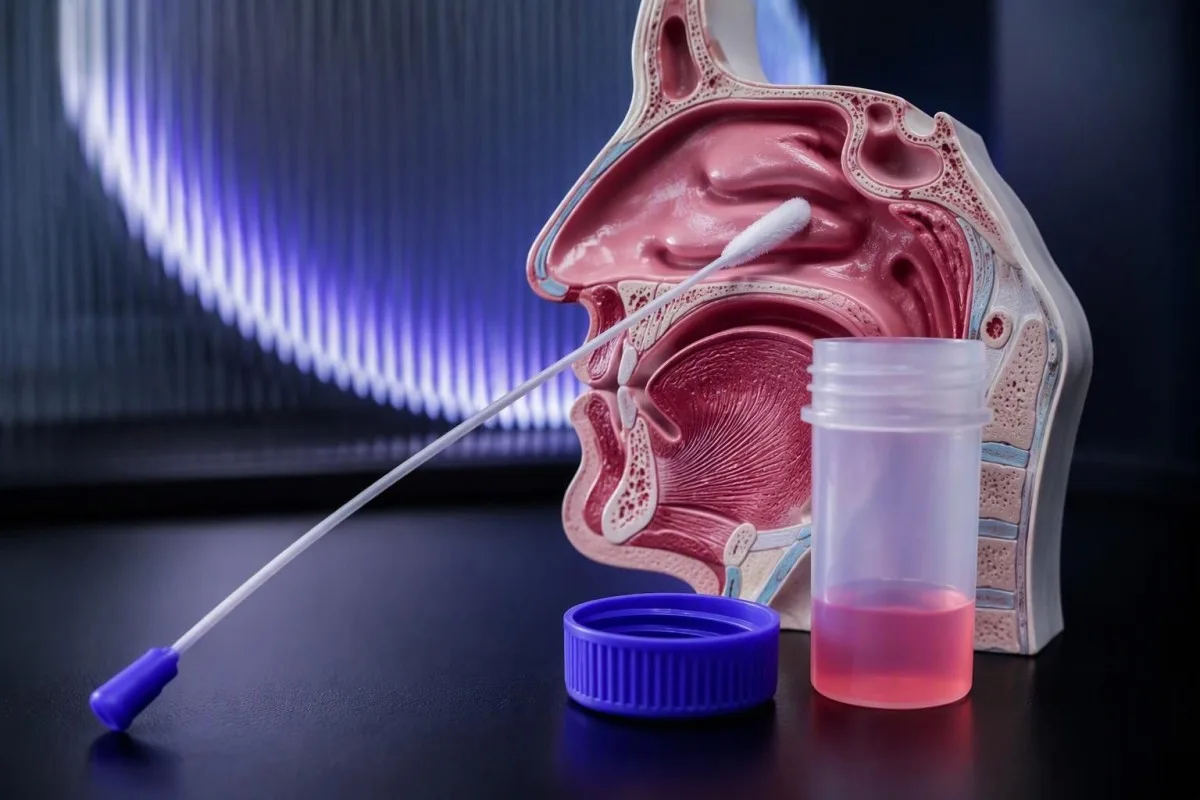
A negative swab is only as reassuring as its timing and collection. Here is how to interpret pertussis results without overlooking an infant who needs immediate care.


- PCR timing: A pertussis PCR test works best during the first 3 weeks of cough; usefulness declines after week 4.
- Negative results: A negative pertussis test does not reliably exclude infection when collection is inadequate, testing is late, or effective antibiotics preceded sampling.
- Specimen choice: Pertussis PCR requires a posterior nasopharyngeal swab or aspirate, not an ordinary throat swab or front-of-nose sample.
- Prior antibiotics: CDC guidance generally discourages PCR after 5 days of effective antibiotic treatment because the result is unlikely to help.
- Culture: Culture is most useful during the first 2 weeks of cough and before effective antibiotics; it can provide an isolate for public health investigation.
- Serology: Validated pertussis antibody testing is most useful 2–8 weeks after cough begins and may help up to 12 weeks.
- Infant emergencies: Breathing pauses, blue or gray color, severe breathing difficulty, seizures, or difficulty waking require emergency care immediately—not a wait for testing.
- Young-infant fever: A temperature of 38°C or higher in an infant younger than 3 months requires urgent medical assessment, regardless of a pertussis result.
Which whooping cough test gives the most useful answer?
The most useful whooping cough test is usually a properly collected nasopharyngeal PCR during the first 3 weeks of cough. A negative result does not exclude pertussis if testing is late, antibiotics have reduced the bacterial burden, or the sample missed the nasopharynx. Infants with breathing pauses or blue-gray color need emergency care immediately, without waiting for testing.
PCR detects bacterial DNA; culture detects viable bacteria; serology measures the immune response. These are 3 different diagnostic questions, not interchangeable versions of the same test, which explains why a blood antibody result cannot simply replace an early respiratory swab in a newborn with suspected pertussis. The best choice depends on cough duration, treatment history, age, and the laboratory's validated methods.
The date that matters is usually the first day of cough, not the day the cough developed a whoop or became exhausting. For example, 10 days of mild coughing followed by 7 days of coughing fits means testing on cough day 17—not day 7; that distinction can change whether culture is still a sensible addition.
Kantesti is an AI blood test analyzer that can help explain accompanying laboratory findings, but it does not replace nasopharyngeal testing or an urgent examination. As of October 13, 2026, this article applies the CDC testing windows cited below; I am Thomas Klein, Chief Medical Officer at Kantesti LTD, and our organizational background explains the scope of our work.
When to test for whooping cough before the classic whoop
Test for whooping cough when compatible symptoms or a meaningful exposure make pertussis plausible; do not wait for a whoop or 2 weeks of coughing. Vaccinated adults can have relatively ordinary-looking coughs, while young infants may present with breathing pauses and very little cough.
Coughing fits, vomiting after coughing, and known household exposure increase suspicion for pertussis. A vaccinated 35-year-old with 8 days of worsening nighttime cough after a child's confirmed illness may deserve testing even without the familiar inspiratory sound; vaccination reduces risk and severity but does not make pertussis impossible. Marked fever or prominent chest symptoms also prompt clinicians to look for additional or alternative diagnoses.
A 2-week cough threshold used in some surveillance definitions is not a rule to delay clinical testing. Surveillance definitions organize reporting, whereas bedside decisions ask whether testing or treatment could help today, especially when an infant is exposed. Other respiratory illnesses can overlap clinically; our guide to adult RSV symptoms explains another cause of prolonged cough without turning symptoms into a definitive diagnosis.
Routine PCR testing of asymptomatic contacts is not recommended to decide who receives preventive antibiotics. Even 1 negative contact swab can create false reassurance because it does not reliably settle future illness risk or replace an exposure assessment. CDC PCR best-practice guidance recommends testing people with compatible symptoms; household exposure and contact with high-risk individuals should be discussed with the treating clinician or public health team.
How cough duration changes pertussis PCR accuracy
Pertussis PCR has its best sensitivity in the first 3 weeks after cough begins; after week 4, falling bacterial DNA increases false-negative risk. Culture is most useful in the first 2 weeks, while validated serology generally becomes more useful during weeks 2–8.
These testing windows reflect changing biology, not an abrupt midnight cutoff. A day-22 PCR can still be useful, whereas a day-10 PCR can fail if the sample is poor or treatment has already reduced the bacterial burden. CDC's Laboratory Testing for Pertussis guidance describes culture within 2 weeks, PCR up to 3–4 weeks, and serology optimally at 2–8 weeks after cough onset (CDC, n.d.-a).
Pertussis symptoms can outlast detectable organisms in the upper airway. Someone coughing for 6 weeks may still have symptoms caused by an earlier pertussis illness even when the swab contains too little DNA to detect; that is not the same as saying every late cough is pertussis. The distinction between symptom duration and test detectability also appears in our discussion of Monospot testing windows, although the underlying biology differs.
An uncertain cough-onset date should be documented as a range rather than forced into a precise day. If cough began between 18 and 25 days ago, tell the clinician both dates and when coughing fits started; the uncertainty may affect the choice of PCR, culture, or later antibody testing. A dated message, school absence, or medication purchase can sometimes reconstruct the timeline better than memory alone.
Why the collection site matters more than the swab's appearance
Pertussis PCR requires a posterior nasopharyngeal swab or aspirate collected with materials approved by the receiving laboratory. A throat swab or anterior nasal swab can miss the target organisms even during the first 1–2 weeks of illness, producing a result that looks more reassuring than it is.
The nasopharynx sits behind the nasal cavity, not at the front of the nostril. Trained collection usually directs a flexible swab backward along the nasal floor rather than upward; patients should not attempt to recreate this technique at home. A specimen collected on cough day 9 may still be inadequate if it sampled the wrong site, regardless of whether collection briefly felt uncomfortable.
Swab composition and transport conditions can affect PCR performance. CDC recommends suitable polyester, rayon, or nylon-flocked materials and cautions against cotton and calcium-alginate swabs because certain materials can interfere with testing; the laboratory's own collection kit remains the safest choice (CDC, n.d.-b). A sample prepared for 1 assay should not automatically be assumed suitable for another, particularly if culture is also requested.
An invalid result is different from a valid negative result. PCR inhibition or a failed internal control may require recollection, while a valid negative may still reflect poor sampling that the assay cannot recognize; read the comments as well as the headline result. This general distinction between specimen quality and analytical performance is explored in our sample interference guide, although hemolysis itself is not the issue in a respiratory swab.
Can antibiotics cause a negative pertussis test?
Effective antibiotics can reduce the yield of a pertussis PCR test, and CDC guidance generally discourages PCR after 5 days of antibiotic treatment. The exact duration of post-treatment DNA detection varies, so neither a positive nor a negative post-treatment PCR reliably measures whether someone remains contagious.
The antibiotic name, start date, and doses taken belong on the test request. Three days of azithromycin before collection is different from 3 days of an antibiotic that is not reliably effective against pertussis; saying only 'I took antibiotics' leaves out the detail needed to interpret the result. Vomited doses, missed doses, and treatment prescribed for another illness should also be reported rather than guessed away.
PCR detects DNA rather than living organisms. Pertussis DNA can sometimes persist after effective treatment, while other treated patients become PCR-negative relatively quickly; CDC notes that the precise duration of positivity after antibiotics is not well understood (CDC, n.d.-b). A repeat swab on treatment day 6 is therefore not a dependable test of cure, and a lingering cough does not by itself demonstrate treatment failure.
Do not stop or delay prescribed antibiotics just to improve test yield. When practical, clinicians collect the specimen before the first dose, but an infant or another high-risk patient should not wait for a laboratory appointment to start appropriate care. A simple record of the first cough date, first dose, and collection time makes illness and medication timelines more useful than an isolated laboratory result.
When pertussis culture adds value—and when it does not
Pertussis culture adds the most value during the first 2 weeks of cough, preferably before effective antibiotics, and can provide a bacterial isolate for outbreak investigation. Culture is slower and generally less sensitive than PCR, so it is usually not a useful rescue test for a late negative PCR.
A positive pertussis culture is highly specific, but a negative culture cannot reliably exclude pertussis. The method depends on viable organisms surviving collection and transport and growing under specialized conditions; antibiotics and a late specimen undermine that process. Laboratories may require up to about 7 days, sometimes longer depending on their protocol, rather than the rapid turnaround often available for PCR.
Obtaining an isolate can answer questions that DNA detection alone cannot. During an outbreak, public health laboratories may use cultured organisms for characterization and, when indicated, antimicrobial susceptibility assessment; confirming at least 1 case by culture can support an investigation. Van der Zee, Schellekens, and Mooi discuss the complementary strengths and limitations of culture, PCR, and serology in Clinical Microbiology Reviews (2015).
Respiratory pertussis culture is not an ordinary blood culture. A request written simply as 'culture' may not trigger the right collection or media, so ask whether the laboratory knows pertussis is suspected and whether the specimen is intended for 2 methods. Our guide to culture result interpretation covers bloodstream testing; it illustrates why the specimen source must always remain part of the diagnosis.
What a negative pertussis PCR result actually means
A negative pertussis PCR means the assay did not detect its target DNA in that specimen; it does not prove pertussis was never present. Reassurance is greater after an early, properly collected specimen without effective pretreatment, and weaker after week 4, inadequate collection, or several treatment days.
The probability of pertussis before testing affects the meaning of a negative result. In an illustrative calculation—not a measured performance claim—starting with a 30% probability and assuming 80% sensitivity and 99% specificity leaves roughly an 8% probability after a negative test. That residual risk may matter greatly if the patient is a young infant or lives with one.
Lower sensitivity makes the same word, 'negative,' less reassuring. Keeping the illustrative 30% starting probability and 99% specificity but reducing sensitivity to 40% leaves about a 21% probability after a negative result; actual laboratory performance must not be inferred from these teaching numbers. At Kantesti, I favor this conditional reading rather than a binary interpretation, much as normal appendicitis blood results cannot independently dismiss a convincing clinical presentation.
Repeat PCR is most reasonable when a correctable collection problem exists and the patient remains within a useful testing window. Replacing a documented throat swab with a proper nasopharyngeal specimen on cough day 12 may help; simply repeating a well-collected test on day 40 often does not. Persistent suspicion should prompt reassessment of exposure, symptoms, treatment needs, alternative diagnoses, and whether validated serology could answer a later-stage question.
When blood antibody testing may help after a negative swab
Validated pertussis serology may help when coughing has lasted 2–8 weeks and PCR is becoming less informative; some testing remains useful up to 12 weeks. Anti-pertussis-toxin IgG is generally more specific than broad antibody panels, but recent vaccination and assay differences can complicate interpretation.
A blood test ordered as 'pertussis antibodies' is not automatically a validated diagnostic assay. Commercial panels differ in antigens, calibration, reporting units, and thresholds; CDC notes that some available serologic tests have unproven or uncertain clinical accuracy. For a patient with 5 weeks of cough, ask whether the laboratory uses a validated anti-pertussis-toxin IgG assay and what its interpretation actually supports.
Recent pertussis vaccination can raise anti-pertussis-toxin antibodies without a new illness. A booster within the preceding 6–12 months may complicate interpretation depending on the assay and reference laboratory policy; that interval is not a universal exclusion rule. Van der Zee et al. (2015) explain why antigen selection, vaccine history, and standardized measurement matter, rather than treating every elevated antibody value as evidence of current transmissible disease.
Pertussis serology does not have 1 universal patient-facing cutoff that applies to every laboratory. An IgG value reported in IU/mL must be read using that assay's validated threshold, timing restrictions, and vaccination guidance; numerical results from different methods may not be directly comparable. Our guide to positive antibody results explains the broader distinction between an immune response, recent exposure, vaccination, and an active condition.
Can a CBC or CRP support a whooping cough diagnosis?
A CBC may support concern for pertussis, particularly when an infant has marked leukocytosis with lymphocytosis, but normal WBC or CRP results do not exclude it. These blood markers assess associated physiology and severity; they do not replace a respiratory pertussis test during the first 3 weeks.
Lymphocyte interpretation must use age-appropriate absolute counts, not percentages alone. An illustrative absolute lymphocyte count of 8 × 10^9/L may be within an infant's laboratory reference interval but would usually be elevated in an adult; the same number has different implications across ages. Our age-specific lymphocyte guide explains why an adult range should not be pasted onto a baby's report.
Very high or rapidly increasing WBC counts in an unwell infant deserve urgent hospital assessment, not an online diagnostic label. For example, a WBC of 40 × 10^9/L combined with worsening breathing or poor feeding is concerning, but 40 is an illustration rather than a universal admission cutoff. Severe infant pertussis can involve marked leukocytosis, yet an absent lymphocytosis does not provide a dependable rule-out.
Kantesti is an AI blood test interpretation platform that can explain WBC units, age-dependent ranges, and accompanying results; it cannot diagnose pertussis from a CBC. A CRP of 3 mg/L, for example, does not exclude pertussis simply because it falls within many laboratories' usual reference intervals. Our discussion of WBC and CRP disagreement helps distinguish a general inflammatory signal from a pathogen-specific test.
Which infant symptoms need care before any test result?
An infant with breathing pauses, blue or gray color, severe breathing difficulty, seizures, or unusual difficulty waking needs emergency care immediately—even with a negative pertussis test. A temperature of 38°C or higher in a baby younger than 3 months also requires urgent medical assessment.
Young infants may have pertussis without a whoop and sometimes without prominent coughing. In a 6-week-old, repeated breathing pauses or color changes can be the presenting problem; waiting for the adult symptom pattern risks missing serious illness. Call the local emergency number for breathing pauses, blue-gray color, severe breathing difficulty, a seizure, or reduced responsiveness, and follow the dispatcher's instructions rather than waiting for an appointment.
A young infant with new cough, a confirmed household exposure, or substantially reduced feeding needs prompt clinical advice even without an emergency sign. Taking less than roughly half the usual amount over 2–3 feeds or producing clearly fewer wet diapers is a reason to seek assessment, not a rigid home diagnostic threshold. Do not force feeds during significant breathing difficulty, and do not postpone care to obtain a better specimen.
A negative PCR cannot overrule a concerning examination in an infant. A sample collected after 5 treatment days or from the wrong site may explain the negative result, but investigating that explanation comes after stabilizing breathing and assessing hydration. Our guide to children's AI interpretation limits makes the same safety boundary explicit: software cannot assess oxygenation, apnea, or a baby's ability to feed.
What AI can explain—and what a pertussis report cannot prove
AI can help explain a report's terminology and associated blood findings, but it cannot determine whether a nasopharyngeal specimen was collected adequately or whether an infant is safe at home. A report marked 'not detected' after 4 weeks of cough still needs clinical interpretation.
An automated result becomes safer to interpret when the original specimen type and collection date remain visible. A screenshot containing only 'negative' may omit 'throat swab,' an inhibition warning, or a comment about testing after treatment; each omission can change the meaning. Before using any interpretation tool, retain at least 3 details: the test name, specimen source, and collection date, plus the laboratory comments.
Kantesti is an AI-powered blood test analysis tool that can put accompanying CBC or chemistry results into understandable language, not a replacement for pertussis diagnostic services. Our AI technology guide describes how our blood-result explanations are generated; neither a roughly 60-second interpretation nor a neatly presented report establishes a respiratory diagnosis. The collection procedure remains outside what a report-reading system can verify.
A respiratory panel does not necessarily include Bordetella pertussis. A panel testing 10 or 20 other pathogens may still leave pertussis untested, so read the actual target list rather than assuming 'all respiratory tests were negative.' Our report source-checking guide explains why a tool should distinguish an absent test from a negative test and avoid supplying certainty the source report does not contain.
Should a negative test delay treatment or contact protection?
A negative pertussis test should not delay clinically indicated treatment or protection of high-risk contacts when suspicion remains strong. CDC treatment guidance generally considers treatment within 3 weeks of cough onset for people aged 1 year or older, and within 6 weeks for infants and pregnant patients, especially near term.
Starting treatment early is more likely to modify the illness than starting it after prolonged coughing fits are established. Later antibiotics may have limited effect on cough duration because airway effects can persist after bacterial clearance; prescribing still depends on age, timing, exposure, and risk. The longer treatment consideration for infants—up to 6 weeks in CDC guidance—reflects their vulnerability, not evidence that a late PCR will remain reliably positive.
Persistent cough is not the same as persistent contagiousness. A commonly used CDC infectious-period framework is 21 days after cough onset without effective treatment, or until 5 days of effective antibiotics have been completed; local school, workplace, and public health exclusion rules can differ. Do not use a repeat PCR as permission to return, and do not replace the local team's instructions with a blanket rule from another country.
Preventive antibiotics for exposed contacts are an exposure-and-risk decision, not a routine screening exercise. Household members and people connected to infants or other high-risk individuals may need prompt advice even when they feel well; a symptom-free contact's negative swab should not be used to cancel that assessment. Our approach to risk-based family testing likewise avoids ordering extra tests when the decision depends on clinical risk rather than a screening result.
What to bring to your clinician after a negative pertussis test
Bring the original report and a 5-part timeline: cough onset, exposure, specimen collection, antibiotic use, and vaccination dates. These details help a clinician decide whether a negative result is reasonably reassuring, whether recollection is worthwhile, or whether later serology or an alternative diagnosis deserves attention.
The specimen question should be specific: 'Was this a posterior nasopharyngeal sample validated for pertussis PCR?' Also ask whether the result was negative, invalid, or indeterminate, and whether the respiratory panel actually included pertussis. A 34-year-old tested on cough day 18 after 3 days of azithromycin has a different interpretation problem from someone tested untreated on day 8 with a documented correct specimen.
Ongoing symptoms deserve reassessment rather than endless repetition of the same swab. At 5–6 weeks, a clinician may consider validated serology while also reviewing asthma, post-viral cough, reflux, pneumonia, medication effects, or another cause; finding a plausible alternative does not automatically exclude coexisting pertussis. Keep the original laboratory wording available for secure clinician sharing rather than forwarding only an automated summary.
Clinical risk determines the urgency of follow-up, not the bold word on the report. I am Thomas Klein, Chief Medical Officer at Kantesti, and my editorial approach is to ask what decision the result can safely change—especially when a baby younger than 3 months is involved. Our medical advisory team describes the clinicians behind our work; a test explanation is not an individual examination or a substitute for urgent care.
Research publications, references, and evidence boundaries
The pertussis recommendations above rely on 3 directly relevant external medical references, not on unrelated general-health publications. The 2 Figshare records listed below are included as separate publication-discovery resources; their topics do not establish pertussis PCR accuracy, infant triage criteria, or treatment effectiveness.
CDC testing guidance and the 2015 Clinical Microbiology Reviews article address the specific limitations discussed here. Laboratory Testing for Pertussis supports the cough-duration windows, while CDC PCR best practices cover collection, antibiotic effects, and testing of symptomatic patients; van der Zee et al. explain the laboratory methods in greater depth. Our technical validation standards concern Kantesti's interpretation work and should not be mistaken for an independent validation of a particular laboratory's pertussis assay.
Diarrhea after fasting, black specks in stool & GI guide 2026. (n.d.). Figshare. doi:10.6084/m9.figshare.31438111. This is 1 supplied record concerning digestive symptoms, not respiratory pathogen testing; our digestive symptom publication provides the corresponding topic context. Author and publication-date metadata were not independently verified for this article, so the title-first citation does not invent either.
Women's health guide: Ovulation, menopause & hormonal symptoms. (n.d.). Figshare. doi:10.6084/m9.figshare.31830721. This second supplied record concerns hormonal symptoms rather than pertussis; our hormonal symptom publication provides its topic context. The DOI links are provided in the publication records below, while ResearchGate and Academia.edu links are clearly identified as discovery searches—not verified copies or evidence of peer review.
Frequently Asked Questions
Can you have whooping cough with a negative PCR test?
Yes, a negative pertussis PCR test does not always exclude whooping cough. False negatives become more likely after week 4 of coughing, after effective antibiotics, or when the sample does not adequately reach the posterior nasopharynx. A clinician should interpret the result alongside exposure, symptoms, specimen details, and treatment history. An infant with breathing pauses, blue-gray color, severe breathing difficulty, or reduced responsiveness needs emergency care regardless of the result.
When is the best time to test for whooping cough?
Pertussis PCR is most useful during the first 3 weeks after cough begins, with declining sensitivity after week 4. Culture is most useful in the first 2 weeks and before effective antibiotics. Validated serology is generally most useful during weeks 2–8 and may help up to 12 weeks. Count from the first cough, not from the first whoop or severe coughing fit.
Do antibiotics affect a whooping cough test?
Effective antibiotics can reduce the yield of a pertussis PCR test and are particularly detrimental to culture, which requires viable bacteria. CDC guidance generally discourages PCR after 5 days of antibiotic treatment because testing is unlikely to help. PCR may sometimes remain positive from residual bacterial DNA, so it is not a reliable test of cure or contagiousness. Do not stop or delay prescribed treatment to improve a specimen.
Is a throat swab accurate for pertussis PCR?
A throat swab is not the recommended specimen for pertussis PCR; a posterior nasopharyngeal swab or aspirate is required. An anterior nasal sample can also miss the target organisms and produce a false-negative result. If an inadequate specimen was collected during the first 1–3 weeks of cough, a clinician may consider recollection using the laboratory's approved kit. Repeating the wrong specimen does not fix the problem.
Can a blood test diagnose whooping cough?
A validated pertussis antibody blood test may support diagnosis later in the illness, usually 2–8 weeks after cough onset. Recent vaccination and differences between assays can complicate interpretation, and broad commercial antibody panels are not equally reliable. A routine CBC or CRP cannot confirm or exclude pertussis. In a young infant, blood testing must not replace respiratory testing or delay assessment of breathing and feeding.
Should a baby wait for a whooping cough test result?
A baby with breathing pauses, blue-gray color, severe breathing difficulty, seizures, or difficulty waking should receive emergency care immediately without waiting for a whooping cough test. Infants younger than 3 months with a temperature of 38°C or higher also need urgent medical assessment. A young infant with new cough, reduced feeding, or a household pertussis exposure needs prompt clinical advice even without a classic whoop. A negative PCR cannot overrule these warning signs.
Get AI-Powered Blood Test Analysis Today
Join over 2 million users worldwide who trust Kantesti for instant, accurate lab test analysis. Upload your blood test results and receive comprehensive interpretation of 15,000+ biomarkers in seconds.
📚 Referenced Research Publications
Klein, T., Mitchell, S., & Weber, H. (2026). Diarrhea After Fasting, Black Specks in Stool & GI Guide 2026. Kantesti AI Medical Research.
Klein, T., Mitchell, S., & Weber, H. (2026). Women's Health Guide: Ovulation, Menopause & Hormonal Symptoms. Kantesti AI Medical Research.
📖 External Medical References
Centers for Disease Control and Prevention (n.d.-a). Laboratory Testing for Pertussis. CDC Pertussis Clinical Guidance.
Centers for Disease Control and Prevention (n.d.-b). Best Practices for Use of Polymerase Chain Reaction for Diagnosing Pertussis. CDC Pertussis Clinical Guidance.
van der Zee A, Schellekens JFP, Mooi FR (2015). Laboratory Diagnosis of Pertussis. Clinical Microbiology Reviews, 28(4), 1005–1026.
⚕️ Medical Disclaimer
This article is for educational purposes only and does not constitute medical advice. Always consult a qualified healthcare provider for diagnosis and treatment decisions.
E-E-A-T Trust Signals
Experience
Physician-led clinical review of lab interpretation workflows.
Expertise
Laboratory medicine focus on how biomarkers behave in clinical context.
Authoritativeness
Written by Dr. Thomas Klein with review by Dr. Sarah Mitchell and Prof. Dr. Hans Weber.
Trustworthiness
Evidence-based interpretation with clear follow-up pathways to reduce alarm.