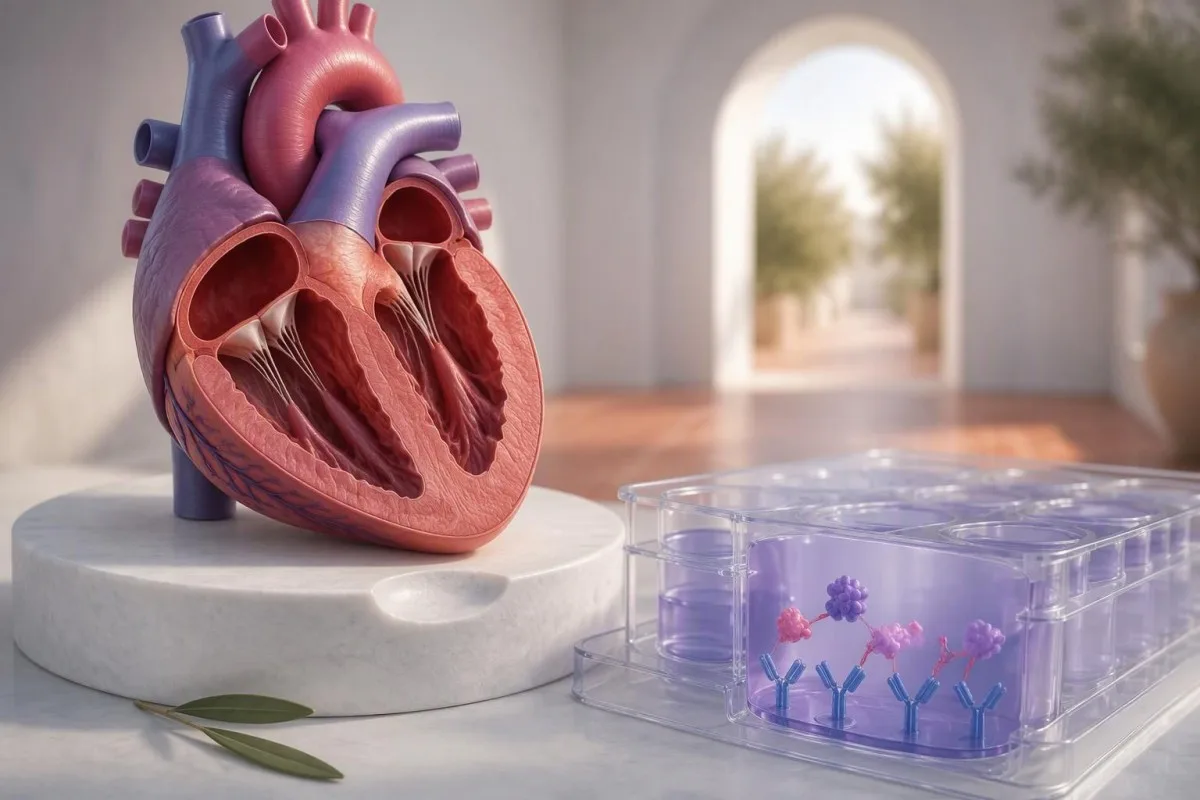
An elevated soluble ST2 result is a reason to review the clinical picture—not a verdict about your heart or an instruction to change medication.


- ST2 blood test results above 35 ng/mL can indicate higher prognostic risk in patients with established heart failure when the laboratory uses an assay validated for that cutoff.
- Soluble ST2 reflects biological stress and immune signaling; it does not measure ejection fraction, fluid overload, or scar tissue directly.
- 35 ng/mL cutoff is a clinical risk decision limit, not a universal healthy-population reference range or an emergency threshold.
- Borderline results of 34 and 36 ng/mL are only about 6% apart; crossing the cutoff does not necessarily represent a meaningful biological change.
- Units matter because 35 ng/mL equals 35 µg/L or 35,000 pg/mL, but converting units does not make different assays interchangeable.
- Heart failure diagnosis requires symptoms, examination, and appropriate cardiac testing; ST2 below 35 ng/mL cannot exclude heart failure.
- Treatment decisions should follow the heart-failure diagnosis, blood pressure, kidney function, potassium, congestion, and medication tolerance—not one elevated ST2 result.
- Urgent symptoms such as chest pressure, severe breathlessness at rest, or fainting require immediate assessment regardless of whether ST2 is above or below 35 ng/mL.
What does ST2 above 35 ng/mL actually mean?
An ST2 blood test above 35 ng/mL generally signals higher prognostic risk in people with established heart failure when measured using an assay validated for that threshold. It does not diagnose heart failure, identify its cause, or independently justify changing treatment. The useful next step is to check the assay and interpret the result alongside symptoms, NT-proBNP or BNP, echocardiography, kidney function, and the clinical course.
The 35 ng/mL decision limit separates risk groups; it does not separate people who have heart failure from people who do not. A result of 48 ng/mL in an established heart-failure population and the same result in an otherwise well person do not carry the same evidence-based interpretation, because their starting probabilities and clinical circumstances differ.
A result just across the line deserves proportionate attention. For example, 34 versus 36 ng/mL is a difference of only about 6%, and analytical imprecision or ordinary within-person variation may contribute; neither result warrants a diagnosis or a medication change simply because the report uses a different color or flag.
Kantesti is an AI blood test analyzer that helps explain why a 35 ng/mL risk flag needs clinical context rather than an automatic treatment recommendation. I’m Thomas Klein, MD, Chief Medical Officer; our organizational background explains our role, while the treating clinician remains responsible for diagnosis and management.
What does soluble ST2 measure in the body?
Soluble ST2, often written sST2, is a circulating form of an interleukin-33 receptor associated with mechanical stress and immune responses. The ST2 blood test measures this soluble protein—not the membrane-bound receptor—and a concentration of 35 ng/mL does not directly quantify cardiac fibrosis, pumping strength, or the amount of fluid retained.
The ST2 system has 2 clinically relevant forms to distinguish: membrane-bound ST2L and soluble sST2. In experimental cardiac models, interleukin-33 signaling through ST2L can oppose adverse remodeling, whereas soluble ST2 can act as a decoy receptor; that biological explanation does not prove that lowering circulating sST2 itself improves patient outcomes.
Cardiac tissue is not the only source of this protein. A patient with sST2 of 65 ng/mL may have contributions from vascular, pulmonary, or systemic stress, which is why calling the test a direct measure of heart scarring goes too far; the sample cannot tell us where each circulating molecule originated.
The ST2 prognostic marker and galectin-3 both appear in discussions of remodeling, but they represent different biology and are not interchangeable. Our explanation of galectin-3 in heart failure helps distinguish these tests; ordering 2 remodeling-associated markers still does not replace an echocardiogram or establish a diagnosis.
Why the 35 ng/mL threshold depends on the assay
The commonly cited 35 ng/mL cutoff is assay-dependent and should only be applied when the laboratory identifies it as appropriate for its soluble ST2 method. Different antibodies, calibrators, specimen requirements, and analytical platforms can produce non-equivalent concentrations, even when every report expresses the result in ng/mL.
A risk decision limit is not the same thing as a reference interval derived from apparently healthy volunteers. A laboratory might display a sex-specific reference interval, a manufacturer-supported prognostic threshold, or both; an ST2 of 38 ng/mL could therefore receive different flags without the laboratories necessarily contradicting one another.
Unit conversion is straightforward: 35 ng/mL equals 35 µg/L and 35,000 pg/mL. Method conversion is not; multiplying a result from a research assay into different units does not establish that the clinical 35 ng/mL cutoff applies, and no universal conversion factor should be assumed between commercial or research methods.
Before interpreting a report containing only “ST2: 42,” ask for the units, assay name, specimen type, and the meaning of the displayed limit. Our guide to quantitative laboratory results explains why a numerical concentration and a positive/negative designation answer different questions; keep the method information with future results.
Why ST2 cannot diagnose or exclude heart failure
ST2 is used primarily for prognosis, not for diagnosing heart failure. An ST2 of 55 ng/mL does not establish heart failure, and an ST2 of 22 ng/mL does not exclude it; diagnosis depends on the symptoms, examination, cardiac structure and function, and evidence supporting abnormal filling pressures or congestion.
The 2022 AHA/ACC/HFSA guideline recommends BNP or NT-proBNP to support diagnosis or exclusion of heart failure in patients presenting with breathlessness (Heidenreich et al., 2022). Those peptides also provide prognostic information, but their diagnostic evidence is different from sST2; our NT-proBNP interpretation guide explains the practical distinction.
The 2021 ESC guideline uses BNP below 35 pg/mL or NT-proBNP below 125 pg/mL to make non-acute heart failure less likely, with clinical caveats (McDonagh et al., 2021). Notice the units: BNP 35 pg/mL and ST2 35 ng/mL are entirely different thresholds for entirely different molecules, despite sharing the number 35.
Consider a hypothetical 68-year-old with new breathlessness, ankle swelling, and sST2 of 28 ng/mL. That lower ST2 result should not stop an ECG, natriuretic peptide testing, or echocardiography when indicated; our breathlessness testing guide also covers anemia and pulmonary causes that may sit outside the heart-failure pathway.
What evidence supports ST2 as a prognostic marker?
Higher soluble ST2 concentrations are associated with worse outcomes in heart-failure cohorts, but the association does not provide an individual patient's absolute risk by itself. Ky and colleagues studied 1,141 patients with chronic heart failure and found that higher sST2 carried prognostic information, including after accounting for other clinical risk factors (Ky et al., 2011).
The 35 ng/mL threshold became useful through clinical assay development and prognostic validation, not because human physiology abruptly changes at that concentration. Research studies also analyze sST2 as a continuous variable or use study-specific categories; an association established in one cohort cannot automatically supply the same risk estimate in every other population.
A value of 70 ng/mL is twice 35 ng/mL, but that does not mean twice the chance of hospitalization or death. Absolute risk depends on the time horizon, severity of heart failure, age, prior admissions, treatment, and the model used; a laboratory concentration alone cannot defensibly be translated into a personalized percentage.
Additional biomarkers can improve statistical prediction without improving the decisions that patients actually receive. The same distinction appears with copeptin risk interpretation: before adding a second stress marker to an ST2 result of 50 ng/mL, ask which clinical action would change and whether that action has outcome evidence.
Can inflammation or lung illness raise soluble ST2?
Systemic inflammation, significant pulmonary illness, and other noncardiac stressors can increase soluble ST2. An ST2 of 80 ng/mL during a serious respiratory illness cannot be attributed automatically to heart failure, although concurrent cardiac stress may still be present and deserves evaluation when the symptoms or examination suggest it.
Timing changes the question that an ST2 result answers. A concentration of 58 ng/mL collected during pneumonia may describe an acute illness state rather than the patient's stable cardiac baseline; a clinician should consider oxygenation, fever, congestion, and imaging rather than dismiss the result as either purely cardiac or merely incidental.
CRP can provide context, but CRP of 30 mg/L does not mathematically correct an ST2 result or determine its source. Our discussion of high hs-CRP results separates vascular risk assessment from acute inflammatory responses; the test purpose and sampling circumstances matter at least as much as the flag.
At Kantesti, we explain why an ST2 above 35 ng/mL and an inflammatory marker may reflect overlapping processes rather than 2 independent diagnoses. Our guide to discordant infection markers offers a useful parallel: normal white-cell counts do not erase inflammation, and raised CRP does not identify the affected organ.
How kidney function changes the clinical interpretation
Kidney function remains clinically relevant even though sST2 is often less strongly influenced by renal function than NT-proBNP in heart-failure studies. An eGFR of 28 mL/min/1.73 m² does not make an ST2 of 45 ng/mL meaningless, nor does it permit a clinician to ignore renal contributions to symptoms, prognosis, or medication safety.
There is no routinely accepted eGFR-adjusted version of the 35 ng/mL cutoff to calculate at home. Lower renal dependence is a relative observation, not proof that sST2 is completely kidney-independent; chronic kidney disease also brings vascular and inflammatory changes that can complicate interpretation even without a simple clearance-based explanation.
A patient with eGFR of 28 and potassium of 5.6 mmol/L may need prompt medication and electrolyte review for reasons unrelated to whether ST2 is 32 or 52 ng/mL. Our chronic kidney disease staging guide explains why eGFR and urine albumin describe dimensions of risk that ST2 cannot replace.
Creatinine trends, BUN, electrolytes, blood pressure, and congestion help determine whether treatment can safely be intensified. A BUN/creatinine ratio above 20 is not diagnostic of dehydration by itself; the BUN and creatinine guide explains why volume status should not be inferred from one ratio before changing a diuretic.
How to prepare for an ST2 test and check the report
An isolated ST2 blood test usually does not require fasting, but the laboratory's instructions and any accompanying tests take priority. Before interpreting a result of 41 ng/mL, confirm that the report identifies soluble ST2, the specimen was suitable for the method, and the laboratory applied its own validated decision limit.
Preparation should preserve the clinical information rather than artificially improve the number. Do not skip prescribed medication or deliberately dehydrate before a test intended to interpret a 35 ng/mL threshold; our baseline sampling checklist explains how to record illness, exercise, medication timing, and the reason for testing without changing treatment yourself.
An assay may accept serum, particular plasma types, or both, depending on its validation. If a report is rejected or comments on sample interference, a fresh concentration of 46 ng/mL may be needed before drawing conclusions; hemolysis, lipemia, and sample handling effects must be assessed using the specific method, not assumptions borrowed from other tests.
Keep 4 report details together: concentration, units, assay identity, and collection date. Immunoassay interference is method-dependent, so an implausible result should prompt laboratory discussion about potential interference or confirmation; tell the clinician about supplements and medications, but do not assume biotin affects every ST2 method in the same way.
When should an elevated ST2 result be repeated?
Repeat ST2 testing is most useful when a clinician has a specific question about risk or change over time; there is no universal retesting interval for everyone above 35 ng/mL. Comparisons are strongest when the same laboratory method is used and the clinical circumstances of each collection are documented.
A fall from 60 to 42 ng/mL is a 30% decrease, but the second result remains above the commonly used decision limit. That trajectory may be more reassuring than an unchanged concentration, yet it cannot prove treatment success or reduced individual risk without considering symptoms, natriuretic peptides, admissions, and measurement uncertainty.
A change from 34 to 36 ng/mL is far smaller and may not exceed combined analytical and biological variation. Our guide to meaningful changes between visits explains reference change values; laboratories do not all provide a validated sST2-specific value, so a universal percentage rule would be misleading.
A concentration collected during hospitalization and another obtained 4 weeks after discharge describe different physiological states, not necessarily a clean medication experiment. Our discussion of post-discharge laboratory changes explains why recovery, altered fluid balance, and changed treatment can move together; repeat testing should answer a question rather than merely chase the flag.
Why one high ST2 should not determine treatment
A single elevated ST2 result should not independently trigger medication initiation, dose escalation, device implantation, or a change in diuretic dose. For heart failure with reduced ejection fraction, generally LVEF of 40% or less, evidence-based treatment follows the clinical diagnosis, symptoms, contraindications, and safety monitoring—not attainment of an ST2 below 35 ng/mL.
The 2022 AHA/ACC/HFSA guideline describes 4 foundational medication groups for eligible patients with HFrEF: renin-angiotensin system inhibition, evidence-based beta blockers, mineralocorticoid receptor antagonists, and SGLT2 inhibitors (Heidenreich et al., 2022). These treatments are not withheld because ST2 is 24 ng/mL, and a result of 75 ng/mL does not override low blood pressure or dangerous potassium.
The treatment question is often practical: is the patient congested, undertreated, unable to tolerate therapy, or developing an adverse effect? An early eGFR dip after starting an SGLT2 inhibitor can have a different meaning from progressive kidney injury; our SGLT2-related eGFR guide explains why an ST2 flag should not settle that distinction.
A prognostic biomarker differs from a drug-monitoring assay. For example, a digoxin concentration expressed in ng/mL addresses exposure and potential toxicity, whereas ST2 of 50 ng/mL does not identify a safe dose; our digoxin monitoring explanation shows why each laboratory result needs its own sampling and decision framework.
Does a high ST2 result require emergency care?
There is no universal ST2 concentration that, by itself, defines an emergency. New chest pressure, severe breathlessness at rest, fainting, confusion, or rapidly worsening symptoms require urgent assessment whether ST2 is 20, 40, or 100 ng/mL; the appropriate response is driven by the clinical presentation, not the prognostic cutoff.
A clinically stable person who finds ST2 of 39 ng/mL on a routine report usually needs a planned discussion, not an emergency visit solely for that number. This is different from a person with new breathlessness and low oxygen saturation; even an apparently lower-risk ST2 result cannot make an unstable clinical presentation safe.
Chest pain assessment relies on the history, ECG, serial troponin when appropriate, and other targeted investigations—not an ST2 result above 35 ng/mL. Our chest pain laboratory guide explains why an isolated reassuring biomarker should never delay assessment of possible acute coronary disease or another dangerous cause.
Rapid weight gain may be a useful congestion warning in a patient with established heart failure. An increase of roughly 2 kg over 3 days is used in some individualized action plans, but the patient's own instructions take priority; do not independently double a diuretic because weight and ST2 both rise, especially with dizziness or reduced urine output.
How AI can help interpret ST2 without overcalling it
AI can organize an ST2 report and explain a 35 ng/mL flag, but it cannot establish heart failure or prescribe treatment from the uploaded concentration alone. The useful workflow preserves the assay, units, collection date, accompanying laboratory results, and symptoms, while identifying missing information that belongs in a clinician's assessment.
Kantesti is an AI blood test interpretation platform for explaining uploaded laboratory results, including why an ST2 of 37 ng/mL is not automatically a diagnosis. Our AI technology explanation describes the broader workflow; laboratory interpretation remains narrower than the clinical evaluation needed to determine symptoms, congestion, or cardiac function.
OCR errors can change the interpretation before any medical reasoning begins. Reading 3.5 as 35 ng/mL, dropping a less-than sign, or confusing pg/mL with ng/mL creates a different result; compare the extracted value with the original report and treat an unexplained mismatch as a data-quality problem rather than a new medical finding.
Kantesti AI should be used to prepare questions and organize trends, not to invent information absent from the report. If the upload contains 1 ST2 result but no echocardiogram, the interpretation cannot establish ejection fraction; likewise, a missing assay name should remain missing rather than being silently replaced with the method associated with the familiar cutoff.
What to ask your clinician after an elevated ST2
After an ST2 above 35 ng/mL, ask whether the assay supports that cutoff, whether heart failure is already established, and which clinical decision the result could change. A useful appointment ends with an explanation of the risk context and a follow-up plan—not simply a request to make the number lower.
Bring 3 items: the original report, a current medication list, and a brief symptom timeline. Ask, “Was this drawn during an illness?” and “Would a repeat result change management?”; these questions reveal whether the result adds information beyond an existing heart-failure assessment or represents an incidental test with uncertain usefulness.
Kantesti is an AI biomarker interpretation platform that can help organize an ST2 result of 44 ng/mL with other uploaded results for a follow-up discussion. Before sharing reports, remove unnecessary identifiers and confirm consent for another person's information; our laboratory upload privacy checklist explains practical safeguards without promising that any digital service eliminates privacy risk.
A follow-up plan should address 2 separate issues: what the concentration suggests about prognosis and what, if anything, should change now. Our medical advisory structure describes clinical oversight; it does not replace the treating team's individualized judgment, and medical review should never turn an assay-dependent threshold into an automatic diagnosis.
Research publications and the limits of validation
Technical validation of an interpretation engine is not evidence that ST2-guided treatment improves heart-failure outcomes. As of October 12, 2026, this article relies on established heart-failure guidelines and peer-reviewed sST2 prognostic evidence; the supplied platform research records below should be read according to their study design and scope.
The supplied Kantesti benchmark title describes 100,000 synthetic test cases, not 100,000 patients followed for hospitalization or mortality. Synthetic cases can assess defined technical tasks, but they cannot independently establish clinical benefit, representative real-world performance, or the usefulness of changing medication when an actual patient's ST2 crosses 35 ng/mL.
A clinical validation framework is a methods or governance document unless its contents separately report an appropriately designed clinical study. Our validation and clinical standards page provides the relevant institutional context; neither a DOI nor a version label such as v2.0 should be interpreted as proof of external peer review, regulatory authorization, or successful prospective outcome testing.
My editorial standard as Thomas Klein, MD is to keep 3 claims separate: the assay measures sST2, the result may improve prognosis assessment, and a treatment strategy improves outcomes. The first 2 do not establish the third; the DOI records below are supplied publication links, and their metadata and indexing should be checked at the destination rather than inferred from citation formatting.
Frequently Asked Questions
What does an ST2 blood test above 35 ng/mL mean?
An ST2 blood test above 35 ng/mL generally indicates a higher prognostic risk category in patients with established heart failure when the assay is validated for that decision limit. It does not diagnose heart failure or provide a personalized probability of hospitalization or death by itself. The clinician should interpret the concentration alongside symptoms, natriuretic peptides, cardiac imaging, kidney function, and the collection circumstances. A single elevated result should not independently determine treatment.
Is 35 ng/mL the normal range for soluble ST2?
The commonly cited 35 ng/mL value is a prognostic decision limit, not a universal normal reference range for soluble ST2. Its applicability depends on the assay and clinical population. A laboratory may also report a method-specific healthy-population reference interval that differs from the risk cutoff. Values just above or below 35 ng/mL should not be treated as a sharp biological boundary.
Can a normal ST2 result rule out heart failure?
An ST2 result below 35 ng/mL cannot rule out heart failure. Heart-failure diagnosis requires the clinical picture and appropriate cardiac investigations, often including BNP or NT-proBNP and echocardiography. A patient with sST2 of 22 ng/mL can still have reduced or preserved ejection fraction heart failure. New breathlessness, swelling, or other concerning symptoms should be assessed regardless of the ST2 result.
Should I change medication if my ST2 is high?
You should not change medication solely because an ST2 result exceeds 35 ng/mL. Heart-failure treatment depends on the diagnosis, ejection fraction, congestion, blood pressure, kidney function, potassium, and medication tolerance. For eligible patients with reduced ejection fraction, generally 40% or less, guideline-directed treatment is not determined by reaching an ST2 target. Discuss the result with your treating clinician rather than independently increasing diuretics or stopping prescribed therapy.
How often should soluble ST2 be retested?
There is no universal retesting schedule for everyone with soluble ST2 above 35 ng/mL. A repeat measurement is most useful when it answers a specific clinical question, preferably using the same assay and documented collection circumstances. A change from 60 to 42 ng/mL is a 30% decrease, but its significance still depends on measurement variation and the patient's course. A clinician should decide whether another result would actually alter assessment or management.
Can infection or kidney disease affect an ST2 result?
Significant inflammatory or pulmonary illness can elevate soluble ST2, so a result of 80 ng/mL during an acute illness is not specific for heart failure. Kidney function also remains relevant to overall prognosis and treatment safety, although sST2 is often less strongly influenced by renal function than NT-proBNP in heart-failure studies. There is no routinely accepted eGFR-adjusted version of the 35 ng/mL cutoff. Interpretation should consider both cardiac and noncardiac contributors rather than assign the result to one organ automatically.
Is a very high ST2 result an emergency?
No universal ST2 concentration independently defines an emergency, including a value of 100 ng/mL. Severe breathlessness at rest, chest pressure, fainting, confusion, or rapidly worsening symptoms require urgent assessment regardless of the concentration. An otherwise stable person with an isolated elevated result usually needs timely clinical review rather than emergency care solely for the laboratory number. Follow an existing heart-failure action plan if one has been provided.
Get AI-Powered Blood Test Analysis Today
Join over 2 million users worldwide who trust Kantesti for instant, accurate lab test analysis. Upload your blood test results and receive comprehensive interpretation of 15,000+ biomarkers in seconds.
📚 Referenced Research Publications
Klein, T., Mitchell, S., & Weber, H. (2026). A Pre-Registered, Rubric-Based Automated Technical Benchmark of the Kantesti Blood-Test Interpretation Engine on 100,000 Synthetic Test Cases. Kantesti AI Medical Research.
Klein, T., Mitchell, S., & Weber, H. (2026). Clinical Validation Framework v2.0 (Medical Validation Page). Kantesti AI Medical Research.
📖 External Medical References
Ky B et al. (2011). High-sensitivity ST2 for prediction of adverse outcomes in chronic heart failure. Circulation: Heart Failure.
Heidenreich PA et al. (2022). 2022 AHA/ACC/HFSA Guideline for the Management of Heart Failure: A Report of the American College of Cardiology/American Heart Association Joint Committee on Clinical Practice Guidelines. Circulation.
McDonagh TA et al. (2021). 2021 ESC Guidelines for the diagnosis and treatment of acute and chronic heart failure. European Heart Journal.
⚕️ Medical Disclaimer
This article is for educational purposes only and does not constitute medical advice. Always consult a qualified healthcare provider for diagnosis and treatment decisions.
E-E-A-T Trust Signals
Experience
Physician-led clinical review of lab interpretation workflows.
Expertise
Laboratory medicine focus on how biomarkers behave in clinical context.
Authoritativeness
Written by Dr. Thomas Klein with review by Dr. Sarah Mitchell and Prof. Dr. Hans Weber.
Trustworthiness
Evidence-based interpretation with clear follow-up pathways to reduce alarm.