בדיקת רמת אינפליקסימאב משלבת את ריכוז התרופה עם נוגדנים כדי להסביר אובדן שליטה ב־IBD. רמה נמוכה של התרופה ללא נוגדנים משמעותיים מצביעה על חשיפה לא מספקת; רמה נמוכה של התרופה עם נוגדנים גבוהים ומתמשכים מצביעה על פינוי בתיווך מערכת החיסון. דלקת פעילה למרות חשיפה מספקת מעלה אפשרות לכישלון מנגנוני — אך רק לאחר אישור קיומה של דלקת, נטילת דגימה במועד הנכון ויעד המתאים למטרת הטיפול.

נקודות עיקריות
- תוצאות משולבות מבחינות בין חשיפה לא מספקת לאינפליקסימאב לבין פינוי הקשור לנוגדנים; אף אחת מהתוצאות לבדה אינה מוכיחה מדוע התסמינים חזרו.
- דגימה לפני העירוי פירושה איסוף דגימת מעבדה לפני תחילת העירוי התוך־ורידי הבא, ולא יומיים לאחר מכן.
- ערכי סף לתחזוקה משתנים: הנחיית AGA משנת 2017 המליצה על 5 µg/mL לפחות לניטור תגובתי, בעוד שקונצנזוס מומחים מתאר טווח של 5–10 µg/mL לתחזוקה.
- רמות נמוכות של אינפליקסימאב בהיעדר נוגדנים יכולות לנבוע מפינוי מהיר יותר, מאובדן חלבון דרך המעי, מעיכוב במתן המנה או ממרווח ארוך מדי בין המנות.
- נוגדנים לאינפליקסימאב חשובים ביותר כאשר הם מתמשכים, משמעותיים עבור אותה בדיקה ומלווים ברמות נמוכות מאוד או בלתי ניתנות לזיהוי של התרופה.
- כשל מכניסטי אפשרי מחייב IBD פעילה באופן אובייקטיבי למרות חשיפה מספקת; שלשול עם רמת שפל של 8 µg/mL אינו מוכיח זאת.
- יחידות בדיקה אינן בנות־החלפה: 1 µg/mL של אינפליקסימאב שווה ל־1 mg/L, אך לא ניתן להמיר באופן אוניברסלי בין U/mL ל־AU/mL של נוגדנים.
- שינויים בטיפול יש לבצע בתיאום עם צוות ה־IBD שלכם; במקרים נבחרים של אובדן תגובה ייתכן שיש הצדקה לנסות להגיע לחשיפה של 10–15 µg/mL לפני הפסקת אינפליקסימאב.
מה למעשה ניתן ללמוד מבדיקת רמת אינפליקסימאב?
אן בדיקת רמת אינפליקסימאב מודדת את רמת האינפליקסימאב במחזור הדם, בדרך כלל לצד נוגדנים נגד התרופה, כדי לברר חשיפה לא מספקת או פינוי של התרופה בתיווך חיסוני. תוצאה של 2 µg/mL ללא נוגדנים שהתגלו מעלה שאלה שונה מתוצאה של 2 µg/mL עם רמות גבוהות ומתמשכות של נוגדנים; אף אחת מהן אינה אומרת אוטומטית שיש להפסיק את התרופה.
ניטור תרופתי טיפולי תגובתי הוא בדיקה שנערכת בעקבות החמרה בתסמינים או עדות למחלה פעילה. הוא שונה מניטור יזום במהלך הפוגה לכאורה: רמת שפל היפותטית של 4 µg/mL עשויה להצדיק בירור במהלך התלקחות מתועדת, אך לחייב דיון אחר כאשר אנדוסקופיה וסמני צואה מעידים על ריפוי מתמשך.
אינפליקסימאב חוסם את גורם נמק הגידול, המקוצר בדרך כלל TNF; בדיקת הריכוז אינה מודדת אם כל אות TNF במעי נוטרל. תוצאה בסרום של 7 µg/mL מודדת את התרופה במחזור הדם, ולא את פעילות התרופה בתוך כל מקטע מעי שנפגע או את היקף הריפוי במעי.
הפרשנות המעשית מתבססת על לפחות 3 נתונים: ריכוז התרופה, ממצאי הנוגדנים ופעילות המחלה האובייקטיבית. גם לתגובה קודמת יש חשיבות—הופעה חוזרת של תסמינים לאחר 18 חודשים של שליטה במחלה מייצגת אובדן תגובה משני, ואילו אי־השגת שליטה כלל במהלך הטיפול הראשוני מעלה שאלות אחרות לגבי החשיפה בשלב האינדוקציה ומנגנון הטיפול.
קנטסטי הוא מנתח בדיקות דם בינה מלאכותית שעוזר לקוראים להבין ממצאים משולבים של אינפליקסימאב בלי להתייחס למספר מעבדה אחד כהנחיה למינון. הפלטפורמה שלנו מופעלת על ידי Kantesti LTD, חברה בריטית שמספרה 17090423; מידע על הארגון שלנו נפרד מהראיות הקליניות התומכות בניטור תרופתי טיפולי.
מתי יש לדגום את רמות השפל של אינפליקסימאב?
רמות שפל של אינפליקסימאב תוך־ורידי יש לדגום מיד לפני תחילת העירוי הבא, כאשר הריכוז קרוב לנקודה הנמוכה ביותר במרווח שבין המנות. דגימה שנאספה יומיים לאחר עירוי אינה דגימת שפל, ואין להשוות אותה ישירות ליעדי רמת שפל לפני עירוי במהלך טיפול אחזקה.
עיתוי הדגימה יכול לשנות את המשמעות לכאורה של תוצאה, גם ללא שינוי ביעילות הטיפול. לדוגמה, תוצאה היפותטית של 18 µg/mL שנאספה זמן קצר לאחר עירוי ושל 3 µg/mL שנאספה לפני העירוי הבא עשויות לתאר את אותו מחזור מינון—ולא הידרדרות פתאומית בין שני מצבי טיפול בלתי תלויים.
יש לתעד את תאריך העירוי הקודם, את המנה בפועל במ״ג, את המרווח המתוכנן ואת מועד איסוף הדגימה לפני פרשנות הדוח. אם עירוי שנקבע לאחר 8 שבועות נדחה עד לשבוע 10, הריכוז שהתקבל משקף מרווח ארוך יותר ללא התרופה; הוא אינו יכול לענות באופן חד־משמעי אם לוח הזמנים המקורי של 8 שבועות סיפק חשיפה מספקת.
Collection from a line recently used to administer infliximab can contaminate the specimen and produce a misleadingly high result. Ask the infusion service about its collection protocol, and tell it if sampling occurred after treatment started; the timing principles resemble other pre-dose medication tests, although their targets differ.
Fasting is generally not required for the infliximab concentration itself, but another test ordered during the same visit may have preparation requirements. Our מדריך הכנה לצילום ראשון explains how to document medication timing; for this test, an accurate infusion timeline usually matters more than an 8-hour fast.
איזו רמת אינפליקסימאב נחשבת מספקת?
אין no universal adequate infliximab trough for every patient, disease phenotype, assay, and treatment phase. The 2017 AGA guideline suggested at least 5 µg/mL during reactive maintenance monitoring, while a 2021 expert consensus described maintenance concentrations of 5–10 µg/mL and higher exposure in selected loss-of-response situations.
The AGA benchmark of at least 5 µg/mL is a clinical decision aid, not a healthy-population reference range (Feuerstein et al., 2017). Infliximab is a prescribed biologic: an untreated person normally has no circulating infliximab, so a laboratory's therapeutic interval should never be read like the normal range for sodium.
The TAXIT trial enrolled 263 adults with stable responses and optimized intravenous infliximab toward 3–7 µg/mL before randomized follow-up. Its primary remission endpoint did not improve with concentration-based dosing, although some secondary outcomes favored that approach; this explains why the historical 3–7 µg/mL window is useful context rather than a universal modern target (Vande Casteele et al., 2015).
Cheifetz et al. (2021) recommended considering exposure of 10–15 µg/mL before discontinuing infliximab for secondary loss of response in selected patients. This is expert consensus, not proof that everyone should be escalated to 15 µg/mL; fistulas, endoscopic goals, disease severity, safety, and prior optimization affect whether that reasoning applies.
A concentration of 12 µg/mL is not automatically toxic, and a concentration of 4 µg/mL does not automatically require escalation in an asymptomatic patient with documented healing. Unlike the narrower toxicity discussions around some תרופות אחרות הנמדדות במצב תחתית, infliximab has no single established serum toxicity cutoff that dictates action.
| רמה | טווח | מה פירוש הדבר |
|---|---|---|
| Historical TAXIT optimization window | 3–7 µg/mL | Studied in adults with stable responses; not a universal threshold for active disease or fistula healing. |
| AGA reactive maintenance benchmark | At least 5 µg/mL | Suggested in the 2017 guideline for reactive monitoring; interpret alongside objective activity and the assay. |
| Expert-consensus maintenance range | 5–10 µg/mL | Described by the 2021 consensus; the appropriate goal varies with disease phenotype and desired outcome. |
| Selected loss-of-response reassessment | 10–15 µg/mL | Exposure experts suggest considering before abandoning treatment in selected cases; not a routine target or toxicity range. |
מדוע רמות האינפליקסימאב נמוכות כשאין נוגדנים?
Low infliximab levels with no significant antibodies usually suggest pharmacokinetic underexposure: too little drug remains available over the dosing interval. A trough of 1.5 µg/mL can reflect faster clearance, intestinal protein loss, a delayed infusion, or insufficient dose or frequency—not necessarily failure of TNF blockade as a treatment mechanism.

Severe intestinal disease can increase infliximab clearance and allow protein, including therapeutic antibody, to be lost through the bowel. A hypothetical patient with albumin of 28 g/L and a trough of 1 µg/mL therefore needs assessment of disease burden and protein loss, not just a question about whether the infusion was attended.
Low albumin is associated with faster infliximab clearance, but it is not a direct measure of drug binding or an instruction to apply a free-drug correction. Albumin of 30 g/L and 40 g/L may provide different clearance context; our מדריך לפרשנות חלבון סרום explains why inflammation, liver synthesis, nutrition, and loss must be distinguished.
Infliximab is mainly broken down through protein-catabolic pathways rather than cleared unchanged by the kidneys. A creatinine of 90 µmol/L cannot predict the infliximab trough, and the medicine should not be interpreted using small-molecule renal dosing assumptions; body size, inflammatory burden, and treatment interruptions may be more informative.
Kantesti AI helps place a low trough alongside reported albumin, CRP, and infusion timing; 1 result cannot identify the clearance pathway by itself. Low albumin should not automatically trigger protein supplements, because inflammation also changes circulating proteins—as explained in our guide to inflammation and transferrin.
על מה מצביעים רמות נמוכות של התרופה יחד עם נוגדנים?
Low or undetectable infliximab with persistent high antibodies suggests immune-mediated pharmacokinetic failure: antibodies can accelerate clearance, neutralize drug activity, or both. A trough below an assay's 0.5 µg/mL quantification limit with a substantial antibody result is more concerning than a weak antibody signal alongside a maintained drug concentration.
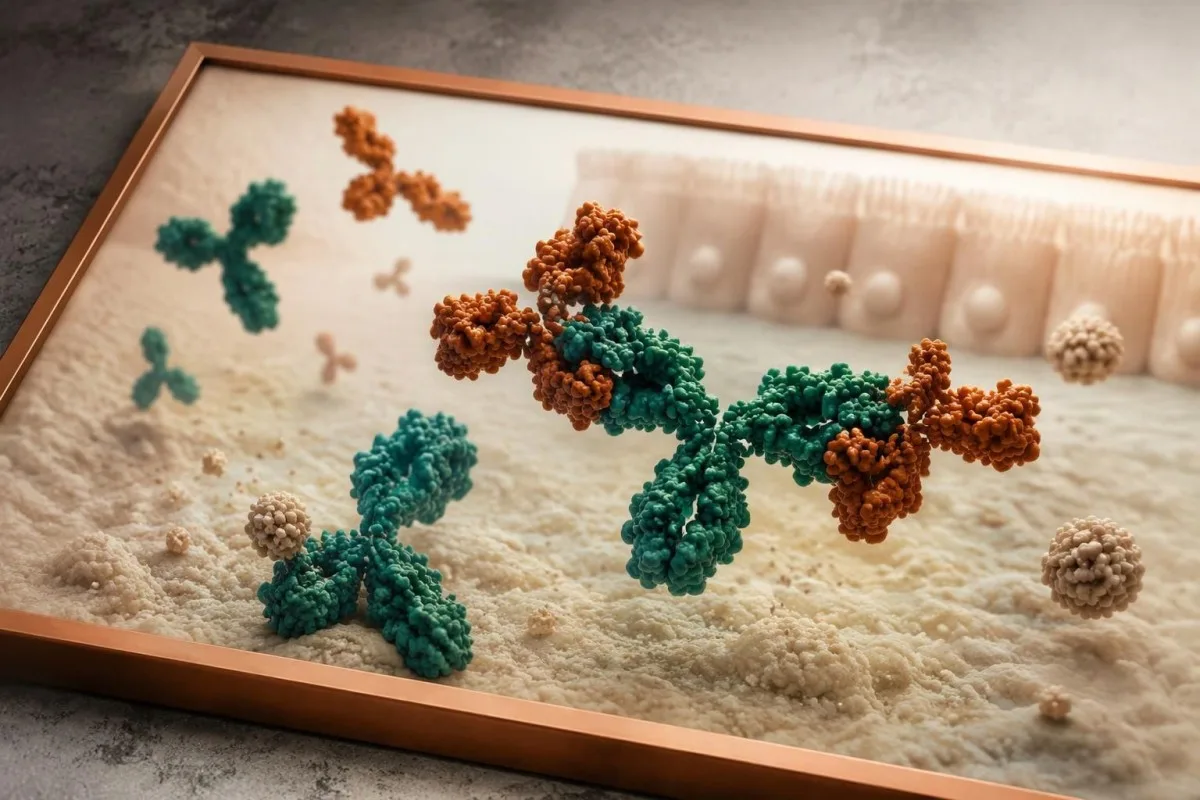
Anti-infliximab antibody tests usually detect binding antibodies; they do not all directly measure neutralizing activity. A positive result of 20 U/mL therefore identifies an assay-defined antibody signal, not a universal percentage of blocked infliximab or a precise prediction of how much benefit remains.
Antibody persistence and magnitude influence whether dose optimization is likely to recover exposure. Cheifetz et al. (2021) described low-titer antibodies as below 10 U/mL for the homogeneous mobility shift assay specifically; that threshold must not be transferred to an ELISA reporting AU/mL or to another laboratory's calibration.
A single low antibody result may be transient or become less clinically relevant after supervised treatment optimization. Repeating paired drug and antibody testing can distinguish a 1-time signal from a rising pattern, but severe disease or an infusion reaction may require action before a second result is available.
Antibodies to infliximab are not the same as antibodies against your own bowel, and they do not by themselves diagnose an immediate allergy. Our explanation of סוגי תוצאות נוגדנים חיוביות helps separate these concepts; breathlessness or faintness during an infusion still requires immediate attention regardless of the antibody number.
מתי רמת שפל מספקת מצביעה על כישלון מנגנוני?
כשל מכניסטי אפשרי means objectively active IBD persists despite sufficient infliximab exposure for the treatment goal. A trough of 8 µg/mL with confirmed active colitis may raise this possibility, but selected patients need further exposure optimization before clinicians conclude that another inflammatory pathway should be targeted.
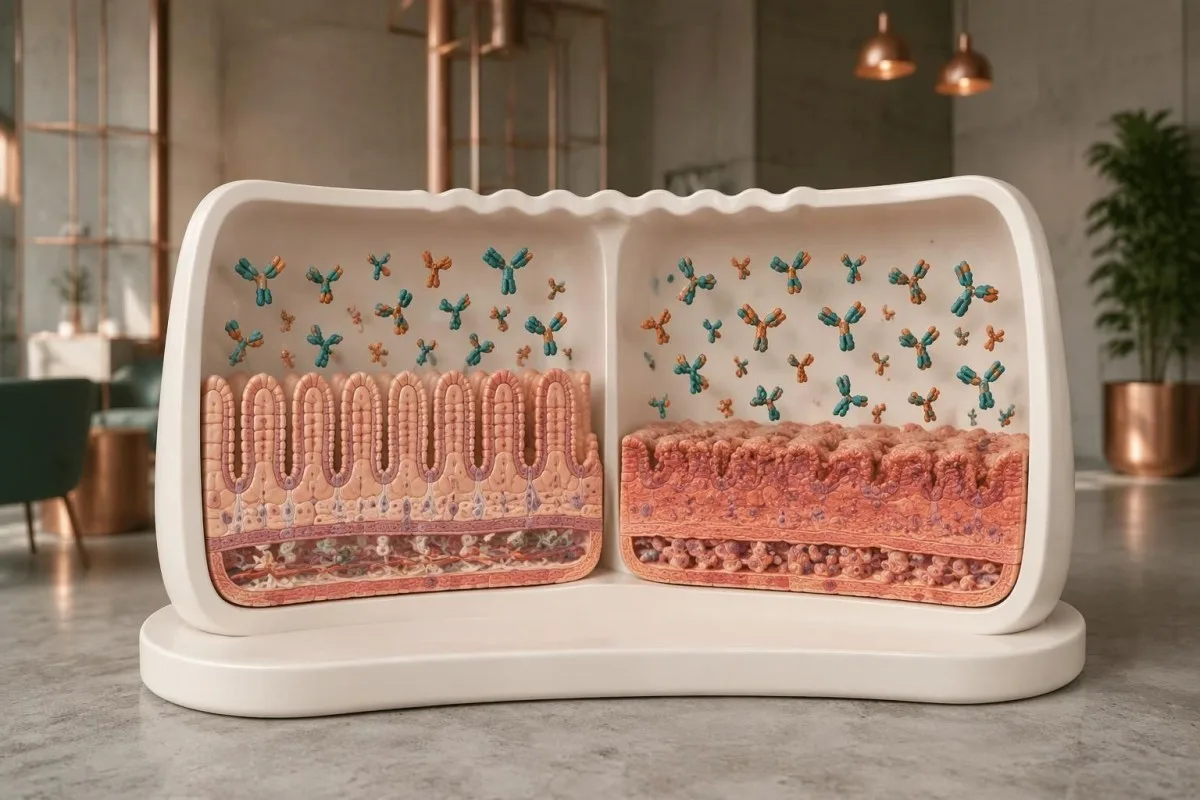
An adequate serum concentration cannot prove that TNF is the only pathway driving a person's current disease. Persistent endoscopic activity with a trough of 12 µg/mL is more supportive of a mechanism problem than the same concentration with normal objective testing and symptoms from bile acid diarrhea.
Calling treatment failure at exactly 5 µg/mL can be premature when the goal is fistula control or substantial endoscopic improvement. The 10–15 µg/mL reassessment discussed in the 2021 consensus provides a safeguard against abandoning an under-optimized treatment, but it is not a requirement to escalate every patient with symptoms.
Objective evidence also has limits: CRP of 3 mg/L does not exclude active IBD, especially in people whose CRP has remained low during previous flares. Borderline stool results need context and sometimes repetition; our guide to קלפרוטקטין צואתי גבולי explains why an isolated intermediate value should not determine a biologic switch.
The strongest case for changing mechanism combines 3 findings: documented inflammation, adequate exposure on a correctly timed sample, and an inadequate clinical response despite appropriate optimization. Structural complications, such as a fixed Crohn's stricture, can also cause symptoms that neither more infliximab nor a different biologic will reliably reverse.
האם ייתכן שנוגדנים יהיו חיוביים כשרמת האינפליקסימאב מספקת?
Antibodies can be detected while infliximab remains measurable or adequate, particularly with drug-tolerant assays. A trough of 7 µg/mL and a weak positive antibody result do not automatically mean treatment failure; the assay, antibody trend, and evidence of disease activity determine how much weight that finding deserves.
Drug-tolerant methods can identify antibodies in samples containing infliximab that would interfere with some drug-sensitive methods. This greater analytical sensitivity may reveal early or low-level immunogenicity, but 1 newly detected signal does not necessarily establish clinically meaningful loss of response.
A qualitative positive result contains less information than a quantitative result with the assay's cutoff and units. A report reading only positive cannot distinguish a value just above a 10 AU/mL cutoff from a much larger signal; our guide to בדיקות כמותיות ואיכותניות explains what each format can establish.
Compare antibody trajectories using the same laboratory method whenever feasible. Hypothetical results of 12, 15, and 13 AU/mL across 3 correctly timed visits may carry a different implication from 12, 80, and 200 AU/mL, although analytical variability and clinical findings still prevent interpretation from trend alone.
קנטסטי הוא פלטפורמת פענוח בדיקות דם של AI that helps distinguish a reported antibody cutoff from a treatment target. When the report lacks the method or units, our interpretation should preserve that uncertainty rather than labeling 1 positive result as proof that infliximab has stopped working.
מדוע יש חשיבות לשיטות המעבדה וליחידות המדידה של הנוגדנים?
Infliximab and antibody results are method-dependent, so values from different assays are not always interchangeable. Infliximab 1 µg/mL equals 1 mg/L, but antibody results in U/mL, AU/mL, or ng/mL do not have a universal conversion because laboratories use different standards, detection limits, and approaches to drug interference.
An assay may report free or functionally available drug differently from another method that detects a broader pool of circulating drug. Two laboratories can therefore produce somewhat different concentrations from similar specimens; a change from 6 to 8 µg/mL after switching methods may not represent a true gain in exposure.
Below the quantification limit means the assay cannot reliably assign a numerical concentration below its validated boundary. A report of less than 0.4 µg/mL is not proof of exactly 0 µg/mL, and greater than 100 U/mL cannot tell you whether the true antibody result is 110 or 1,000 U/mL.
Some laboratories use reflex antibody testing only when the drug concentration falls below a preset threshold. If antibodies were not tested because infliximab was 9 µg/mL, the result is not equivalent to antibodies negative; ask whether the antibody field says not performed, not detected, or below detection.
Kantesti's report interpretation should retain the assay name, units, and collection context instead of silently converting 20 AU/mL into another method's scale. Our מידע על המתודולוגיה הקלינית explains the distinction between technical interpretation and clinical decision-making; no AI explanation removes the need to confirm an unusual result with the reporting laboratory.
כיצד הרופאים מאשרים שהתסמינים שחזרו נובעים מ־IBD?
Returning symptoms do not necessarily mean returning intestinal inflammation; clinicians combine stool markers, CRP, infection testing, endoscopy, and imaging as appropriate. Three loose stools daily with a trough of 6 µg/mL can arise from active IBD, an intestinal infection, bile acid diarrhea, or a functional bowel disorder.
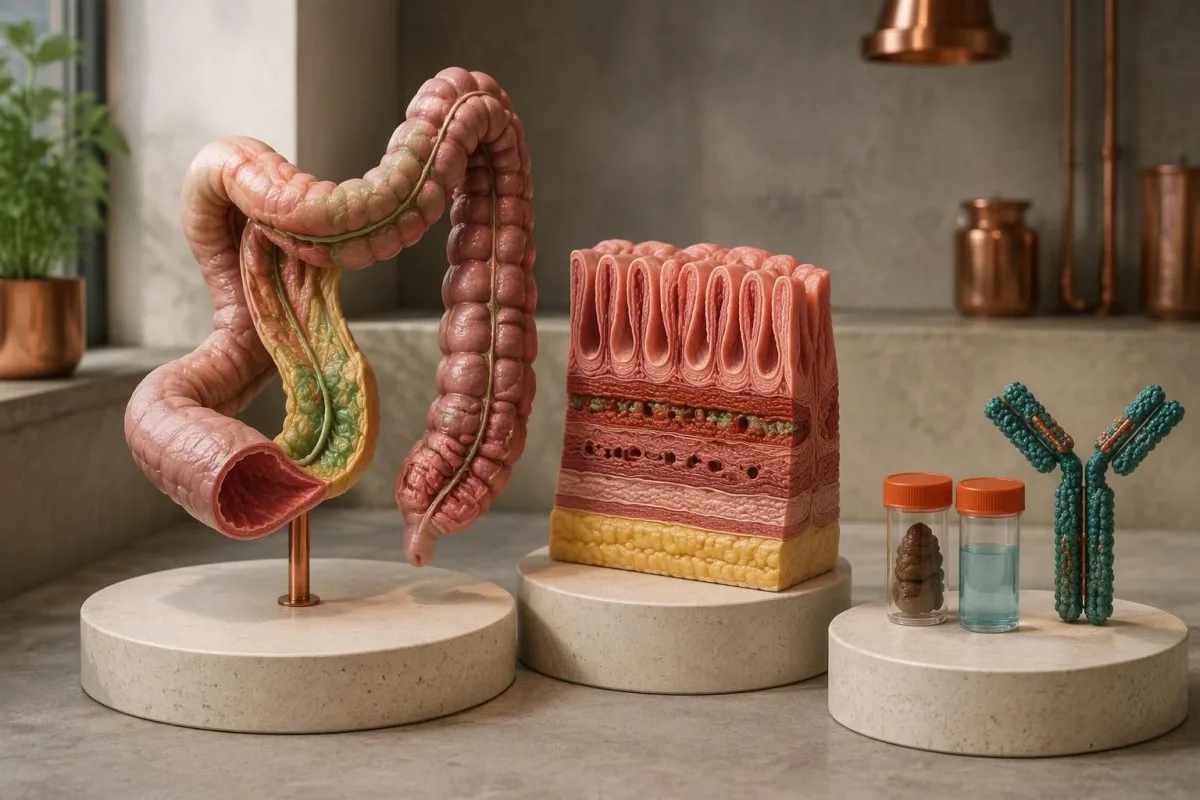
Fecal calprotectin and lactoferrin assess intestinal inflammatory activity rather than infliximab exposure. A hypothetical calprotectin of 800 µg/g adds different information from a trough of 2 µg/mL; our stool inflammation marker comparison explains why paired disease and drug measurements answer separate clinical questions.
C. difficile testing can be necessary during new or worsening diarrhea, even without recent antibiotics. A positive screening test and negative toxin result require contextual interpretation, not automatic classification as an IBD flare; our guide to תוצאות לא תואמות של C. difficile describes why 2 test components can disagree.
Bile acid diarrhea is particularly relevant after ileal disease or resection and can persist despite controlled inflammation. A person with a trough of 10 µg/mL and reassuring objective IBD assessment may need a different evaluation; our explanation of SeHCAT retention results covers one diagnostic route where that test is available.
Bloating, gas, and altered stool frequency can also reflect bacterial overgrowth or carbohydrate malabsorption. At least 2 explanations can coexist with IBD, so a satisfactory trough should not end the assessment; our SIBO breath test guide explains preparation and limitations rather than treating breath testing as proof of every symptom's cause.
כיצד צוות IBD עשוי להגיב לחשיפה נמוכה?
Low exposure without substantial persistent antibodies may lead an IBD team to increase the infliximab dose, shorten the dosing interval, or address a treatment interruption. A common adult intravenous maintenance schedule is 5 mg/kg every 8 weeks after induction, but any adjustment requires individualized prescribing and reassessment of disease activity.
For a hypothetical 70 kg adult, 5 mg/kg corresponds to 350 mg before local preparation or rounding rules. Shortening an unchanged dose from every 8 weeks to every 6 weeks increases average drug administered per unit time by about 33%; the trough increase cannot be predicted as exactly 33% because clearance is not constant.
Increasing the dose and shortening the interval are not pharmacokinetically identical strategies. A larger dose changes peak exposure, while a shorter interval reduces time for concentrations to decline; a hypothetical patient whose symptoms repeatedly return during week 7 may prompt a different discussion from someone symptomatic throughout all 8 weeks.
A useful reassessment checks both exposure and the treatment outcome rather than declaring success because the trough rose. If infliximab increases from 2 to 9 µg/mL but calprotectin remains 900 µg/g and endoscopic disease persists, the new result has narrowed the explanation without necessarily improving the underlying disease.
The timing of repeat testing depends on severity, the revised schedule, and the clinical question; waiting 3 months is not appropriate for every deteriorating patient. Our מדריך מגמות בטיחות תרופות explains why comparable dates and methods matter, but an app should never independently recommend extra infusions.
מתי נשקלים מעבר לטיפול אחר או טיפול משולב?
Persistent high antibodies with low drug may favor changing treatment, while adequate exposure with confirmed active IBD may favor switching to a different mechanism. Low-level immunogenicity can sometimes be addressed through supervised optimization or an immunomodulator, but a result of 15 U/mL alone cannot determine which option offers the best benefit-risk balance.
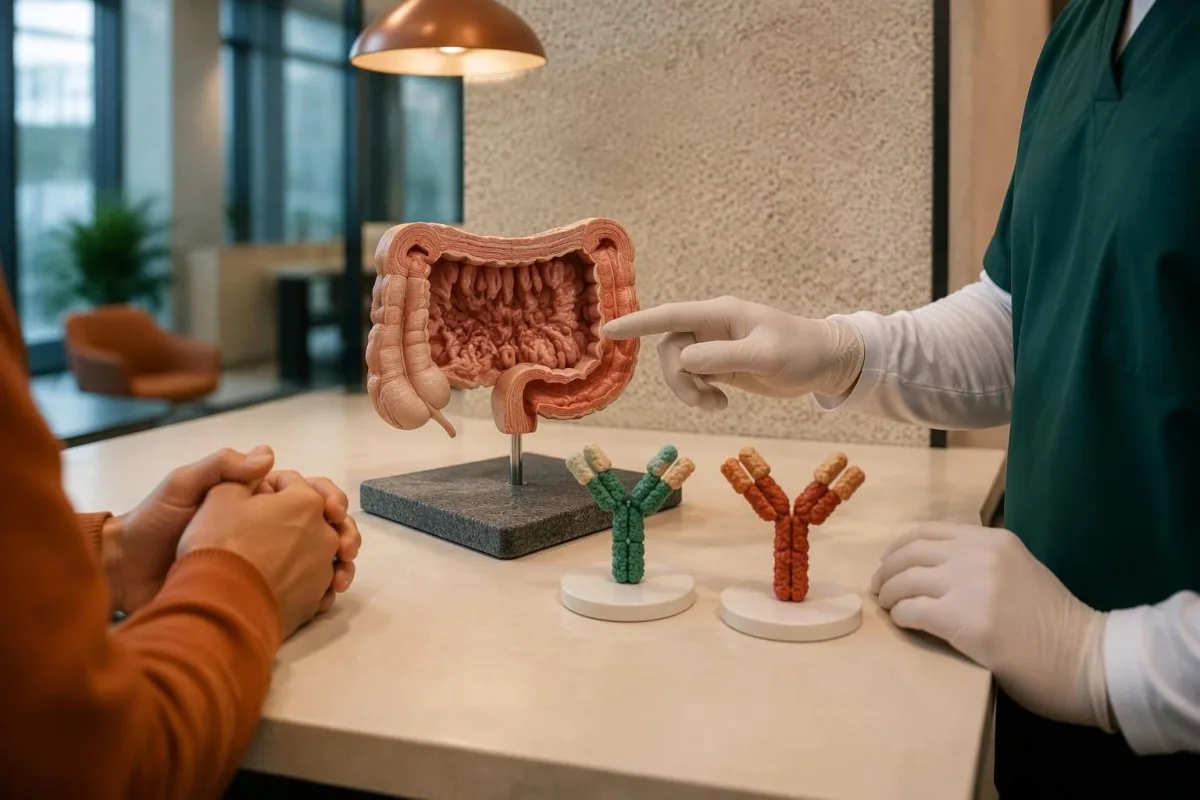
Switching within the anti-TNF class can make sense when infliximab previously controlled disease but antibody-associated clearance now prevents adequate exposure. Switching to another mechanism becomes more persuasive when inflammation persists with adequate exposure; these are 2 different failure patterns, not interchangeable reasons to choose the next medicine.
An immunomodulator such as azathioprine or methotrexate may reduce immunogenicity in selected circumstances, but adding one introduces additional monitoring and adverse-effect risks. Before azathioprine, TPMT testing and safety assessment can inform prescribing; TPMT and NUDT15 assessment do not replace ongoing CBC and liver monitoring, even when baseline results are normal.
If a person already takes a thiopurine, metabolite testing can help clarify exposure or a metabolism pattern before assuming combination therapy has failed. For example, 2 patients prescribed the same mg dose may have very different metabolite findings; our thiopurine treatment pattern guide explains why prescription dose alone is incomplete.
Restarting infliximab after a long interruption deserves a separate safety discussion because immunogenicity and infusion reactions can complicate re-exposure. A treatment gap of 6 months is not equivalent to a routine 1-week scheduling delay; never restart, add an immunomodulator, or stop an existing medicine based solely on an online interpretation.
האם השראת הפוגה, פיסטולות, ילדים וזריקות משנים את היעדים?
Treatment phase, disease phenotype, age, and formulation can change the relevant exposure goal; intravenous maintenance targets should not be copied into every setting. Standard adult intravenous induction commonly uses 5 mg/kg at weeks 0, 2, and 6, and those early concentrations are interpreted differently from an established 8-week maintenance trough.

The 2021 expert consensus described induction goals of approximately 20–25 µg/mL at week 2, 15–20 µg/mL at week 6, and 7–10 µg/mL at week 14 (Cheifetz et al., 2021). These are consensus exposure goals influenced by disease phenotype and outcome, not interchangeable minimums from one definitive randomized trial.
Perianal fistula outcomes may require higher exposure than symptom control in uncomplicated luminal disease, but observational associations do not establish a universal healing threshold. A fistula still draining at 10 µg/mL may also need imaging, drainage of an abscess, or procedural care; raising the trough cannot substitute for addressing an undrained collection.
Children can have different clearance and dosing requirements, particularly with lower body weight or severe disease. An adult maintenance benchmark of 5 µg/mL should not become a parent-directed dosing rule; our discussion of פירוש AI לילדים explains why pediatric specialist context and age-appropriate interpretation remain necessary.
Subcutaneous infliximab produces a different concentration-time profile from intermittent intravenous infusions, and availability and prescribing schedules vary internationally. A concentration of 15 µg/mL during injection treatment should not be labeled excessive merely because an intravenous report lists 3–7 µg/mL; the formulation, actual regimen, and sampling convention must be specified.
כיצד תוצאות משולבות משנות את החשיבה הקלינית?
Paired results guide the next question rather than dictate a prescription: low drug without antibodies suggests underexposure, low drug with persistent antibodies suggests immunogenicity, and adequate drug with inflammation raises possible mechanism failure. The following 4 examples are entirely hypothetical; the concentrations are illustrative, not personalized treatment recommendations.
Example 1: a 34-year-old with Crohn's disease has a true trough of 1.8 µg/mL, no detected antibodies, albumin of 29 g/L, and calprotectin of 1,100 µg/g. This pattern supports underexposure in active disease; confirming the infusion schedule and considering supervised optimization are more logical than immediately declaring TNF blockade ineffective.
Example 2: a 46-year-old with ulcerative colitis has infliximab below 0.4 µg/mL and antibodies above the laboratory's 100 U/mL reporting limit on 2 visits. Assuming the assay defines that antibody signal as substantial, persistent immunogenicity is plausible; simply increasing the dose may be less successful than a clinician-directed treatment change.
Example 3: a 28-year-old has a trough of 11 µg/mL, no significant antibodies, and repeatedly active colitis on endoscopy despite appropriate optimization. Example 4: a 61-year-old has the same 11 µg/mL trough but reassuring endoscopy and diarrhea after ileal resection; the first pattern raises mechanism failure, whereas the second prompts investigation of non-inflammatory causes.
קנטסטי הוא כלי לניתוח בדיקות דם מבוסס AI that helps organize these distinctions when the report and treatment details are supplied. Our הסבר טכנולוגיית AI describes how laboratory context informs interpretation; if a 2-week-old report lacks sampling timing, the missing information must stay visible rather than being guessed.
מה כדאי להביא לביקורת, ואילו ראיות רלוונטיות?
Bring the complete report, infusion timeline, and objective disease results to your IBD review; these 3 evidence streams make paired drug-antibody testing actionable. Seek earlier care for severe deterioration rather than waiting for the next trough, and distinguish infliximab-specific clinical research from general educational publications about accompanying laboratory abnormalities.
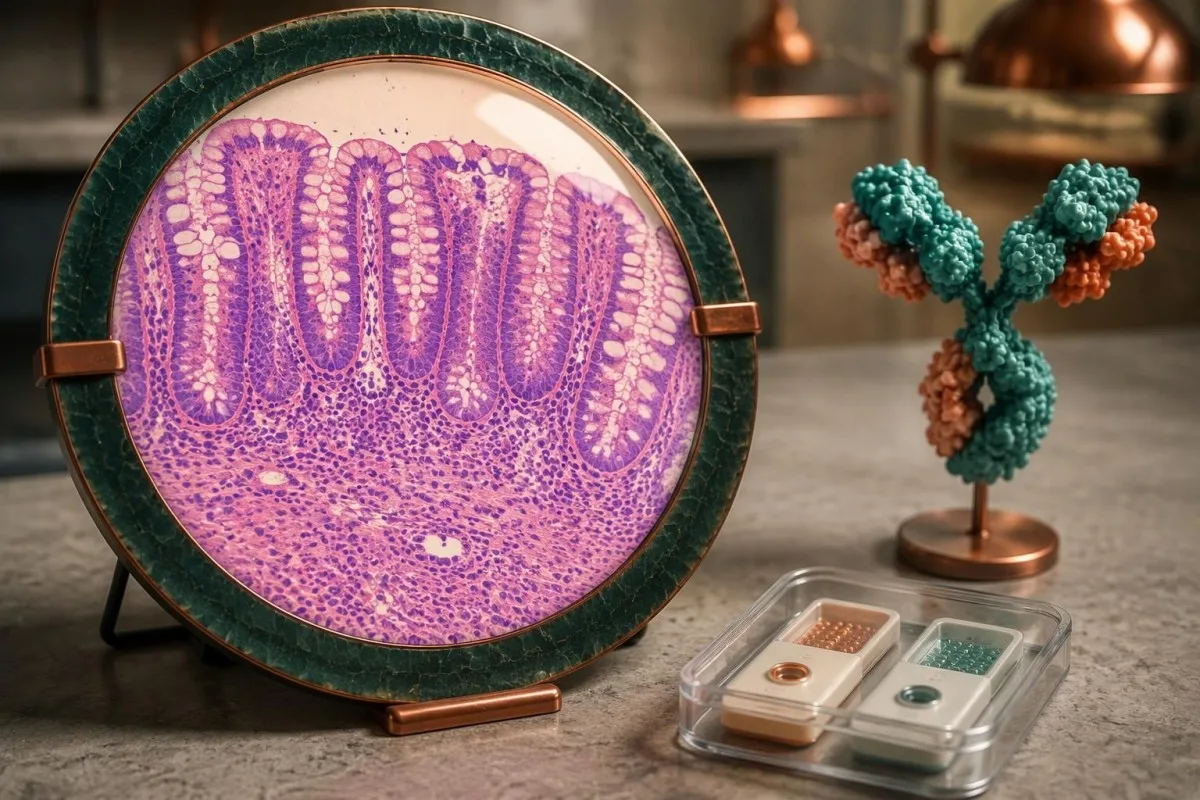
A useful review record includes the previous 2 infusion dates, actual dose, collection timing, assay name, antibody units, and recent CRP, albumin, and fecal calprotectin. Add symptom timing, steroid use, recent antibiotics, and missed doses; ask whether the proposed change addresses insufficient exposure, immunogenicity, active non-TNF disease, or a non-inflammatory explanation.
Contact your clinical team promptly for worsening diarrhea with dehydration, persistent vomiting, new significant bleeding, or fever of 38°C or higher while immunosuppressed. Severe abdominal pain with distension, fainting, or inability to keep fluids down may require emergency assessment; during an infusion, sudden breathing difficulty or collapse requires immediate staff attention, not interpretation of an antibody report.
Kantesti provides educational interpretation, not independent biologic prescribing, and our שלנו בנושא בינה מלאכותית אחראית explain that boundary. A reassuring trough of 10 µg/mL does not establish that an infusion is safe during an acute illness; the treating service must assess symptoms, examination findings, and any necessary investigations.
The 2 Zenodo publications listed below address accompanying laboratory interpretation, not infliximab target validation: our מדריך RDW ותאי דם אדומים concerns anemia patterns, while our המדריך ל-BUN וקריאטינין concerns renal and hydration context. These educational deposits are not evidence for anti-drug antibody cutoffs; the AGA guideline, TAXIT trial, and biologic-monitoring consensus supply the directly relevant clinical references.
שאלות נפוצות
מה המשמעות של רמה נמוכה של אינפליקסימאב?
רמה נמוכה של אינפליקסימאב פירושה שהחשיפה לתרופה במחזור הדם נמוכה מערך הסף שנבחר עבור שלב הטיפול והמטרה; אין פירוש הדבר באופן אוטומטי שיש להפסיק את האינפליקסימאב. רמת שפל אמיתית של 2 µg/mL במהלך טיפול אחזקה, ללא נוגדנים משמעותיים, עשויה להעיד על פינוי מהיר יותר, אובדן חלבון דרך המעי או מינון או מרווח שאינם מספקים. רמה נמוכה של התרופה לצד נוגדנים משמעותיים מתמשכים מעידה במקום זאת על פינוי בתיווך חיסוני. צוות ה-IBD שלך צריך לפרש את התוצאה לצד פעילות המחלה האובייקטיבית, מועד העירוי והבדיקה.
מהי רמת שפל טובה של אינפליקסימאב לטיפול במחלות מעי דלקתיות?
אין רמת שפל יחידה מיטבית של אינפליקסימאב המתאימה לכל אדם עם IBD. הנחיית AGA משנת 2017 הציעה רמה של 5 µg/mL לפחות לצורך ניטור תגובתי במהלך טיפול אחזקה, ואילו קונצנזוס מומחים משנת 2021 תיאר ריכוזים של 5–10 µg/mL במהלך טיפול אחזקה. ייתכן שמטופלים מסוימים עם אובדן תגובה משני יזדקקו להערכה מחדש ברמה של 10–15 µg/mL לפני הפסקת הטיפול. השראת הפוגה, פיסטולות וטיפול תת־עורי מצריכים התייחסות שונה, ולכן טווח מעבדתי אינו יעד מינון אוניברסלי.
מתי עליי לבצע בדיקת רמת אינפליקסימאב?
For intravenous infliximab, a trough sample should be collected immediately before the next infusion begins. A sample obtained 2 days after an infusion is not comparable with routine pre-infusion targets. Record the last infusion date, dose, scheduled interval, and actual collection time, especially if an 8-week appointment was delayed. Subcutaneous infliximab has a different exposure profile, so sampling should follow the prescribing team's and laboratory's instructions.
האם נוגדנים לאינפליקסימאב יכולים להיעלם?
נוגדנים ברמה נמוכה לאינפליקסימאב עשויים לעיתים להפוך לבלתי ניתנים לזיהוי או לפחות רלוונטיים מבחינה קלינית, אך קשה יותר להתגבר על נוכחות מתמשכת של נוגדנים ברמה משמעותית כשהתרופה נמצאת ברמה נמוכה מאוד. בקונצנזוס המומחים משנת 2021 הוגדרו נוגדנים בטיטר נמוך ככאלה שרמתם נמוכה מ־10 U/mL בבדיקת homogeneous mobility shift assay אחת; לא ניתן להחיל את סף זה על כל שיטות המעבדה. אופטימיזציה בפיקוח או טיפול באימונומודולטור עשויים לסייע למטופלים מסוימים, בעוד שאחרים זקוקים לשינוי בטיפול. בדיקה חוזרת של שתי הבדיקות יחד עשויה להבהיר אם הנוגדנים נמשכים, אך מטופלים אינם צריכים לשנות את הטיפול בעצמם.
האם אינפליקסימאב עלול להפסיק לפעול גם אם רמתו תקינה?
אינפליקסימאב עלול שלא לשלוט ב-IBD פעילה באופן אובייקטיבי, למרות ריכוז מספק במחזור הדם, דבר המעלה אפשרות של כישלון מכניסטי. רמת שפל של 10 µg/mL אינה מבטיחה ריפוי של המעי או מוכיחה ש-TNF הוא המסלול היחיד המניע את המחלה. לפני שינוי מנגנון הפעולה, רופאים מאשרים שקיימת דלקת, מעריכים סיבוכים מבניים או זיהומיים, ושוקלים אם החשיפה הייתה מספקת ביחס למטרת הטיפול הספציפית. לשלשול, כאשר ההערכה האובייקטיבית אינה מעוררת חשש, עשויה להיות סיבה שאינה דלקתית.
האם רמה גבוהה של אינפליקסימאב מסוכנת?
ריכוז גבוה של אינפליקסימאב אינו מסוכן באופן אוטומטי, ואין סף רעילות יחיד ומבוסס בנסיוב שחל על כל המטופלים עם מחלת מעי דלקתית (IBD). ניתן לפרש תוצאה של 15 µg/mL באופן שונה במהלך טיפול השראה, טיפול בפיסטולה או טיפול תת־עורי, לעומת טיפול אחזקה תוך־ורידי שגרתי. הבטיחות תלויה במשטר הטיפול הכולל, בזיהומים, בתגובות לעירוי ובממצאים קליניים אחרים, ולא רק בריכוז. אל תדלג על עירוי ואל תפחית מינון בלי לדון בתוצאה עם הצוות המטפל שרשם לך את התרופה.
מדוע השתנו תוצאות בדיקת הנוגדנים לאינפליקסימאב שלי לאחר שעברתי למעבדה אחרת?
תוצאות נוגדנים לאינפליקסימאב עשויות להשתנות לאחר מעבר בין מעבדות, משום שהבדיקות שונות בכיול, ביחידות, בגבולות הזיהוי וביכולתן להתמודד עם התרופה במחזור הדם. לא ניתן להמיר באופן אוניברסלי תוצאה של 20 AU/mL ל־U/mL או ל־ng/mL. שיטה עמידה לתרופה עשויה לזהות נוגדנים שבדיקת רגישת־תרופה אינה מזהה כאשר עדיין ניתן למדוד אינפליקסימאב. השוו מגמות באמצעות אותה שיטה במידת האפשר, ובררו אם בדיקת הנוגדנים אכן בוצעה ולא הושמטה עקב כלל של בדיקה רפלקסיבית.
קבלו הסבר על תוצאות בדיקות הדם שלכם
העלו את דוח המעבדה שלכם, וה-AI של Kantesti יסביר כל סמן ביולוגי בשפה פשוטה בתוך שניות. יותר מ-2 מיליון אנשים ברחבי העולם משתמשים בו.
הפניות
- Klein, T., Mitchell, S., & Weber, H. (2026). בדיקת דם ל-RDW: מדריך מלא ל-RDW-CV, MCV ו-MCHC. מחקר רפואי של Kantesti AI. DOI
- Klein, T., Mitchell, S., & Weber, H. (2026). יחס BUN/קריאטינין מוסבר: מדריך לבדיקת תפקוד כליות. מחקר רפואי של Kantesti AI. DOI
- Feuerstein JD et al. (2017). American Gastroenterological Association Institute Guideline on Therapeutic Drug Monitoring in Inflammatory Bowel Disease. גסטרואנטרולוגיה. DOI
- Vande Casteele N et al. (2015). Trough concentrations of infliximab guide dosing for patients with inflammatory bowel disease. גסטרואנטרולוגיה. DOI
- Cheifetz AS et al. (2021). A Comprehensive Literature Review and Expert Consensus Statement on Therapeutic Drug Monitoring of Biologics in Inflammatory Bowel Disease. The American Journal of Gastroenterology. DOI
- 2 מיליון+בדיקות שנותחו
- 127+מדינות
- 100+שפות
על הצוות הרפואי


אותות אמון E-E-A-T
הִתנַסוּת
סקירה קלינית בהובלת רופא של תהליכי עבודה לפענוח בדיקות מעבדה.
מוּמחִיוּת
רפואה מעבדתית מתמקדת באופן שבו סמנים ביולוגיים מתנהגים בהקשר קליני.
סמכותיות
נבדק רפואית על ידי ד״ר Thomas Klein, בתרומתם של ד״ר Sarah Mitchell ופרופ׳ ד״ר Hans Weber.
אֲמִינוּת
פרשנות מבוססת-ראיות עם מסלולי המשך ברורים כדי להפחית בהלה.





הצהרה רפואית
מאמר זה מיועד למטרות חינוכיות בלבד ואינו מהווה ייעוץ רפואי. תמיד יש להתייעץ עם גורם מוסמך בתחום הבריאות לצורך החלטות אבחון וטיפול.
פורסם · צרו קשר עם צוות העריכה
פורסם על ידי Kantesti Ltd, הרשומה באנגליה ובוויילס, מספר חברה. 17090423, לונדון, בריטניה.
